


Abstract
Search and rescue operations can range from small, confined spaces, such as collapsed buildings, to large area searches during missing person operations. K9 units are tasked with intervening in such emergencies and assist in the optimal way to ensure a successful outcome for the mission. They are required to operate in unknown situations were the lives of the K9 handler and the canine companion are threatened as they operate with limited situational awareness. Within the context of the INGENIOUS project, we developed a K9 vest for the canine companion of the unit, aiming to increase the unit’s safety while operating in the field, assist the K9 handler in better monitoring the location and the environment of the K9 and increase the information provided to the Command and Control Center during the operation.
1. Introduction
Rescue operations range from small-scale emergencies, within one small geographic area and handled by one discipline of responders, to major disasters spread over a wide range of incident locations. These operations often require complex response operational planning as well as collaboration between different agencies. Such operational conditions require first responders to undertake varying risks and operate under unknown, possibly hazardous or life-threatening situations where time and the timely availability of tactical information are integral to their safety and the successful completion of the mission [1].
In this context, various technologies have been developed, aiming to support first responders during field operations, by increasing their situational awareness and ensuring timely notification about changes to the operational plan [2].
Within the context of the INGENIOUS project [3,4], the consortium is developing an integrated toolkit that aims to unify all these technologies. The main focus is to assist first responders operating in the field by increasing their efficiency and their situational awareness and decreasing their response time. This is pursued through the development of a Next Generation Integrated Toolkit (NGIT) for Collaborative Response. It includes a set of elements that aim to increase the protection level of the first responders and augment their operational capacity when responding to incidents. The toolkit includes a smart, integrated K9 vest that provides situational awareness to the canine handler regarding the canine’s well-being, location and operational status [5].
The history of using K9 units in operations started as early as 1889, when the Commissioner of the Metropolitan Police of London, Sir Charles Warren, after the repeated failures at identifying and apprehending the serial killer Jack the Ripper had earned him much vilification from the press, including being denounced for not using bloodhounds to track the killer. He soon had two bloodhounds trained for the performance of a simple tracking test from the scene of another of the killer’s crimes. The results were far from satisfactory, with one of the hounds biting the Commissioner, and both dogs later running off, requiring a police search to find them [6,7].
Currently, K9 units are well-trained and specialized in specific tasks where the dogs outperform humans and machines with their ability to identify and track smells even under stressful and difficult situations. These tasks include tracking in wide areas, detecting illegal substances, finding missing persons and searching in rubble. In detail, these are [8]:
- Search and Rescue in confined spaces. K9 units are usually employed during natural and man-made disasters, such as mud slides, tornadoes, building collapses, and floods, to locate survivors who may be trapped or unconscious under debris.
- Search and Rescue in wide area. This also extends to lost and missing people, such as hikers who have been stranded in the wilderness or kidnapping victims. The keen olfactory senses of dogs also makes them useful for pinpointing cadavers and organic tissue.
- Detection. In many cases where there has been a bomb threat, a shooting or the presence of illicit substances, a K9 unit will be used to locate and identify a variety of different objects and/or compounds that will either be used as evidence or clues. Increasingly, units are being trained to detect specific items. These items include drugs, such as cocaine or marijuana, or the presence of chemicals related to incendiary devices. The detection of discharged firearms is also a priority, both in terms of locating expelled shells and casings, as well as identifying responsible individuals who have residual burn odours on them. In a growing number of cases involving poachers, duties might also include locating illegal quarry and tracking offenders to their base of operations.
For many years, K9 units operated without any technological support, based only on the chemistry between the handler and the canine. Many efforts have been dedicated in identifying the traits [9,10,11] such as trainability, fearlessness, and energy, that are required for dogs to succeed in search and rescue. In addition, experiments have been conducted aiming to identify correlations between the humidity, temperature, or wind speed and effectiveness. The age of the dog has a small positive correlation. It is also notable that dogs covered a mean distance 2.4-times greater than their human handlers but travelled at roughly average human walking speed. It has been only recently that efforts have been made to provide sensors and applications that support such interactions to ensure that the dogs are not limited to their operations by the handlers and that their well-being is closely monitored.
A two-part system consisting of a wearable computer interface for working search and rescue dogs that communicates with their handler via a mobile application, as developed in [12], is an example of such effort. The viability of the tool was evaluated with feedback from three experts. The use of monitoring technologies to provide handlers with real-time information about the behaviour and emotional state of their canines and the working environment, aiming to establish a more intelligent canine–human collaboration was presented in [13].
Currently, most K9 units operate without any technological equipment, relying heavily on the training of the dog and the collaboration between the dog and the handler as the available solutions do not cover all their needs. In detail, the available solutions take into consideration only the needs in the field and fail to provide a holistic solution that includes a smart vest for the canine, a monitoring system for the handler at the field as well as monitoring capabilities at the Command and Control Center. For this reason, within the context of Ingenious, we developed a K9 vest that aims to increase the operational capacity of the K9 unit, the situational awareness of the K9 handler and the situational awareness of the Strategic Coordinator. The K9 vest adds remote monitoring capabilities enhancing the victim locating capabilities as well as command of the canines.
The vest worn by a K9 dog is an integrated platform that offers a set of functionalities for the dog handlers aiming to meet all the system requirements that have been identified based on user needs. We present here the functionalities and their association with the system requirements. The vest provides tracking in real time of the position of the dog, increased awareness of the dog’s detection using visual confirmation through cameras and allows the handler to command the dog remotely and communicate with located victims through a smartphone.
Contribution. The K9 Vest has been carefully designed to meet the user and system requirements as identified through extensive research and close collaboration with the K9 unit trainers. The main contributions of the smart integrated vest can be summarized as:
- Modular design to support the different requirements and complex use cases.
- Multiple deployment options, following the operational needs and the infrastructure availability at the operation area.
- Comfortable and robust design that prioritizes the safety of the canine companion.
- Smart functionalities toolkit ensuring the monitoring of the well-being of the canine companion and the improvement of situational awareness both in the field and at the command centre.
2. System Architecture
The user requirements were gathered within the Ingenious project through a close interaction with first responders. Bi-weekly user and technical teleconferences set from the start of the project along with several bilateral teleconferences served as meeting points for this exchange of information. A preliminary workshop on the validation of the use cases and user requirements was held as part of the project’s Kick-off meeting, and this was followed by a preliminary 5-h internal user workshop held through teleconference. Two official end user workshops followed, the first one intended to be more specific on user requirements but it was quickly realized that end users did not have sufficient understanding of each tool, and we decided that it was important to invest most of the workshop time on this to be able to acquire meaningful requirements later on.
During the workshop, well-needed discussions were held, and working groups were formed to record user requirements. At the first project plenary meeting, preliminary findings of an aggregate requirement list were presented, and excess time was given to discussions between technical partners and end users in small working groups in order to understand the tools and provide better targeted requirements. Such a process led to updates and refinement of the user requirements.
The requirements collected during the workshops from the end users of the project, were enriched with requirements available in recent studies, regarding the challenges of wearable computing for working dogs [14,15] and resulted in the following list of identified system requirements:
- Stable video feed.
- Geolocation.
- Captures HD video.
- Captures thermal video, with resolution sufficient to recognize a human from 50 m.
- Modular design, as dogs carry different equipment for each task.
- Adaptable design to support different tasks.
- Tearable for dogs in rubble and tight spaces.
- Sensors much be on the vest, no sensors can be mounted on the dog.
- All connections should be wireless and/or properly integrated in the material (no loose cables).
- Provide visualization to the Command and Control Center.
- Provide remote command to the dog.
- Provide remote communication between the dog handler and located victims.
Based on the discipline of the first responder, as well as the task that the unit must accomplish, there are different user requirements that will ensure that the K9 handler receives the needed information while, at the same time, the canine companion remains safe in the field. For search and rescue operations in small and confined places, the handler is constantly aware of the location of the dog, so the GPS tracker and the cameras are not very useful, the remote commands and the ability to communicate with a located victim, however, are of upmost importance. At the same time, in order to ensure that the canine companion is safe, the vest should have the minimum possible size and be easily removable and detachable.
In wide-area search and rescue missions, the GPS tracking is crucial for the Command and Control Center when there are multiple units operating at the same area, as this is the only way to verify that the units have covered the complete area of interest. At the same time, during such operations, the K9 handler is not constantly in visual contact with the dog; thus, the streaming from the cameras as well as bi-directional audio are crucial for a successful operation.
Search and rescue operations in general, have a relatively limited duration as the canine is on constant alert, which can be very tiresome. In this context, battery duration is not critical; however, the comfort and the stability of the vest is important for the success of the mission.
In detection operations, the canine companions are trained to operate over longer periods of time, and while they are constantly in the vicinity of their handlers, rendering video and sound functionalities is not integral in the field; however, the GPS localization and the video from the field are very useful to the commanders at the operation centre that can have a near real time image of the situation in the field.
The K9 vest offers two video streams (HD and thermal) as well as bidirectional audio. In addition, the canine’s location is detected with a high-precision GNSS receiver with an attached accelerometer that provides dead reckoning calculations in case of signal loss. The vest transmits data through WiFi LAN connectivity. Information is made available to the dog’s handler as well as the local field coordinator of the mission, while it can also be forwarded to the Command and Control Centre upon request. This allows the canine handler to focus on the mission, ensuring the unit’s safety in the field while providing near-real time information to the mission coordinators, increasing the overall situational awareness. Power is provided through an independent 5V power supply.
The features of the vest are divided between two distinct components, the camera module and the localisation/audio module. Each component operates independently, and they can be added or removed ad hoc in the field depending on the specific requirements of each mission. Care has been taken to distribute the components evenly over the vest, to minimize weight concentrations and protruding components.
In the following paragraphs, the hardware and software components of the K9 Vest are presented in detail. The high-level block diagram of the K9 Vest is presented in Figure 1.
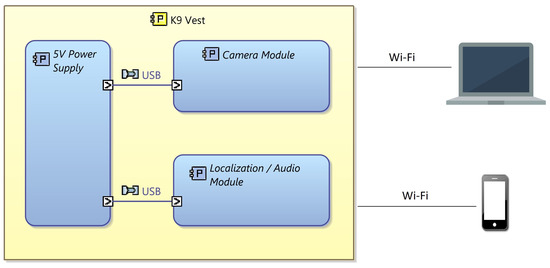
Figure 1.
The K9 Vest block diagram.
3. System Design
The system was designed based on the findings of the initial interviews with the canine units as well as the desk research on the state of the art. The design was then modified based on two rounds of testing with canine units in training and simulated field conditions.
Each round of testing was organised in three parts. First, the modules and their operation were presented to the canine handlers along with the scenarios that would be tested. These scenarios were then modified and finalized according to their feedback. The the actual tests were run on the field in an iterative manner, where small corrections and adjustments were applied between tests. Finally a feedback session was organised. This started with a focus group where the tests and their results were thoroughly discussed and continued with the distribution of a questionnaire that participants would fill in.
The first round of testing focused on the physical design of the components and limitations of the canines. A prototype was attached to dogs, trained in search and rescue operations, in order to record how it affected their behaviour and movement and whether it inhibited their performance in any way. The main output of this round of testing was the decision to move towards a more distributed design and reduce the size of protruding parts to ensure the freedom of movement between obstacles.
As the stabilising module protruding from the dog’s back would potentially hinder the dog in enclosed areas, an alternate attachment of the cameras on the front of the dog’s neck was suggested. This option would not include any stabilization of the video image but would facilitate the dogs’ normal behaviour of “exploring” enclosed areas with their heads without any risk of getting trapped. Table 1 provides an overview of the results of the first round of testing.

Table 1.
Summary of the first round of testing.
Based on the feedback from dog handlers, we redistributed the components following a modular design, separating the HD and thermal cameras into a distinct module that could be attached either to the back of the vest on a stabilizing gimbal or in the front of the dog’s breast without stabilization. Given the fact that dogs operating in restricted spaces (e.g., inside ruins) cannot wear anything that protrudes and might restrict their movement, the camera module was designed so that it can be easily removed or attached on the field, independently from the other components. The rest of the components were redistributed on the vest to make sure they do not protrude and do not form hard edges. The Wi-Fi antennas were replaced with low profile antennas that provide a similar range without protruding from the components.
The second round of testing focused on rescue scenarios in a wooded area and inside a building. The vest and components were also tested for their durability in open grounds, wet conditions and in the movement through rough terrain and obstacles (Figure 2). The camera feeds were tested for both positions of the camera module (back of the vest with stabilization and on the front without stabilization. The GPS module and dead reckoning were tested in a wooded area and with the dog entering a building. The audio was tested in three specific functions:
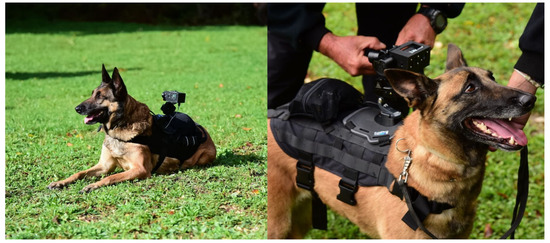
Figure 2.
Both modules attached on the vest during the second round of testing.
- 1.
- Listening to the dog’s bark over a distance or over surrounding noise. This was an important issue for the handlers as the dogs bark to indicate if they have located a victim, and their bark is often lost in the overall noise of a rescue operation.
- 2.
- Communication with a victim, acquiring information and offering advice until the rescue team can approach.
- 3.
- Issuing commands to the dog over the speaker. Testing this feature offered mixed results, as expected, as the dogs were not used to hearing commands over a speaker. Handlers were very interested in training dogs specifically for this and were optimistic about the expected results.
The durability of the construction was tested thoroughly, with the canine running repeatedly through briars and metal obstacles in wet conditions. Repeated collisions of the modules with obstacles were sustained without any structural damage to the enclosures. The vest is not fully waterproof and will not withstand immersion in water when all modules are attached, mainly due to the fact that the stabilizing gimbal is not waterproof. Despite this, it was successfully tested in wet conditions (movement through shallow water and wet briars).
Table 2 summarizes the main feedback received through the second round of field testing. The components of the two modules of the K9 vest are presented in Figure 3.
Table 2.
Summary of the second round of testing.
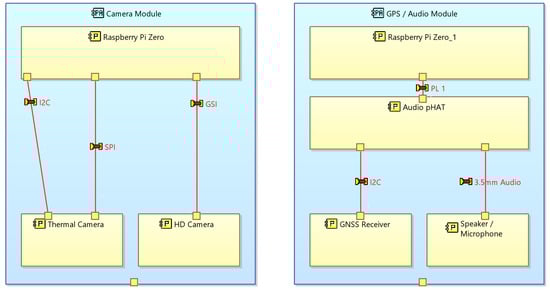
Figure 3.
The K9 Vest Camera and Localisation/Audio modules.
3.1. Hardware Components
3D printed ABS enclosures. The two modules are contained in two specially designed 3D printed enclosures. They were designed to protect the components and allow for external connections for power supply, Wi-Fi antennas and speaker/microphone. Special attention was given to minimize the size and distribute the components so that they lay as flat as possible on the vest without sharply protruding parts.
The power supply was attached independently to the vest to allow for its easy removal and replacement in the field. A single USB connection allows for the connection of a new power supply to the vest. The main concern in reducing the size of the enclosures was heat dissipation and the danger of overheating of the electronic components. Once the final enclosures were designed and the components assembled, a test run was performed, followed by stress/heat test using the Stressberry (https://github.com/nschloe/stressberry (accessed on 10 October 2021)) open source stress module.
The test was run on both modules, while both where connected to the vest’s power supply. A 30 min stress test was run, with 5 min idle periods before and after. The CPU frequency was measured in combination with the CPU temperature. The ambient temperature was 21 °C.
The stress test showed that the module could operate continuously at full power without overheating as the CPU temperature stabilized at acceptable levels. Longer stress tests were run to verify that the power supply could support the module for at least 2 h with the CPU at full consumption. Figure 4 and Figure 5 show graphs of the CPU temperature and CPU core frequency over the duration of the 30 min stress test.
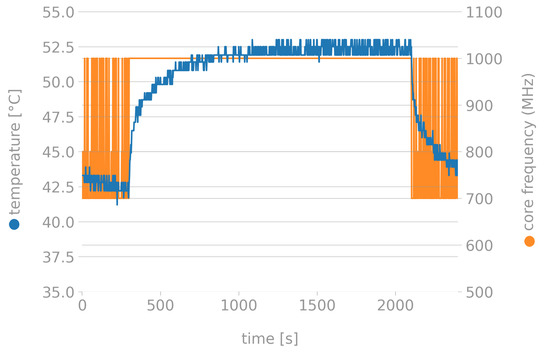
Figure 4.
Camera module stress test results.
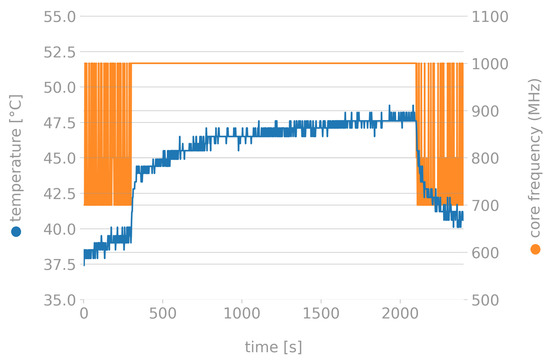
Figure 5.
Localization module stress test results.
Main computing module. The vest’s main computing module is a Raspberry Pi Zero W, as shown in Figure 6a. It offers on-board wireless connectivity via Wi-Fi and Bluetooth radio interfaces as well as multiple wired interfaces to support the various connected components. The main computing module runs the Raspbian (https://www.raspbian.org/ (accessed on 24 October 2021)) operating system.
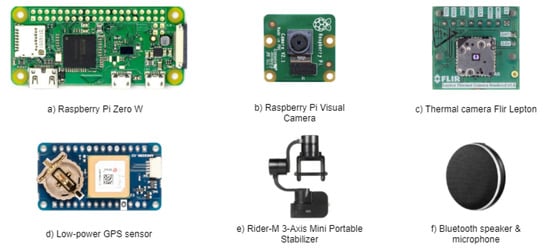
Figure 6.
The K9 Vest components.
The initial design of the vest included one single computing module for all the components. The choice was made to add a second computing module for two main reasons: reducing the processing load on each of the modules and providing versatility by breaking up components into two distinct modules that can be used independently. The testing sessions with canine units described above informed the decision to have one module for the cameras and one for localization/audio.
With the decision of adding a secondary processing module, the power supply for the entire vest had to be reassessed to ensure that we could support the operational requirements provided by the K9 units—namely two hours of uninterrupted operation. The selected lightweight 5V power supply was tested with the processors being stressed at full capacity.
Antennas and connectivity An additional radio frequency connector, the U.FL connector, was installed on the computing module in order to use an external antenna instead of the on-board one to increase radio performance. Since the canines can occasionally access hard to reach areas or remote locations were the WiFi signal is inadequate, an alternative LoRa (https://lora-developers.semtech.com/documentation/tech-papers-and-guides/lora-and-lorawan (accessed on 10 October 2021)) antenna is provided so that the system can connect to a LoRa concentrator. In this case, video streams are dropped to preserve the data rate.
Visual (RGB) camera. The visual camera is a Raspberry Pi Camera (shown in Figure 6b). It is a high definition, lightweight image sensor module. It connects to the main Raspberry Pi board through the onboard CSI connector. The video is recorded, encoded and forwarded to the back-end server. The camera is part of the vest’s camera module.
Thermal camera. The K9 camera module contains a thermal camera, which is a Flir Lepton 2.5 module, as shown in Figure 6c, with an accompanying breakout board. It requires two interfaces, an I2C for control and an SPI for the video feed. This is a thermal sensor, which captures non-contact temperature data while being small and lightweight. The thermal imaging sensor provides information about heat sources in the field, traditionally not available and, thus, further increases the situational awareness.
Based on the initial requirements collected from the K9 units the main requirement for the Thermal camera would be that it would allow recognition of a human body against the ground (ground temperature) from a distance of 50 m. This requirement informed the selection of the camera resolution, balancing the data rate needs of streaming. Two cameras were tested: a Flir Lepton 2.5 with a resolution of 80 × 60 and a Flir Lepton 3 with a resolution of 160 × 120; both were found adequate according to the requirements. The Flir Lepton 3 was selected for the final implementation since the processing and bandwidth load difference was not major.
GPS sensor. The vest determines location via a low-power GPS sensor, as shown in Figure 6d. It can calculate position based on multiple satellite systems (GPS, GLONAS and Galileo). It connects to the main board using an I2C or UART interface. It sends information to the board using the NMEA format [16]. The board includes an accelerometer used to perform dead reckoning calculations in case of GPS signal loss. When entering an enclosed area where the GPS signal is lost, the module continuously provides a calculated position with decreasing accuracy over time. When the satellite signal is reestablished, the position is corrected, and normal transmission resumes.
Gimbal. The Rider-M 3-Axis Mini Portable Stabilizer, as shown in Figure 6e, stabilizes the image captured for the two video streams when the camera module is placed on the canine’s back. Its compact design ensures that it does not hinder the canine in its movements. It is important to the overall design, as without it the video would be unstable due to constant movement, reducing the usefulness of the information. The effect of unstabilized shaking is less crippling for the thermal camera, and thus the alternate position of the camera module to the front of the vest without stabilization has been explored.
Microphone and speaker. The audio input/output component consists of a wireless Bluetooth speaker, as shown in Figure 6f, with optional wired connectivity. It offers a bidirectional audio feed between the remote location and the canine handler. It can be used by the handler to issue commands to the canine, communicate with located victims as well as hear the canine’s bark over the loud noises of a rescue operation.
3.2. Software Components
The architecture of the K9 Vest, as shown in Figure 7, includes the following software components:
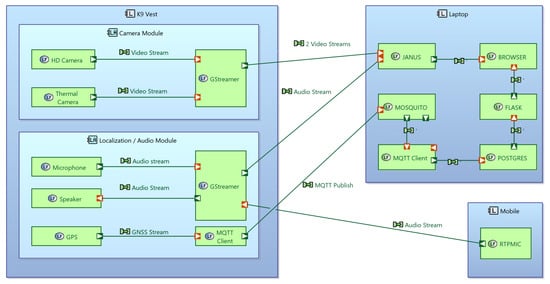
Figure 7.
The K9 Vest inner architecture.
Video Streaming. GSTREAMER [17] is an open-source multimedia framework. It can work for multiple processor architectures and operating systems and is lightweight enough to operate on a resource-constrained environment, such as the single-core processor of the raspberry pi zero w. It is responsible for collecting the two video streams from the HD Camera and the Thermal Camera as well as the audio stream from the microphone and forwarding them to the media server. Additionally, it receives the audio stream and forwards it to the speaker.
GPS integration. A small software component was developed to read the NMEA messages from the GPS. To ensure the processing module would be compatible with different protocols and boards, distinct tools were developed to read over the UART interface.
The UART interface was accessed with the help of the Serial class included in the pySerial library for Python (https://pyserial.readthedocs.io/en/latest/pyserial_api.html (accessed on 10 October 2021). The following setup was used:
The board is polled every 1 s, and the GNGGA message is read from the NMEA stream. The GNGGA message was selected as it includes all necessary information (longitude, latitude, altitude as well as GPS signal quality indicator). The GNRMC message from the board was also queried as it provides the mode of operation (A for autonomous mode and E for estimated mode when dead reckoning is operation).
GNGGA signal sample (including: latitude, longitude, quality, and altitude):
GNRMC signal sample (including: latitude, longitude, and type of operation):
For each message, the software constructs a JSON [18] that updates the position of the canine. The message is stored and indexed appropriately [19] in a PostgreSQL database.
Audio Streaming. RtpMic (https://play.google.com/store/apps/details?id=com.rtpmic&hl=en&gl=US (accessed on 10 October 2021)) is an android application that provides live audio streaming. It captures voice from the mobile device microphone and sends an RTP stream through the GSTREAMER to the speaker.
Message exchange. The message exchanges of the K9 vest are handled by Eclipse Mosquitto [20], an open source MQTT message broker. It is lightweight and suitable for single board applications as well as power-constrained devices. It also provides a portable client library for use in applications.
3.3. User Interface
Aiming to facilitate the usage of the K9 vest, a user interface was developed (Figure 8). The user interface offers a map where the recorded GPS co-ordinates of the location of the canine are presented in near-real time and a video stream of the cameras attached to the main processing unit. The user interface accompanying the K9 vest was developed using Flask [21], (a Python web framework), Janus (a WebRTC Server) and HTML, CSS and JavaScript (tools for the user visualization).
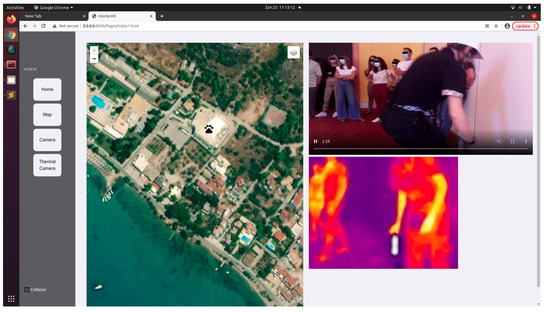
Figure 8.
The K9 Vest user interface showing the localization on map along with the HD and thermal camera stream.
The main two aspects that are set on the local command terminal (ruggedized laptop or tablet) were Flask and Janus. Flask and Janus are both server-side software programs. They work independently and have distinct roles. Flask’s main responsibility is to create the necessary hosting environment in order to serve the client-side code (HTML, CSS and JavaScript). More details about the client-side code will be presented below.
In addition to serving the client-side code, Flask is conducted to provide the needed information about the canine’s location to the K9 handler. With the aim of doing that, Flask receives the location (latitude, longitude) from an MQTT server installed in the local terminal. The canine vest’s central processing unit (Raspberry Pi Zero W) publishes the position of the canine via WiFi every second. Flask subsequently creates an API endpoint containing the location in a JSON format, which is aimed to be consumed by the client-code.
On the other hand, Janus server is in control of the video component (HD and Thermal cameras). Its task is to provide the required video source stream to the client-side code, so that the last one can optimize the HD and Thermal video streams to the K9 handler. The main reason that the Janus server was chosen instead of any other server that supports video distribution was the fact that Janus server is a WebRTC server. With the help of WebRTC, it was possible to add real-time communication capabilities among the K9 vest part and the client-side part.
Real-time communications are crucial for any kind of search and rescue operations. The WebRTC technology is available on all modern browsers as well as on native clients for all major platforms meaning that there are no restrictions in using that technology. More specifically, Janus can receive the video streams of HD and Thermal cameras from GSTREAMER and redirect them in a streaming way to all the connected peers, thus, creating a direct communication channel between the peers and the Raspberry Pi Zero W.
Moreover, HTML, CSS and JavaScript make up the client-side code, visualizing the incoming information to the K9 handler. The client-side code consists of two main modules. The first module initializes the connection with the Janus server and obtains the incoming video stream. It is executed two times: one for the HD camera video stream and one for the Thermal camera video stream. The second module is tasked with communicating with the Flask framework gaining the location information. The communication is established through HTTP requests from the client-side towards the API endpoint every two seconds. The received location is displayed on a map by leaflet.js, a JavaScript open-source library for mobile-friendly interactive maps.
4. Conclusions
We present a K9 Vest that aims to support first responders in the field as well as the operational commanders of the K9 units by offering both hardware and software solutions for the monitoring of field operations.
In the early stages of design, we first discussed, with K9 unit handlers, their operations and challenges they face in the field and the possibilities of technological tools that could increase their awareness in the field and reduce risk to themselves and the canines. We gathered their user requirements and, through the iterative process presented above, we defined the technical requirements for the system.
Gathering feedback for wearable technologies is inherently difficult when addressing trained animals, since gauging the animal’s comfort levels and reactions does not readily translate to specific actionable feedback and corrective actions. We found that, through several rounds of testing with alternative solutions, quickly replacing and testing different versions of the hardware in the field, we could determine the areas that needed further development or corrections. Testing with different dogs of varying body types and character is also integral to providing a universally useful tool.
The use of the system in the field by operational K9 units presented certain interesting questions that will be investigated in future steps, like training canines to specifically respond to commands provided through the audio module, without visual contact with the handler and without becoming confused. The initial results on this were, understandably, inconclusive but encouraging. The solution will be intensively tested within the context of the INGENIOUS project aiming to improve the functionalities provided by the vest through multiple design sprints.
Author Contributions
Conceptualization, A.S. and N.M. and S.A.; methodology, M.K and G.V.; software, G.V. and K.V. and M.P.-A.; writing—original draft preparation, G.V. and M.K.; supervision, A.A.; funding acquisition, A.A. All authors have read and agreed to the published version of the manuscript.
Funding
This work is a part of the INGENIOUS project, funded by the European Union’s Horizon 2020 Research and Innovation Programme and the Korean Government under Grant Agreement No 833435. Content reflects only the authors’ view.
Institutional Review Board Statement
Not applicable.
Informed Consent Statement
Not applicable.
Conflicts of Interest
The authors declare no conflict of interest.
Abbreviations
The following abbreviations are used in this manuscript:
| NGIT | Next Generation Integrated Toolkit |
| K9 | Canine |
| GPS | Global Positioning System |
| HD | High-Definition |
| CPU | Central processing unit |
| LAN | Local Area Network |
| GNSS | Global Navigation Satellite System |
References
- Mason, A.; Drew, S.; Weaver, D. Managing Crisis-induced uncertainty: First responder experiences from the 2011 Joplin-Duquesne Tornado. Int. JDRR 2017, 23, 231–237. [Google Scholar] [CrossRef]
- Baldini, G.; Karanasios, S.; Allen, D.; Vergari, F. Survey of Wireless Communication Technologies for Public Safety. IEEE Commun. Surv. Tutor. 2014, 16, 619–641. [Google Scholar] [CrossRef]
- Ingenious. The First Responder (FR) of the Future: A Next Generation Integrated Toolkit (NGIT) for Collaborative Response, Increasing protection and Augmenting Operational Capacity. 2020. Available online: https://ingenious-first-responders.eu/ (accessed on 10 October 2021).
- Douklias, A.; Krommyda, M.; Amditis, A. Resilient Communications for the First Responders in the field. In Proceedings of the Asia-Pacific Conference on Communications Technology and Computer Science, Shenyang, China, 22–24 January 2021. [Google Scholar]
- Krommyda, M.; Stamou, A.; Mitro, N.; Voulgary, K.; Amditis, A. Increasing the Situation Awareness and Response Time of the K9 Units Using a Smart Integrated Vest for the Canine Companion. Presented at the 8th International Symposium on Sensor Science, Dresden, Germany, 26–28 June 2021; Volume 17, p. 26. [Google Scholar]
- Nagel, T. The History Of Police K9 Dogs. 2021. Available online: https://customcanineunlimited.com/the-history-of-police-k9-dogs/#:~:text=1888%3A%20The%20first%20uses%20of,600%20of%20their%20largest%20cities (accessed on 20 October 2021).
- Wikipedia. Police Dogs. 2021. Available online: https://en.wikipedia.org/wiki/Police_dog (accessed on 20 October 2021).
- Coulibaly, P. Job Description of K9 Units. 2021. Available online: https://work.chron.com/job-description-k9-units-22542.html (accessed on 20 October 2021).
- Hare, E.; Kelsey, K.M.; Serpell, J.A.; Otto, C.M. Behavior Differences between Search-and-Rescue and Pet Dogs. Front. Vet. Sci. 2018, 5, 118. [Google Scholar] [CrossRef] [PubMed]
- Rovira, S.; Munoz, A.; Benito, M. Effect of exercise on physiological, blood and endocrine parameters in search and rescue-trained dogs. Vet. Med. Praha 2008, 53, 333. [Google Scholar] [CrossRef] [Green Version]
- Jones, K.E.; Dashfield, K.; Downend, A.B.; Otto, C.M. Search-and-rescue dogs: An overview for veterinarians. J. Am. Vet. Med. Assoc. 2004, 225, 854–860. [Google Scholar] [CrossRef] [PubMed] [Green Version]
- Zeagler, C.; Byrne, C.; Valentin, G.; Freil, L.; Kidder, E.; Crouch, J.; Starner, T.; Jackson, M.M. Search and Rescue: Dog and Handler Collaboration through Wearable and Mobile Interfaces. In Proceedings of the Third International Conference on Animal-Computer Interaction (ACI ’16), Milton Keynes, UK, 15–17 November 2016; Association for Computing Machinery: New York, NY, USA, 2016. [Google Scholar] [CrossRef] [Green Version]
- Bozkurt, A.; Roberts, D.L.; Sherman, B.L.; Brugarolas, R.; Mealin, S.; Majikes, J.; Yang, P.; Loftin, R. Toward Cyber-Enhanced Working Dogs for Search and Rescue. IEEE Intell. Syst. 2014, 29, 32–39. [Google Scholar] [CrossRef]
- Valentin, G.; Alcaidinho, J.; Jackson, M.M. The Challenges of Wearable Computing for Working Dogs. In Proceedings of the 2015 ACM International Joint Conference on Pervasive and Ubiquitous Computing and Proceedings of the 2015 ACM International Symposium on Wearable Computers (UbiComp/ISWC’15 Adjunct), Osaka, Japan, 7–11 September 2015; Association for Computing Machinery: New York, NY, USA, 2015; pp. 1279–1284. [Google Scholar] [CrossRef]
- Jackson, M.M.; Zeagler, C.; Valentin, G.; Martin, A.; Martin, V.; Delawalla, A.; Blount, W.; Eiring, S.; Hollis, R.; Kshirsagar, Y.; et al. FIDO—Facilitating Interactions for Dogs with Occupations: Wearable Dog-Activated Interfaces. In Proceedings of the 2013 International Symposium on Wearable Computers (ISWC ’13), Zurich, Switzerland, 8–12 September 2013; Association for Computing Machinery: New York, NY, USA, 2013; pp. 81–88. [Google Scholar] [CrossRef]
- Langley, R. Nmea 0183: A GPS Receiver. GPS World 1995. Available online: http://www2.unb.ca/gge/Resources/gpsworld.july95.pdf (accessed on 10 October 2021).
- Taymans, W.; Baker, S.; Wingo, A.; Bultje, R.S.; Kost, S. Gstreamer Application Development Manual (1.2.3). Publicado en la Web. 2013. Available online: https://docplayer.net/145060101-Gstreamer-application-development-manual-wim-taymans-steve-baker-andy-wingo-ronald-s-bultje-stefan-kost.html (accessed on 10 October 2021).
- Pezoa, F.; Reutter, J.L.; Suarez, F.; Ugarte, M.; Vrgoč, D. Foundations of JSON schema. In Proceedings of the 25th International Conference on World Wide Web, Montreal, QC, Canada, 11–15 April 2016; pp. 263–273. [Google Scholar]
- Krommyda, M.; Kantere, V. Spatial Data Management in IoT systems: A study of available storage and indexing solutions. In Proceedings of the 2020 Second International Conference on Transdisciplinary AI (TransAI), Irvine, CA, USA, 21–23 September 2020; pp. 146–153. [Google Scholar]
- Light, R.A. Mosquitto: Server and client implementation of the MQTT protocol. J. Open Source Softw. 2017, 2, 265. [Google Scholar] [CrossRef]
- Grinberg, M. Flask Web Development: Developing Web Applications with Python; O’Reilly Media, Inc.: Newton, MA, USA, 2018. [Google Scholar]
Publisher’s Note: MDPI stays neutral with regard to jurisdictional claims in published maps and institutional affiliations. |
© 2021 by the authors. Licensee MDPI, Basel, Switzerland. This article is an open access article distributed under the terms and conditions of the Creative Commons Attribution (CC BY) license (https://creativecommons.org/licenses/by/4.0/).