Abstract
Background/Objectives: Puerto Ricans (PRs) face significant challenges in accessing essential parenting resources and support due to language barriers and lack of culturally appropriate healthcare services, perpetuating health disparities. Cultural adaptation of psychosocial measurement tools is crucial for promoting health equity and improving health outcomes. This study describes the cultural adaptation of two parenting discipline assessment measures for use with Spanish-speaking PR mothers of 2–4-year-old children. Methods: We used a community-engaged, mixed-methods approach to measurement adaptation that involved independent translations (n = 2), back-translations (n = 2), and an adaptation committee (n = 6, including all translators) who reviewed, appraised, and modified survey versions. We conducted cognitive interviews (n = 20) to pretest the semi-finalized Spanish measures and assess mothers’ understanding of survey items. Results: Mothers had a mean age of 28.6 years. Most were married/cohabitating (70%), had a high school diploma or GED (90%), and a household income of less than $40,000 (68%). Indexed children’s mean age was 2.9 years, with most identified by mothers as female (60%). Feedback from the adaptation committee and pretesting participants led to specific changes like rephrasing culturally specific terms and adjusting examples to better fit the daily experiences of PR mothers. Most mothers found the Spanish version of the measures to be clear and culturally relevant. This cultural adaptation process addressed translation inconsistencies and design issues, and better captured culturally relevant discipline practices. Conclusions: Engaging communities in measurement adaptations ensures culturally and linguistically tailored measures that respect participant preferences, strengthen partnerships, and enable interventions to address health disparities, thereby promoting child health.
Keywords:
parenting; discipline; preschooler; cultural adaptation; measurement; Puerto Rican; health equity 1. Introduction
Promoting equity and inclusion in research and healthcare is essential to understanding diverse populations and ensuring that they benefit equally from advances in science and public health; however, a significant barrier is a lack of research instruments created or validated for use with underrepresented groups. This problem is a particular concern in parenting research, which is limited by an inadequate inclusion of racial/ethnic minoritized groups in measurement development and validation studies [1]. The paucity of parenting research in non-English speaking communities hampers our ability to (1) assess the applicability and function of parenting constructs across cultures, (2) accurately comprehend these constructs and their effects, and (3) create meaningful and effective interventions for these populations when needed.
Parenting practices are behaviors parents use to achieve the critical goals of ensuring their children’s socialization, internalization of cultural values, and safety and health [2]. Discipline is a parenting practice utilized to teach/train children to behave in an acceptable manner, reinforce positive behavior, and foster children’s well-being [3]. Parenting practices, such as child discipline, help to mitigate the impact of social determinants of health, especially poverty, on childhood outcomes [4,5]. For example, parental warmth (e.g., affection and nurturance) has been associated with a lower likelihood of children presenting with a psychiatric disorder (e.g., depression or disruptive behavior disorder), even when a parent uses coercive discipline practices (e.g., physical or verbal punishment) [6]. Effective parenting practices (e.g., communicating expectations and modeling/rewarding good behavior [7]) are important, given that children who are raised in poverty experience a greater risk of health and social problems that can pose a serious threat to their well-being and success later in life [8,9].
For many Latinxs, the effects of poverty are often worsened by migration and acculturation stressors, which can impact how they parent and adapt to living in the United States (U.S.) [10]. Additionally, persistent language barriers make it difficult for Latinxs to access essential parenting interventions, resources, and support [11,12]. These challenges are particularly concerning for Puerto Ricans (PRs), who are underrepresented in the parenting literature, despite being the second largest Latinx subgroup, comprising 9% of this population across the 50 U.S. states and the District of Columbia (hereafter U.S.), with their numbers continuing to grow substantially [13]. For instance, in Monroe County, New York, 69% of Latinxs are of PR descent [14], and experience higher rates of poverty. Specifically, 32% of all Latinxs and 40% of Latinx children in Monroe County live in poverty compared with 21% and 28% nationwide, respectively [15]. County-level data from the American Community Survey show that 53% of Latinxs over the age of five report speaking Spanish at home, and 41% indicate that they speak English less than “very well” [16]. These challenges are further compounded by a shortage of Latinx healthcare providers (HCPs) and a lack of culturally appropriate healthcare services and measurement instruments to evaluate and support parenting.
The lack of culturally and linguistically appropriate parenting services not only highlights the barriers this population faces, but also points to the larger systemic issue of underrepresentation in the parenting literature. Nevertheless, the existing literature reveals that Latinx, including PR, parenting practices are guided by the core cultural value of respeto (Respect) [17,18,19]. This value places considerable importance on children being obedient and behaving in an acceptable manner. PR mothers typically bear the primary responsibility for disciplining their children and ensuring that they are behaving appropriately, while fathers are generally expected to enforce the rules [20]. Research has shown that island PR mothers recommend the use of verbal communication, corporal punishment, and removal of privileges most frequently to increase their young children’s compliance and deal with disobedience [21]. Moreover, a study of first-generation Dominican and PR mothers of 2–6-year-olds showed that these mothers used praise and physical affection more often than harsh (e.g., corporal punishment), inconsistent, punitive (e.g., taking away privileges without explanation) parenting practices [22]. It is important to note that given Puerto Rico’s status as a territory of the U.S., PR mothers tend to be more acculturated than other Latinx ethnic groups [23]. Despite this, research indicates that PR mothers living in the U.S. and with extensive exposure to the American culture are more similar to island PR mothers in their parenting than to White mothers [18].
The potential protective role of effective parenting practices in mitigating children’s exposure to adverse social determinants of health underscores the need for a deeper understanding of PR parenting practices. PR mothers, like all parents, can benefit from guidance on effective disciplinary approaches [24]. Despite existing guidelines that emphasize the importance of culturally competent care [7], our knowledge of effective disciplinary methods for PR parents is limited, challenging HCPs who seek to recommend culturally appropriate practices.
Given the need to better understand PR parents’ discipline practices, we adapted two parenting measures for use with this population. This study addresses the methodological process, challenges, and conclusions drawn from the cultural adaptation of these measures, with insights provided by a sample of Spanish-speaking PR mothers. Cultural adaptation is the process of modifying a measure developed for one culture and language to fit another [25]. It involves systematic, empirical approaches to assess and ensure that the constructs appraised are both relevant and valid for the population of interest [25]. Collecting data in the preferred language and dialect of Spanish-speaking PR mothers is crucial to understanding their culture and discipline practices. Without such an understanding, linguistic and cultural barriers have more impact, hindering research on health disparities and impeding health improvements in this population [26].
2. Materials and Methods
2.1. Study Design
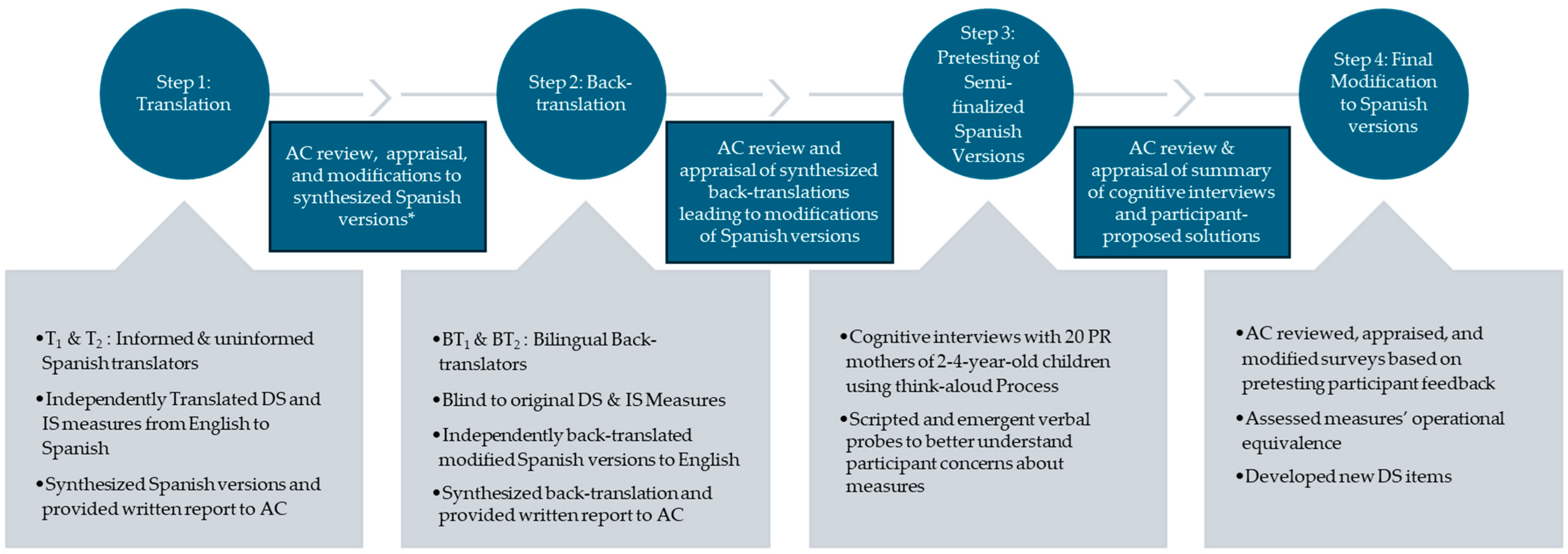
This study is part of a larger mixed-methods study conducted between 2016 and 2020. We followed a modified process of cultural adaptation to adapt two parenting discipline measures to the PR culture and language (see Figure 1) [27]. This process involved (1) translation of the measurement instruments from English to Spanish, (2) back-translation of the synthesized Spanish versions into English, (3) use of cognitive interviews with PR mothers to pretest the semi-finalized Spanish versions, and (4) an Adaptation Committee (AC; composed of translators, back-translators, and two mental health experts; all bilingual Spanish speakers) that reviewed and appraised all translations, back-translations, and written reports leading to modifications of the Spanish versions of the measures. Throughout the adaptation process, we sought to maintain the following equivalences: (1) semantic to ensure that the words used in the original and adapted measures relayed the same messages or meanings; (2) idiomatic to develop comparable expressions for colloquial language, which are often more difficult to translate; (3) experiential to replace poorly fitted questionnaire items with similar items that more closely capture the experiences of PRs; and (4) conceptual to modify words that may have different conceptual meanings in the PR culture [27]. Synthesis and decision-making processes were documented in detail. Most AC discussions were audio-recorded.
Figure 1.
Process of cultural adaptation of the discipline survey (DS) and immediate situation (IS) measurement instruments. Note: T1: Translator one; T2: Translator two; DS: Discipline Survey; IS: Immediate Situation; BT1: Back-translator one; BT2: Back-translator two; AC: Adaptation Committee; * Back-translators not included as part of AC at this stage.
2.2. Measures
2.2.1. Discipline Survey (DS)
The DS measures parents’ reactive disciplinary practices (behaviors used to reduce or eliminate children’s misbehaviors) and the modes in which these practices are employed [28]. This measurement instrument is composed of 32 items assessing 10 types of reactive discipline and 6 modes of administration with Cronbach’s alpha values as reported by Socolar and colleagues (2004) [28]. The discipline practices are measured by five subscales: Modeling Behavior (e.g., show child how to behave; 3 items; α = 0.82), Verbal Communication (e.g., talk about problem; 3 items; α = 0.76), Ignoring Behavior (e.g., withdraw attention; 3 items; α = 0.64), Monitoring (e.g., let child know you are watching; 2 items; α = 0.74), and Corporal Punishment (e.g., spank; 2 items; α = 0.78) in addition to five single items: Distract, Natural Consequences, Time Out, Reward (when behaving well), and Remove Privileges [28]. The modes of administration are measured by four subscales: Positive Parental Demeanor (e.g., calm; 3 items; α = 0.56), Negative Parental Demeanor (e.g., angry; 3 items; α = 0.56), Consistency (e.g., child knew what to expect; 3 items; α = 0.57), and Follow-Through (e.g., do what you said you would; 3 items; α = 0.71) in addition to two single items: Belittling Demeanor (i.e., embarrassing child) and Stern Demeanor (i.e., firm and serious) [29,30]. All responses are assessed using a 6-point Likert-type scale ranging from 1 (never) to 6 (always). They concentrate on parental behaviors used to address the target child’s misbehavior in the last 3 months. Scores for each subscale are based on the mean of item responses for that subscale [28]. The DS also includes seven sub-questions to evaluate (1) the frequency of child misbehavior, (2) the amount of time that parents spoke, spanked, and withdrew privileges from their child, and (3) how the participating parent was disciplined as a child.
2.2.2. Immediate Situation (IS)
The IS measurement instrument evaluates whether specific circumstances/situations affect parents’ choice of discipline [29]. It consists of 11 items comprising 4 subscales: Type of Misbehavior (e.g., what child did to misbehave; 2 items; α = 0.77), Parent–Child Interaction (e.g., how child reacted when disciplined; 4 items; α = 0.71), Location (e.g., whether in public; 2 items; α = 0.71), and Temporary Stressors (e.g., parent having a bad day; 3 items; α = 0.74) [29]. Please note that Cronbach’s alpha values are as reported by Socolar and colleagues (2005). Responses are recorded on a 6-point Likert scale ranging from 1 (not at all) to 6 (very much). Subscale scores are determined by calculating the mean item score. IS subscales are typically related to most of the DS subscales in expected patterns [29].
A benefit of the DS and IS measures is the inclusion of modes of reactive discipline administration and the immediate situations influencing parents’ approach to discipline [28]. To date, neither instrument has been translated nor adapted from their English versions. We took a first step by adapting these measures into culturally specific Spanish versions.
2.3. Cultural Adaptation Process
2.3.1. Translation
The DS and IS measures were translated from English to Spanish independently by two bilingual HCPs (T1 and T2) whose primary language was Spanish. They demonstrated their language proficiency by effectively delivering patient care and education in both languages and accurately documenting care in English. T1, the principal investigator (PI), had formal training as a Spanish interpreter and knowledge of the discipline concept as described in the literature. T1 is of Dominican descent and has worked extensively with the PR population in clinical practice. T2 is a PR mother of an 11-year-old child and was naïve to the underlying concepts of the measures. After completion of the translations, the two translators met to discuss any differences/concerns, reached a consensus, and synthesized the translations into preliminary Spanish versions of the measures.
2.3.2. Back-Translation
To ensure that the translated Spanish versions accurately reflected the original English versions, two additional translators (BT1 and BT2) followed a similar process to independently back-translate the synthesized Spanish versions into English [27]. Both back-translators were bilingual PR health professionals proficient in English and Spanish. They were masked to the original English measures. Once both back-translations were completed, these translators met with the PI (T1) to synthesize the back-translations of the DS and IS. During this process, any errors and/or discrepancies in interpretations of back-translated items were examined and discussed until consensus was achieved among the three translators.
2.3.3. Adaptation Committee (AC) Appraisal and Modifications of Translations
After the back-translations were completed, the AC met to review and evaluate any inconsistencies between the language of the original and the synthesized translations. The committee consisted of the two translators, the two back-translators, and two bilingual experts. One expert was a Panamanian mental health provider who was a certified Spanish translator and worked closely with the PR population; the other was a PR with a master’s degree in Marriage and Family Therapy. All AC members read and reviewed all three DS and IS versions (original, synthesized translations, and synthesized back-translations). Discrepancies across the versions and/or concerns about linguistic clarity and cultural sensitivity of the measures were discussed and addressed until consensus was reached, creating semi-finalized Spanish versions of the DS and IS to use for pretesting.
2.3.4. Pretesting of the Adapted Instruments
To safeguard against the inclusion of items that could be misleading or lack equivalence, the committee-approved Spanish translations were pretested with 20 PR mothers of 2–4-year-old children [27,31]. Mothers were recruited from the local community through snowball sampling, word of mouth, and placing study flyers at local churches and businesses (e.g., restaurants and hair salons) serving this population. After obtaining consent, the PI interviewed participants in Spanish for approximately 60 min at their homes. Interviews were conducted until no additional issues or insights were identified. Interviews were audio-recorded and detailed notes were taken and reviewed after each interview. Participants were compensated with USD 25 for their time.
Cognitive Interviewing Using the Think-Aloud Process
Cognitive interviewing is designed to gather insights into participants’ interpretation of questionnaire items and response categories by requesting them to verbalize their thoughts as they examine and answer items on the questionnaires [32]. To evaluate which survey items participants struggled to understand, we used the think-aloud technique of asking mothers to read questions aloud and talk through their decision-making process [33,34]. Prior to initiating these interviews, participants were trained in the process of ‘thinking aloud’ by using two practice questions from the Cultural Socialization of Latino Children measure [35]. These questions were (1) “I believe that children should obey no matter what”, and (2) “It is not acceptable for children to interrupt adult conversations” (both answered from 1 = Strongly Disagree to 5 = Strongly Agree). If participants struggled during the think-aloud sessions, the following prompts were used: (1) “Tell me what you are thinking” or (2) “What are you thinking about right now?” [32].
Probes Used during Pretesting
Verbal probes were used to help clarify any participant’s difficulty with stem-question recall, comprehension of questionnaire items, and/or response category options. These probes helped the investigator to understand the participants’ decision-making process [27,33,36]. Ten scripted probes were available to be asked at the end of the think-aloud sessions (see Table 1). Emergent probes were developed during survey administration and used in later think-aloud sessions to capture any concerns raised by research participants [37]. Examples of emergent probes included (1) What does the phrase ‘llevarse bien en el mundo’ (get along in the world) mean to you? and (2) What does the word ‘recompensa’ (reward) suggest? (see Table 1).
Table 1.
Scripted and emergent probes used in think-aloud sessions (TASs).
Documentation and Data Analysis
Memos were written as the study progressed and included the PI’s thoughts and insights about the developing codes and themes [39]. Continuous data analysis was used throughout the process. The audio-recorded cognitive interviews were transcribed verbatim and translated into English by the PI. The collected memos and de-identified participant data were organized and analyzed question-by-question, using thematic qualitative analysis [40]. Specifically, open coding was utilized to identify initial codes. They were then grouped into categories to create themes. The developed themes were reviewed and discussed with all AC members until a consensus was reached. These themes were used to (1) evaluate whether the measures appeared to effectively assess the intended discipline concepts and (2) develop additional items related to the Positive and Negative Demeanor concepts to help improve the internal consistency of these respective subscales [41]. In addition, deductive coding was conducted using the ‘translation, cultural adaptation, generic problem’ (TCG) system [42], described below. The TCG system helped to inform the development and identification of translation-related themes used to further adapt the Spanish versions of the DS and IS.
Translational problems represent linguistic issues caused by errors in the translation methodology [42], such as mistranslation of a specific concept or errors in grammar. For example, if a participant struggled to comprehend a certain term, they were asked if there was a word to better capture the targeted meaning. In reporting this type of semantic change, we described the following key components: (1) the Spanish word of concern; (2) a verbatim translation of the word’s semantic meaning, its significance to the PR culture, and how it is utilized; (3) reasons respondents interpreted a specified word in a particular manner; (4) suggestions for use of another word; (5) translation of a new word into English; and (6) explanation behind the use of the new word [37].
Cultural adaptation problems are indicative of survey items that fail to operate in the same manner across populations [42]. This can occur because of cultural differences in worldviews. To address this challenge and ensure a better fit of the DS and IS measures to the PR population, the objectives of survey questions were clarified and specific items with similar meanings were developed [34].
Lastly, generic problems represent issues/defects with the original DS and IS items that transcended culture and were carried over to the Spanish translation [42]. Specifically, issues that interfered with a participant’s ability to answer questionnaire items were recorded. Prior to assigning observations to a specified TCG category, the problems elicited by the participants were summarized across interviews to create related themes [43]. Based on these themes, written suggestions to modify specific items were provided to the AC.
2.3.5. Adaptation Committee (AC) Reappraisal and Modifications
The AC met to discuss and evaluate concerns elicited from the pretesting participants. To facilitate these deliberations, the PI transcribed and summarized recorded encounters and participant-proposed resolutions. All six AC members needed to concur before any survey changes were made. Based on feedback from the pretesting participants and what is known from the literature, the committee assessed the measures’ operational equivalence by determining the adequacy of their format, layout, and application for administration in the PR population [44]. After the AC reached a consensus, the appropriate semantic and operational changes were made to create the adapted Discipline Survey—Spanish (DS-S; see Table A1) and Immediate Situation–Spanish (IS-S; See Table A2) measures.
2.4. Ethical Considerations
Because the owner of the DS and IS measurement tools was deceased, permission to culturally adapt them was obtained from the owner’s next of kin. This study was approved by the University of Rochester Research Subjects Review Board (Study number: RSRB00059732). Written consent was obtained from participating mothers.
3. Results
3.1. Report on the Synthesized Translation
The following results pertain to the translations of both the DS and IS measures. The translations of each measure by T1 and T2 were relatively similar and generally conveyed the meaning of the original questionnaire items. Metaphrase (word-for-word translation), along with sentence structure arrangements, were used in both translations. A total of 41 differences were noted between the completed translations. Many reflected variations in conjugation and the use of synonyms for the same words. To resolve these discrepancies, the translators deliberated until they reached a consensus. As a sign of respect for future participants, they decided to use the more formal pronoun ‘usted,’ when conjugating verbs that referred to the pronoun ‘you.’ They also chose Spanish words that were more commonly understood by PRs.
In ensuring semantic equivalence, a few mutually agreed-upon decisions were made by the AC. For example, one of the DS survey items (what would you say was the main method used to discipline you when you were a child?), required further explanation to ensure semantic equivalence. Spanish definitions for the parent punishment practices of time-out (time spent alone) and grounding (time that you could not go out) were used because exact words for these concepts do not exist in the Spanish language. While the Spanish word ‘castigo’ refers to punishment, it does not specify the actual (or specific) type of punishment.
Maintaining experiential equivalence was a concern for survey items related to spanking (e.g., did you spank him/her?). The experience of PR mothers in disciplining their children through spanking/corporal punishment includes more than slightly hitting on the buttocks (nalgadas). For example, the child may be hit on the mouth (tapaboca) if he/she says a bad word or on the head (cocotazo) if he/she is being hardheaded [24]; thus, the more comprehensive words for ‘hitting’ (pegar and dar) were used instead of spanking. Lastly, there was a need to achieve idiomatic equivalence for the item ‘did you slap or pop his/her hand?’ Since the colloquial term ‘pop’ is not used in the Spanish language, both translators used the phrase ‘did you hit his/her hands’ (le dio en sus manos) to convey the essence of this item.
3.2. Report of the Synthesized Back-Translation
The two back-translations were similar and maintained the semantic equivalence of the original questionnaire items. A total of 60 differences were noted between the two back-translations, many of which were related to differences in sentence structure or the use of synonyms to translate the same concepts/words. Ultimately, the words that were more like the original English version were chosen. If the back-translated word or item was not like the original English version, other Spanish words that might better target the item/word’s essence were explored to better achieve semantic equivalence.
There were some instances in which the back-translated words did not resemble the original measures or needed further modifications. For example, this was noted in the response options for the DS (never, rarely, sometimes, often, almost always, always) and IS (very much, quite a bit, some, not really, not much, not at all). In terms of the DS responses, ‘muchas veces’ was translated by both back-translators to ‘many times’. While ‘many times’ is defined as ‘often’ [45], it was perceived to have the same or a higher degree of frequency than ‘almost always’. To maintain semantic equivalence, ‘muchas veces’ was changed to ‘frecuentemente’, which directly translates to ‘often’ [46] (see Table 2).
Table 2.
Adaptation process: discipline survey (DS) and immediate situation (IS) items requiring further modifications.
The IS response options proved to be problematic and appeared to be a limitation of the original measure. Although the intention of the response scale was presumably to decrease in frequency from left to right, the last three response choices did not appear to be in the correct order despite being accurately translated. ‘Not much’ was thought to imply that behaviors could sometimes happen in a small amount and should, thus, come before ‘not really.’ In defining these two words, ‘not much’ is described as “a small amount of (something)” [47], while ‘not really’ is construed as an idiom “used to say ‘no’ in a way that is not very forceful or definite” [48]. The first three categories in the IS response set also required modification to achieve semantic equivalence. The final synthesized back-translated response options read as follows: very much, often, sometimes, not much, not really, never (see Table 2).
Finally, for DS-S item #4, a concern with the word ‘discipline’ (disciplina) emerged (see Table 3). While this word is used in the PR population, it is not commonly used by the average PR. To further clarify its meaning, the word ‘corregir’ (‘to correct’) was added to this question.
Table 3.
Adaptation process: discipline survey—Spanish (DS-S) items requiring examples for further clarification.
3.3. Adaptation Committee (AC) Appraisal and Modifications of Translations
The AC’s review resulted in several items requiring modifications to the synthesized Spanish version of the surveys prior to pretesting. These adjustments were related to the DS-S items associated with modeling (#8), spanking (#11), and lack of follow-through (#24). Further revisions were also needed for the IS-S instructions and response options (see Table 2). These modifications maintained the item-semantic equivalence and were approved by all AC members.
There was concern that, as written, DS-S item #8 could be perceived as offensive to some mothers. It was thus adjusted to ‘did you demonstrate to NAME how to behave in the correct way when he/she misbehaved so that he/she could imitate your behavior?’ (see Table 2). To diminish the potential perceived harshness of the word ‘pegar’ (to hit), item #11 was modified by adding the word ‘nalgadas’ (‘hitting the butt’) to the list of presented examples (see Table 3). Finally, DS-S item #24 needed modifications as the AC favored the phrase ‘se dio por vencida’ for a more accurate representation of ‘give in.’ This decision was validated by verifying that ‘give in’ translates to ‘darse por vencido’ from English to Spanish [49].
Regarding the IS-S measure, the word ‘situations’ (situaciones) was added to the instructions to clarify that when using ‘each of the following,’ it would refer to different specific situations. Lastly, the IS-S response options were further adapted to ensure that the scale was indeed decreasing from left to right. With this goal in mind, the word ‘a menudo’ (often) was replaced by its synonym ‘frecuentemente’, ‘un poco’ (a little) was used to substitute for ‘no mucho’ (not much), and ‘casi nunca’ (almost never) took the place of ‘no realmente’ (not really). Thus, the final IS-S response options are now as follows: very much, often, sometimes, a little, almost never, and never (see Table 2).
3.4. Pretesting and Adaptation Committee (AC) Appraisal and Modifications
The age of the 20 participating mothers ranged from 21 to 40 years (mean = 28.6 years, SD = 4.36). Most mothers reported being either married (25%) or cohabitating (45%), having a high school diploma or GED (90%), and a household income of less than $40,000 (68%). The mean age of index children was 2.9 years, with most identified by mothers as female (60%).
Participant responses during the cognitive interviews largely confirmed, as intended, that the pretested DS-S and IS-S measures assessed PR mothers’ discipline practices, modes of administration, and situations influencing these practices. Participants raised a total of 22 concerns in understanding the questionnaire items. Most concerns were translational problems related to words like: ‘enfado’ (anger), ‘avergonzar’ (embarrass), and ‘ánimos’ (encourage). Although most mothers understood these terms, a small number had difficulty comprehending them, possibly due to unfamiliarity with the vocabulary used or their educational/reading background. We addressed these challenges by exploring other word alternatives with participants. In addition, to better assess and understand these findings and determine the best solution or word alternative, emergent probes were developed for use with subsequent participants. A more significant translational concern was related to the reward–discipline practice. While we found a word for ‘reward’ (recompensa), a few mothers struggled to understand it and suggested that examples be provided; therefore, a few examples of rewards were included for this item (see Table 3). No significant cultural adaptation problems were identified during pretesting.
Three main concerns arose in the generic problems category. They included (1) difficulty interpreting the word NAME in the provided context, (2) challenges in remembering the item stem, which led to problems answering questions accurately, and (3) the length of item #4 caused confusion. To resolve the first generic problem, we added the following in parenthesis: NAME represents the name of your son/daughter (NOMBRE representa el nombre de su hijo/a). The second generic problem was amended by including the stem in each item and italicizing the remaining portion of the question. The third generic problem was addressed by deleting the word ‘like’ and putting the detailed item examples in parenthesis (see Table 3). This solution allowed participants to focus on the main question, using the examples if additional clarification was required.
Eight themes were identified from the participants’ cognitive interviews and open-ended question responses (see Table 4). These themes were used to develop eight additional DS-S items with the intention of better capturing the specific cultural practices and experiences of PR mothers (see Table 4). Two of these items were about the common discipline strategy of yelling or scolding when a misbehavior occurred, while the other six were about Negative Demeanor (4 items) and Positive Demeanor (2 items). The stem and response options for these additional items were the same as those used in their respective categories. While these additions contributed to cultural relevance, their psychometric properties, as well as those of the adapted instruments, require further study.
Table 4.
Emerging themes informing development of additional DS-S questions from pretesting.
Quantitative data from the cognitive interviews further supported the preliminary validity of the measures. PR mothers in this study frequently endorsed the discipline practices and modes of administration included in the DS-S, indicating the relevance of the items. For example, 90% of mothers reported using Verbal Communication and Modeling Behavior often or more frequently (see Table 5). While practices such as Corporal Punishment and Ignoring Behavior were used less often, 75% and 60% of mothers, respectively, reported using these practices. Mothers endorsed all modes of administration except for Belittling Demeanor, with 95% of mothers reporting that they never embarrassed their children. The Cronbach’s alpha for the discipline practices subscales, based on the factor structure of the original measure, ranged from 0.44 to 0.71, while that of the modes of administration ranged from 0.19 to 0.72. It is important to note that these calculations did not account for the newly created items, as they were developed during the cognitive interviewing process, and not all participants responded to these new questions.
Table 5.
Frequencies of disciplinary practices and modes of administration as reported by mothers (N = 20).
Regarding the IS-S, 70–85% of mothers reported that the situations assessed affected the way they disciplined their child at some level, ranging from very much to almost never (see Table 6). These findings indicate that the items are understood and relevant to PR mothers’ lived experiences. The Cronbach’s alpha for the IS-S subscales, based on the factor structure from the original measure, ranged from 0.66 to 0.85.
Table 6.
Frequencies of immediate situations affecting mothers’ discipline choice (N = 20).
4. Discussion
We adapted the DS and IS tools for use with Spanish-speaking PR mothers, employing an iterative, community-engaged approach. This methodology allowed us to apply a systematic strategy that supported the cultural adaptation of these measures, going beyond simple translation. Our findings underscore the importance of culturally adapting existing measures to consider culture, values, and language. Such adaptation is crucial for research that explores potential protective factors like parenting practices that can mitigate the effects of social determinants of health on childhood development, including parenting practices.
Several lessons emerged while adapting the DS and IS for Spanish-speaking PR mothers. The first lesson involved difficulties with translations; that is, the need to carefully adjust for (1) word conjugation, (2) pronouns for gender-specific nouns, and (3) sentence syntax or grammatical ordering of subject, verbs, and objects when translating measures into Spanish [50,51]. The use of a dialect and vocabulary that could be readily understood by PRs was also critical. To help address this concern, commonly used words were chosen over direct translation equivalents that were less often used and presumably less understood within the PR population. For example, the word ‘corregir’ was used for discipline in addition to its direct translation ‘disciplinar.’ Furthermore, changes in language often led to the use of more words to communicate linguistically non-equivalent language or expressions [50]. Longer questions can lead to difficulty in understanding and may produce a cumulative fatigue effect. We addressed this concern by breaking down complex sentences into simpler structures and parenthetically adding examples where they were deemed helpful. In addition, colloquial terms were avoided to facilitate future adaptation and psychometric testing of these measures for other Spanish-speaking groups.
The second lesson confirmed that translation alone is not enough when adapting measures as they may result in items being biased and having differing connotations [50]. An example in this study was the use of words that sounded similar but meant different things like ‘cedió’ (to cease) and ‘se dio’ (to give). An important strength of our work was engaging an AC of bilingual Latina women in translation, back-translation, and pretesting. This enriched the discussion of mothers’ parenting practices and safeguarded against biased and inappropriate items [27].
Through the adaptation process, several translational and generic problems were identified and addressed. While generic problems (e.g., problems with the original DS and IS) constituted only a few of these concerns, one was a significant limitation to both the existing and adapted measures. It required modification of the IS Likert response options to ensure that they decreased in frequency from left to right, with more equidistant spacing between choices. The absence of cultural adaptation problems during the pretesting stage can be attributed to our focus on maintaining experiential equivalence during the translation and back-translation steps. During this phase, attention was given not only to linguistic accuracy, but also to ensuring that the survey items reflected the discipline experiences of PR mothers.
The third lesson reinforced the importance of considering both culture and language when adapting measures for other populations, as items may behave differently across cultures [52]. Accounting for the cultures of the source and target populations is critical in informing research to ensure that the concepts being measured are relevant and have equivalent meanings in both populations. In this study, our focus was on assessing whether the constructs measured by the DS and IS remained relevant and operated similarly in the PR sample, consistent with their functioning in the Black and White samples originally used to validate them. Attention to cultural context and language allowed us to identify and address discrepancies, ensuring that the adapted measures accurately reflected the constructs they were intended to assess.
Ideally, an adaptation should maintain the semantic equivalence of the original measure as much as possible. Yet, to effectively do so, items whose literal translations result in cultural bias should be modified [51]. In adapting the DS measure, we encountered challenges due to lexical gaps: instances where a word or concept in English lacked a direct equivalent in Spanish [53,54]. For example, we faced difficulty translating the disciplinary practices of Reward, Time Out, and Corporal Punishment because the literal translations did not fully capture important cultural nuances. Translating these practices required adjustments to better convey the intended meaning within the PR cultural context.
Although we found a word for ‘reward’ (recompensa), we had to provide examples of the discipline strategy to make this item more culturally equivalent. The examples we originally listed (i.e., purchase of an item or activity) failed to include any non-monetary forms of this practice, which was needed for this cultural group. This idea is supported by a qualitative study of treatment acceptability of parenting practices, which found that most Latina mothers, including PRs, opposed the use of material rewards, as they did not perceive it to be a feasible practice, given their limited financial circumstances [55]. In retrospect, praising the child’s good behavior would have been an important example of a reward to include. Verbal praise is often used by PR parents as a reward strategy in parenting [22,23]. This finding suggests that, in future studies, it would be valuable to examine how PRs use different types of rewards for positive reinforcement [55].
The item related to the discipline practice of Time Out also required modification because a specific Spanish term could not be identified, despite mothers’ acknowledging the use of this strategy. It is likely that Time Out is used less often in the PR culture. For example, research has demonstrated that PR parents who had not been acculturated to the American culture and were living in Puerto Rico were not willing to adopt the use of a time-out room as a disciplinary practice [56]. Even when these parents were able to view their 4–6-year-old child through a one-way mirror, they felt distressed about using a time-out room. In addition, Latin Americans born in the U.S. have been shown to perceive Time Out as more effective than their foreign-born counterparts [57]. Thus, for PR mothers living in the U.S., acculturation may contribute to their awareness, comprehension, and perceptions of the suitability of this practice [55].
The items related to corporal punishment required modifications as well to attempt to minimize item bias (the risk of a response based on social desirability), and the chances that PR mothers would be less forthcoming about the use of this practice. Research shows that PRs perceive spanking to be an acceptable discipline practice to instill the value of respect and ensure that children obey and behave properly [21,58,59]. Nonetheless, PR mothers may fear that the surrounding American culture would misconstrue spanking as abusive. The potential legal ramifications of using corporal punishment may leave parents feeling disempowered when raising their children [55]; thus, we felt it was essential that the translation of spanking encompassed the specific forms of this practice that mothers engaged in, while avoiding terms that may be perceived as too severe or non-normative. These translational concerns reinforced the importance of considering culture when translating terms and words [19].
It is important to note that all participants indicated that the items assessing discipline practices, modes of administration, and situations included in the adapted DS and IS were pertinent to PR mothers’ discipline encounters. Because many PR mothers reported disciplining children by yelling and scolding, we added two new questions related to these specific practices. Another study of PR mothers, in contrast, found that 55% perceived verbal reprimands (e.g., screaming, negative scolding, insults, etc.) to be an inappropriate discipline strategy to deal with disobedience and non-compliance in children under 6 years of age [21]. However, their definition of a verbal reprimand was broader and included practices such as insults, swearing, and belittling, which may be perceived to be abusive and demeaning.
In this study, we adapted the DS and IS measurement instruments for use with Spanish-speaking PR mothers through a community-engaged adaptation process. While we calculated and reported Cronbach’s alpha using the original measures’ factor structure, caution is advised in interpretation due to our small sample size. Specifically, research has shown that estimates of Cronbach’s alpha require a sample size of 30 or more to achieve stability and accuracy [60]. Additionally, we did not have enough responses to the newly created DS-S items to conduct a factor analysis and add these items to Cronbach’s alpha calculations. There is a possibility that the factor structure for the PR population may differ from that of the original measure. Despite this, the primary objective of achieving linguistic and cultural relevance was met, although with the understanding that further psychometric validation is necessary. Future studies with larger sample sizes are needed to determine the factor structure of these measures, assess the measures’ psychometric properties, including validity and reliability, and further strengthen their overall robustness. This would help to expand our understanding of PR discipline practices, enabling researchers and HCPs to develop and implement effective, culturally attuned recommendations. In doing so, they could potentially cultivate a more professional and trusting partnership with PR parents—promoting successful socialization and minimizing developmental and behavioral challenges among PR children [61,62].
4.1. Limitations
A limitation of this study is that despite the AC being composed of all bilingual Latinas, the cultural/ethnic background of two of the six members was not PR. This limitation was likely offset by their close work with the PR population in clinical practice, as well as our thorough pretesting of the DS-S and IS-S measures with PR mothers. Cognitive interviews provided direct insights into the PR culture, aiding in the cultural relevance and comprehensiveness of the adapted measures. This approach helped address cultural nuances that may have been overlooked by the AC. Future studies should consider the use of a standardized translation and adaptation review form to ensure that all AC members are systematically and consistently addressing adaptation concerns.
Another limitation of this study is that we were unable to conduct factor analyses on the fully modified or adapted measures with this small sample size. This prevented us from determining the factor structure and assessing the internal stability of the respective subscales. Consequently, the reliability and validity of the newly adapted items could not be thoroughly evaluated. This limitation highlights the need for future research to include larger PR samples to facilitate factor analysis and ensure the psychometric robustness of the adapted measures.
Lastly, this study only included PR mothers living in the U.S., so its applicability to fathers and parents living on the Island of Puerto Rico is unknown. As in all cultures, fathers and other important caretakers serve critical roles in children’s care and development. Future studies should aim to include these groups to improve the generalizability of the findings.
4.2. Implications for Clinical Practice and Public Health
Given the need for HCPs to provide culturally competent care and disciplinary guidance for Spanish-speaking PR families, our adaptation of the DS and IS measures provides potentially useful tools to develop a culturally appropriate understanding of PR disciplinary practices. This knowledge can help to strengthen HCP–parent partnerships to promote child health and assist clinician researchers in creating culturally and linguistically tailored interventions that address health disparities and foster community trust in public health services.
5. Conclusions
This study provides guidance on navigating the complexity of translating and adapting existing research instruments. We have demonstrated in detail how cultural adaptation methodology, including translation, back-translation, expert committee review, and pretesting of the measures, was applied to adapt two parenting measures. Spanish versions of the DS and IS were developed and demonstrated relevance with the target population of PR mothers of 2–4-year-olds. The adaptation resulted in the addition of six new items for the demeanor subscales and two more discipline practices applicable to this population. Clarification of response scales for both measurement tools was also achieved. Our linguistic and cultural translation of the DS and IS may help expand the study of parental discipline practices involving PR populations. Such research also contributes to health and language equity for the often-underrepresented Spanish-speaking PR population, offering measures that are more easily understood and culturally relevant in assessing key practices used in disciplining their children. Effective measurement of these practices can help to increase providers’ knowledge of the types and extent of discipline practices used, and ultimately lead to designing and tailoring culturally attuned parenting interventions for this population.
Author Contributions
Conceptualization, J.C., H.R. and H.F.C.; methodology, J.C., H.R. and H.F.C.; validation, J.C.; formal analysis, J.C.; investigation, J.C.; resources, J.C.; data curation, J.C.; writing—original draft preparation, J.C.; writing—review and editing, J.C., H.R., H.F.C., S.W.G., M.Q.-C. and J.G.P.-R.; visualization, J.C. and M.Q.-C.; supervision, J.C. and H.F.C.; project administration, J.C.; funding acquisition, J.C. All authors have read and agreed to the published version of the manuscript.
Funding
This research was funded by the University of Rochester School of Nursing, Katharine Donohoe PhD Student Scholarly Practitioner Award. This publication was supported by the Health Resources and Services Administration T32HP42020 fellowship grant, the National Center for Advancing Translational Sciences of the National Institutes of Health, University of Rochester CTSA award number TL1 TR002000, and the National Heart, Lung, and Blood Institute of the National Institutes of Health, University of Houston, grant number R25HL126145. The content is solely the responsibility of the authors and does not necessarily represent the views of the National Institutes of Health or the Health Resources and Services Administration. The APC was funded by Jahaira Capellán.
Institutional Review Board Statement
The study was conducted in accordance with the Declaration of Helsinki and approved by the Institutional Review Board of the University of Rochester (protocol code study number RSRB00059732 and date of approval 17 December 2015).
Informed Consent Statement
Informed consent was obtained from all subjects involved in the study.
Data Availability Statement
The raw data supporting the conclusions of this article will be made available by the authors upon request.
Acknowledgments
We would like to thank the late Rebecca Socolar for creating the Discipline Survey and Immediate Situation measurement instruments, and her husband, Joshua Socolar, for giving us permission to adapt them. Thank you to the participating mothers and the Adaptation Committee for their help and contributions to adapting these measures. We would also like to thank the Research Facilitation Group of the University of Rochester School of Nursing for their assistance with data entry and verification. We are grateful to Constance Baldwin, Deborah Ossip, and Bettina Beech for their editorial support. A special thank you to the late Harriet Kitzman for her unwavering support and guidance throughout this research.
Conflicts of Interest
The authors declare no conflicts of interest. The funders had no role in the design of the study; in the collection, analyses, or interpretation of data; in the writing of the manuscript; or in the decision to publish the results.
Appendix A
Table A1.
Discipline survey—Spanish (DS-S) item table with English translation.
Table A1.
Discipline survey—Spanish (DS-S) item table with English translation.
| Item | Spanish | English |
|---|---|---|
| Introductory Text | Todas las madres manejan sus problemas con el comportamiento de sus hijos en diferentes maneras. Queremos aprender sobre cómo usted ha manejado los problemas de comportamiento en los últimos tres meses con NOMBRE (NOMBRE representa el nombre de su hijo/a). Queremos que piense en lo que usted hizo cuando su hijo/a se portó mal y también como usted logro que su hijo/a se comportara de una manera beneficiosa para su futuro o que le ayudará a él/ella a llevarse bien en el mundo. Usted puede notar que algunas preguntas son similares. Esto nos ayuda a aprender con mayor precisión lo que usted hace cuando disciplina/corrige a su hijo/a. | All mothers manage their children’s behavior problems in different ways. We want to learn about how you have managed behavior problems in the last three months with NAME (NAME represents the name of your son/daughter). We want you to think more or less what you did when your child misbehaved and also how you got your child to behave in a way that would be beneficial to his/her future’ or that would help him/her to get along well in the world. You will notice that some of the questions are similar. This helps us learn with more precision what you do when you discipline your child. |
| Instructions | Para todas las preguntas, queremos que usted piense sobre como usted ha manejado problemas con NOMBRE en los últimos 3 meses. En los últimos tres meses cuando usted tuvo un problema con la manera en que NOMBRE se comportó, (Circule una respuesta) | For all of the questions, we want you to think about how you have managed problems with NAME in the last 3 months. In the last three months when you had a problem with the way NAME behaved, (Circle one answer) |
| Question Stem | En los últimos tres meses cuando usted tuvo un problema con la manera en que NOMBRE se comportó, | In the last three months when you had a problem with the way NAME behaved, |
| 1 | ¿habló usted con él/ella sobre el problema? | did you talk with him/her about the problem? |
| Sub-question | Cuándo habló usted con NOMBRE sobre un mal comportamiento, ¿por cuánto tiempo hablan? (Marque una) | When you talked with NAME about a misbehavior, how long did you talk? (Check one) |
| Sub-question Responses | Yo nunca he hablado con él/ella sobre un mal comportamiento | I never talked with him/her about a misbehavior |
| Menos de un minuto | Less than 1 min | |
| 1–3 minutos | 1–3 min | |
| 3–10 minutos | 3–10 min | |
| Más de 10 minutos, pero menos de una hora | More than 10 min but less than one hour | |
| Una hora o más | One hour or more | |
| 2 | ¿ignoró usted el comportamiento? | did you ignore the behavior? |
| 3 | ¿después que le dijo que no, dejó que él/ella lo hiciera de todos modos? | after you said no, did you let him/her do it anyway? |
| 4 | en vez de disciplinar/corregir a NOMBRE, ¿dejó usted que él/ella se enfrentara a las consecuencias de su comportamiento? (Por ejemplo: ¿tener hambre cuando él/ella no quiso comer? ¿tener frío si él/ella no quiso ponerse una chaqueta? ¿tener dolor de estómago por comer demasiado dulce?)? | instead of disciplining/correcting NAME, did you let him/her deal with the consequences of his/her behavior (for example: being hungry when he/she refused to eat? being cold if he/she did not want to put on a jacket? Having a stomach-ache from eating too much candy?)? |
| 5 | ¿le explicó el problema a él/ella? | did you explain the problem to him/her? |
| 6 | ¿usó usted la misma disciplina, cada vez que él/ella repitió el mismo mal comportamiento? | did you use the same discipline, each time he/she repeated the same misbehavior? |
| 7 | ¿le dio a NOMBRE una recompensa/premio (por ejemplo: dulce, ‘estiquer’, o ir a su lugar preferido como Sky zone o Chuck E. Cheeses) la próxima vez que él/ella enfrentó una situación similar y se portó bien? | did you give NAME a reward (for example: candy, sticker, or going to his/her favorite place like Sky Zone or Chuck E. Cheeses) the next time he/she faced a similar situation and behaved well? |
| 8 | ¿le demostró a NOMBRE cómo comportarse de manera correcta cuando él/ella se portó mal para que él/ella pudiera imitar su comportamiento? | did you demonstrate to NAME how to behave in the correct way when he/she misbehaved so that he/she could imitate your behavior? |
| 9 | ¿siguió usted adelante con lo que dijo que iba hacer? | did you follow through with what you said you would do? |
| 10 | ¿hizo que NOMBRE se quedara solo/a por un tiempo breve (time out)? | did you make NAME stay by him/herself for a brief time (time out)? |
| Sub-question | Si es así, ¿por cuánto tiempo? (Marque uno) | If so, how long? Mark one |
| Sub-question Response Options | 0–5 minutos | 0–5 min |
| 5–10 minutos | 5–10 min | |
| 11 minutos–1 hora | 11 min–1 h | |
| Más de una hora | More than an hour | |
| 11 | ¿le pego usted a él/ella? (p. ej. ‘Papao’, nalgadas, tapaboca, cocotazo) | did you hit him/her (ex. hitting on the hands, butt, mouth, or head)? |
| Sub-question | Por lo general, cuándo le dio (p. ej. nalgadas o ‘papao’) a NOMBRE por un mal comportamiento ¿cuántas veces le dio? (Marque una) | In general, when you hit (spank on butt or hit hands) NAME for a misbehavior, how many times did you hit him/her? (Mark one) |
| Sub-question Response Options | Ninguna | None |
| Una | One | |
| Dos | Two | |
| Tres | Three | |
| Cuatro | Four | |
| Cinco | Five | |
| Más de Cinco | More than Five | |
| 12 | ¿sabía NOMBRE qué esperar de usted cuando él/ella se portaba mal? | did NAME know what to expect from you when he/she misbehaved? |
| 13 | ¿le quitó usted los privilegios de él/ella? | did you take away his/her privileges? |
| Sub-question | Si es así, ¿qué le quitó? (Marque uno) | If so, what did you take away? (Mark one) |
| Sub-question Response Options | Juguete o juego | Toy or game |
| Otro objeto que le pertenece a él/ella | Another object belonging to him/her | |
| Televisión | T.V. | |
| Vídeo o juego de vídeo | Video or video game | |
| Computadora/tableta | Computer/Tablet | |
| Comida/dulce | food/candy | |
| Otro | Other | |
| Sub-question | ¿Por cuánto tiempo se lo quitó? (Marque uno) | How long did you take it away? (Mark one) |
| Sub-question Response Options | 0–5 minutos | 0–5 min |
| Más de 5 minutos, pero menos de una hora | More than 5 min, but less than an hour | |
| Más de una hora, pero menos de tres horas | More than an hour, but less than three hours | |
| Más de tres horas, pero menos de 12 horas | More than three hours but less than 12 h | |
| Más de 12 horas | More than 12 h | |
| 14 | ¿trató de distraer a NOMBRE para que él/ella parara el comportamiento? | did you try to distract NAME so that he/she would stop the behavior? |
| 15 | ¿le dejó usted saber a NOMBRE que lo/la estaba vigilando? | did you let NAME know that you were watching him/her? |
| 16 | ¿le demostró a NOMBRE buenos ejemplos de cómo comportarse en esa situación en el momento que él/ella se estaba portando mal? | in the moment he/she was misbehaving, did you demonstrate good examples for NAME of how to behave in that situation? |
| 17 | ¿ya sabía usted cuál sería su disciplina cuando NOMBRE se comportará de una manera en particular? | did you already know what your discipline would be when NAME would behave in a particular way? |
| 18 | ¿le dejo usted de prestar atención a NOMBRE mientras se estaba comportando de esta manera? | did you stop paying attention to NAME while he/she was behaving that way? |
| 19 | ¿le dijo usted a NOMBRE por qué él/ella no debería de comportarse así? | did you tell NAME why he/she should not behave that way? |
| 20 | ¿le dio en sus manos? | did you slap his/her hand? |
| 21 | ¿le dejó saber a NOMBRE que usted lo/la estaba mirando para ver si el comportamiento seguía? | did you let NAME know that you were looking at him/her to see if the behavior would continue? |
| 22 | ¿le mostró a NOMBRE como él/ella debería de comportarse en esa situación? | did you show NAME how he/she should behave in that situation? |
| 23 | ¿actuó como si el comportamiento no estaba ocurriendo? | did you act as if the behavior was not happening? |
| 24 | ¿se echó para atrás, se dio por vencida, y no disciplinó, si él/ella se ‘enfogonó’ o molesto? | did you back out, give up, and not discipline, if he/she got angry/upset? |
| 25 * | ¿le gritó a él/ella? | did you yell at him/her? |
| 26 * | ¿lo/la regañó? | did you scold him/her? |
| Introductory text | Ahora nos gustaría que usted piense sobre la manera en que usted disciplina a NOMBRE, y como se sintió mientras lo/la estaba disciplinando. | Now we would like you to think about the way that you discipline NAME, and how you felt while you were disciplining him/her. |
| Instructions | Cuando usted estaba manejando un problema de comportamiento en los últimos 3 meses, (Circule una respuesta) | When you were handling a behavior problem in the last 3 months, (Circle one answer) |
| 27 | ¿diría usted que estaba calmada? | would you say you were calm? |
| 28 | ¿diría que estaba enojada? | would you say you were mad? |
| 29 | ¿fue respetuosa con NOMBRE? | were you respectful of NAME? |
| 30 | ¿diría usted que fue mala? | would you say you were mean? |
| 31 | ¿diría usted que estaba tratando de avergonzar/abochornar a NOMBRE? | would you say you were trying to embarrass NAME? |
| 32 | ¿intentó que él/ella se sintiera amado/a por usted en ese momento? | did you try to make him/her feel loved by you at that time? |
| 33 | ¿diría que estaba actuando de una manera firme y seria? | would you say you were acting in a firm and serious way? |
| 34 | ¿le dijo cosas que lo/la motivaran? | did you say things that would motivate him/her? |
| 35 * | ¿diría que estaba frustrada? | would you say you were frustrated? |
| 36 * | ¿diría usted que se sentía abochornada o avergonzada? | would you say you were embarrassed? |
| 37 * | ¿respiró profundo varias veces antes de disciplinar a NOMBRE? | did you take some deep breaths before disciplining NAME? |
| 38 * | ¿paró y pensó cómo iba a responder antes de disciplinar a NOMBRE? | did you stop and think about how to respond before disciplining NAME? |
| 39 * | ¿reaccionó inmediatamente sin pensar cuando disciplinó a NOMBRE? | did you immediately react without thinking? |
| 40 * | ¿estaba tratando de asustar o darle miedo a NOMBRE? | would you say you were trying to scare NAME? |
| 41 | En general, ¿con qué frecuencia piensa usted que NOMBRE se porta mal? (Marque una) | In general, how often do you think NAME misbehaves? (Circle one) |
| Response Options ^ | Nunca (1) | Never (1) |
| Raramente (2) | Rarely (2) | |
| A Veces (3) | Sometimes (3) | |
| Frecuentemente (4) | Often (4) | |
| Casi Siempre (5) | Almost Always (5) | |
| Siempre (6) | Always (6) | |
| 42 | ¿Cuál diría usted que fue el método principal usado para disciplinarla a usted cuando era una niña (Circule una) | What would you say was the primary method used to discipline you as a child?(Circle one) |
| Response Options | Castigos corporales—p. ej. nalgadas, le pegaron, la empujaron | Corporal punishment-e.g., spankings, you were hit, you were pushed |
| Quitando privilegios—p. ej. tiempo que usted pasaba sola como castigo, tiempo que usted no podía salir como castigo, no ver T.V. | Taking away privileges-e.g., time out (time that you would spend a lone as punishment), time that you could not go out as a punishment, no television | |
| Hablando sobre el problema | Talking about the problem | |
| Otro, por favor especifiqué | Other, please specify |
Note. The Spanish version of this measure was adapted from the Discipline Survey [28] with permission. * Represents items added during pretesting of measure. ^ Represents response options for all items except for sub-questions and item 42.
Table A2.
Immediate Situation—Spanish (IS-S) Item Table with English translation.
Table A2.
Immediate Situation—Spanish (IS-S) Item Table with English translation.
| Item | Spanish | English |
|---|---|---|
| Introductory Text | Muchas cosas pueden afectar la manera en que una madre disciplina/corrige a su hijo/a. Piense en las cosas que han afectado la manera en que usted disciplina a NOMBRE en los últimos 3 meses. ¿Con cuánta frecuencia diría usted que cada una de las siguientes situaciones han afectado la manera en que usted a disciplinado a NOMBRE? | Many things can affect the way a parent disciplines his/her son/daughter. Think of the things that have affected the way that you disciplined NAME in the last 3 months. How often would you say that each of the following situations have affected the way you disciplined NAME? |
| Instructions | Dígame con cuánta frecuencia cada una de las siguientes situaciones han afectado la manera que usted ha disciplinado a NOMBRE en los últimos 3 meses: | Tell me how often each of the following situations affected the way you disciplined NAME in the last 3 months: |
| Question Stem | …¿ha afectado la manera que usted ha disciplinado a NOMBRE en los últimos 3 meses? | …has it affected the way you disciplined NAME in the last 3 months? |
| 1 | Si usted estaba teniendo un mal día | If you were having a bad day |
| 2 | Si usted estaba afuera en público | If you were out in public |
| 3 | Si alguien más estaba alrededor | If someone else was around |
| 4 | Lo que hizo NOMBRE para comportarse mal | What NAME did to misbehave |
| 5 | Si usted ya había disciplinado a NOMBRE por la misma mala conducta | If you had already disciplined NAME for the same bad conduct |
| 6 | Si usted estaba bajo mucho estrés | If you were under a lot of stress |
| 7 | La manera en que NOMBRE reaccionó hacia usted cuando usted lo/la disciplinó | The way that NAME reacted to you when you disciplined him/her |
| 8 | Si usted tenía o no tenía mucho tiempo en ese momento para bregar con la situación | If you had or did not have a lot of time at that moment to deal with the situation |
| 9 | Si usted estaba cansada | If you were tired |
| 10 | Si usted se sentía apoyada o no | If you felt supported or not |
| 11 | El número de veces que NOMBRE ya se había portado mal ese día | The number of times that NAME had already misbehaved that day |
| Response Options | Muchísimo (6) | Very much (6) |
| Frecuentemente (5) | Often (5) | |
| Algunas veces (4) | Sometimes (4) | |
| Un Poco (3) | A Little (3) | |
| Casi Nunca (2) | Almost Never (2) | |
| Nunca (1) | Never (1) |
Note. The Spanish version of this measure was adapted from the Immediate Situation measurement instrument [29], with permission.
References
- Rodriguez, V.J.; La Barrie, D.L.; Zegarac, M.C.; Shaffer, A. A Systematic Review of Parenting Scales Measurement Invariance/Equivalence of by Race and Ethnicity: Recommendations for Inclusive Parenting Research. Assessment 2023, 30, 22–36. [Google Scholar] [CrossRef] [PubMed]
- American Psychological Association. Parenting. Available online: https://www.apa.org/topics/parenting/ (accessed on 14 August 2024).
- Sege, R.D.; Siegel, B.S.; Council on Child Abuse and Neglect; Committee on Psychological Aspects of Child and Family Health; Flaherty, E.G.; Gavril, A.R.; Idzerda, S.M.; Laskey, A.T.; Legano, L.A.; Leventhal, J.M.; et al. Effective Discipline to Raise Healthy Children. Pediatrics 2018, 142, e20183112. [Google Scholar] [CrossRef]
- Kaiser, T.; Li, J.; Pollmann-Schult, M.; Song, A.Y. Poverty and Child Behavioral Problems: The Mediating Role of Parenting and Parental Well-Being. Int. J. Envrion. Res. Public Health 2017, 14, 981. [Google Scholar] [CrossRef] [PubMed]
- McLeod, J.D.; Shanahan, M.J. Poverty, Parenting, and Children’s Mental Health. Am. Sociol. Rev. 1993, 58, 351–366. [Google Scholar] [CrossRef]
- Santesteban-Echarri, O.; Ramos-Olazagasti, M.A.; Eisenberg, R.E.; Wei, C.; Bird, H.R.; Canino, G.; Duarte, C.S. Parental warmth and psychiatric disorders among Puerto Rican children in two different socio-cultural contexts. J. Psychiatr. Res. 2017, 87, 30–36. [Google Scholar] [CrossRef] [PubMed]
- American Academy of Pediatrics. Bright Futures Guidelines for Health Supervision of Infants, Children, and Adolescents, 4th ed.; American Academy of Pediatrics: Elk Grove Village, IL, USA, 2017. [Google Scholar] [CrossRef]
- Comeau, J.; Boyle, M.H. Patterns of poverty exposure and children’s trajectories of externalizing and internalizing behaviors. SSM Popul. Health 2018, 4, 86–94. [Google Scholar] [CrossRef]
- Annie, E. Casey Foundation. 2023 Kids Count Data Book: State Trends in Child Well-Being. Available online: https://assets.aecf.org/m/resourcedoc/aecf-2023kidscountdatabook-2023.pdf (accessed on 22 July 2024).
- Taylor, Z.E.; Carrizales, A.; Moffitt, A.; Ruiz, Y. Structural risks and family adjustment in midwestern Latine immigrant families: Extending the family stress model. Cult. Divers Ethn. Minor Psychol. 2024. [Google Scholar] [CrossRef]
- Common Ground Health. Unheard: How Silencing Latino Voices harms Latino Health Equity. Available online: https://media.cmsmax.com/ravk3pgz5ktlujs1r08ci/cgh-latinohealthreport-2023-r8-smaller.pdf (accessed on 22 July 2024).
- Benito-Gomez, M.; Flores Rojas, K. Designing and Implementing Parenting Interventions With Latino Immigrant Families: Challenges and Strategies. Fam. Soc. 2020, 101, 528–538. [Google Scholar] [CrossRef]
- Moslimani, M.; Noe-Bustamante, L.; Shah, S. Facts on Hispanics of Puerto Rican origin in the United States. 2021. Available online: https://www.pewresearch.org/fact-sheet/us-hispanics-facts-on-puerto-rican-origin-latinos/ (accessed on 22 July 2024).
- CGR Inc. Profile of the Hispanic/Latino Community in Monroe County: A Demographic and Socioeconomic Analysis of Trends. Available online: https://www.ibero.org/wp-content/uploads/2019/03/201812-Profile-Hispanic-Latino-Community-Monroe-County.pdf (accessed on 22 July 2024).
- Doherty, E.J.; Banister, S.; Argust, T.; Singer, P. Hard Facts Update: Race and Ethnicity in the Nine-County Greater Rochester Area. Available online: https://static1.squarespace.com/static/64d1467a1f876c37e47e455a/t/654e8b6e128b0403bc12bdf7/1699646319980/2020HardFacts.pdf (accessed on 22 July 2024).
- United States Censu Bureau. American Community Survey: Language Spoken at Home by Ability to Speak English for the Population 5 Years and over (Hispanic or Latino) (2022: ACS 1-Year Estimates Detailed Tables): Table C16006. Available online: https://data.census.gov/table/ACSDT1Y2022.C16006?t=Language%20Spoken%20at%20Home&g=050XX00US36055&y=2022 (accessed on 22 July 2024).
- Calzada, E.J.; Fernandez, Y.; Cortes, D.E. Incorporating the cultural value of respeto into a framework of Latino parenting. Cult. Divers Ethn. Minor Psychol. 2010, 16, 77–86. [Google Scholar] [CrossRef]
- Harwood, R.L.; Schoelmerich, A.; Ventura-Cook, E.; Schulze, P.A.; Wilson, S.P. Culture and class influences on Anglo and Puerto Rican mothers’ beliefs regarding long-term socialization goals and child behavior. Child Dev. 1996, 67, 2446–2461. [Google Scholar]
- Gonzalez-Ramos, G.; Zayas, L.H.; Cohen, E.V. Child-rearing values of low-income, urban Puerto Rican mothers of preschool children. Prof. Psychol. Res. Pract. 1998, 29, 377–382. [Google Scholar] [CrossRef]
- Garcia-Preto, N. Chapter 18: Puerto Rican Families. In Ethnicity and Family Therapy, 3rd ed.; McGoldrick, M., Giordano, J., Garcia Preto, N., Eds.; Guilford Publications: New York, NY, USA, 2005; pp. 242–255. [Google Scholar]
- Negroni-Rodriguez, L.K. Puerto Rican Abusive and Non-Abusive Mothers’ Beliefs About Appropriate and Inappropriate Child Discipline. J. Ethn. Cult. Divers. Soc. Work 2003, 12, 65–90. [Google Scholar] [CrossRef]
- Calzada, E.J.; Eyberg, S.M. Self-Reported Parenting Practices in Dominican and Puerto Rican Mothers of Young Children. J. Clin. Child Adolesc. Psychol. 2002, 31, 354–363. [Google Scholar] [CrossRef]
- Planos, R.; Zayas, L.H.; Busch-Rossnagel, N.A. Acculturation and Teaching Behaviors of Dominican and Puerto Rican Mothers. Hisp. J. Behav. Sci. 1995, 17, 225–236. [Google Scholar] [CrossRef]
- Fontes, L.A. Child discipline and physical abuse in immigrant Latino families: Reducing violence and misunderstandings. J. Couns. Dev. 2002, 80, 31–40. [Google Scholar] [CrossRef]
- International Test Commission. The ITC Guidelines for Translating and Adapting Tests (Second Edition). Available online: https://www.intestcom.org/files/guideline_test_adaptation_2ed.pdf (accessed on 22 July 2024).
- Chen, A.; Demaestri, S.; Schweiberger, K.; Sidani, J.; Wolynn, R.; Chaves-Gnecco, D.; Hernandez, R.; Rothenberger, S.; Mickievicz, E.; Cowden, J.D.; et al. Inclusion of Non-English-Speaking Participants in Pediatric Health Research: A Review. JAMA Pediatr. 2023, 177, 81–88. [Google Scholar] [CrossRef] [PubMed]
- Beaton, D.E.; Bombardier, C.; Guillemin, F.; Ferraz, M.B. Guidelines for the process of cross-cultural adaptation of self-report measures. Spine 2000, 25, 3186–3191. [Google Scholar] [CrossRef]
- Socolar, R.; Savage, E.; Devellis, R.F.; Evans, H. The discipline survey: A new measure of parental discipline. Ambul. Pediatr. 2004, 4, 166–173. [Google Scholar] [CrossRef]
- Socolar, R.R.; Savage, E.; Keyes-Elstein, L.; Evans, H. Factors that affect parental disciplinary practices of children aged 12 to 19 months. South. Med. J. 2005, 98, 1181–1191. [Google Scholar] [CrossRef]
- Socolar, R.R.; Savage, E.; Evans, H. A longitudinal study of parental discipline of young children. South. Med. J. 2007, 100, 472–477. [Google Scholar] [CrossRef]
- Gjersing, L.; Caplehorn, J.R.; Clausen, T. Cross-cultural adaptation of research instruments: Language, setting, time and statistical considerations. BMC Med. Res. Methodol. 2010, 10, 13. [Google Scholar] [CrossRef] [PubMed]
- Shafer, K.; Lohse, B. How to Conduct a Cognitive Interview: A Nutrition Education Example [pdf]. Available online: https://www.nifa.usda.gov/sites/default/files/resource/how-to-conduct-a-cognitive-interview.pdf (accessed on 22 July 2024).
- Willis, G. Introduction to Cognitive Interviewing. In Cognitive Interviewing: A Tool for Improving Questionnaire Design; SAGE Publications, Inc.: Thousand Oaks, CA, USA, 2005; pp. 2–12. [Google Scholar]
- Willis, G. Planning and conducting cognitive interviews. In Cognitive Interviewing: A Tool for Improving Questionnaire Design; SAGE Publications, Inc.: Thousand Oaks, CA, USA, 2005; pp. 136–151. [Google Scholar]
- Calzada, E.J. Cultural socialization of Latino children. In Unpublished Measure; School of Medicine, New York University: New York, NY, USA, 2007. [Google Scholar]
- Willis, G.; Lawrence, D.; Hartman, A.; Stapleton Kudela, M.; Levin, K.; Forsyth, B. Translation of a tobacco survey into Spanish and Asian languages: The Tobacco Use Supplement to the Current Population Survey. Nicotine Tob. Res. 2008, 10, 1075–1084. [Google Scholar] [CrossRef]
- Goerman, P.L.; Caspar, R.A. Chapter 5 Managing the cognitive pretesting of multilingual survey instruments: A case study of pretesting of the U.S. census bureau bilingual Spanish/English questionnaire. In Survey Methods in Multinational, Multiregional, and Multicultural Contexts; Harkness, J.A., Braun, M., Edwards, B., Johnson, T.P., Lyberg, L., Mohler, P.P., Pennell, B.-E., Smith, T.W., Eds.; John Wiley & Sons, Inc.: Hoboken, NJ, USA, 2010; pp. 75–90. [Google Scholar]
- Pan, Y.; Landreth, A.; Park, H.; Hinsdale-Shouse, M.; Schoua-Glusberg, A. Cognitive Interviewing in Non-English Languages: A Cross-Cultural Perspective. In Survey Methods in Multinational, Multiregional, and Multicultural Contexts; John Wiley & Sons. Inc.: Hoboken, NJ, USA, 2010; pp. 91–113. [Google Scholar] [CrossRef]
- Marshall, C.; Rossman, G.B. Designing Qualitative Research, 5th ed.; SAGE Publications: Thousand Oaks, CA, USA, 2011. [Google Scholar]
- Braun, V.; Clarke, V. Using thematic analysis in psychology. Qual. Res. Psychol. 2006, 3, 77–101. [Google Scholar] [CrossRef]
- Tavakol, M.; Dennick, R. Making sense of Cronbach’s alpha. Int. J. Med. Educ. 2011, 2, 53–55. [Google Scholar] [CrossRef] [PubMed]
- Willis, G.B.; Kudela, M.S.; Levin, K.; Norberg, A.; Stark, D.S.; Forsyth, B.H.; Brick, P.D.; Berrigan, D.; Thompson, F.E.; Lawrence, D.; et al. Chapter 8 Evaluation of a multistep survey translation process. In Survey Methods in Multinational, Multiregional, and Multicultural Contexts; Harkness, J.A., Braun, M., Edwards, B., Johnson, T.P., Lyberg, L., Mohler, P.P., Pennell, B.-E., Smith, T.W., Eds.; John Wiley & Sons, Inc.: Hoboken, NJ, USA, 2010; pp. 141–156. [Google Scholar]
- Willis, G. Analyzing and documenting cognitive interview results. In Cognitive Interviewing: A Tool for Improving Questionnaire Design; SAGE Publications, Inc.: Thousand Oaks, CA, USA, 2005; pp. 151–176. [Google Scholar]
- Reichenheim, M.E.; Moraes, C.L. Operationalizing the cross-cultural adaptation of epidemiological measurement instruments. Rev. Saude Publica 2007, 41, 665–673. [Google Scholar] [CrossRef]
- Merriam-Webster Incorporated. Often. Merriam-Webster. 2024. Available online: https://www.merriam-webster.com/dictionary/often (accessed on 27 August 2024).
- WordReference.com. Frecuentemente. WordReference.com: Online Language Dictionaries. 2024. Available online: https://www.wordreference.com/es/en/translation.asp?spen=frecuentemente (accessed on 27 August 2024).
- Merriam-Webster Incorporated. Not Much. Merriam-Webster. 2024. Available online: https://www.merriam-webster.com/dictionary/not%20much (accessed on 27 August 2024).
- Merriam-Webster Incorporated. Not Really. Merriam-Webster. 2024. Available online: https://www.merriam-webster.com/dictionary/not%20really# (accessed on 27 August 2024).
- WordReference.com. Give in. WordReference.com: Online Language Dictionaries. 2024. Available online: https://www.wordreference.com/es/translation.asp?tranword=give%20in (accessed on 27 August 2024).
- Hambleton, R.K.; Zenisky, A.L. Translating and Adapting Tests for Cross-Cultural Assessments. In Cross-Cultural Research Methods in Psychology; Matsumoto, D., van de Vijver, F.J.R., Eds.; Culture and Psychology; Cambridge University Press: Cambridge, UK, 2010; pp. 46–74. [Google Scholar]
- Van De Vijver, F.J.R.; Leung, K. Equivalence and Bias: A Review of Concepts, Models, and Data Analytic Procedures. In Cross-Cultural Research Methods in Psychology; Matsumoto, D., van de Vijver, F.J.R., Eds.; Culture and Psychology; Cambridge University Press: Cambridge, UK, 2010; pp. 17–45. [Google Scholar]
- Scheuneman, J.D. Item Bias and Individual Differences. In Advances in Computer-Based Human Assessment; Dann, P.L., Irvine, S.H., Collis, J.M., Eds.; Springer Netherlands: Dordrecht, The Netherlands, 1991; pp. 259–278. [Google Scholar]
- Cabanting Decano, J. Lexical Gaps and Strategies Used by Language Teachers and Translators; Universitat de Barcelona: Barcelona, Spain, 2021; Available online: https://diposit.ub.edu/dspace/handle/2445/180451 (accessed on 27 August 2024).
- Janssen, M. Multilingual Lexical Databases, Lexical Gaps, and SIMuLLDA. Int. J. Lexicogr. 2004, 17, 137–154. [Google Scholar] [CrossRef]
- Calzada, E.J.; Basil, S.; Fernandez, Y. What Latina Mothers Think of Evidence-Based Parenting Practices: A Qualitative Study of Treatment Acceptability. Cogn. Behav. Pract. 2013, 20, 362–374. [Google Scholar] [CrossRef]
- Matos, M.; Torres, R.; Santiago, R.; Jurado, M.; Rodríguez, I. Adaptation of Parent–Child Interaction Therapy for Puerto Rican Families: A Preliminary Study. Fam. Process 2006, 45, 205–222. [Google Scholar] [CrossRef]
- O’Brien Caughy, M.; Franzini, L. Neighborhood Correlates of Cultural Differences in Perceived Effectiveness of Parental Disciplinary Actions. Parenting 2005, 5, 119–151. [Google Scholar] [CrossRef]
- Mogro-Wilson, C.; Rojas, R.; Haynes, J. A Cultural Understanding of the Parenting Practices of Puerto Rican Fathers. Soc. Work Res. 2016, 40, 237–248. [Google Scholar] [CrossRef]
- Zayas, L.H. Childrearing, social stress, and child abuse: Clinical considerations with Hispanic families. J. Soc. Distress Homeless 1992, 1, 291–309. [Google Scholar] [CrossRef]
- Bujang, M.A.; Omar, E.D.; Baharum, N.A. A Review on Sample Size Determination for Cronbach’s Alpha Test: A Simple Guide for Researchers. Malays. J. Med. Sci. 2018, 25, 85–99. [Google Scholar] [CrossRef] [PubMed]
- Arnold, E. Structuring the relationship. In Interpersonal Relationships: Professional Communication Skills for Nurses, 5th ed.; Arnold, E., Boggs, K.U., Eds.; Saunders-Elsevier: St. Louis, MO, USA, 2007; pp. 91–116. [Google Scholar]
- Santisteban, D.A.; Dillon, F.; Mena, M.P.; Estrada, Y.; Vaughan, E.L. Psychiatric, Family, and Ethnicity-Related Factors That Can Impact Treatment Utilization Among Hispanic Substance Abusing Adolescents. J. Soc. Work Pract. Addict. 2005, 5, 133–155. [Google Scholar] [CrossRef] [PubMed]
Disclaimer/Publisher’s Note: The statements, opinions and data contained in all publications are solely those of the individual author(s) and contributor(s) and not of MDPI and/or the editor(s). MDPI and/or the editor(s) disclaim responsibility for any injury to people or property resulting from any ideas, methods, instructions or products referred to in the content. |
© 2024 by the authors. Licensee MDPI, Basel, Switzerland. This article is an open access article distributed under the terms and conditions of the Creative Commons Attribution (CC BY) license (https://creativecommons.org/licenses/by/4.0/).