MAPT Subhaplotypes in Different Progressive Supranuclear Palsy Phenotypes

 , , ,
, , ,
Abstract
1. Introduction
2. Materials and Methods
2.1. Patients
2.2. Genetic Analysis
2.3. Statistical Analysis
3. Results
3.1. Linkage Disequilibrium Analysis
3.2. Association of MAPT rs8070723 Alleles with PSP
3.3. Genetic Association of MAPT Haplotypes with PSP
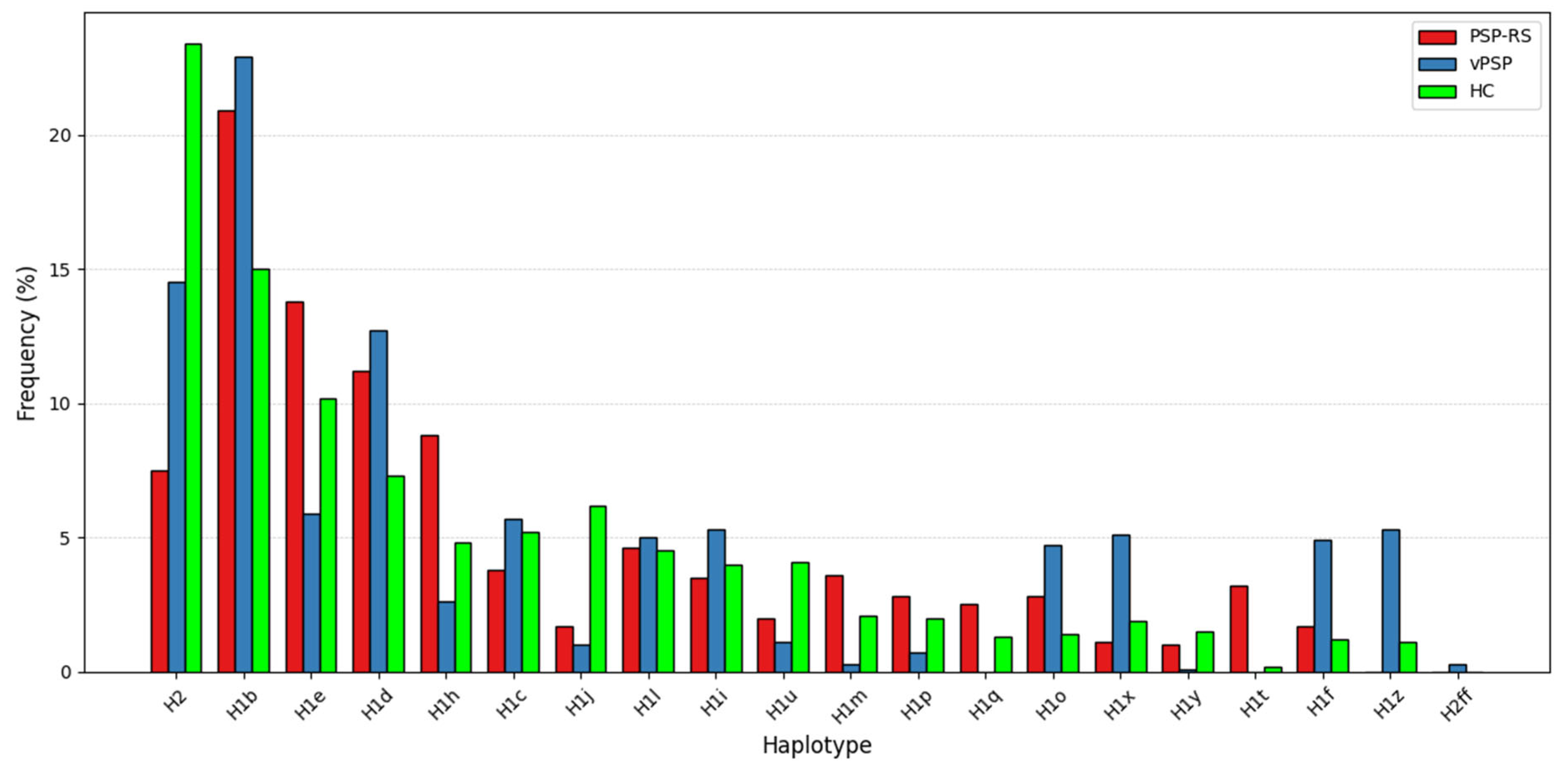
3.4. Haplotype-Based Genetic Stratification of PSP-RS and vPSP
4. Discussion
Supplementary Materials
Author Contributions
Funding
Institutional Review Board Statement
Informed Consent Statement
Data Availability Statement
Conflicts of Interest
Abbreviations
| PSP | Progressive Supranuclear Palsy |
| PSP-RS | Progressive Supranuclear Palsy Richardson syndrome |
| vPSP | Progressive Supranuclear Palsy variants |
| PSP-P | Progressive Supranuclear Palsy with predominant parkinsonism |
| PSP-PGF | Progressive Supranuclear Palsy with progressive gait freezing |
| PSP-CBS | Progressive Supranuclear Palsy with predominant corticobasal syndrome |
| PSP-SL | Progressive Supranuclear Palsy with a predominant speech/language disorder |
| PSP-F | Progressive Supranuclear Palsy with predominant frontal presentation |
| PSP-C | Progressive Supranuclear Palsy with cerebellar ataxia |
| PSP-OM | Progressive Supranuclear Palsy with oculomotor dysfunction |
| NFTs | Neurofibrillary tangles |
| TA | Tufted astrocytes |
| CB | Oligodendroglial coiled bodies |
| NT | Neuropil threads |
| NTR | N-terminal region |
| PRR | Proline-rich domain |
| MTBD | Microtubule-binding domain |
| LD | Linkage disequilibrium |
| HC | Healthy control |
| r2 | Squared correlation coefficient |
| EM | Expectation-Maximization algorithm |
| ORs | Odds ratios |
| CI | Confidence intervals |
| HWE | Hardy–Weinberg equilibrium |
References
- Schrag, A.; Ben-Shlomo, Y.; Quinn, N.P. Prevalence of progressive supranuclear palsy and multiple system atrophy: A cross-sectional study. Lancet 1999, 354, 1771–1775. [Google Scholar] [CrossRef] [PubMed]
- Höglinger, G.U.; Respondek, G.; Stamelou, M.; Kurz, C.; Josephs, K.A.; Lang, A.E.; Mollenhauer, B.; Müller, U.; Nilsson, C.; Whitwell, J.L.; et al. Clinical diagnosis of progressive supranuclear palsy: The movement disorder society criteria. Mov. Disord. 2017, 32, 853–864. [Google Scholar] [CrossRef] [PubMed]
- Boxer, A.L.; Yu, J.-T.; Golbe, L.I.; Litvan, I.; Lang, A.E.; Höglinger, G.U. Advances in progressive supranuclear palsy: New diagnostic criteria, biomarkers, and therapeutic approaches. Lancet Neurol. 2017, 16, 552–563. [Google Scholar] [CrossRef] [PubMed]
- Stamelou, M. Sensitivity and specificity of diagnostic criteria for progressive supranuclear palsy. Mov. Disord. 2019, 34, 1087–1088. [Google Scholar] [CrossRef]
- Barbier, P.; Zejneli, O.; Martinho, M.; Lasorsa, A.; Belle, V.; Smet-Nocca, C.; Tsvetkov, P.O.; Devred, F.; Landrieu, I. Role of Tau as a Microtubule-Associated Protein: Structural and Functional Aspects. Front. Aging Neurosci. 2019, 11, 204. [Google Scholar] [CrossRef]
- Corsi, A.; Bombieri, C.; Valenti, M.T.; Romanelli, M.G. Tau Isoforms: Gaining Insight into MAPT Alternative Splicing. Int. J. Mol. Sci. 2022, 23, 15383. [Google Scholar] [CrossRef]
- Wen, Y.; Zhou, Y.; Jiao, B.; Shen, L. Genetics of Progressive Supranuclear Palsy: A Review. J. Park. Dis. 2021, 11, 93–105. [Google Scholar] [CrossRef]
- Vaquer-Alicea, J.; Diamond, M.I.; Joachimiak, L.A. Tau strains shape disease. Acta Neuropathol. 2021, 142, 57–71. [Google Scholar] [CrossRef]
- Zhong, Q.; Congdon, E.E.; Nagaraja, H.N.; Kuret, J. Tau isoform composition influences rate and extent of filament formation. J. Biol. Chem. 2012, 287, 20711–20719. [Google Scholar] [CrossRef]
- Schoch, K.M.; DeVos, S.L.; Miller, R.L.; Chun, S.J.; ∙Norrbom, M.; Wozniak, D.F.; ∙Dawson, H.N.; Bennett, C.F.; Rigo, F.; Miller, T.M. Increased 4R-Tau Induces Pathological Changes in a Human-Tau Mouse Model. Neuron 2016, 90, 941–947. [Google Scholar] [CrossRef]
- Stefansson, H.; Helgason, A.; Thorleifsson, G.; Steinthorsdottir, V.; Masson, G.; Barnard, J.; Baker, A.; Jonasdottir, A.; Ingason, A.; Gudnadottir, V.G.; et al. A common inversion under selection in Europeans. Nat. Genet. 2005, 37, 129–137. [Google Scholar] [CrossRef] [PubMed]
- Evans, W.; Fung, H.C.; Steele, J.; Eerola, J.; Tienari, P.; Pittman, A.; de Silva, R.; Myers, A.; Vrieze, F.W.-D.; Singleton, A.; et al. The tau H2 haplotype is almost exclusively Caucasian in origin. Neurosci. Lett. 2004, 369, 183–185. [Google Scholar] [CrossRef]
- Baker, M.; Litvan, I.; Houlden, H.; Adamson, J.; Dickson, D.; Perez-Tur, J.; Hardy, J.; Lynch, T.; Bigio, E.; Hutton, M. Association of an extended haplotype in the tau gene with progressive supranuclear palsy. Hum. Mol. Genet. 1999, 8, 711–715. [Google Scholar] [CrossRef] [PubMed]
- Pittman, A.M.; Myers, A.J.; Abou-Sleiman, P.; Fung, H.C.; Kaleem, M.; Marlowe, L.; Duckworth, J.; Leung, D.; Williams, D.; Kilford, L.; et al. Linkage disequilibrium fine mapping and haplotype association analysis of the tau gene in progressive supranuclear palsy and corticobasal degeneration. J. Med. Genet. 2005, 42, 837–846. [Google Scholar] [CrossRef] [PubMed]
- Pittman, A.M.; Myers, A.J.; Duckworth, J.; Bryden, L.; Hanson, M.; Abou-Sleiman, P.; Wood, N.W.; Hardy, J.; Lees, A.; de Silva, R.; et al. The structure of the tau haplotype in controls and in progressive supranuclear palsy. Hum. Mol. Genet. 2004, 13, 1267–1274. [Google Scholar] [CrossRef][Green Version]
- Myers, A.J.; Pittman, A.M.; Zhao, A.S.; Rohrer, K.; Kaleem, M.; Marlowe, L.; Lees, A.; Leung, D.; McKeith, I.G.; Perry, R.H.; et al. The MAPT H1c risk haplotype is associated with increased expression of tau and especially of 4 repeat containing transcripts. Neurobiol. Dis. 2007, 25, 561–570. [Google Scholar] [CrossRef]
- Boettger, L.M.; Handsaker, R.E.; Zody, M.C.; McCarroll, S.A. Structural haplotypes and recent evolution of the human 17q21.31 region. Nat. Genet. 2012, 44, 881–885. [Google Scholar] [CrossRef]
- Heckman, M.G.; Brennan, R.R.; Labbé, C.; Soto, A.I.; Koga, S.; DeTure, M.A.; Murray, M.E.; Petersen, R.C.; Boeve, B.F.; van Gerpen, J.A.; et al. Association of MAPT Subhaplotypes with Risk of Progressive Supranuclear Palsy and Severity of Tau Pathology. JAMA Neurol. 2019, 76, 710–717. [Google Scholar] [CrossRef]
- Pastor, P.; Ezquerra, M.; Perez, J.C.; Chakraverty, S.; Norton, J.; Racette, B.A.; McKeel, D.; Perlmutter, J.S.; Tolosa, E.; Goate, A.M. Novel haplotypes in 17q21 are associated with progressive supranuclear palsy. Ann. Neurol. 2004, 56, 249–258. [Google Scholar] [CrossRef]
- Zhang, C.-C.; Zhu, J.-X.; Wan, Y.; Tan, L.; Wang, H.-F.; Yu, J.-T.; Tan, L. Meta-analysis of the association between variants in MAPT and neurodegenerative diseases. Oncotarget 2017, 8, 44994–45007. [Google Scholar] [CrossRef]
- Pedicone, C.; Weitzman, S.A.; Renton, A.E.; Goate, A.M. Unraveling the complex role of MAPT-containing H1 and H2 haplotypes in neurodegenerative diseases. Mol. Neurodegener. 2024, 19, 43. [Google Scholar] [CrossRef] [PubMed]
- Chen, J.; Yu, J.-T.; Wojta, K.; Wang, H.-F.; Zetterberg, H.; Blennow, K.; Yokoyama, J.S.; Weiner, M.W.; Kramer, J.H.; Rosen, H.; et al. Genome-wide association study identifies MAPT locus influencing human plasma tau levels. Neurology 2017, 88, 669–676. [Google Scholar] [CrossRef] [PubMed]
- Peterson, D.; Munger, C.; Crowley, J.; Corcoran, C.; Cruchaga, C.; Goate, A.M.; Norton, M.C.; Green, R.C.; Munger, R.G.; Breitner, J.C.S.; et al. Variants in PPP3R1 and MAPT are associated with more rapid functional decline in Alzheimer’s disease: The Cache County Dementia Progression Study. Alzheimers Dement. 2014, 10, 366–371. [Google Scholar] [CrossRef] [PubMed]
- Wang, S.; Luo, G.; Ding, X.; Sun, G.; Zhang, M.; Dong, J.; Xu, H.; Lu, J.; Li, Z.; Ning, B.; et al. A comprehensive analysis of MAPT-related genetic risk in Alzheimer’s disease. IBRO Neurosci. Rep. 2025, 18, 300–305. [Google Scholar] [CrossRef]
- Wang, X.; Campbell, M.R.; Lacher, S.E.; Cho, H.-Y.; Wan, M.; Crowl, C.L.; Chorley, B.N.; Bond, G.L.; Kleeberger, S.R.; Slattery, M.; et al. A polymorphic antioxidant response element links NRF2/sMAF binding to enhanced MAPT expression and reduced risk of Parkinsonian disorders. Cell Rep. 2016, 15, 830–842. [Google Scholar] [CrossRef]
- Leko, M.B.; Popovački, E.Š.; Willumsen, N.; Perković, M.N.; Pleić, N.; Zubčić, K.; Horvat, L.L.; Vogrinc, Ž.; Boban, M.; Borovečki, F.; et al. Further validation of the association between MAPT haplotype-tagging polymorphisms and Alzheimer’s disease: Neuropsychological tests, cerebrospinal fluid biomarkers, and APOE genotype. Front. Mol. Neurosci. 2024, 17, 1456670. [Google Scholar] [CrossRef]
- Majounie, E.; Cross, W.; Newsway, V.; Dillman, A.; Vandrovcova, J.; Morris, C.M.; Nalls, M.A.; Ferrucci, L.; Owen, M.J.; O’Donovan, M.C.; et al. Variation in tau isoform expression in different brain regions and disease states. Neurobiol. Aging 2013, 34, 1922.e7–1922.e12. [Google Scholar] [CrossRef]
- Höglinger, G.U.; Melhem, N.M.; Dickson, D.W.; Sleiman, P.M.A.; Wang, L.-S.; Klei, L.; Rademakers, R.; de Silva, R.; Litvan, I.; Riley, D.E.; et al. Identification of common variants influencing risk of the tauopathy progressive supranuclear palsy. Nat. Genet. 2011, 43, 699–705. [Google Scholar] [CrossRef]
- de Silva, R.; Weiler, M.; Morris, H.R.; Martin, E.R.; Wood, N.W.; Lees, A.J. Strong association of a novel Tau promoter haplotype in progressive supranuclear palsy. Neurosci. Lett. 2001, 311, 145–148. [Google Scholar] [CrossRef]
- Rademakers, R.; Melquist, S.; Cruts, M.; Theuns, J.; Del-Favero, J.; Poorkaj, P.; Baker, M.; Sleegers, K.; Crook, R.; De Pooter, T.; et al. High-density SNP haplotyping suggests altered regulation of tau gene expression in progressive supranuclear palsy. Hum. Mol. Genet. 2005, 14, 3281–3292. [Google Scholar] [CrossRef]
- Valentino, R.R.; Scotton, W.J.; Roemer, S.F.; Lashley, T.; Heckman, M.G.; Shoai, M.; Martinez-Carrasco, A.; Tamvaka, N.; Walton, R.L.; Baker, M.C.; et al. MAPT H2 haplotype and risk of Pick’s disease in the Pick’s disease International Consortium: A genetic association study. Lancet Neurol. 2024, 23, 487–499. [Google Scholar] [CrossRef]
- Leko, M.B.; Willumsen, N.; Perković, M.N.; Klepac, N.; Borovečki, F.; Hof, P.R.; Sonicki, Z.; Pivac, N.; de Silva, R.; Šimić, G. Association of MAPT haplotype-tagging polymorphisms with cerebrospinal fluid biomarkers of Alzheimer’s disease: A preliminary study in a Croatian cohort. Brain Behav. 2018, 8, e01128. [Google Scholar] [CrossRef]


| PSP | HC | |
|---|---|---|
| Mean Age, Range | 69.90 ± 6.97 | 72.85 ± 7.32 |
| Sex, No. (%) | ||
| Female | 25 (34.25) | 53 (56.99) |
| Male | 48 (65.75) | 40 (43.01) |
| Haplotype | MAPT Variant | |||||
|---|---|---|---|---|---|---|
| rs1467967 | rs242557 | rs3785883 | rs2471738 | rs8070723 | rs7521 | |
| H1b | G | G | G | C | A | A |
| H2 | A | G | G | C | G | G |
| H1e | A | G | G | C | A | A |
| H1d | A | A | G | C | A | A |
| H1h | A | G | A | C | A | A |
| H1c | A | A | G | T | A | G |
| H1l | A | G | A | C | A | G |
| H1j | A | G | G | C | A | G |
| H1i | G | A | G | C | A | A |
| H1u | A | A | G | C | A | G |
| H1m | G | A | G | C | A | G |
| H1o | A | A | A | C | A | A |
| H1x | G | A | A | T | A | G |
| H1f | G | G | A | C | A | A |
| H1z | G | A | G | T | A | G |
| H1p | G | G | G | T | A | G |
| H1q | A | A | G | T | A | A |
| H1y [32] | G | A | A | C | A | G |
| H1t | A | G | A | T | A | G |
| rs1467967 | rs242557 | |||||||||||
| Sample | A | G | A/A | A/G | G/G | HWE p-Value | G | A | G/G | G/A | A/A | HWE p-Value |
| HC | 69.9% | 30.1% | 51.6% | 36.6% | 11.8% | 0.205 | 68.8% | 31.2% | 47.3% | 43.0% | 9.7% | 1.000 |
| PSP | 58.9% | 41.1% | 32.9% | 52.1% | 15.1% | 0.520 | 64.4% | 35.6% | 41.1% | 46.6% | 12.3% | 0.893 |
| rs3785883 | rs2471738 | |||||||||||
| Sample | A | G | A/A | A/G | G/G | HWE p-Value | C | T | C/C | C/T | T/T | HWE p-Value |
| HC | 16.1% | 83.9% | 1.1% | 30.1% | 68.8% | 0.277 | 87.6% | 12.4% | 76.4% | 22.6% | 1.1% | 0.686 |
| PSP | 24.0% | 76.0% | 6.8% | 34.2% | 58.9% | 0.605 | 83.6% | 16.4% | 68.5% | 30.1% | 1.4% | 0.407 |
| rs8070723 | rs7521 | |||||||||||
| Sample | A | G | A/A | A/G | G/G | HWE p-value | A | G | A/A | A/G | G/G | HWE p-Value |
| HC | 75.3% | 24.7% | 58.1% | 34.4% | 7.5% | 0.465 | 45.2% | 54.8% | 20.4% | 49.5% | 30.1% | 1.000 |
| PSP | 89.0% | 11.0% | 80.8% | 16.4% | 2.7% | 0.178 | 63.7% | 36.3% | 41.1% | 45.5% | 13.7% | 0.605 |
| SNP1 | SNP2 | HC | PSP | ||
|---|---|---|---|---|---|
| D’ | r2 | D’ | r2 | ||
| rs1467967 | rs242557 | 0.102 | 0.01 | 0.116 | 0.005 |
| rs1467967 | rs3785883 | 0.127 | 0.01 | 0.352 | 0.027 |
| rs1467967 | rs2471738 | 0.183 | 0.011 | 0.249 | 0.017 |
| rs1467967 | rs8070723 | 1.0 | 0.142 | 0.783 | 0.053 |
| rs1467967 | rs7521 | 0.516 | 0.139 | 0.182 | 0.013 |
| rs242557 | rs3785883 | 0.154 | 0.01 | 0.203 | 0.007 |
| rs242557 | rs2471738 | 0.661 | 0.136 | 0.563 | 0.113 |
| rs242557 | rs8070723 | 0.783 | 0.091 | 1.0 | 0.068 |
| rs242557 | rs7521 | 0.14 | 0.011 | 0.032 | 0.001 |
| rs3785883 | rs2471738 | 0.154 | 0.017 | 0.094 | 0.006 |
| rs3785883 | rs8070723 | 1.0 | 0.063 | 1.0 | 0.039 |
| rs3785883 | rs7521 | 0.053 | 0.001 | 0.189 | 0.02 |
| rs2471738 | rs8070723 | 1.0 | 0.046 | 1.0 | 0.024 |
| rs2471738 | rs7521 | 0.78 | 0.071 | 0.829 | 0.237 |
| rs8070723 | rs7521 | 1.0 | 0.271 | 0.87 | 0.163 |
| Allele Frequency (%) in rs8070723 | |||||
|---|---|---|---|---|---|
| Allele | Patients with PSP (n = 73) | Controls (n = 93) | OR (95% CI) | OR Power | p-Value |
| A | 89.0 | 75.3 | 2.620 [1.399–5.140] | 0.90 | 0.0035 |
| G | 11.0 | 24.7 | 0.382 [0.195–0.715] | 0.92 | 0.0035 |
| PSP-RS Subtype (n = 46) | Controls(n = 93) | OR (95% CI) | OR Power | p-Value | |
| A | 91.3 | 75.3 | 4.004 [1.798–10.237] | 0.95 | 0.0015 |
| G | 8.7 | 24.7 | 0.250 [0.098–0.556] | 0.95 | 0.0015 |
| vPSP Subtype (n = 27) | Controls(n = 93) | OR (95% CI) | OR Power | p-Value | |
| A | 85.2 | 75.3 | 1.516 [0.649–3.871] | 0.49 | 0.3558 |
| G | 14.8 | 24.7 | 0.660 [0.258–1.541] | 0.49 | 0.3558 |
| Haplotype Frequency (%) | |||||
|---|---|---|---|---|---|
| Haplotype | Patients with PSP (n = 73) | Controls (n = 93) | OR (95% CI) | OR Power | p-Value |
| H1b | 21.9 | 15.0 | 1.584 [0.903–2.777] | 0.36 | 0.1156 |
| H2 * | 10.1 | 23.4 | 0.370 [0.196–0.695] | 0.90 | 0.0015 |
| H1e | 10.9 | 10.2 | 1.082 [0.535–2.186] | 0.04 | 0.8585 |
| H1d | 12.2 | 7.3 | 1.728 [0.828–3.603] | 0.31 | 0.1891 |
| H1h | 6.4 | 4.8 | 1.292 [0.499–3.342] | 0.08 | 0.6318 |
| H1c | 4.4 | 5.2 | 0.754 [0.268–2.126] | 0.08 | 0.7972 |
| H1l | 4.8 | 4.5 | 1.121 [0.397–3.165] | 0.04 | 1.000 |
| H1j ** | 1.3 | 6.2 | 0.201 [0.044–0.915] | 0.67 | 0.0265 |
| H1i | 3.5 | 4.0 | 0.907 [0.282–2.918] | 0.04 | 1.000 |
| H1u | 1.6 | 4.1 | 0.309 [0.065–1.478] | 0.36 | 0.1951 |
| H1m | 2.7 | 2.1 | 1.282 [0.315–5.214] | 0.05 | 0.7345 |
| H1o | 3.5 | 1.4 | 2.163 [0.508–9.204] | 0.18 | 0.3068 |
| H1x | 2.5 | 1.9 | 1.282 [0.315–5.214] | 0.05 | 0.7345 |
| H1f | 3.0 | 1.2 | 2.592 [0.468–14.349] | 0.20 | 0.4108 |
| H1z | 2.9 | 1.1 | 2.592 [0.468–14.349] | 0.20 | 0.4108 |
| H1p | 1.8 | 2.0 | 0.955 [0.210–4.333] | 0.03 | 1.000 |
| H1q | 1.7 | 1.3 | 1.278 [0.178–9.181] | 0.04 | 1.000 |
| H1y [32] | 0.6 | 1.5 | 0.421 [0.043–4.087] | 0.12 | 0.6337 |
| H1t ** | 2.0 | 0.2 | 3.881 [0.466–37.705] | 0.39 | 0.0377 |
| Haplotype Frequency (%) | |||||
|---|---|---|---|---|---|
| Haplotype | Patients with PSP-RS (n = 46) | Controls (n = 93) | OR (95% CI) | OR Power | p-Value |
| H2 * | 7.5 | 23.3 | 0.274 [0.118–0.636] | 0.95 | 0.0014 |
| H1b | 20.9 | 15.0 | 1.469 [0.770–2.800] | 0.23 | 0.2400 |
| H1e | 13.8 | 10.1 | 1.446 [0.680–3.076] | 0.17 | 0.4244 |
| H1d | 11.2 | 7.2 | 1.623 [0.683–3.855] | 0.20 | 0.3543 |
| H1h | 8.8 | 5.2 | 1.676 [0.638–4.401] | 0.19 | 0.3073 |
| H1c | 3.8 | 5.2 | 0.593 [0.159–2.210] | 0.14 | 0.5548 |
| H1j | 1.7 | 6.2 | 0.322 [0.071–1.471] | 0.42 | 0.1535 |
| H1l | 4.6 | 4.2 | 1.011 [0.296–3.450] | 0.03 | 1.000 |
| H1i | 3.5 | 4.1 | 0.750 [0.194–2.896] | 0.07 | 1.000 |
| H1u | 2.0 | 4.1 | 0.494 [0.103–2.377] | 0.17 | 0.5050 |
| H1m | 3.6 | 2.1 | 1.534 [0.336–7.000] | 0.08 | 0.6882 |
| H1p | 2.8 | 2.0 | 1.534 [0.336–7.000] | 0.08 | 0.6882 |
| H1q | 2.5 | 1.4 | 1.356 [0.223–8.257] | 0.05 | 0.6672 |
| H1o | 2.8 | 1.2 | 3.101 [0.509–18.89] | 0.24 | 0.3362 |
| H1x | 1.1 | 1.9 | 0.500 [0.055–4.538] | 0.10 | 1.000 |
| H1y [32] | 1.0 | 1.7 | 0.670 [0.069–6.535] | 0.06 | 1.000 |
| H1t | 3.2 | 0.3 | 6.236 [0.640–60.80] | 0.38 | 0.1074 |
| H1f | 1.7 | 0.9 | 2.044 [0.283–14.75] | 0.11 | 0.6014 |
| Haplotype Frequency (%) | |||||
|---|---|---|---|---|---|
| Haplotype | Patients with vPSP (n = 27) | Controls (n = 93) | OR (95% CI) | OR Power | p-Value |
| H2 | 14.5 | 23.4 | 0.561 [0.246–1.279] | 0.41 | 0.1922 |
| H1b | 22.9 | 14.9 | 1.612 [0.756–3.437] | 0.30 | 0.2183 |
| H1e | 5.9 | 10.5 | 0.488 [0.139–1.710] | 0.31 | 0.3058 |
| H1d | 12.7 | 7.0 | 1.982 [0.749–5.248] | 0.34 | 0.1686 |
| H1c | 5.7 | 5.5 | 1.035 [0.275–3.904] | 0.03 | 1.000 |
| H1j | 1.0 | 6.3 | 0.274 [0.035–2.153] | 0.43 | 0.3076 |
| H1l | 5.0 | 4.6 | 1.157 [0.302–4.433] | 0.04 | 0.7350 |
| H1i | 5.3 | 4.3 | 1.309 [0.335–5.114] | 0.07 | 0.7143 |
| H1h | 2.6 | 4.4 | 0.420 [0.051–3.433] | 0.19 | 0.6881 |
| H1u | 1.1 | 4.0 | 0.482 [0.058–4.010] | 0.14 | 0.6874 |
| H1x | 5.1 | 2.0 | 2.676 [0.580–12.35] | 0.28 | 0.1909 |
| H1o | 4.7 | 1.5 | 3.588 [0.703–18.32] | 0.37 | 0.1293 |
| H1f | 4.9 | 1.3 | 5.412 [0.880–33.26] | 0.49 | 0.0768 |
| H1z | 5.3 | 1.0 | 5.412 [0.880–33.26] | 0.49 | 0.0768 |
| H1p | 0.7 | 1.9 | 0.372 [0.020–7.019] | 0.14 | 0.5773 |
| H1m | 0.3 | 1.8 | 0.481 [0.024–9.456] | 0.09 | 0.5778 |
| H1y [32] | 0.1 | 1.5 | 0.481 [0.024–9.456] | 0.09 | 0.5778 |
| H2ff | 0.3 | 1.3 | 0.677 [0.032–14.32] | 0.05 | 1.000 |
Disclaimer/Publisher’s Note: The statements, opinions and data contained in all publications are solely those of the individual author(s) and contributor(s) and not of MDPI and/or the editor(s). MDPI and/or the editor(s) disclaim responsibility for any injury to people or property resulting from any ideas, methods, instructions or products referred to in the content. |
© 2025 by the authors. Licensee MDPI, Basel, Switzerland. This article is an open access article distributed under the terms and conditions of the Creative Commons Attribution (CC BY) license (https://creativecommons.org/licenses/by/4.0/).
Share and Cite
Gagliardi, M.; Procopio, R.; Felicetti, A.; Annesi, G.; Talarico, M.; Vescio, B.; Quattrone, A.; Quattrone, A. MAPT Subhaplotypes in Different Progressive Supranuclear Palsy Phenotypes. Biomedicines 2025, 13, 1405. https://doi.org/10.3390/biomedicines13061405
Gagliardi M, Procopio R, Felicetti A, Annesi G, Talarico M, Vescio B, Quattrone A, Quattrone A. MAPT Subhaplotypes in Different Progressive Supranuclear Palsy Phenotypes. Biomedicines. 2025; 13(6):1405. https://doi.org/10.3390/biomedicines13061405
Chicago/Turabian StyleGagliardi, Monica, Radha Procopio, Alessia Felicetti, Grazia Annesi, Mariagrazia Talarico, Basilio Vescio, Aldo Quattrone, and Andrea Quattrone. 2025. "MAPT Subhaplotypes in Different Progressive Supranuclear Palsy Phenotypes" Biomedicines 13, no. 6: 1405. https://doi.org/10.3390/biomedicines13061405
APA StyleGagliardi, M., Procopio, R., Felicetti, A., Annesi, G., Talarico, M., Vescio, B., Quattrone, A., & Quattrone, A. (2025). MAPT Subhaplotypes in Different Progressive Supranuclear Palsy Phenotypes. Biomedicines, 13(6), 1405. https://doi.org/10.3390/biomedicines13061405