


Non-Integrating Lentiviral Vectors in Clinical Applications: A Glance Through
 , , ,
, , , 
Abstract
1. Introduction
2. Lentiviral Vector Biology
3. Non-Integrating Lentiviral Vector (NILV) Design
3.1. Comparisons of NILVs with Other Non-Integrating Methods
3.2. Limitations of NILVs and Possible Solutions
4. Clinical Application of NILVs
4.1. Vaccination
4.2. Cell-Type Differentiation
4.3. Site-Directed Integration
4.4. Gene Therapy
5. Future Directions and Challenges
Author Contributions
Funding
Institutional Review Board Statement
Informed Consent Statement
Data Availability Statement
Acknowledgments
Conflicts of Interest
References
- Delviks-Frankenberry, K.A.; Ackerman, D.; Timberlake, N.D.; Hamscher, M.; Nikolaitchik, O.A.; Hu, W.-S.; Torbett, B.E.; Pathak, V.K. Development of Lentiviral Vectors for HIV-1 Gene Therapy with Vif-Resistant APOBEC3G. Mol. Ther.-Nucleic Acids 2019, 18, 1023–1038. [Google Scholar] [CrossRef]
- Milone, M.C.; O’Doherty, U. Clinical use of lentiviral vectors. Leukemia 2018, 32, 1529–1541. [Google Scholar] [CrossRef] [PubMed]
- Gama-Norton, L.; Botezatu, L.; Herrmann, S.; Schweizer, M.; Alves, P.; Hauser, H.; Wirth, D. Lentivirus Production Is Influenced by SV40 Large T-Antigen and Chromosomal Integration of the Vector in HEK293 Cells. Hum. Gene Ther. 2011, 22, 1269–1279. [Google Scholar] [CrossRef] [PubMed]
- Merten, O.-W.; Hebben, M.; Bovolenta, C. Production of lentiviral vectors. Mol. Ther.-Methods Clin. Dev. 2016, 3, 16017. [Google Scholar] [CrossRef]
- Rothe, M.; Modlich, U.; Schambach, A. Biosafety challenges for use of lentiviral vectors in gene therapy. Curr. Gene Ther. 2014, 13, 453–468. [Google Scholar] [CrossRef] [PubMed]
- Schlimgen, R.; Howard, J.; Wooley, D.; Thompson, M.; Baden, L.R.; Yang, O.O.; Christiani, D.C.; Mostoslavsky, G.; Diamond, D.V.; Duane, E.G.; et al. Risks Associated with Lentiviral Vector Exposures and Prevention Strategies. J. Occup. Environ. Med. 2016, 58, 1159–1166. [Google Scholar] [CrossRef] [PubMed]
- Themis, M.; Waddington, S.N.; Schmidt, M.; von Kalle, C.; Wang, Y.; Al-Allaf, F.; Gregory, L.G.; Nivsarkar, M.; Themis, M.; Holder, M.V.; et al. Oncogenesis Following Delivery of a Nonprimate Lentiviral Gene Therapy Vector to Fetal and Neonatal Mice. Mol. Ther. 2005, 12, 763–771. [Google Scholar] [CrossRef] [PubMed]
- Engelman, A.; Englund, G.; Orenstein, J.M.; Martin, A.M.; Craigie, R. Multiple effects of mutations in human immunodeficiency virus type 1 integrase on viral replication. J. Virol. 1995, 69, 2729–2736. [Google Scholar] [CrossRef]
- Shaw, A.; Cornetta, K. Design and potential of non-integrating lentiviral vectors. Biomedicines 2014, 2, 14–35. [Google Scholar] [CrossRef]
- Luis, A. The old and the new: Prospects for non-integrating lentiviral vector technology. Viruses 2020, 12, 1103. [Google Scholar]
- Nordin, F.; Hamid, Z.A.; Chan, L.; Farzaneh, F.; Hamid, M.K.A.A. Transient Expression of Green Fluorescent Protein in Integrase-Defective Lentiviral Vector-Transduced 293T Cell Line. In Methods in Molecular Biology; Humana Press: New York, NY, USA, 2016; Volume 1448, pp. 159–173. Available online: https://pubmed.ncbi.nlm.nih.gov/27317180/ (accessed on 19 February 2021).
- Zynteglo|European Medicines Agency. Available online: https://www.ema.europa.eu/en/medicines/human/EPAR/zynteglo#overview-section (accessed on 6 December 2021).
- Zufferey, R.; Dull, T.; Mandel, R.J.; Bukovsky, A.; Quiroz, D.; Naldini, L.; Trono, D. Self-Inactivating Lentivirus Vector for Safe and Efficient In Vivo Gene Delivery. J. Virol. 1998, 72, 9873–9880. [Google Scholar] [CrossRef] [PubMed]
- Wu, X.; Wakefield, J.K.; Liu, H.; Xiao, H.; Kralovics, R.; Prchal, J.T.; Kappes, J.C. Development of a Novel Trans-Lentiviral Vector That Affords Predictable Safety. Mol. Ther. 2000, 2, 47–55. [Google Scholar] [CrossRef] [PubMed]
- Dull, T.; Zufferey, R.; Kelly, M.; Mandel, R.J.; Nguyen, M.; Trono, D.; Naldini, L. A Third-Generation Lentivirus Vector with a Conditional Packaging System. J. Virol. 1998, 72, 8463–8471. [Google Scholar] [CrossRef] [PubMed]
- Cornetta, K.; Yao, J.; Jasti, A.; Koop, S.; Douglas, M.; Hsu, D.; Couture, A.L.; Hawkins, T.; Duffy, L. Replication-competent Lentivirus Analysis of Clinical Grade Vector Products. Mol. Ther. 2011, 19, 557–566. [Google Scholar] [CrossRef]
- Cornetta, K.; Duffy, L.; Turtle, C.J.; Jensen, M.; Forman, S.; Binder-Scholl, G.; Fry, T.; Chew, A.; Maloney, D.G.; June, C.H. Absence of Replication-Competent Lentivirus in the Clinic: Analysis of Infused T Cell Products. Mol. Ther. 2018, 26, 280–288. [Google Scholar] [CrossRef] [PubMed]
- Craigie, R.; Fujiwara, T.; Bushman, F. The IN protein of Moloney murine leukemia virus processes the viral DNA ends and accomplishes their integration in vitro. Cell 1990, 62, 829–837. [Google Scholar] [CrossRef]
- Katz, R.A.; Merkel, G.; Kulkosky, J.; Leis, J.; Skalka, A.M. The avian retroviral IN protein is both necessary and sufficient for integrative recombination in vitro. Cell 1990, 63, 87–95. [Google Scholar] [CrossRef]
- Apolonia, L.; Waddington, S.; Fernandes, C.; Ward, N.J.; Bouma, G.; Blundell, M.; Thrasher, A.J.; Collins, M.K.; Philpott, N.J. Stable Gene Transfer to Muscle Using Non-integrating Lentiviral Vectors. Mol. Ther. 2007, 15, 1947–1954. [Google Scholar] [CrossRef] [PubMed]
- Cornu, I.; Cathomen, T. Targeted Genome Modifications Using Integrase-deficient Lentiviral Vectors. Mol. Ther. 2007, 15, 2107–2113. [Google Scholar] [CrossRef] [PubMed]
- Yáñez-Muñoz, R.J.; Balaggan, K.S.; MacNeil, A.; Howe, S.J.; Schmidt, M.; Smith, A.J.; Buch, P.; MacLaren, R.; Anderson, P.N.; Barker, E.S.; et al. Effective gene therapy with nonintegrating lentiviral vectors. Nat. Med. 2006, 12, 348–353. [Google Scholar] [CrossRef]
- Negri, D.; Michelini, Z.; Baroncelli, S.; Spada, M.; Vendetti, S.; Buffa, V.; Bona, R.; Leone, P.; Klotman, E.M.; Cara, A. Successful Immunization with a Single Injection of Non-integrating Lentiviral Vector. Mol. Ther. 2007, 15, 1716–1723. [Google Scholar] [CrossRef] [PubMed]
- Vargas, J., Jr.; Gusella, G.L.; Najfeld, V.; Klotman, M.E.; Cara, A. Novel Integrase-Defective Lentiviral Episomal Vectors for Gene Transfer. Hum. Gene Ther. 2004, 15, 361–372. [Google Scholar] [CrossRef] [PubMed]
- Banasik, M.B.; McCray, P.B. Integrase-defective lentiviral vectors: Progress and applications. Gene Ther. 2010, 17, 150–157. [Google Scholar] [CrossRef] [PubMed]
- Goubin, G.; Hill, M. Monomer and multimer covalently closed circular forms of Rous sarcoma virus DNA. J. Virol. 1979, 29, 799–804. [Google Scholar] [CrossRef]
- Engelman, A.; Craigie, R. Identification of conserved amino acid residues critical for human immunodeficiency virus type 1 integrase function in vitro. J. Virol. 1992, 66, 6361–6369. [Google Scholar] [CrossRef] [PubMed]
- Shibagaki, Y.H.; Chow, S.A. Central Core Domain of Retroviral Integrase Is Responsible for Target Site Selection. J. Biol. Chem. 1997, 272, 8361–8369. [Google Scholar] [CrossRef] [PubMed]
- Leavitt, A.D.; Robles, G.; Alesandro, N.; Varmus, E.H. Human immunodeficiency virus type 1 integrase mutants retain in vitro integrase activity yet fail to integrate viral DNA efficiently during infection. J. Virol. 1996, 70, 721–728. [Google Scholar] [CrossRef] [PubMed]
- Nightingale, S.J.; Hollis, R.P.; Pepper, K.A.; Petersen, D.; Yu, X.J.; Yang, C.; Bahner, I.; Kohn, D.B. Transient Gene Expression by Nonintegrating Lentiviral Vectors. Mol. Ther. 2006, 13, 1121–1132. [Google Scholar] [CrossRef]
- Nishimura, K.; Sano, M.; Ohtaka, M.; Furuta, B.; Umemura, Y.; Nakajima, Y.; Ikehara, Y.; Kobayashi, T.; Segawa, H.; Takayasu, S.; et al. Development of Defective and Persistent Sendai Virus Vector: A Unique gene delivery/expression system ideal for cell reprogramming. J. Biol. Chem. 2011, 286, 4760. [Google Scholar] [CrossRef] [PubMed]
- Sano, M.; Nakasu, A.; Ohtaka, M.; Nakanishi, M. A Sendai Virus-Based Cytoplasmic RNA Vector as a Novel Platform for Long-Term Expression of MicroRNAs. Mol. Ther.-Methods Clin. Dev. 2019, 15, 371–382. [Google Scholar] [CrossRef]
- Seki, T.; Yuasa, S.; Fukuda, K. Generation of induced pluripotent stem cells from a small amount of human peripheral blood using a combination of activated T cells and Sendai virus. Nat. Protoc. 2012, 7, 718–728. [Google Scholar] [CrossRef] [PubMed]
- Yamaki, Y.; Fukushima, T.; Yoshida, N.; Nishimura, K.; Fukuda, A.; Hisatake, K.; Aso, M.; Sakasai, T.; Kijima-Tanaka, J.; Miwa, Y.; et al. Utilization of a novel Sendai virus vector in ex vivo gene therapy for hemophilia A. Int. J. Hematol. 2021, 113, 493–499. [Google Scholar] [CrossRef]
- Mardanova, E.S.; Blokhina, E.A.; Tsybalova, L.M.; Peyret, H.; Lomonossoff, G.P.; Ravin, N.V. Efficient Transient Expression of Recombinant Proteins in Plants by the Novel pEff Vector Based on the Genome of Potato Virus X. Front. Plant Sci. 2017, 8, 247. [Google Scholar] [CrossRef] [PubMed]
- Meng, X.; Neises, A.; Su, R.-J.; Payne, K.; Ritter, L.; Gridley, D.S.; Wang, J.; Sheng, M.; Lau, K.-H.; Baylink, D.J.; et al. Efficient Reprogramming of Human Cord Blood CD34+ Cells into Induced Pluripotent Stem Cells with OCT4 and SOX2 Alone. Mol. Ther. 2012, 20, 408–416. [Google Scholar] [CrossRef] [PubMed]
- Yamamoto, T.; Hoshikawa, K.; Ezura, K.; Okazawa, R.; Fujita, S.; Takaoka, M.; Mason, H.S.; Ezura, H.; Miura, K. Improvement of the transient expression system for production of recombinant proteins in plants. Sci. Rep. 2018, 8, 4755. [Google Scholar] [CrossRef] [PubMed]
- Chou, B.K.; Mali, P.; Huang, X.; Ye, Z.; Dowey, S.N.; Resar, L.M.; Zou, C.; Zhang, Y.A.; Tong, J.; Cheng, L. Efficient human iPS cell derivation by a non-integrating plasmid from blood cells with unique epigenetic and gene expression signatures. Cell Res. 2011, 21, 518–529. [Google Scholar] [CrossRef]
- Chen, G.; Gulbranson, D.R.; Hou, Z.; Bolin, J.M.; Ruotti, V.; Probasco, M.D.; Smuga-Otto, K.; Howden, S.E.; Diol, N.R.; Propson, N.E.; et al. Chemically defined conditions for human iPSC derivation and culture. Nat. Methods 2011, 8, 424–429. [Google Scholar] [CrossRef]
- Yu, J.; Chau, K.F.; Vodyanik, M.A.; Jiang, J.; Jiang, Y. Efficient Feeder-Free Episomal Reprogramming with Small Molecules. PLoS ONE 2011, 6, e17557. [Google Scholar] [CrossRef] [PubMed]
- Yu, J.; Hu, K.; Smuga-Otto, K.; Tian, S.; Stewart, R.; Slukvin, I.I.; Thomson, J.A. Human induced pluripotent stem cells free of vector and transgene sequences. Science 2009, 324, 797–801. [Google Scholar] [CrossRef]
- Hu, K.; Yu, J.; Suknuntha, K.; Tian, S.; Montgomery, K.; Choi, K.D.; Stewart, R.; Thomson, J.A.; Slukvin, I.I. Efficient generation of transgene-free induced pluripotent stem cells from normal and neoplastic bone marrow and cord blood mononuclear cells. Blood 2011, 117, e109–e119. [Google Scholar] [CrossRef]
- Marchetto, M.C.N.; Yeo, G.W.; Kainohana, O.; Marsala, M.; Gage, F.H.; Muotri, A.R. Transcriptional Signature and Memory Retention of Human-Induced Pluripotent Stem Cells. PLoS ONE 2009, 4, e7076. [Google Scholar] [CrossRef] [PubMed]
- Sherpa, C.; Le Grice, S.F. Adeno-Associated Viral Vector Mediated Expression of Broadly-Neutralizing Antibodies against HIV-Hitting a Fast-Moving Target. Curr. HIV Res. 2020, 18, 114–131. [Google Scholar] [CrossRef]
- Slon-Campos, J.L.; Poggianella, M.; Zentilin, L.; Burrone, O.R. Use of Adeno-associated viral vectors to improve delivery of a DNA vaccine against dengue virus. J. Gen. Virol. 2020, 101, 73–78. [Google Scholar] [CrossRef]
- Senís, E.; Mosteiro, L.; Wilkening, S.; Wiedtke, E.; Nowrouzi, A.; Afzal, S.; Fronza, R.; Landerer, H.; Abad, M.; Niopek, D.; et al. AAV vector-mediated in vivo reprogramming into pluripotency. Nat. Commun. 2018, 9, 1–14. [Google Scholar] [CrossRef] [PubMed]
- Yusuf, Y.; Yoshii, T.; Iyori, M.; Yoshida, K.; Mizukami, H.; Fukumoto, S.; Yamamoto, D.S.; Alam, A.; Bin Emran, T.; Amelia, F.; et al. Adeno-Associated Virus as an Effective Malaria Booster Vaccine Following Adenovirus Priming. Front. Immunol. 2019, 10, 730. [Google Scholar] [CrossRef] [PubMed]
- Jia, F.; Wilson, K.D.; Sun, N.; Gupta, D.M.; Huang, M.; Li, Z.; Panetta, N.J.; Chen, Z.Y.; Robbins, R.C.; Kay, M.A.; et al. A nonviral minicircle vector for deriving human iPS cells. Nat. Methods 2010, 7, 197–199. [Google Scholar] [CrossRef] [PubMed]
- Gallego, I.; Villate-Beitia, I.; Martínez-Navarrete, G.; Menéndez, M.; López-Méndez, T.; Soto-Sánchez, C.; Zárate, J.; Puras, G.; Fernández, E.; Pedraz, J.L. Non-viral vectors based on cationic niosomes and minicircle DNA technology enhance gene delivery efficiency for biomedical applications in retinal disorders. Nanomed. Nanotechnol. Biol. Med. 2019, 17, 308–318. [Google Scholar] [CrossRef]
- Narsinh, K.H.; Jia, F.; Robbins, R.C.; Kay, M.A.; Longaker, M.T.; Wu, J.C. Generation of adult human induced pluripotent stem cells using nonviral minicircle DNA vectors. Nat. Protoc. 2011, 6, 78–88. [Google Scholar] [CrossRef] [PubMed]
- Schleef, M.; Schirmbeck, R.; Reiser, M.; Michel, M.L.; Schmeer, M. Minicircle: Next Generation DNA Vectors for Vaccination. Methods Mol. Biol. 2015, 1317, 327–339. [Google Scholar] [PubMed]
- Monjezi, R.; Miskey, C.; Gogishvili, T.; Schleef, M.; Schmeer, M.; Einsele, H.; Ivics, Z.; Hudecek, M. Enhanced CAR T-cell engineering using non-viral Sleeping Beauty transposition from minicircle vectors. Leukemia 2017, 31, 186–194. [Google Scholar] [CrossRef]
- Gaspar, V.; Melo-Diogo, D.D.; Costa, E.; Moreira, A.; Queiroz, J.; Pichon, C.; Correia, I.; Sousa, F. Minicircle DNA vectors for gene therapy: Advances and applications. Expert Opin. Biol. Ther. 2015, 15, 353–379. [Google Scholar] [CrossRef] [PubMed]
- Rohani, L.; Fabian, C.; Holland, H.; Naaldijk, Y.; Dressel, R.; Löffler-Wirth, H.; Binder, H.; Arnold, A.; Stolzing, A. Generation of human induced pluripotent stem cells using non-synthetic mRNA. Stem Cell Res. 2016, 16, 662–672. [Google Scholar] [CrossRef] [PubMed]
- Warren, L.; Lin, C. mRNA-Based Genetic Reprogramming. Mol. Ther. J. Am. Soc. Gene Ther. 2019, 27, 729–734. [Google Scholar] [CrossRef]
- Oh, S.; Kessler, J.A. Design, Assembly, Production, and Transfection of Synthetic Modified mRNA. Methods 2018, 133, 29–43. [Google Scholar] [CrossRef] [PubMed]
- Yoshioka, N.; Gros, E.; Li, H.R.; Kumar, S.; Deacon, D.C.; Maron, C.; Muotri, A.R.; Chi, N.C.; Fu, X.-D.; Yu, B.D.; et al. Efficient Generation of Human iPS Cells by a Synthetic Self-Replicative RNA. Cell Stem Cell 2013, 13, 246–254. [Google Scholar] [CrossRef] [PubMed]
- Henry, J.C.; Azevedo-Pouly AC, P.; Schmittgen, T.D. MicroRNA replacement therapy for cancer. Pharm. Res. 2011, 28, 3030–3042. [Google Scholar] [CrossRef]
- Costard, L.S.; Kelly, D.C.; Power, R.N.; Hobbs, C.; Jaskaniec, S.; Nicolosi, V.; Cavanagh, B.L.; Curtin, C.M.; O’Brien, F. Layered Double Hydroxide as a Potent Non-viral Vector for Nucleic Acid Delivery Using Gene-Activated Scaffolds for Tissue Regeneration Applications. Pharmaceutics 2020, 12, 1219. [Google Scholar] [CrossRef] [PubMed]
- Miyoshi, N.; Ishii, H.; Nagano, H.; Haraguchi, N.; Dewi, D.L.; Kano, Y.; Nishikawa, S.; Tanemura, M.; Mimori, K.; Tanaka, F.; et al. Reprogramming of mouse and human cells to pluripotency using mature microRNAs. Cell Stem Cell 2011, 8, 633–638. [Google Scholar] [CrossRef] [PubMed]
- Bian, W.S.; Shi, P.X.; Mi, X.F.; Sun, Y.Y.; Yang, D.D.; Gao, B.F. MiR-210 protects cardiomyocytes from OGD/R injury by inhibiting E2F3. Eur. Rev. Med. Pharmacol. Sci. 2018, 22, 743–749. [Google Scholar] [PubMed]
- Khan, N.; Cheemadan, S.; Saxena, H.; Bammidi, S.; Jayandharan, G.R. MicroRNA-based recombinant AAV vector assembly improves efficiency of suicide gene transfer in a murine model of lymphoma. Cancer Med. 2020, 9, 3188–3201. [Google Scholar] [CrossRef] [PubMed]
- Fusaki, N.; Ban, H.; Nishiyama, A.; Saeki, K.; Hasegawa, M. Efficient induction of transgene-free human pluripotent stem cells using a vector based on Sendai virus, an RNA virus that does not integrate into the host genome. Proc. Jpn. Acad. Ser. B 2009, 85, 348–362. [Google Scholar] [CrossRef] [PubMed]
- Nakanishi, M.; Otsu, M. Development of Sendai Virus Vectors and their Potential Applications in Gene Therapy and Regenerative Medicine. Curr. Gene Ther. 2012, 12, 410. [Google Scholar] [CrossRef] [PubMed]
- Hung, S.C.; Kang, M.-S.; Kieff, E. Maintenance of Epstein–Barr virus (EBV) oriP-based episomes requires EBV-encoded nuclear antigen-1 chromosome-binding domains, which can be replaced by high-mobility group-I or histone H1. Proc. Natl. Acad. Sci. USA 2001, 98, 1865–1870. [Google Scholar] [CrossRef] [PubMed]
- Howard, D.; Powers, K.; Wang, Y.; Harvey, B.K. Tropism and toxicity of adeno-associated viral vector serotypes 1, 2, 5, 6, 7, 8, and 9 in rat neurons and glia in vitro. Virology 2008, 372, 24–34. [Google Scholar] [CrossRef]
- Karra, D.; Dahm, R. Transfection Techniques for Neuronal Cells. J. Neurosci. 2010, 30, 6171–6177. [Google Scholar] [CrossRef] [PubMed]
- Kiyosue, K.; Miwa, Y. Epstein-Barr virus-derived vector suitable for long-term expression in neurons. Heliyon 2020, 6, e03504. [Google Scholar] [CrossRef]
- Xu, Z.; Chen, F.; Zhang, L.; Lu, J.; Xu, P.; Liu, G.; Xie, X.; Mu, W.; Wang, Y.; Liu, D. Non-integrating lentiviral vectors based on the minimal S/MAR sequence retain transgene expression in dividing cells. Sci. China Life Sci. 2016, 59, 1024–1033. [Google Scholar] [CrossRef]
- Schambach, A.; Zychlinski, D.; Ehrnstroem, B.; Baum, C. Biosafety features of lentiviral vectors. Hum. Gene Ther. 2013, 24, 132–142. [Google Scholar] [CrossRef]
- Zhou, S.; Mody, D.; DeRavin, S.S.; Hauer, J.; Lu, T.; Ma, Z.; Abina, S.H.-B.; Gray, J.T.; Greene, M.R.; Cavazzana-Calvo, M.; et al. A self-inactivating lentiviral vector for SCID-X1 gene therapy that does not activate LMO2 expression in human T cells. Blood 2010, 116, 900–908. [Google Scholar] [CrossRef] [PubMed]
- Zychlinski, D.; Schambach, A.; Modlich, U.; Maetzig, T.; Meyer, J.; Grassman, E.; Mishra, A.; Baum, C. Physiological promoters reduce the genotoxic risk of integrating gene vectors. Mol. Ther. 2008, 16, 718–725. [Google Scholar] [CrossRef]
- Bayer, M.; Kantor, B.; Cockrell, A.; Ma, H.; Zeithaml, B.; Li, X.; McCown, T.; Kafri, T. A Large U3 Deletion Causes Increased In Vivo Expression from a Nonintegrating Lentiviral Vector. Mol. Ther. 2008, 16, 1968–1976. [Google Scholar] [CrossRef]
- Poon, B.; Chen, I.S.Y. Human Immunodeficiency Virus Type 1 (HIV-1) Vpr Enhances Expression from Unintegrated HIV-1 DNA. J. Virol. 2003, 77, 3962–3972. [Google Scholar] [CrossRef]
- Wanisch, K.; Yáñez-Muñoz, R.J. Integration-deficient Lentiviral Vectors: A Slow Coming of Age. Mol. Ther. 2009, 17, 1316–1332. [Google Scholar] [CrossRef] [PubMed]
- Ranzani, M.; Annunziato, S.; Calabria, A.; Brasca, S.; Benedicenti, F.; Gallina, P.; Naldini, L.; Montini, E. Lentiviral Vector-based Insertional Mutagenesis Identifies Genes Involved in the Resistance to Targeted Anticancer Therapies. Mol. Ther. 2014, 22, 2056–2068. [Google Scholar] [CrossRef] [PubMed]
- Bokhoven, M.; Stephen, S.L.; Knight, S.; Gevers, E.F.; Robinson, I.C.; Takeuchi, Y.; Collins, M.K. Insertional Gene Activation by Lentiviral and Gammaretroviral Vectors. J. Virol. 2009, 83, 283–294. [Google Scholar] [CrossRef] [PubMed]
- Coutant, F.; Frenkiel, M.-P.; Despres, P.; Charneau, P. Protective Antiviral Immunity Conferred by a Nonintegrative Lentiviral Vector-Based Vaccine. PLoS ONE 2008, 3, e3973. [Google Scholar] [CrossRef]
- Coutant, F.; Sanchez David, R.Y.; Félix, T.; Boulay, A.; Caleechurn, L.; Souque, P.; Thouvenot, C.; Bourgouin, C.; Beignon, A.-S.; Charneau, P. A Nonintegrative Lentiviral Vector-Based Vaccine Provides Long-Term Sterile Protection against Malaria. PLoS ONE 2012, 7, e48644. [Google Scholar] [CrossRef]
- Michelini, Z.; Minkoff, J.; Yang, J.; Negri, D.; Cara, A.; Hanson, B.; Salvatore, M. Integrase-Defective Lentiviral Vectors for Delivery of Monoclonal Antibodies against Influenza. Viruses 2020, 12, 1460. [Google Scholar] [CrossRef]
- Odegard, J.M.; Kelley-Clarke, B.; Tareen, S.U.; Campbell, D.J.; Flynn, P.A.; Nicolai, C.J.; Slough, M.M.; Vin, C.D.; McGowan, P.J.; Nelson, L.T.; et al. Virological and Preclinical Characterization of a Dendritic Cell Targeting, Integration-deficient Lentiviral Vector for Cancer Immunotherapy. J. Immunother. 2015, 38, 41–53. [Google Scholar] [CrossRef]
- Ku, M.W.; Anna, F.; Souque, P.; Petres, S.; Prot, M.; Simon-Loriere, E.; Charneau, P.; Bourgine, M. A Single Dose of NILV-Based Vaccine Provides Rapid and Durable Protection against Zika Virus. Mol. Ther. 2020, 28, 1772–1782. [Google Scholar] [CrossRef]
- Deng, Y.; Guan, J.; Wen, B.; Zhu, N.; Chen, H.; Song, J.; Yang, Y.; Wang, Y.; Tan, W. Induction of Broadly Neutralising HCV Antibodies in Mice by Integration-Deficient Lentiviral Vector-Based Pseudotyped Particles. PLoS ONE 2013, 8, e62684. [Google Scholar] [CrossRef]
- Gallinaro, A.; Borghi, M.; Bona, R.; Grasso, F.; Calzoletti, L.; Palladino, L.; Cecchetti, S.; Vescio, M.F.; Macchia, D.; Morante, V.; et al. Integrase Defective Lentiviral Vector as a Vaccine Platform for Delivering Influenza Antigens. Front. Immunol. 2018, 9, 171. [Google Scholar] [CrossRef] [PubMed]
- Ku, M.W.; Bourgine, M.; Authié, P.; Lopez, J.; Nemirov, K.; Moncoq, F.; Noirat, A.; Vesin, B.; Nevo, F.; Blanc, C.; et al. Intranasal vaccination with a lentiviral vector protects against SARS-CoV-2 in preclinical animal models. Cell Host Microbe 2021, 29, 236–249.e6. [Google Scholar] [CrossRef]
- LeLeux, J.A.; Albershardt, T.C.; Parsons, A.J.; Ter Meulen, J.; Berglund, P. ZVex™, a dendritic-cell-tropic lentivector, primes protective antitumor T cell responses that are significantly boosted using heterologous vaccine modalities. Vaccine 2020, 38, 6367–6373. [Google Scholar] [CrossRef]
- Hu, B.; Dai, B.; Wang, P. Vaccines delivered by integration-deficient lentiviral vectors targeting dendritic cells induces strong antigen-specific immunity. Vaccine 2010, 28, 6675–6683. [Google Scholar] [CrossRef] [PubMed][Green Version]
- Gallinaro, A.; Borghi, M.; Pirillo, M.F.; Cecchetti, S.; Bona, R.; Canitano, A.; Michelini, Z.; Di Virgilio, A.; Olvera, A.; Brander, C.; et al. Development and Preclinical Evaluation of an Integrase Defective Lentiviral Vector Vaccine Expressing the HIVACAT T Cell Immunogen in Mice. Mol. Ther.-Methods Clin. Dev. 2020, 17, 418–428. [Google Scholar] [CrossRef]
- Michelini, Z.; Negri, D.R.; Baroncelli, S.; Spada, M.; Leone, P.; Bona, R.; Klotman, M.E.; Cara, A. Development and use of SIV-based Integrase defective lentiviral vector for immunization. Vaccine 2009, 27, 4622–4629. [Google Scholar] [CrossRef]
- Karwacz, K.; Mukherjee, S.; Apolonia, L.; Blundell, M.; Bouma, G.; Escors, D.; Collins, M.K.; Thrasher, A.J. Nonintegrating Lentivector Vaccines Stimulate Prolonged T-Cell and Antibody Responses and Are Effective in Tumor Therapy. J. Virol. 2009, 83, 3094–3103. [Google Scholar] [CrossRef] [PubMed]
- Albershardt, T.C.; Campbell, D.J.; Parsons, A.J.; Slough, M.M.; ter Meulen, J.; Berglund, P. LV305, a dendritic cell-targeting integration-deficient ZVex TM -based lentiviral vector encoding NY-ESO-1, induces potent anti-tumor immune response. Mol. Ther.-Oncolytics 2016, 3, 16010. [Google Scholar] [CrossRef]
- Pollack, S.M. The potential of the CMB305 vaccine regimen to target NY-ESO-1 and improve outcomes for synovial sarcoma and myxoid/round cell liposarcoma patients. Expert Rev. Vaccines 2018, 17, 107–114. [Google Scholar] [CrossRef]
- Yang, G.; Si-Tayeb, K.; Corbineau, S.; Vernet, R.; Gayon, R.; Dianat, N.; Martinet, C.; Clay, D.; Goulinet-Mainot, S.; Tachdjian, G.; et al. Integration-deficient lentivectors: An effective strategy to purify and differentiate human embryonic stem cell-derived hepatic progenitors. BMC Biol. 2013, 11, 86. [Google Scholar] [CrossRef]
- Papapetrou, E.P.; Sadelain, M. Generation of transgene-free human induced pluripotent stem cells with an excisable single polycistronic vector. Nat. Protoc. 2011, 6, 1251–1273. [Google Scholar] [CrossRef] [PubMed]
- Yu, J.; Vodyanik, M.A.; Smuga-Otto, K.; Antosiewicz-Bourget, J.; Frane, J.L.; Tian, S.; Nie, J.; Jonsdottir, G.A.; Ruotti, V.; Stewart, R.; et al. Induced pluripotent stem cell lines derived from human somatic cells. Science 2007, 318, 1917–1920. [Google Scholar] [CrossRef] [PubMed]
- Papapetrou, E.P.; Tomishima, M.J.; Chambers, S.M.; Mica, Y.; Reed, E.; Menon, J.; Tabar, V.; Mo, Q.; Studer, L.; Sadelain, M. Stoichiometric and temporal requirements of Oct4, Sox2, Klf4, and c-Myc expression for efficient human iPSC induction and differentiation. Proc. Natl. Acad. Sci. USA 2009, 106, 12759–12764. [Google Scholar] [CrossRef]
- Takahashi, K.; Yamanaka, S. Induction of Pluripotent Stem Cells from Mouse Embryonic and Adult Fibroblast Cultures by Defined Factors. Cell 2006, 126, 663–676. [Google Scholar] [CrossRef] [PubMed]
- Kiskinis, E.; Eggan, K. Progress toward the clinical application of patient-specific pluripotent stem cells. J. Clin. Investig. 2010, 120, 51–59. [Google Scholar] [CrossRef]
- Saha, K.; Jaenisch, R. Technical Challenges in Using Human Induced Pluripotent Stem Cells to Model Disease. Cell Stem Cell 2009, 5, 584–595. [Google Scholar] [CrossRef]
- Hu, K. All Roads Lead to Induced Pluripotent Stem Cells: The Technologies of iPSC Generation. Stem Cells Dev. 2014, 23, 1285–1300. [Google Scholar] [CrossRef]
- Sommer, C.A.; Stadtfeld, M.; Murphy, G.J.; Hochedlinger, K.; Kotton, D.N.; Mostoslavsky, G. Induced Pluripotent Stem Cell Generation Using a Single Lentiviral Stem Cell Cassette. Stem Cells 2009, 27, 543–549. [Google Scholar] [CrossRef]
- Awe, J.P.; Lee, P.C.; Ramathal, C.; Vega-Crespo, A.; Durruthy-Durruthy, J.; Cooper, A.; Karumbayaram, S.; Lowry, E.W.; Clark, A.T.; Zack, A.J.; et al. Generation and characterization of transgene-free human induced pluripotent stem cells and conversion to putative clinical-grade status. Stem Cell Res. Ther. 2013, 4, 87. [Google Scholar] [CrossRef]
- Kaji, K.; Norrby, K.; Paca, A.; Mileikovsky, M.; Mohseni, P.; Woltjen, K. Virus-free induction of pluripotency and subsequent excision of reprogramming factors. Nature 2009, 458, 771–775. [Google Scholar] [CrossRef]
- Mali, P.; Ye, Z.; Hommond, H.H.; Yu, X.; Lin, J.; Chen, G.; Zou, J.; Cheng, L. Improved Efficiency and Pace of Generating Induced Pluripotent Stem Cells from Human Adult and Fetal Fibroblasts. Stem Cells 2008, 26, 1998–2005. [Google Scholar] [CrossRef] [PubMed]
- Sultanov, R.; Lebedeva, O.; Arapidi, G.; Lagarkova, M.; Kiselev, S. Methylation profile of induced pluripotent stem cells generated by integration and integration-free approaches. Data Brief 2018, 17, 662–666. [Google Scholar] [CrossRef]
- Lian, Q.; Chow, Y.; Esteban, M.A.; Pei, D.; Tse, H.-F. Future perspective of induced pluripotent stem cells for diagnosis, drug screening and treatment of human diseases. Thromb. Haemost. 2010, 104, 39–44. [Google Scholar] [CrossRef]
- Cyranoski, D. Japanese man is first to receive ‘reprogrammed’ stem cells from another person. Nat. Cell Biol. 2017. [Google Scholar] [CrossRef]
- Takahashi, J. iPS cell-based therapy for Parkinson’s disease: A Kyoto trial. Regen. Ther. 2020, 13, 18–22. [Google Scholar] [CrossRef] [PubMed]
- Schweitzer, J.S.; Song, B.; Herrington, T.M.; Park, T.-Y.; Lee, N.; Ko, S.; Jeon, J.; Cha, Y.; Kim, K.; Li, Q.; et al. Personalized iPSC-Derived Dopamine Progenitor Cells for Parkinson’s Disease. N. Engl. J. Med. 2020, 382, 1926–1932. [Google Scholar] [CrossRef] [PubMed]
- Staunstrup, N.; Moldt, B.; Mátés, L.; Villesen, P.; Jakobsen, M.; Ivics, Z.; Izsvák, Z.; Mikkelsen, J.G. Hybrid Lentivirus-transposon Vectors with a Random Integration Profile in Human Cells. Mol. Ther. 2009, 17, 1205–1214. [Google Scholar] [CrossRef]
- Moldt, B.; Staunstrup, N.H.; Jakobsen, M.; Yáñez-Muñoz, R.J.; Mikkelsen, J.G. Genomic insertion of lentiviral DNA circles directed by the yeast Flp recombinase. BMC Biotechnol. 2008, 8, 60. [Google Scholar] [CrossRef]
- Shariati, L.; Modarressi, M.H.; Tabatabaiefar, M.A.; Kouhpayeh, S.; Hejazi, Z.; Shahbazi, M.; Sabzehei, F.; Salehi, M.; Khanahmad, H. Engineered zinc-finger nuclease to generate site-directed modification in the KLF1 gene for fetal hemoglobin induction. J. Cell. Biochem. 2019, 120, 8438–8446. [Google Scholar] [CrossRef]
- Sadeghi, M.M.; Shariati, L.; Hejazi, Z.; Shahbazi, M.; Tabatabaiefar, M.A.; Khanahmad, H. Inducing indel mutation in the SOX6 gene by zinc finger nuclease for gamma reactivation: An approach towards gene therapy of beta thalassemia. J. Cell. Biochem. 2018, 119, 2512–2519. [Google Scholar] [CrossRef]
- Rio, P.; Baños, R.; Lombardo, A.L.; Quintana-Bustamante, O.; Alvarez, L.; Garate, Z.; Genovese, P.; Almarza, E.; Valeri, A.; Díez, B.; et al. Targeted gene therapy and cell reprogramming in F anconi anemia. EMBO Mol. Med. 2014, 6, 835–848. [Google Scholar] [CrossRef]
- Osborn, M.J.; Starker, C.; McElroy, A.N.; Webber, B.R.; Riddle, M.J.; Xia, L.; DeFeo, A.P.; Gabriel, R.; Schmidt, M.; Von Kalle, C.; et al. TALEN-based Gene Correction for Epidermolysis Bullosa. Mol. Ther. 2013, 21, 1151–1159. [Google Scholar] [CrossRef]
- Okada, Y.; Ueshin, Y.; Hasuwa, H.; Takumi, K.; Okabe, M.; Ikawa, M. Targeted gene modification in mouse ES cells using integrase-defective lentiviral vectors. Genesis 2009, 47, 217–223. [Google Scholar] [CrossRef]
- Joglekar, A.V.; Hollis, R.P.; Kuftinec, G.; Senadheera, S.; Chan, R.; Kohn, D.B. Integrase-defective lentiviral vectors as a delivery platform for targeted modification of adenosine deaminase locus. Mol. Ther. 2013, 21, 1705–1717. [Google Scholar] [CrossRef]
- Lombardo, A.; Genovese, P.; Beausejour, C.M.; Colleoni, S.; Lee, Y.L.; Kim, K.A.; Ando, D.; Urnov, F.D.; Galli, C.; Gregory, P.D.; et al. Gene editing in human stem cells using zinc finger nucleases and integrase-defective lentiviral vector delivery. Nat. Biotechnol. 2007, 25, 1298–1306. [Google Scholar] [CrossRef]
- Sürün, D.; Schwäble, J.; Tomasovic, A.; Ehling, R.; Stein, S.; Kurrle, N.; von Melchner, H.; Schnütgen, F. High Efficiency Gene Correction in Hematopoietic Cells by Donor-Template-Free CRISPR/Cas9 Genome Editing. Mol. Ther.-Nucleic Acids 2018, 10, 1–8. [Google Scholar] [CrossRef] [PubMed]
- Izmiryan, A.; Ganier, C.; Bovolenta, M.; Schmitt, A.; Mavilio, F.; Hovnanian, A. Ex Vivo COL7A1 Correction for Recessive Dystrophic Epidermolysis Bullosa Using CRISPR/Cas9 and Homology-Directed Repair. Mol. Ther.-Nucleic Acids 2018, 12, 554–567. [Google Scholar] [CrossRef] [PubMed]
- Schuessler-Lenz, M.; Enzmann, H.; Vamvakas, S. Regulators’ Advice Can Make a Difference: European Medicines Agency Approval of Zynteglo for Beta Thalassemia. Clin. Pharmacol. Ther. 2020, 107, 492–494. [Google Scholar] [CrossRef] [PubMed]
- Aiuti, A.; Roncarolo, M.G.; Naldini, L. Gene therapy for ADA-SCID, the first marketing approval of an ex vivo gene therapy in Europe: Paving the road for the next generation of advanced therapy medicinal products. EMBO Mol. Med. 2017, 9, 737–740. [Google Scholar] [CrossRef] [PubMed]
- Hacein-Bey-Abina, S.; Von Kalle, C.; Schmidt, M.; McCormack, M.P.; Wulffraat, N.; Leboulch, P.; Lim, A.; Osborne, C.S.; Pawliuk, R.; Morillon, E.; et al. LMO2-Associated Clonal T Cell Proliferation in Two Patients after Gene Therapy for SCID-X1. Science 2003, 302, 415–419. [Google Scholar] [CrossRef] [PubMed]
- Hacein-Bey-Abina, S.; Garrigue, A.; Wang, G.P.; Soulier, J.; Lim, A.; Morillon, E.; Clappier, E.; Caccavelli, L.; Delabesse, E.; Beldjord, K.; et al. Insertional oncogenesis in 4 patients after retrovirus-mediated gene therapy of SCID-X1. J. Clin. Investig. 2008, 118, 3132–3142. [Google Scholar] [CrossRef]
- Jarraya, B.; Boulet, S.; Ralph, G.S.; Jan, C.; Bonvento, G.; Azzouz, M.; Miskin, J.E.; Shin, M.; Delzescaux, T.; Drouot, X.; et al. Dopamine Gene Therapy for Parkinson’s Disease in a Nonhuman Primate Without Associated Dyskinesia. Sci. Transl. Med. 2009, 1, 2ra4. [Google Scholar] [CrossRef] [PubMed]
- Uchida, N.; Drysdale, C.M.; Nassehi, T.; Gamer, J.; Yapundich, M.; DiNicola, J.; Shibata, Y.; Hinds, M.; Gudmundsdottir, B.; Haro-Mora, J.J.; et al. Cas9 protein delivery non-integrating lentiviral vectors for gene correction in sickle cell disease. Mol. Ther.-Methods Clin. Dev. 2021, 21, 121–132. [Google Scholar] [CrossRef]
- Chen, F.; Qi, X.; Zhang, R.; Wu, Z.-Y.; Yan, C.-E.; Li, J.; Liu, Q.-Y.; Qi, J. Episomal lentiviral vectors confer erythropoietin expression in dividing cells. Plasmid 2017, 90, 15–19. [Google Scholar] [CrossRef] [PubMed]
- Mehmetoglu-Gurbuz, T.; Yeh, R.; Garg, H.; Joshi, A. Combination gene therapy for HIV using a conditional suicidal gene with CCR5 knockout. Virol. J. 2021, 18, 1–14. [Google Scholar] [CrossRef] [PubMed]
- Piras, F.; Riba, M.; Petrillo, C.; Lazarevič, D.; Cuccovillo, I.; Bartolaccini, S.; Stupka, E.; Gentner, B.; Cittaro, D.; Naldini, L.; et al. Lentiviral vectors escape innate sensing but trigger p53 in human hematopoietic stem and progenitor cells. EMBO Mol. Med. 2017, 9, 1198–1211. [Google Scholar] [CrossRef]
- Kampik, D.; Basche, M.; Luhmann, O.U.F.; Nishiguchi, K.M.; Williams, A.E.J.; Greenwood, J.; Moss, E.S.; Han, H.; Azam, S.; Duran, Y.; et al. In situ regeneration of retinal pigment epithelium by gene transfer of E2F2: A potential strategy for treatment of macular degenerations. Gene Ther. 2017, 24, 810–818. [Google Scholar] [CrossRef]
- Kantor, B.; Bayer, M.; Ma, H.; Samulski, J.; Li, C.; McCown, T.; Kafri, T. Notable Reduction in Illegitimate Integration Mediated by a PPT-deleted, Nonintegrating Lentiviral Vector. Mol. Ther. 2011, 19, 547–556. [Google Scholar] [CrossRef]
- Peluffo, H.; Foster, E.; Ahmed, S.G.; Lago, N.; Hutson, T.H.; Moon, L.; Yip, P.; Wanisch, K.; Caraballo-Miralles, V.; Olmos, G.; et al. Efficient gene expression from integration-deficient lentiviral vectors in the spinal cord. Gene Ther. 2012, 20, 645–657. [Google Scholar] [CrossRef]
- Philippe, S.; Sarkis, C.; Barkats, M.; Mammeri, H.; Ladroue, C.; Petit, C.; Mallet, J.; Serguera, C. Lentiviral vectors with a defective integrase allow efficient and sustained transgene expression in vitro and in vivo. Proc. Natl. Acad. Sci. USA 2006, 103, 17684–17689. [Google Scholar] [CrossRef] [PubMed]
- Rahim, A.A.; Wong, A.M.S.; Howe, S.J.; Buckley, S.M.K.; Acosta-Saltos, A.D.; Elston, E.K.; Ward, N.J.; Philpott, N.J.; Cooper, J.; Anderson, P.N.; et al. Efficient gene delivery to the adult and fetal CNS using pseudotyped non-integrating lentiviral vectors. Gene Ther. 2009, 16, 509–520. [Google Scholar] [CrossRef]
- Mátrai, J.; Cantore, A.; Bartholomae, C.C.; Annoni, A.; Wang, W.; Acosta-Sanchez, A.; Samara-Kuko, E.; De Waele, L.; Ma, L.; Genovese, P.; et al. Hepatocyte-targeted expression by integrase-defective lentiviral vectors induces antigen-specific tolerance in mice with low genotoxic risk. Hepatology 2011, 53, 1696–1707. [Google Scholar] [CrossRef] [PubMed]
- Cantore, A.; Nair, N.; Della Valle, P.; Di Matteo, M.; Màtrai, J.; Sanvito, F.; Brombin, C.; Di Serio, C.; D’Angelo, A.; Chuah, M.; et al. Hyperfunctional coagulation factor IX improves the efficacy of gene therapy in hemophilic mice. Blood 2012, 120, 4517–4520. [Google Scholar] [CrossRef] [PubMed]
- Hu, J.; Schokrpur, S.; Archang, M.; Hermann, K.; Sharrow, A.C.; Khanna, P.; Novak, J.; Signoretti, S.; Bhatt, R.S.; Knudsen, B.S.; et al. A Non-integrating Lentiviral Approach Overcomes Cas9-Induced Immune Rejection to Establish an Immunocompetent Metastatic Renal Cancer Model. Mol. Ther.-Methods Clin. Dev. 2018, 9, 203–210. [Google Scholar] [CrossRef] [PubMed]
- Kim, D.; Kim, C.H.; Moon, J.I.; Chung, Y.G.; Chang, M.Y.; Han, B.S.; Ko, S.; Yang, E.; Cha, K.Y.; Lanza, R.; et al. Generation of human induced pluripotent stem cells by direct delivery of reprogramming proteins. Cell Stem Cell 2009, 4, 472–476. [Google Scholar] [CrossRef]
- Seki, T.; Yuasa, S.; Oda, M.; Egashira, T.; Yae, K.; Kusumoto, D.; Nakata, H.; Tohyama, S.; Hashimoto, H.; Kodaira, M.; et al. Generation of induced pluripotent stem cells from human terminally differentiated circulating T cells. Cell Stem Cell 2010, 7, 11–14. [Google Scholar] [CrossRef]
- Bhutani, K.; Nazor, K.L.; Williams, R.; Tran, H.; Dai, H.; Džakula, Ž.; Cho, E.; Pang, A.W.C.; Rao, M.; Cao, H.; et al. Whole-genome mutational burden analysis of three pluripotency induction methods. Nat. Commun. 2016, 7, 10536. [Google Scholar] [CrossRef]
- Hsu, C.C.; Li, H.P.; Hung, Y.H.; Leu, Y.W.; Wu, W.H.; Wang, F.S.; Lee, K.-D.; Chang, P.-J.; Wu, C.-S.; Lu, Y.-J.; et al. Targeted methylation of CMV and E1A viral promoters. Biochem. Biophys. Res. Commun. 2010, 402, 228–234. [Google Scholar] [CrossRef] [PubMed]
- Osterlehner, A.; Simmeth, S.; Göpfert, U. Promoter methylation and transgene copy numbers predict unstable protein production in recombinant Chinese hamster ovary cell lines. Biotechnol. Bioeng. 2011, 108, 2670–2681. [Google Scholar] [CrossRef] [PubMed]
- Hamilton, A.M.; Foster, P.J.; Ronald, J. Evaluating Nonintegrating Lentiviruses as Safe Vectors for Noninvasive Reporter-Based Molecular Imaging of Multipotent Mesenchymal Stem Cells. Hum. Gene Ther. 2018, 29, 1213–1225. [Google Scholar] [CrossRef] [PubMed]
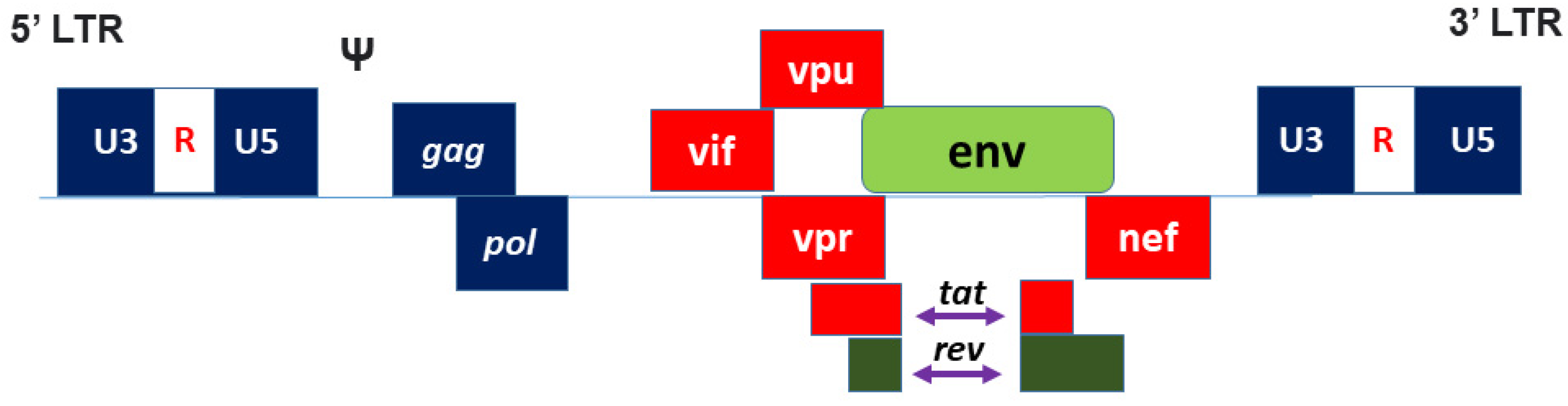

| Gene | Size of Proteins | Protein | Function | |
|---|---|---|---|---|
| Structural Proteins Proteins | gag | Pr55Gag | precursor of the inner structural proteins | |
| p24 | capsid protein (CA) | forms the conical capsid | ||
| p17 | matrix protein (MA) | forms the inner membrane layer | ||
| p7 | nucleoprotein (NC) | forms the nucleoprotein–RNA complex | ||
| P6 | 52aa precursor of Pr55Gag | involved in virus particle release | ||
| pol | Pr160GagPol | precursor of the viral enzymes | ||
| p10 | protease (PR) | release of structural proteins and viral enzymes | ||
| p51 | reverse transcriptase (RT) | transcription of HIV RNA in proviral DNA | ||
| p15 (66) | RNase H | degrade viral RNA | ||
| p32 | integrase (IN) | integrates proviral DNA into the host genome | ||
| env | PrGp160 | precursor of the envelope proteins SU and TM | ||
| gp120 | surface glycoprotein (SU) | attaches the virus to the target cell | ||
| gp41 | transmembrane protein (TM) | fusion of viral and cell membranes | ||
| Regulatory Proteins | Tat | p14 | transactivator protein | activates the transcription of viral genes |
| rev | p19 | RNA splicing regulator | regulates the export of non-spliced and partially spliced viral mRNA | |
| Tev | p26 | tat/rev protein | Tat-Env-Rev fusion protein regulates the activity of Tat and Rev in the nucleus | |
| Accessory Proteins | nef | p27 | negative regulating factor | affects HIV replication, enhancement of infectivity of viral particles |
| vif | p23 | viral infectivity protein | infectious virus production | |
| vpr | p15 | virus protein r | facilitates virus infectivity, affects the cell cycle | |
| vpu | p16 | virus protein unique | virus particle release, regulates intracellular trafficking. | |
| vpx | p15 | virus protein x | involved in early steps of virus replication of HIV-2 |
| Started Year | Study Title | Diseases/Conditions | Interventions | Citations |
|---|---|---|---|---|
| 2017 | Gene Transfer for SCID-X1 Using a Self-Inactivating Lentiviral Vector (TYF-IL-2Rg) | Severe Combined Immunodeficiency (SCID), X-Linked | Biological: TYF-IL-2Rg gene-modified autologous stem cells | https://clinicaltrials.gov/ct2/show/NCT03217617 (accessed on 25 May 2021) |
| 2017 | FANCA Gene Transfer for Fanconi Anaemia Using a High-Safety, High-Efficiency, Self-Inactivating Lentiviral Vector. | Fanconi Anaemia | Genetic: Gene-modified autologous stem cells | https://clinicaltrials.gov/ct2/show/NCT03351868 (accessed on 25 May 2021) |
| 2018 | Gene Transfer for ADA-SCID Using an Improved Lentiviral Vector (TYF-ADA) | Adenosine Deaminase Severe Combined Immunodeficiency (ADA-SCID) | Genetic: TYF-ADA gene-modified autologous stem cells | https://clinicaltrials.gov/ct2/show/NCT03645460 (accessed on 25 May 2021) |
| 2018 | Lentiviral Gene Therapy for MLD | Metachromatic Leukodystrophy (MLD) | Biological: Lentivirus-mediated delivery of ARSA to the CNS | https://clinicaltrials.gov/ct2/show/NCT03725670 (accessed on 25 May 2021) |
| 2018 | Autologous Gene Therapy for Artemis-Deficient SCID | Severe Combined Immunodeficiency (SCID) | Drug: AProArt Device: CliniMACS® CD34 Reagent System cell sorter device Drug: Busulfan | https://clinicaltrials.gov/ct2/show/NCT03538899 (accessed on 25 May 2021) |
| 2019 | Gene Therapy with Modified Autologous Hematopoietic Stem Cells for Patients with Mucopolysaccharidosis Type IIIA | Mucopolysaccharidosis Type IIIA | Drug: Autologous CD34+ cells transduced with a lentiviral vector containing the human SGSH gene | https://clinicaltrials.gov/ct2/show/NCT04201405 (accessed on 25 May 2021) |
| Mutation Type | Sites of NILV Mutation | Steps Affected | References |
|---|---|---|---|
| H12 | N-terminal domain | IN multimerization | [20] |
| D64 | Core domain | Inactivates catalytic properties of IN | [21,22] |
| D116 | Core domain | Inactivates catalytic properties of IN | [21,23,24] |
| N120 | Core domain | Impairs binding to genomic DNA | [20] |
| Q148 | Core domain | Vector DNA binding | [20] |
| E152 | Core domain | Inactivates catalytic properties of IN | [21] |
| W235 | C-terminal domain | Impairs binding to genomic DNA | [20] |
| Integration-Free Methods | Advantages | Disadvantages | References |
|---|---|---|---|
| SeV vector |
|
| [31,32,33,34] |
| Transient transfection |
|
| [35,36,37] |
| EBV episomal plasmids |
|
| [36,38,39,40,41,42,43] |
| AAV vector |
|
| [44,45,46,47] |
| Minicircle |
|
| [48,49,50,51,52,53] |
| Synthetic mRNA |
|
| [54,55,56,57] |
| MicroRNA mimic |
|
| [58,59,60,61,62] |
| NILV Mutations | Disease | Transgene/Effector | Target | References |
|---|---|---|---|---|
| D64V | Influenza Virus | Influenza virus hemagglutinin (HA) and nucleoprotein (NP) transgenes. | Antigen-presenting cells | [84] |
| D64V | Zika Virus | ZIKA Protein codon-optimized | Dendritic cells | [82] |
| D64V | SARS-CoV-2 | Codon-optimized nucleotide fragments encoding a stabilized, foldon-trimerized version of the SARS-CoV-2 | Dendritic cells | [85] |
| D64V | CTA New York Esophageal Squamous Cell Carcinoma-1 (NY-ESO-1) | NY-ESO-1 gene | Dendritic cells | [86] |
| NILV Mutations | Disease | Transgene/Effector | Target | References |
|---|---|---|---|---|
| D64V | Purification of hESC-derived progenitors | Green Fluorescence Protein | Hepatic Progenitor | [93] |
| D64V | iPSC transgene excision | Cre recombinase | iPSCs | [94] |
| NILV Modification | Disease/Application | Transgene/Effector | Target | References |
|---|---|---|---|---|
| D64V | β-thalassemia/site-directed integration and KLF1 gene modification | Zinc finger nuclease/ZFN donor template–GFP expression cassette | γ-globin and HbF expression | [112] |
| D64V | β-thalassemia/site-specific gene modification | Zinc finger nuclease/ZFN donor template | SOX6 region | [113] |
| D64V | Fanconi anemia/gene targeting using ZFN and IDLVs | OCT4, SOX2, c-MYC, and KLF4 flanked by loxP sequences. | AAVS1 safe harbor locus in fibroblasts | [114] |
| D64V | Site-specific gene modification | Transcription activator-like effector nucleases/TALEN donor template | COL7A1 gene | [115] |
| NILV Modification | Disease/Application | Transgene/Effector | Target | References |
|---|---|---|---|---|
| D64V | Sickle cell disease | Efficient GFP-to-YFP gene conversion with Cas9 protein | engraftable HSCs | [126] |
| D64V | Stable gene transfer | Episomal erythropoietin (EPO) gene expression | human cord blood CD34+ cells | [127] |
| D64V | Stable gene transfer | CCR5gRNA-CRISPR/Cas9 cassette and HIV Tat protein, HIV Tat-dependent thymidine kinase mutant SR39 (TK-SR39) and GFP reporter gene | CD34+ stem cells | [128] |
| D64V | Stable gene transfer | Green fluorescence protein | hematopoietic stem and progenitor cells | [129] |
| D64V | Maculardegenerations/stable gene transfer | Green fluorescence protein, E2F2 gene | Eye | [130] |
| D64V | In situ gene correction | Green fluorescence protein, RNA-guided Cas9 endonucleases (RGNs) | Hematopoietic cells | [119] |
Publisher’s Note: MDPI stays neutral with regard to jurisdictional claims in published maps and institutional affiliations. |
© 2022 by the authors. Licensee MDPI, Basel, Switzerland. This article is an open access article distributed under the terms and conditions of the Creative Commons Attribution (CC BY) license (https://creativecommons.org/licenses/by/4.0/).
Share and Cite
Gurumoorthy, N.; Nordin, F.; Tye, G.J.; Wan Kamarul Zaman, W.S.; Ng, M.H. Non-Integrating Lentiviral Vectors in Clinical Applications: A Glance Through. Biomedicines 2022, 10, 107. https://doi.org/10.3390/biomedicines10010107
Gurumoorthy N, Nordin F, Tye GJ, Wan Kamarul Zaman WS, Ng MH. Non-Integrating Lentiviral Vectors in Clinical Applications: A Glance Through. Biomedicines. 2022; 10(1):107. https://doi.org/10.3390/biomedicines10010107
Chicago/Turabian StyleGurumoorthy, Narmatha, Fazlina Nordin, Gee Jun Tye, Wan Safwani Wan Kamarul Zaman, and Min Hwei Ng. 2022. "Non-Integrating Lentiviral Vectors in Clinical Applications: A Glance Through" Biomedicines 10, no. 1: 107. https://doi.org/10.3390/biomedicines10010107
APA StyleGurumoorthy, N., Nordin, F., Tye, G. J., Wan Kamarul Zaman, W. S., & Ng, M. H. (2022). Non-Integrating Lentiviral Vectors in Clinical Applications: A Glance Through. Biomedicines, 10(1), 107. https://doi.org/10.3390/biomedicines10010107

