AI-Based Electromyographic Analysis of Single-Leg Landing for Injury Risk Prediction in Taekwondo Athletes

 , , ,
, , , 
Abstract
1. Introduction
2. Materials and Methods
2.1. Participants
2.2. Experimental Procedure and Data Collection
2.2.1. Feature Extraction and Transformation
2.2.2. EMG Signal Processing and Feature Extraction
2.2.3. Data Augmentation and Feature Optimization
2.3. Model Training and Evaluation
2.3.1. Classification Model Training
2.3.2. Regression Model Training and Tuning
2.4. Evaluation Metrics
3. Results
3.1. Experimental Setup
3.2. Data Integrity and Feature Basis
3.3. Classification Task Performance
3.4. Regression Task Performance
4. Discussion
5. Conclusions
Author Contributions
Funding
Institutional Review Board Statement
Informed Consent Statement
Data Availability Statement
Conflicts of Interest
Abbreviations
| EMG | Electromyography |
| AI | Artificial Intelligence |
| ACL | Anterior Cruciate Ligament |
| RMS | Root Mean Square |
| SMOTE | Synthetic Minority Oversampling Technique |
| LR | Logistic Regression |
| RF | Random Forest |
| XGBoost/XGB | eXtreme Gradient Boosting |
| RR | Ridge Regression |
| CV | Cross-Validation |
| MAE | Mean Absolute Error |
| RMSE | Root Mean Squared Error |
| R2 | Coefficient of Determination |
| SHAP | SHapley Additive exPlanations |
| SENIAM | Surface ElectroMyoGraphy for the Non-Invasive Assessment of Muscles |
References
- Jia, M.; Liu, L.; Huang, R.; Ma, Y.; Lin, S.; Peng, Q.; Xiong, J.; Wang, Z.; Zheng, W. Correlation Analysis between Biomechanical Characteristics of Taekwondo Double Roundhouse Kick and Effective Scoring of Electronic Body Protector. Front. Physiol. 2024, 14, 1269345. [Google Scholar] [CrossRef] [PubMed]
- Hewett, T.E.; Bates, N.A. Preventive Biomechanics: A Paradigm Shift with a Translational Approach to Injury Prevention. Am. J. Sports Med. 2017, 45, 2654–2664. [Google Scholar] [CrossRef]
- Saxby, D.J.; Catelli, D.S.; Lloyd, D.G.; Sawacha, Z. Editorial: The Role of Biomechanics in Anterior Cruciate Ligament Injuries Prevention. Front. Sports Act. Living 2023, 5, 1134969. [Google Scholar] [CrossRef] [PubMed]
- Luiz Vancini, R.; Andrade, M.S.; De Lira, C.A.B.; Russomano, T. Recent Advances in Biomechanics Research: Implications for Sports Performance and Injury Prevention. Health Nexus 2023, 1, 7–20. [Google Scholar] [CrossRef]
- Myer, G.D.; Ford, K.R.; Palumbo, J.P.; Hewett, T.E. Neuromuscular Training Improves Performance and Lower-Extremity Biomechanics in Female Athletes. J. Strength Cond. Res. 2005, 19, 51–60. [Google Scholar] [CrossRef]
- Lopes, T.J.A.; Simic, M.; Myer, G.D.; Ford, K.R.; Hewett, T.E.; Pappas, E. The Effects of Injury Prevention Programs on the Biomechanics of Landing Tasks: A Systematic Review with Meta-Analysis. Am. J. Sports Med. 2018, 46, 1492–1499. [Google Scholar] [CrossRef]
- Ji, M. Analysis of Injuries in Taekwondo Athletes. J. Phys. Ther. Sci. 2016, 28, 231–234. [Google Scholar] [CrossRef]
- Pieter, W.; Fife, G.P.; O’Sullivan, D.M. Competition Injuries in Taekwondo: A Literature Review and Suggestions for Prevention and Surveillance. Br. J. Sports Med. 2012, 46, 485–491. [Google Scholar] [CrossRef]
- Jeong, G.; Chun, B. Differences in Sports Injury Types According to Taekwondo Athlete Types (Sparring, Poomsae, and Demonstration). J. Sports Sci. Med. 2022, 21, 473–481. [Google Scholar] [CrossRef]
- Maniar, N.; Schache, A.G.; Pizzolato, C.; Opar, D.A. Muscle Contributions to Tibiofemoral Shear Forces and Valgus and Rotational Joint Moments during Single Leg Drop Landing. Scand. J. Med. Sci. Sports 2020, 30, 1664–1674. [Google Scholar] [CrossRef]
- Besomi, M.; Hodges, P.W.; Clancy, E.A.; Van Dieën, J.; Hug, F.; Lowery, M.; Merletti, R.; Søgaard, K.; Wrigley, T.; Besier, T.; et al. Consensus for Experimental Design in Electromyography (CEDE) Project: Amplitude Normalization Matrix. J. Electromyogr. Kinesiol. 2020, 53, 102438. [Google Scholar] [CrossRef] [PubMed]
- Campanini, I.; Disselhorst-Klug, C.; Rymer, W.Z.; Merletti, R. Surface EMG in Clinical Assessment and Neurorehabilitation: Barriers Limiting Its Use. Front. Neurol. 2020, 11, 934. [Google Scholar] [CrossRef] [PubMed]
- Di Rocco, F.; Papale, O.; Festino, E.; De Maio, M.; Cortis, C.; Fusco, A. Acute Effects of Mini Trampoline Training Session on Leg Stiffness and Reactive Power. Appl. Sci. 2023, 13, 9865. [Google Scholar] [CrossRef]
- De Maio, M.; Di Rocco, F.; Papale, O.; Festino, E.; Fusco, A.; Cortis, C. Could Mini-Trampoline Training Be Considered as a New Strategy to Reduce Asymmetries? Appl. Sci. 2023, 13, 3193. [Google Scholar] [CrossRef]
- Fuchs, P.X.; Fusco, A.; Bell, J.W.; von Duvillard, S.P.; Cortis, C.; Wagner, H. Effect of Differential Training on Female Volleyball Spike-Jump Technique and Performance. Int. J. Sports Physiol. Perform. 2020, 15, 1019–1025. [Google Scholar] [CrossRef]
- Impellizzeri, F.M.; Rampinini, E.; Maffiuletti, N.; Marcora, S.M. A Vertical Jump Force Test for Assessing Bilateral Strength Asymmetry in Athletes. Med. Sci. Sports Exerc. 2007, 39, 2044–2050. [Google Scholar] [CrossRef]
- Quinzi, F.; Camomilla, V.; Felici, F.; Di Mario, A.; Sbriccoli, P. Differences in Neuromuscular Control between Impact and No Impact Roundhouse Kick in Athletes of Different Skill Levels. J. Electromyogr. Kinesiol. 2013, 23, 140–150. [Google Scholar] [CrossRef]
- Leckey, C.; van Dyk, N.; Doherty, C.; Lawlor, A.; Delahunt, E. Machine Learning Approaches to Injury Risk Prediction in Sport: A Scoping Review with Evidence Synthesis. Br. J. Sports Med. 2025, 59, 491–500. [Google Scholar] [CrossRef]
- Amendolara, A.; Pfister, D.; Settelmayer, M.; Shah, M.; Wu, V.; Donnelly, S.; Johnston, B.; Peterson, R.; Sant, D.; Kriak, J.; et al. An Overview of Machine Learning Applications in Sports Injury Prediction. Cureus 2023, 15, e46170. [Google Scholar] [CrossRef]
- Majumdar, A.; Bakirov, R.; Hodges, D.; Scott, S.; Rees, T. Machine Learning for Understanding and Predicting Injuries in Football. Sports Med. Open 2022, 8, 73. [Google Scholar] [CrossRef]
- Van Eetvelde, H.; Mendonça, L.D.; Ley, C.; Seil, R.; Tischer, T. Machine Learning Methods in Sport Injury Prediction and Prevention: A Systematic Review. J. Exp. Orthop. 2021, 8, 27. [Google Scholar] [CrossRef] [PubMed]
- Khan, I.; Ali, H.; Siddiqui, M.F.; Geetha, G.M.N. Machine Learning Approaches to Injury Risk Prediction in Sport. Prem. J. Comput. Sci. 2025, 4, 100012. [Google Scholar] [CrossRef]
- Parashar, P.; Sharma, M.K.; Nahak, B.K.; Khan, A.; Hsu, W.-Z.; Tseng, Y.-H.; Chowdhury, J.R.; Huang, Y.-H.; Liao, J.-C.; Kao, F.-C.; et al. Machine Learning-Driven Gait-Assisted Self-Powered Wearable Sensing: A Triboelectric Nanogenerator-Based Advanced Healthcare Monitoring. J. Mater. Chem. A Mater. 2025, 13, 13750–13762. [Google Scholar] [CrossRef]
- Pangestuputra, A.W.; Changestu, D.A. Neuromuscular Training in ACL Injury Prevention: A Narrative Review. Orthop. J. Sports Med. 2024, 12, 2325967124S00394. [Google Scholar] [CrossRef]
- Hamoongard, M.; Hadadnezhad, M.; Abbasi, A. Effect of Combining Eight Weeks of Neuromuscular Training with Dual Cognitive Tasks on Landing Mechanics in Futsal Players with Knee Ligament Dominance Defect: A Randomized Controlled Trial. BMC Sports Sci. Med. Rehabil. 2022, 14, 196. [Google Scholar] [CrossRef]
- Salleh, N.A.; Azaman, A.; Sulaiman, M.; As’ari, M.A.; Zulkapri, I. Classifying Muscle Performance of Junior Endurance and Power Athletes Using Machine Learning. Int. J. Biomed. Eng. Technol. 2023, 1, 337–353. [Google Scholar] [CrossRef]
- Zohirov, K.; Makhmudjanov, S.; Ruziboev, F.; Berdiev, G.; Temirov, M.; Sherboboyeva, G.; Achilova, F.; Pardayeva, G.; Boykobilov, S. EMG-Based Recognition of Lower Limb Movements in Athletes: A Comparative Study of Classification Techniques. Signals 2025, 6, 45. [Google Scholar] [CrossRef]
- Barramuño Medina, M.; Valdés-Badilla, P.; Fonseca Oyarzún, F.; Gálvez-García, G. Surface Electromyography in Ballistic Movement: A Comparative Methodological Analysis from Taekwondo Athletes (Electromiografía de Superficie En Movimientos Balísticos: Un Análisis Metodológico Comparativo En Atletas de Taekwondo). Retos 2021, 44, 146–154. [Google Scholar] [CrossRef]
- Rommers, N.; Rössler, R.; Verhagen, E.; Vandecasteele, F.; Verstockt, S.; Vaeyens, R.; Lenoir, M.; D’hondt, E.; Witvrouw, E. A Machine Learning Approach to Assess Injury Risk in Elite Youth Football Players. Med. Sci. Sports Exerc. 2020, 52, 1745–1751. [Google Scholar] [CrossRef]
- Sun, J.; Wang, Y.; Dong, D. Lower Limb Electromyographic Characteristics and Implications of Taekwondo Roundhouse Kick “Hit” and “Miss” Actions. Front. Bioeng. Biotechnol. 2024, 11, 1258613. [Google Scholar] [CrossRef]



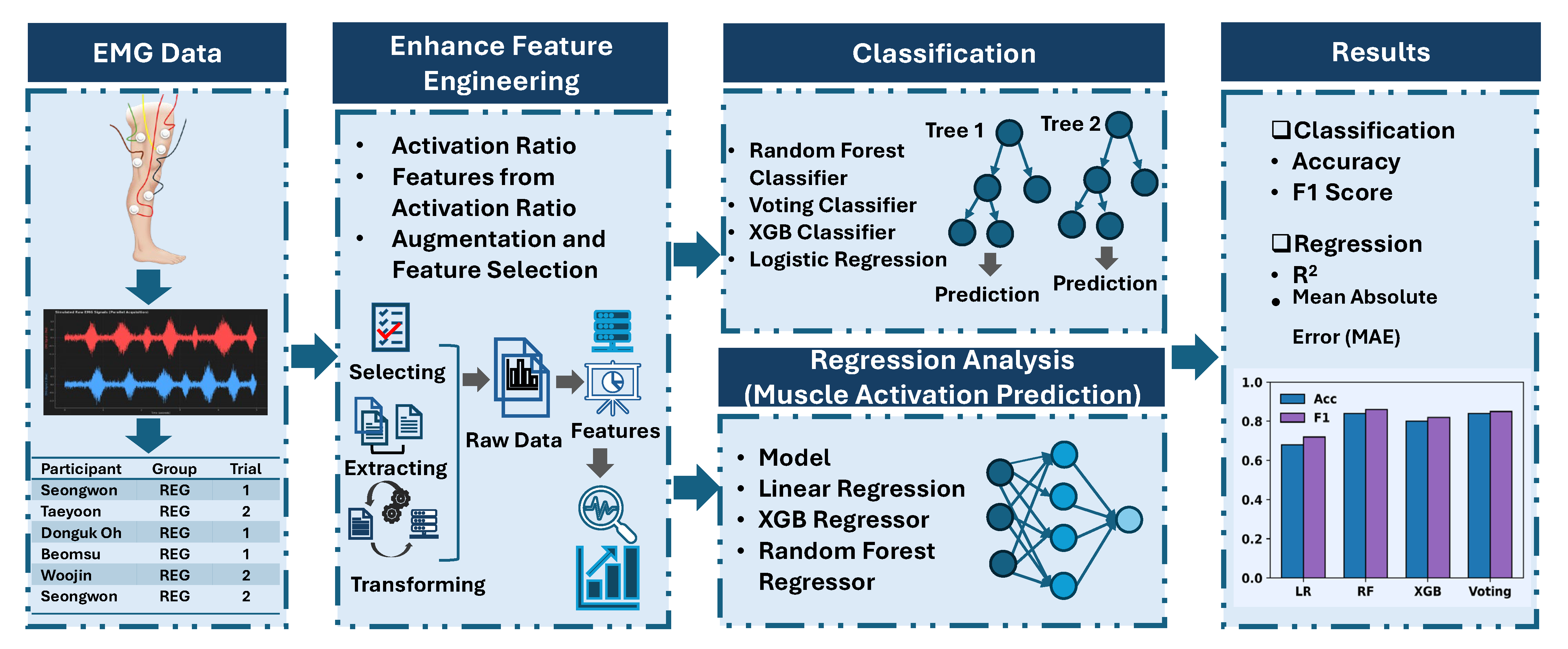
| Type | Model | Parameters |
|---|---|---|
| Classification | Logistic Regression | max_iter = 1000 |
| Random Forest Classifier | n_estimators = 200; random_state = 42 | |
| XGBoost Classifier | n_estimators = 200; max_depth = 3; learning_rate = 0.1; eval_metric = ‘logloss’ | |
| Voting Classifier | estimators = (LR, RF, XGB); voting = ‘soft’ | |
| Regression | Ridge Regression | alpha = 1.0 |
| Random Forest Regressor | n_estimators = 200; random_state = 42 | |
| XGBoost Regressor | n_estimators = 200; max_depth = 3; learning_rate = 0.1; random_state = 42 |
| Model | Test Accuracy | F1-Score | 5-Fold CV Accuracy (Mean ± Std) |
|---|---|---|---|
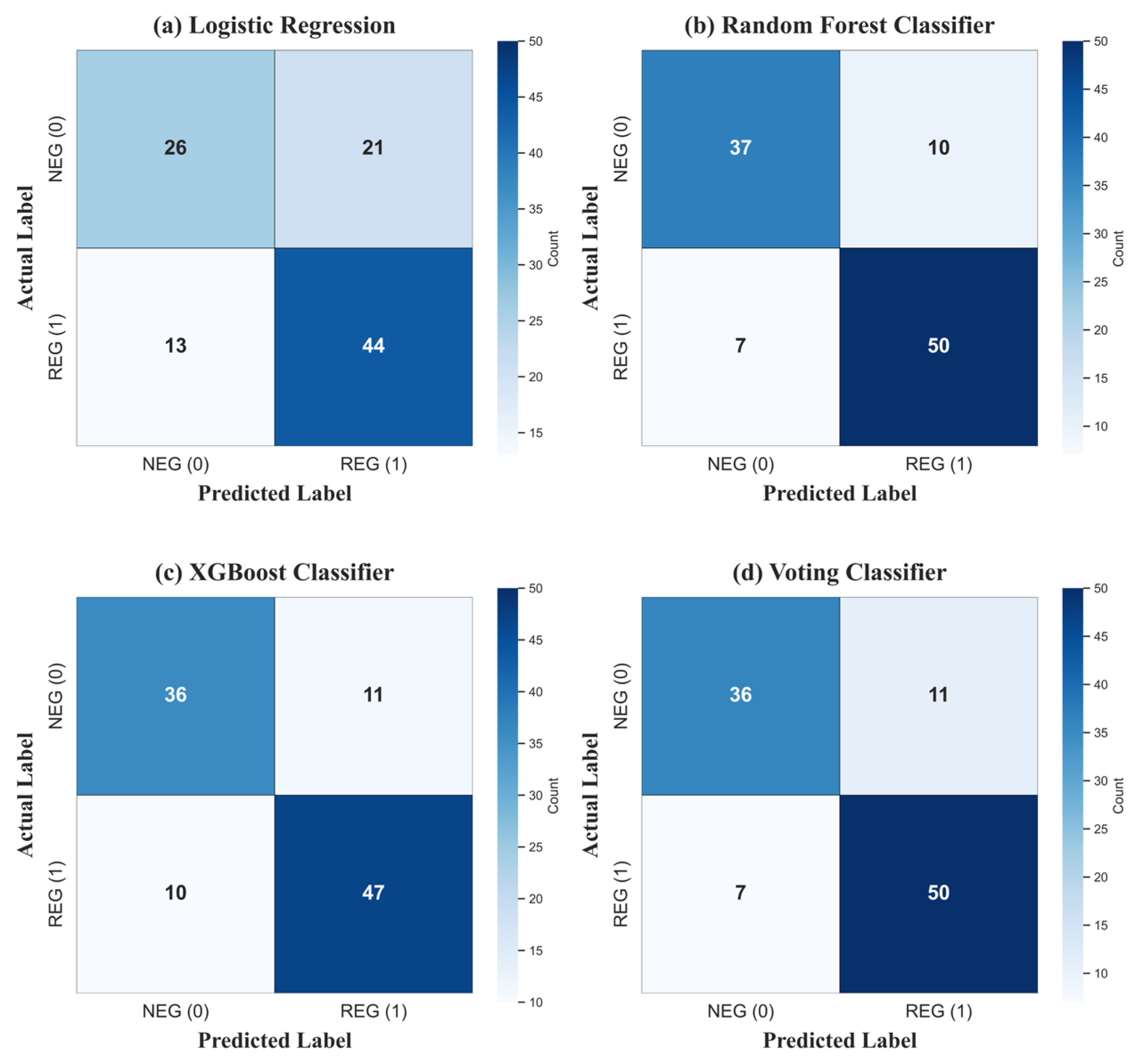
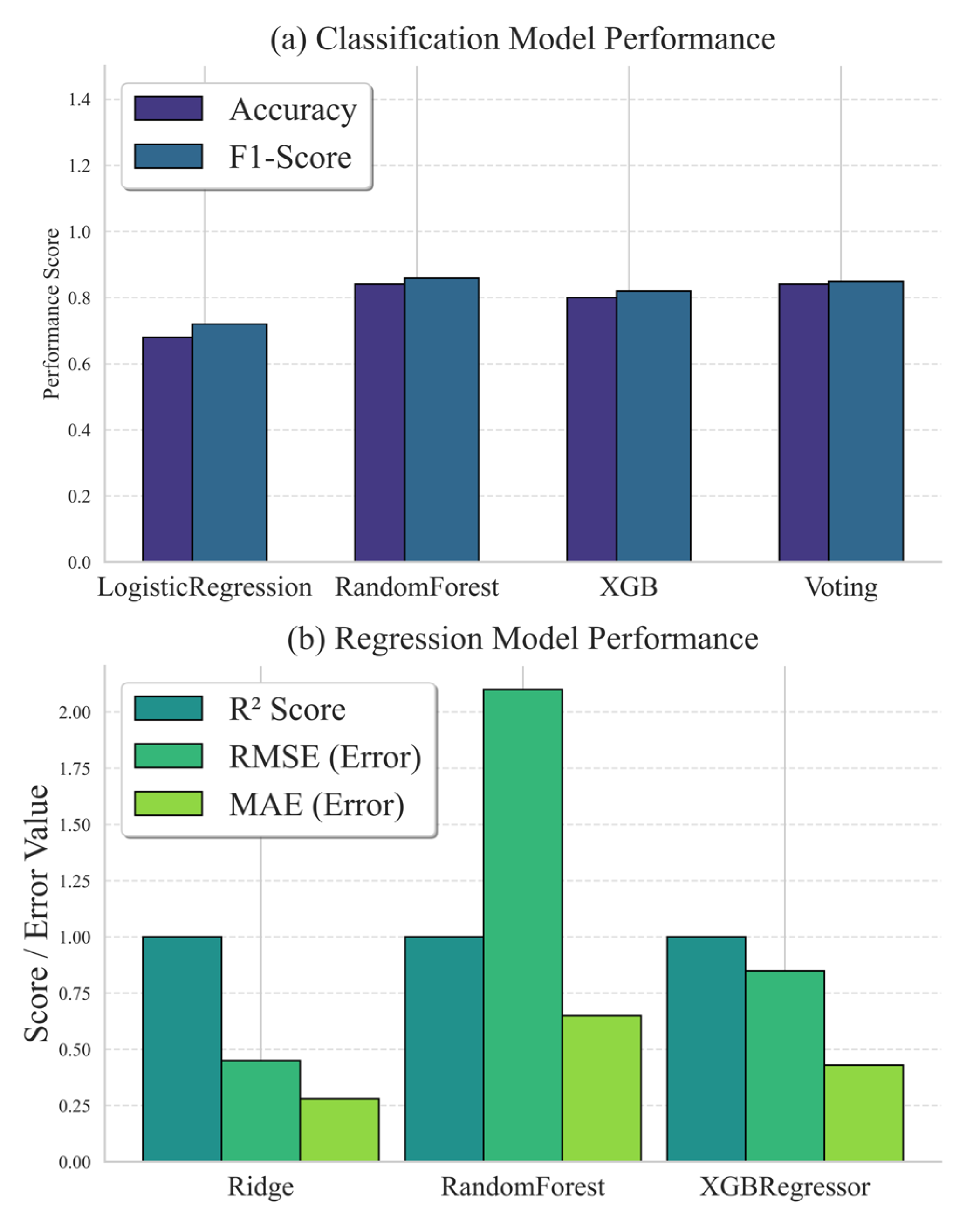
| Random Forest Classifier | 0.8365 | 0.8547 | 0.7980 ± 0.0422 |
| Voting Classifier | 0.8269 | 0.8475 | 0.7763 ± 0.0367 |
| XGB Classifier | 0.7981 | 0.8174 | 0.7691 ± 0.0360 |
| Logistic Regression | 0.6731 | 0.7213 | 0.6729 ± 0.0488 |
| Model | Train R2 Score | Test R2 Score | Mean Absolute Error (MAE) | Root Mean Squared Error (RMSE) | 5-Fold CV MAE (Mean ± Std Dev) |
|---|---|---|---|---|---|
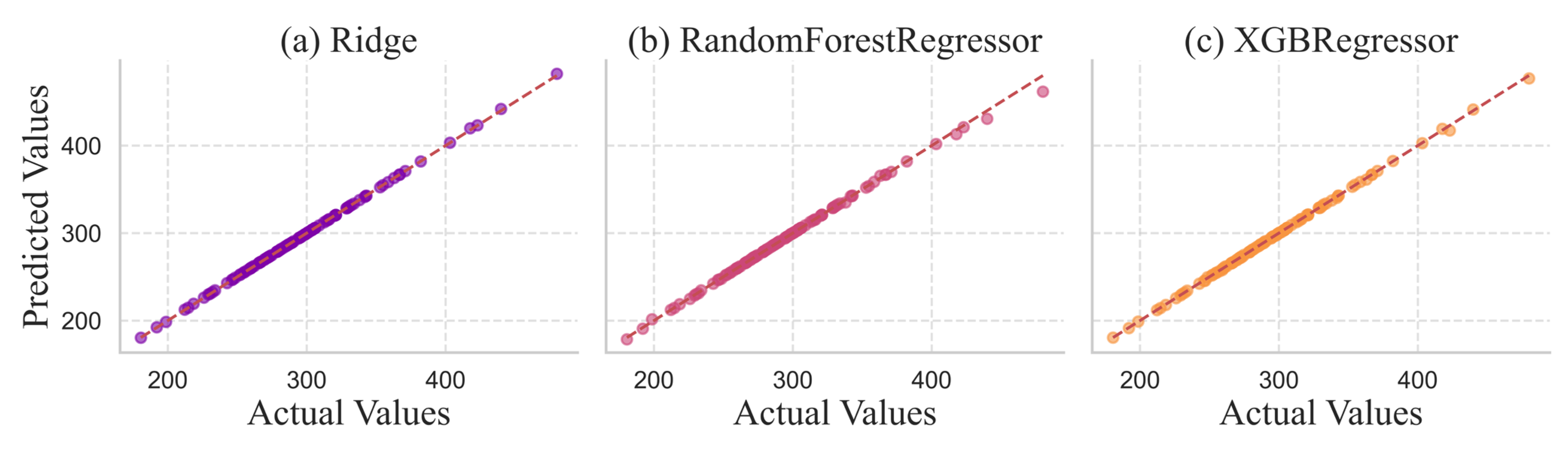
| Ridge Regression | 0.9999 | 0.9974 | 0.2620 | 0.4284 | 0.2459 ± 0.0270 |
| XGB Regression | 0.9997 | 0.9999 | 0.4302 | 0.8086 | 0.8268 ± 0.2604 |
| Random Forest Regression | 0.9982 | 0.9999 | 0.6260 | 2.1562 | 0.7302 ± 0.4616 |
| Study | Sport | Method | Model | Key Findings |
|---|---|---|---|---|
| [17] | Taekwondo | Impact vs. no-impact kicks | ANOVA | Neuromuscular control varies by skill; single-parameter approach |
| [27] | General athletics | Lower-limb movement recognition | Random Forest | High accuracy for discrete movement classification |
| [28] | Taekwondo | Ballistic movement EMG | Statistical comparison | Signal processing method critically affects EMG values in ballistic movements |
| [29] | Soccer | Prospective cohort study using preseason anthropometric and physical performance assessments. | XGBoost | Injury prediction achieved high precision |
| Current Study (2025) | Taekwondo | Single-leg landing classification | Random Forest, XGBoost | EMG patterns differentiate neuromuscular adaptations |
Disclaimer/Publisher’s Note: The statements, opinions and data contained in all publications are solely those of the individual author(s) and contributor(s) and not of MDPI and/or the editor(s). MDPI and/or the editor(s) disclaim responsibility for any injury to people or property resulting from any ideas, methods, instructions or products referred to in the content. |
© 2026 by the authors. Licensee MDPI, Basel, Switzerland. This article is an open access article distributed under the terms and conditions of the Creative Commons Attribution (CC BY) license.
Share and Cite
Kim, J.-S.; Faridoon, F.; Choi, J.; Oh, J.; Kang, J.; Lim, H.G. AI-Based Electromyographic Analysis of Single-Leg Landing for Injury Risk Prediction in Taekwondo Athletes. Healthcare 2026, 14, 292. https://doi.org/10.3390/healthcare14030292
Kim J-S, Faridoon F, Choi J, Oh J, Kang J, Lim HG. AI-Based Electromyographic Analysis of Single-Leg Landing for Injury Risk Prediction in Taekwondo Athletes. Healthcare. 2026; 14(3):292. https://doi.org/10.3390/healthcare14030292
Chicago/Turabian StyleKim, Jun-Sik, Fatima Faridoon, Jaeyeop Choi, Junghwan Oh, Juhyun Kang, and Hae Gyun Lim. 2026. "AI-Based Electromyographic Analysis of Single-Leg Landing for Injury Risk Prediction in Taekwondo Athletes" Healthcare 14, no. 3: 292. https://doi.org/10.3390/healthcare14030292
APA StyleKim, J.-S., Faridoon, F., Choi, J., Oh, J., Kang, J., & Lim, H. G. (2026). AI-Based Electromyographic Analysis of Single-Leg Landing for Injury Risk Prediction in Taekwondo Athletes. Healthcare, 14(3), 292. https://doi.org/10.3390/healthcare14030292