1. Introduction
Investment in childhood health is a cornerstone of sustainable population development, generating significant social returns and lifelong benefits [
1]. However, China’s urban–rural dual structure jeopardizes rural children’s health through geographical disadvantages, resource misallocation, and institutional flaws, rendering them a vulnerable group in the “Healthy China” initiative. First, a significant structural imbalance exists in the supply of quality pediatric resources between urban and rural areas. Rural regions suffer from a shortage of qualified pediatricians, insufficient primary care capacity, and a lack of advanced diagnostic equipment. Consequently, rural families face significant barriers—including travel distance, time, and transportation costs—to accessing care comparable to urban standards. This supply-side deficiency creates economic burdens and dilemmas, forcing households to choose between inadequate local care and costly treatment in distant hospitals.
Concurrently, the protection provided by basic medical insurance for children is markedly insufficient. The main public medical insurance for children in China is the Urban and Rural Resident Basic Medical Insurance (URRBMI) system, which applies the same financing and benefit standards to them as to non-employed adults. The system exhibits a design bias toward covering major illnesses and inpatient services. However, research indicates that children are predominantly affected by common conditions such as respiratory and digestive illnesses, characterized by an “outpatient-heavy and inpatient-light” utilization pattern [
2]. This mismatch between insurance design and children’s healthcare needs results in a low effective reimbursement rate for outpatient costs. One study estimated that the average out-of-pocket share of medical expenses for rural children reached 92.1% [
3]. This combination of inadequate supply and misaligned insurance increases child-rearing costs and threatens the long-term health of rural children.
In this context, the basic medical insurance’s outpatient cost-sharing policy, which aims to strengthen primary care capacity and reduce the public’s outpatient financial burden, offers a precise policy instrument to address the aforementioned predicaments faced by rural children. This policy incorporates high-frequency, low-cost outpatient expenses into the social pooling fund. It shifts these costs, previously paid out-of-pocket, to a risk-pooling model. Furthermore, it enhances reimbursement levels at primary healthcare institutions to optimize medical resource allocation. This policy design directly and precisely addresses the dual squeeze: on one hand, it lowers the out-of-pocket costs for routine outpatient visits, creating economic incentives for rural families to seek timely medical care, ensuring that children receive continuous and timely basic medical services. On the other hand, by setting higher reimbursement rates at primary care facilities, the policy effectively encourages utilizing grassroots care as the first point of contact. This not only provides a more convenient and affordable healthcare option for rural families burdened by travel and other non-medical costs but, in the long run, also helps to channel insurance funds and patient flows to the grassroots level, thereby feeding back to and bolstering the service capacity and quality of rural medical institutions. Since the establishment of the catastrophic-illness pooling plus outpatient cost-sharing model in 2008, the policy has continuously evolved. Local implementation rules have explicitly designated children as a key priority group, generally granting them favorable benefits (e.g., lower deductibles, higher reimbursement rates), reflecting a policy orientation aimed at bridging the last mile in rural children’s health security.
The implementation of China’s outpatient cost-sharing policy exhibits regional heterogeneity, which correlates with factors such as local economic development levels. Policy documents from major regions show that these disparities appear primarily in three dimensions: deductibles, reimbursement ratios, and payment ceilings. First, concerning deductibles, regions differ regarding the presence or absence of a threshold. Provinces such as Jiangxi and Hunan, along with certain municipalities, have not established deductible lines. Conversely, regions like Beijing and Shanxi have set differentiated deductibles based on the tier of the medical institution. While this design supports the hierarchical medical system, it may discourage the use of some low-cost outpatient services. Second, regarding reimbursement ratios, regions generally adopt differentiated payment strategies that favor primary care institutions. Although some regions implement a uniform reimbursement ratio, the majority (e.g., Tianjin, Shanxi, and Henan) stipulate significantly higher ratios for primary medical institutions compared to secondary and tertiary hospitals, with differentials typically ranging from 5% to 25%. This price leverage mechanism aims to incentivize rural households to prioritize village clinics or township health centers for common childhood diseases, thereby promoting tiered diagnosis and treatment. Finally, significant disparities exist across regions regarding maximum payment limits. In economically developed regions (e.g., Beijing, Tianjin, and certain cities in Jiangsu), annual ceilings can reach several thousand yuan, effectively covering the annual outpatient medical risks for children. In contrast, in parts of the central and western regions (e.g., certain cities in Gansu and Sichuan), annual payment limits may be as low as 80 to 200 yuan, or are subject to per-visit (or daily) caps.
A rich body of academic literature has explored the effects of the basic medical insurance outpatient cost-sharing policy. The general consensus is that the policy effectively enhances access to and utilization of outpatient services for the insured, particularly for vulnerable groups such as low-income individuals and those with chronic diseases [
4,
5,
6,
7]. However, a central and unresolved debate in current research is whether increased service utilization necessarily translates into substantive improvements in health outcomes and effective control of medical costs. On one hand, some studies have confirmed the policy’s positive effects. Timely outpatient care can effectively manage medical conditions and prevent minor ailments from escalating into major diseases, thereby directly improving the health of farmers and middle-aged and elderly employees [
8,
9]. It may also generate overall cost savings by substituting for more expensive inpatient services [
10]. On the other hand, some research has raised doubts or uncovered complexities regarding the policy’s effects. For example, the policy may induce ex-post moral hazard, wherein patients are inclined to consume more low-value care services that offer limited health benefits, thereby straining the insurance fund [
11]. The mixed (positive or negative) empirical findings in the existing literature are deeply rooted in the heterogeneity of policy design (e.g., benefit levels, whether services are restricted to primary care facilities) and variations in study populations, causing different policy parameters to have disparate impacts on the health and economic burdens of different groups [
12]. For instance, one study pointed out that overly limited benefit levels can create a conflict between insured people’s psychological expectation of being covered and the reality of inadequate protection, potentially even exerting a negative impact on their perceived mental health [
13].
Existing literature, whether supportive or critical, has focused almost exclusively on adults, particularly the elderly, employees, and patients with chronic diseases. However, existing findings regarding policy effects on adults—such as the “substitution effect” or “moral hazard”—are difficult to directly extrapolate to the pediatric population. This is mainly due to fundamental differences between the two groups. Key differences include health production functions, price elasticity of demand, and medical decision-making [
14,
15]. For instance, in contrast to the prevalence of chronic conditions among adults, pediatric diseases are predominantly acute respiratory or digestive tract infections. These conditions are characterized by sudden onset and rapid progression, the corresponding medical services exhibit “high marginal health benefits” and “low price elasticity of demand.” Therefore, the likelihood of induced demand (moral hazard) arising among children is relatively low; instead, the risk of health loss resulting from underutilization warrants greater attention [
16,
17]. Consequently, investigating the association between outpatient cost-sharing policy and the health and economic outcomes of rural children not only fills a significant gap in the existing literature but also provides precise empirical evidence tailored to pediatric characteristics. Ultimately, this serves to rectify potential biases inherent in directly transplanting adult-centric policy logic onto the child population.
The contributions of this study are threefold: First, by shifting the research focus from the general population to rural children, it fills a critical gap in the literature regarding the policy’s benefits and potential pathways for a key vulnerable group. Second, it provides more comprehensive evaluative evidence by simultaneously examining the policy’s relationships with both health outcomes and economic burden. Finally, the findings will offer important policy implications for optimizing China’s child medical security system. In conclusion, this study not only theoretically elucidates the relationship between outpatient cost-sharing policy and rural children, but also provides key micro-evidence for the practice of utilizing medical insurance design to interrupt the inter-generational transmission of “health poverty” and support China’s rural revitalization.
1.1. Theoretical Framework
Unlike other age cohorts, children are unable to make independent decisions regarding their own health investments due to their developmental immaturity. Consequently, child health is incorporated into the family utility function, with parents or other family members making relevant medical decisions on their behalf [
18]. To this end, this paper first constructs a family utility function. This function treats the family as the decision-making unit, aiming to maximize family utility:
While many factors influence the family utility function, this study focuses on the child’s health status and the mother’s health status , with other household consumption goods represented by the variable Z.
Families do not purchase child health directly; instead, they “produce” it by inputting various factors. Its production function can be expressed as:
where
represents the utilization of outpatient medical services for the child;
represents the utilization of inpatient medical services; and
represents other health-related inputs for the child, such as food supplements.
and E denote the mother’s health status and other household endowments, respectively. The first three variables are regarded as direct production factors of the child’s health status, while the latter two variables are viewed as key inputs influencing the efficiency of child health investment. The healthier the mother, the higher the efficiency with which direct production factors are converted into child health [
19].
Rational households aim to maximize utility within a budget constraint. This paper introduces the constraint function as follows:
Here, the total household income W is allocated across various expenditures. The variables , , , represent the prices of other consumption goods, non-medical health-related products, outpatient services, and inpatient services, respectively. The variable denotes the opportunity cost for rural households to obtain medical services for children, including transportation and caregiving costs. The variables and represent the reimbursement ratios for outpatient and inpatient services, respectively. The variable represents the household’s current precautionary savings, the magnitude of which is directly proportional to the risk faced by the household.
1.2. Research Hypotheses
This paper argues that the key to understanding the effects of the outpatient cost-sharing policy lies in recognizing the fundamental differences in healthcare demand between rural China and developed nations. In the healthcare systems of developed countries, represented by the United States, increasing copayments is typically viewed as a mechanism to curb excessive medical care and moral hazard; its policy objective is to suppress utilization rates without compromising health outcomes [
20,
21]. However, within the context of China’s urban–rural dual structure, the primary challenge facing rural children is not “over-utilization,” but rather “under-utilization” constrained by affordability and the unequal distribution of medical resources [
22,
23,
24]. Consequently, within the context of this study, reducing copayments (i.e., increasing reimbursement ratios) should not be construed as an inducement for moral hazard, but rather as a form of “pro-social investment in human capital.” In other words, one of the objectives of implementing the current outpatient cost-sharing policy in China is to achieve better health outcomes for rural children, rather than cost containment or the prevention of excessive medical care.
This paper posits that the outpatient cost-sharing policy will be positively associated with children’s health. First, the policy lowers the price of outpatient care by increasing the reimbursement rate or expanding reimbursement coverage, and reduces opportunity costs (like travel for rural children) by incentivizing local care. This may encourage higher utilization of outpatient services, leading to more regular and timely treatment which is conducive to improving child health. Secondly, by lowering medical costs, the policy might also relate to the mother’s health status [
25]. Since mother’s health is a key input for the efficiency of child health production, this could indirectly boost the child’s well-being. Thirdly, if the policy reduces out-of-pocket spending or lowers psychological expectations of future medical expenses, it frees up household income. This allows families to reallocate resources toward other health inputs, such as school-related food and accommodation expenses [
26].
The policy’s relationship with total out-of-pocket medical expenditure of children is uncertain. This ambiguity arises from two effects. First, the association with outpatient spending is unclear: while the quantity of services will rise, total expenditure depends on the price elasticity of demand [
27], which is unknown for this suppressed-demand population. Second, the policy may create a substitution effect: better access to outpatient care (early treatment) can reduce the need for expensive inpatient services [
28]. The final change in total costs depends on the trade-off between the change in outpatient spending and the cost savings from inpatient substitution.
Based on the theoretical derivations above, this paper proposes the following hypotheses for empirical testing:
Hypothesis 1. The outpatient cost-sharing policy is positively associated with the health status of rural children.
Hypothesis 1a. The positive association between the policy and rural children’s health may be partially associated with better health status of their mothers.
Hypothesis 1b. The positive association between the policy and rural children’s health may be partially linked to greater school-related food and accommodation expenses.
Hypothesis 2. The policy is associated with a significantly greater probability of outpatient service utilization and a decreased probability of inpatient service utilization for rural children. Its association with children’s out-of-pocket medical expenditure is uncertain.
3. Results
This section tests the research hypotheses using the specified empirical models, reporting baseline results on rural children’s health and medical expenditure, followed by an analysis of potential factors associated with these outcomes.
3.1. Baseline Results
Table 2 reports the baseline results. In the full-sample Ordered Probit model (Column 1), the policy coefficient is positive but statistically insignificant.
To address endogeneity, we employ Propensity Score Matching (PSM). First-stage estimates (
Appendix A,
Table A3) show that household income, medical resource availability, mother’s employment, and child characteristics significantly relate to policy implementation, indicating that policy implementation is not a random process, underscoring the importance of eliminating such selection bias via propensity score matching.
Column (2) presents the estimation results based on the PSM-matched sample, where the policy coefficient becomes significant (0.307, p < 0.05). The marginal effect indicates that the policy is associated with an 11.2 percentage-point increase in the probability of children reporting “very good” health. This finding is consistent with Hypothesis 1.
In
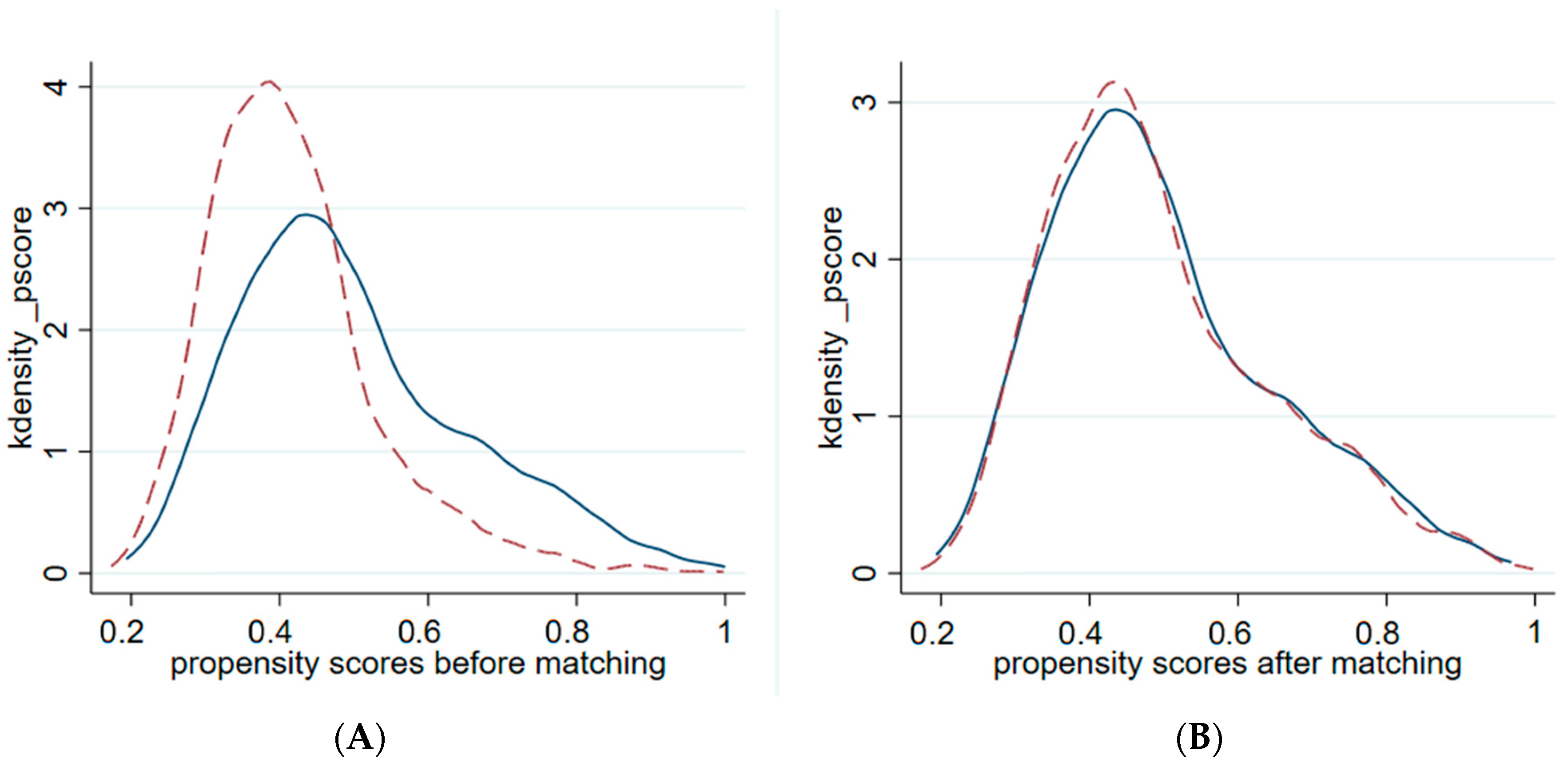
Figure 1, panel A depicts the kernel density estimation of the propensity scores for the treatment group (solid line) and the control group (dashed line) before matching. Panel B displays the distribution after performing Kernel matching. The substantial overlap in Panel B indicates that the matching procedure successfully balanced the covariate distribution between the two groups, satisfying the common support assumption. We also examined the balance of all covariates before and after matching based on standardized percentage bias (%bias) and
t-tests. Prior to matching, significant imbalances existed across several key characteristics. Specifically, variables such as age, mother’s employment, HH per capita income, and hospital beds exhibited statistically significant differences (
p < 0.05). Notably, the standardized bias for hospital beds and HH per capita income was substantial (42.3% and 37.8%, respectively), suggesting strong selection bias in the raw sample. After applying Kernel matching, the standardized bias for all covariates was reduced to below 5% (with a maximum of 3.8%). Furthermore, post-match t-tests for all variables yield statistically insignificant results (
p > 0.1), indicating that the treatment and control groups are indistinguishable in terms of observable characteristics. These results confirm that the balance condition is well satisfied.
Table 3 employs a Two-Part Model to analyze medical service expenditure and reimbursement ratios. The “first part” captures the probability of incurring expenses or receiving reimbursement, while the “second part” measures the specific amounts or ratios for those who did.
First, regarding out-of-pocket (OOP) expenditure, both the first (−0.050) and second stage (−0.257) coefficients are insignificant (
Table 3, Columns 1–2). This indicates that the policy is not significantly associated with the probability or amount of OOP expenditure for rural children.
Second, for the reimbursement ratio (Columns 3–4), the first-stage coefficient is significantly positive (0.594, p < 0.05), with an average marginal effect of 8.9 percentage points, which means that the policy is associated with an increase in the probability of rural children receiving reimbursement by an average of 8.9 percentage points. The second stage is insignificant. This indicates that, for those rural children already enjoying reimbursement, the policy is not significantly associated with the specific value of their reimbursement ratios. These results are consistent with Hypothesis 2.
In economic terms, these results may reflect an association at the extensive margin: the policy appears to be linked to a lower threshold for accessing outpatient security, incorporating a larger group of children into the reimbursement scope. However, the intensive margin appears to be limited: the policy is not significantly associated with children’s overall OOP expenditure, nor does it show a major link with overall reimbursement levels. This suggests the policy’s primary function appears to be expanding coverage breadth—enabling reimbursement for minor outpatient issues (e.g., common colds)—rather than reducing costs.
3.2. Robustness Checks
3.2.1. Sample Sensitivity Analysis
To check results are not driven by a single city with an overwhelmingly large sample size, we excluded Tianshui (the largest sample city, 163 observations) and re-estimated the models. The associations with health, expenditure, and reimbursement remained stable (
Appendix A,
Table A4, Columns 1–3), consistent with baseline findings.
3.2.2. Alternative Econometric Models
We employed PSM-OLS and Tobit models (suitable for zero-inflated expenditure data) as alternative models (
Appendix A,
Table A4, Columns 4–6). The results align with the baseline.
3.2.3. Rosenbaum Bounds
Propensity Score Matching (PSM) accounts only for selection based on observables; thus, potential unobserved confounders at the city or household level may still bias the estimates. So we conducted a Rosenbaum bounds sensitivity analysis to assess the robustness of the PSM to unobserved factors and determine whether the potential hidden bias is within an acceptable range. The results show that the maximum Gamma value is 2.1 at the 0.10 significance level. This indicates the reliability of our findings.
3.3. Exploratory Analysis
This section examines potential factors connected to the relationship between the policy and the health outcomes of rural children: mother’s health, school-related food and accommodation expenses, and medical-seeking behavior.
Notably, it is crucial to acknowledge the limitations imposed by the cross-sectional nature of our data. Specifically, we lack the temporal ordering required to formally establish mediation or causal chains (e.g., verifying that improvements in maternal health occurred chronologically after policy implementation but before child health improvements). Therefore, the following analysis should be interpreted as descriptive associations that are consistent with theoretical expectations, rather than as definitive causal mechanisms or proven pathways.
Columns 1–2 of
Table 4 show that the policy is significantly associated with better mother’s health. The marginal effect result shows that the policy is associated with a 7.9 percentage-point increase in the probability of mother’s health status being “very good”. This is consistent with Hypothesis 1a. As primary caregivers, healthier mothers may be associated with higher child health level by health production function and positive intergenerational spillovers.
Regarding school-related food and accommodation expenses, the policy is not associated with the probability of incurring these expenses (Column 7,
Table 4), but is significantly associated with higher expenditure for those with positive spending, reflecting a 26.1% increase (Column 8,
Table 4). This finding is consistent with research Hypothesis 1b. As a critical health-related expenditure in children’s daily school life, an increase in school-related food and accommodation expenses may be associated with better child health outcomes. Specifically, given its nature as a relatively rigid expenditure, such an increase may be interpreted as a form of parental “targeted investment” and preference, and could also suggest greater spending on unmeasured health-related items (such as hygiene products and clothing).
Columns 3–6 in
Table 4 analyze medical-seeking behavior. The result of Column 4 shows that the coefficient is significantly positive, with an average marginal effect of 6 percentage points, which means that the policy is associated with an increase in the probability of rural children seeking outpatient care by an average of 6 percentage points. This finding aligns with the expectation of Research Hypothesis H2.
In the column 5–6 of
Table 4, the coefficient of the policy variable is negative but statistically insignificant, indicating that the policy has no significant association with the probability of hospitalization. This contrasts with the statement about “the policy is associated with a significantly decreased probability of inpatient service utilization” in hypothesis 2. This may indicate that the expected substitution effect between outpatient and inpatient services in hypothesis H2 may be very weak in practice (this substitution effect has been observed in many studies on adult or elderly).
One plausible explanation for this phenomenon lies in the rigidity of pediatric hospitalization decisions. Specifically, this rigidity manifests at both the clinical characteristics and decision-making model levels. Clinically, pediatric hospitalizations often involve acute, rapid-onset conditions (e.g., severe infections) where outpatient care serves as screening rather than prevention, unlike the chronic disease management effective for the elderly [
32]. Decision-wise, pediatric care relies on risk-averse parents who lack the ability and Information to negotiate medical recommendations, contrasting with adults who can weigh trade-offs based on experience [
33]. This may explain why a policy that effectively guides the medical behavior of the middle-aged and elderly might not be associated with similar patterns in the pediatric population.
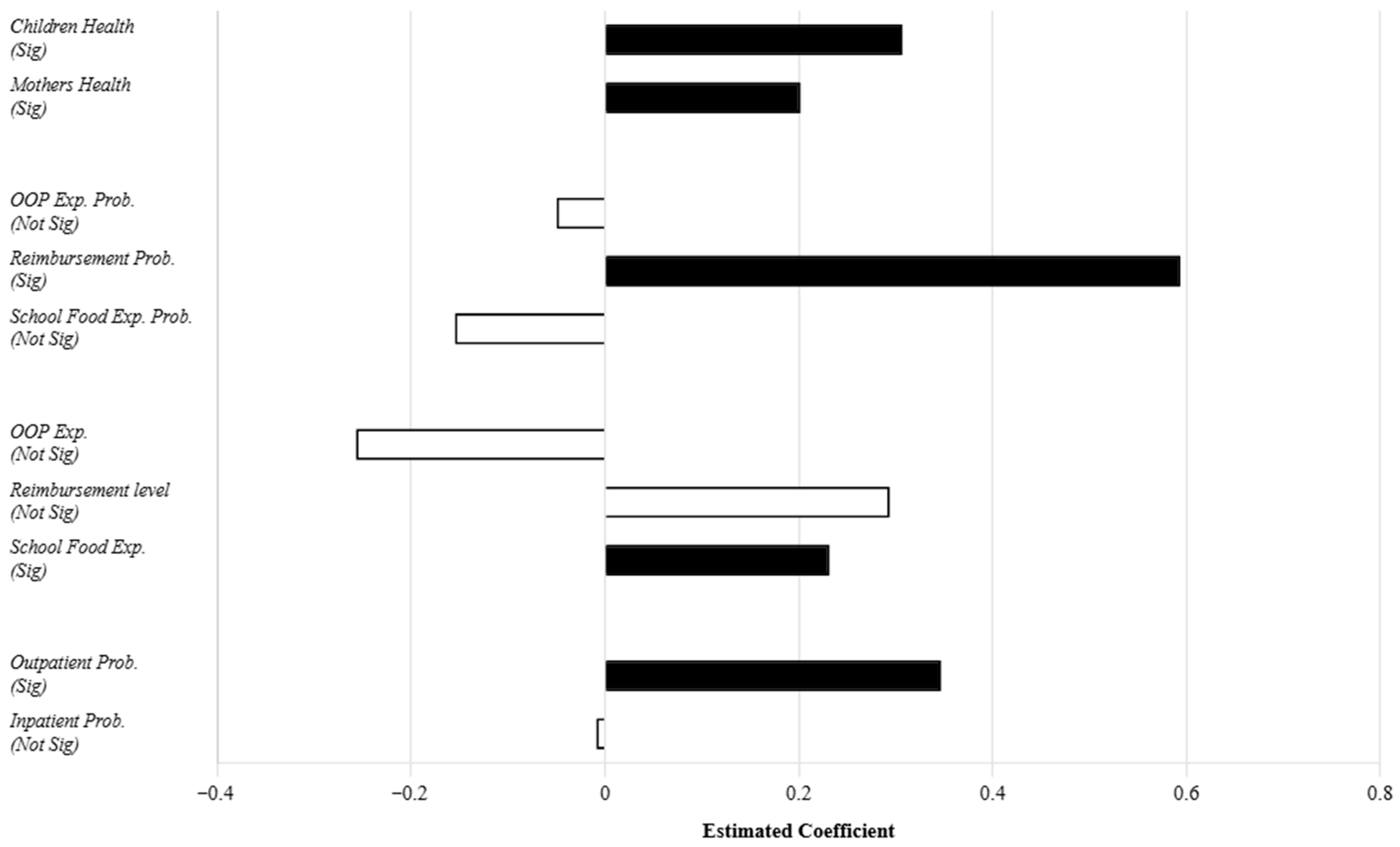
Figure 2 summarizes the estimated coefficients of the outpatient cost-sharing policy across key outcome variables. Notably, the contrast between greater outpatient visits and stable out-of-pocket expenditure probability may suggest the policy relates to the “site of care” rather than the “decision to seek treatment.” One plausible explanation is that, prior to the implementation of the outpatient cost-sharing policy, as outpatient care at formal hospitals was not reimbursed, households confronted with minor illnesses or common diseases in children may have been more inclined to purchase medication directly from nearby pharmacies—a practice known as “self-medication.” The outpatient cost-sharing policy is theoretically associated with a lower relative price of formal medical services. Consequently, it is possible that parents might be less inclined to purchase medication from pharmacies and more likely to take their children to hospital outpatient departments. Thus, its association with better access to formal care may be through altering care-seeking behavior, rather than expanding the pool of the “paying population”, as sick children inevitably incur costs.
4. Discussion
This study evaluates the association between outpatient cost-sharing and rural child health and economic outcomes. Regarding the analysis of multiple outcomes, we view health, expenditure, and utilization as distinct dimensions based on a specific theoretical framework. Therefore, we consider these results to exhibit internal consistency and present unadjusted estimates. Key findings include:
First, the policy is significantly associated with better health scores and an increase in probability of outpatient visits. This may suggest that rural households are price-sensitive. The significant increase in reimbursement probability could indicate that the policy’s value lies in covering high-frequency, common outpatient expenses. We also find that the positive associations between the policy and child health outcomes appear to be connected to better mother’s health and greater school-related food and accommodation expenses.
Second, a key economic finding of this study is the possible rigid nature of demand for pediatric inpatient care. Unlike studies focusing on the elderly or patients with chronic diseases [
34,
35], we found the association of the policy variable with the probability of outpatient service utilization is significant, while the association with the probability of inpatient service utilization is statistically insignificant, which possibly means no substitution for children. This highlights the unique economics of pediatric care. As mentioned earlier, the reason for this difference may lie in the acute nature of childhood illness and the agency model of pediatric medical decision-making.
From an international perspective, this finding also contrasts with conclusions based on developed countries. Those studies might view greater outpatient use without decreased inpatient use as inefficient, because the goal of cost containment has not been achieved. However, in the context of rural China’s “under-utilization”, this represents a positive outcome. It suggests that the policy may be associated with the fulfillment of necessary demand and more comprehensive early intervention, which means better service balance.
Third, these findings have profound implications for rural sector. In the rural context, primary healthcare institutions are the main providers of outpatient services. This policy may be associated with a tendency for rural pediatric patients to utilize local clinics due to reimbursement incentives, which is the key for the issue of imbalanced resource allocation under the dual structure. This could indicate that for rural China, this policy is not only a financial tool, but also a means to potentially optimize the allocation of scarce pediatric resources.
Furthermore, while cross-sectional data limit our ability to trace long-term outcomes directly, our empirical results could imply potential long-term benefits. For instance, the policy is associated with higher household investment in child school-related food and accommodation expenses. According to the theory of early human capital formation, school-age health inputs are foundational for future cognitive development [
36].
Limitations: We acknowledge that reliance on cross-sectional data limits the ability to draw definitive causal conclusions. Therefore, the relationships identified should be interpreted as associations rather than strictly causal effects. Future research should utilize panel data or quasi-experimental designs to achieve causal inference and explore long-term human capital effects.
5. Conclusions
This study provides new evidence that the outpatient cost-sharing policy is associated with better health for rural Chinese children. It also explores the potential factors by discussing mother health, school-related food and accommodation expenses, and medical-seeking behavior. Uniquely, we find pediatric inpatient demand is rigid, challenging the “outpatient-substituting-inpatient” logic derived from adult studies.
Our findings are consistent with some other international evidence. For instance, Kang et al. (2022) found that in Japan, lower co-payments improved children’s health status and increased outpatient utilization without reducing inpatient care [
37], suggesting that substitution is not the primary driver. Evidence from diverse contexts, including China, Pakistan, and the U.S., indicates that health insurance promotes child health via multifaceted pathways, including enhanced maternal health and increased spending on children’s food [
38,
39,
40].
Based on the observed associations, we suggest the following policy implications for consideration to further optimize China’s rural child medical security system:
Consider Broader Implementation: The positive associations observed in this study suggest that the policy aligns well with children’s “outpatient-heavy” healthcare needs, which may inform policymakers to expand the policy to include more rural children.
Refine Evaluation Metrics: Our findings suggest that traditional metrics focusing solely on cost containment or inpatient substitution may not fully capture the policy’s value for children. Future evaluations might benefit from prioritizing metrics such as health outcomes and accessibility.