A Novel Strategy for Understanding What Patients Value Most in Informed Consent Before Surgery



Abstract
1. Introduction
2. Materials and Methods
2.1. Sample
2.2. Design
2.3. Procedure and Materials
2.4. Data Analysis
3. Results
Descriptive Analysis
4. Discussion
5. Conclusions
Author Contributions
Funding
Institutional Review Board Statement
Informed Consent Statement
Data Availability Statement
Acknowledgments
Conflicts of Interest
References
- Beauchamp, T.L.; Childress, J.F. Principles of Biomedical Ethics; Oxford University Press: Oxford, UK, 2012; ISBN 978-0199924585. [Google Scholar]
- Schenker, Y.; Meisel, A. Informed consent in clinical care: Practical considerations in the effort to achieve ethical goals. JAMA 2011, 305, 1130–1131. [Google Scholar] [CrossRef] [Scilit]
- Shamir, E.R.; Ewald, A.J. Three-dimensional organotypic culture: Experimental models of mammalian biology and disease. Nat. Rev. Mol. Cell Biol. 2014, 15, 647–664. [Google Scholar] [CrossRef] [Scilit]
- Kinnersley, P.; Phillips, K.; Savage, K.; Kelly, M.J.; Farrell, E.; Morgan, B.; Whistance, R.; Lewis, V.; Mann, M.K.; Stephens, B.L.; et al. Interventions to promote informed consent for patients undergoing surgical and other invasive healthcare procedures. Cochrane Database Syst. Rev. 2013, CD009445. [Google Scholar] [CrossRef] [Scilit] [PubMed]
- Falagas, M.E.; Korbila, I.P.; Giannopoulou, K.P.; Kondilis, B.K.; Peppas, G. Informed consent: How much and what do patients understand? Am. J. Surg. 2009, 198, 420–435. [Google Scholar] [CrossRef] [Scilit]
- Gabay, G.; Bokek-Cohen, Y. What do patients want? Surgical informed-consent and patient-centered care—An augmented model of information disclosure. Bioethics 2020, 34, 467–477. [Google Scholar] [CrossRef] [Scilit] [PubMed]
- Gabay, G.; Bokek-Cohen, Y. Infringement of the right to surgical informed consent: Negligent disclosure and its impact on patient trust in surgeons at public general hospitals—The voice of the patient. BMC Med. Ethics 2019, 20, 77. [Google Scholar] [CrossRef] [Scilit]
- Nebeker, C.; Harlow, J.; Giacinto, R.E.; Orozco-Linares, R.; Bloss, C.S.; Weibel, N. Ethical and regulatory challenges of research using pervasive sensing and other emerging technologies: IRB perspectives. AJOB Empir. Bioeth. 2017, 8, 266–276. [Google Scholar] [CrossRef] [Scilit] [PubMed]
- Grady, C. Enduring and emerging challenges of informed consent. N. Engl. J. Med. 2015, 372, 2172. [Google Scholar] [CrossRef] [Scilit]
- Hall, D.E.; Prochazka, A.V.; Fink, A.S. Informed consent for clinical treatment. Can. Med. Assoc. J. 2012, 184, 533–540. [Google Scholar] [CrossRef] [Scilit]
- Leclercq, W.K.G.; Keulers, B.J.; Scheltinga, M.R.M.; Spauwen, P.H.M.; van der Wilt, G.-J. A review of surgical informed consent: Past, present, and future. A quest to help patients make better decisions. World J. Surg. 2010, 34, 1406–1415. [Google Scholar] [CrossRef] [Scilit]
- Wang, Y.; Liu, Z.; Chen, S.; Ye, X.; Xie, W.; Hu, C.; Iezzi, T.; Jackson, T. Pre-surgery beliefs about pain and surgery as predictors of acute and chronic post-surgical pain: A prospective cohort study. Int. J. Surg. 2018, 52, 50–55. [Google Scholar] [CrossRef] [Scilit] [PubMed]
- Banja, J. The normalization of deviance in healthcare delivery. Bus. Horiz. 2010, 53, 139. [Google Scholar] [CrossRef] [Scilit]
- Faghanipour, S.; Joolaee, S.; Sobhani, M. Surgical informed consent in Iran—How much is it informed? Nurs. Ethics 2014, 21, 314–322. [Google Scholar] [CrossRef] [Scilit]
- Krumholz, H.M. Informed Consent to Promote Patient-Centered Care. JAMA 2010, 303, 1190–1191. [Google Scholar] [CrossRef] [Scilit]
- Ochieng, J.; Buwembo, W.; Munabi, I.; Ibingira, C.; Kiryowa, H.; Nzarubara, G.; Mwaka, E. Informed consent in clinical practice: Patients’ experiences and perspectives following surgery. BMC Res. Notes 2015, 8, 765. [Google Scholar] [CrossRef] [Scilit]
- Ripley, B.A.; Tiffany, D.; Lehmann, L.S.; Silverman, S.G. Improving the Informed Consent Conversation: A Standardized Checklist that Is Patient Centered, Quality Driven, and Legally Sound. J. Vasc. Interv. Radiol. 2015, 26, 1639–1646. [Google Scholar] [CrossRef] [Scilit]
- Somer, E.; Soffer-Dudek, N.; Ross, C.A.; Halpern, N. Maladaptive daydreaming: Proposed diagnostic criteria and their assessment with a structured clinical interview. Psychol. Conscious. Theory Res. Pract. 2017, 4, 176–189. [Google Scholar] [CrossRef] [Scilit]
- Sandberg, E.H.; Sharma, R.; Sandberg, W.S. Deficits in retention for verbally presented medical information. Anesthesiology 2012, 117, 772–779. [Google Scholar] [CrossRef] [Scilit]
- West, A.M.; Bittner, E.A.; Ortiz, V.E. The effects of preoperative, video-assisted anesthesia education in Spanish on Spanish-speaking patients’ anxiety, knowledge, and satisfaction: A pilot study. J. Clin. Anesth. 2014, 26, 325–329. [Google Scholar] [CrossRef] [Scilit]
- Bagheri, M.; Maleki, M.; Mardani, A.; Momen-beromi, M.H.; Daliri, S.; Rezaie, S. The effect of video training and intraoperative progress report on the anxiety of family caregivers waiting for relatives undergoing surgery. Heliyon 2022, 8, e10065. [Google Scholar] [CrossRef] [Scilit]
- De Oliveira, G.S.; Holl, J.L.; McCarthy, R.J.; Butt, Z.A.; Nouriel, J.; McCaffery, K.; Wolf, M.S. Overestimation of mortality risk and preoperative anxiety in patients undergoing elective general surgery procedures: A propensity matched analysis. Int. J. Surg. 2014, 12, 1473–1477. [Google Scholar] [CrossRef] [Scilit] [PubMed]
- Kagan, I.; Bar-Tal, Y. The effect of preoperative uncertainty and anxiety on short-term recovery after elective arthroplasty. J. Clin. Nurs. 2008, 17, 576–583. [Google Scholar] [CrossRef] [Scilit] [PubMed]
- Starkweather, A.R.; Witek-Janusek, L.; Nockels, R.P.; Peterson, J.; Mathews, H.L. Immune function, pain, and psychological stress in patients undergoing spinal surgery. Spine 2006, 31, E641–E647. [Google Scholar] [CrossRef] [Scilit] [PubMed]
- Burkle, C.M.; Pasternak, J.J.; Armstrong, M.H.; Keegan, M.T. Patient perspectives on informed consent for anaesthesia and surgery: American attitudes. Acta Anaesthesiol. Scand. 2013, 57, 342–349. [Google Scholar] [CrossRef] [Scilit]
- Delcambre, M.; Haynes, D.; Hajar, T.; Golden, S.; Bar, A.; Latour, E.; Leitenberger, J.J. Using a Multimedia Tool for Informed Consent in Mohs Surgery: A Randomized Trial Measuring Effects on Patient Anxiety, Knowledge, and Satisfaction. Dermatol. Surg. 2020, 46, 591–598. [Google Scholar] [CrossRef] [Scilit]
- Goldberger, J.J.; Kruse, J.; Kadish, A.H.; Passman, R.; Bergner, D.W. Effect of informed consent format on patient anxiety, knowledge, and satisfaction. Am. Heart J. 2011, 162, 780–785.e1. [Google Scholar] [CrossRef] [Scilit]
- Yucel, A.; Gecici, O.; Emul, M.; Oyar, O.; Gulsoy, U.K.; Dayanir, Y.O.; Acar, M.; Degirmenci, B.; Haktanir, A. Effect of Informed Consent for Intravascular Contrast Material on the Level of Anxiety: How Much Information Should Be Given? Acta Radiol. 2005, 46, 701–707. [Google Scholar] [CrossRef] [Scilit]
- Perin, A.; Galbiati, T.F.; Ayadi, R.; Gambatesa, E.; Orena, E.F.; Riker, N.I.; Silberberg, H.; Sgubin, D.; Meling, T.R.; DiMeco, F. Informed consent through 3D virtual reality: A randomized clinical trial. Acta Neurochir. 2021, 163, 301–308. [Google Scholar] [CrossRef] [Scilit]
- Ding, L.; Hua, H.; Zhu, H.; Zhu, S.; Lu, J.; Zhao, K.; Xu, Q. Effects of virtual reality on relieving postoperative pain in surgical patients: A systematic review and meta-analysis. Int. J. Surg. 2020, 82, 87–94. [Google Scholar] [CrossRef] [Scilit]
- Zhuo, Q.; Ma, F.; Cui, C.; Bai, Y.; Hu, Q.; Hanum, A.L.; Wei, W.; Liang, H. Effects of pre-operative education tailored to information-seeking styles on pre-operative anxiety and depression among patients undergoing percutaneous coronary intervention: A randomized controlled trial. Int. J. Nurs. Sci. 2023, 10, 174–181. [Google Scholar] [CrossRef] [Scilit]
- Al-Hemiary, N.J.; Cucchi, A.; Al-Nuaimi, A.S.; Al-Saffar, H.; Al-Ani, K. Inter-personal versus content: Assessment of communication skills in Iraqi physicians. Heliyon 2020, 6, e05145. [Google Scholar] [CrossRef] [Scilit] [PubMed]
- Gabay, G. Patient Self-worth and Communication Barriers to Trust of Israeli Patients in Acute-Care Physicians at Public General Hospitals. Qual. Health Res. 2019, 29, 1954–1966. [Google Scholar] [CrossRef] [Scilit] [PubMed]
- Hupcey, J.E.; Penrod, J.; Morse, J.M. Establishing and maintaining trust during acute care hospitalizations. Sch. Inq. Nurs. Pract. 2000, 14, 227–228. [Google Scholar] [PubMed]
- Hupcey, J.E. Maintaining Validity: The Development of the Concept of Trust. Int. J. Qual. Methods 2002, 1, 45–53. [Google Scholar] [CrossRef] [Scilit]
- Schmitz, D.; Reinacher, P.C. Informed consent in neurosurgery–translating ethical theory into action. J. Med. Ethics 2006, 32, 497–498. [Google Scholar] [CrossRef] [Scilit]
- Hammami, M.M.; Al-Jawarneh, Y.; Hammami, M.B.; Al Qadire, M. Information disclosure in clinical informed consent: “Reasonable” patient’s perception of norm in high-context communication culture. BMC Med. Ethics 2014, 15, 3. [Google Scholar] [CrossRef] [Scilit]
- Schenker, Y.; Fernandez, A.; Sudore, R.; Schillinger, D. Interventions to improve patient comprehension in informed consent for medical and surgical procedures: A systematic review. Med. Decis. Mak. 2011, 31, 151–173. [Google Scholar] [CrossRef] [Scilit]
- Jaeger, S.R.; Mielby, L.H.; Heymann, H.; Jia, Y.; Frøst, M.B. Analysing conjoint data with OLS and PLS regression: A case study with wine. J. Sci. Food Agric. 2013, 93, 3682–3690. [Google Scholar] [CrossRef] [Scilit]
- Green, P.E.; Carmone, F.J.; Schaffer, C.M. An Individual Importance Weights Model for Conjoint Analysis BT—Data, Expert Knowledge and Decisions. In Data, Expert Knowledge and Decisions; Gaul, W., Schader, M., Eds.; Springer: Berlin/Heidelberg, Germany, 1988; pp. 250–257. ISBN 978-3-642-73489-2. [Google Scholar]
- Green, P.E.; Rao, V.R. Conjoint Measurement for Quantifying Judgmental Data. J. Mark. Res. 1971, 8, 355–363. [Google Scholar] [CrossRef] [Scilit]
- Moskowitz, H.R. Base size in product testing: A psychophysical viewpoint and analysis. Food Qual. Prefer. 1997, 8, 247–255. [Google Scholar] [CrossRef] [Scilit]
- Gere, A.; Zemel, R.; Papajorgij, P.; Radványi, D.; Moskowitz, H. Chapter 3—Public driven and public perceptible innovation of environmental sector. In Innovation Strategies in Environmental Science; Galanakis, C.M., Ed.; Elsevier: Amsterdam, The Netherlands, 2019; pp. 69–106. ISBN 978-0-12-817382-4. [Google Scholar]
- Gere, A.; Moskowitz, H. Chapter 9 Assigning People to Empirically Uncovered Mind-sets: A New Horizon to Understand the Minds and Behaviors of People. In Consumer-Based New Product Development for the Food Industry; The Royal Society of Chemistry: London, UK, 2021; pp. 132–149. ISBN 978-1-83916-139-1. [Google Scholar]
- Kirk, R.E. Experimental Design. In Handbook of Psychology; Weiner, I.B., Schinka, J.A., Velicer, W.F., Eds.; Wiley: Hoboken, NJ, USA, 2012; pp. 23–46. ISBN 978-0-470-89064-6. [Google Scholar]
- Gofman, A.; Moskowitz, H. Isomorphic Permuted Experimental Designs and Their Application in Conjoint Analysis. J. Sens. Stud. 2010, 25, 127–145. [Google Scholar] [CrossRef] [Scilit]
- Charrad, M.; Ghazzali, N.; Boiteau, V.; Niknafs, A. NbClust: An R Package for Determining the Relevant Number of Clusters in a Data Set. J. Stat. Softw. 2014, 61, 1–36. [Google Scholar] [CrossRef] [Scilit]
- Milligan, G.W. A monte carlo study of thirty internal criterion measures for cluster analysis. Psychometrika 1981, 46, 187–199. [Google Scholar] [CrossRef] [Scilit]
- Ankuda, C.K.; Block, S.D.; Cooper, Z.; Correll, D.J.; Hepner, D.L.; Lasic, M.; Gawande, A.A.; Bader, A.M. Measuring critical deficits in shared decision making before elective surgery. Patient Educ. Couns. 2014, 94, 328–333. [Google Scholar] [CrossRef] [Scilit]
- McKneally, M.F.; Martin, D.K.; Ignagni, E.; D’Cruz, J. Responding to trust: Surgeons’ perspective on informed consent. World J. Surg. 2009, 33, 1341–1347. [Google Scholar] [CrossRef] [Scilit]
- Sarela, A.I.; Thomson, M. Balancing law, ethics and reality in informed consent for surgery. Ann. R. Coll. Surg. Engl. 2014, 96, 329–330. [Google Scholar] [CrossRef] [Scilit]
- Su, C.-L.; Chiang, L.-L.; Yang, S.-H.; Lin, H.-Y.; Cheng, K.-C.; Huang, Y.-C.T.; Wu, C.-P. Preventive Use of Noninvasive Ventilation After Extubation: A Prospective, Multicenter Randomized Controlled Trial. Respir. Care 2012, 57, 204–210. [Google Scholar] [CrossRef] [Scilit]
- Coulter, A. After Bristol: Putting patients at the centre. BMJ 2002, 324, 648–651. [Google Scholar] [CrossRef] [Scilit]
- Jones, J.W.; McCullough, L.B.; Richman, B.W. A Comprehensive Primer of Surgical Informed Consent. Surg. Clin. N. Am. 2007, 87, 903–918. [Google Scholar] [CrossRef] [Scilit]
- Doyen, B.; Vlerick, P.; Maertens, H.; Vermassen, F.; Van Herzeele, I. Non-technical attributes and surgical experience: A cross-sectional study comparing communication styles and attitudes in surgical staff, trainees and applicants. Int. J. Surg. 2019, 63, 83–89. [Google Scholar] [CrossRef] [Scilit]



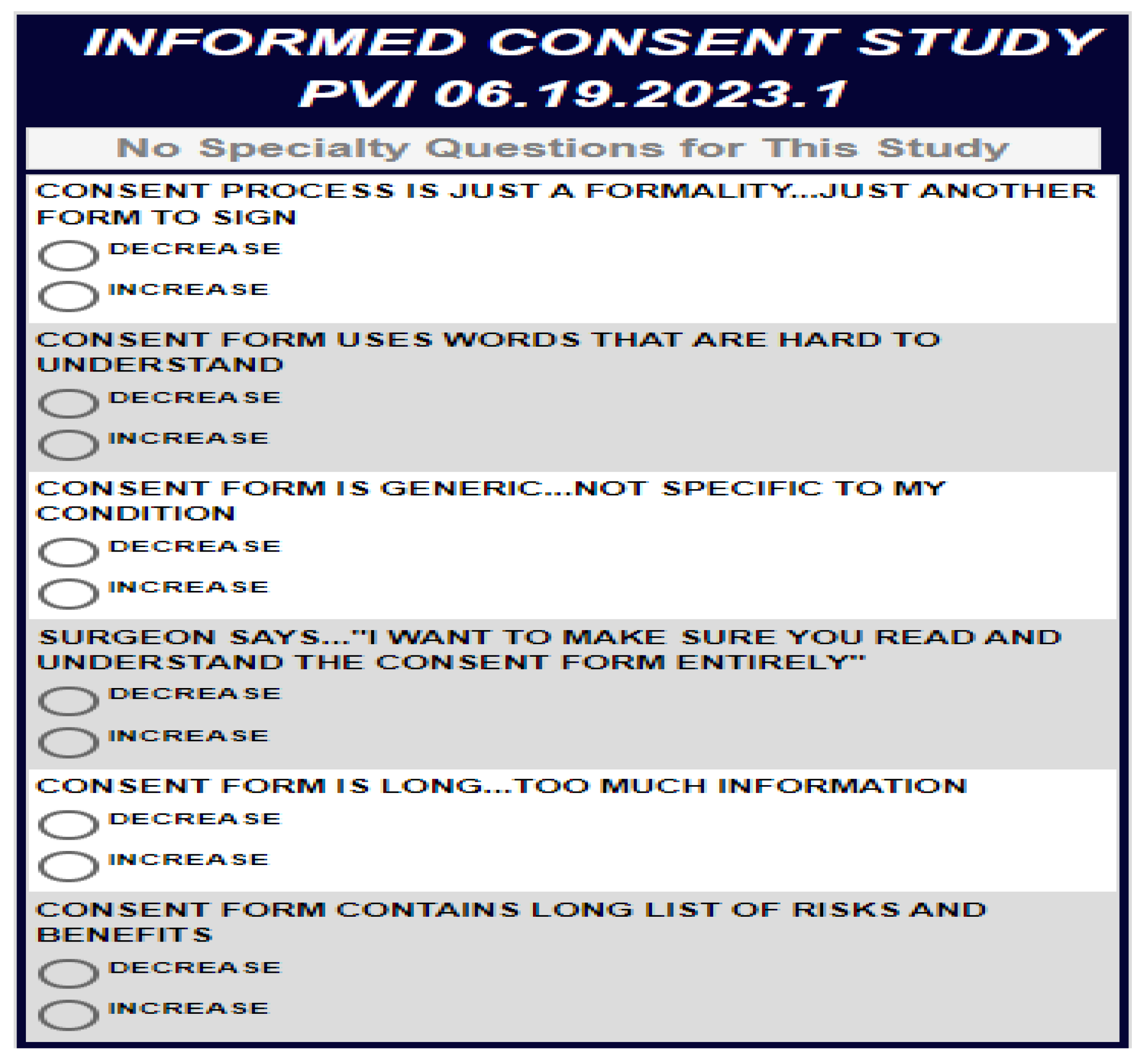
| Question A—What is “Unfriendly” about the IC? | |
| A1 | The informed consent form (ICF) is long… too much information. |
| A2 | The ICF uses words that are hard to understand. |
| A3 | The ICF is specific to my condition. |
| A4 | The ICF contains a long list of risks and benefits. |
| A5 | The ICF is generic… not specific to my condition. |
| A6 | The ICF is too technical, I need legal/medical knowledge to understand. |
| Question B—How can the consent form be friendly? | |
| B1 | The IC process is patient-centered, educating on risks/benefits of procedure. |
| B2 | The IC process only for signing form… just protects hospital and doctor. |
| B3 | The IC process… full discussion of the risks/benefits/alternatives. |
| B4 | Giving consent is more than just a legal release. |
| B5 | The consent process is there to protect you… the patient. |
| B6 | The consent process is just a formality… just another form to sign. |
| Question C—What IC process makes you feel comfortable? | |
| C1 | Receive information both orally and written… patient’s fundamental right. |
| C2 | Everything is provided in clear and simple terms. |
| C3 | Information is tailored to me… to my situation. |
| C4 | Afterwards… I can explain back important information… understand the conversation. |
| C5 | A fact sheet is given to explain why IC is important. |
| C6 | Once informed, you could decline the procedure. |
| Question D—What is a situation in which the IC process fails? | |
| D1 | Requires giving consent when you’re not feeling well. |
| D2 | I don’t understand the medical terminology. |
| D3 | I’m embarrassed to reveal to the medical staff that I don’t understand. |
| D4 | I’m rushed and there is not enough time to make a decision |
| D5 | There is too little time given to read the consent form. |
| D6 | Lack of information… What am I signing? What’s the purpose? |
| Question E—What is the language you prefer that the surgeon to use? | |
| E1 | Surgeon says, “This form gives me permission to perform the procedure… sign here.” |
| E2 | Surgeon says, “Do you have any other questions or concerns?” |
| E3 | Surgeon says, “Let’s go over the entire consent form.” |
| E4 | Surgeon says, “Let me highlight only relevant information.” |
| E5 | Surgeon says, “I want to make sure you read and understand the consent form entirely.” |
| E6 | The surgeon is the one explaining things. |
| Question F—How may the IC process occur? | |
| F1 | Sign consent form minutes before procedure. |
| F2 | Receive the form to read days prior to procedure… when possible. |
| F3 | Give consent over the phone. |
| F4 | Get the IC done in the doctor’s office. |
| F5 | Obtain IC over electronic means… video call, FaceTime, Skype. |
| F6 | Give consent when family is present for better decision-making. |
| Demographic Variable | Levels | N | Percentage |
|---|---|---|---|
| Sex | Male | 37 | 36% |
| Female | 67 | 64% | |
| Age (years) | 18–29 | 3 | 3% |
| 30–39 | 23 | 22% | |
| 40–49 | 13 | 12% | |
| 50–59 | 23 | 22% | |
| 60–69 | 19 | 18% | |
| 70–79 | 20 | 19% | |
| 80 years and older | 3 | 3% | |
| Race | White | 85 | 82% |
| Black/African American | 12 | 12% | |
| Hispanic | 2 | 2% | |
| Native American | 1 | 1% | |
| Asian | 2 | 2% | |
| Other | 2 | 2% | |
| Marital status | Married | 53 | 51% |
| Divorced | 18 | 17% | |
| Never married | 22 | 21% | |
| Widow/widower | 11 | 11% | |
| Household income in the last 12 months, USD | <20,000 | 19 | 18% |
| 20,000 to 49,000 | 47 | 45% | |
| 50,000 to 99,000 | 28 | 27% | |
| 100,000 to 149,000 | 7 | 7% | |
| 150,000 to 199,000 | 3 | 3% | |
| Level of education | Less than high school | 0 | 0% |
| High school or equivalent | 25 | 24% | |
| Some college | 27 | 26% | |
| Associate degree | 18 | 17% | |
| Bachelor’s degree | 24 | 23% | |
| Graduate or professional degree | 10 | 10% | |
| Size of the household (including the respondent) | 1 | 26 | 25% |
| 2 | 42 | 40% | |
| 3 | 14 | 13% | |
| 4 | 17 | 16% | |
| 5 | 2 | 2% | |
| 6 or more | 3 | 3% | |
| Place of residence | City/urban | 27 | 26% |
| Suburban | 47 | 45% | |
| Rural | 30 | 29% |
| IC—Increased Anxiety | Value | S.E. | |
|---|---|---|---|
| Additive Constant | 40.3 | ||
| A1 | The ICF is long, too much information. | 2 | 0.03 |
| A2 | The ICF uses words that are hard to understand. | 6 | 0.19 |
| A3 | The ICF is specific to my condition. | −3 | 0.09 |
| A4 | The ICF contains long list of risks and benefits. | −1 | 0.08 |
| A5 | The ICF is generic… not specific to my condition. | 4 | 0.12 |
| A6 | The ICF is too technical… need legal/medical knowledge to understand. | 2 | 0.05 |
| B1 | The IC process is patient centered educating on risks/benefits of procedure. | −6 | 0.17 |
| B2 | The IC process for signing form… just protects hospital and doctor. | 1 | 0.03 |
| B3 | The IC process… full discussion of the risks/benefits/alternatives. | −4 | 0.26 |
| B4 | Giving consent is more than just a legal release. | −1 | 0.06 |
| B5 | The IC process is there to protect you… the patient. | −3 | 0.05 |
| B6 | The IC process is just a formality… just another form to sign. | −2 | 0.07 |
| C1 | Receive information both orally and written… patient’s fundamental right. | −5 | 0.49 |
| C2 | Everything is provided in clear and simple terms. | −10 | 0.25 |
| C3 | Information is tailored to me… my situation. | −7 | 0.26 |
| Afterwards, I can explain back important information, understand the conversation. | −1 | 0.05 | |
| C5 | A fact sheet given to explain why informed consent is important. | −6 | 0.05 |
| C6 | Once informed, you could decline the procedure. | −3 | 0.04 |
| D1 | Requiring giving consent when I’m not feeling well. | 6 | 0.04 |
| D2 | Don’t understand the medical terminology. | 8 | 0.73 |
| D3 | Embarrassed to reveal to the medical staff that I don’t understand. | 9 | 0.81 |
| D4 | IC is rushed, not enough time to make a decision | 12 | 1.11 |
| D5 | Too little time given to actually read the consent form | 11 | 0.29 |
| D6 | Lack of information… What am I signing? What’s the purpose? | 7 | 0.32 |
| E1 | Surgeon says, “This form gives me permission to perform the procedure… sign here” | 2 | 0.13 |
| E2 | Surgeon says, “Do you have any other questions or concerns?” | −8 | 0.59 |
| E3 | Surgeon says, “Let’s go over the entire consent form” | −12 | 0.58 |
| E4 | Surgeon says, “Let me highlight only relevant information” | −1 | 0.02 |
| E5 | Surgeon says, “I want to make sure you read and understand the consent form entirely” | −10 | 0.05 |
| E6 | The surgeon is the one explaining things | −6 | 0.23 |
| F1 | Sign consent form minutes before procedure | 7 | 0.02 |
| F2 | Receive the form to read days prior to procedure when possible | −7 | 0.4 |
| F3 | Ok to give consent over the phone | 3 | 0.17 |
| F4 | Get it done in the doctor’s office | 0 | 0.01 |
| F5 | Obtain over electronic means… video call, FaceTime, Skype | 0 | 0.03 |
| F6 | Consent given when family present… better decision-making | −6 | 0.46 |
| IC—Increased Anxiety | MS 1 | MS2 | MS 3 | |
|---|---|---|---|---|
| 63% | 18% | 19% | ||
| Additive Constant | 35b | 73a | 153c | |
| A1 | The ICF is long, too much information | 5b | 58c | −34a |
| A2 | The ICF uses words that are hard to understand | 6b | 49c | −33a |
| A3 | The ICF is specific to my condition | 2b | 37c | −41a |
| A4 | The ICF contains long list of risks and benefits | 1b | 43c | −46a |
| A5 | The ICF is generic… not specific to my condition | 12b | 43c | −58a |
| A6 | The ICF is too technical, I need legal/medical knowledge to understand | 0b | 44c | −28a |
| B1 | The ICF is patient-centered, educating about risks/benefits of procedure | −4b | 32c | −39a |
| B2 | The IC process only for signing form… just protects hospital and doctor. | −1b | 33c | −25a |
| B3 | The IC process… full discussion of the risks/benefits/alternatives | −1b | 35c | −37a |
| B4 | Giving consent is more than just a legal release | 1b | 47c | −22a |
| B5 | The IC process is there to protect you… the patient | −2b | 45c | −27a |
| B6 | The IC process is just a formality… just another form to sign | −1a | 51b | −19a |
| C1 | Receive information both orally and written… patient’s fundamental right | −2b | 36c | −29a |
| C2 | Everything is provided in clear and simple terms | −0b | 17b | −30a |
| C3 | Information is tailored to me… my situation | −6b | 40c | −33a |
| Afterwards… I can explain back important information… understand the conversation | 0a | 34b | −21a | |
| C5 | A fact sheet is given to explain why informed consent is important | −4b | 34c | −40a |
| C6 | Once informed, you could decline the procedure | 0a | 23b | −19a |
| D1 | Requiring giving consent when I’m not feeling well | 8b | 47c | −23a |
| D2 | Don’t understand the medical terminology | 8b | 39c | −13a |
| D3 | Embarrassed to reveal to the medical staff that I don’t understand | 5b | 42c | −27a |
| D4 | IC is rushed, not enough time to make a decision | 10b | 46c | −20a |
| D5 | Too little time is given to actually read the consent form | 13b | 32b | 0a |
| D6 | Lack of information… What am I signing? What’s the purpose? | 6b | 44c | −22a |
| E1 | Surgeon says, “This form gives me permission to perform the procedure… sign here” | −2a | 22b | −25a |
| E2 | Surgeon says, “Do you have any other questions or concerns?” | −5b | 2b | −34a |
| E3 | Surgeon says, “Let’s go over the entire consent form” | −18a | 17b | −44a |
| E4 | Surgeon says, “Let me highlight only relevant information” | 0b | 25c | −36a |
| E5 | Surgeon says, ”I want to make sure you read and understand the consent form entirely” | −3.7b | 10b | −51a |
| E6 | The surgeon is the one explaining things | −6b | 26c | −37a |
| F1 | Sign ICF minutes before procedure | 3b | 47c | −33a |
| F2 | Receive the ICF to read days prior to procedure… when possible | −4b | 18b | −38a |
| F3 | Ok to give consent over the phone | −6b | 18b | −29a |
| F4 | Get it done in the doctor’s office | −1b | 19b | −36a |
| F5 | Obtain over electronic means… video call, FaceTime, Skype | −0b | 20b | −39a |
| F6 | Consent given when family present… better decision-making | −15b | 8c | −45a |
| IC—Decreased Anxiety | MS 1 | MS 2 | MS 3 | |
|---|---|---|---|---|
| SIZE | 73 | 13 | 18 | |
| Additive Constant | 11b | 104a | 123c | |
| A1 | The ICF is long, too much information | −5b | 48c | −36a |
| A2 | The ICF uses words that are hard to understand | −5b | 32c | −30a |
| A3 | The ICF is specific to my condition | 4b | 44c | −16a |
| A4 | The ICF contains long list of risks and benefits | −1b | 44c | −30a |
| A5 | The ICF is generic… not specific to my condition | −3b | 48c | −42a |
| A6 | The ICF is too technical, I need legal/medical knowledge to understand | −3b | 24c | −49a |
| B1 | The IC process is patient-centered, educating on risks/benefits of procedure | 5a | 51b | −7a |
| B2 | IC process only for signing form, just protects hospital and doctor | 1b | 48c | −18a |
| B3 | IC process… full discussion of the risks/benefits/alternatives | 6b | 26c | −13a |
| B4 | Giving IC is more than just a legal release | 5b | 35c | −14a |
| B5 | The IC process is there to protect you… the patient | 6b | 40c | −17a |
| B6 | The IC process is just a formality… just another form to sign | −2a | 22b | −20a |
| C1 | Receive information both orally and written about your fundamental rights | 6b | 25b | −19a |
| C2 | Everything is provided in clear and simple terms | 2b | 47c | −26a |
| C3 | Information is tailored to me and my situation | 9b | 44c | −19a |
| C4 | Afterwards, I can explain back important information, understand the conversation | −2b | 26c | −33a |
| C5 | A fact sheet is given to explain why IC is important | 7b | 37c | −31a |
| C6 | Informed, you have the opportunity to decline the procedure | 1b | 42c | −37a |
| D1 | Requiring giving consent when I’m not feeling well | 0b | 8b | −49a |
| D2 | Don’t understand the medical terminology | −5b | 20c | −26a |
| D3 | Embarrassed to reveal to the medical staff that I don’t understand | −1b | 19c | −32a |
| D4 | IC is rushed, not enough time to make a decision | −7b | 13b | −50a |
| D5 | Too little time given to actually read the consent form | 2.b | 13b | −39a |
| D6 | Lack of information on What am I signing? What’s the purpose? | −5b | 27c | −45a |
| E1 | Surgeon says, “This form gives me permission to perform the procedure… sign here” | 1a | 39b | −16a |
| E2 | Surgeon says, “Do you have any other questions or concerns?” | 3a | 55b | −2a |
| E3 | Surgeon says, “Let’s go over the entire consent form” | 9a | 39b | −7a |
| E4 | Surgeon says, “Let me highlight only relevant information” | −2b | 38c | −31a |
| E5 | Surgeon says, “I want to make sure you read and understand the ICF entirely” | 8b | 38c | −13a |
| E6 | The surgeon is the one explaining things | 4b | 46c | −15a |
| F1 | ICF is signed minutes before procedure | −4b | 34c | −40a |
| F2 | Receive the form to read days prior to procedure, when possible | 4b | 31c | −17a |
| F3 | Ok to give consent over the phone | 2b | 32c | −18a |
| F4 | Get it done in the doctor’s office | 1b | 48c | −18a |
| F5 | Obtain over electronic means like video call, FaceTime, Skype | −4b | 39c | −29a |
| F6 | IC is given when the family is present, better decision-making. | 7b | 43c | −25a |
Disclaimer/Publisher’s Note: The statements, opinions and data contained in all publications are solely those of the individual author(s) and contributor(s) and not of MDPI and/or the editor(s). MDPI and/or the editor(s) disclaim responsibility for any injury to people or property resulting from any ideas, methods, instructions or products referred to in the content. |
© 2025 by the authors. Licensee MDPI, Basel, Switzerland. This article is an open access article distributed under the terms and conditions of the Creative Commons Attribution (CC BY) license (https://creativecommons.org/licenses/by/4.0/).
Share and Cite
Gabay, G.; Gere, A.; Zemel, G.; Moskowitz, H. A Novel Strategy for Understanding What Patients Value Most in Informed Consent Before Surgery. Healthcare 2025, 13, 534. https://doi.org/10.3390/healthcare13050534
Gabay G, Gere A, Zemel G, Moskowitz H. A Novel Strategy for Understanding What Patients Value Most in Informed Consent Before Surgery. Healthcare. 2025; 13(5):534. https://doi.org/10.3390/healthcare13050534
Chicago/Turabian StyleGabay, Gillie, Attila Gere, Glenn Zemel, and Howard Moskowitz. 2025. "A Novel Strategy for Understanding What Patients Value Most in Informed Consent Before Surgery" Healthcare 13, no. 5: 534. https://doi.org/10.3390/healthcare13050534
APA StyleGabay, G., Gere, A., Zemel, G., & Moskowitz, H. (2025). A Novel Strategy for Understanding What Patients Value Most in Informed Consent Before Surgery. Healthcare, 13(5), 534. https://doi.org/10.3390/healthcare13050534