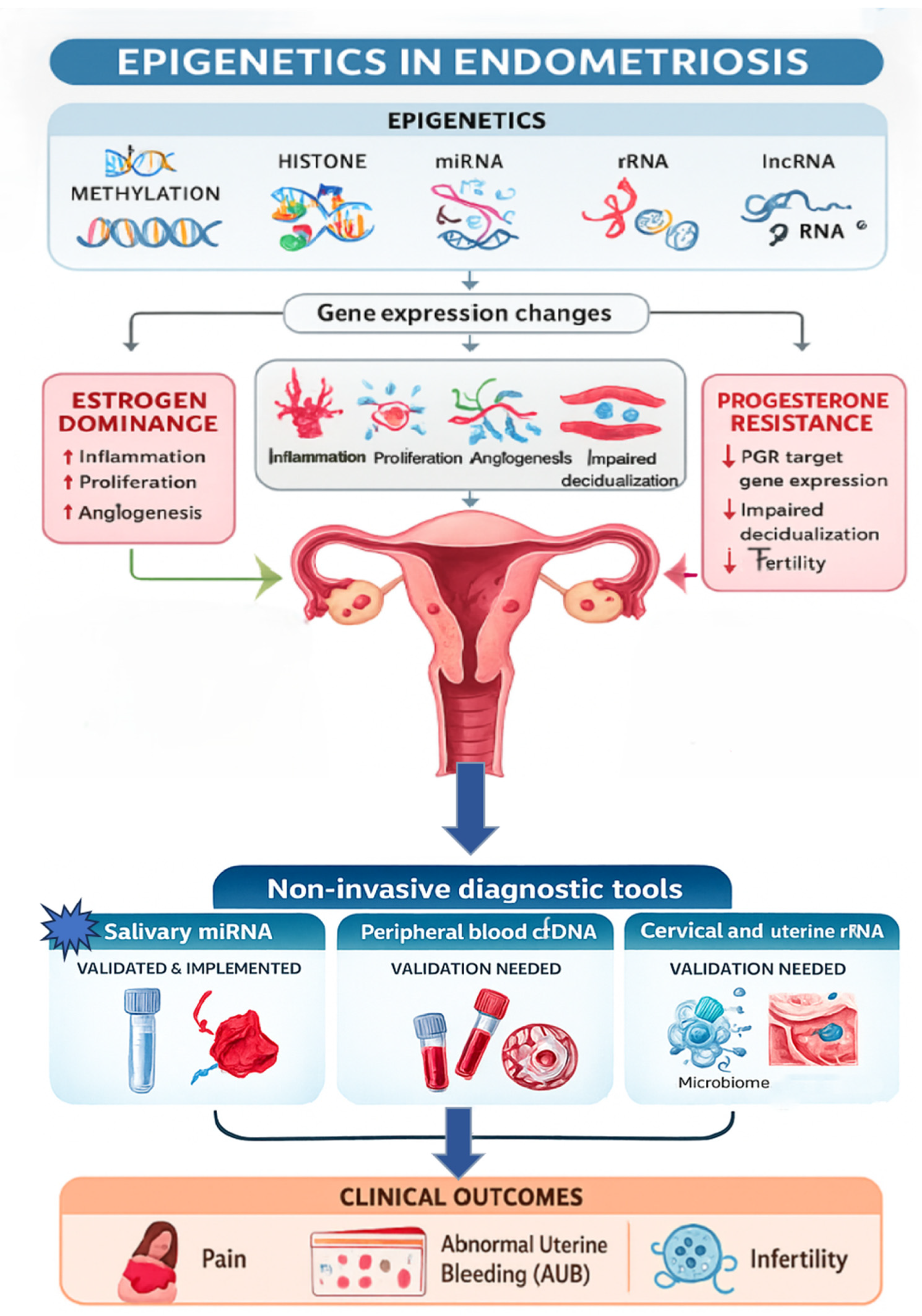
Non-Invasive Methods for Early Diagnosis of Endometriosis—A Comprehensive Narrative Literature Review

 , , and
Abstract
1. Introduction
1.1. Endometriosis and Its Common Definitions
1.2. The Current State of Endometriosis and Its Early Diagnosis
2. Methodological Design
2.1. Study/Framework Aim
2.2. Search Strategy
2.3. Inclusion and Exclusion Criteria
2.4. Selection of Evidence Source
2.5. Sustaining the Concept
3. Fundamental Outcomes in Endometriosis
3.1. Genetics and Their General Implications
3.1.1. Based on DNA
DNA Methylation Changes
Histone Changes
DNA Mutations
3.1.2. Based on RNA
MicroRNA (miRNA)
Ribosomal RNA (rRNA)
Long Non-Coding RNA (lncRNA)
Gene Expression
3.2. Microbiota and Its Possible Link to Endometriosis
3.2.1. Gut Microbiota
3.2.2. Reproductive Tract Microbiota

| Gut Microbiota | Reproductive Tract Microbiota (Vagina, Cervix, Endometrium, Endometriosis Lesions) | |
|---|---|---|
| Different germs | CLOSTRIDIALES CLOSTRIDIA decreased [9] CLOSTRIDIALE LACHNOSPIRACEAE decreased [9] LACHNOSPIRACEAE RUMINOCOCCUS decreased [9,35] FAECALEBACTERIUM increased [9] BIFIDOBACTERIUM increased [6,9] SHIGELLA increased [9] AKKERMANSIA [9] | ATROPOBIUM absent (vagina) [34] UREAPLASMA increased (cervical, endometriosis lesions) [34,48] PSEUDOMONAS increased (endometriosis lesions) [48] ALISHE WANELLA increased (endometriosis lesions) [48] SHIGELLA increased (cervical) [34] FIRMICUTES increased [49] ACTINOBACTERIACEAE decrease (cervical) [49] BACTEROIDES decrease (cervical) [49] DALIASTER- decrease (deep endometriosis) [49] |
| Common germs | LACTOBACILLUS decreased (gut, vagina, cervix, endometrium, fallopian tube) [6,9] ESCHERICHIA COLI increased (gut, endometrium, cervical, vagina) [6,18,34,50] STREPTOCOC increased (gut, endometrium, cervix, endometrioma, deep endometriosis) [6,34,50] ENTEROCOC increased (gut, endometrium, endometriotic lesions) [6,50] PREVOTELLA increased (gut, endometrium) [9,51] GARDNERELLA increased (gut, cervical) [34] | |
4. Clinical Implications of Biomarkers in Endometriosis
4.1. Clinical Implications of DNA. Peripheral Blood cfDNA Methylation Profile
4.2. Clinical Implications of RNA
4.2.1. miRNA Salivary Test
4.2.2. Cervical and Uterine rRNA Microbiota Biomarkers
4.3. An Integrative Appraisal of Non-Invasive Tools in Endometriosis
5. Conclusions
6. Future Directions and Trends
6.1. Improving Early Diagnostic Strategies for Novel Treatments
6.2. The Applicability of Non-Invasive Tests in Endometriosis Diagnosis in Adolescents—A Model of Preventive Medicine
Author Contributions
Funding
Data Availability Statement
Conflicts of Interest
Abbreviations
| AI | Artificial Intelligence |
| AUB | Abnormal Uterine Bleeding |
| CfDNA | Cell-free DNA |
| DNMTs | DNA Methyltransferases; |
| GWAS | Genome-Wide Association Study |
| lnc RNA | Long non-coding RNA |
| cf DNA | Cell-free DNA |
| MRI | Magnetic Resonance Imaging |
| ME | Menstrual Effluent |
| mRNA | Messenger RNA |
| miRNA | MicroRNA |
| NGS | Next-Generation Sequencing |
| PGR | Progesterone Resistance |
| rRNA | Ribosomal RNA |
| snRNA | Small nuclear RNA |
| tRNA | Transfer RNA |
References
- Swift, B.; Taneri, B.; Becker, C.M.; Basarir, H.; Naci, H.; Missmer, S.A.; Zondervan, K.T.; Rahmioglu, N. Prevalence, Diagnostic Delay and Economic Burden of Endometriosis and Its Impact on Quality of Life: Results from an Eastern Mediterranean Population. Eur. J. Public Health 2024, 34, 244–252. [Google Scholar] [CrossRef]
- Ellis, K.; Munro, D.; Clarke, J. Endometriosis Is Undervalued: A Call to Action. Front. Glob. Women’s Health 2022, 3, 902371. [Google Scholar] [CrossRef]
- Marquardt, R.M.; Tran, D.N.; Lessey, B.A.; Rahman, M.S.; Jeong, J.-W. Epigenetic Dysregulation in Endometriosis: Implications for Pathophysiology and Therapeutics. Endocr. Rev. 2023, 44, 1074–1095. [Google Scholar] [CrossRef]
- Yu, J.; Chen, L.-H.; Zhang, B.; Zheng, Q.-M. The Modulation of Endometriosis by lncRNA MALAT1 via NF-κB/iNOS. Eur. Rev. Med. Pharmacol. Sci. 2019, 23, 4073–4080. [Google Scholar] [CrossRef]
- Zubrzycka, A.; Zubrzycki, M.; Perdas, E.; Zubrzycka, M. Genetic, Epigenetic, and Steroidogenic Modulation Mechanisms in Endometriosis. JCM 2020, 9, 1309. [Google Scholar] [CrossRef]
- Kobayashi, H. Gut and Reproductive Tract Microbiota: Insights into the Pathogenesis of Endometriosis (Review). Biomed. Rep. 2023, 19, 43. [Google Scholar] [CrossRef]
- Grigore, M.; Popovici, R.M.; Gafitanu, D.; Himiniuc, L.; Murarasu, M.; Micu, R. Logistic Models and Artificial Intelligence in the Sonographic Assessment of Adnexal Masses—A Systematic Review of the Literature. Med. Ultrason. 2020, 22, 469–475. [Google Scholar] [CrossRef] [PubMed]
- Bendifallah, S.; Dabi, Y.; Suisse, S.; Delbos, L.; Spiers, A.; Poilblanc, M.; Golfier, F.; Jornea, L.; Bouteiller, D.; Fernandez, H.; et al. Validation of a Salivary miRNA Signature of Endometriosis—Interim Data. NEJM Evid. 2023, 2, EVIDoa2200282. [Google Scholar] [CrossRef] [PubMed]
- Huang, L.; Liu, B.; Liu, Z.; Feng, W.; Liu, M.; Wang, Y.; Peng, D.; Fu, X.; Zhu, H.; Cui, Z.; et al. Gut Microbiota Exceeds Cervical Microbiota for Early Diagnosis of Endometriosis. Front. Cell. Infect. Microbiol. 2021, 11, 788836. [Google Scholar] [CrossRef] [PubMed]
- Micu, R.; Petrut, B.; Zlatescu-Marton, C.; Traila, A.; Harsa, R.; Achimas-Cadariu, P. Current Strategies and Future Perspectives in Fertility Preservation for Cancer Patients. J. BUON 2017, 22, 844–852. [Google Scholar] [PubMed]
- Chiorean, D.; Mitranovici, M.-I.; Toru, H.; Cotoi, T.; Tomuț, A.; Turdean, S.; Cotoi, O. New Insights into Genetics of Endometriosis—A Comprehensive Literature Review. Diagnostics 2023, 13, 2265. [Google Scholar] [CrossRef]
- Baethge, C.; Goldbeck-Wood, S.; Mertens, S. SANRA—A Scale for the Quality Assessment of Narrative Review Articles. Res. Integr. Peer Rev. 2019, 4, 5. [Google Scholar] [CrossRef] [PubMed]
- Bulun, S.E.; Yilmaz, B.D.; Sison, C.; Miyazaki, K.; Bernardi, L.; Liu, S.; Kohlmeier, A.; Yin, P.; Milad, M.; Wei, J. Endometriosis. Endocr. Rev. 2019, 40, 1048–1079. [Google Scholar] [CrossRef] [PubMed]
- Ali Syeda, Z.; Langden, S.S.S.; Munkhzul, C.; Lee, M.; Song, S.J. Regulatory Mechanism of MicroRNA Expression in Cancer. IJMS 2020, 21, 1723. [Google Scholar] [CrossRef] [PubMed]
- Ferrero, S.; Dutta, M. Editorial: Endometriosis: Pathogenesis, Diagnosis and Treatment, Volume II. Front. Endocrinol. 2023, 14, 1334596. [Google Scholar] [CrossRef]
- Benkhalifa, M.; Menoud, P.A.; Piquemal, D.; Hazout, J.Y.; Mahjoub, S.; Zarquaoui, M.; Louanjli, N.; Cabry, R.; Hazout, A. Quantification of Free Circulating DNA and Differential Methylation Profiling of Selected Genes as Novel Non-Invasive Biomarkers for Endometriosis Diagnosis. Biomolecules 2025, 15, 69. [Google Scholar] [CrossRef] [PubMed]
- Gaia-Oltean, A.I.; Pop, L.A.; Cojocneanu, R.M.; Buse, M.; Zimta, A.A.; Kubelac, P.; Irimie, A.; Coza, O.F.; Roman, H.; Berindan-Neagoe, I. The Shifting Landscape of Genetic Alterations Separating Endometriosis and Ovarian Endometrioid Carcinoma. Am. J. Cancer Res. 2021, 11, 1754–1769. [Google Scholar]
- Cousins, F.L.; McKinnon, B.D.; Mortlock, S.; Fitzgerald, H.C.; Zhang, C.; Montgomery, G.W.; Gargett, C.E. New Concepts on the Etiology of Endometriosis. J. Obstet. Gynaecol. Res. 2023, 49, 1090–1105. [Google Scholar] [CrossRef] [PubMed]
- Ding, L.; Yang, L.; Ren, C.; Zhang, H.; Lu, J.; Wang, S.; Wu, Z.; Yang, Y. A Review of Aberrant DNA Methylation and Epigenetic Agents Targeting DNA Methyltransferases in Endometriosis. Curr. Drug Targets 2020, 21, 1047–1055. [Google Scholar] [CrossRef] [PubMed]
- Millán-Zambrano, G.; Burton, A.; Bannister, A.J.; Schneider, R. Histone Post-Translational Modifications—Cause and Consequence of Genome Function. Nat. Rev. Genet. 2022, 23, 563–580. [Google Scholar] [CrossRef] [PubMed]
- Adamczyk, M.; Wender-Ozegowska, E.; Kedzia, M. Epigenetic Factors in Eutopic Endometrium in Women with Endometriosis and Infertility. Int. J. Mol. Sci. 2022, 23, 3804. [Google Scholar] [CrossRef]
- Dyson, M.T.; Roqueiro, D.; Monsivais, D.; Ercan, C.M.; Pavone, M.E.; Brooks, D.C.; Kakinuma, T.; Ono, M.; Jafari, N.; Dai, Y.; et al. Genome-Wide DNA Methylation Analysis Predicts an Epigenetic Switch for GATA Factor Expression in Endometriosis. PLoS Genet. 2014, 10, e1004158. [Google Scholar] [CrossRef] [PubMed]
- Rahmioglu, N.; Drong, A.W.; Lockstone, H.; Tapmeier, T.; Hellner, K.; Saare, M.; Laisk-Podar, T.; Dew, C.; Tough, E.; Nicholson, G.; et al. Variability of Genome-Wide DNA Methylation and mRNA Expression Profiles in Reproductive and Endocrine Disease Related Tissues. Epigenetics 2017, 12, 897–908. [Google Scholar] [CrossRef]
- Ducreux, B.; Patrat, C.; Firmin, J.; Ferreux, L.; Chapron, C.; Marcellin, L.; Parpex, G.; Bourdon, M.; Vaiman, D.; Santulli, P.; et al. Systematic Review on the DNA Methylation Role in Endometriosis: Current Evidence and Perspectives. Clin. Epigenet 2025, 17, 32. [Google Scholar] [CrossRef] [PubMed]
- Gaia-Oltean, A.I.; Braicu, C.; Gulei, D.; Ciortea, R.; Mihu, D.; Roman, H.; Irimie, A.; Berindan-Neagoe, I. Ovarian Endometriosis, a Precursor of Ovarian Cancer: Histological Aspects, Gene Expression and microRNA Alterations (Review). Exp. Ther. Med. 2021, 21, 243. [Google Scholar] [CrossRef] [PubMed]
- Mathur, R. ARID1A Loss in Cancer: Towards a Mechanistic Understanding. Pharmacol. Ther. 2018, 190, 15–23. [Google Scholar] [CrossRef]
- Yoo, J.-Y.; Kim, T.H.; Fazleabas, A.T.; Palomino, W.A.; Ahn, S.H.; Tayade, C.; Schammel, D.P.; Young, S.L.; Jeong, J.-W.; Lessey, B.A. KRAS Activation and Over-Expression of SIRT1/BCL6 Contributes to the Pathogenesis of Endometriosis and Progesterone Resistance. Sci. Rep. 2017, 7, 6765. [Google Scholar] [CrossRef]
- Alberts, B. (Ed.) Molecular Biology of the Cell, 4th ed.; Garland Science: New York, NY, USA, 2002; ISBN 978-0-8153-3218-3. [Google Scholar]
- Jiang, I.; Yong, P.J.; Allaire, C.; Bedaiwy, M.A. Intricate Connections between the Microbiota and Endometriosis. Int. J. Mol. Sci. 2021, 22, 5644. [Google Scholar] [CrossRef] [PubMed]
- Cui, D.; Ma, J.; Liu, Y.; Lin, K.; Jiang, X.; Qu, Y.; Lin, J.; Xu, K. Analysis of Long Non-Coding RNA Expression Profiles Using RNA Sequencing in Ovarian Endometriosis. Gene 2018, 673, 140–148. [Google Scholar] [CrossRef]
- Mortlock, S.; Kendarsari, R.I.; Fung, J.N.; Gibson, G.; Yang, F.; Restuadi, R.; Girling, J.E.; Holdsworth-Carson, S.J.; Teh, W.T.; Lukowski, S.W.; et al. Tissue Specific Regulation of Transcription in Endometrium and Association with Disease. Hum. Reprod. 2020, 35, 377–393. [Google Scholar] [CrossRef] [PubMed]
- Marla, S.; Mortlock, S.; Houshdaran, S.; Fung, J.; McKinnon, B.; Holdsworth-Carson, S.J.; Girling, J.E.; Rogers, P.A.W.; Giudice, L.C.; Montgomery, G.W. Genetic Risk Factors for Endometriosis near Estrogen Receptor 1 and Coexpression of Genes in This Region in Endometrium. Mol. Hum. Reprod. 2021, 27, gaaa082. [Google Scholar] [CrossRef]
- GTEx Consortium. The GTEx Consortium Atlas of Genetic Regulatory Effects across Human Tissues. Science 2020, 369, 1318–1330. [Google Scholar] [CrossRef]
- Ata, B.; Yildiz, S.; Turkgeldi, E.; Brocal, V.P.; Dinleyici, E.C.; Moya, A.; Urman, B. The Endobiota Study: Comparison of Vaginal, Cervical and Gut Microbiota Between Women with Stage 3/4 Endometriosis and Healthy Controls. Sci. Rep. 2019, 9, 2204. [Google Scholar] [CrossRef]
- Chen, C.; Song, X.; Wei, W.; Zhong, H.; Dai, J.; Lan, Z.; Li, F.; Yu, X.; Feng, Q.; Wang, Z.; et al. The Microbiota Continuum along the Female Reproductive Tract and Its Relation to Uterine-Related Diseases. Nat. Commun. 2017, 8, 875. [Google Scholar] [CrossRef]
- Stinson, L.F.; Payne, M.S.; Keelan, J.A. Planting the Seed: Origins, Composition, and Postnatal Health Significance of the Fetal Gastrointestinal Microbiota. Crit. Rev. Microbiol. 2017, 43, 352–369. [Google Scholar] [CrossRef]
- Baker, J.M.; Chase, D.M.; Herbst-Kralovetz, M.M. Uterine Microbiota: Residents, Tourists, or Invaders? Front. Immunol. 2018, 9, 208. [Google Scholar] [CrossRef]
- Khan, K.N.; Fujishita, A.; Hiraki, K.; Kitajima, M.; Nakashima, M.; Fushiki, S.; Kitawaki, J. Bacterial Contamination Hypothesis: A New Concept in Endometriosis. Reprod. Med. Biol. 2018, 17, 125–133. [Google Scholar] [CrossRef]
- Yuanyue, L.; Dimei, O.; Ling, L.; Dongyan, R.; Xiaomei, W. Association between Endometriosis and Gut Microbiota: Systematic Review and Meta-Analysis. Front. Microbiol. 2025, 16, 1552134. [Google Scholar] [CrossRef] [PubMed]
- Yang, Y.; Cheng, J.; Liu, C.; Zhang, X.; Ma, N.; Zhou, Z.; Lu, W.; Wu, C. Gut Microbiota in Women with Polycystic Ovary Syndrome: An Individual Based Analysis of Publicly Available Data. eClinicalMedicine 2024, 77, 102884. [Google Scholar] [CrossRef] [PubMed]
- Poli-Neto, O.B.; Meola, J.; Rosa-E-Silva, J.C.; Tiezzi, D. Transcriptome Meta-Analysis Reveals Differences of Immune Profile between Eutopic Endometrium from Stage I-II and III-IV Endometriosis Independently of Hormonal Milieu. Sci. Rep. 2020, 10, 313. [Google Scholar] [CrossRef] [PubMed]
- Chadchan, S.B.; Popli, P.; Ambati, C.R.; Tycksen, E.; Han, S.J.; Bulun, S.E.; Putluri, N.; Biest, S.W.; Kommagani, R. Gut Microbiota-Derived Short-Chain Fatty Acids Protect against the Progression of Endometriosis. Life Sci. Alliance 2021, 4, e202101224. [Google Scholar] [CrossRef]
- Warren, L.A.; Shih, A.; Renteira, S.M.; Seckin, T.; Blau, B.; Simpfendorfer, K.; Lee, A.; Metz, C.N.; Gregersen, P.K. Analysis of Menstrual Effluent: Diagnostic Potential for Endometriosis. Mol. Med. 2018, 24, 1. [Google Scholar] [CrossRef] [PubMed]
- Wang, R.; Zhou, G.; Wu, L.; Huang, X.; Li, Y.; Luo, B.; Zhu, H.; Huang, W. The Microbial Composition of Lower Genital Tract May Affect the Outcome of in Vitro Fertilization-Embryo Transfer. Front. Microbiol. 2021, 12, 729744. [Google Scholar] [CrossRef]
- Moreno, I.; Garcia-Grau, I.; Perez-Villaroya, D.; Gonzalez-Monfort, M.; Bahçeci, M.; Barrionuevo, M.J.; Taguchi, S.; Puente, E.; Dimattina, M.; Lim, M.W.; et al. Endometrial Microbiota Composition Is Associated with Reproductive Outcome in Infertile Patients. Microbiome 2022, 10, 1. [Google Scholar] [CrossRef] [PubMed]
- Yu, T.; Gao, S.; Jin, F.; Yan, B.; Wang, W.; Wang, Z. Characteristics of the Vaginal Microbiota and Vaginal Metabolites in Women with Cervical Dysplasia. Front. Cell. Infect. Microbiol. 2024, 14, 1457216. [Google Scholar] [CrossRef] [PubMed]
- Trifanescu, O.G.; Trifanescu, R.A.; Mitrica, R.I.; Bran, D.M.; Serbanescu, G.L.; Valcauan, L.; Marinescu, S.A.; Gales, L.N.; Tanase, B.C.; Anghel, R.M. The Female Reproductive Tract Microbiome and Cancerogenesis: A Review Story of Bacteria, Hormones, and Disease. Diagnostics 2023, 13, 877. [Google Scholar] [CrossRef]
- Symons, L.K.; Miller, J.E.; Kay, V.R.; Marks, R.M.; Liblik, K.; Koti, M.; Tayade, C. The Immunopathophysiology of Endometriosis. Trends Mol. Med. 2018, 24, 748–762. [Google Scholar] [CrossRef]
- Chang, C.Y.-Y.; Chiang, A.-J.; Lai, M.-T.; Yan, M.-J.; Tseng, C.-C.; Lo, L.-C.; Wan, L.; Li, C.-J.; Tsui, K.-H.; Chen, C.-M.; et al. A More Diverse Cervical Microbiome Associates with Better Clinical Outcomes in Patients with Endometriosis: A Pilot Study. Biomedicines 2022, 10, 174. [Google Scholar] [CrossRef]
- Koninckx, P.R.; Ussia, A.; Tahlak, M.; Adamyan, L.; Wattiez, A.; Martin, D.C.; Gomel, V. Infection as a Potential Cofactor in the Genetic-Epigenetic Pathophysiology of Endometriosis: A Systematic Review. Facts Views Vis. Obgyn 2019, 11, 209–216. [Google Scholar]
- Lagkouvardos, I.; Lesker, T.R.; Hitch, T.C.A.; Gálvez, E.J.C.; Smit, N.; Neuhaus, K.; Wang, J.; Baines, J.F.; Abt, B.; Stecher, B.; et al. Sequence and Cultivation Study of Muribaculaceae Reveals Novel Species, Host Preference, and Functional Potential of This yet Undescribed Family. Microbiome 2019, 7, 28. [Google Scholar] [CrossRef] [PubMed]
- Burney, R.O.; Giudice, L.C. Pathogenesis and Pathophysiology of Endometriosis. Fertil. Steril. 2012, 98, 511–519. [Google Scholar] [CrossRef]
- Miller, J.E.; Ahn, S.H.; Monsanto, S.P.; Khalaj, K.; Koti, M.; Tayade, C. Implications of Immune Dysfunction on Endometriosis Associated Infertility. Oncotarget 2017, 8, 7138–7147. [Google Scholar] [CrossRef]
- Mani, S.; Ghosh, J.; Coutifaris, C.; Sapienza, C.; Mainigi, M. Epigenetic Changes and Assisted Reproductive Technologies. Epigenetics 2020, 15, 12–25. [Google Scholar] [CrossRef] [PubMed]
- Lalami, I.; Abo, C.; Borghese, B.; Chapron, C.; Vaiman, D. Genomics of Endometriosis: From Genome Wide Association Studies to Exome Sequencing. Int. J. Mol. Sci. 2021, 22, 7297. [Google Scholar] [CrossRef]
- Barjaste, N.; Shahhoseini, M.; Afsharian, P.; Sharifi-Zarchi, A.; Masoudi-Nejad, A. Genome-Wide DNA Methylation Profiling in Ectopic and Eutopic of Endometrial Tissues. J. Assist. Reprod. Genet. 2019, 36, 1743–1752. [Google Scholar] [CrossRef] [PubMed]
- Houshdaran, S.; Oke, A.B.; Fung, J.C.; Vo, K.C.; Nezhat, C.; Giudice, L.C. Steroid Hormones Regulate Genome-Wide Epigenetic Programming and Gene Transcription in Human Endometrial Cells with Marked Aberrancies in Endometriosis. PLoS Genet. 2020, 16, e1008601. [Google Scholar] [CrossRef]
- Agrawal, S.; Tapmeier, T.; Rahmioglu, N.; Kirtley, S.; Zondervan, K.; Becker, C. The miRNA Mirage: How Close Are We to Finding a Non-Invasive Diagnostic Biomarker in Endometriosis? A Systematic Review. Int. J. Mol. Sci. 2018, 19, 599. [Google Scholar] [CrossRef] [PubMed]
- Anastasiu, C.V.; Moga, M.A.; Elena Neculau, A.; Bălan, A.; Scârneciu, I.; Dragomir, R.M.; Dull, A.-M.; Chicea, L.-M. Biomarkers for the Noninvasive Diagnosis of Endometriosis: State of the Art and Future Perspectives. Int. J. Mol. Sci. 2020, 21, 1750. [Google Scholar] [CrossRef]
- Setti, G.; Pezzi, M.E.; Viani, M.V.; Pertinhez, T.A.; Cassi, D.; Magnoni, C.; Bellini, P.; Musolino, A.; Vescovi, P.; Meleti, M. Salivary MicroRNA for Diagnosis of Cancer and Systemic Diseases: A Systematic Review. Int. J. Mol. Sci. 2020, 21, 907. [Google Scholar] [CrossRef] [PubMed]
- Bendifallah, S.; Roman, H.; Suisse, S.; Spiers, A.; Petit, E.; Delbos, L.; Dabi, Y.; Touboul, C.; Dennis, T.; Merlot, B.; et al. Validation of a Saliva Micro–RNA Signature for Endometriosis. NEJM Evid. 2025, 4, EVIDoa2400195. [Google Scholar] [CrossRef]
- Zheng, W.; Zhou, H.; Fu, Z.; Feng, L.; Wen, D.; Liang, X.; Cao, L. Integration of 16 S rRNA Gene Sequencing, Metabonomics and Metagenome Analysis to Investigate the Mechanism of Sparganium Stoloniferum-Curcuma Phaeocaulis in Treating of Endometriosis in Rats. J. Pharm. Biomed. Anal. 2024, 241, 115970. [Google Scholar] [CrossRef]
- Talwar, C.; Davuluri, G.V.N.; Kamal, A.H.M.; Coarfa, C.; Han, S.J.; Veeraragavan, S.; Parsawar, K.; Putluri, N.; Hoffman, K.; Jimenez, P.; et al. Identification of Distinct Stool Metabolites in Women with Endometriosis for Non-Invasive Diagnosis and Potential for Microbiota-Based Therapies. Med 2025, 6, 100517. [Google Scholar] [CrossRef] [PubMed]

Disclaimer/Publisher’s Note: The statements, opinions and data contained in all publications are solely those of the individual author(s) and contributor(s) and not of MDPI and/or the editor(s). MDPI and/or the editor(s) disclaim responsibility for any injury to people or property resulting from any ideas, methods, instructions or products referred to in the content. |
© 2025 by the authors. Licensee MDPI, Basel, Switzerland. This article is an open access article distributed under the terms and conditions of the Creative Commons Attribution (CC BY) license (https://creativecommons.org/licenses/by/4.0/).
Share and Cite
Gaia-Oltean, A.I.; Boitor, D.; Pop, L.-A.; Galea, G.; Telecan, T.; Micu, R. Non-Invasive Methods for Early Diagnosis of Endometriosis—A Comprehensive Narrative Literature Review. Healthcare 2025, 13, 3276. https://doi.org/10.3390/healthcare13243276
Gaia-Oltean AI, Boitor D, Pop L-A, Galea G, Telecan T, Micu R. Non-Invasive Methods for Early Diagnosis of Endometriosis—A Comprehensive Narrative Literature Review. Healthcare. 2025; 13(24):3276. https://doi.org/10.3390/healthcare13243276
Chicago/Turabian StyleGaia-Oltean, Adriana Ioana, Dan Boitor, Laura-Ancuta Pop, Geanina Galea, Teodora Telecan, and Romeo Micu. 2025. "Non-Invasive Methods for Early Diagnosis of Endometriosis—A Comprehensive Narrative Literature Review" Healthcare 13, no. 24: 3276. https://doi.org/10.3390/healthcare13243276
APA StyleGaia-Oltean, A. I., Boitor, D., Pop, L.-A., Galea, G., Telecan, T., & Micu, R. (2025). Non-Invasive Methods for Early Diagnosis of Endometriosis—A Comprehensive Narrative Literature Review. Healthcare, 13(24), 3276. https://doi.org/10.3390/healthcare13243276