


Constructing Directed Acyclic Graphs (DAGs) to Inform Tobacco Cessation Intervention Research: A Methodological Extension Using Evidence Synthesis

Abstract
1. Introduction
2. Materials and Methods
2.1. Study Design and Evidence Base
2.2. ESC-DAG Protocol Application
2.3. Conceptual Framework and Quality Assurance
3. Results
3.1. Mapping Stage Findings
3.2. Translation Stage and Integration of Extracted DAGs
3.2.1. Semantic Aggregation
3.2.2. Temporal Re-Alignment
3.2.3. Directional Mapping and Validity Assessment
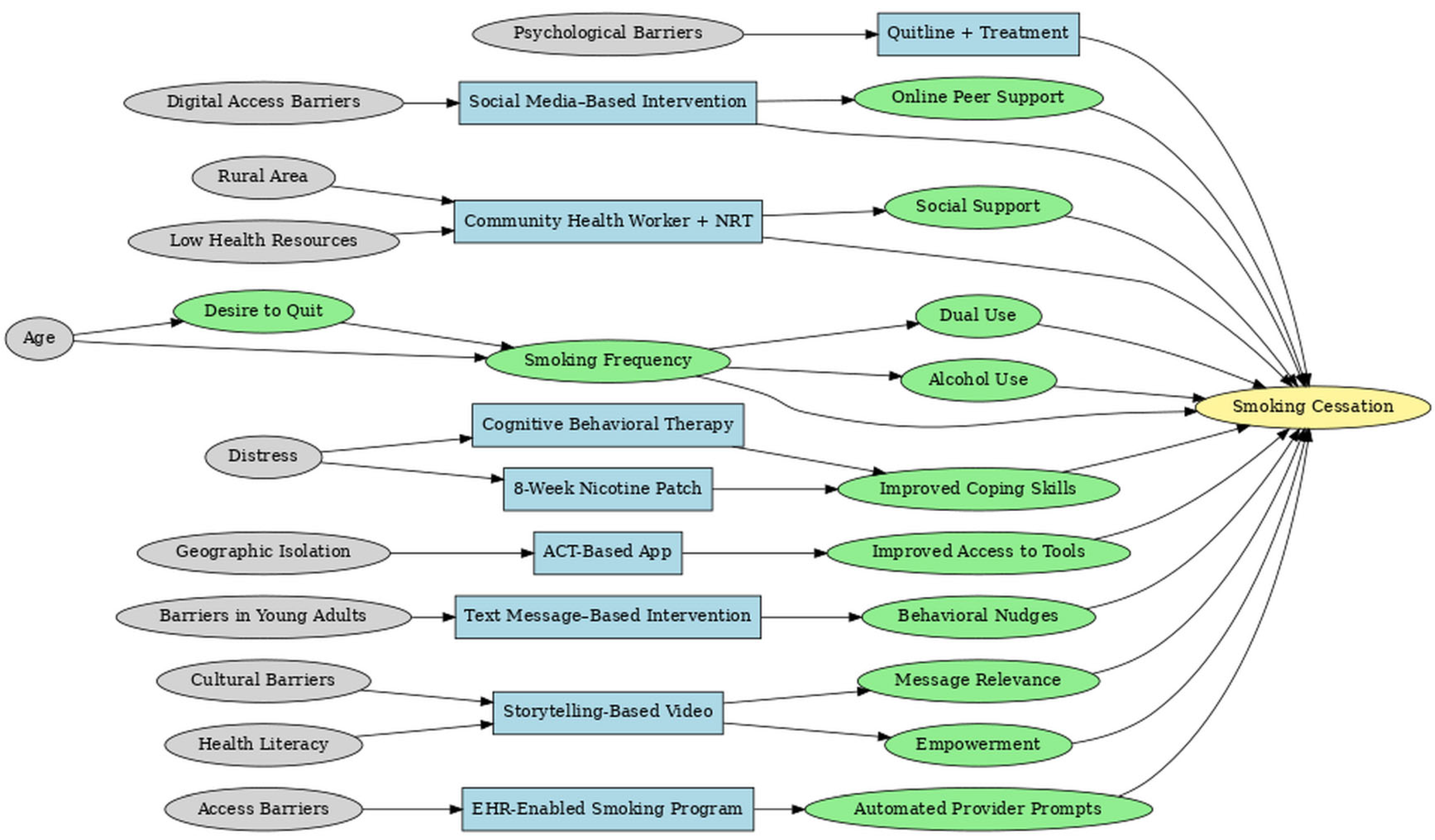
3.3. Integrated DAG
3.3.1. Structural: Upstream Determinants
3.3.2. Intervention: Modality-Specific Pathways
3.3.3. Mechanistic: Mediators of Change
3.3.4. Behavioral: Modifiable Risk Factors
3.3.5. Outcome: Smoking Cessation
4. Discussion
4.1. Methodological Contributions
4.2. Policy and Practice Implications
5. Conclusions
Author Contributions
Funding
Institutional Review Board Statement
Informed Consent Statement
Data Availability Statement
Conflicts of Interest
Appendix A

| Edge | Temporality | Face Validity | Recourse to Theory | Final Action | Pathway Type |
|---|---|---|---|---|---|
| Age → Desire to Quit | Valid | Plausible | Supported in behavioral models | Retain | Confounder |
| Age → Smoking Frequency | Valid | Valid | Risk exposure literature supports | Retain | Confounder |
| Age → Dual Use | Valid | Supported by age-based substance use research | Yes | Retain | Confounder |
| Smoking Frequency → Dual Use | Valid | Strong behavioral linkage | Supported | Retain | Mediator |
| Desire to Quit → Smoking Frequency | Valid | Valid | TTM & quit models | Retain | Mediator |
| Dual Use → Alcohol Use | Valid | Comorbid use theory | Strong support | Retain | Mediator |
| Dual Use → Smoking Cessation | Valid | Plausible | Mixed evidence | Retain (flag for sensitivity) | Mediator |
| Alcohol Use → Smoking Cessation | Valid | Mixed support | Substance relapse theory | Retain | Mediator |
| Cognitive Behavioral Therapy → Improved Coping | Valid | Strong support | Core of CBT | Retain | Mediator |
| Improved Coping Skills → Smoking Cessation | Valid | Plausible | Strong in addiction theory | Retain | Mediator |
| Distress → Cognitive Behavioral Therapy | Valid | Yes | Routine clinical pathway | Retain | Confounder |
| Distress → 8-Week Nicotine Patch | Valid | Common clinical response | Yes | Retain | Confounder |
| Distress → Improved Coping Skills | Valid | Established stress models | Yes | Retain | Confounder |
| Geographic Isolation → ACT-Based App | Valid | Yes | Rural access models | Retain | Confounder |
| ACT-Based App → Improved Access to Tools | Valid | Strong | Valid | Retain | Mediator |
| Improved Access to Tools → Smoking Cessation | Valid | Behavioral support theory | Yes | Retain | Mediator |
| Barriers in Young Adults → Text Msg Intervention | Valid | Known access issue | Valid | Retain | Confounder |
| Text Msg Intervention → Behavioral Nudges | Valid | Behaviorism support | Yes | Retain | Mediator |
| Behavioral Nudges → Smoking Cessation | Valid | Supported | Yes | Retain | Mediator |
| Cultural Barriers → Storytelling Video | Valid | Strong support | Yes | Retain | Confounder |
| Health Literacy → Storytelling Video | Valid | Supported | Yes | Retain | Confounder |
| Storytelling Video → Message Relevance | Valid | Yes | Yes | Retain | Mediator |
| Message Relevance → Smoking Cessation | Valid | Plausible | Yes | Retain | Mediator |
| Health Literacy → Empowerment | Valid | Supported | Yes | Retain | Mediator |
| Empowerment → Smoking Cessation | Valid | Supported | Yes | Retain | Mediator |
| Access Barriers → EHR Intervention | Valid | Structural logic | Yes | Retain | Confounder |
| EHR Intervention → Provider Prompts | Valid | Plausible | Systematic evidence | Retain | Mediator |
| Provider Prompts → Smoking Cessation | Valid | Workflow behavior support | Yes | Retain | Mediator |
| Digital Access Barriers → Social Media Intervention | Valid | Digital divide evidence | Yes | Retain | Confounder |
| Social Media Intervention → Online Peer Support | Valid | Plausible | Yes | Retain | Mediator |
| Online Peer Support → Smoking Cessation | Valid | Peer-based models | Yes | Retain | Mediator |
| Rural Area → CHW + NRT | Valid | Intervention targeting | Yes | Retain | Confounder |
| Low Health Resources → CHW + NRT | Valid | Targeting underserved | Yes | Retain | Confounder |
| CHW + NRT → Social Support | Valid | Social pathway logic | Yes | Retain | Mediator |
| Social Support → Smoking Cessation | Valid | Strong evidence | Yes | Retain | Mediator |
| Psychological Barriers → Quitline + Treatment | Valid | Valid | Yes | Retain | Confounder |
| Quitline + Treatment → Smoking Cessation | Valid | Supported | Strong theoretical support | Retain | Mediator |
| Harmonized Construct | Operational Definition | Distinct From | Source Constructs |
|---|---|---|---|
| Psychological Distress | Emotional or mental strain interfering with readiness to quit or treatment engagement | Minority Stress, Depression | “mental health”, “stress”, “emotional burden” |
| Minority Stress | Stressors from identity-based discrimination, stigma, or exclusion | General Stress, Socioeconomic Disadvantage | “racial stigma”, “LGBTQ discrimination”, “social bias” |
| Digital Access Barriers | Limited access to or usability of digital cessation tools due to device, connectivity, or literacy gaps | Health Literacy, Technological Engagement | “no smartphone”, “low digital literacy”, “poor access” |
| Socioeconomic Disadvantage | Structural deprivation limiting intervention access or adherence | Minority Stress, Rural Residence | “low income”, “unemployment”, “housing instability” |
| Provider Engagement | Direct action by healthcare providers to recommend, facilitate, or reinforce cessation | Passive Access, System Navigation | “counseling”, “EHR trigger”, “referral to services” |
| Coping Skills Enhancement | Mechanisms that strengthen emotional self-regulation and relapse prevention | Empowerment, Support | “stress management”, “resilience training”, “CBT” |
| Motivation to Quit | Individual’s readiness and intention to initiate cessation | Self-Efficacy, Knowledge | “desire to quit”, “stage of change”, “quit intention” |
| Social Support | External encouragement or assistance from family, peers, or community | Provider Engagement, Empowerment | “family support”, “peer encouragement”, “group sessions” |
| Mobile App Interventions | Use of structured, evidence-based cessation content delivered via smartphone apps | Quitlines, Storytelling | “ACT app”, “digital CBT”, “motivational text” |
| Financial Incentives | Monetary or material rewards linked to cessation behavior | Social Support, Intrinsic Motivation | “cash rewards”, “gift cards for abstinence” |
References
- Leventhal, A.M.; Dai, H.; Higgins, S.T. Smoking Cessation Prevalence and Inequalities in the United States: 2014–2019. JNCI J. Natl. Cancer Inst. 2021, 114, 381. [Google Scholar] [CrossRef]
- Maki, K.G.; Volk, R.J. Disparities in Receipt of Smoking Cessation Assistance Within the US. JAMA Netw. Open 2022, 5, e2215681. [Google Scholar] [CrossRef]
- Lapoint, D.N.; Quigley, B.; Monegro, A.F. Health Care Disparities and Smoking Cessation Counseling: A Retrospective Study on Urban and Non-Urban Populations. Chest 2023, 164, A6390. [Google Scholar] [CrossRef]
- VanFrank, B.; Malarcher, A.; Cornelius, M.E.; Schecter, A.; Jamal, A.; Tynan, M. Adult Smoking Cessation—United States, 2022. In Morbidity and Mortality Weekly Report (MMWR); Centers for Disease Control MMWR Office: Atlanta, GA, USA, 2024. [Google Scholar]
- Goodin, A.; Talbert, J.; Freeman, P.R.; Hahn, E.J.; Fallin-Bennett, A. Appalachian Disparities in Tobacco Cessation Treatment Utilization in Medicaid. Subst. Abus. Treat. Prev. Policy 2020, 15, 5. [Google Scholar] [CrossRef]
- Sultana, S.; Inungu, J.; Jahanfar, S. Barriers and Facilitators of Tobacco Cessation Interventions at the Population and Healthcare System Levels: A Systematic Literature Review. Int. J. Environ. Res. Public Health 2025, 22, 825. [Google Scholar] [CrossRef]
- Patel, N.; Karimi, S.M.; Little, B.; Egger, M.; Antimisiaris, D. Applying Evidence Synthesis for Constructing Directed Acyclic Graphs to Identify Causal Pathways Affecting U.S. Early-Stage Non-Small Cell Lung Cancer Treatment Receipt and Overall Survival. Therapeutics 2024, 1, 64–94. [Google Scholar] [CrossRef]
- Greenland, S.; Pearl, J.; Robins, J.M. Causal diagrams for epidemiologic research. Epidemiology 1999, 10, 37–48. [Google Scholar] [CrossRef] [PubMed]
- Ferguson, K.D.; McCann, M.; Katikireddi, S.V.; Thomson, H.; Green, M.J.; Smith, D.J.; Lewsey, J.D. Evidence Synthesis for Constructing Directed Acyclic Graphs (ESC-DAGs): A Novel and Systematic Method for Building Directed Acyclic Graphs. Int. J. Epidemiol. 2019, 49, 322. [Google Scholar] [CrossRef] [PubMed]
- Textor, J.; van der Zander, B.; Gilthorpe, M.S.; Liśkiewicz, M.; Ellison, G.T. Robust causal inference using directed acyclic graphs: The R package “dagitty”. Int. J. Epidemiol. 2016, 45, 1887–1894. [Google Scholar] [CrossRef]
- Aday, L.A.; Begley, C.E.; Larison, D.R.; Slater, C.H.; Richard, A.J.; Montoya, I.D. A Framework for Assessing the Effectiveness, Efficiency, and Equity of Behavioral Healthcare—PubMed. Am. J. Manag. Care 1999, 5, 25–44. [Google Scholar]
- Baggett, T.P.; Chang, Y.; Yaqubi, A.; McGlave, C.; Higgins, S.T.; Rigotti, N.A. Financial Incentives for Smoking Abstinence in Homeless Smokers: A Pilot Randomized Controlled Trial. Nicotine Tob. Res. 2018, 20, 1442–1450. [Google Scholar] [CrossRef]
- Bailey, S.R.; Marino, M.; Ezekiel-Herrera, D.; Schmidt, T.; Angier, H.; Hoopes, M.J.; DeVoe, J.E.; Heintzman, J.; Huguet, N. Tobacco Cessation in Affordable Care Act Medicaid Expansion States Versus Non-expansion States. Nicotine Tob. Res. 2020, 22, 1016–1022. [Google Scholar] [CrossRef] [PubMed]
- Bricker, J.B.; Santiago-Torres, M.; Mull, K.E.; Sullivan, B.M.; David, S.P.; Schmitz, J.; Stotts, A.; Rigotti, N.A. Do medications increase the efficacy of digital interventions for smoking cessation? Secondary results from the iCanQuit randomized trial. Addiction 2024, 119, 664–676. [Google Scholar] [CrossRef] [PubMed]
- Brooks, D.R.; Burtner, J.L.; Borrelli, B.; Heeren, T.C.; Evans, T.; Davine, J.A.; Greenbaum, J.; Scarpaci, M.; Kane, J.; Rees, V.W.; et al. Twelve-Month Outcomes of a Group-Randomized Community Health Advocate-Led Smoking Cessation Intervention in Public Housing. Nicotine Tob. Res. 2018, 20, 1434–1441. [Google Scholar] [CrossRef] [PubMed]
- Chen, C.; Anderson, C.M.; Babb, S.D.; Frank, R.; Wong, S.; Kuiper, N.M.; Zhu, S.-H. Evaluation of the Asian Smokers’ Quitline: A Centralized Service for a Dispersed Population. Am. J. Prev. Med. 2021, 60, S154–S162. [Google Scholar] [CrossRef]
- Christiansen, B.A.; Reeder, K.M.; TerBeek, E.G.; Fiore, M.C.; Baker, T.B. Motivating Low Socioeconomic Status Smokers to Accept Evidence-Based Smoking Cessation Treatment: A Brief Intervention for the Community Agency Setting. Nicotine Tob. Res. 2015, 17, 1002–1011. [Google Scholar] [CrossRef]
- Collins, B.N.; Nair, U.S.; Davis, S.M.; Rodriguez, D. Increasing Home Smoking Restrictions Boosts Underserved Moms’ Bioverified Quit Success. Am. J. Health Behav. 2019, 43, 50–56. [Google Scholar] [CrossRef]
- Dahne, J.; Wahlquist, A.E.; Smith, T.T.; Carpenter, M.J. The di fferential impact of nicotine replacement therapy sampling on cessation outcomes across established tobacco disparities groups. Prev. Med. 2020, 136, 106096. [Google Scholar] [CrossRef]
- Fu, S.S.; van Ryn, M.; Nelson, D.; Burgess, D.J.; Thomas, J.L.; Saul, J.; Clothier, B.; Nyman, J.A.; Hammett, P.; Joseph, A.M. Proactive tobacco treatment offering free nicotine replacement therapy and telephone counselling for socioeconomically disadvantaged smokers: A randomised clinical trial. Thorax 2016, 71, 446–453. [Google Scholar] [CrossRef]
- Galiatsatos, P.; Soybel, A.; Jassal, M.; Cruz, S.A.P.; Spartin, C.; Shaw, K.; Cunningham, J.; Kanarek, N.F. Tobacco treatment clinics in urban public housing: Feasibility and outcomes of a hands-on tobacco dependence service in the community. BMC Public Health 2021, 21, 1514. [Google Scholar] [CrossRef]
- Graham, A.L.; Papandonatos, G.D.; Cha, S.; Erar, B.; Amato, M.S. Improving Adherence to Smoking Cessation Treatment: Smoking Outcomes in a Web-based Randomized Trial. Ann. Behav. Med. 2018, 52, 331–341. [Google Scholar] [CrossRef] [PubMed]
- Halpern, S.D.; French, B.; Small, D.S.; Saulsgiver, K.; Harhay, M.O.; Audrain-McGovern, J.; Loewenstein, G.; Brennan, T.A.; Asch, D.A.; Volpp, K.G. Randomized Trial of Four Financial-Incentive Programs for Smoking Cessation. N. Engl. J. Med. 2015, 372, 2108–2117. [Google Scholar] [CrossRef] [PubMed]
- Heffner, J.L.; Mull, K.E.; Watson, N.L.; McClure, J.B.; Bricker, J.B. Long-Term Smoking Cessation Outcomes for Sexual Minority Versus Nonminority Smokers in a Large Randomized Controlled Trial of Two Web-Based Interventions. Nicotine Tob. Res. 2020, 22, 1596–1604. [Google Scholar] [CrossRef] [PubMed]
- Hickman, I.I.I.N.J.; Delucchi, K.L.; Prochaska, J.J. Treating Tobacco Dependence at the Intersection of Diversity, Poverty, and Mental Illness: A Randomized Feasibility and Replication Trial. Nicotine Tob. Res. 2015, 17, 1012–1021. [Google Scholar] [CrossRef]
- Higgins, S.T.; Plucinski, S.; Orr, E.; Nighbor, T.D.; Coleman, S.R.M.; Skelly, J.; DeSarno, M.; Bunn, J. Randomized clinical trial examining financial incentives for smoking cessation among mothers of young children and possible impacts on child secondhand smoke exposure. Prev. Med. 2023, 176, 107651. [Google Scholar] [CrossRef]
- Hooper, M.W.; Miller, D.B.; Saldivar, E.; Mitchell, C.; Johnson, L.; Burns, M.; Huang, M.-C. Randomized Controlled Trial Testing a Video-Text Tobacco Cessation Intervention Among Economically Disadvantaged African American Adults. Psychol. Addict. Behav. 2021, 35, 769–777. [Google Scholar] [CrossRef]
- Kamke, K.; Grenen, E.; Robinson, C.; El-Toukhy, S. Dropout and Abstinence Outcomes in a National Text Messaging Smoking Cessation Intervention for Pregnant Women, SmokefreeMOM: Observational Study. JMIR mHealth uHealth 2019, 7, e14699. [Google Scholar] [CrossRef]
- Kendzor, D.E.; Businelle, M.S.; Frank-Pearce, S.G.; Waring, J.J.C.; Chen, S.; Hebert, E.T.; Swartz, M.D.; Alexander, A.C.; Sifat, M.S.; Boozary, L.K.; et al. Financial Incentives for Smoking Cessation Among Socioeconomically Disadvantaged Adults A Randomized Clinical Trial. JAMA Netw. Open 2024, 7, e2418821. [Google Scholar] [CrossRef]
- Kerkvliet, J.L.; Wey, H.; Fahrenwald, N.L. Cessation Among State Quitline Participants with a Mental Health Condition. Nicotine Tob. Res. 2015, 17, 735–741. [Google Scholar] [CrossRef]
- Kurti, A.N.; Tang, K.; Bolivar, H.A.; Evemy, C.; Medina, N.; Skelly, J.; Nighbor, T.; Higgins, S.T. Smartphone-based financial incentives to promote smoking cessation during pregnancy: A pilot study. Prev. Med. 2020, 140, 106201. [Google Scholar] [CrossRef]
- Lee, J.; Contrera Avila, J.; Ahluwalia, J.S. Differences in Cessation Attempts and Cessation Methods by Race/ethnicity Among US Adult Smokers, 2016–2018. Addict. Behav. 2023, 137, 107523. [Google Scholar] [CrossRef]
- Lee, M.; Miller, S.M.; Wen, K.-Y.; Hui, S.A.; Roussi, P.; Hernandez, E. Cognitive-behavioral intervention to promote smoking cessation for pregnant and postpartum inner city women. J. Behav. Med. 2015, 38, 932–943. [Google Scholar] [CrossRef] [PubMed]
- Mays, D.; Johnson, A.C.; Phan, L.; Sanders, C.; Shoben, A.; Tercyak, K.P.; Wagener, T.L.; Brinkman, M.C.; Lipkus, I.M. Tailored Mobile Messaging Intervention for Waterpipe Tobacco Cessation in Young Adults: A Randomized Trial. Am. J. Public Health 2021, 111, 1686–1695. [Google Scholar] [CrossRef] [PubMed]
- Meernik, C.; McCullough, A.; Ranney, L.; Walsh, B.; Goldstein, A.O. Evaluation of Community-Based Cessation Programs: How Do Smokers with Behavioral Health Conditions Fare? Community Ment. Health J. 2018, 54, 158–165. [Google Scholar] [CrossRef] [PubMed]
- Vidrine, J.I.; Sutton, S.K.; Wetter, D.W.; Shih, Y.-C.T.; Ramondetta, L.M.; Elting, L.S.; Walker, J.L.; Smith, K.M.; Frank-Pearce, S.G.; Li, Y.; et al. Efficacy of a Smoking Cessation Intervention for Survivors of Cervical Intraepithelial Neoplasia or Cervical Cancer: A Randomized Controlled Trial. J. Clin. Oncol. 2023, 41, 2779–2788. [Google Scholar] [CrossRef]
- Wewers, M.E.; Shoben, A.; Conroy, S.; Curry, E.; Ferketich, A.K.; Murray, D.M.; Nemeth, J.; Wermert, A. Effectiveness of Two Community Health Worker Models of Tobacco Dependence Treatment Among Community Residents of Ohio Appalachia. Nicotine Tob. Res. 2017, 19, 1499–1507. [Google Scholar] [CrossRef]
- Lyu, J.C.; Meacham, M.C.; Nguyen, N.; Ramo, D.; Ling, P.M. Factors Associated With Abstinence Among Young Adult Smokers Enrolled in a Real-world Social Media Smoking Cessation Program. Nicotine Tob. Res. 2024, 26, S27–S35. [Google Scholar] [CrossRef]
- Hooper, M.W.; Calixte-Civil, P.; Verzijl, C.; Brandon, K.O.; Asfar, T.; Koru-Sengul, T.; Antoni, M.H.; Lee, D.J.; Simmons, V.N.; Brandon, T.H. Associations between perceived racial discrimination and tobacco cessation among diverse treatment seekers. Ethn. Dis. 2020, 30, 411–420. [Google Scholar] [CrossRef]
- McCarthy, D.E.; Baker, T.B.; Zehner, M.E.; Adsit, R.T.; Kim, N.; Zwaga, D.; Coates, K.; Wallenkamp, H.; Nolan, M.; Steiner, M.; et al. A Comprehensive Electronic Health Record-Enabled Smoking Treatment Program: Evaluating Reach and Effectiveness in Primary Care in a Multiple Baseline Design. Prev. Med. 2022, 165, 107101. [Google Scholar] [CrossRef]
- Kreuter, M.W.; Garg, R.; Fu, Q.; Caburnay, C.; Thompson, T.; Roberts, C.; Sandheinrich, D.; Javed, I.; Wolff, J.M.; Butler, T.; et al. Helping Low-Income Smokers Quit: Findings from a Randomized Controlled Trial Comparing Specialized Quitline Services with and Without Social Needs Navigation. Lancet Reg. Health Am. 2023, 23, 100529. [Google Scholar] [CrossRef]
- Santiago-Torres, M.; Mull, K.E.; Sullivan, B.M.; Ferketich, A.K.; Bricker, J.B. Efficacy of an acceptance and commitment therapy-based smartphone application for helping rural populations quit smoking: Results from the iCanQuit randomized trial. Prev. Med. 2022, 157, 107008. [Google Scholar] [CrossRef]
- Santiago-Torres, M.; Mull, K.E.; Sullivan, B.M.; Kwon, D.M.; Henderson, P.N.; Nelson, L.A.; Patten, C.A.; Bricker, J.B. Efficacy and Utilization of Smartphone Applications for Smoking Cessation Among American Indians and Alaska Natives: Results From the iCanQuit Trial. Nicotine Tob. Res. 2022, 24, 544–554. [Google Scholar] [CrossRef]
- Webb Hooper, M.; Kolar, S.K. Distress, race/ethnicity and smoking cessation in treatment-seekers: Implications for disparity elimination. Addiction 2015, 110, 1495–1504. [Google Scholar] [CrossRef]
- Bhatt, G.; Goel, S.; Yadav, S.K.; Patial, A.; Medhi, B.; Grover, S.; Attri, S.; Kaur, R.; Singh, G.; Gill, S.S. A Randomised Controlled Trial to Evaluate the Effectiveness of a Culture and Disease-Specific, Patient-Centric Multi-Component Tobacco Cessation Intervention Package for the Patients Attending Non-Communicable Disease Clinics in PUNJAB. India Psychol. Health 2025, 40, 1497–1514. [Google Scholar] [CrossRef]
- Okpako, T.; Kale, D.; Perski, O.; Brown, J. Prevalence and Characteristics of Smokers Interested in Using Virtual Reality for Encouraging Smoking Cessation: A Representative Population Survey in Great Britain. BMC Digit. Health 2024, 2, 79. [Google Scholar] [CrossRef]
| Study | Graph |
|---|---|
| [12] |  |
| [13] |  |
| [14] |  |
| [15] |  |
| [16] | 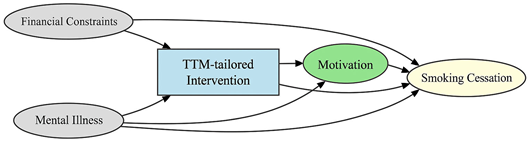 |
| [17] | 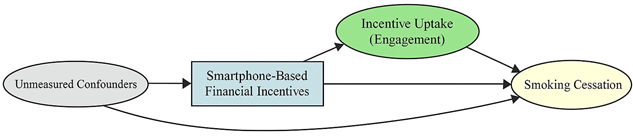 |
| [18] | 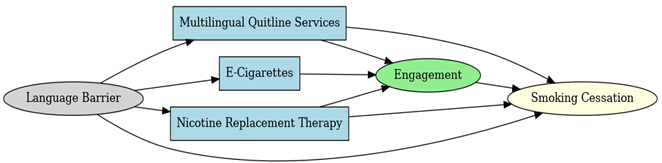 |
| [19] | 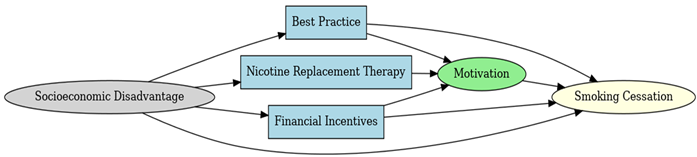 |
| [20] | 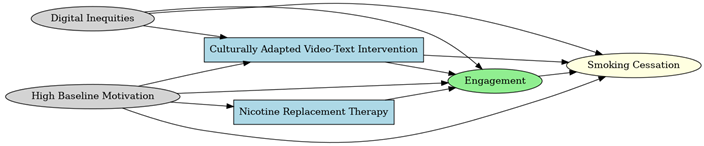 |
| [21] |  |
| [22] |  |
| [23] | 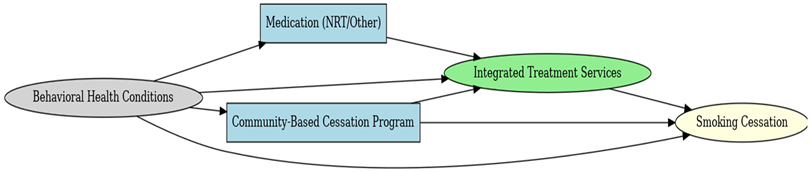 |
| [24] |  |
| [25] |  |
| [26] |  |
| [27] |  |
| [28] |  |
| [29] |  |
| [30] |  |
| [31] |  |
| [32] | 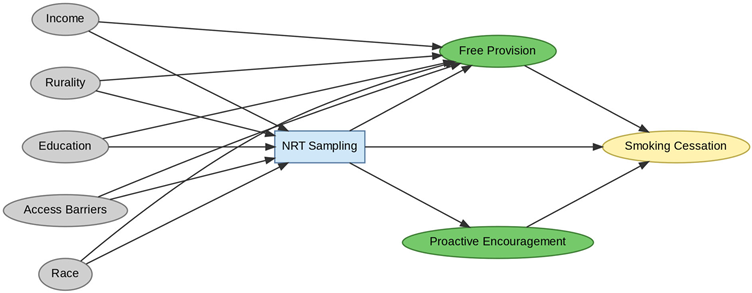 |
| [33] | 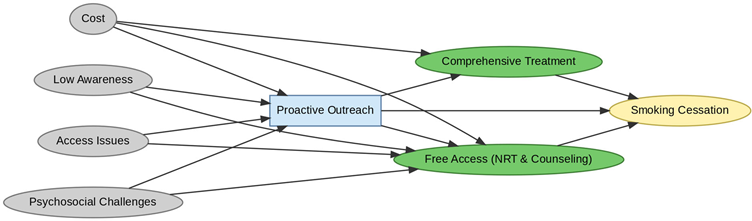 |
| [34] | 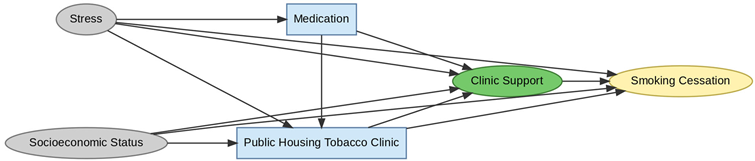 |
| [35] |  |
| [36] |  |
| [37] | 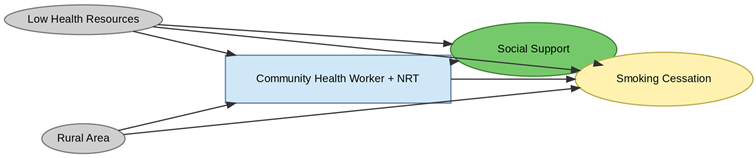 |
| [38] | 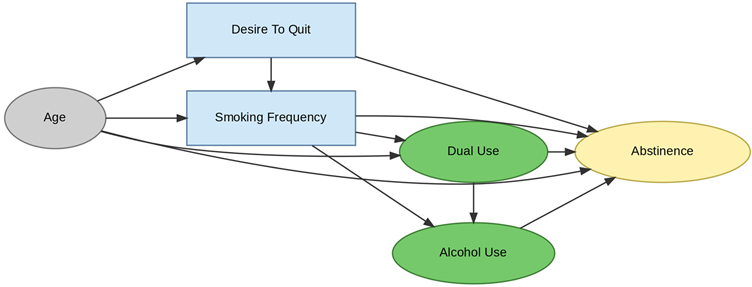 |
| [39] |  |
| [40] | 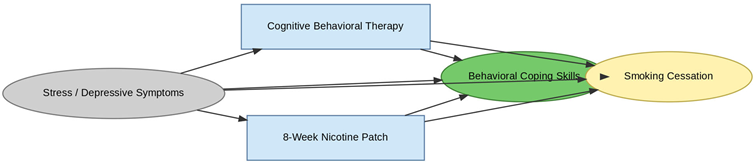 |
| [41] |  |
| [42] | 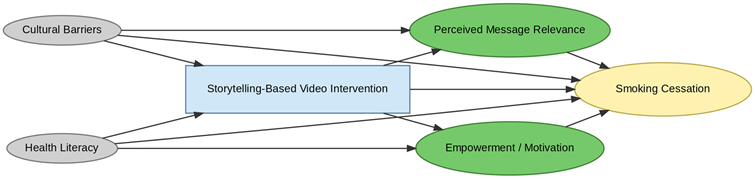 |
| [43] |  |
| [44] |  |
| Category | Top Constructs Identified | Frequency (Number of Studies) | Illustrative Pathways |
|---|---|---|---|
| Barriers | 1. Socioeconomic disadvantage | 19 | Income → Access barriers → Cessation outcome |
| 2. Digital inequities/low digital literacy | 15 | Digital access → Engagement → Cessation outcome | |
| 3. Low motivation/readiness to quit | 13 | Motivation → Engagement → Cessation outcome | |
| 4. Rurality/geographic isolation | 10 | Rural residence → Access barriers → Cessation outcome | |
| 5. Psychological stress/depression | 9 | Stress → Adherence → Cessation outcome | |
| Facilitators | 1. Provider engagement/proactive outreach | 17 | Provider engagement → Cessation advice → Cessation outcome |
| 2. Financial incentives | 14 | Financial support → Treatment adherence → Cessation outcome | |
| 3. Digital engagement/mobile-based support | 12 | Digital access → Self-paced engagement → Cessation outcome | |
| 4. Culturally tailored interventions | 10 | Cultural tailoring → Motivation → Cessation outcome | |
| 5. Social support/peer encouragement | 8 | Peer support → Motivation → Cessation outcome |
Disclaimer/Publisher’s Note: The statements, opinions and data contained in all publications are solely those of the individual author(s) and contributor(s) and not of MDPI and/or the editor(s). MDPI and/or the editor(s) disclaim responsibility for any injury to people or property resulting from any ideas, methods, instructions or products referred to in the content. |
© 2025 by the authors. Licensee MDPI, Basel, Switzerland. This article is an open access article distributed under the terms and conditions of the Creative Commons Attribution (CC BY) license (https://creativecommons.org/licenses/by/4.0/).
Share and Cite
Sultana, S.; Patel, N.; Inungu, J. Constructing Directed Acyclic Graphs (DAGs) to Inform Tobacco Cessation Intervention Research: A Methodological Extension Using Evidence Synthesis. Healthcare 2025, 13, 2837. https://doi.org/10.3390/healthcare13222837
Sultana S, Patel N, Inungu J. Constructing Directed Acyclic Graphs (DAGs) to Inform Tobacco Cessation Intervention Research: A Methodological Extension Using Evidence Synthesis. Healthcare. 2025; 13(22):2837. https://doi.org/10.3390/healthcare13222837
Chicago/Turabian StyleSultana, Sanchita, Naiya Patel, and Joseph Inungu. 2025. "Constructing Directed Acyclic Graphs (DAGs) to Inform Tobacco Cessation Intervention Research: A Methodological Extension Using Evidence Synthesis" Healthcare 13, no. 22: 2837. https://doi.org/10.3390/healthcare13222837
APA StyleSultana, S., Patel, N., & Inungu, J. (2025). Constructing Directed Acyclic Graphs (DAGs) to Inform Tobacco Cessation Intervention Research: A Methodological Extension Using Evidence Synthesis. Healthcare, 13(22), 2837. https://doi.org/10.3390/healthcare13222837

