


Abstract
Background/Objectives: For kidney transplantation, it is very important to provide effective post-transplantation interventions to help patients achieve continuous and efficient self-management. Therefore, we review the self-management interventions applied to kidney transplant recipients and suggest the optimal approach to increase the effectiveness of future self-management interventions. Design: Systematic review. Methods: Search terms and strategies included kidney transplantation; self-management; intervention; systematic review. We searched MEDLINE via PubMed, Excerpta Media dataBASE, Cochrane Register Controlled Trials, Cumulative Index to Nursing and Allied Health Literature, and one domestic Korean database to identify studies of self-management interventions for kidney transplant recipients aged ≥ 18 years published in English or Korean until 14 May 2025. Two reviewers independently selected related studies and extracted relevant data. Identified studies were assessed for quality and bias. Results: Of 1340 studies identified, 27 with 1912 participants met the inclusion criteria. Educational interventions were the most common self-management interventions and were provided 3 months to 1 year after kidney transplantation; most interventions were administered by nurses. Outcome variables were divided into cognitive, behavioral, affective, and health outcomes. Educational interventions were effective in improving cognitive, behavioral, and affective aspects. Some differences were observed, depending on the study. Conclusions: We recommend that nurse-involved educational interventions be included when developing self-management interventions and guidelines for kidney transplant recipients in clinical and community nursing settings.
1. Introduction
Kidney transplantation is considered the optimal treatment for patients with end-stage renal failure. In 2022, 25,498 people in the United States [1] and 2028 people in South Korea [2] underwent kidney transplantation, a procedure actively performed worldwide. However, kidney transplant does not completely cure the disease, even if the transplant is successful. Over time, infection, malignant tumors, and health problems (e.g., hypertension, diabetes, hyperlipidemia, muscle weakness, cardiovascular disease, and osteoporosis) may occur as a consequence of immunosuppressive therapy [3]. To prevent these complications and maintain function of the transplanted kidney, self-management strategies, such as accurate intake of immunosuppressants, early detection of organ rejection, prevention of complications, prevention of infection, dietary management, and daily life management, are essential [3,4]. Self-management is defined as actively participating in one’s own treatment process [5]. The treatment process for kidney transplant patients includes medication adherence, dietary management, infection control, and daily life management [6].
However, kidney transplant recipients often neglect disease management, fail to take their medications, or fail to carry out self-management interventions, including treatment instructions, as they find it difficult to deal with their disease [7,8]. In kidney transplant recipients, from early to late post-transplantation, non-compliance with immunosuppressants is 5.9–54.5% [9,10,11,12], the rate of non-adherence to dietary management is 34–85.3% [13,14,15], and the rate of non-adherence to daily life management (e.g., vital sign measurement and outpatient visits) is 16–95% [15,16,17,18]. In the United States, when immunosuppressant medications are not taken consistently, the medical cost per person increases by USD 12,840 for 3 years [11].
An immunosuppressant medication is essential for maintaining transplanted kidney function, but continuous use increases the risk of developing complications, such as infection, hypertension, and diabetes [19]. Hence, corresponding dietary management and daily life management should be implemented [20,21]. Effective self-management, such as adherence to the medication treatment, dietary management, and daily life management, can improve the health indicators within a short term and improve the quality of life by reducing the long-term risk of developing complications [20,21].
There are various methods of providing self-management interventions for kidney transplant recipients. With the recent development of information and communication technology, patient education at the time of discharge [22] and self-management interventions are implemented using mobile applications or artificial intelligence [23]. The interventions are provided as group or individual therapy. The outcome variables used for measuring the effectiveness of self-management interventions are reported in various categories including clinical outcomes and care process outcomes [23].
The interventions should be provided immediately after transplantation to enable patients to perform self-management interventions continuously and efficiently [21,24]. To develop effective interventions, preliminary studies should be conducted to analyze existing self-management interventions and methods of providing them. However, few literature reviews on the existing self-management interventions, such as information technology-based interventions and exercise training, have been conducted [23,25]. Moreover, studies that comprehensively analyze the composition or delivery method of all relevant interventions are limited.
Therefore, this systematic literature review aimed to examine the self-management interventions applied to early to late-stage kidney transplant recipients and to determine the strategies to increase their effectiveness in the future. Specifically, the types, components, and contents of self-management interventions applied to kidney transplant recipients were analyzed.
2. Materials and Methods
2.1. Study Design
This systematic literature review comprehensively analyzed the types, components, and contents of existing self-management interventions by integrating the self-management interventions applied to kidney transplant recipients. The review was conducted in accordance with the Preferred Reporting Items for Systematic Reviews and Meta-Analyses guidelines [26] (Tables S1 and S2). This review was pre-registered in the International Prospective Register of Systematic Reviews [PROSPERO] (registration date: 20 June 2022; registration number: CRD42022306551; Supplementary Materials S3). PROSPERO is an international database that can register research plans for systematic literature reviews; addresses issues, such as reporting bias and unnecessary repetition of research; and ensures transparency [27]. We aimed to reduce the potential bias in conducting and reporting research by pre-registering research protocols.
2.2. Search Methods
A literature search was conducted based on the following core question: ‘What self-management interventions are applicable to kidney transplant recipients and what are their types and component contents?’ All literature published until 14 May 2025 was searched. The search was performed according to the Core/Standard/Ideal model presented by the National Library of Medicine [28]. For core searches conducted overseas, MEDLINE via PubMed, Excerpta Media database (EMBASE), and Cochrane Central Register of Controlled Trials were used. For domestic searches, the Korean Studies Information Service System (KISS) and DataBase Periodical Information Academic were used. For overseas standard searches, the Cumulative Index to Nursing and Allied Health Literature (CINAHL) was used; for domestic searches, the Research Information Service System (RISS) was used. Additionally, the reference lists of all retrieved articles were reviewed to search for additional related studies.
The first preliminary search was conducted based on the type of study participants, interventions, comparisons, outcomes, and study design to select the appropriate search terms and establish search strategies appropriate for domestic and international data searches. Based on the Medical Subject Headings terms and text words used, AND/OR and truncation were appropriately applied. To search for studies conducted among target participants, the terms ‘kidney transplant*’, ‘renal transplant*’, ‘kidney replace’, ‘kidney graft’, ‘renal graft’, and ‘kidney transplantation’ were used during the search. The terms ‘self management’, ‘self care’, ‘self monitoring’, ‘self-administration’, ‘self guided’, ‘self help’, ‘self directed’, ‘self regulate’, and ‘self management’ were used to search for studies reporting the relevant interventions Supplementary Materials S4 shows the detailed search strategies.
Data retrieval, screening, and selection were independently conducted by two researchers with experience in numerous workshops related to systematic literature review and meta-analysis. In the event of disagreement, the two researchers reviewed whether the literature selection criteria were satisfied, and the items that did not match were selected after discussing their opinions with a third researcher. The third researcher was selected based on their experience with conducting multiple meta-analytical studies. The bibliographic information of all eligible studies was equally managed using RefWorks, and duplicates were excluded. After removing the duplicates, the titles and abstracts of the remaining studies were screened; studies that met the literature selection criteria were selected, while those that did not meet the selection criteria were excluded. The remaining studies that were not excluded were assessed for suitability by reviewing the original texts; the results of the assessment of excluded documents in each step were retained.
2.3. Inclusion and Exclusion Criteria
2.3.1. Participants
This review evaluated studies that included kidney transplant recipients aged ≥18 years who were discharged after undergoing organ transplantation.
2.3.2. Intervention
Studies that applied self-management interventions to kidney transplant recipients were selected. Self-management interventions refer to all interventions provided to kidney transplant recipients to promote self-management after undergoing transplantation. Studies selected included RCTs, quasi-experimental studies, and mixed methods studies.
2.3.3. Comparisons
Since this review aimed to identify the self-management interventions applied to kidney transplant recipients, the presence or absence of a control group was not restricted.
2.3.4. Outcomes
The results of this review were based on the quantitative values measured after providing self-management interventions to kidney transplant recipients. No restrictions were applied on the selection of search terms used as a result variable.
2.3.5. Study Design
All types of studies that provided self-management interventions to kidney transplant recipients were included.
Studies that only presented protocols or abstracts and studies that were not published in Korean or English language were excluded.
2.4. Search Outcome
After searching the database using the appropriate search terms, 1303 non-Korean articles from MEDLINE via PubMed, EMBASE, the Cochrane Central Register of Controlled Trials, and CINAHL and 36 Korean articles from KISS, DBPia, and RISS were found. Moreover, the references were manually searched, and one relevant study was found; therefore, a total of 1340 articles were found during the search.
After removing the duplicates, 991 studies were retained. After the titles and abstracts were reviewed according to the inclusion and exclusion criteria, 66 studies were selected, and only 27 of these were included in the final review (Figure 1).
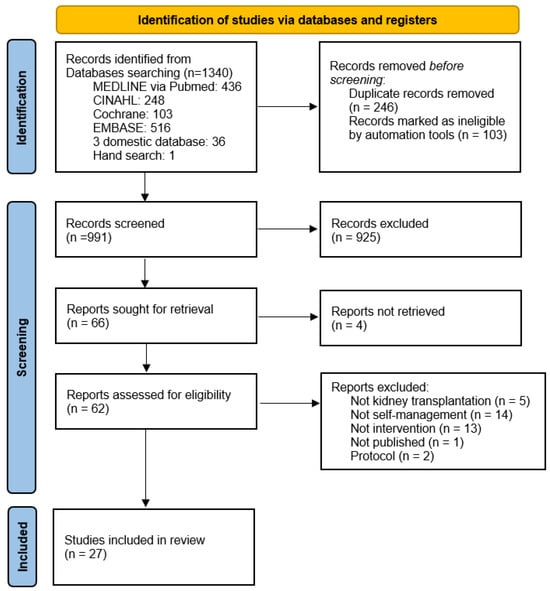
Figure 1.
PRISMA flow diagram.
2.5. Quality Appraisal
The quality of studies included in the analysis was critically reviewed using the Joanna Briggs Institute (JBI; Adelaide, South Australia) quality assessment tool. The quality of randomized controlled studies was assessed using the JBI critical appraisal tool for randomized controlled trials [29], which comprised 13 items. The quality of quasi-experimental studies was assessed using the JBI critical appraisal tool for quasi-experimental studies [30], which comprised nine items. The questions were rated as ‘yes’, ‘no’, ‘unclear’, and ‘not applicable’. A ‘yes’ response indicated that the JBI quality evaluation criteria were met. The JBI quality evaluation tool does not contain the quantitative criteria for evaluating the quality of studies; instead, it examines the appropriateness of the evaluation items. Therefore, after the two independent researchers had evaluated each other’s assessment findings, quality evaluation was conducted via review and discussion until a consensus was reached. Twenty studies were selected and rated as follows: 1 point for a ‘yes’ response and 0 points for a ‘no’ or an ‘unclear’ response. When the number of ‘yes’ responses was more than half of the total score, the studies were selected for systematic review [31].
2.6. Data Abstraction
To analyze the characteristics of self-management interventions, data on the intervention type, author’s name, year of publication, providers, targets, duration of the interventions, and content of the intervention were extracted and used as a basis for analyzing the selected studies.
2.7. Synthesis
Two researchers, including the author, independently analyzed the characteristics of all selected studies and presented them in a coding table. The coding table contained the author’s name, year of publication, country of publication, study design, number of participants, average age of participants, type of intervention, intervention of control group, and outcome variable. If the two reviewers provided different opinions on the selection and exclusion criteria, the original text was reviewed by a third expert, and the disagreement was resolved by consensus.
3. Results
3.1. General Characteristics of the Selected Literature
Table 1 shows the general characteristics of the 27 selected studies. Five studies were conducted in Iran (18.5%), five in the United States (18.5%), four in China (14.8%), three in South Korea (11.1%), one in Germany (3.7%), one in the Netherlands (3.7%), one in France (3.7%), one in Italy (3.7%), one in Switzerland (3.7%), one in Poland (3.7%), one in Pakistan (3.7%), one in Kuwait (3.7%), one in Thailand (3.7%), and one in Canada (3.7%). The publication years ranged from 2012 to 2024, with four studies (14.8%) conducted in 2018, 2022, and 2023. Analysis of the study design identified 16 randomized controlled trials (RCTs) (59.3%), nine quasi-equivalent studies (33.3%), and one mixed method study and retrospective study (3.7%), respectively. The review included 1912 participants, of whom 1083 were assigned to the experimental groups and 829 assigned to the control groups. For the control groups, 11 studies (40.7%) involved the provision of general nursing care, while two studies (7.4%) did not involve the performance of any intervention. The outcome variables for self-management among kidney transplant recipients included quality of life, self-management knowledge and behavior, self-care, self-efficacy, treatment adherence, satisfaction level, burden, anxiety, depression, uncertainty, biomedical parameters (HbA1c, lipid profile, blood pressure, renal function tests, body mass index, etc.).

Table 1.
Descriptive summary of all included studies (n = 27).
3.2. Methodological Quality Assessment of Literature
Table 2 shows the quality evaluation results of 27 studies. All 16 RCTs were randomized. Thirteen studies included groups with similar characteristics at baseline [20,32,33,39,43,44,45,46,50,51,53,54,55], six studies involved blinding of the participants to the interventions [32,36,45,48,49,53], seven studies involved blinding of the treatment providers [33,45,48,49,50,51,53], and seven studies involved blinding of the assessors [32,33,48,49,50,51,55]. Nine studies explained the reasons for dropouts and the differences between the groups due to dropouts [33,36,39,43,44,45,48,49,53]; meanwhile, 14 studies conducted an intention-to-treat analysis [20,32,33,36,39,43,44,46,48,49,50,51,53,54]. Reliable measurements and analyses were conducted in all studies. Of the ten quasi-experimental studies [21,35,37,38,40,41,42,47,52,56], the cause and effect were clearly presented in all studies, and four studies had control groups [36,38,48,56]. Both groups showed similar characteristics at baseline. The results of all ten studies were accurately measured in all study groups using a reliable method, and statistical analyses were appropriately performed. As JBI does not provide a mixed-method research checklist, and this review focused on examining the interventions, the JBI quasi-experimental research checklist was applied in one study [41]. The participants responded ‘yes’ to seven out of the nine items in the study. None of the studies were excluded based on methodological quality.
Table 2.
JBI critical appraisal of all included studies by research design.
3.3. Self-Management Interventions for Kidney Transplant Recipients
Table 3 shows the characteristics of self-management interventions applied to kidney transplant recipients. Self-management educational interventions were the most common (44.4%), followed by exercise interventions (11.1%) and education combined with counseling interventions, and mobile apps (7.4% each). Education combined with an exercise intervention, mobile app combined with nursing coaching, counselling, medication monitoring, motivational enhancement, empowerment enhancement, self-management support, and behavioral educational interview interventions were also provided (3.7% each).
Table 3.
Self-management intervention.
The providers of interventions included nurses in ten studies (37.0%); nurses, psychologists, and dietitians, or nurses, public health workers, and pharmacists, or nurses, dietitians, and pharmacists or physicians and clinical psychologists in one study (3.7%); nurse–doctor or nutritionist or mobile app and nurse in two studies (7.4%); physicians in one study (3.7%); pharmacists in one study (3.7%); mobile app in one study and web, mobile phones, and tablets in five studies (18.5%).
The participants who received interventions included patients treated immediately after undergoing kidney transplantation [21,38,41,53,54] and patients treated within 20 years after undergoing kidney transplantation. Five studies included individuals who were treated within 3 months after undergoing kidney transplantation [20,33,43,44,46], while three studies included individuals who were treated within 1 year after undergoing kidney transplantation [34,35,45]. One study included individuals who were treated within 6 months after undergoing kidney transplantation [48]. The duration of the intervention ranged from the time the patient waited for an outpatient doctor [50] until 12 months [42,51], with 3 months being the most common intervention period reported in nine studies [20,33,39,44,45,47,48,49,55].
The contents of educational interventions included information on the method of administration, therapeutic and side effects of the medications, diet, physical and self-care activities, problem solving, emotional control, social interaction [20,21,32,33,35,38,40,43,48,53]; the methods of maintaining effective relationships with family, friends, and healthcare professionals [43]; nutrition management [21,32,41,42,43,51,52,53]; exercises and activities [32,41,42,51,52,53]; evaluation of new therapies [43]; blood concentration monitoring [20,52]; prevention and treatment of complications [20,41,42,52,53]; rejection management [41,42]; self-care activities [21,45]; methods of detecting unusual symptoms after undergoing kidney transplant and the corresponding management [45]; stress management [38,45,53]; skin cancer prevention strategies [50]; emotional or mental health management [51]; weight management [51]; and healthcare in daily life [42,52]. The exercise interventions included aerobic and strength training exercises and dietary management [37], provision of assistance and improvement in physical activities [46], maintenance or achievement of normal body weight, and the integration of physical activity into the individual’s daily routine [51]. In particular, web-, mobile phone-, or tablet-based interventions included those that enhance individual motivation [34]; health knowledge related to each stage of renal transplantation [56]; self-monitoring [56]; nurse–patient communication [56]; monitoring diet and physical activity [47]; help cope with the medication side effects; control events that may interfere with the effects of medications; promote good interaction between patients and healthcare providers [36]; involve the provision of medication reminders, making phone calls, and sending text messages [44]; and allow the provision of skin cancer prevention education using the applications installed in tablets [50].
3.4. Outcomes of Self-Management Interventions Applied to Kidney Transplant Recipients
The outcome variables that provided self-management interventions were divided into four categories (Table 4): cognitive outcomes (e.g., treatment knowledge, and self-management knowledge), behavioral outcomes (e.g., self-management behavior, medication adherence, self-management behavior, and daily step), affective outcomes (e.g., quality of life, feelings after kidney transplantation, adherence to immunosuppressive medications, satisfaction, and anxiety), and health outcomes (e.g., blood pressure, heart rate, and body mass index).
Table 4.
Categorization and summary of outcomes.
The four effective cognitive outcomes of self-management interventions were treatment knowledge [35], self-management knowledge [21,48,52], knowledge of skin cancer and sun protection [50], and perception of care [51]. Conversely, the self-management interventions did not affect the self-perceived general health status [36]. The effects of self-management interventions on quality of life varied between studies.
The effective behavioral outcomes of self-management interventions included enhanced self-care ability [20,54], sun protection behavior [50], and treatment compliance [42]; however, they did not affect medication intake-related skills [36] and physical activity [51,55]. The effects of self-care behavior, medication adherence, and daily steps varied between studies.
Self-management interventions were effective in improving the affective outcomes including feelings after kidney transplantation, adherence to immunosuppressive therapy [34], perceived level of empowerment [39], satisfaction level [20], self-perceived burden [20], stress [47], and level of uncertainty [42]. However, these interventions did not affect the patients’ comfort levels [54].
The effective health outcomes included heart rate [46], HbA1c [48], and waist circumference [46], but they did not affect the results of the six-minute walking test [46], medication side effects [36], or myocardial function [37]. The effects on blood pressure, body mass index, and renal function varied between studies.
4. Discussion
This review aimed to systematically examine the self-management interventions provided to kidney transplant recipients and determine strategies that can help increase their effectiveness. In this section, we focus our discussion on the key findings identified through the review.
About 44% of the included studies were conducted in Iran, China, and Korea. All three countries have a high prevalence of end-stage renal disease and are countries where kidney transplantation is widely performed. As the importance of self-management is emphasized for long-term survival and quality of life after transplantation, self-management intervention studies are actively being conducted in Iran, China, and Korea [57,58,59]. In addition, these countries have high national interest in kidney disease management and transplant patient management, and self-management-related studies are actively being conducted centered on university hospitals and research institutes [6]. Additional analyses considering sociocultural factors in each country will be necessary.
4.1. Types of Self-Management Interventions for Kidney Transplant Patients: Educational Interventions and Mobile Apps
With regard to the type of self-management interventions applied to kidney transplant recipients, various interventions (e.g., educational intervention, exercise intervention, and counseling intervention) were applied, the majority of which were education-related. This finding supports the result of previous studies, which indicated that kidney transplant recipients had high educational needs owing to the complicated post-kidney transplant management [60]. After kidney transplantation, patients require knowledge about medication, rejection management, complication management, and infection prevention to maintain the function of the transplanted kidney [61,62,63]. Insufficient patient knowledge can lead to serious consequences, such as rejection of transplanted organs due to low adherence with immunosuppressant therapy and therapeutic management [63]. Sufficient knowledge regarding kidney transplantation has been shown to reduce morbidity and mortality rates, as well as the costs associated with healthcare and disease management [64]. Accordingly, education is a critical component of self-management interventions, as it enhances patient understanding and engagement. A previous meta-analysis of interventions for hypertensive patients reported that 66.7% of studies included educational components, and those combining education, counseling, and management strategies were particularly effective in lowering blood pressure [65].
In developing future self-management interventions for kidney transplant recipients, education should serve as a key modality for knowledge transfer. Core educational content typically includes medication adherence, nutrition, physical activity, complication monitoring, and stress and emotional management. These elements must be effectively communicated, and mobile technologies offer a highly accessible and scalable platform for delivery. However, beyond mere knowledge dissemination, it is crucial to ensure patient adherence to self-management behaviors. Therefore, incorporating nurse-led monitoring and coaching alongside mobile interventions may yield more effective outcomes than relying on mobile applications alone.
4.2. Self-Management Intervention Methods for Kidney Transplant Patients
Nurses were the most common intervention providers. In a preliminary review study [66] analyzing how nurse-led interventions can help improve self-management skills among outpatients with chronic conditions, nurses were identified as the most effective providers of self-management interventions in specific settings and for specific patient populations. Since nurses are at the forefront of patient management, they can quickly identify symptoms, discomfort, and difficulties in performing self-management and promote active self-management. The role of nurses is especially important within the first year after organ transplantation until the patient is able to perform self-management independently. The duration of intervention ranged from 3 months to 1 year after kidney transplantation. This is intended to help patients quickly learn unfamiliar and complex life activities after undergoing kidney transplantation and apply them in their daily lives. Educational intervention was provided multiple times rather than one time. This finding suggests that repeated education is important not only because of the need to share different contents with the target patients but also because of the need to establish different behavioral guidelines as part of daily life (habit formation) after undergoing kidney transplantation.
4.3. Self-Management Intervention Effects for Kidney Transplant Patients
The effectiveness of actual self-management interventions for kidney transplant recipients was evaluated using various outcome variables depending on the type of intervention used. In the cognitive outcome domain, the most frequently reported significant effects of self-management interventions were self-management knowledge [21,48,52] and quality of life [20,32,33,40,43,54,56]. Repetitive education improved knowledge of lifestyle factors such as diet and exercise [48], and individual education programs enhanced knowledge of medication management, dietary management, weight management, complication management, physical activity, and stress management [52]. Additionally, the multidisciplinary self-management education program improved self-management knowledge in medication management, dietary management, exercise, and infection prevention [21]. These repetitive individual or multidisciplinary education programs help improve knowledge, which is important for their health management. The self-management program improved both physical health and emotional well-being, leading to enhanced overall quality of life as patients improved their self-management skills [43]. The quality of life was positively affected by rapid surgical recovery nursing and continuous nursing care [54], and the quality of life was improved in both mental health (reduction in depression and stress levels) and physical health (weight, blood sugar management, etc.) as weight loss was achieved through cognitive–behavioral therapy and dietary control weight loss intervention [33]. Although one study found no effect on quality of life [34], indicating the need for repeated studies, most research results suggest that improvements in quality of life have a significant impact on patients’ long-term treatment adherence and health.
In the behavioral outcome domain, the most frequently reported significant effects of self-management interventions were self-care behavior [39,40,45,56] and self-care ability [20,54]. Specifically, the interventions led to an increase in self-efficacy [20,39,54], which significantly improved self-management behaviors such as medication adherence [39,40,45,56], diet management [39,40,45,56], weight monitoring [39], blood pressure monitoring [39,56], blood sugar monitoring [40,56], and exercise [40,56]. Mobile health application interventions were important in continuously adjusting and improving behaviors by providing real-time feedback [56]. Nurse-led self-management support was also reported to play a crucial role in positively changing self-management behaviors [40]. Nursing interventions based on the Health Belief Model and continuous nursing were effective in enhancing patients’ self-management abilities (medication adherence and diet management) [20,54].
In the health outcome domain, the most frequently reported significant effects of self-management interventions were waist circumference (WC) [46,48] and weight [33,47]. Repetitive and structured education [48] and cognitive–behavioral therapy [33] influenced the lifestyle knowledge and self-management of kidney transplant patients, resulting in effective reductions in waist circumference and weight. Cognitive–behavioral therapy helps improve self-control and manage stress, which in turn helps prevent unnecessary overeating. However, there are results showing that BMI, related to WC and weight, was not effective [51,55], indicating the need for further research.
The effect of the intervention type on the outcome variable was confirmed. Educational intervention was effective in improving the cognitive, behavioral, and affective outcomes, while exercise intervention was effective in improving the cognitive and health outcomes. Changes in behavioral results were expected after providing the exercise intervention, but this type of intervention did not affect the outcome variables; hence, further studies are warranted to evaluate the effectiveness of exercise interventions.
Since self-management interventions after kidney transplantation are diverse and complex, a variety of tailored approaches are necessary to help recipients maintain a healthy life after transplantation [60]. Accordingly, to actively utilize evidence-based interventions for which the effects have been verified, including self-management education, multidisciplinary considerations and cooperation are required in the clinical and community nursing settings [21]. In particular, in studies conducted in the last two years, the tendency of various occupations such as nurses, pharmacists, dietitians, and clinical psychologists to provide interventions was remarkable [21]. Various aspects of self-management after kidney transplantation should be considered, and multidisciplinary management is essential for this.
To properly interpret and apply the results of this review, the following limitations should be considered. First, since this review did not statistically analyze the effect sizes, it is difficult to objectively compare the effects according to the outcome variables. Hence, a meta-analysis of the effect size should be conducted in the future. Second, although this review presents various self-management interventions, measurement variables, and tools, the number of relevant studies is relatively small to make a comparison of the effects of each intervention; hence, caution should be observed when interpreting the results, and further studies are needed. Third, this study included only studies published in English and Korean, so future studies including multiple languages are needed. Fourth, since this systematic literature review was only conducted in published studies, a publication bias may exist owing to the exclusion of unpublished studies. Fifth, we conducted a systematic literature review to identify the overall content of self-management interventions provided to kidney transplant patients. Results showed that the outcome variables and measurement tools used in each study were diverse, and the number of studies was small, so a formal analysis of heterogeneity was not performed. As the number of studies increases in the future, we recommend that heterogeneity by study design, participant, intervention type, and follow-up period be identified and meta-analysis performed accordingly.
This review has some strengths. First, this review attempted to determine the overall status and contents of interventions by comprehensively identifying the types of self-management interventions applied to kidney transplant recipients. Since efforts were made to provide information on the factors considered and the outcome variables measured when constructing future interventions, sufficient baseline data were used to develop effective interventions. Second, the quality assessment was performed to increase the accuracy of the results of the included studies, and most of the 27 studies were randomized controlled trials and quasi-equivalent experimental studies, showing high quality, so the risk of bias was low, and the strength of the evidence was high. This increases the reliability of the results of this review, which analyzed the effects of self-management interventions for kidney transplant recipients and can serve as a reliable basis for selecting the appropriate interventions for kidney transplant recipients in the future.
5. Conclusions
This review aimed to identify the main contents, methods, and effects of self-management interventions applied to kidney transplant recipients through a systematic literature review. The literature analysis revealed that studies using educational intervention are actively progressing, and a complex application of various interventions might be required in the future. Specifically, most intervention providers are nurses, who can quickly identify and respond to symptoms reported by patients or difficulties in self-management during patient management; therefore, they promote active self-management among patients. Self-management interventions for kidney transplant recipients had a positive effect on patients’ cognitive, behavioral, affective, and health outcomes. In particular, educational intervention was effective in improving the patients’ cognitive, behavioral, and affective outcomes. The results of this review encourage the inclusion of educational interventions involving nurses in the development of self-management interventions and guidelines for kidney transplant recipients in clinical and community nursing settings.
Supplementary Materials
The following supporting information can be downloaded at: https://www.mdpi.com/article/10.3390/healthcare13151918/s1, Table S1: PRISMA 2020 Checklist; Table S2: PRISMA 2020 for Abstracts Checklist; Supplementary Materials S3: International prospective register of systematic reviews; Supplementary Materials S4: Example search strategy. Reference [67] is cited in the Supplementary Materials.
Author Contributions
Conceptualization, H.L. and C.M.K.; Methodology, H.L. and C.M.K.; Formal analysis, H.L. and C.M.K.; Writing—original draft preparation, H.L. and C.M.K. All authors have read and agreed to the published version of the manuscript.
Funding
This work was supported by the Dongseo University Research Fund of 2024 (DSU-20240002).
Institutional Review Board Statement
As this study is a systematic review using data from previously published studies, it did not require Institutional Review Board (IRB) approval.
Informed Consent Statement
Not applicable.
Data Availability Statement
The dataset used and/or analyzed during this study can be provided by the corresponding author upon reasonable request.
Conflicts of Interest
The authors declare no conflicts of interest.
References
- United Network for Organ Sharing. Current State of Organ Donation and Transplantation: Transplant Trends. United Network for Organ Sharing. Available online: https://unos.org/data/ (accessed on 11 January 2023).
- National Institute of Organ Tissue Blood Management. Statistical Data. Ministry of Health and Welfare. Updated 2023. Available online: https://www.konos.go.kr/board/boardViewPage.do (accessed on 23 January 2023).
- Mayo Clinic Staff. Kidney Transplant; Mayo Clinic Publications: Rochester, MN, USA, 2023; Available online: https://www.mayoclinic.org/tests-procedures/kidney-transplant/about/pac-20384777 (accessed on 15 January 2023).
- Gordon, E.J.; Prohaska, T.; Siminoff, L.A.; Minich, P.J.; Sehgal, A.R. Can focusing on self-care reduce disparities in kidney transplantation outcomes? Am. J. Kidney Dis. 2005, 45, 935–940. [Google Scholar] [CrossRef] [PubMed]
- Erdem, C.; Cebeci, F. Reliability and validity of the Turkish version of the self-management scale for kidney transplant recipients. Rev. Nefrol. Dial. Traspl. 2022, 42, 117–123. [Google Scholar]
- Sim, M.K.; Son, S.Y.; Ju, M.K. Factors influencing the self-management of kidney transplant patients based on self-determination theory: A cross-sectional study. Korean J. Transplant. 2022, 36, 37–44. [Google Scholar] [CrossRef] [PubMed]
- Dew, M.A.; DiMartini, A.F.; Dabbs, A.D.V.; Myaskovsky, L.; Steel, J.; Unruh, M.; Switzer, G.E.; Zomak, R.; Kormos, R.L.; Greenhouse, J.B. Rates and risk factors for nonadherence to the medical regimen after adult solid organ transplantation. Transplantation 2007, 83, 858–873. [Google Scholar] [CrossRef]
- Gordon, E.J.; Gallant, M.; Sehgal, A.R.; Conti, D.; Siminoff, L.A. Medication-taking among adult renal transplant recipients: Barriers and strategies. Transpl. Int. 2009, 22, 534–545. [Google Scholar] [CrossRef]
- Ganjali, R.; Sabbagh, M.G.; Nazemiyan, F.; Mamdouhi, F.; Aval, S.B.; Taherzadeh, Z.; Nabavi, F.H.; Golmakani, R.; Tohidinezhad, F.; Eslami, S. Factors associated with adherence to immunosuppressive therapy and barriers in Asian kidney transplant recipients. ImmunoTargets Ther. 2019, 8, 53–62. [Google Scholar] [CrossRef]
- Jung, J.H.; Kim, Y.H.; Han, D.J.; Kim, K.S.; Chu, S.H. Medication adherence in patients taking immunosuppressants after kidney transplantation. Korean J. Transplant. 2010, 24, 289–297. [Google Scholar] [CrossRef]
- Pinsky, B.W.; Takemoto, S.K.; Lentine, K.L.; Burroughs, T.E.; Schnitzler, M.A.; Salvalaggio, P.R. Transplant outcomes and economic costs associated with patient noncompliance to immunosuppression. Am. J. Transplant. 2009, 9, 2597–2606. [Google Scholar] [CrossRef]
- Taj, S.M.; Baghaffar, H.; Alnajjar, D.K.; Almashabi, N.K.; Ismail, S. Prevalence of non-adherence to immunosuppressive medications in kidney transplant recipients: Barriers and predictors. Ann. Transplant. 2021, 26, e928356. [Google Scholar] [CrossRef]
- Gheith, O.A.; El-Saadany, S.A.; Abuo Donia, S.A.; Salem, Y.M. Compliance with recommended lifestyle behaviors in kidney transplant recipients: Does it matter in living donor kidney transplant? Iran J. Kidney Dis. 2008, 2, 218–226. [Google Scholar]
- Kluch, M.; Kurnatowska, I.; Matera, K.; Łokieć, K.; Puzio, T.; Czkwianianc, E.; Grzelak, P. Nutrition trends in patients over the long term after kidney transplantation. Transplant. Proc. 2020, 52, 2357–2362. [Google Scholar] [CrossRef]
- Kobus, G.; Małyszko, J.; Małyszko, J.S.; Puza, E.; Bachórzewska-Gajewska, H.; Myśliwiec, M. Compliance with lifestyle recommendations in kidney allograft recipients. Transplant. Proc. 2011, 43, 2930–2934. [Google Scholar] [CrossRef] [PubMed]
- Cramer, E.; Rasmussen, K.; Jemec, G.B. Patients’ knowledge of the risk of skin cancer following kidney transplantation. Ugeskr. Laeger. 2009, 171, 3341–3345. [Google Scholar] [PubMed]
- Kenawy, A.S.; Gheith, O.; Al-Otaibi, T.; Othman, N.; Atya, H.A.; Al-Otaibi, M.; Nagy, M.S. Medication compliance and lifestyle adherence in renal transplant recipients in Kuwait. Patient Prefer. Adherence 2019, 13, 1477–1486. [Google Scholar] [CrossRef] [PubMed]
- Jamieson, N.J.; Hanson, C.S.; Josephson, M.A.; Gordon, E.J.; Craig, J.C.; Halleck, F.; Budde, K.; Tong, A. Motivations, challenges, and attitudes to self-management in kidney transplant recipients: A systematic review of qualitative studies. Am. J. Kidney Dis. 2016, 67, 461–478. [Google Scholar] [CrossRef]
- Rysz, J.; Franczyk, B.; Radek, M.; Ciałkowska-Rysz, A.; Gluba-Brzózka, A. Diabetes and cardiovascular risk in renal transplant patients. Int. J. Mol. Sci. 2021, 22, 3422. [Google Scholar] [CrossRef]
- Hu, S.; Xiong, R.; Hu, Q.; Li, Q. Effects of nursing intervention based on health belief model on self-perceived burden, drug compliance, and quality of life of renal transplant recipients. Contrast Media Mol. Imaging 2022, 2022, 3001780. [Google Scholar] [CrossRef]
- Thangto, P.; Srisuk, O.; Chunpeak, K.; Hutchinson, A.; van Gulik, N. Effectiveness of a multidisciplinary self-management education programme for kidney transplant recipients in Thailand. J. Kidney Care 2022, 7, 163–171. [Google Scholar] [CrossRef]
- Potter, L.; Lushin, E.N.; Hofmeyer, B.; Ensor, C.; Wilson, N.; Tremblay, S.; Campara, M.; American Society of Transplantation Transplant Pharmacy Community of Practice. Discharge medication procurement and education after kidney transplantation. Clin. Transplant. 2019, 33, e13627. [Google Scholar] [CrossRef]
- Eslami, S.; Khoshrounejad, F.; Golmakani, R.; Taherzadeh, Z.; Tohidinezhad, F.; Mostafavi, S.M.; Ganjali, R. Effectiveness of IT-based interventions on self-management in adult kidney transplant recipients: A systematic review. BMC Med. Inform. Decis. Mak. 2021, 21, 2. [Google Scholar] [CrossRef]
- Kim, M.; Joo, M.; Chang, M.; Kim, Y. Establishment of a national database for post-transplant management of organ transplant patients. J. Korean Soc. Transplant. 2007, 21, 147–160. [Google Scholar]
- Calella, P.; Hernández-Sánchez, S.; Garofalo, C.; Ruiz, J.R.; Carrero, J.J.; Bellizzi, V. Exercise training in kidney transplant recipients: A systematic review. J Nephrol. 2019, 32, 567–579. [Google Scholar] [CrossRef] [PubMed]
- Moher, D.; Liberati, A.; Tetzlaff, J.; Altman, D.G.; PRISMA Group. Preferred Reporting Items for Systematic Reviews and Meta-Analyses: The PRISMA statement. Ann. Intern. Med. 2009, 151, 264–269. [Google Scholar] [CrossRef] [PubMed]
- Booth, A.; Clarke, M.; Dooley, G.; Ghersi, D.; Moher, D.; Petticrew, M.; Stewart, L. The nuts and bolts of PROSPERO: An international prospective register of systematic reviews. Syst. Rev. 2012, 1, 2. [Google Scholar] [CrossRef]
- Bidwell, S.; Jensen, M.F. Using a search protocol to identify sources of information: The COSI model. In Etext on Health Technology Assessment (HTA) Information Resources [Internet]; United States National Library of Medicine, National Institutes of Health, Health & Human Services: Bethesda, MD, USA, 2003; Volume 6, p. 14. Available online: http://www.nlm.nih.gov/archive/20060905/nichsr/ehta/chapter3.html#COSI (accessed on 5 July 2016).
- JBI. Critical Appraisal Tools; 2020a. Available online: https://jbi.global/sites/default/files/2021-10/Checklist_for_RCTs.docx (accessed on 23 January 2025).
- JBI. Critical Appraisal Tools; 2020b. Available online: https://jbi.global/sites/default/files/2021-10/Checklist_for_Quasi-Experimental_Appraisal_Tool%20%281%29.docx (accessed on 23 January 2023).
- Park, S.; Lee, T. Factors influencing Korean nurses’ intention to stay: A systematic review and meta-analysis. J. Korean Acad. Nurs. Adm. 2018, 24, 139–148. [Google Scholar] [CrossRef]
- Aghakhani, N.; Maslakpak, M.H.; Jalali, S.; Parizad, N. Self-care education program as a new pathway toward improving quality of life in kidney transplant patients: A single-blind, randomized, controlled trial. Exp. Clin. Transplant. 2021, 19, 224–230. [Google Scholar] [CrossRef]
- Barchfeld, D.C.; Vagi, R.-K.; Lüdtke, K.; Schieffer, E.; Güler, F.; Einecke, G.; Jäger, B.; de Zwaan, M.; Nöhre, M. Cognitive-behavioral and dietary weight loss intervention in adult kidney transplant recipients with overweight and obesity: Results of a pilot RCT study (Adi-KTx). Front. Psychiatry 2023, 14, 1071705. [Google Scholar] [CrossRef]
- Been-Dahmen, J.M.J.; Beck, D.K.; Peeters, M.A.C.; van der Stege, H.; Tielen, M.; van Buren, M.C.; Ista, E.; van Staa, A.; Massey, E.K. Evaluating the feasibility of a nurse-led self-management support intervention for kidney transplant recipients: A pilot study. BMC Nephrol. 2019, 20, 143. [Google Scholar] [CrossRef]
- Chambord, J.; Couzi, L.; Merville, P.; Moreau, K.; Xuereb, F.; Djabarouti, S. Benefit of a pharmacist-led intervention for medication management of renal transplant patients: A controlled before-and-after study. Ther. Adv. Chronic Dis. 2021, 12, 20406223211005275. [Google Scholar] [CrossRef]
- Côté, J.; Fortin, M.-C.; Auger, P.; Rouleau, G.; Dubois, S.; Boudreau, N.; Vaillant, I.; Gélinas-Lemay, É. Web-based tailored intervention to support optimal medication adherence among kidney transplant recipients: Pilot parallel-group randomized controlled trial. JMIR Form. Res. 2018, 2, e14. [Google Scholar] [CrossRef]
- Enrico, M.; Klika, R.; Ingletto, C.; Mascherini, G.; Pedrizzetti, G.; Stefani, L. Changes in global longitudinal strain in renal transplant recipients following 12 months of exercise. Intern. Emerg. Med. 2018, 13, 805–809. [Google Scholar] [CrossRef] [PubMed]
- Hoseinian, M.; Mohebi, M.; Sadat, Z.; Ajorpaz, N.M. Effect of educating health promotion strategies model on self-care self-efficacy in elderly with kidney transplantation. J. Educ. Health Promot. 2023, 12, 139. [Google Scholar] [CrossRef] [PubMed]
- Hsiao, C.Y.; Lin, L.W.; Su, Y.W.; Yeh, S.H.; Lee, L.N.; Tsai, F.M. The effects of an empowerment intervention on renal transplant recipients: A randomized controlled trial. J. Nurs. Res. 2016, 24, 201–210. [Google Scholar] [CrossRef] [PubMed]
- Jabeen, R.; Perveen, K.; Afzal, M.; Khan, S. Effect of nurse-led self-management support intervention on quality of life among kidney transplant patients. Med. Forum Mon. 2021, 32, 165–169. [Google Scholar]
- Jeong, H.W.; Song, C.E.; An, M. Feasibility and preliminary effects of a theory-based self-management program for kidney transplant recipients: A pilot study. PLoS ONE 2021, 16, e0248947. [Google Scholar] [CrossRef]
- Kim, S.H.; You, H.S. The effects of an empowerment education program for kidney transplantation patients. J. Korean Acad. Nurs. 2017, 47, 445–455. [Google Scholar] [CrossRef]
- Kuwaiti, S.; Ghadami, A.; Yousefi, H. Effects of the self-management program on the quality of life among kidney-transplant patients in Isfahan’s Hazrat Abolfazl Health and Medical Charity in 2015. Ann. Trop. Med. Public Health 2017, 10, 1607. [Google Scholar] [CrossRef]
- McGillicuddy, J.W.; Gregoski, M.J.; Weiland, A.K.; A Rock, R.; Brunner-Jackson, B.M.; Patel, S.K.; Thomas, B.S.; Taber, D.J.; Chavin, K.D.; Baliga, P.K.; et al. Mobile health medication adherence and blood pressure control in renal transplant recipients: A proof-of-concept randomized controlled trial. JMIR Res. Protoc. 2013, 2, e32. [Google Scholar] [CrossRef]
- Mollazadeh, F.; Hemmati Maslakpak, M.H. The effect of teach-back training on self-management in kidney transplant recipients: A clinical trial. Int. J. Community Based Nurs. Midwifery 2018, 6, 146–155. [Google Scholar]
- O’bRien, T.; Russell, C.L.; Tan, A.; Mion, L.; Rose, K.; Focht, B.; Daloul, R.; Hathaway, D. A pilot randomized controlled trial using SystemCHANGE™ approach to increase physical activity in older kidney transplant recipients. Prog. Transplant. 2020, 30, 306–314. [Google Scholar] [CrossRef]
- O’bRien, T.; Rose, K.; Focht, B.; Al Kahlout, N.; Jensen, T.; Heareth, K.; Nori, U.; Daloul, R. The feasibility of Technology, Application, Self-Management for Kidney (TASK) intervention in post-kidney transplant recipients using a pre/posttest design. Pilot Feasibility Stud. 2024, 10, 190. [Google Scholar] [CrossRef]
- Othman, N.; Al-Otaibi, T.; Halim, M.A.; Said, T.; Elserwy, N.; Mahmoud, F.; Abduo, H.; Jahromi, M.; Nampoory, N.; Gheith, O.A. Effect of repeated structured diabetes education on lifestyle knowledge and self-care diabetes management in kidney transplant patients with posttransplant diabetes. Exp. Clin. Transplant. 2024, 22 (Suppl. S1), 128–140. [Google Scholar] [CrossRef] [PubMed]
- Pollock, M.D.P.; Stauffer, N.M.; Lee, H.-J.; Chow, S.-C.; Satoru, I.B.; Moats, L.R.; Swan-Nesbit, S.R.; Li, Y.; Roberts, J.K.; Ellis, M.J.; et al. MyKidneyCoach, Patient Activation, and Clinical Outcomes in Diverse Kidney Transplant Recipients: A randomized control pilot trial. Transplant. Direct 2023, 9, e1462. [Google Scholar] [CrossRef] [PubMed]
- Robinson, J.K.; Friedewald, J.J.; Desai, A.; Gordon, E.J. Response across the health-literacy spectrum of kidney transplant recipients to a sun-protection education program delivered on tablet computers: Randomized controlled trial. JMIR Cancer 2015, 1, e8. [Google Scholar] [CrossRef] [PubMed]
- Schmid-Mohler, G.; Zala, P.; Graf, N.; Witschi, P.; Mueller, T.F.; Wüthrich, R.P.; Huber, L.; Fehr, T.; Spirig, R. Comparison of a behavioral versus an educational weight management intervention after renal transplantation: A randomized controlled trial. Transplant. Direct 2019, 5, e507. [Google Scholar] [CrossRef]
- Sim, M.K.; Son, S.Y. The effects of an individual educational program on self-care knowledge and self-care behavior in kidney transplantation patients. J. East-West Nurs. Res. 2012, 18, 9–17. [Google Scholar]
- Soltannezhad, F.; Farsi, Z.; Jabari Moroei, M. The effect of educating health promotion strategies on self-care self-efficacy in patients undergoing kidney transplantation: A double-blind randomized trial. Nurs. Midwifery Stud. 2013, 2, 64–70. [Google Scholar] [CrossRef]
- Song, L.; Jin, Q.; Zhu, L.; Liu, Z.; Cheng, W. Application of rapid rehabilitation surgical nursing combined with continuous nursing in self-care ability, medication compliance and quality of life of renal transplant patients. Front. Surg. 2022, 9, 844533. [Google Scholar] [CrossRef]
- Wesołowska-Górniak, K.; Wójtowicz, M.; Federowicz, M.; Gierus, J.; Czarkowska-Pączek, B. The level of daily physical activity and methods to increase it in patients after liver or kidney transplantation. Adv. Rehabil. 2022, 36, 25–32. [Google Scholar] [CrossRef]
- Xie, X.; Wang, X.; Li, A.; Yan, Y.; Lu, T.; Wu, Y.; Lin, Z. A study of the effectiveness of mobile health application in a self-management intervention for kidney transplant patients. Iran J. Kidney Dis. 2023, 17, 263–270. [Google Scholar] [CrossRef]
- Khezerloo, S.; Mahmoudi, H.; Sharif Nia, H.; Vafadar, Z. Predictors of self-management among kidney transplant recipients. Urol J. 2019, 16, 366–370. [Google Scholar] [CrossRef]
- Lin, K.; Wei, C.; Li, J.; Guo, X.; Gao, F.; Zhao, P.; Liu, H. Development and validation of the Chinese version of the self-management support scale for kidney transplant recipients. BMC Nurs. 2023, 22, 128. [Google Scholar] [CrossRef]
- Khezerloo, S.; Mahmoudi, H.; Vafadar, Z.; Sharifnia, H. Self-management behaviors in kidney transplant recipients: Qualitative content analysis. Nurs. Midwifery J. 2023, 21, 653–663. [Google Scholar] [CrossRef]
- Urstad, K.H.; Andersen, M.H.; Øyen, O.; Moum, T.; Wahl, A.K. Patients’ level of knowledge measured five days after kidney transplantation. Clin. Transplant. 2011, 25, 646–652. [Google Scholar] [CrossRef]
- Gavaldà, J.; Vidal, E.; Lumbreras, C. Infection prevention in solid organ transplantation. Enferm. Infecc. Microbiol. Clin. 2012, 30 (Suppl. S2), 27–33. [Google Scholar] [CrossRef] [PubMed]
- Jones, J.; Rosaasen, N.; Taylor, J.; Mainra, R.; Shoker, A.; Blackburn, D.; Wilson, J.; Mansell, H. Health literacy, knowledge, and patient satisfaction before kidney transplantation. Transplant. Proc. 2016, 48, 2608–2614. [Google Scholar] [CrossRef] [PubMed]
- Rosaasen, N.; Taylor, J.; Blackburn, D.; Mainra, R.; Shoker, A.; Mansell, H. Development and validation of the kidney transplant understanding tool (K-TUT). Transplant. Direct 2017, 3, e132. [Google Scholar] [CrossRef]
- Osborne, R.H.; Elsworth, G.R.; Whitfield, K. The health education impact questionnaire (heiQ): An outcomes and evaluation measure for patient education and self-management interventions for people with chronic conditions. Patient Educ. Couns. 2007, 66, 192–201. [Google Scholar] [CrossRef]
- Xia, T.; Zhao, F.; Nianogo, R.A. Interventions in hypertension: Systematic review and meta-analysis of natural and quasi-experiments. Clin. Hypertens. 2022, 28, 13. [Google Scholar] [CrossRef]
- van Hooft, S.M.; Been-Dahmen, J.M.J.; Ista, E.; van Staa, A.; Boeije, H.R. A realist review: What do nurse-led self-management interventions achieve for outpatients with a chronic condition? J. Adv. Nurs. 2017, 73, 1255–1271. [Google Scholar] [CrossRef]
- Page, M.J.; McKenzie, J.E.; Bossuyt, P.M.; Boutron, I.; Hoffmann, T.C.; Mulrow, C.D.; Shamseer, L.; Tetzlaff, J.M.; Akl, E.A.; Brennan, S.E.; et al. The PRISMA 2020 statement: An updated guideline for reporting systematic reviews. BMJ 2021, 372, n71. [Google Scholar] [CrossRef]
Disclaimer/Publisher’s Note: The statements, opinions and data contained in all publications are solely those of the individual author(s) and contributor(s) and not of MDPI and/or the editor(s). MDPI and/or the editor(s) disclaim responsibility for any injury to people or property resulting from any ideas, methods, instructions or products referred to in the content. |
© 2025 by the authors. Licensee MDPI, Basel, Switzerland. This article is an open access article distributed under the terms and conditions of the Creative Commons Attribution (CC BY) license (https://creativecommons.org/licenses/by/4.0/).