Concept Paper

Using AI–ML to Augment the Capabilities of Social Media for Telehealth and Remote Patient Monitoring


1
School of Public Health, University at Albany, Albany, NY 12222, USA
2
Business School, National University of Singapore, Singapore 119245, Singapore
Healthcare 2023, 11(12), 1704; https://doi.org/10.3390/healthcare11121704

Submission received: 4 April 2023 / Revised: 30 May 2023 / Accepted: 8 June 2023 / Published: 10 June 2023
(This article belongs to the Special Issue Telehealth and Remote Patient Monitoring)

Abstract

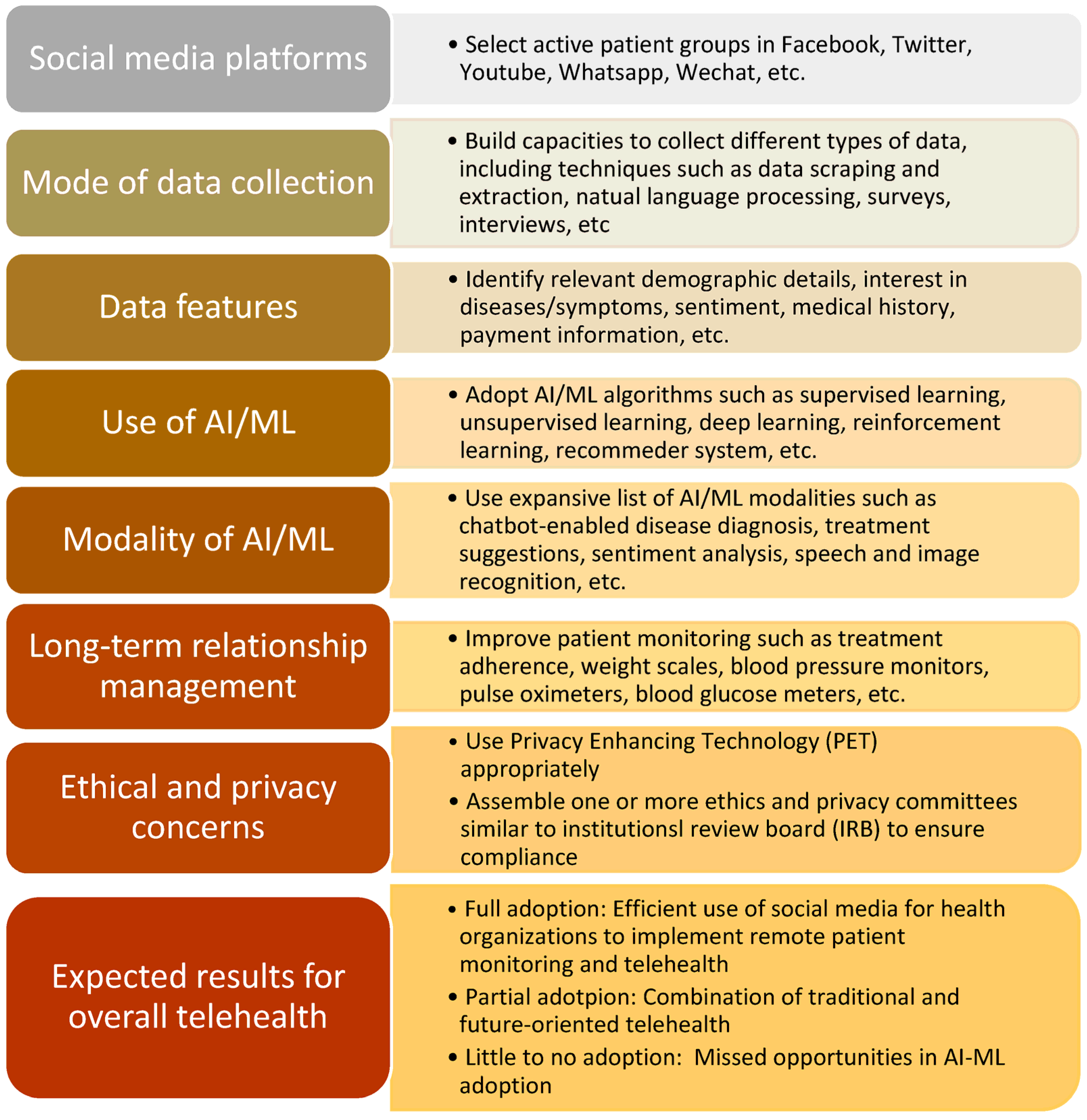
Artificial intelligence (AI) and machine learning (ML) have revolutionized the way health organizations approach social media. The sheer volume of data generated through social media can be overwhelming, but AI and ML can help organizations effectively manage this information to improve telehealth, remote patient monitoring, and the well-being of individuals and communities. Previous research has revealed several trends in AI–ML adoption: First, AI can be used to enhance social media marketing. Drawing on sentiment analysis and related tools, social media is an effective way to increase brand awareness and customer engagement. Second, social media can become a very useful data collection tool when integrated with new AI–ML technologies. Using this function well requires researchers and practitioners to protect users’ privacy carefully, such as through the deployment of privacy-enhancing technologies (PETs). Third, AI–ML enables organizations to maintain a long-term relationship with stakeholders. Chatbots and related tools can increase users’ ability to receive personalized content. The review in this paper identifies research gaps in the literature. In view of these gaps, the paper proposes a conceptual framework that highlights essential components for better utilizing AI and ML. Additionally, it enables researchers and practitioners to better design social media platforms that minimize the spread of misinformation and address ethical concerns more readily. It also provides insights into the adoption of AI and ML in the context of remote patient monitoring and telehealth within social media platforms.
Keywords: AI; ML; health organizations; social media AI; ML; health organizations; social media