1. Introduction
Comparison of important characteristics of lifetimes of technical systems is of interest in many problems. Let be non-negative independent random variables representing lifetimes of components of a system. Let be independent Bernoulli random variables with if the i-th component survives from random shocks and if the i-th component fails from the shocks and , for . Further, let them also be independent of s. For a given time period, we can then use to denote the lifetimes of components that are subject to random shocks. Of special interest are and corresponding to lifetimes of parallel and series systems, respectively. Throughout this work, we use the term “heterogeneity” to mean that components have different lifetime distributions. A similar assumption is also made on the survival probabilities. It is then of natural interest to evaluate the influence of heterogeneity among the components and the random shocks on the lifetimes of parallel and series systems, and this reliability problem forms the main basis for the present work.
We can present a different motivation for this problem as follows. Consider a finite system with each of its components equipped with a starter whose performance is modelled by a Bernoulli random variable, and with all component lifetimes being independent. As a starter may fail to initiate the component, the total number of components in operation would thus be random. Such situations arise naturally in a number of applications. Some possible examples are as follows: start-ups of power plants with gas turbines, length of time of a conference online being the maximum online time of those who successfully register for the conference, and the maximum loss of an insured individual who has a policy covering multiple risks being the maxima of those invoked losses. Another interesting scenario discussed by [
1,
2] in auction theory is when an auctioneer attracts some predetermined potential bidders by advertising a valuable object; in this case, the largest bid of those participants defines the price of the object for sale. One may additionally refer to [
3,
4,
5,
6] for the role of random extremes in financial economics, reliability theory, actuarial science, hydrology, and so on.
In actuarial set-up, the claims sizes may be represented by variables s, and the variables s represent their occurrences. In this case, and correspond to the largest and smallest claim amounts in a portfolio of risks, respectively.
Considerable attention has been paid in the actuarial literature to different stochastic comparisons of numbers of claims and aggregate claim amounts. In particular, [
7] consider a general scale model and discuss orderings of smallest and largest claim amounts, while [
8] focus on the comparison of smallest and largest claim amounts from two sets of heterogeneous portfolios. These authors have specifically discussed the ordering results in the presence of heterogeneity among the sample sizes and the probabilities of claims and also in the presence of dependence between claim sizes and probabilities of claims.
The flexible family of distributions offered by the proportional reversed hazard rate (PRHR) model has found key applications in lifetime data analysis. For a system consisting of
n components, let
and
(for
) denote the lifetime and the reversed hazard rate of the
i-th component. Then, when
the variables
s are said to have the
model, where
is referred to as the baseline reversed hazard rate function and
s (all positive) are the proportionality constants. It is then easy in this case to see that
, the distribution function of
, is given by
,
, where
is the baseline distribution function corresponding to
. The PRHR family of distributions include many commonly used lifetime distributions as special cases such as generalized exponential and exponentiated Weibull distributions. In addition, when the proportionality constants
s are integers, then
s are in fact the lifetimes of parallel systems consisting of
components with their lifetimes being independent and identically distributed with distribution function
As parallel systems with more components are less prone to failure, the PRHR model is also referred to as resilience model in the reliability literature; one may refer to [
9] for relevant details.
Suppose
,
Then, the survival function of series systems,
, is given by
Similarly, the survival function of
is given by
Then, the stochastic comparison between and is equivalent to the comparison between and . It should be mentioned that the comparison between and has been investigated by many authors earlier. For this reason, we have not considered this problem in the present work.
In this paper, we consider only stochastic comparisons of parallel systems with proportional reversed hazard rate (PRHR) distributed components equipped with starting devices. We specifically establish the hazard rate, reversed hazard rate and usual stochastic orders of parallel systems with PRHR distributed components equipped with starting devices.
The rest of this paper is organized as follows. In
Section 2, we present some basic definitions and notation pertaining to stochastic orders and majorization orders that are used in the present work.
Section 3 discusses stochastic comparisons of parallel systems for different probabilities of starters in terms of hazard rate order. In
Section 4, stochastic comparisons of parallel systems are established for different probabilities of starters in terms of reversed hazard rate order.
Section 5 discusses stochastic comparisons of parallel systems for different probabilities of the starters in terms of usual stochastic order. Finally, some concluding remarks are made in
Section 6.
2. Preliminaries
In this section, we present some basic definitions and lemmas that will be useful for all subsequent developments. For convenience, we use the notation to denote that both sides of an equality have the same sign.
Definition 1. Suppose X and Y are two non-negative continuous random variables with distribution functions and survival functions and hazard rate functions and , and reversed hazard rate functions and . We assume that all involved expectations exist. Then:
- (i)
X is said to be larger than Y in the usual stochastic order (denoted by if for all This is equivalent to saying that for all increasing functions
- (ii)
X is said to be larger than Y in the hazard rate order (denoted by if and only if increases in This is equivalent to saying that for all
- (iii)
X is said to be larger than Y in the reversed hazard rate order (denoted by if and only if increases in This is equivalent to saying that for all
It is known that the usual stochastic order is included in both hazard rate and reversed hazard rate orders. The books by [
10,
11] provide elaborate details on various stochastic orders and their applications to a wide array of problems.
Definition 2. Consider two vectors and with corresponding increasing arrangements and , respectively. Then:
- (i)
a is said to majorize denoted by if for and ;
- (ii)
a is said to weakly submajorize denoted by if for .
The concept of majorization is a way of comparing two vectors of the same dimension, in terms of the dispersion of their components, in which the order means that s are more dispersive than s for a fixed sum. For example, we always have where with . It is evident that the majorization order implies weak submajorization order.
Definition 3. A real-valued function ϕ, defined on a set , is said to be Schur-convex on ifFurther, ϕ is said to be Schur-concave function on if is Schur-convex on Lemma 1. ([12], p. 84) Suppose is an open interval and is continuously differentiable. Then, necessary and sufficient conditions for ϕ to be Schur-convex (Schur-concave) on are - (i)
ϕ is symmetric on ;
- (ii)
for all and all ,where denotes the partial derivative of ϕ with respect to its i-th argument.
Lemma 2. ([12], p. 87) Consider the real-valued function defined on a set . Then, implies if and only if ϕ is increasing and Schur-convex on 3. Hazard Rate Order
In this section, we discuss stochastic comparisons of parallel systems for different probabilities of starters in terms of hazard rate order.
Theorem 1. Suppose and are independent non-negative random variables with . Further, suppose , , , and are independent Bernoulli random variables, independently of s, with and , . Let and . Then, the following statements hold true:
- (i)
If () and ( ), then - (ii)
Proof. - (i)
The survival functions of
and
are given by
and
For the necessity part, note that
implies that
and so
. We thus have
Therefore, we get
which implies that
. Now, for the sufficiency part, let us consider
and it is then enough to show that
is increasing in
x. Upon differentiating
with respect to
x, we get
For proving the increasing property of
, it is enough to show that
is positive. For this purpose, we find
Let us now consider
. Then, we have
; since
, we find
and so
is decreasing. Consequently,
for
, and so
. Thus, Part (i) of the theorem is proved.
- (ii)
The survival functions of
and
, for
, are
and
respectively. Then, it is enough to show that
is increasing in
x. We can then see easily that
Based on Part (i) and Equation (
1), for
, we have
being positive. From
and
, there exist positive real numbers
d and
c such that
and
. Now, from
, we have
, and also from
, we get
and then
. So,
and clearly
. Furthermore, we have
Therefore, all terms of the last equality in are positive, and the desired result is obtained.
□
We now present an example to show that Theorem 1 (under ) may not hold when the condition is not satisfied.
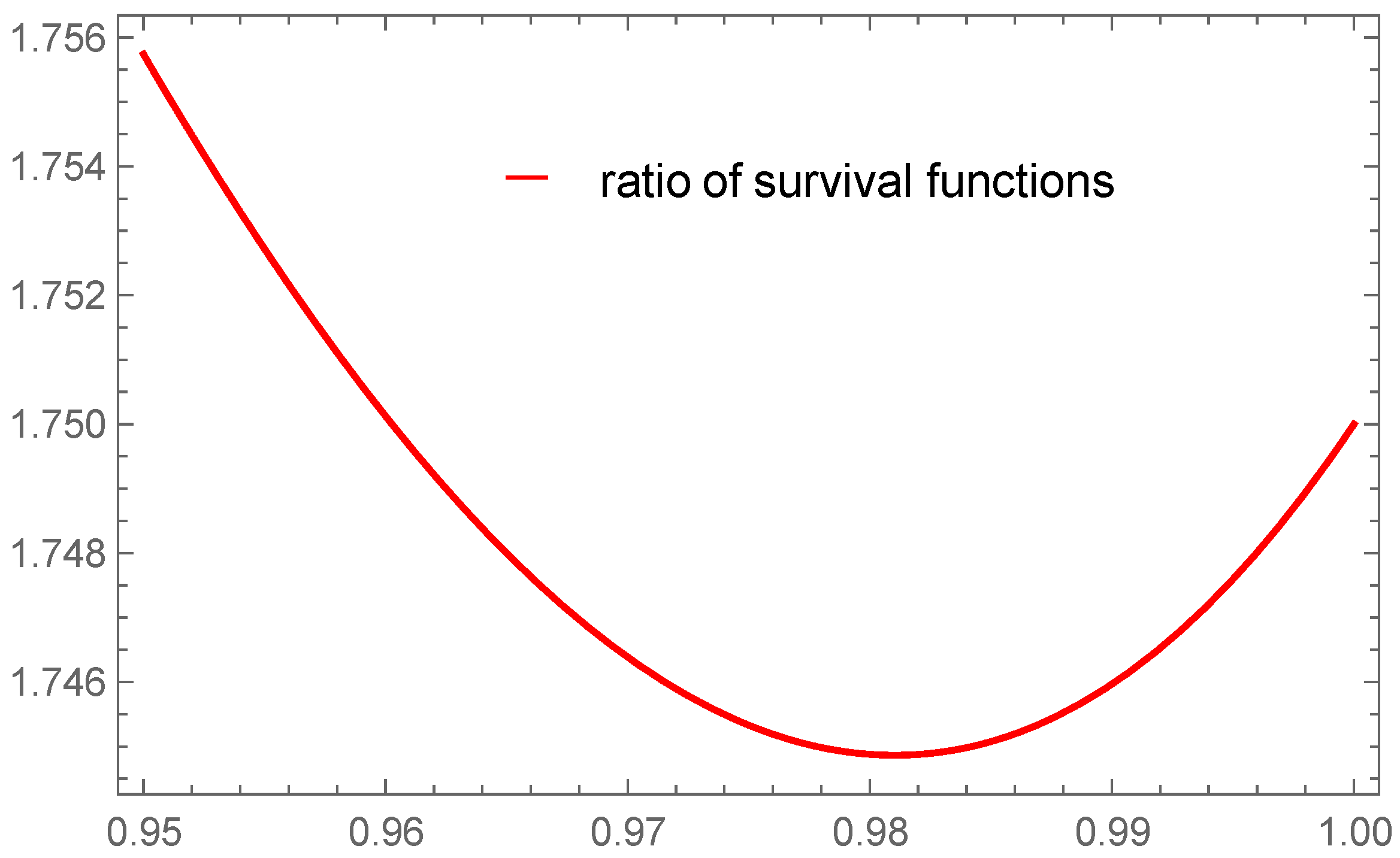
Example 1. Let us consider as baseline distribution function. Set , and . Then, we findto be not monotone when (as seen in Figure 1), and this negates the results that and . Remark 1. Under the , the result of Theorem 1 also hold under the following conditions:
- 1.
and ;
- 2.
and .
We now present an example to show that Part (ii) of Theorem 1 may not hold when .
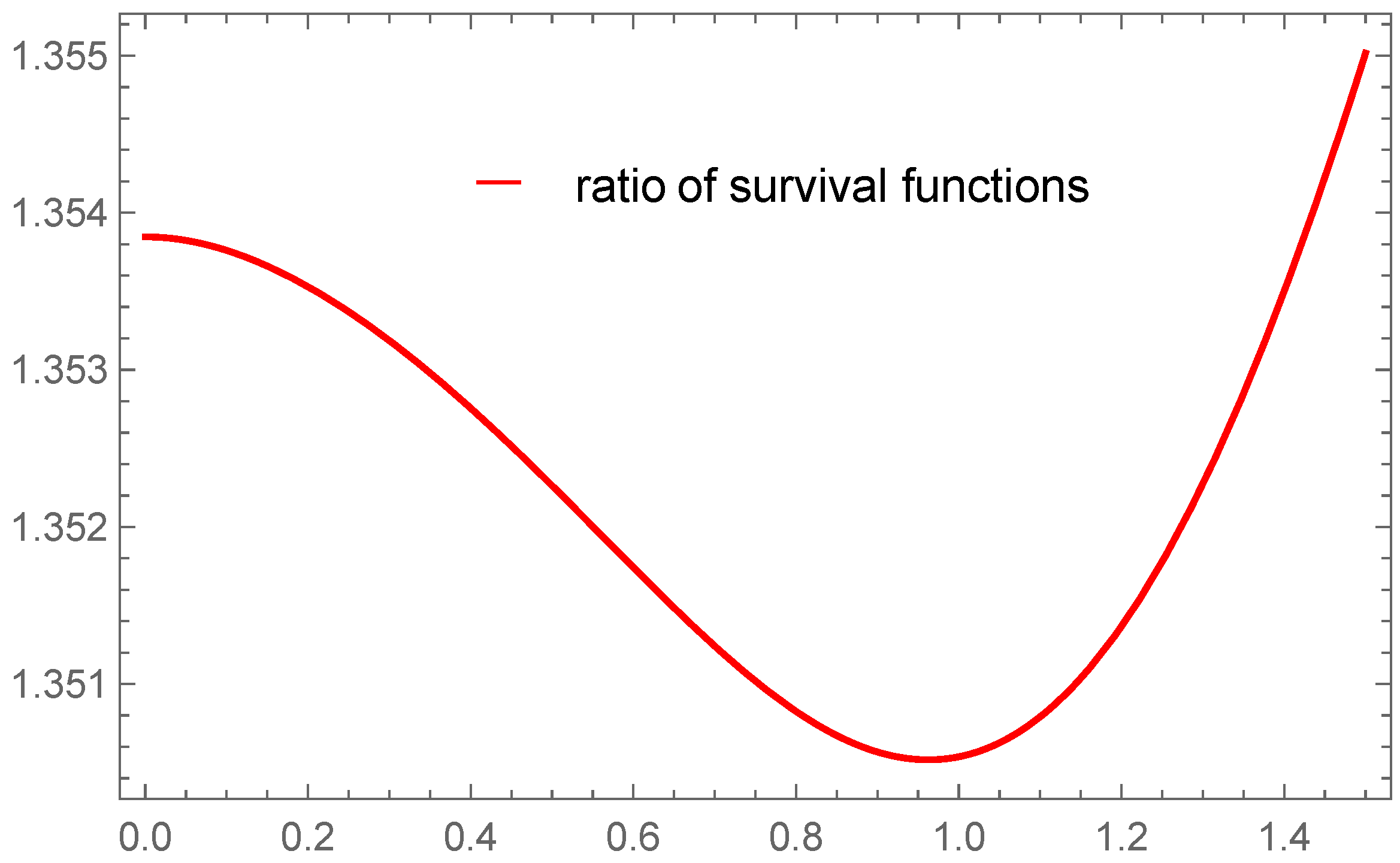
Example 2. Let us consider the standard exponential as baseline distribution with , for . Set , and . Clearly, and . We then haveto be not monotone in (as seen in Figure 2), and this negates the results that and . 6. Concluding Remarks
A parallel system is one of the most commonly used coherent systems in practice. For this reason, a careful study of its performance characteristics, such as reliability function, hazard function and reversed hazard function, based on the characteristics of the component lifetime distribution, is of great interest to reliability engineers. In this work, we have focused our attention primarily on a parallel system with two components as a parallel system with more components can be decomposed into many subsystems with two components in parallel. One of the prominent examples of a two-component parallel system is a twin-engine jet system, which, in addition to being safer than a single-engine jet system, is more efficient in terms of fuel consumption than a jet system with more than two engines.
Specifically, we have proved the hazard rate and reversed hazard rate orders of parallel systems with two components having proportional hazard rates and starting devices.
It will be of interest to consider the problems discussed here by allowing dependence between components using some general copulas for the joint distribution of lifetime components. We are working in this direction at the present time and will present the corresponding results in the future.