1. Introduction
Fractional differential equations have been of high interest during recent decades. The variety of their applications in biology, physics, engineering and economics (see [
1,
2,
3,
4]) has led to development of techniques to study the qualitative behavior of solutions of these equations.
Particular attention has to be paid to the class of nonlinear fractional boundary value problems (FBVPs). Construction of their exact solutions may be impossible or one may even face computational difficulties trying to find their analytical representation. However, precise approximate methods may help to simplify and even solve this task.
In the current paper, we provide a new view on the successive approximations approach [
5], recently used for the study of FBVPs for periodic, Cauchy–Nicoletti-type, and interpolation boundary conditions (see [
6,
7,
8,
9,
10]). An original parametrization technique, initially suggested for the reduction of nonlinearities in boundary restrictions (see discussions [
11,
12]), and a dichotomy-type approach (see results in [
13,
14,
15,
16]) led to the investigation of solutions of two “model”-type FBVPs, containing some artificially introduced parameters. The approximate solutions of these problems were constructed analytically, while the numerical values of the parameters were determined as solutions of the so-called “bifurcation” equations.
The novel technique suggested in this paper has never been applied in study of FBVPs. It allowed us to improve and essentially sharpen the estimates obtained in [
6,
7,
8,
9,
10]. Along with the other well-known approximate methods, dealing with the fractional differential equations and their systems (see discussions in [
17,
18,
19,
20,
21]), the aforementioned approach complements the fundamental study of such essentially nonlinear problems.
3. Nonlinear FBVP and Its Decomposition
Consider a system of fractional differential equations (FDEs):
for some
,
subjected to the two-point boundary constraints:
where
is the generalized Caputo fractional derivative with the lower limit at
a, defined by (
1);
and
are continuous vector functions, and
is a closed and bounded domain.
To solve this problem, we used the so-called “freezing” (or parametrization) technique (see discussions in [
11,
12,
16]), coupled with the modification of the numerical–analytic method [
5]. The aim of such an approach consists of the introduction of an appropriate parametrization with further reduction of the original FBVP (
6) and (
7) with nonlinear boundary conditions to two problems, containing already linear separated boundary constraints. Numerical values of the introduced parameters are then evaluated from the corresponding determining system of algebraic equations, one of which is the relation (
7).
As a first step in study of the FBVP (
6) and (
7), let us fix three closed sets
, where we look for the initial values of solutions
:
Without loss of generality, we chose these sets to be convex.
Then, we formally substitute the boundary and intermediate values of solution
by vector parameters:
where
and
Using relation (
9), we reduce the study of the original problem (
6) and (
7) to an investigation of solutions of two decomposed “model” problems with separated linear boundary conditions, dependent on parameters:
and:
with
and
defined by (
9).
In addition, we connect to the parametrized FBVPs (
10)–(
13) the correspondent sets:
and their
-,
-neighborhoods of the form:
where
, and
,
are defined in accordance with Definition 4.
Remark 1. The parametrization (9) reduces the study of the original FBVP (6) and (7) with nonlinear boundary conditions on the full interval to the investigation of two decomposed problems (10), (11) and (12), (13), defined on the half intervals and , respectively. This approach allows to diminish some values in the qualitative analysis of the given FBVP and to essentially improve the estimates of the iteration schemes, presented in the coming sections (see also discussions in [6,7,8,9,10]). Remark 2. It is also worth emphasizing that the set of solutions of the FBVP (6) and (7) coincides with the set of solutions of the modified problems (10), (11), and (12), (13) under additional conditions (9). 5. Successive Approximation Technique on the Half Intervals
To derive the recursive sequence of functions, approximating solutions of the auxiliary FBVP (
10) and (
11), we first consider a perturbed system:
coupled with the parametrized boundary conditions (
11):
where
is an unknown vector to be defined.
Direct integration shows that the general solution of (
22) can be written in the form:
After substituting (
23) into the boundary restrictions (
11), and taking into account the parametrization (
9), we can obtain:
and:
Relation (
24) is satisfied, since it corresponds to the first of the boundary conditions in (
11). On the other hand, the relation (
25) will hold if the perturbation term
is defined as:
Hence, we can obtain the exact solution to the perturbed FBVP (
22), (
11) in the form:
Now, assume that
and the
-neighborhood of domain
satisfies an inequality:
where:
Based on (
26), we introduce an iterative sequence of functions:
where
,
, associated with the parametrized BVP (
10) and (
11).
Using a similar approach to (
22)–(
26), for
:
and
satisfying an inequality:
we connect to the parametrized FBVP (
12), (
13) the corresponding sequence of functions:
for all
and
,
.
Remark 3. Note that the sequences (29), (30) and (33), (34) are derived in such a way that they satisfy the parametrized boundary conditions (11) and (13) beforehand. For the sequence of functions (
30), the following convergence theorem holds.
Theorem 1. Let, for the parametrized FBVP (10) and (11), there exist a non-negative vector satisfying inequality (27), such that on interval . In addition, assume that for the matrix:inequality:holds. Then, for an arbitrary pair of vector parameters :
Proof. Assertion 1 follows from the theorem’s assumptions and by direct substitution of (
30) into the parametrized boundary conditions (
11).
Now, we prove that, for all
functions
of the sequence (
30) remain in their domain of definition
, and that (
30) is the Cauchy sequence in the Banach space
. For this purpose, let us estimate the differences:
where functions
and
are given by formulas (
29) and (
30). For every
, we get:
where
and
are defined by (
19) and (
28), respectively.
To prove the error estimate (
43), we analyse the difference:
where
are functions of the sequence (
30).
For
from the inequality (
44), we conclude that:
Using the method of mathematical induction, we derive, that for the general case of the iteration step
m:
In view of inequality (
45), we obtain an estimate:
for
,
, and
defined by (
20), (
35), and (
28), respectively.
Under condition (
36), the maximal eigenvalue
of matrix
does not exceed 1. This means that:
Passing in (
46) to the limit for
, we can get the estimate (
43).
Moreover, according to the Cauchy criteria, the sequence of functions
, defined by the iterative formula (
30), is uniformly convergent in the domain
to its limit function
.
Since all functions of sequence (
43) satisfy the two-point parametrized boundary conditions (
11), the limit function
also satisfies them.
Analogically to Theorem 1 in [
6], by letting
m in relation (
30) tend to
∞, it is easy to show that the limit function (
37) is the solution of the integral Equation (
39), i.e., it is a unique solution of the Cauchy problem (
40), (
39) with the perturbation term
, defined by (
42). □
Similarly to the Theorem 1 conditions, one can prove convergence of the sequence of functions , i.e., the theorem holds.
Theorem 2. Let, for a parametrized FBVP (12) and (13), there exist a non-negative vector satisfying an inequality (32), such that , . In addition assume, that matrix:satisfies inequality: Then, for an arbitrary pair of vector parameters :
All functions of the sequence (34) are continuous on the interval and satisfy the separated boundary conditions (13). The sequence of functions (34) converges uniformly as to its limit function:for all . The limit function (49) satisfies the boundary conditions: and is a unique solution of an integral equation:in domain . In other words, it is a solution of the corresponding Cauchy problem for a perturbed system of FDEs:where is a mapping, given by formula: The following error estimation holds: where and are defined by (47) and (31), respectively.
Proof. The proof is similar to Theorem 1. □
Remark 4. Theorems 1 and 2 guarantee that under assumed conditions functions:are well-defined for all pairs of artificially introduced parameters and . Then, by putting:we can obtain a well-defined continuous function , which, at point , attains the value: 8. Example
In this section, we demonstrate the applicability and improvement of the numerical–analytic technique, previously presented in this paper.
We consider an FBVP:
whose exact solution is given by the system of functions:
The BVPs (
79) and (
80) are particular cases of (
6) and (
7) for
,
:
and:
where
.
We are looking for approximate solutions
of FBVPs (
79) and (
80), continuous on
and defined on the domain:
Note that knowledge of the exact solution of problems (79) and (80) is obviously beneficial, since we can provide an explicit comparison of the obtained computational results with those in (81). Direct computations show that the vector function
in FDS (
79) satisfies the Lipschitz condition (
5) with the matrix:
where
In addition, the maximum eigenvalue of the matrix:
satisfies inequality:
Validity of the last relation means that we cannot apply the classical version of the numerical–analytic method (see discussions in [
6,
11]), since one of the sufficient conditions in the convergence theorem fails.
However, the dichotomy-type approach, described in
Section 3, allows to decompose the original problems (
79) and (
80) in such a way that the value
in the inequality (
82) will be reduced.
Following our steps in
Section 3 of the paper, we first introduced the following parameters:
where
,
,
.
Then, in alignment with (
10)–(
13), we decompose the original BVPs (
79) and (
80) onto two “model”-type parametrized FBVPs:
and:
Let us now choose the sets
and
containing values
,
of the solutions of the FBVPs (
83) and (
84) by taking:
At the same time, the sets
and
, where one looks for the values
,
of the solution of the parametrized problems (
85) and (
86), are defined as:
Thus, we can determine the convex sets
and
, originally given by formulae (
14) and (
15), as:
and:
Now, the vector function
in FDS (
83) satisfies the Lipschitz condition (
5) with the matrix:
In addition, the maximum eigenvalue of the matrix:
satisfies inequality:
Analogically, we can conclude that the vector function
of FDS (
85) satisfies the Lipschitz condition (
5) with the matrix:
and the maximum eigenvalue of the matrix:
satisfies the relation:
We want to recall that initially, the maximal eigenvalue of the matrix
Q, correspondent to the original problems (
79) and (
80), failed to be less than 1. This issue was resolved in FBVPs (
84)–(
87).
Vector functions
and
in FDSs (
84) and (
86) are such that:
Moreover, we define the
- and
-neighborhoods of the sets
and
as:
Thus, all conditions of the convergence Theorems 1 and 2 hold, and we are able to proceed with construction of the approximate solution of the parametrized FBVPs (
84)–(
85) and (
86)–(
87).
As a zero approximation to the exact solution of the auxiliary problems (
84)–(
85) and (
86)–(
87), we take the systems of functions:
and:
Using the mathematical package Maple 2018, we obtained the first approximation of the exact solution of the decomposed FBVPs (
84) and (
85), and (
86), (
87). These solutions were of the form:
Computations showed that the approximate determining system (
71) and (
72) in the first iteration had the following solutions:
Substituting value (
92) into approximations (
88)–(
91) and using formula (
70), we can write down components of the first approximation to the exact solution of the given nonlinear BVPs (
79) and (
80):
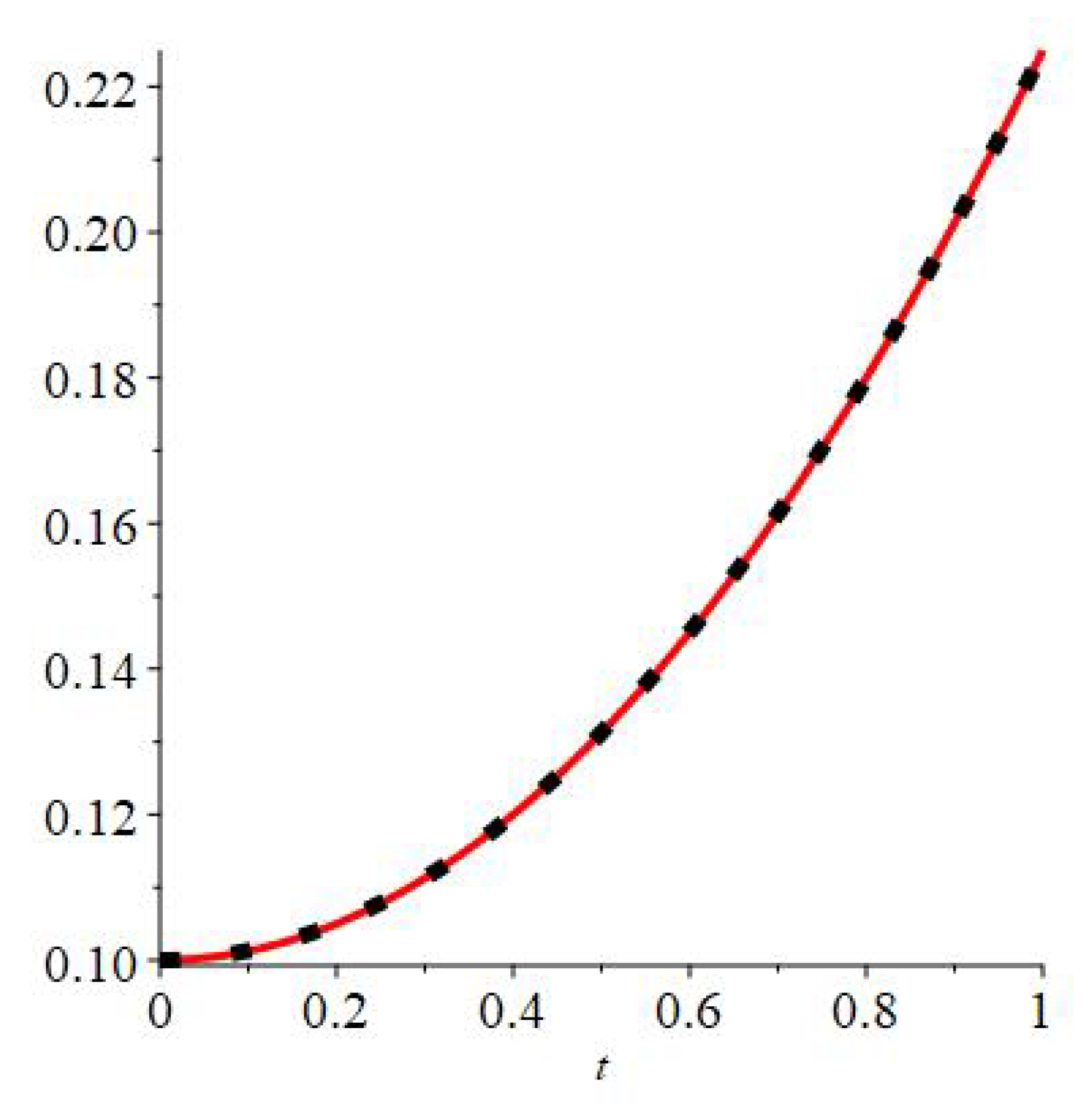
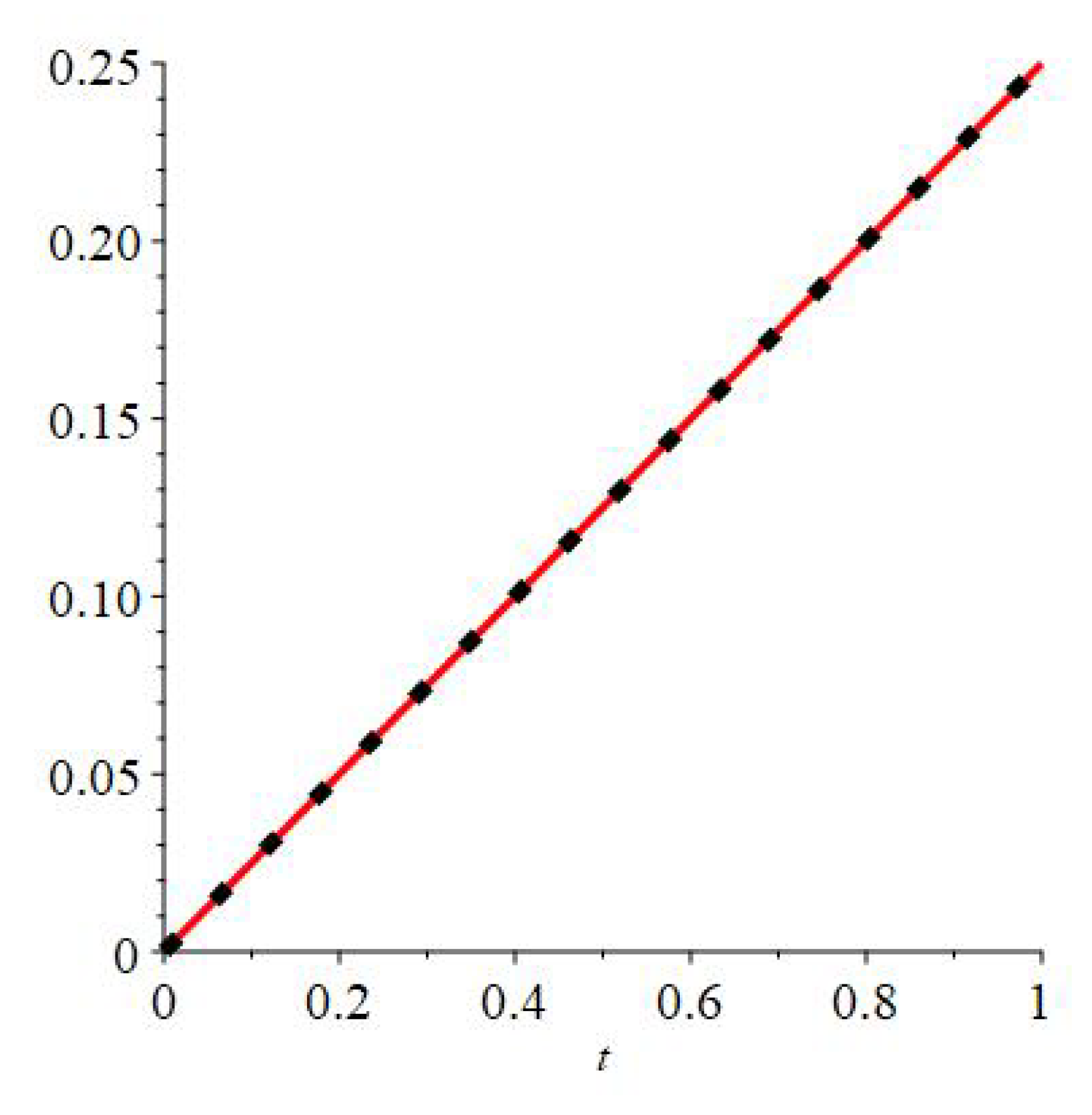
The graphs of the first approximations (
93) and (
94) and the exact solution (
81) are given in
Figure 1 and
Figure 2.