


Abstract
This paper is devoted to introducing a nonlinear reconstruction operator, the piecewise polynomial harmonic (PPH), on nonuniform grids. We define this operator and we study its main properties, such as its reproduction of second-degree polynomials, approximation order, and conditions for convexity preservation. In particular, for quasi-uniform grids with , we get a quasi reconstruction that maintains the convexity properties of the initial data. We give some numerical experiments regarding the approximation order and the convexity preservation.
Keywords:
interpolation; reconstruction; nonlinearity; nonuniform; σ quasi-uniform; convexity; class quasi C3 1. Introduction
Reconstruction operators are widely used in computer-aided geometric design. For simplicity, the functions that are typically used as operators are polynomials. In order to avoid undesirable phenomena generated by high-degree polynomials, reconstructions are usually built piecewise. Due to the bad behavior of linear operators in the presence of discontinuities, it has become necessary to design nonlinear operators to overcome this drawback. One of these operators was defined in [1] and was called the piecewise polynomial harmonic (PPH). This operator essentially consists of a clever modification of the classical four-point piecewise Lagrange interpolation. The initial purpose of this definition was to deal with discontinuities, reducing the undesirable effects to only one interval instead of the three intervals affected in a reconstruction built with a four-point stencil. In addition to that, as we will see throughout this paper, the reconstruction may also play an important role in design purposes, since it keeps the convexity properties of the given starting data.
For the sake of simplicity, as much in the theoretical analysis as in the practical implementation and computational time, studies usually start with data given in uniform grids. Nevertheless, some applications require dealing with data over nonuniform grids. At times, it is not trivial to adapt operators defined over uniform grids to the nonuniform case. The above-mentioned PPH operator was defined over a uniform grid and some of its properties were studied in [1]. These reconstruction operators are the basis for the definition of associated subdivision and multi-resolution schemes. In this paper, we use the definition that we made of the PPH reconstruction operator for data over nonuniform grids in [2], and we study some properties of this operator in greater depth. In particular, we focus on the smoothness of the reconstruction and the convexity-preserving properties of the initial data. We show that PPH reconstruction gives a function, except for the knots where the function remains and the differences between the first, second, and third one-sided derivatives are of the third, second, and first order, respectively (see Definition 5).
In [3], the authors proved that the related subdivision scheme in uniform meshes preserves the convexity of the control points. In this article, we attempt to determine if this result about preserving convexity can be extended for the reconstruction operator and not only in uniform meshes, but also in quasi-uniform meshes with
The paper is organized as follows: Section 2 is devoted to defining the PPH reconstruction operator over nonuniform grids. For this purpose, we will use the weighted harmonic mean with appropriate weights. Then, we show that the new reconstruction operator amounts to the original PPH reconstruction operator when we restrict to uniform grids. The definition is given for general nonuniform meshes, although in order to establish some theoretical results, we consider quasi-uniform meshes. In Section 3, we study some basic properties of PPH reconstruction, such as the reproduction of polynomials of the second degree, approximation order, smoothness, boundedness of the operator, Lipschitz continuity, and convexity preservation. In Section 4, we analyze the reconstruction when dealing with strictly convex (or concave) initial data. In Section 5, we present some numerical tests. Finally, some conclusions are included in Section 6.
2. A Nonlinear PPH Interpolation Procedure on Nonuniform Grids
Let us define the nonuniform grid Let us also denote the nonuniform spacing between abscissae as . We will work with continuous piecewise reconstructions of a given underlying continuous function with, at most, a finite set of isolated corner or jump discontinuities, that is,
where is a third-degree polynomial satisfying
From now on, we will use the notation
Taking (1) into account, this implies that we are interested in building the appropriate polynomial piece in the interval Let us consider the set of values for some corresponding to subsequent ordinates of a function at the abscissae of a nonuniform grid and is the Lagrange interpolatory polynomial built with the points that is, the unique polynomial of degree less or equal 3 satisfying
The polynomial can be expressed as
where
It is well known that from conditions (3), one obtains the following linear system of equations, where the coefficient matrix is a Vandermonde matrix with different nodes and is, therefore, invertible:
In order to express the solution of system (5) in a form that is convenient for our purposes, we introduce the definition of the second-order divided differences,
and a weighted arithmetic mean of and , defined as
with the weights
With these definitions, after solving the system (5), we get the following expressions for the coefficients of the polynomial (4):
which can also be expressed as
At this point, we give some more definitions and lemmas that we will need later.
Lemma 1.
Let us consider the set of ordinates for some at the abscissae of a nonuniform grid . Then, the values and at the extremes can be expressed as
with the constants given by
Proof.
This proof is an immediate calculation just by expanding the expression of the weighted arithmetic mean in (7) in terms of , that is,
□
Definition 1.
A nonuniform mesh is said to be a σ quasi-uniform mesh if there exist and a finite constant σ such that
In the presence of isolated singularities, predictions made using Lagrange reconstruction operators lose their accuracy in the vicinity of the discontinuity; in fact, three intervals are expected to be affected, since we are considering a stencil of four points. In order to reduce the affected intervals to only one, the one containing the singularity, we introduce a weighted harmonic mean over nonuniform grids, which will be used in the general definition of the PPH reconstruction operator. Notice that it is not possible to recover the exact position of a jump discontinuity inside an interval by using point value discretization of an underlying function. For the case of a corner discontinuity, a strategy such as the subcell resolution technique [4] could be used to detect its position. This harmonic mean is built as the inverse of the weighted arithmetic mean of the inverses of the given values. We define the following function.
Definition 2.
Given and such that and we denote as the function
Lemma 2.
If and , the harmonic mean is bounded as follows:
Before giving another important lemma for our purposes, we will introduce a definition about a basic concept that will be used throughout the rest of the article.
Definition 3.
The expression means that there exist and such that ,
Lemma 3.
Let be a fixed positive real number and let If then the weighted harmonic mean is also close to the weighted arithmetic mean
Remark 1.
The smaller the value of in Lemma 3, the smaller the in Definition 3 required to attain the expected theoretical order.
It is well known that the divided differences (6) work as smoothness indicators [5,6,7,8,9,10,11,12,13,14]. If a potential singularity appears at the interval we propose that the data are not interpolated, and that the ordinate is exchanged for another value that is more convenient for what happens in the target interval where we want to implement the local polynomial piece according to (1). In the same manner, if a potential singularity lies in the interval a symmetrical modification is carried out. According to these observations, we can give the following definition for the PPH reconstruction on nonuniform meshes.
Definition 4
(PPH reconstruction). Let be a nonuniform mesh. Let be a sequence in Let and be the second-order divided differences, and for each , let us consider the modified values built according to the following rule:
- Case 1: If ,
- Case 2: If
According to Definition 4, and establishing a parallelism with expression (4), we can write the PPH reconstruction as
where the the coefficients are calculated by imposing conditions (20). Depending on the local case, Case 1 or Case 2, the coefficients will have different expressions.
Case 1: , i.e., the possible singularity lies in . The replacement of with by exchanging the weighted arithmetic mean in Equation (11b) for its corresponding weighted harmonic mean has been proposed. It is also important to point out that Equation (17) shows that is not significantly affected by a potential singularity at the interval , since, by property (15) in Lemma 2, and in turn, is not affected by this discontinuity. Therefore, the influence of on the values of the reconstruction in the interval will be limited. In this case, the coefficients of the new polynomial (21) come from solving the linear system
Thus, the coefficients take the form
Case 2: , i.e., the possible singularity lies in . In this case, in Definition 4, the value is replaced with by using expression (18). The net effect is again the exchange of the weighted arithmetic mean in Equation (11a) for the corresponding weighted harmonic mean. On this occasion, we get an adaption of the reconstruction to a potential singularity in since the effect of the value is largely reduced. In fact, by property (15) in Lemma 2, and is not affected by any discontinuity.
Remark 2.
The replacement of the weighted arithmetic mean for the corresponding harmonic mean in Definition 4 does not only guarantee adaptation near singularities, but also enlarges the region where the reconstruction preserves convexity according to expressions (40) and (43), as we will see in the next section.
Remark 3.
In both cases, the value of the PPH reconstruction at the midpoint of gets the value This expression directly defines an associated subdivision scheme and, consequently, also an associated multi-resolution scheme in nonuniform meshes. The interested reader is referred to [1,5] for more details in the context of uniform meshes.
Remark 4.
Notice that, considering uniform meshes, i.e., all the given expressions reduce to the equivalent expressions in [1], which are valid only for the uniform case.
Remark 5.
Notice that Definition 4 of the PPH reconstruction operator has been given for general nonuniform meshes. From now on, one needs to take into account that some results are true for general grids, while others need the restriction to σ quasi-uniform meshes.
3. Main Properties of the PPH Reconstruction Operator in Nonuniform Meshes
In this section, we study some interesting properties of the new reconstruction operator. More precisely, we study the reproduction of polynomials, accuracy of the reconstruction, smoothness, boundedness, Lipschitz continuity, and convexity preservation. We start with the reproduction of polynomials up to degree
3.1. Reproduction of Polynomials up to Degree 2
If the underlying function is a polynomial of degree 2, then is constant and . Using Equations (7), (10), (14), (23), and (24), we get
So, , i.e., , reproduces polynomials of a degree less than or equal 2, since does this.
3.2. Approximation Order for Strictly Convex (Concave) Functions
We will prove full-order accuracy, that is, fourth order, for a reconstruction that locally uses four centered points to get the approximation at a given interval for any In particular, we can enunciate the following proposition.
Proposition 1.
Let be a strictly convex (concave) function of class and let be such that (let be such that ). Let be a σ quasi-uniform mesh in with and the sequence of point values of the function Then, the reconstruction satisfies
where
Proof.
Given there exist such that This implies that
Now, let us suppose that the initial data come from a strictly convex function (for a concave function, the arguments remain the same) satisfying the given hypothesis for some Then, since second-order divided differences amount to second derivatives at an intermediate point divided by two, i.e.,
with and Moreover, we have
where M is a bound of the third derivative of in the compact interval
Thus,
where is the Lagrange interpolatory polynomial. Taking the triangular inequality into account again,
and using that Lagrange interpolation also attains fourth-order accuracy. □
3.3. Smoothness
In this part, we study the smoothness of the resulting reconstruction, and for this purpose, we give the following definition.
Definition 5
(Quasi function). A function is said to be quasi if it satisfies:
- (a)
- belongs to class except for a numerable set of points with where
- (b)
- There exist one-sided derivatives until order and , and these satisfy
Before giving the main result regarding smoothness, we will prove an auxiliary lemma that we need.
Lemma 4.
Let be a derivable function in and let us suppose that there exist and such that :
then, there exists such that
Proof.
From the fact that f is derivable in , we have that given for all , there exists such that, ,
Let ; then, we take , and there exists such that,
We now define Then, for all with , we get:
□
We are now ready to present the following proposition with respect to the PPH reconstruction given in Definition 4.
Proposition 2.
Let be a strictly convex (concave) function of class and such that ( such that ). Let be a σ quasi-uniform mesh in with and the sequence of point values of the function Then, the reconstruction is quasi
Proof.
By construction, the PPH reconstruction is for all , since it is nothing else but a piecewise polynomial. Let us study the situation at a grid point where two polynomial pieces join. Again, by construction, and therefore, the reconstruction is a continuous function. Using the proof of Proposition 1, we know that
From (28), we get that
Thus, from Lemma 4, we get that
3.4. Boundedness and Lipschitz Continuity
We start by giving the exact definitions of the concepts treated in this section.
Definition 6.
A nonlinear reconstruction operator is called bounded if there exists a constant such that
Definition 7.
A nonlinear reconstruction operator is called Lipschitz continuous if there exists a constant such that , it is verified that
Before addressing these properties, we need to prove some lemmas.
Lemma 5.
Let be a σ quasi-uniform mesh in with and let be the Lagrange basis for a four-point stencil Then,
Proof.
As is well known, the Lagrange bases are given by
Denoting we have
In order to obtain the bound for , we distinguish two cases.
- If
- If working in a similar way, we also get .
Finally,
□
Lemma 6.
Proof.
From Equation (12), we get
According to property (15) of the harmonic mean , we also get
Following a similar path for ,
Proposition 3.
The nonlinear reconstruction operator is a bounded operator over σ quasi-uniform meshes.
Proof.
Let and such that . Depending on the relative size of and the PPH reconstruction operator replaces the value with or by as follows:
where stand for the Lagrange polynomials. Applying the triangular inequality for each case, we get
According to Lemmas 5 and 6, we obtain the following bound for both cases:
□
The following lemma will be used for proving the Lipschitz continuity.
Lemma 7.
Let be a σ quasi-uniform mesh in with and let be a sequence in Then, the nonlinear reconstruction operator defined in (4) satisfies that
Proof.
Since there exists such that
The reconstruction and its derivative read
Without lost of generalization, we will suppose that The case can be carried out similarly. First, we prove the following inequalities:
where depends on the particular quasi-uniform mesh.
Thus,
where depends on the quasi-uniform mesh. □
Proposition 4.
The nonlinear reconstruction operator is Lipschitz continuous over σ quasi-uniform meshes.
Proof.
Let us suppose first that there exists such that Using the Lagrange mean value theorem, , such as
Thus, using Lemma 7 now, we get
In the general case, we can suppose that with If we have already proved the result. For ,
□
3.5. Convexity Preservation
We first introduce a definition concerning what we call strictly convex data and a strictly convexity-preserving reconstruction operator.
Definition 8.
Let be a nonuniform mesh in with , and let be a sequence in We say that the data are strictly convex (concave) if, for all , it is satisfied that (), where stands for the second-order divided differences.
Definition 9.
Let be a nonuniform mesh in with and let be a strictly convex (concave) sequence. We say that an operator is strictly convexity preserving in the interval if there exists and
Next, we give a proposition that introduces sufficient conditions on the grid for convexity preservation of the proposed reconstruction.
Proposition 5.
Let be a σ quasi-uniform mesh in and Let be a sequence of strictly convex data. Then, the reconstruction is strictly convexity preserving in each , that is, it is a piecewise convex function satisfying
Proof.
Let and such that Let us also consider that The case is proved in the same way.
Computing derivatives in Equation (21), we get
In order to analyze the sign of we need to consider two cases due to the fact that the expression of is different for than for .
Case 1: .
Taking into account that from (39), we get that proving is trivial if Otherwise, the inequality reads
Replacing with its expression in Equation (14), we obtain
Evaluating the previous expression at , we obtain the condition for convexity preservation in . This condition reads
Since X is a quasi-uniform mesh with , we have , and therefore, the condition (42) is immediately satisfied. This proves the proposition in this case.
Case 2: .
This time, by replacing the coefficients coming from Equation (24) in expression (38) and following a similar track to that in Case 1, we obtain expressions similar to (40) and (41) for the abscissae verifying :
Now, evaluating at , we get
Thus, since X is a quasi-uniform mesh with , we get the result. □
Remark 6.
Remark 7.
Working in a similar way with the Lagrange reconstruction operator , we obtain the following expression that is analogue to (41) for the abscissa-fulfilling condition :
Then, if we are under the supposition that calling and to the second members of inequalities (41) and (46), respectively, we get
i.e., reconstruction operator preserves the strict convexity in a wider interval than the Lagrange reconstruction operator does. A similar conclusion can be reached under the supposition that
4. PPH Reconstruction Operator over Quasi-Uniform Meshes for Strictly Convex (Concave) Initial Data
In this section, we gather the most important properties of the presented PPH reconstruction for strictly convex (concave) starting input data, and we give them in a unifying theorem. We want to emphasize the potential practical importance of the studied technique for designing processes.
Theorem 1.
Let be a strictly convex (concave) function of class and let such that ( such that ). Let be a σ quasi-uniform mesh in with and let be the sequence of point values of the function Then, the reconstruction satisfies
- 1.
- Reproduction of polynomials up to the second degree.
- 2.
- Fourth-order accuracy.
- 3.
- It presents a quasi smoothness.
- 4.
- It is bounded and Lipschitz continuous.
- 5.
- It is strictly convexity preserving in each
Proof.
Taking the previous results into account, the proof of this theorem is now immediate. In fact, the first affirmation is proven in Section 3.1, and the rest of the affirmations are proven in Propositions 1–5, respectively. □
5. Numerical Experiments
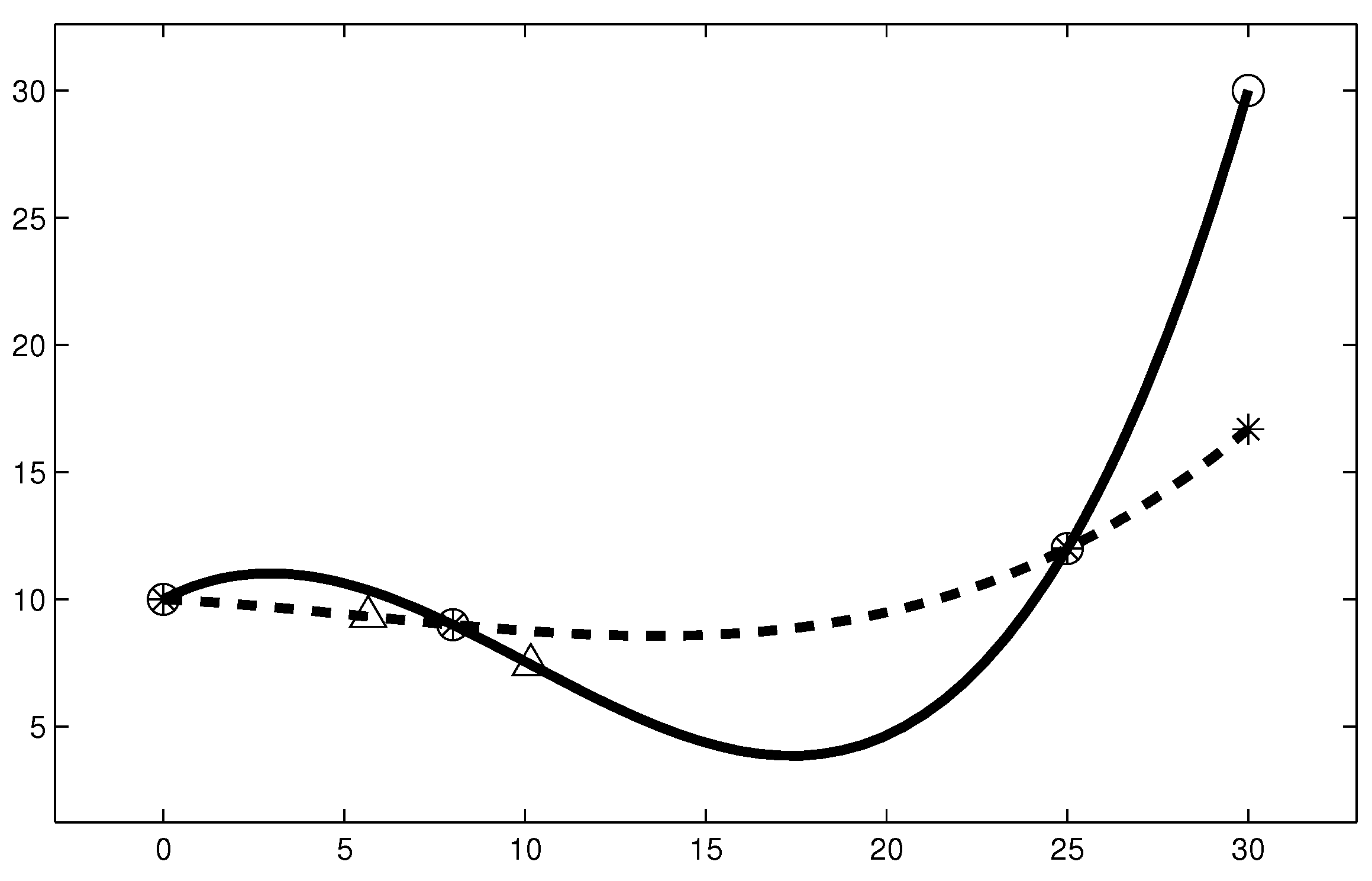
In this section, we present three simple numerical experiments. The first one is dedicated to comparing the convexity preservation between the Lagrange and PPH reconstructions. Let us consider the initial convex set of points, , , , and , that is, . In Figure 1, we have depicted the reconstruction operators corresponding to Lagrange and PPH, and we have marked with triangles the inflection points for each reconstruction (5.66 and 10.16, respectively). We observe that PPH preserves convexity in a wider range than the Lagrange reconstruction does (see expression (47)). In fact, according to Theorem 1, PPH reconstruction is strictly convexity preserving for the abscissae corresponding with the central interval while Lagrange reconstruction is not.
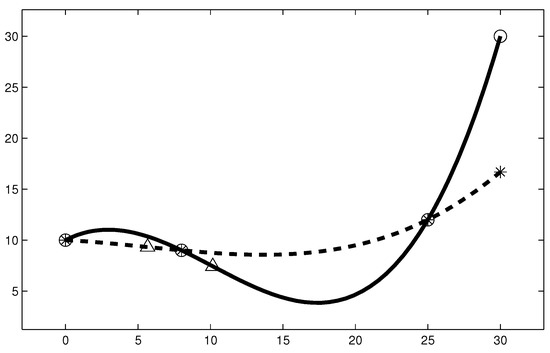
Figure 1.
Solid line: Lagrange polynomial; dashed line: piecewise polynomial harmonic (PPH) polynomial. Circles stand for Lagrange values at the nodes, asterisks stand for PPH values at the nodes, and triangles stand for inflection points.
The next experiment computes the numerical approximation order of the considered reconstruction operator.
Let X be a nonuniform grid:
and let be a smooth test function. Let us consider the set of initial points given by In this experiment, we will measure the approximation errors and the numerical order of approximation of the presented PPH reconstruction. The numerical order of approximation is calculated in an iterative way, just by considering at each new iteration a nonuniform grid built from the previous one by introducing a new node in the middle of each two consecutive existing nodes. The error for the reconstruction at each iteration is calculated as a discrete approximation to , thus evaluating a much denser set of points. Both the errors and the approximation orders for each iteration are shown in Table 1, where we can see that PPH reconstruction tends to fourth-order accuracy with this smooth concave function, as is expected according to Proposition 1.

Table 1.
Approximation errors in the norm and corresponding approximation orders p obtained after k iterations for the PPH reconstruction with .
Defining , we use the following formulae to compute the numerical order of approximation p:
Thus,
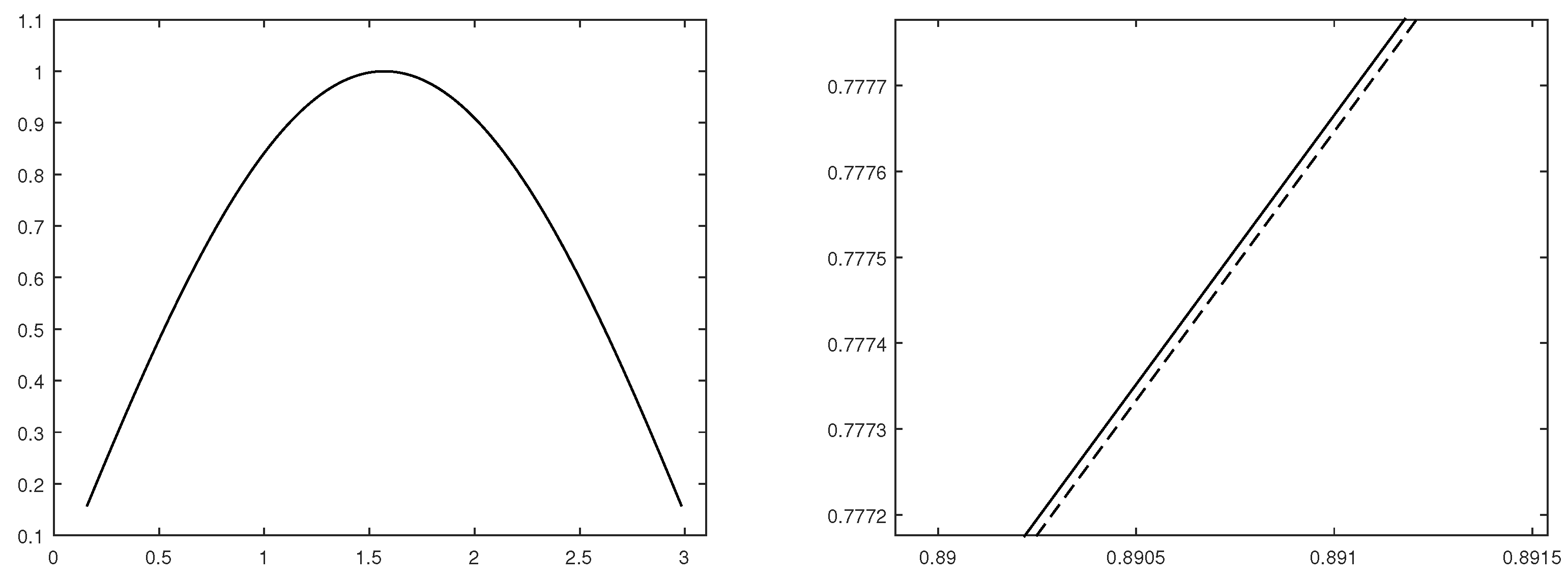
The appropriate behavior of the reconstruction can be checked in Figure 2, where the preservation of the concavity and the accuracy of the approximation can be observed.
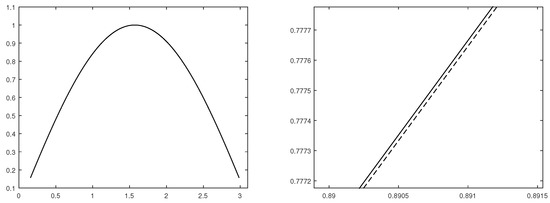
Figure 2.
Solid line: function ; dashed line: PPH reconstruction obtained with the finest considered nonlinear grid. (Left) Original function and PPH reconstruction. (Right) Zoom of a part of the signal.
6. Conclusions
We have defined and studied the PPH reconstruction operator over nonuniform grids, paying special attention to the case of quasi-uniform grids and initial data coming from strictly convex (concave) underlying functions.
We have theoretically proven some very interesting properties of the new reconstruction operator from the point of view of a potential use in graphical design applications. These properties include the reproduction of polynomials up to the second degree, approximation order, smoothness, boundedness of the operator, Lipschitz continuity, and convexity preservation. In particular, we would like to emphasize the quasi smoothness of the operator and the preservation of strict convexity according to the result contained in Theorem 1.
In the section on the numerical experiments, we checked that the behavior corresponded to the developed theory—in particular, the reconstruction attained fourth-order accuracy and preserved the convexity of the initial data. The results clearly show that the reconstruction introduces improvements in comparison with the Lagrange reconstruction. Therefore, the numerical experiments that we carried out reinforce the theoretical results.
Author Contributions
Conceptualization, P.O. and J.C.T.; methodology, P.O. and J.C.T.; software, P.O. and J.C.T.; validation, P.O. and J.C.T.; formal analysis, P.O. and J.C.T.; investigation, P.O. and J.C.T.; writing—original draft preparation, P.O. and J.C.T.; writing—review and editing, P.O. and J.C.T. All authors have read and agreed to the published version of the manuscript.
Funding
This research was funded by the FUNDACIÓN SÉNECA, AGENCIA DE CIENCIA Y TECNOLOGÍA DE LA REGIÓN DE MURCIA grant number and by the Spanish national research project PID2019-108336GB-I00.
Institutional Review Board Statement
Not applicable.
Informed Consent Statement
Not applicable.
Data Availability Statement
Not available.
Acknowledgments
We would like to thank the anonymous referees and our colleagues S. Amat and D. Yañez for their help in improving the article.
Conflicts of Interest
The authors declare no conflict of interest.
Abbreviations
The following abbreviations are used in this manuscript:
| PPH | Piecewise polynomial harmonic |
References
- Amat, S.; Donat, R.; Liandrat, J.; Trillo, J.C. Analysis of a new nonlinear subdivision scheme. Applications in image processing. Found. Comput. Math. 2006, 6, 193–225. [Google Scholar] [CrossRef]
- Ortiz, P.; Trillo, J.C. Nonlinear interpolatory reconstruction operator on non uniform grids. arXiv 2018, arXiv:1811.10566. [Google Scholar]
- Amat, S.; Donat, R.; Trillo, J.C. Proving convexity preserving properties of interpolatory subdivision schemes through reconstruction operators. Appl. Math. Comput. 2013, 219, 7413–7421. [Google Scholar] [CrossRef]
- Harten, A. Eno schemes with subcell resolution. J. Comput. Phys. 1989, 83, 148–184. [Google Scholar] [CrossRef]
- Aràndiga, F.; Donat, R. Nonlinear Multi-scale Decomposition: The Approach of A. Harten. Numer. Algorithms 2000, 23, 175–216. [Google Scholar] [CrossRef]
- Amat, S.; Dadourian, K.; Liandrat, J.; Trillo, J.C. High order nonlinear interpolatory reconstruction operators and associated multiresolution schemes. J. Comput. Appl. Math. 2013, 253, 163–180. [Google Scholar] [CrossRef]
- Amat, S.; Liandrat, J. On the stability of PPH nonlinear multiresolution. Appl. Comput. Harmon. Anal. 2005, 18, 198–206. [Google Scholar] [CrossRef]
- Dyn, N.; Gregori, J.A.; Levin, D. A 4-point interpolatory subdivision scheme for curve design. Comput. Aided Geom. Des. 1987, 4, 257–268. [Google Scholar] [CrossRef]
- Dyn, N.; Levin, D. Stationary and non-stationary binary subdivision schemes. Math. Methods Comput. Aided Geom. Des. II 1991, 209–216. Available online: https://doi.org/10.1016/B978-0-12-460510-7.50019-7 (accessed on 3 January 2021).
- Dyn, N.; Kuijt, F.; Levin, D.; Van Damme, R. Convexity preservation of the four-point interpolatory subdivision scheme. Comput. Aided Geom. Des. 1999, 16, 789–792. [Google Scholar] [CrossRef]
- Floater, M.S.; Michelli, C.A. Nonlinear Stationary Subdivision. Approx. Theory 1998, 212, 209–224. [Google Scholar]
- Harten, A. Multiresolution representation of data II. SIAM J. Numer. Anal. 1996, 33, 1205–1256. [Google Scholar] [CrossRef]
- Kuijt, F.; Van Damme, R. Convexity preserving interpolatory subdivision schemes. Constr. Approx. 1998, 14, 609–630. [Google Scholar] [CrossRef]
- Trillo, J.C. Nonlinear Multiresolution and Applications in Image Processing. Ph.D. Thesis, University of Valencia, Valencia, Spain, 2007. [Google Scholar]
Publisher’s Note: MDPI stays neutral with regard to jurisdictional claims in published maps and institutional affiliations. |
© 2021 by the authors. Licensee MDPI, Basel, Switzerland. This article is an open access article distributed under the terms and conditions of the Creative Commons Attribution (CC BY) license (http://creativecommons.org/licenses/by/4.0/).