Approximate Solutions for a Class of Nonlinear Fredholm and Volterra Integro-Differential Equations Using the Polynomial Least Squares Method


Abstract
:1. Introduction
2. The Polynomial Least Squares Method
- If the conditions are included, we compute as the values corresponding to the minimum of the functional (10) and again as functions of by using the initial conditions. If the conditions are not included, then are the values that correspond to the minimum of the functional.
- Using computed at the previous step, we construct the following polynomial:
- Regarding the choice of the degree of the polynomial approximation, in the computations, we usually start with the lowest degree (i.e., first degree polynomial) and compute successively higher degree approximations until the error (see next item) is considered low enough from a practical point of view for the given problem (or, in the case of a test problem, until the error is lower than the error corresponding to the solutions obtained by other methods). Of course, in the case of a test problem when the known solution is a polynomial, one may start directly with the corresponding degree, but this is just a shortcut and by no means necessary when using the method.
- If the exact solutions of the problem are not known, as would be the case of a real-life problem, and as a consequence, the error cannot be computed, then instead of the actual error, we can consider as an estimation of the error the value of the remainder R (4) corresponding to the computed approximation, as mentioned in the previous remark.
- If the problem has an (unknown) exact polynomial solution, it is easy to see if PLSM has found it since the value of the minimum of the functional in this case is actually 0. In this situation, if we keep increasing the degree (even though there is no point in that), from the computation, we obtain that the coefficients of the higher degrees are actually zero.
- Regarding the choice of the optimization method used for the computation of the minimum of the functional (9), if the solution of the problem is a known polynomial (such as in the case of Application 1, Application 3, Application 5 and Application 6) we usually employ the critical (stationary) points method, because in this way, by using PLSM, we can easily find the exact solution. Such problems are relatively simple ones; the expression of the functional (9) is also not very complicated; and indeed, the solutions can usually be computed even by hand (as in the case of this application). In general, no concerns of conditioning or stability arise.However, for a more complicated (real-life) problem, when the solution is not known (or even if the exact solution is known but not polynomial), we would not use the critical points method. In fact, we would not even use a iterative-type method, but rather a heuristic algorithm, such as differential evolution or simulated annealing. In our experience, with this type of problem, even a simple Nelder–Mead-type algorithm works well (as was the case for the following Application 2, Application 4 and Application 7). In fact, Application 4 includes a small comparison of several optimization methods.
- Finally, we remark that in the case when the solution of the problem is not analytic, the convergence of the PLSM solutions will be slower; another basis of functions (wavelets, and piecewise polynomials) should be used to control the approximation levels.
3. Numerical Examples
3.1. Application 1: First Order Nonlinear Fredholm Integro-Differential Equation
3.2. Application 2: Second Order Fredholm Integro-Differential Equation
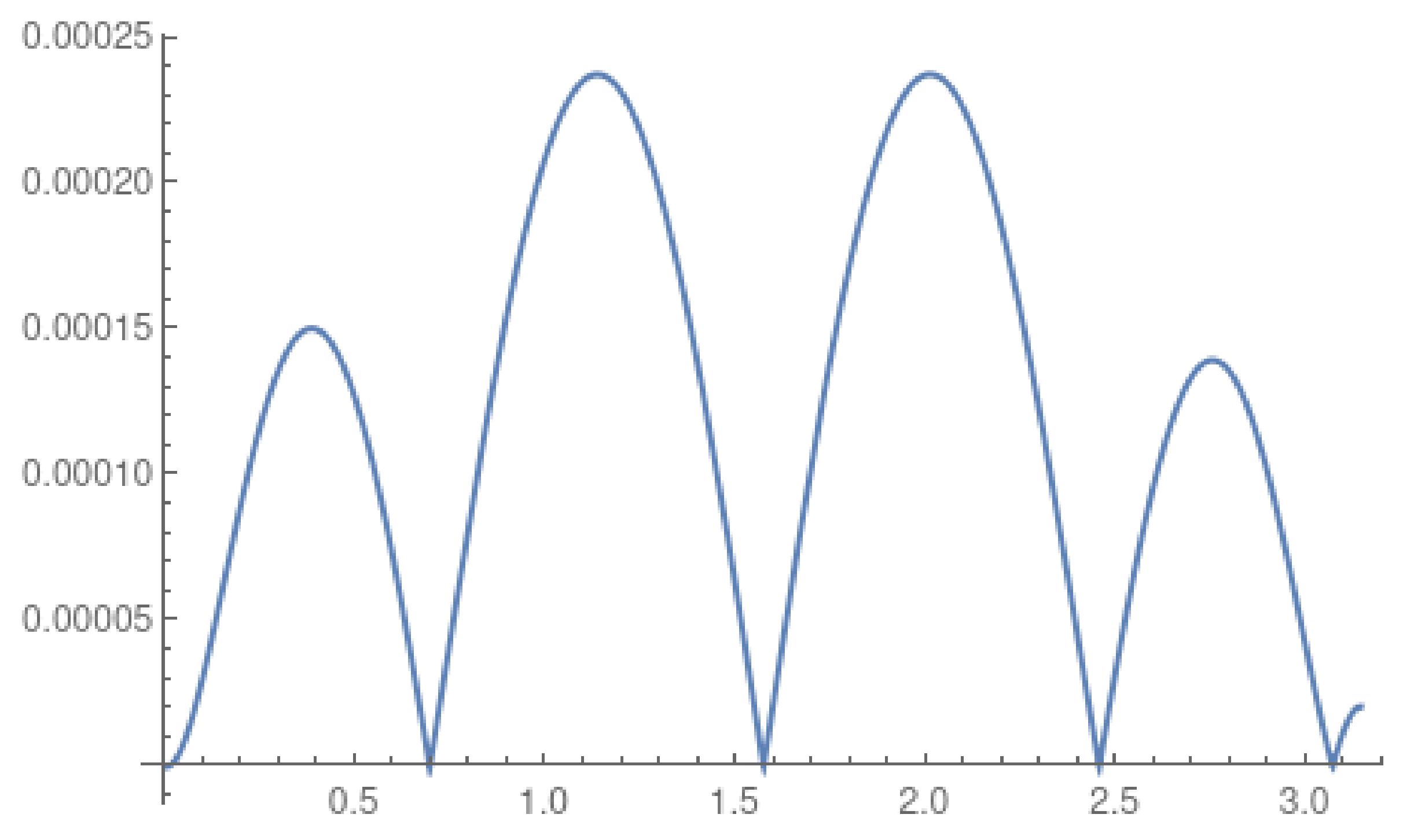
- The 7th degree polynomial approximation:
- The 9th degree polynomial approximation:
3.3. Application 3: Voltera Integro-Differential Equation
3.4. Application 4: Nonlinear Volterra Integral Equation
- The 7th degree polynomial approximation, using the stationary points method:
- The 7th degree polynomial approximation, using a differential evolution algorithm:
- The 7th degree polynomial approximation, using a simulated annealing algorithm:
- The 7th degree polynomial approximation, using a Nelder–Mead algorithm:
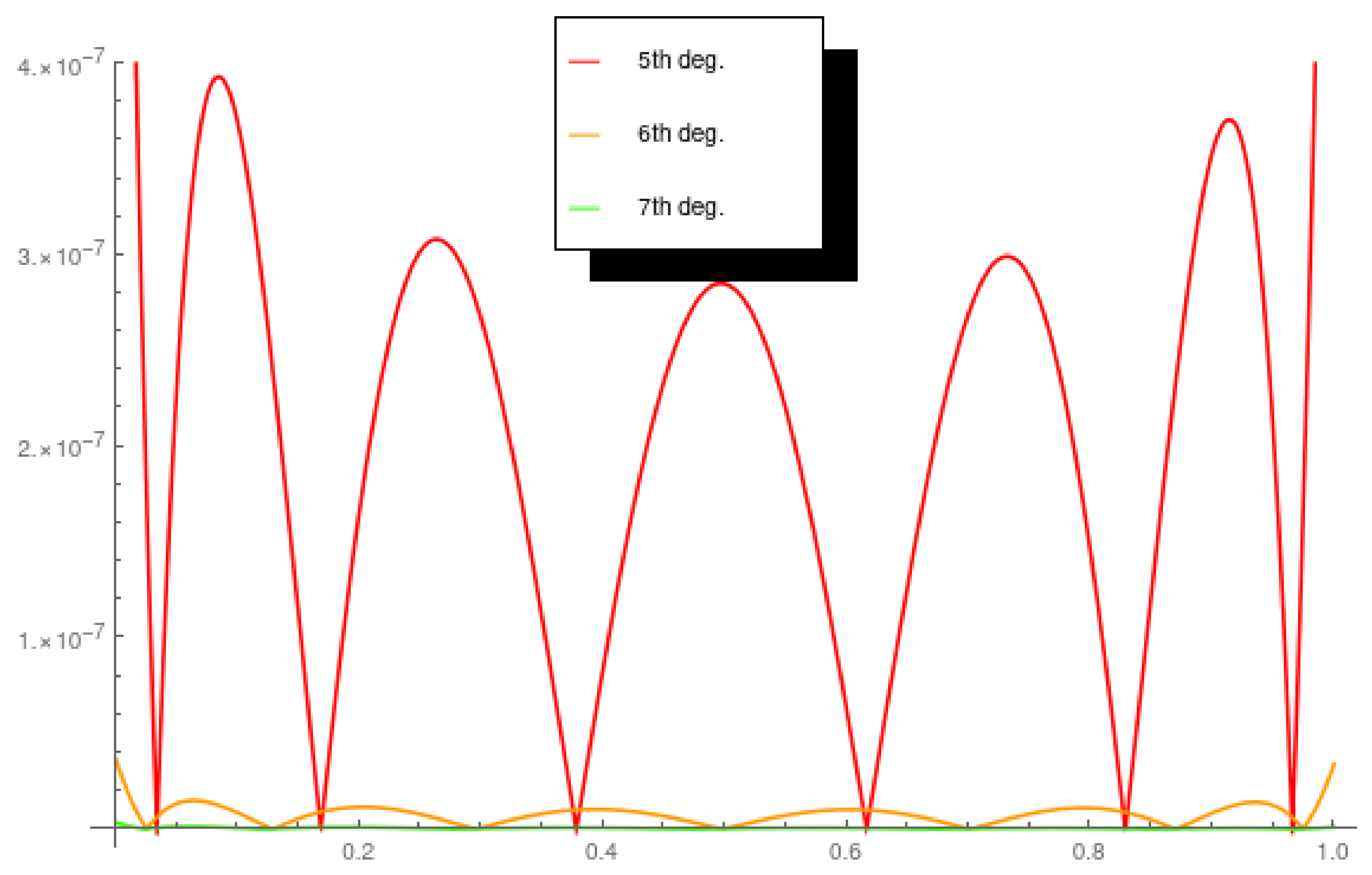
- The 4th degree polynomial approximation:
- The 5th degree polynomial approximation:
- The 6th degree polynomial approximation:
- The 7th degree polynomial approximation:
3.5. Application 5: Volterra–Fredholm Integro-Differential Equation
3.6. Application 6: Fourth Order Nonlinear Volterra–Fredholm Integro-Differential Equation
3.7. Application 7: Eighth Order Volterra–Fredholm Integro-Differential Equation
4. Conclusions
- The simplicity of the method—the computations involved in PLSM are as straightforward as possible (in fact, in the case of a lower degree polynomial, the computations can be easily carried out by hand; see Application 1).
- The accuracy of the method—this is well illustrated by the applications presented since by using PLSM, we could compute approximations more precisely than the ones computed in previous papers. We remark that, even though we only included a handful of (significant) test problems, we actually tested the method on most of the usual test problems for this type of equation. In all the cases when the solution was a polynomial (which is a frequent case), we could find the exact solution, while in the cases when the solution was not polynomial, most of the time we were able to find approximations that were at least as good (if not better) than the ones computed by other methods.
- The simplicity of the approximation—since the approximations are polynomial, they also have the simplest possible form and thus, any subsequent computation involving the solution can be performed with ease. While it is true that for some approximation methods which work with polynomial approximations the convergence may be very slow, this is not the case here (see, for example, Application 2, Application 4 and Application 7, which are representative for the performance of the method).
Author Contributions
Funding
Institutional Review Board Statement
Informed Consent Statement
Data Availability Statement
Conflicts of Interest
References
- Benchohra, M.; Rezoug, N. Existence and attractivity of solutions of semilinear Volterra type integro-differential evolution equations. Surv. Math. Its Appl. 2018, 13, 215–235. [Google Scholar]
- Tunç, C.; Tunç, O. On the stability, integrability and boundedness analyses of systems of integro-differential equations with time-delay retardation. Rev. Real Acad. Cienc. Exactas Físicas Nat. Ser. A. Mat. 2021, 115. [Google Scholar] [CrossRef]
- Maleknejad, K.; Mahmoudi, Y. Taylor polynomial solution of high-order nonlinear Volterra-Fredholm integro-differential equations. Appl. Math. Comput. 2003, 145, 641–653. [Google Scholar] [CrossRef]
- Wang, K.; Wang, Q. Taylor collocation method and convergence analysis for the Volterra–Fredholm integral equations. J. Comput. Appl. Math. 2014, 260, 294–300. [Google Scholar] [CrossRef]
- Hosseini, S.M.; Shahmorad, S. Numerical piecewise approximate solution of Fredholm integro-differential equations by the Tau method. Appl. Math. Model. 2005, 29, 1005–1021. [Google Scholar] [CrossRef]
- Hosseini, S.M.; Shahmorad, S. Tau numerical solution of Fredholm integro-differential equations with arbitrary polynomial bases. Appl. Math. Model. 2003, 27, 145–154. [Google Scholar] [CrossRef]
- Ghasemi, M.; Tavassoli, M.; Babolian, E. Application of He’s homotopy perturbation method to nonlinear integro-differential equations. Appl. Math. Comput. 2007, 188, 538–548. [Google Scholar] [CrossRef]
- Yüzbaşi, Ş.; Sezer, M.; Kemanci, B. Numerical solutions of integro-differential equations and application of a population model with an improved Legendre method. Appl. Math. Model. 2013, 37, 2086–2101. [Google Scholar] [CrossRef]
- Lakestani, M.; Saray, B.N.; Dehghan, M. Numerical solution for the weakly singular Fredholm integro-differential equations using Legendre multiwavelets. J. Comput. Appl. Math. 2011, 235, 3291–3303. [Google Scholar] [CrossRef] [Green Version]
- Bhrawya, A.H.; Tohidic, E.; Soleymanic, F. A new Bernoulli matrix method for solving high-order linear and nonlinear Fredholm integro-differential equations with piecewise intervals. Appl. Math. Comput. 2012, 219, 482–497. [Google Scholar] [CrossRef]
- Sathar, M.H.A.; Rasedee, A.F.N.; Ahmedov, A.A.; Bachok, N. Numerical Solution of Nonlinear Fredholm and Volterra Integrals by Newton-Kantorovich and Haar Wavelets Methods. Symmetry 2020, 12, 2034. [Google Scholar] [CrossRef]
- Amin, R.; Shah, K.; Asif, M.; Khan, I. Efficient numerical technique for solution of delay Volterra-Fredholm integral equations using Haar wavelet. Heliyon 2020, 6, e05108. [Google Scholar] [CrossRef] [PubMed]
- Islam, S.; Aziz, I.; Al-Fhaid, A.S. An improved method based on Haar wavelets for numerical solution of nonlinear integral and integro-differential equations of first and higher orders. J. Comput. Appl. Math. 2014, 260, 449–469. [Google Scholar] [CrossRef]
- Ming, W.; Huanga, C. Collocation methods for Volterra functional integral equations with non-vanishing delays. Appl. Math. Comput. 2017, 296, 198–214. [Google Scholar] [CrossRef]
- Davaeifar, S.; Rashidinia, J. Boubaker polynomials collocation approach for solving systems of nonlinear Volterra–Fredholm integral equations. J. Taibah Univ. Sci. 2017, 11, 1182–1199. [Google Scholar] [CrossRef]
- Buranay, S.C.; Özarslan, M.A.; Falahhesar, S.S. Numerical solution of the Fredholm and Volterra integral equations by using modified Bernstein–Kantorovich operators. Mathematics 2021, 9, 1193. [Google Scholar] [CrossRef]
- Maleknej, K.; Attary, M. An efficient numerical approximation for the linear class of Fredholm integro-differential equations based on Cattani’s method. Commun. Nonlinear Sci. Numer. Simul. 2011, 16, 2672–2679. [Google Scholar] [CrossRef]
- Shang, X.; Han, D. Application of the variational iteration method for solving nth-order integro-differential equations. J. Comput. Appl. Math. 2010, 234, 1442–1447. [Google Scholar] [CrossRef] [Green Version]
- Acar, N.I.; Daşcioglu, A. A projection method for linear Fredholm–Volterra integro-differential equations. J. Taibah Univ. Sci. 2019, 13, 644–650. [Google Scholar] [CrossRef] [Green Version]
- Sabzevari, M. A review on “Numerical solution of nonlinear Volterra-Fredholm integral equations using hybrid of ...” [Alexandria Eng. J. 52 (2013) 551–555]. Alex. Eng. J. 2019, 58, 1099–1102. [Google Scholar] [CrossRef]
- Hosry, A.; Nakad, R.; Bhalekar, S. A hybrid function approach to solving a class of Fredholm and Volterra integro-differential equations. Math. Comput. Appl. 2020, 25, 30. [Google Scholar] [CrossRef]
- Rahmani, L.; Mordad, M. Numerical solution of Volterra-Fredholm integro-differential equation by Block Pulse functions and operational matrices. Gen. Math. Notes 2011, 4, 37–48. [Google Scholar]
- Maturi, D.A.; Simbawa, E.A.M. The modified decomposition method for solving volterra fredholm integro-differential equations using maple. Int. J. GEOMATE 2020, 18, 84–89. [Google Scholar] [CrossRef]
- Behiry, S.; Mohamed, S. Solving high-order nonlinear Volterra-Fredholm integro-differential equations by differential transform method. Nat. Sci. 2012, 4, 581–587. [Google Scholar] [CrossRef] [Green Version]



| x | [5] | PLSM 5th | PLSM 7th | PLSM 9th |
|---|---|---|---|---|
| 0 | 0 | 0 | 0 | 0 |
| 0.3 | ||||
| 0.7 | ||||
| 0.99 | ||||
| 1.19 | ||||
| 1.49 | ||||
| 1.97 | ||||
| 2.27 | ||||
| 2.66 | ||||
| 3.06 |
| x | Stationary Points | Differential Evolution | Simulated Annealing | Nelder–Mead |
|---|---|---|---|---|
| 0 | ||||
| 0.1 | ||||
| 0.2 | ||||
| 0.3 | ||||
| 0.4 | ||||
| 0.5 | ||||
| 0.6 | ||||
| 0.7 | ||||
| 0.8 | ||||
| 0.9 |
| x | [20] | [11] | PLSM 4th | PLSM 5th | PLSM 6th | PLSM 7th |
|---|---|---|---|---|---|---|
| 0 | 0 | |||||
| 0.1 | ||||||
| 0.2 | ||||||
| 0.3 | ||||||
| 0.4 | ||||||
| 0.5 | ||||||
| 0.6 | ||||||
| 0.7 | ||||||
| 0.8 | ||||||
| 0.9 |
Publisher’s Note: MDPI stays neutral with regard to jurisdictional claims in published maps and institutional affiliations. |
© 2021 by the authors. Licensee MDPI, Basel, Switzerland. This article is an open access article distributed under the terms and conditions of the Creative Commons Attribution (CC BY) license (https://creativecommons.org/licenses/by/4.0/).
Share and Cite
Căruntu, B.; Paşca, M.S. Approximate Solutions for a Class of Nonlinear Fredholm and Volterra Integro-Differential Equations Using the Polynomial Least Squares Method. Mathematics 2021, 9, 2692. https://doi.org/10.3390/math9212692
Căruntu B, Paşca MS. Approximate Solutions for a Class of Nonlinear Fredholm and Volterra Integro-Differential Equations Using the Polynomial Least Squares Method. Mathematics. 2021; 9(21):2692. https://doi.org/10.3390/math9212692
Chicago/Turabian StyleCăruntu, Bogdan, and Mădălina Sofia Paşca. 2021. "Approximate Solutions for a Class of Nonlinear Fredholm and Volterra Integro-Differential Equations Using the Polynomial Least Squares Method" Mathematics 9, no. 21: 2692. https://doi.org/10.3390/math9212692
APA StyleCăruntu, B., & Paşca, M. S. (2021). Approximate Solutions for a Class of Nonlinear Fredholm and Volterra Integro-Differential Equations Using the Polynomial Least Squares Method. Mathematics, 9(21), 2692. https://doi.org/10.3390/math9212692