1. Introduction
Let
H be a real Hilbert space and
C be a nonempty subset of
H. For a mapping
T from
C into
H, we will denote by
the set of all fixed points, i.e.,
In 2010, Kocourek et al. [
1] introduced the notion of a generalized hybrid mapping
by the condition that there exist
such that
for all
and proved a fixed point theorem of this kind of mapping; see [
2,
3] for more results for fixed point theorems of generalized hybrid mappings.
In 2011, the notion of attractive points for nonlinear mappings in Hilbert spaces was introduced by Takahashi and Takeuchi [
4]. For a mapping of
T from
C into
H, we will denote by
the set of all attractive points, i.e.,
They also proved an existence theorem for attractive points for generalized hybrid mappings without convexity in Hilbert spaces.
In 2013, Kawasaki and Takahashi [
5] defined a class of widely more generalized hybrid mappings. A mapping
is called a widely more generalized hybrid if there exists
such that
We call such mapping an -widely more generalized hybrid mapping.
In 2018, Khan [
6] introduced the concept of common attractive points for two nonlinear mappings. For two mappings
, we will denote by
the set of common attractive points of
S and
T, i.e.,
It is obvious that
The author also introduced a new mapping, which is more general than generalized hybrid mappings, called further generalized hybrid mappings. A mapping
is called a further generalized hybrid if there exists
such that
Obviously, this is a special case of widely more generalized hybrid mappings when in (1).
In 2015, Zheng [
7] guaranteed the weak and strong convergence theorems of attractive points for generalized hybrid mappings in Hilbert spaces by using the iterative scheme (2), known as Ishikawa iteration [
8],
where
and
are sequences in
.
To approximate the common fixed points of two mappings, Das and Debata [
9] and Takahashi and Tamura [
10] generalized the Ishikawa iterative for mappings
S and
T as follows:
where
and
are sequences in
. Note that when
, (3) can be reduced to (2). It is worth noting that the approximation of common fixed points of a two mappings case has its own importance as there is a direct link with minimization problems; see [
11] for examples.
In 2020, Thongpaen and Inthakon [
12] used the iteration (3) to prove a weak convergence theorem for common attractive points of two widely more generalized hybrid mappings in Hilbert spaces and applied the main result to some common fixed point problems. Furthermore, see [
13,
14] and references therein for more results of common attractive points theorems.
For another approximation algorithm, Khan [
15] employed iterative scheme of Yao and Chen [
16] to obtain weak and strong convergence results of the sequence defined by:
where
and
are sequences in
and
T are quasi-asymptotically nonexpansive mappings in uniformly convex Banach spaces. As far as the author’s observation, (3) and (4) are independent.
In 2019, Ali and Ali [
17] proved some weak and strong convergence theorems for common fixed points of two generalized nonexpansive mappings using the iteration presented in (4) in uniformly Banach spaces.
The convergence of several iterations to a fixed point is usually established under the assumption that the domain of those above mappings is closed and convex.
Motivated by [
17] and abovementioned works, our goal in this paper is to employ the iteration (4) for finding common attractive points of two widely more generalized hybrid mappings without assuming the closedness of the domain and prove weak and strong convergence theorems of (4). Furthermore, we complete this paper by applying our main results to some common fixed point theorems together with some numerical experiments.
2. Preliminaries
Throughout this paper, the set of positive integers and real numbers will be denoted by and . Let H be a real Hilbert space with an inner product that induces its norm . We use → for the strong convergence and ⇀ for the weak convergence. One of the most important properties in Hilbert spaces is Opial’s property:
Theorem 1 ([
18])
. Let be a sequence in H and . If , thenfor all Next, we recall the following property of a Hilbert space H which is useful for proving our main result.
Theorem 2 ([
18])
. Let C be a nonempty closed convex subset of H. Then for each , there exists a unique element such thatwhere and is called the metric projection of H on C. We have the following lemma from Khan [
6].
Lemma 1. Let C be a nonempty subset of H and let be two mappings from C into H. Then is a closed and convex subset of H.
Moreover, the following result of Guu and Takahashi [
19] also plays an important role for our main results.
Lemma 2. Let C be a nonempty subset of Suppose is an -widely more generalized hybrid mapping satisfying either of the conditions(1) or (2):
- (1)
and ;
- (2)
and
If and then .
Recall that a mapping
is quasi-nonexpansive if
and
for all
. Furthermore, Takahashi et al. [
20] proved the following result for quasi-nonexpansive mappings.
Lemma 3. Let C be a nonempty subset of Suppose T is a quasi-nonexpansive mapping from C into H. Then .
We know from [
5] that the following condition provides widely more generalized hybrid mappings to be quasi-nonexpansive.
Lemma 4 ([
5])
. Let C be a nonempty closed convex subset of Suppose is an -widely more generalized hybrid mapping such that and satisfying either of the conditions(1)
or(2)
:- (1)
and ;
- (2)
and
Then T is quasi-nonexpansive.
We also need the following result to prove our main theorem.
Lemma 5 ([
21])
. Let X be a uniformly convex Banach space. Suppose and two sequences and in X satisfy the following:- (i)
- (ii)
- (iii)
where for all Then
3. Main Results
In this section, we present weak and strong convergence theorems using the iteration (4) for two widely more generalized hybrid mappings in a Hilbert space. Before proving the main theorem, the following results are required.
Lemma 6. Let C be a nonempty convex subset of H. Suppose are two mappings with . If is defined by (4) as:where and are sequences in such that . Then exists for all Proof. Let
. Then,
Therefore, is nonincreasing and bounded for all which implies that exists. □
Lemma 7. Let C be a nonempty convex subset of H. Suppose are two -widely more generalized hybrid mappings with . Let be defined by (4) as:where and are sequences in such that and there exist such that , for every . Then and Proof. Let
By Lemma 6, let
Since
we have
Using the control conditions of
and
, we have
and
Applying Lemma 5 to (6), (7) and (8), we obtain
Since
for every
, we get
We can show in a similar way that
and
Therefore,
and
□
3.1. Weak Convergence Theorems
We are now proving weak convergence theorems for two widely more generalized hybrid mappings in a Hilbert space.
Theorem 3. Let C be a nonempty convex subset of Suppose are two -widely more generalized hybrid mappings satisfying either the following condition (1) or (2) holds:
- (1)
and ;
- (2)
and
with . Let be defined by (4) as:where and are sequences in such that and there exist such that , for every . Then converges weakly to Proof. By Lemma 6, we know
is bounded and hence there exists a subsequence
of
such that
Lemma 2 and Lemma 7 imply that
. Let
be any weakly convergent subsequence of
, then there exists
such that
Using the same argument, we get
. By the way, the weak limit is unique. Indeed, if
then by Opial’s condition and Lemma 6, we have
This is a contradiction, that is Therefore . □
Furthermore, if the subset C in Theorem 3 is closed, we also obtain a weak convergence theorem for common fixed points of two -widely more generalized hybrid mappings in Hilbert spaces as follows.
Corollary 1. Let C be a nonempty closed convex subset of Suppose are two -widely more generalized hybrid mappings satisfying either the following condition (1) or (2) holds:
- (1)
and ;
- (2)
and
with . Let be defined by (4) as:where and are sequences in such that and there exist such that , for every . Then converges weakly to Proof. By Lemma 4, we get
S and
T are quasi-nonexpansive. It is derived from Lemma 3 that
The fact in assumption implies the set . By Theorem 3, we have . Since C is closed and convex, C is weakly closed which implies that . Therefore, we can conclude that □
3.2. Strong Convergence Theorems
Firstly, we give one important result as follows.
Theorem 4. Let C be a nonempty convex subset of H. Suppose are two -widely more generalized hybrid mappings with . Let be defined by (4) as:where and are sequences in such that and there exist such that , for every . Then converges strongly to if and only if or , where and Proof. Put
. Suppose that
converges strongly to
. Then, for
, there exists
such that
It follows that
and hence
Conversely, if
then
Assume that
. We obtain from Lemma 5 that
exists for all
By assumption, we get
and hence for any
there exists
such that
For
put
It follows from (3) that
and hence by Lemma 1 and Theorem 2, there exists
such that
For
, put
Then
and
. From (3), we have
and obtain
such that
Continuing this process, we can choose
, where
such that
Therefore, there exist a subsequence
of
and a sequence
in
A such that
Since
is nonincreasing for every
, we get that
and
for all
If
we employ the triangle inequality to obtain
Therefore,
is a Cauchy sequence in
A which implies that
is convergent. Since
A is closed, we obtain
. Moreover,
Let , we get that
Since exists, we obtain and the proof is complete. □
By the way, one idea to prove strong convergence is employing the concept introduced by Senter and Dotson [
22] called condition
A. Let
C be a subset of Hilbert space
H. A mapping
T satisfies condition
A if there exists a nondecreasing function
with
for all
such that
for all
, where
. Moreover, the examples of mappings satisfying condition
A was also given in [
22].
In 2007, Chidume [
23] extended the condition
A for two mappings, called condition
. Two mappings
satisfy condition
if there exists a nondecreasing function
with
for all
such that either
for all
, where
.
As a consequence of Theorem 4, we obtain a strong convergence theorem for common attractive points of two widely more generalized hybrid mappings satisfying condition
Theorem 5. Let C be a nonempty convex subset of Suppose are two -widely more generalized hybrid mappings with . Let be defined by (4) as:where and are sequences in such that and . If S and T satisfy condition , then converges strongly to Proof. Since
S and
T satisfy condition
, we obtain that there exists a nondecreasing function
with
for all
such that either
or
In both case, it follows that By Theorem 4, we conclude that converges strongly to a common attractive point of S and T. □
Furthermore, if the subset C and both two mappings S and T in Theorem 5 satisfy the same conditions in Corollary 1, then we obtain the following corollary.
Corollary 2. Let C be a nonempty closed convex subset of Let be two -widely more generalized hybrid mappings. Suppose that either the following condition (1) or (2) holds:
- (1)
and ;
- (2)
and
with . Let be defined by (4) as:where and are sequences in such that and . If S and T satisfy condition , then converges strongly to Proof. By Theorem 5, we can prove similarly to the proof of Corollary 1. □
We end this section with formally constructing an example to support our main results.
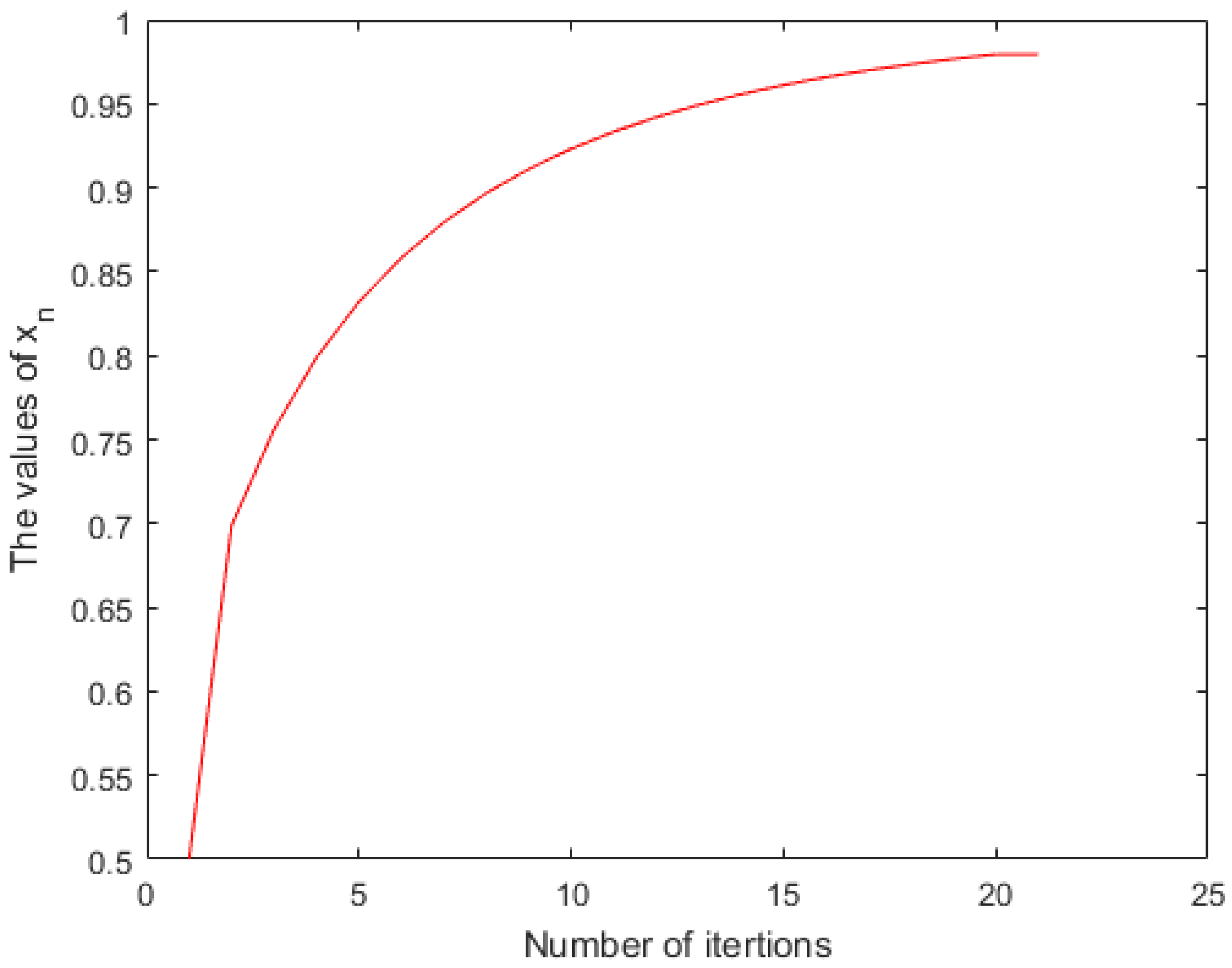
Example 1. Let and . Then C is a nonempty convex subset of H. Suppose are defined by and for all It can be easily investigated that S and T are -widely more generalized hybrid mappings because they are nonexpansive and . We choose the parameters and initial point . Then, we compute the sequence generated by (4) as seen in Table 1. It is seen from Table 1 that the error and Furthermore, the result of convergence behavior of iterative method (4) is shown in Figure 1. 



 ,
,