1. Introduction
The variational inequality problem (VIP for short) is a significant branch of mathematics. Over the decades, this problem has been extensively studied for solving many real-world problems in various applied research areas such as physics, economics, finance, optimization, network analysis, medical images, water resources and structural analysis. Moreover, it contains fixed point problems, optimization problems arising in machine learning, signal processing and linear inverse problems, (see [
1,
2,
3]). The set of solutions of the variational inequality problem is denoted by
where
C is a nonempty closed convex subset of the Hilbert space
H and
is a mapping.
Moudafi and Mainge [
4] established the hierarchical fixed point problem for a nonexpansive mapping
T with respect to another nonexpansive mapping
S on
H by utilizing the concept of the variational inequality problem: Find
such that
where
is a nonexpansive mapping and
. It is easy to see that (
1) is equivalent to the following fixed point problem: Find
such that
where
stands for the metric projection on the closed convex set
. The solution set of HFPP (
1) is denoted by
. It is obvious that
. It is worth noting (
1) covers monotone variational inequality on fixed point sets as well as minimization problem, etc. For several fixed point theory and solving the hierarchical fixed point problem in (
1), many iterative methods have been studied and developed, (see [
4,
5,
6,
7,
8]).
On the other hand, The split monotone variational inclusion problem (in short, SpMVIP) is proposed and studied by Moudafi [
9]. It had been applied to the intensity-modulated radiation therapy treatment planning as a model, (see [
10]). This concept has appeared in many inverse problems which emerge in phase retrieval and other real-world problems such as sensor networks, data compression as well as comprised tomography, (see [
11,
12]): Find
such that
and such that
where
and
are multi-valued monotone operators,
,
are two single-valued operators and
is a bounded linear operator. The solution set of SpMVIP is denoted by
.
They introduced the following iterative method and studied the weak convergence theorem for SpMVIP: For a given
, compute iterative sequence
generated by the following scheme:
where
,
such that
and
are the resolvent mappings of
F and
G, respectively (see the definition in
Section 2) and
I is the identity mapping. The operator
A is a bounded linear operator with
is adjoint of
A and
with
L being the spectral radius of the operator
. They proved that the sequence
converges weakly to a solution of hierarchical fixed point and split monotone variational inclusion problems.
In 2017, Kazmi et al. [
13] developed a Krasnoselski–Mann type iterative method to approximate a common solution set of a hierarchical fixed point problem for nonexpansive mappings
and a split monotone variational inclusion problem which was defined as follows:
where
,
and the step size
where
L is the spectral radius of the operator
. Under some suitable conditions on
and
:
.
They proved that the sequence converges weakly to a solution of hierarchical fixed point and split monotone variational inclusion problems. Normally, an interesting question is how to construct the strongly convergence results which approximate the solution of the split monotone variational inclusion and hierarchical fixed point problems.
In 2021, Dao-Jun Wen [
14] modified Krasnoselski–Mann type iteration (
5) which replaced operator
T with
where
D is a strongly monotone operator and
L-Lipschitzian. Define a sequence
in the following manner:
where
,
,
are two nonexpansive mappings and the step size
where
L is the spectral radius of the operator
. They established the strong convergence result and constructed the new condition of coefficients which replaced of condition (C2).
If
and
, then the split monotone variational inclusion problem reduced to the following split variational inclusion problem (SVIP): Find
such that
Byrne et al. [
15] have attempted to solve a special case of (
6) and defined
in the following:
Moreover, they obtained the weak and strong convergence results of problem (
6) with resolvent operator technique and the stepsize
. In order to speed up the convergence speed, Alvarez and Attouch [
16] considered the following iterative scheme:
, where
F is a maximal monotone operator,
and
, such the iterative scheme is called the inertial proximal method, and
is referred to as the inertial extrapolation term which is a procedure of speeding up the convergence properties under the condition that
(see [
17]). At the same time, the idea of the inertial technique plays an important role in the optimization community as a technology to build an accelerating iterative method, (see [
18,
19]).
On the other hand, the iterative methods mentioned above share a common manner, that is, their step size requires a knowlegde of the prior information of the operator (matrix) norm
. It may be difficult to calculate
and the fixed step size of iterative methods have an impact on the implementation. To conquer, the construction of self-adaptive step size has aroused interest among researchers. Recently, there are many iterative methods that do not require the prior information of the operator (matrix) norm, (see [
20,
21,
22]).
Motivated and inspired by the work mentioned above, we further investigate the self-adaptive inertial Krasnoselski-mann iterative method for solving hierarchical fixed point and split monotone variational inclusion problems. This manuscript aims to suggest modifications of the results that appeared in [
14] by applying the inertial scheme that is effective for speeding up the iteration process and adding the step size that the prior information of the operator (matrix) norm is not required. A strong convergence theorem of the proposed iterative method is established under some suitable conditions. Furthermore, we also present some numerical experiments to demonstrate the advantages of the stated iterative method over other existing methods [
9,
13,
14] and apply our main results to solving the image restoration problem.
2. Materials and Methods
In this section, we recall some basic definitions and properties which will be frequently used in our later investigation. Some useful results proved already in the literature are also summarized.
Definition 1. A mapping is said to be:
- (i)
- (ii)
α-inverse strongly monotone, if there exists a constant such that - (iii)
β-Lipschitz continuous, if there exists a constant such that
Let
be a multivalued operator on
H. Then the graph
of
F is defined by
and
- (i)
the operator
F is called a monotone operator, if
- (ii)
the operator F is called a maximal monotone operator, if F is monotone and the graph of F is not properly contained in the graph of other monotone mappings.
Let
be a set-valued maximal monotone mapping, which Graph (
F) is not property contained in the graph of any other monotone mapping. Then the resolvent operator
is defined by
where
I stands for the identity operator on
H. It is well known that resolvent operator
is single-valued, nonexpansive and firmly nonexpansive for
.
Lemma 1. Let f be a κ-inverse strongly monotone mapping and F be a maximal monotone mapping, then is averaged for all .
Lemma 2 ([
9]).
Let f be a mapping and F be a maximal monotone mapping, then if and only if , i.e., for . Lemma 3. For any , the following results hold:
- (i)
- (ii)
Lemma 4 ([
23]).
Let be η-strongly monotone and L-Lipschitz continuous. Then is a -contraction, i.e.,where is a sequence such that and with . Lemma 5 ([
24]).
Let and be two sequences of non-negative real numbers such thatwhere is a sequence in and is a sequence in . Assume that . If for some , then is a bounded sequence. Lemma 6 ([
25]).
Let be a sequence of non-negative real numbers, be a sequence of real numbers in with and be a sequence of real numbers such thatIf for every subsequence of satisfying , then .
3. Results
In this section, we propose a self-adaptive method with inertial extrapolation term for solving hierarchical fixed point and split variational inclusion problems. To begin with, the control conditions need to be satisfied by Condition 1:
- (A1)
for some such that , i.e.,
- (A2)
such that and ;
- (A3)
such that , ;
- (A4)
is a positive sequence such that and ;
- (A5)
, and
Remark 1. From = and Algorithm 1, we have Therefore
| Algorithm 1: Inertial Krasnoselski-Mann Iterative Method |
Initialization: Let , , and
. |
| Iterative steps: Calculate follows: |
Step 1. Given the iterates and for each , choose where
= |
Step 2. Compute
; . |
Step 3. Compute , and
, where
= |
Step 4. Compute
.
Set , and return to Step 1. |
Lemma 7. Assume that and are real Hilbert spaces and is a bounded linear operator with its adjoint operator Let and be set-valued maximal monotone operators. Let and be -inverse strongly monotone mappings with . Then, for any , and , the following statements hold:
- (i)
and are nonexpansive;
- (ii)
where .
Proof.
(i) Since f and g are -inverse strongly monotone mappings, respectively. From Lemma 1, we obtain that is averaged. So U is nonexpansive for . Similarly, we can prove that is nonexpansive.
(ii) From
is nonexpansive, we have
□
Lemma 8. The sequence formed by Algorithm 1, then is bounded.
Proof.
If
, then
From
A is bounded and linear, we get
Hence , thus is bounded. □
Lemma 9. Assume that and are formed by Algorithm 1. If converges weakly to z and , then .
Proof.
Since
U is nonexpansive, we get
which together
gives that
This combines with Lemma 2 and yields . In view of the fact A is a linear operator, we get . From , we obtain . Therefore □
Theorem 1. Let and be are two real Hilbert spaces and C be a nonempty closed convex subset of and be a bounded linear operator with its adjoint operator . Assume that and are set-valued maximal monotone operators. Let and be are -inverse strongly monotone mappings with . Let be η-strongly monotone and L-Lipschitzian, be a nonexpansive mapping, be a continuous quasi-nonexpansive mapping such that is monotone and Let be the sequence defined by Algorithm 1 and the Condition 1 holds. Then the sequence converges strongly to in the norm, where
Proof.
This proof is divided the remaining proof into several steps.
Step 1. We will show that
is bounded. Let us assume that
. From the definition of
, we get
According to Condition 1, one has
. Therefore, there exists a constant
such that
Combining (
8) and (
9), we obtain
Set
and
, we get
From (
11) and (
12), we get
Indeed, it follows Lemma 7,
and (
7), we have
It follows from
, we obtain
Combining (
10), (
13) and (
15), we get
Set
, it follows that
By the definition of
, we also have
By (
16) and Condition 1, we get
Substituting (
19) into (
17), we obtain
From Lemma 5, this implies that
is bounded. Together with (
10), (
13) and (
16), we get
,
and
are also bounded.
Step 2. We will show that
By the definition of
, we get
for some
From Lemma 3, we have
From Lemma 3, Lemma 4 and (
10), we obtain
Substituting (
20) and (
22) into (
21), we get
From (
14) and (
23), it follows that
By the definition of
, we have
for some
. Substituting (
18), (
24) and using Condition 1 into (
25), we obtain
for some
. Thus
Step 3. We will show that
From the definition of
, we get
Let
. Then we have
and
From the definition of
, we obtain
Step 4. We will show
. Assume that
is a subsequence of
such that
From Step 2, we see that
which indicates that
From the definition of
, we get
From
, we have
Since
T is nonexpansive,
S is a continuous quasi-nonexpansive mapping, we have
From (
35) and Condition 1, we get
By the definition of
, we have
From (
31) and (
37), we obtain
Since
, we have
. It follows that
Set
. Now we estimate
From (
31) and (
33), we get
Since
by (
33) and (
40), we have
By the definition of
and Lemma 7, we get
By the definition of
and (
21), (
22), (
25), (
42), we have
Substituting
n into
, from the boundness of
, Condition 1, (
31), and taking
, we get
Since
is firmly nonexpansive, we obtain
From (
23), (
25) and (
46), we have
Substituting
n into
, from the boundness of
, Condition 1, (
45) and taking limit
, we get
Since
it follows from (
41) and (
48), we obtain
By the definition of
, we get
Using (
50) and Condition 1, we have
Since
is bounded, there exists a subsequence
which converges weakly to
. Assume that
, by Opial property
This is a contradiction. Hence
and
. On the other hand, we note that
and
In particular, for each
, we have
which comes from the monotonicity of
and
Replacing
n with
, we have
Moreover, by (
32) and Condition 1, we get
Since
, one has
. Taking limit on both sides of (
53) for
, it follows from (
37) and (
38) that
If
z is substituted by
for
, we get
Since
is continuous, on taking limit
, we have
That is . Next we will show that
Note that
can be rewritten as
where
is nonexpansive for Lemma 7. Taking
in (
54) by (
31), (
49) and the graph of maximal monotone mapping is weakly strongly closed, we obtain
. Moreover, since
and
have the same asymptotical behavior, we have
. Since the resolvent operator
is average and hence nonexpansive, we can obtain
This shows that and so .
Step 5. We will show that
where
Since
is bounded, there exists a subsequence
of
such that
. Moreover,
Since
, one has
, which together with
and Lemma 9, we get
. From the definition of
and (
55), we obtain
Combining (
56) and (
52), we obtain
This together with (
50), Step 3. and Lemma 6, we can conclude that
strongly converges to
. Hence we obtain the desired conclusion. □
Remark 2. We note that our results directly improve and extend some known results in the literature as follows:
- (i)
Our proposed iterative method has a strong convergence in real Hilbert spaces which is more preferable than the weak convergence results of Kazmi et al. [7]. - (ii)
We improve and extend Theorem 3.1 of Dao-Jun Wen [14]. Especially, we use the quasi-nonexpansive mappings instead of the nonexpansive mappings. - (iii)
The selection of the step size in the iterative method provided by Dao-Jun Wen [14] and Kazmi et al. [7] requires the prior information of the operator (matrix) norm while our iterative method can update the step size of each iteration. - (iv)
Our iterative method improve and extend iterative method of Dao-Jun Wen [14] and Kazmi et al. [7].
5. Numerical Experiments
Some numerical results will be presented in this section to demonstate the effeciveness of our proposed method. The MATLAB codes were run in MATLAB version 9.5 (R2018b) on MacBook Pro 13-inch, 2019 with 2.4 GHz Quad-Core Intel Core i5 processor. RAM 8.00 GB.
Example 1. We consider an example in infinite dimensional Hilbert spaces. Assume with inner product and induced norm for all . Let be defined by and where . Let be defined by and where . Then f is 2-inverse strongly monotone, g is 4-inverse strongly monotone and are maximal monotone. Further, we have by a direct calculation that
where . Choose and , we have The mapping is defined by and . Let , and where , Then T is a nonexpansive mapping with and S is a continuous qusi-nonexpansive mapping with and is monotone but S is not a nonexpansive mapping. Hence . Furthermore, it easy to prove that . Therefore . We choose the iterative coefficients
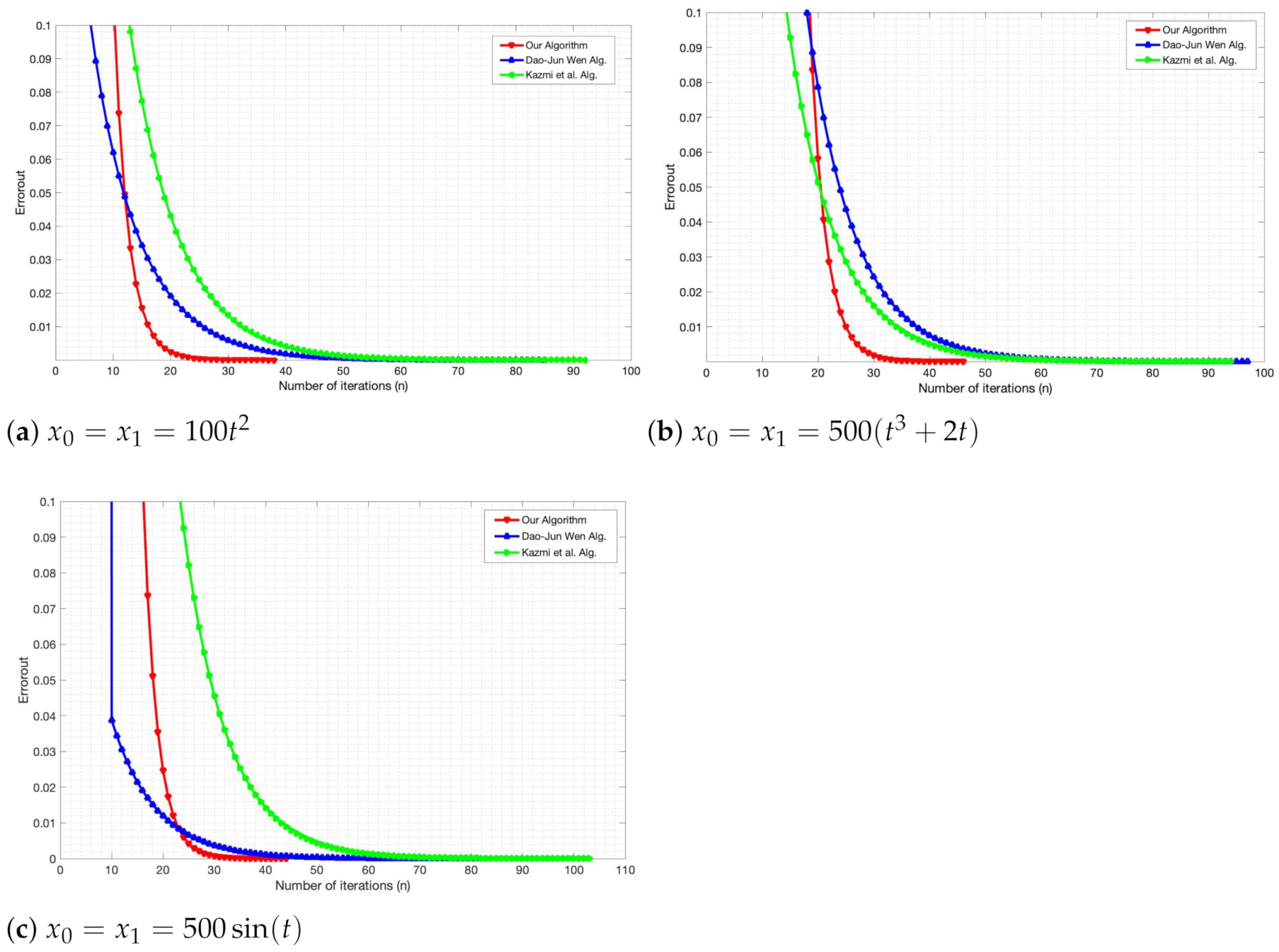
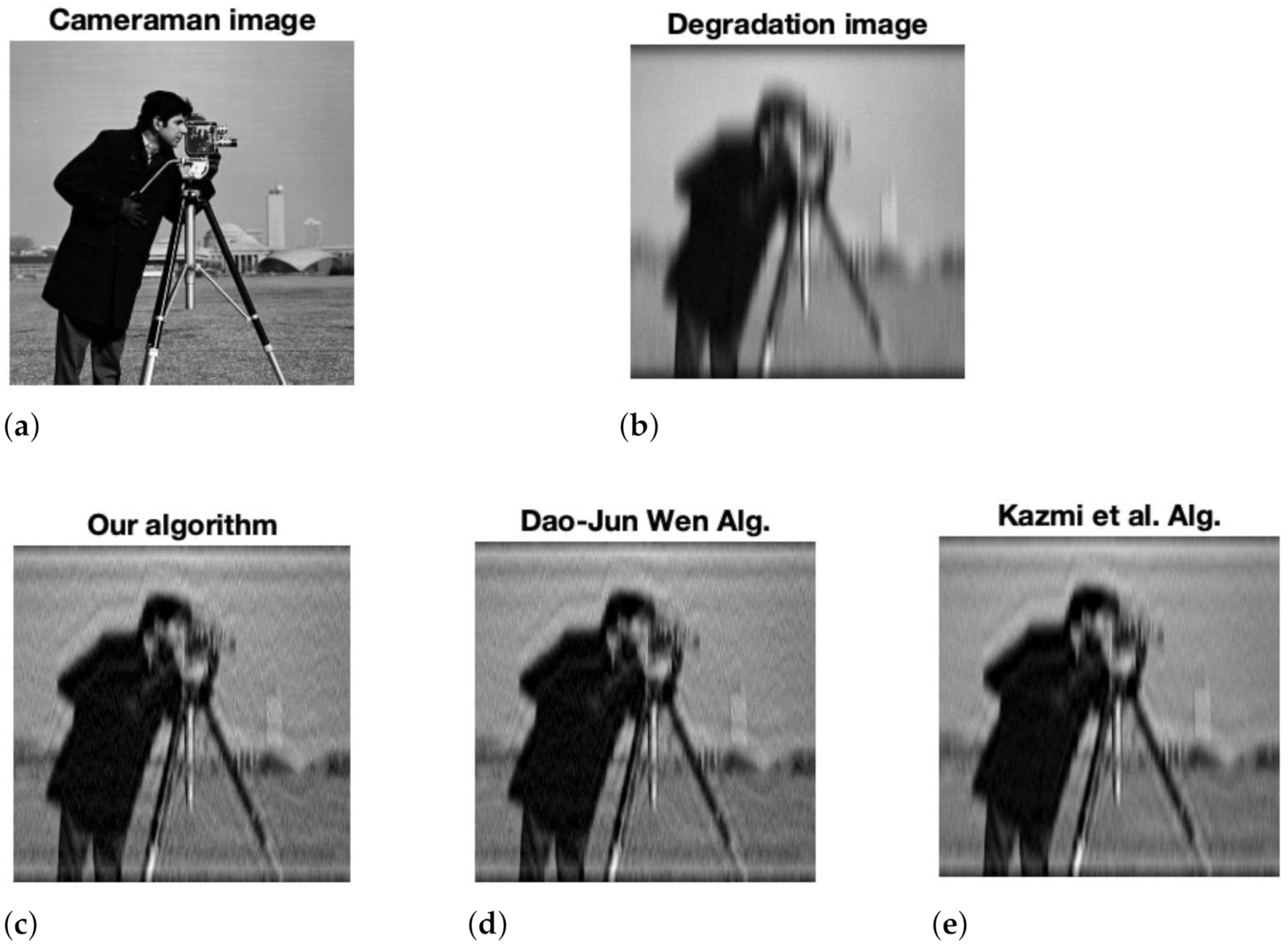
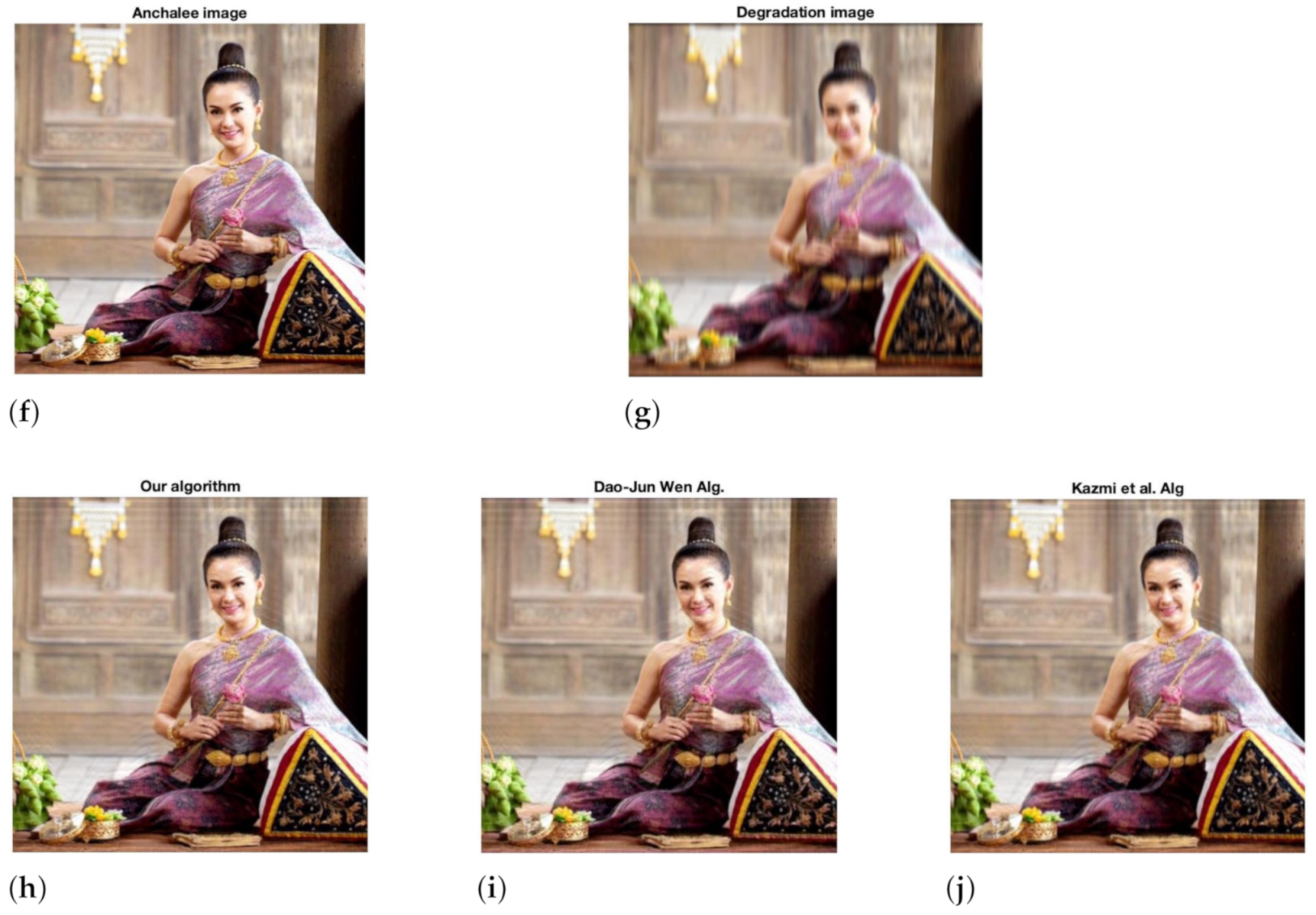
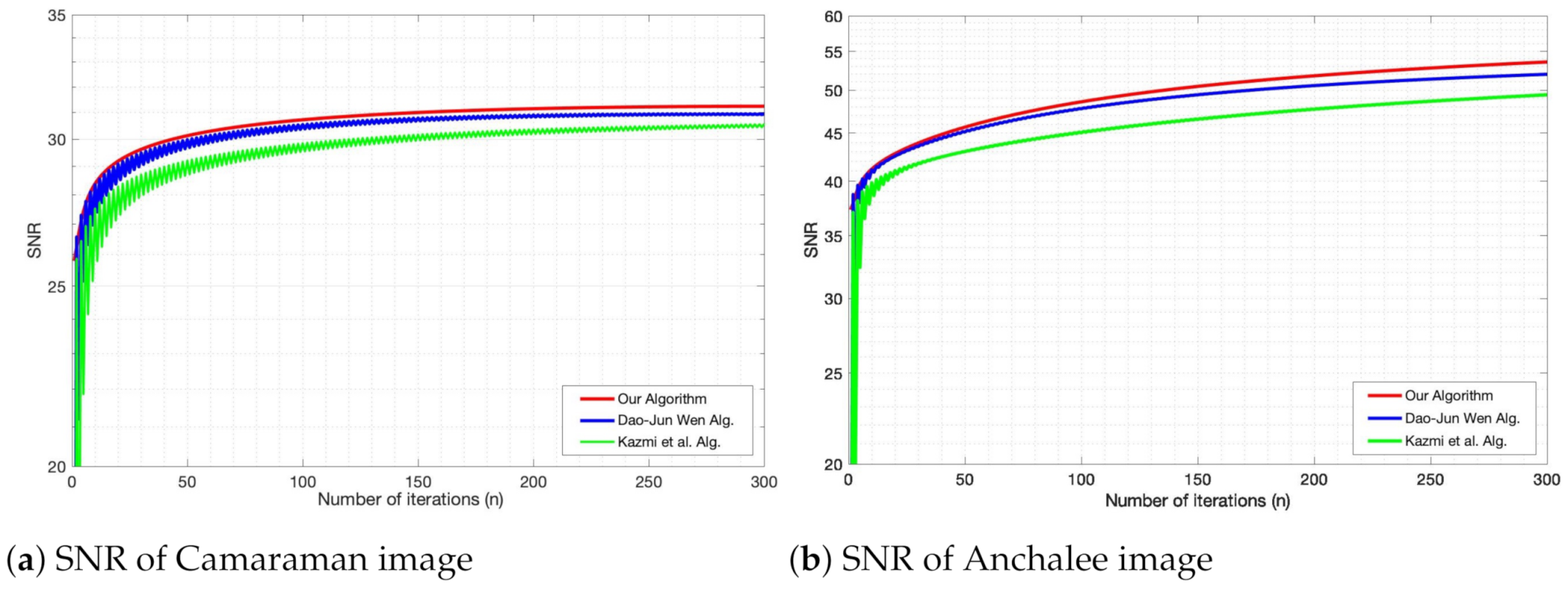
The further comparison of convergence behavior between our proposed method and Dao-Jun Wen. [14] and Kazmi et al. [7] is displayed in Figure 1 and Table 1 with the stopping criteria . Remark 3. Table 1 shows that the different inertial points have almost on effect on the number of iterations and shows that our proposed method has a better number of iterations and CPU time than Dao-Jun Wen. [14] and Kazmi et al. [7]. Example 2. In this example, we apply our main result to solve the image restoration problem by using Algorithm 1. We consider the convex minimization problem as follows:where is a smooth convex loss function and differentiable with L-Lipschitz continuous gradient where and is a continuous convex function. It is well known that the convex minimization problem (58) is equivalent to the following problem: We consider the degradation model that represents image restoration problems as the following mathematical model:where is a blurring matrix and is a noise term. The goal is to recover the original image by minimizing a noise term. We consider a model which produces the restored image given by the following minimization problem: for some regularization parameter . In this situation, we choose and and set operators , , , , , , and is defined as Example 1. We set parameters as follows: For this example, we choose the regularization parameter and the original gray and RGB images (see in Figure 2a,f). We use an average and motion blur create the blurred and noise images (see in Figure 2b,g). The performance for image restoring process is quantitatively measured by signal-to-noise ratio (SNR), which is defined aswhere x and denote the original image and the restored image at iteration n, respectively. A higher SNR implies that the recovered image is of higher quality. Our numerical results are explained in Table 2 and Figure 3. Remark 4. It can be observed from Figure 2 that the restoration quality of the the gray and RGB images restored by our algorithm is better than the quality of the image restored by Dao-Jun Wen. Alg. [14] and Kazmi et al. Alg. [7], and Table 2 and Figure 3 are verified by the higher SNR values of our algorithm.