


Abstract
We study a boundary value problem for nonlinear partial differential equations of the hyperbolic type on the plain in a domain with a complex boundary. To find the missing data for the given boundary constraints, we solve a supplementary nonlinear problem. For the approximation of solutions, one constructive method is built.
1. Introduction
The study of processes of a different nature (e.g., gas sorption, drying by the air flow, pipes heating by a stream of hot water, etc.) often leads to boundary value problems (for short, BVPs) for nonlinear differential equations of the hyperbolic type on the plane, defined in the domains with a complex structure of the boundary. The general problem setting of such BVPs was first introduced by Collatz (see discussions in [1]). The author suggests splitting the given domain D by characteristics onto subdomains and the consecutive solution of the classical Cauchy, Darboux, and Gaursat problems on each of these subdomains. Since it is not possible to find the exact solution of the given nonlinear problem, every following BVP will contain errors in their outcome data. At the same time, it is unknown how these errors will influence the end result. This leads to the significant disadvantage of the approach, suggested by Collatz.
On the other hand, there are some recent results, devoted to constructive methods of investigation and approximate solution of such BVPs with continuous and discontinuous right-hand sides in the nonlinear differential equations (see discussions in [2,3,4,5,6]). In these papers, the studied problem is reduced to the equivalent system of nonlinear integral equations. It allows us to approximately solve the system by the constructed iterative methods, where at every iteration step, one gets a solution of the studied BVP in the given domain with a pre-defined precision. This eliminates the aforementioned disadvantage of Collatz’s approach.
Note that in [2,3,4,5,6], the authors studied problems where the initial data (i.e., the boundary conditions) are known. However, there are processes dependent on prehistory, which means that in the mathematical model, not all of the income data are defined. In this case, one has to investigate an additional BVP describing this prehistory. A classical example of such problems can be the mathematical model describing exploitation of the already used respirator. Even though the model of the previous usage of the respirator is given, the gas concentration in the sorbent (due to its exploitation) is unknown, and thus, is defined as a prehistory.
To our best knowledge, these types of problems are not studied in the literature. This explains the motivation of our research, of which results we present in the current paper.
2. Problem Setting
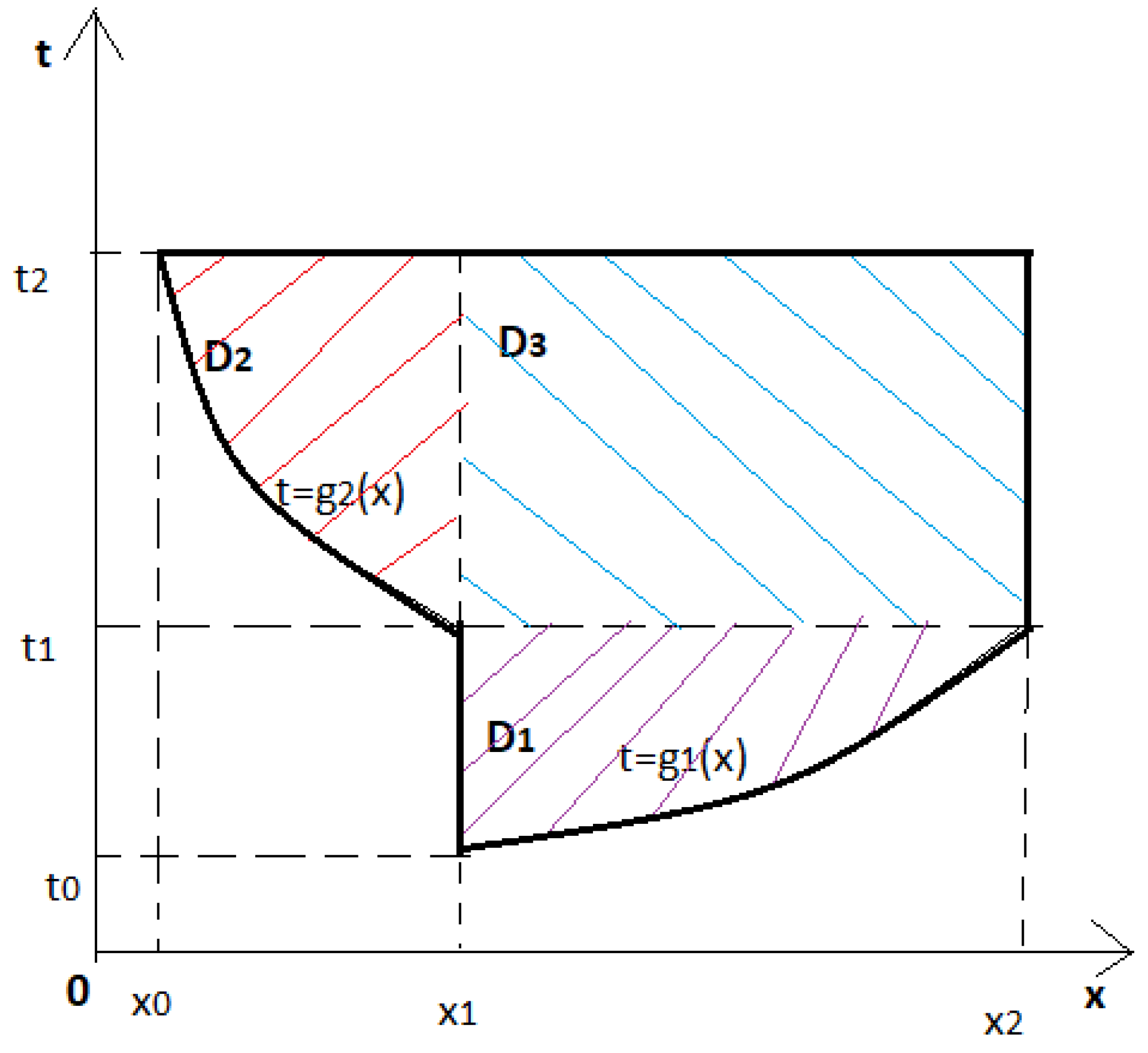
On the phase plain , let us define a domain (see Figure 1), where
if , are the “free” curves and
for
Figure 1.
Domain .
Problem 1.
In the space of functions
find the solution of the wave equation
which satisfies the conditions:
Here, function is a solution of the differential equation
satisfying constraints:
Moreover, for the aforementioned problems conditions, we hold:
From here on, we assume that
In addition, let equalities
hold, and the given functions and are such that
Note that the solution of the BVP (1)–(4), (7) , , , where is a solution of the Darboux problem (1), (3) for and is a solution of the Goursat problem for the differential Equation (1) with restrictions on the characteristics and given by
Furthermore, due to condition (7), an equality
is true.
3. Auxiliary Statements
It is easy to show that the lemma holds.
Lemma 1.
Thus, a lemma holds.
4. Constructive Method of Investigation and Approximation of Solutions
Let us establish sufficient conditions of the existence and uniqueness of the solution of the system of integral Equation (10). For this purpose, let us introduce a space of functions .
Definition 1.
We say that functions
if they satisfy conditions [7]:
- 1.
- 2.
- in the space of functions , , there exist functions , such that:
- ;
- for any pair of continuous functions satisfying condition , , in the domain the inequalitieshold;
- functions in the domain satisfy the Lipschitz condition, that is, for any two arbitrary pairs of continuous functions , , conditions are true:where , and are the Lipschitz constants, .
Remark 1.
It is easy to prove that if functions have the bounded first-order partial derivatives with respect to , then they always belong to the space , . An inverse statement is not true.
Assume that functions , correspondingly belong to the domains , for all and .
Additionally, let us introduce the following notations:
where and are arbitrary functions from the space that satisfy conditions:
Let us construct sequences of functions and in the form [7,8]:
As a zero approximation, we take arbitrary functions , from the space , such that for , the inequalities
hold.
Definition 2.
Let us emphasize that due to (15), an estimate is true:
i.e., , , if only , .
However, then from (18) and (19), taking into account (12), for , we get the inequalities
or, in other words, relations
hold. Thus, , .
Let us choose arbitrary functions and from the space of functions , which satisfy restrictions (15), in such a way that the inequalities
hold.
Then from (20) for , we have that , , that is, the constructed functions and are the comparison functions of the problems (1)–(7).
Taking and as the income data and repeating the aforementioned arguments via the method of mathematical induction, we conclude that if, at every iteration step (16) continuous in functions , satisfying conditions (15) are chosen in a way that the inequalities
where are true, then for any , we obtain
Let us show that the domain of functions and , which satisfy conditions (15) and inequalities (21), is non–empty.
Theorem 1.
5. Convergence Results
Let us show that the sequences of functions , , defined by (16), (21), converge uniformly for to the unique solution of the corresponding integral equation of the system (10).
Let us put
Then, using the method of mathematical induction from (19), it is easy to conclude that for any , , the estimate
is true, where .
From the estimate (24), it follows that
Thus, due to inequalities (22), we get
Passing in (16) to the limit, when , we ensure that the limit functions for are solutions of the corresponding integral equations of the system (10).
By contradiction, it is easy to show that if and conditions (18) hold, then the system (10) has a unique solution.
Theorem 2.
Then:
- 1.
- The system of integral Equation (10) has a solution, and it is unique for , ;
- 2.
- 3.
- 4.
- For arbitrary and , , inequalitiesare true;
- 5.
Then, taking into account (22), at this point we get
Hence, the sequence of functions for does not converge to . We came to a contradiction.
Analogically, we can prove that the inequality is true.
Consequently,
The last inequalities prove the fifth statement of the theorem.
6. Some Corollaries
Corollary 1.
Corollary 2.
Consider an equation of the form
- ;
- Function , and in the domain, has a bounded first-order derivative with respect to that satisfies an inequality:
- For any function from the space , the inequalitieshold.
Theorem 3
(comparison theorem). Let , in the domain satisfy conditions (8). Let, for the right-hand sides and of Equations (1) and (27), the aforementioned conditions (1)–(3) hold, and in the domain there exist the comparison functions of the problems (1)–(7) and (27), (3)–(7).
Then, solutions of these problems satisfy conditions:
Proof.
According to Theorem 2 and Corollary 2, solutions of the problems (1)–(7) and (27), (3)–(7) exist, and are unique (regular or irregular). Hence, putting and using the Mean Value Theorem, we get:
where is a derivative, evaluated at some fixed value , .
Obviously, function satisfies the homogeneous conditions (3), (6) and , . Moreover,
that is, due to (28), (29) we get:
and
On the basis of the Corollary 2
that is, the inequalities (30) hold. □
7. Discussion
To summarize, in the current paper, we have presented our recent results in the study of one boundary value problem for a nonlinear partial differential equation of the hyperbolic type on the plane in a domain with a complex boundary and a prehistory. To find the missing data for the given boundary constraints, we solved a supplementary nonlinear problem. In addition, we have built a two-sided constructive method to approximate solutions of the studied problems, and proved appropriate convergence properties.
As it was already mentioned in the Introduction, these problems have a wide spectrum of applications in applied sciences. Thus, the obtained results can be further broadened to study the mathematical models of real physical processes.
Author Contributions
Conceptualization, V.M., K.M. and O.K.; methodology, V.M., K.M. and O.K.; validation, V.M., K.M. and O.K.; formal analysis, V.M., K.M. and O.K.; investigation, V.M., K.M. and O.K.; resources, V.M., K.M. and O.K.; writing—original draft preparation, V.M. and K.M.; writing—review and editing, K.M.; visualization, V.M., K.M. and O.K.; supervision, V.M.; project administration, V.M. All authors have read and agreed to the published version of the manuscript.
Funding
This research received no external funding.
Institutional Review Board Statement
Not applicable.
Informed Consent Statement
Not applicable.
Acknowledgments
The authors are grateful to reviewers for their valuable comments.
Conflicts of Interest
The authors declare no conflict of interest.
Notations
In the current paper the following abbreviations and notations are used:
| BVP | boundary value problem; |
| closure of the domain D: ; | |
| mixed partial derivative of the function , defined as ; | |
| linear differential operator with respect to function with coefficients of the form: ; | |
| projection of a domain D onto the plane. |
References
- Collatz, L. Funktionalanalysis und Numerische Mathematik; Springer: Berlin/Heidelberg, Germany, 1964; 448p. [Google Scholar]
- Marynets, V.V.; Kohutych, O.I. On one approach of investigation of a boundary value problem for quasilinear differential equation of the hyperbolic type. Math. Comput. Model. Phys. Math. Sci. 2019, 19, 71–77. (In Ukranian) [Google Scholar]
- Marynets, V.; Marynets, K. Investigation of the Goursat–Darboux boundary value problem for nonlinear equation of the hyperbolic type. Fract. Mech. Phys. Constr. Matherials Struct. 2014, 10, 56–68. (In Ukranian) [Google Scholar]
- Marynets, V.; Marynets, K. On Goursat-Darboux boundary-value problem for systems of non-linear differential equations of hyperbolic type. Miskolc Math. Notes 2013, 14, 1009–1020. [Google Scholar] [CrossRef]
- Marynets, V.; Marynets, K. The Goursat-Darboux boundary-value problem for non-linear differential equation of the hyperbolic type. Rep. Natl. Acad. Sci. Ukr. 2014, 10, 23–28. (In Ukranian) [Google Scholar]
- Marynets, V.; Marynets, K.; Pytjovka, O. On one constructive method of the investigation of the boundary-value problem for differential equations of the hyperbolic type. Sci. Trans. Uzhhorod Natl. Univ. Math. Inform. 2015, 27, 76–85. [Google Scholar]
- Krasnosel’skii, M.A.; Vainikko, G.M.; Zabreyko, R.P.; Ruticki, Y.B.; Stet’senko, V.V. Approximate Solution of Operator Equations; Springer: Amsterdam, The Netherlands, 1972; 496p. [Google Scholar]
- Marynets, V.V.; Marynets, K.V.; Pytjovka, O.Y. Analytical Methods of the Boundary—Value Problem Investigation; Goverla: Uzhhorod, Ukraine, 2019; 288p. (In Ukranian) [Google Scholar]
Publisher’s Note: MDPI stays neutral with regard to jurisdictional claims in published maps and institutional affiliations. |
© 2021 by the authors. Licensee MDPI, Basel, Switzerland. This article is an open access article distributed under the terms and conditions of the Creative Commons Attribution (CC BY) license (https://creativecommons.org/licenses/by/4.0/).

