Abstract
We consider a general second order self-adjoint elliptic operator on an arbitrary metric graph, to which a small graph is glued. This small graph is obtained via rescaling a given fixed graph by a small positive parameter . The coefficients in the differential expression are varying, and they, as well as the matrices in the boundary conditions, can also depend on and we assume that this dependence is analytic. We introduce a special operator on a certain extension of the graph and assume that this operator has no embedded eigenvalues at the threshold of its essential spectrum. It is known that under such assumption the perturbed operator converges to a certain limiting operator. Our main results establish the convergence of the spectrum of the perturbed operator to that of the limiting operator. The convergence of the spectral projectors is proved as well. We show that the eigenvalues of the perturbed operator converging to limiting discrete eigenvalues are analytic in and the same is true for the associated perturbed eigenfunctions. We provide an effective recurrent algorithm for determining all coefficients in the Taylor series for the perturbed eigenvalues and eigenfunctions.
MSC:
34B45; 34E15
1. Introduction
Spectral properties of elliptic operators on graphs with small edges are of a special interest and attract quite a lot of attention. Small edges is a specific singular geometric perturbation, which can be introduced due to the nature of graphs. One of early results on graphs with small edges was about a model of a woven membrane, see [1,2], which was shown to be approximated by a two-dimensional operator on an Euclidean domain covered by such membrane.
The graphs with finitely many small edges attracted more attention and one of early results stated that that a general vertex condition in a graph can be approximated in the norm resolvent sense via ornamenting by small edges supporting a magnetic field and with delta-coupling at the vertices [3]. An essential progress was made in very recent works [4,5] just few years ago. Here, Schrödinger operators on general graphs with arbitrarily placed small edges were considered. The main obtained result stated that under a certain non-resonance condition, see Condition 3.2 in [4], the perturbed operator converged to a certain limiting operator in the norm resolvent sense and the estimate for the convergence rate was established. The limiting operators was defined on a graph, in which the small edges were replaced by the vertices to which they shrink and at such vertices certain limiting boundary conditions were determined. These results were further developed in [6,7], where a general elliptic operator with varying coefficients was considered on a graph with small edges rescaled by means of a single small parameter. The coefficients in the differential expression and in the boundary conditions were allowed to depend analytically on the same small parameter. It was shown that certain parts of the resolvent of such operator depended analytically in and were represented by converging Taylor series. This allowed to represent the perturbed resolvent by a converging Taylor-like series with effective estimates for the remainders.
A next natural question is the behavior of the spectrum. This question was addressed in [4] for the aforementioned Schrödinger operator on a general graph with small edges. The convergence of the spectrum and corresponding spectral projectors was established. In particular, it was shown that the non-resonance condition was important and without it, the convergence of the spectrum could fail. We also mention few recent papers [8,9,10,11], where the resolvents and spectra were studied for some toy models represented by very simple graphs with small edges.
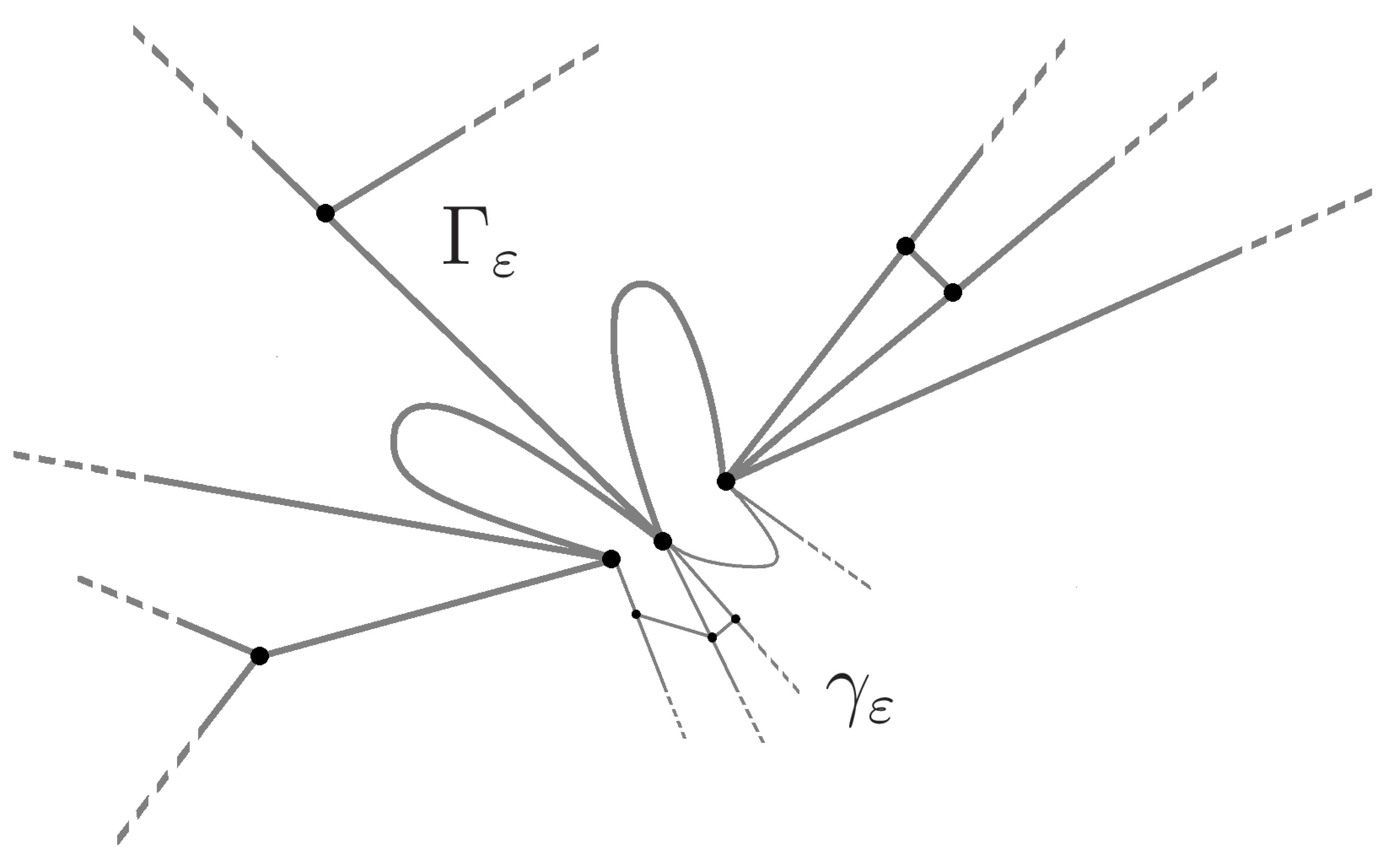
In the present work, we continue studying the model proposed in [6,7]. Namely, we consider a general self-adjoint second order elliptic operator on an arbitrary graph, to which a small graph is glued. The small graph is obtained via rescaling a given fixed graph by a small positive parameter , see Figure 1 and Figure 2. The coefficients of the differential expression are varying and can additionally depend on . For the coefficients on fixed edges, this dependence on is analytic, while the coefficients on small edges can be even meromorphic. The boundary conditions are of a general matrix form with the matrices analytically depending on . The limiting operator is known thanks to the results in [6,7]. We show that the spectrum of the perturbed operator converges to that of the limiting operator and we provide an estimate for the distance between these two spectra. We also establish the convergence of the corresponding spectral projectors. Our second main result states that the eigenvalues of the perturbed operator converging to limiting discrete eigenvalues are analytic in . A similar analyticity property is established for the associated eigenfunctions. We provide an effective recurrent algorithm for determining the coefficients in the Taylor series for both eigenvalues and eigenfunctions. Once the coefficients are found, the sums of the Taylor series are exactly the eigenvalues and the eigenfunctions of the perturbed operator and in this sense, we can say that these eigenvalues and eigenfunctions are found explicitly.
Figure 1.
Graph with a glued small graph. The small edges in the graph are indicated by thin lines.
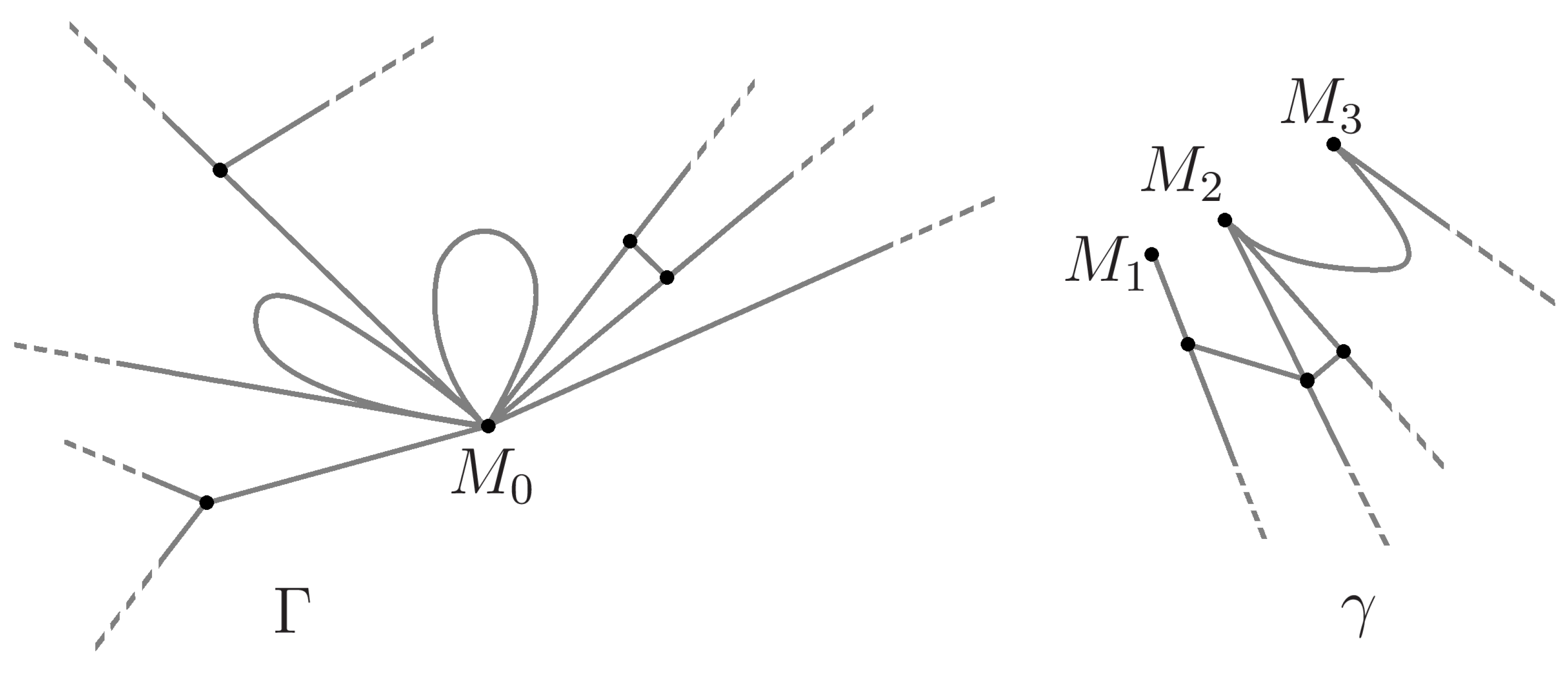
Figure 2.
Examples of initial graphs and . Here, the edges incident to are split into three groups ().
The paper is organized as follows. In the next section, we describe the problem, introduce auxiliary notations, formulate our main results and discuss their main features. The third section is devoted to proving the convergence of the spectrum and of the associated spectral projectors. In the fourth section, we prove the analyticity of the perturbed eigenvalues and the associated eigenfunctions, while in the fifth section, we describe an algorithm for determining the coefficients of their Taylor series.
2. Problem and Main Results
2.1. Problem
Let be a finite graph, that is, it contains finitely many vertices and edges. We assume that this graph contains no isolated vertices and edges and is metric, that is, each edge is equipped with a length, direction and a variable on it and on each edge, the usual Lebesgue measure is introduced. The graph can contain edges of both finite and infinite lengths.
By we denote an arbitrary vertex in the graph , while , , are the edges incident to ; each possible loop in the family is counted twice. We introduce one more arbitrary finite metric graph containing only edges of finite lengths and no isolated vertices or edges, see Figure 2.
We contract the graph in times, where is a small positive parameter, that is, each edge in the graph of a length is replaced by an edge of the length , while all vertices remain unchanged. The graph obtained under such contraction is denoted by .
The graph we study is obtained by gluing the graph to at the vertex . This gluing is defined as follows. First we choose n arbitrary vertices , , in the graph . Using the same number n, we partition the edges , , of the graph into n disjoint non-empty groups , , and replace the vertex in the graph by its n copies, one copy for each group . Here, are some disjoint non-empty sets of indices and , . The gluing then is made by considering the union of the graphs and and identifying the vertices , , with the aforementioned copies of the vertex in the graph , see Figure 1. This new graph is denoted by . It consists of a fixed part and of a small graph . In the graph , the edges , , are not incident to the same vertex . Instead of this, each group is incident to the vertex in the graph .
Hereafter, we identify the graphs and with the corresponding subgraphs in . Each function defined on is also supposed to be defined on and and vice versa. On each edge in and we introduce arbitrarily a direction and an associated variable. The chosen directions then is transferred to the graph ; the same is done for the variables on the edges in the graph .
The main object of our study is an operator in with the differential expression
This expression is defined on each edge of the graph and the symbol x stands for the variable on a considered edge. The symbol denotes the imaginary unit, and are some real bounded measurable functions defined on the graphs and . By we denote a linear operator mapping onto and acting as
on each edge in the graph .
We assume that , , , , and that these functions are analytic in in the sense of the corresponding norms. The operator is supposed to be uniformly elliptic, namely, we assume that there exists a fixed independent of , and such that
Thanks to the assumed analyticity in , it is sufficient to impose the above condition for and then it holds for sufficiently small with a possible less constant c.
The vertex conditions on the graph describing the domain of the operator read as follows. Given an arbitrary vertex M in the graph , let , , , be the edges incident to this vertex. By , , we denote the restrictions of an arbitrary function u to the edges and we introduce two -dimensional vectors:
where is the variable on the edge . For each vertex of a degree , the following general vertex condition is imposed:
where and are some matrices of size analytic in . The matrix
is supposed to be self-adjoint, where
are the edges incident to the vertex M and is the number of such edges. We let if direction on the edge from the vertex M inside the edge coincides with the chosen direction on this edge and otherwise.
The matrices and in conditions (4) can be left multiplied by an arbitrary non-degenerate matrix and this procedure keeps the vertex conditions unchanged. Employing this arbitrariness, for each verttex we let and without loss of generality we suppose that the first rows in the matrix are linearly independent and the other rows are zero, while last rows in the matrix are non-zero. Then at each vertex we impose the following rank condition:
which is obviously equivalent to
for all sufficiently small .
For an arbitrary graph we denote . The domain of the operator is a subspace of a Sobolev space and this subspace is formed by the functions obeying boundary conditions (4). The action of the operator on such functions is defined by differential expression (1). According [6] (Theorem 2.1), the operator is self-adjoint.
2.2. Assumptions and Notations
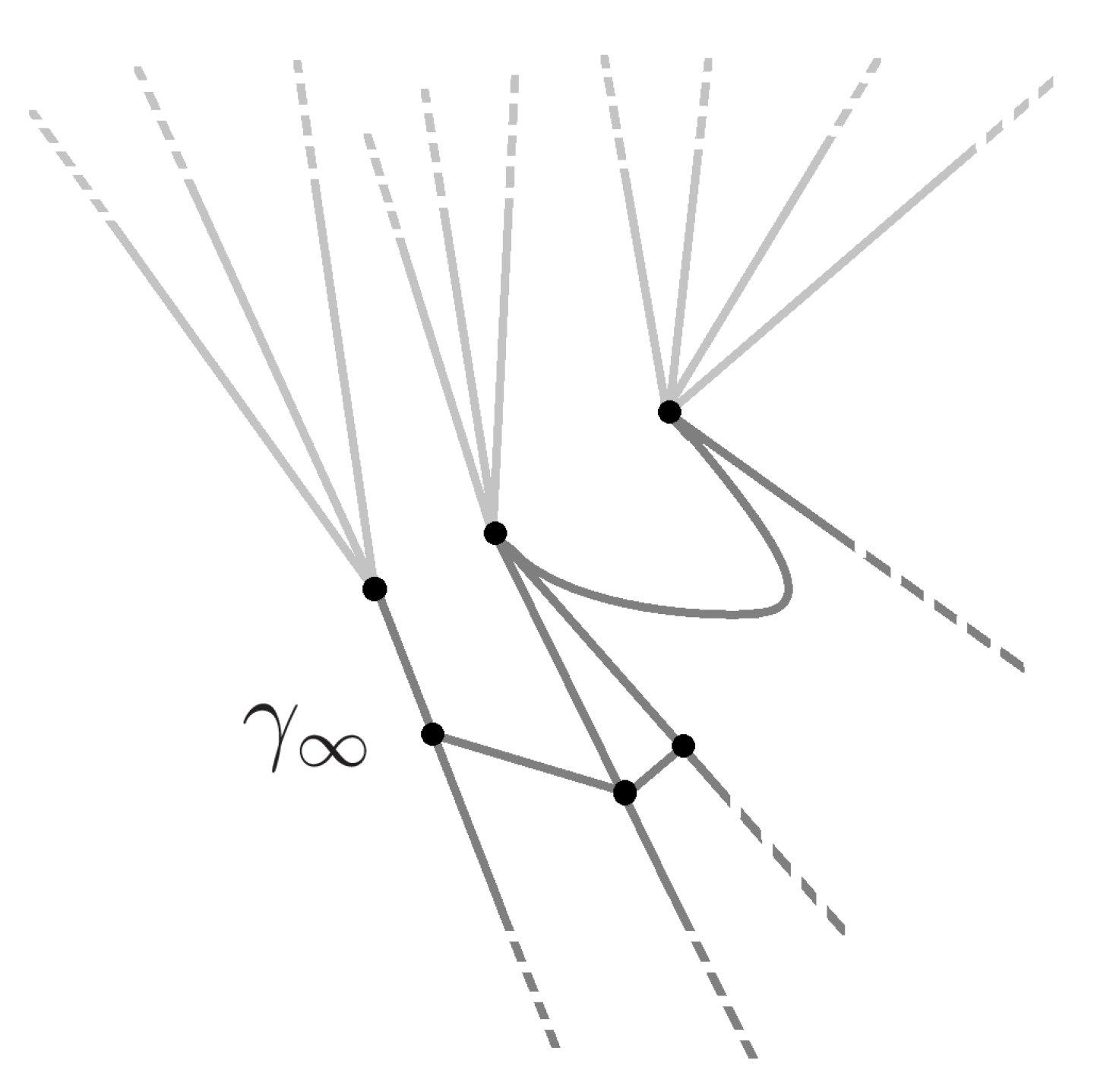
Here, we introduce additional notations and assumptions, which will be employed then to formulate our main results. We attach edges of infinite lengths (leads) , , , to the vertices , , in the graph . The obtained graph is denoted by , see Figure 3. In this graph, the vertices serve as the origins for the attached edges , .
Figure 3.
Graph . The leads in the graph are of light gray color.
On the graph , namely, in the space , we introduce an operator with the differential expression
where, we recall, are the edges in the graph incident to the vertex , and is a variable on the graph . The vertex conditions read as
where the vectors and are introduced in the same way as in (2) but with the derivatives replaced by and
Here the symbols and denote the matrices formed by last rows of respectively the matrices and , and the matrix is formed by first rows of the matrix . The domain of the operator is a subspace of the functions in the Sobolev space satisfying the imposed vertex conditions. It was shown in [6] (Section 4.2) that the operator is self-adjoint and its essential spectrum coincides with .
The main condition we assume in the work is as follows.
- (A)
- The operator has no embedded eigenvalue at the bottom of its essential spectrum.
The above assumption means that zero, which is the bottom of the essential spectrum, is not an eigenvalue of the operator . In other words, the boundary value problem
has no non-trivial solutions square integrable on . In view of the definition of the differential expression in (6), each non-trivial solutions to problem (8) is to be a linear function on the leads . Therefore, Condition (A) excludes the existence of non-trivial solutions to problem (8) vanishing identically on . However, this problem can have non-trivial solutions , which satisfies the identities on , , , with some constants depending on the choice of the edge . In this case one usually says that the operator has a virtual level at the bottom of its essential spectrum.
On each function u defined and continuous on the edges in the vicinity of the points we introduce the following vector
where stands for the restriction of u to the edge . In terms of the introduced notations, Condition (A) can be equivalently reformulated as follows: each non-trivial solution to problem (8) obeys the inequality
We proceed to auxiliary notations. Let and be the operators restricting a given function to the subgraphs and of the graph : , . In the sense of the decomposition
the identity
holds, where stands for the identity mapping in .
As we have said above, under Condition (A), the operator can have a virtual level at the bottom of its essential spectrum. By , , we denote linearly independent bounded non-trivial solutions to problem (8) obeying condition (9). We clearly have . If the operator has no virtual level at the bottom of its essential spectrum, we let . We denote: , . Hereafter we suppose that the functions are chosen so that the vectors are orthonormalized in . If , we choose additional vectors , , so that the vectors , , form an orthonormalized basis in . Then a matrix is unitary. We also let .
We introduce the following families of matrices:
where , are the edges incident to the vertex M, the numbers are defined as in (5). Employing Formula (12) for , we need to continue the functions on the leads , , , and we do this as , . It was shown in [6] (Lemma 4.1) that the matrix defined in (11) is unitary. Let be the projector in onto the eigenspace of the matrix associated with the eigenvalue , and .
We define a matrix
Then we let
where the symbol 0 in the first row of the matrix denotes the zero matrix of the size , while in the second row the same symbol stands for the zero matrix of the size . The first matrix in the definition of the matrix is of the size and the symbols 0 stand for the zero matrices of respectively the sizes , , and . The numbers are defined as in (5) and, we recall, are the edges in the graph incident to the vertex .
Let be an operator in with the differential expression
and with the vertex conditions
where the matrices , are introduced in (13), while for other vertices these matrices are given by the formulae , . The domain of the operator is a subspace of consisting of functions satisfying vertex conditions (14). According [6] (Theorem 2.1), the operator is self-adjoint. Then its spectrum consists of its essential part and a discrete spectrum.
We shall make use of the following spaces of continuous functions on graphs:
In the case when the functions and have an additional smoothness , , , , and are analytic in in the norms of these spaces, we define the space as .
The spectrum of an operator is denoted by . Given a self-adjoint operator and two real numbers a, b such that and , by we denote a spectral projector of associated with the segment .
2.3. Main Results
Now we are in position to formulate our main results. Our first result states the convergence of the spectrum.
Theorem 1.
Let Condition (A) be satisfied. As , the spectrum of the operator converges to the spectrum of the operator . Namely, for each bounded interval I on the real axis we have
where is some constant independent of ε but depending on the choice of the segment I. For arbitrary real numbers a, b such that , , the convergence of spectral projectors holds:
Let be a discrete eigenvalue of the operator , that is, an isolated eigenvalue of a finite multiplicity ℓ. By , , we denote the associated eigenfunctions orthonormalized in . Our second result states the analyticity of the perturbed eigenvalues converging to and of the corresponding eigenfunctions.
Theorem 2.
Let Condition (A) be satisfied, be an isolated eigenvalue of the operator of a finite multiplicity ℓ and , , be the associated eigenfunctions orthonormalized in . Then there exist exactly ℓ eigenvalues , , of the operator taken counting their multiplicities converging to as . These eigenvalues are analytic in ε. The associated eigenfunctions , , can be chosen so that they are analytic in ε in the following sense: the functions are analytic in the norm of , while the functions are analytic in the norm of .
In this work, we also describe a way of determining the coefficients of the Taylor series for the perturbed eigenvalues and eigenfunctions described in the previous theorem. This is our third main result. However, in order to formulate it, we need to introduce many additional notations and this is why it is more convenient to provide this theorem in Section 5, see Theorem 3.
2.4. Discussion and Possible Generalizations of Main Results
Here, we briefly discuss our main results and their possible generalizations. Our first result, Theorem 1, establishes the convergence of the spectrum of the operator to that of the operator . Inequality (15) states the convergence of the spectrum in each compact subset in the complex plane and moreover, the distance between the perturbed and limiting spectra is estimated. Relation (16) means that we also have a convergence of the corresponding spectral projectors. The limiting spectral projector in fact corresponds to the operator only and there is no contribution from the subgraph . These convergence results are of same nature as in the case of the uniform resolvent convergence of the self-adjoint operators. However, the results in [6] on the approximation of the resolvent of do not imply immediately the statement of Theorem 1 just by applying classical theorems on norm resolvent convergence from the spectral theory. The reason is that our operator acts in the Hilbert space depending on and this dependence is singular in the sense that the subgraph shrinks to a single vertex. Moreover, it is very essential to have Condition (A) here since without it the convergence of the spectrum can fail, see examples in [4] and paper [12]. Since the graph can contain also the edges of infinite lengths, the spectra of both operators and can also involve a non-empty essential component. Theorem 1 then states also the convergence of such components as well as of the corresponding spectral projectors.
Our second theorem states the analytic dependence on of the perturbed eigenvalues converging to limiting discrete operators. The same result holds for the associated perturbed eigenfunctions. The restriction of these eigenfunctions to the subgraph is analytic in the sense of the norms in and . The restriction to is not analytic but it becomes analytic after applying the operator . This means that we consider the restriction of the eigenfunctions to and then we pass to the rescaled variable , which ranges over . Then the considered restriction becomes analytic in the norm of .
The analytic dependence on of the perturbed eigenvalues and eigenfunctions imply that they can be represented by converging Taylor series (56)–(58). In Section 5 we describe an algorithm for determining all coefficients in these three series. Although in Section 5 we consider only the case of a simple limiting eigenvalue , our technique also work perfectly for the case of a multiple eigenvalue . However, in this case the formulae become too bulky and this is the reason why we restrict ourselves by considering only the case a simple limiting eigenvalue. We stress that since series (56)–(58) converge, we can regard the result of Section 5 as a way of finding explicitly the perturbed eigenvalues and the eigenfunctions. This is true in the sense that they are represented by converging series and there is a direct and effective way of determining their coefficients.
To demonstrate our results, we mention a simple example of a star graph with a small edge considered in [9,10], see Figure 4a. Here, the edges are finite and of the lengths , while the edge is small and its length is . The differential expression for the operator on the edges reads as
where is some real valued continuous function. At the vertex we impose the Kirchhoff condition, that is,
while the boundary vertices are subject to the Dirichlet condition. Then the limiting operator is defined one the graph formed by the vertices and , see Figure 4b, with the differential expression subject to the Dirichlet condition at all vertices. The eigenvalues of the latter can be found explicitly:
Let be a simple eigenvalue corresponding to some , then according to our result, there exists a unique eigenvalue of the operator converging to as . The eigenvalue is simple and analytic in . Then our approach described in Section 5 gives the following formula for the leading terms in the Taylor series for :
Figure 4.
(a) Star graph with a small edge. (b) Limiting star graph.
Our main results can be generalized in several directions. The first immediate generalization concerns the case, when instead of one small graph glued at the vertex , several small graphs are glued to several vertices in the graph . If all these small graphs are rescaled by the same small parameter , all our results remain true. In such situation, Condition (A) is to be assumed separately for each small graph. If each of the small graphs is rescaled by means of a small parameter and the parameters are assumed to be independent, then under certain additional conditions for the coefficients in the differential expression and the boundary conditions it is still possible to obtain the results analyticity of the eigenvalues and the eigenfunctions with respect to all small parameters. These conditions are the same as those in [6], which ensured a similar analyticity of the resolvent.
One more way of generalization is to assume that the coefficients in the differential expression and the boundary conditions are infinitely differentiable in or just have power in asymptotic expansions instead of the analyticity property. In this case the convergence result in Theorem 1 remains true. The perturbed eigenvalues in Theorem 2 now becomes infinite differentiable in or having power asymptotic expansions in , while a similar statement of the associated eigenfunctions can fail. In a particular case, when the limiting eigenvalue is simple, the corresponding perturbed eigenfunction is nevertheless infinite differentiable in or has a power asymptotic expansion in . Such statements can be proved by a technique different from that used in the present work. The results of Section 5 also remains true with the only modification that now series for the eigenvalues and eigenfunctions are to be treated as asymptotic in . If is a multiple eigenvalue, then the technique used results of Section 5 still allows one to construct power asymptotic series for all perturbed eigenvalues converging . However, the corresponding eigenfunctions can have a more complicated dependence on and in general, power asymptotic series are no longer true even in the asymptotic sense.
In conclusion, let us also mention the following application of our main results. Quantum graphs often arise and are employed, for instance, as models of thin quantum waveguide and nanotubes and many other applications, see [13] (Chapter 7). Then graphs with small edges correspond to the case, when the lengths of some tubes or waveguides are much less than the lengths of the others. Usually, in such regime, it is extremely troublesome to employ numerical methods for solving boundary value problems on such graphs since one has to employ the numerical schemes with a very small step. At the same time, our results show how to find effectively the eigenvalues and eigenfunctions of the considered model up to an arbitrary small error. Namely, it is sufficient to employ the partial sums of series (56)–(58), the coefficients of which can be found by the algorithm presented in Theorem 3.
3. Convergence of Spectrum
In this section, we prove Theorem 1. In the proof, by , , we denote the norms of a bounded operator acting respectively in , and . By and we denote the zero operator respectively in and .
We fix an arbitrary bounded segment and we define its subset for some fixed , which will be chosen later. We are going to show that as is small enough, for all with the resolvent is well-defined; here C is a constant independent of . This fact will imply that and this will yield estimate (15).
For we consider the equation for the resolvent with an arbitrary and we rewrite it as
According Theorem 2.1 in [6] and Theorem 2 in [7], the resolvent is well-defined and it can be represented as
where the direct sum is understood in the sense of decomposition (10) and is a bounded operator in obeying the estimate
where C is some constant independent of . We apply the resolvent to Equation (17) and then we substitute representation (18) into the obtained identity:
We have:
where is the identity mapping in and is the identity mapping in and for the resolvent is well-defined. We substitute then (21) into (20) and invert the operator , where is the identity mapping in . Then we get:
As , we have a standard estimate for the resolvent of the self-adjoint operator :
where the resolvent is regarded as an operator in . Then, by (19) we immediately get
where C is some fixed constant independent of , and . The right hand side in the above estimate is less than provided . Then estimate (23) yields the existence of the a bounded inverse operator in . This existence allows us to solve Equation (22) as
Hence, the resolvent is well-defined and its action on arbitrary function is given by the right hand side of the above identity.
We proceed to studying the convergence of the spectral projectors. The operator is obviously lower-semibounded and in view of the established convergence of the spectrum we can choose a fixed real negative constant such that and for all sufficiently small . Then both the resolvents and are well-defined. Moreover, it is possible to reproduce the proof of Theorem 2.1 in [6] for the operator and to establish an identity similar to (10). Namely, the only point we need to confirm in the proof in [6] is the invertibility of the matrix used in [6] (Lemma 5.1), where , are some fixed self-adjoint matrices and is positive definite. This is obviously true provided is negative and its absolute value is large enough. Then the aforementioned identity similar to (10) reads as
where
are some bounded operator analytic in and
where are some linear functionals on and we recall that are non-trivial solutions of problem (8). Having decomposition (10) in mind, we introduce an unitary operator acting by the rule
The above definitions and identities (25) imply
where , , and are bounded operators analytic in . Hence, the operators , are also analytic in z.
Since the operator is self-adjoint, the unitary equivalent operator is self-adjoint in . The established analyticity of the operators , and representation (27) mean that the operator converges to the operator :
where C is some constant independent of . We also observe that the and the spectra of the operator and of its resolvent are in one-to-one correspondence
A similar correspondence holds for the spectra of the operator and of its resolvent . In particular, this means that the spectrum of converges to that of .
Let be an infinitely differentiable function on vanishing outside the segment with , , and being identically one on and on . We observe the identities
The above convergence and definition (26) of the operators and imply:
as . This completes the proof of Theorem 1.
4. Analyticity of Eigenvalues and Eigenfunctions
In this section, we prove Theorem 2. The first part of the theorem on existence and convergence of the perturbed eigenvalues is implied immediately by Theorem 1. In the considered case the spectral projector is the projector on the space spanned over the eigenfunctions associated with the eigenvalues of converging to , while is the projector on the eigenspace associated with the eigenvalue . The convergence of these projectors implied by (16) means that the total multiplicity of the perturbed eigenvalues converging to coincides with the multiplicity of .
We proceed to proving the analyticity of the eigenvalues and of the associated eigenfunctions. As in (26), (27), Here, we again pass to the operator and we rewrite the eigenvalue problem for and as
According to (27)–(29), the operator is bounded as acting from into and it is analytic in . We consider finitely many eigenvalues converging to a limiting eigenvalue of a finite multiplicity. Then according to the results in [15] (Chapter VII, Section 3.1), we can apply the statements established in [15] (Chapter II, Section 6) for analytic self-adjoint operators in finite-dimensional spaces. This implies that the eigenvalues are analytic in . The associated eigenfunctions can be chosen orthonormalized in and analytic in in the norm of this space. Since and is strictly positive, the eigenvalues are analytic in . In view of eigenvalue Equation (31) we then see that the eigenfunctions are also analytic in . Returning back to the eigenvalues , we then conclude that they are analytic in . We also observe that the eigenfunctions are recovered from the eigenfunctions by the following formulae valid due to (31), (26):
As a next step, we are going to prove that the eigenvalues and the functions , are analytic in in the norms of the spaces and .
First of all we observe that owing to formulae (27), (29) and eigenvalue Equation (31) we have:
and hence, the function is analytic in in the space .
The stated analyticity property means that
where , , are some analytic in functions. We consider the eigenvalue equation for and as a boundary value problem for the differential equation
subject to boundary conditions (3). The above equation is considered separately on subgraphs and ; on the latter subgraph we also pass to the rescaled variable . This leads us to the following equations:
where is the following differential expression:
The coefficients of both differential expressions and are analytic in . Having this fact in mind, we substitute representations (32) into (33) and in view of the analyticity of , , in , we then necessarily have
A similar procedure can be done with boundary conditions (3), in which we can also separate an analytic in part and a similar one multiplied by . Considering then the obtained boundary value problems for , , we see immediately that they can be written as two equations
where , , and is an eigenfunction of the operator . We multiply the first equation in (35) by in and integrate by parts employing the second equation in (35):
Since as , the obtained identity imply immediately that and for all sufficiently small . Then the equations in (35) mean that both and are eigenfunctions associated with . Hence, without loss of generality, we can assume that , where C is some constant and then we just choose . The proof of Theorem 2 is complete.
5. Taylor Series
In this section, we describe an algorithm for determining all coefficients in the Taylor series for the perturbed eigenvalues and the associated eigenfunctions .
Since by our assumptions the eigenvalue is simple, the same is true for the eigenvalue and there is just one associated eigenfunction . The analyticity of and in has been established in Theorem 2. This yields that and are represented by converging Taylor series (56)–(58), where are some constants and , are some functions. Series (57) converges in , while series (58) converges in .
We substitute series (56), (57) into the eigenvalue equation , rewrite it as a boundary value problem on and consider this problem separately on the subgraph and . This leads us to equations similar to those on in (34) with , , , . In these equations we expand the coefficients of the differential expressions into the power series in and equate the coefficients at the like powers of and we arrive at the following recurrent system of equations:
where the differential expressions are defined as
In the same way we substitute series (57) into boundary conditions (3), expand the matrices and into the power series in and equate the coefficients at the like powers of . This gives:
where the matrices and for , are defined as
The way of finding boundary value problems for the coefficients of series (58) follows the same lines but with an additional trick. Namely, first we introduce an auxiliary graph by attaching additional unit edges , , , to the each vertex , , in the graph . The boundary vertices, being the end-points of the edges and not coinciding with , are denoted by , , . We observe that the set of the vertices in the graph not coinciding with , , is in fact the set of the vertices of the graph . We introduce the notations
for all functions . On the graph we introduce an auxiliary operator with the differential expression
where is the variable on the edge measured from the vertex and the constants are defined in (6). The boundary conditions for the operator are (7) and
We continue the functions from the graph on the graph . Namely, on the edges , , , we continue them as linear functions
where are the edges of the graph incident to the vertex . Since the functions and are the coefficients in Taylor series (57), (58) and these series represent the same eigenfunction but restricted to and , we see that the following identities should hold:
Here, we have also employed that the variables on the edges and are related by the rescaling .
Now we substitute series (56), (58) into the eigenvalue equation for and considered on the subgraph and we rescale the variables by passing to . Then we arrive at equations similar to ones in (34) on with , , , . Then we expand the coefficients in the obtained equation into the power series in and equate the coefficients at the like powers of . This gives:
where the differential expressions are defined as
In the same way we substitute series (58) into boundary conditions (3), expand the matrices and into the power series in and equate the coefficients at the like powers of . Then we obtain:
where the matrices and read as
We stress that since the eigenvalues and the eigenfunctions are well-defined, the obtained boundary value problems for the functions and are solvable. Using these boundary value problems, we are going to study the structure of the functions and and to find the constants . In order to do this, we first introduce auxiliary notations and mention some statements proved in [6].
First, we consider as a separate graph and for each vertex we introduce matrices by formulae (11), where
The matrices turn out to be unitary, see [6] (Section 4). Then, as above, for such vertices M we let to be the projector in onto the eigenspace of the matrix associated with the eigenvalue , and . Finally, for , and for we define:
We also denote:
The following lemma was proved in [6], see Lemma 5.2 in that work.
Lemma 1.
Assume that Condition (A) holds and the operator can have a virtual level at the bottom of its essential spectrum with associated non-trivial solutions. Given an arbitrary family of vectors , for each vertex , , an arbitrary vector , and an arbitrary function , the boundary value problem
is solvable in if and only if
for each . Under these conditions, there exists the unique solution obeying the identities
The general solution of problem (42) reads as
where are arbitrary constants.
A similar statement for the operator on the graph can be proved exactly in the same way as the above lemma was proved in [6]. This statement is as follows.
Lemma 2.
Let be a simple eigenvalue of the operator and be the associated eigenfunction normalized in . Given an arbitrary family of vectors , for each vertex , and an arbitrary function , the boundary value problem
is solvable in if and only if
Under this condition, there exists the unique solution obeying the identities
The general solution of problem (44) reads as
where c is an arbitrary constant.
Equation (40) with for and the first boundary condition in (39) are homogeneous. Hence, the function is a linear combination of the functions ; we recall that the latter functions correspond to the virtual level at the bottom of the essential spectrum of the operator . We have
where are some constants to be determined. The function is apriori known and in view of the boundary condition for this function at the vertex we see that
This means that the vector is a linear combination of the vectors , . Employing now identities (38) with , we conclude immediately that
and hence,
The latter identity and (46) determine completely the function .
In order to study other problems for the functions and , we rewrite boundary conditions to another form more appropriate for applying Lemmata 1 and 2. First, we represent the left hand side of both conditions (37), (41) as
Then we apply the matrix to these boundary conditions and in view of the definition of the matrix and the identities
we get:
Now we apply the projectors and to the above identity and we arrive at the needed equivalent formulation of the boundary conditions:
where .
We proceed to determining other functions and . In view of the above boundary value problems for these functions, each of them is defined up to a linear combinations of a corresponding non-trivial solutions to the homogeneous problem. Namely, the functions are of form (60), where are some constants and is the solution to the same problem as for but satisfying orthogonality condition (61). Each function is also defined up to an additive term . At the same time, the perturbed eigenfunctions is defined up to a multiplicative constant, which can depend on . And in fact, adding to each function corresponds to multiplying of by an appropriate constant depending on . This is why we apriori suppose that the functions , , satisfy orthogonality condition (59).
In view of our assumptions, the right hand sides in Equation (40) and boundary conditions (41), (47) for are expressed as follows:
It follows from [6] (Equation (5.24)) that
According to Lemma 1, the solvability condition of problem (40), (47), (39) for is given by identity (43) with
Substituting then the above given formulae for these functions and (48) into this solvability condition and employing the self-adjointness of the matrix , we rewrite it as follows:
Definition (13) of the matrices and implies that the corresponding unitary matrix reads as
Hence, the corresponding projector is that onto the subspace spanned over the vectors , , while is the projector onto the subspace spanned over the vectors , . We also observe two formulae
Then it follows from the latter identity that boundary condition (49) can be equivalently rewritten as
Hence, in view of identity (50), the above boundary condition is equivalent to
The obtained boundary condition for is to be treated as a replacement for boundary conditions (38), (39).
Hence, we can apply Lemma 2 to problem (36), (47), (54) for and according to solvability condition (45), this problem is solvable if and only if
Now the functions for and the functions for can be found by the induction in i. Namely, assume that we have constructed the functions for and the functions for satisfying orthogonality conditions (61), (59). We also assume that we have determined the constants , for . Then we first solve boundary value problem (36), (37), (51), (53) for ; we can do this since all right hand sides in this problem are expressed via already determined functions and constants. The solvability condition of this problem determines by Formula (55). By Lemma 2 there exists the unique solution satisfying orthogonality condition (59). Once we know the function , we can determine constants via Formula (52). Namely, we see that identities (62) hold true. We also solve problem (40), (41), (39) for and find its solution obeying orthogonality condition (61). Repeating the above procedure, we determine all coefficients in series (56)–(58).
The results of applying the above procedure are summarized in the following theorem.
Theorem 3.
Let Condition (A) be satisfied, be a simple isolated eigenvalue of the operator and be the associated eigenfunction normalized in . Then the eigenvalue and the associated eigenfunction of converging to and are represented by the converging Taylor series
where two latter series converge respectively in and . The functions are solutions of boundary value problems (36), (37), (51), (53) obeying orthogonality condition
The functions are solutions of boundary value problems (39)–(41) represented as
where are solutions to the same problems as for but satisfying the orthogonality condition
The constants are determined by formula
The constants are given by Formula (55).

6. Conclusions
Here, we stress two important aspects of our results. The first of them concerns the analyticity of the eigenvalues. This is a rather surprising fact since the small edges are an example of a singular perturbation, which can not be treated by the methods of the regular perturbation theory presented, for instance, in [15]. Under singular perturbations, one can usually expect only the possibility to construct some asymptotic series but not to prove their convergence [16]. However, the specific feature of our problem is that in our case, series (56)–(58) do converge, and even uniformly in small . The second important point is that we can effectively find all coefficients in Taylor series (56)–(58) by the recurrent procedure described in Section 5. This algorithm is an adaption of the method of matching asymptotic expansions widely used for partial differential equations on Euclidean domains and manifolds [16]. The present work is the first where this method is employed and adapted for general graphs with small edges for finding eigenvalues and eigenfunctions.
Funding
The research is supported by the Russian Science Foundation (grant no. 20-11-19995).
Institutional Review Board Statement
Not applicable.
Informed Consent Statement
Not applicable.
Data Availability Statement
Not applicable.
Conflicts of Interest
The authors declare no conflict of interest. The funders had no role in the design of the study; in the collection, analyses, or interpretation of data; in the writing of the manuscript, or in the decision to publish the results.
References
- Zhikov, V.V. Homogenization of elasticity problems on singular structures. Izv. Math. 2002, 66, 299–365. [Google Scholar] [CrossRef]
- Pokornyi, Y.V.; Penkin, O.M.; Pryadiev, V.L.; Borovskikh, A.V.; Lazarev, K.P.; Shabrov, S.A. Differential Equations on Geometric Graphs; Fizmatlit: Moscow, Russia, 2005. (In Russian) [Google Scholar]
- Cheon, T.; Exner, P.; Turek, O. Approximation of a general singular vertex coupling in quantum graphs. Ann. Phys. 2010, 325, 548–578. [Google Scholar] [CrossRef] [Green Version]
- Berkolaiko, G.; Latushkin, Y.; Sukhtaiev, S. Limits of quantum graph operators with shrinking edges. Adv. Math. 2019, 352, 632–669. [Google Scholar] [CrossRef] [Green Version]
- Cacciapuoti, C. Scale invariant effective hamiltonians for a graph with a small compact core. Symmetry 2019, 11, 359. [Google Scholar] [CrossRef] [Green Version]
- Borisov, D.I. Analyticity of resolvents of elliptic operators on quantum graphs with small edges. arXiv 2021, arXiv:2102.12958. [Google Scholar]
- Borisov, D.I. Quantum graphs with small edges: Holomorphy of resolvents. Dokl. Math. 2021, 103, 113–117. [Google Scholar]
- Borisov, D.I.; Mukhametrakhimova, A.I. On a model graph with a loop and small edges. J. Math. Sci. 2020, 251, 573–601. [Google Scholar] [CrossRef]
- Borisov, D.I.; Konyrkulzhayeva, M.N. Perturbation of threshold of the essential spectrum of the Schrödinger operator on the simplest graph with a small edge. J. Math. Sci. 2019, 239, 248–267. [Google Scholar] [CrossRef]
- Borisov, D.I.; Konyrkulzhayeva, M.N. Simplest graphs with small edges: Asymptotics for resolvents and holomorphic dependence of spectrum. Ufa Math. J. 2019, 11, 56–70. [Google Scholar] [CrossRef] [Green Version]
- Borisov, D.I.; Konyrkulzhayeva, M.N.; Mukhametrakhimova, A.I. On a discrete spectrum of a model graph with a loop and small edges. J. Math. Sci. 2021, 257, 3–18. [Google Scholar]
- Baradaran, M.; Exner, P.; Tater, M. Ring chains with vertex coupling of a preferred orientation. Rev. Math. Phys. 2021, 33, 2060005. [Google Scholar] [CrossRef] [Green Version]
- Berkolaiko, G.; Kuchment, P. Introduction to Quantum Graphs; American Mathematical Soc.: Providence, RI, USA, 2013. [Google Scholar]
- Reed, M.; Simon, B. Methods of Modern Mathematical Physics. 1. Functional Analysis; Academic Press: New York, NY, USA, 1972. [Google Scholar]
- Kato, T. Perturbation Theory for Linear Operators; Springer: Berlin, Germany, 1976. [Google Scholar]
- Il’in, A.M. Matching of Asymptotic Expansions of Solutions of Boundary Value Problems; American Mathematical Soc.: Providence, RI, USA, 1992. [Google Scholar]
Publisher’s Note: MDPI stays neutral with regard to jurisdictional claims in published maps and institutional affiliations. |
© 2021 by the author. Licensee MDPI, Basel, Switzerland. This article is an open access article distributed under the terms and conditions of the Creative Commons Attribution (CC BY) license (https://creativecommons.org/licenses/by/4.0/).