Abstract
Partial difference equations have received more and more attention in recent years due to their extensive applications in diverse areas. In this paper, we consider a Dirichlet boundary value problem of the partial difference equation involving the mean curvature operator. By applying critical point theory, the existence of at least three solutions is obtained. Furthermore, under some appropriate assumptions on the nonlinearity, we respectively show that this problem admits at least two or three positive solutions by means of a strong maximum principle. Finally, we present two concrete examples and combine with images to illustrate our main results.
1. Introduction
Throughout this article, we denote by and the sets of real numbers and integers, respectively. For satisfying , define .
Consider the following partial discrete Dirichlet boundary value problem, denoted ():
with boundary conditions
Here m and n are given positive integers, and are the forward difference operators, i.e., and , and , denotes the mean curvature operator [1] defined by for , for each , is a real parameter, and for all .
As we all know, the theory of difference equations has been used extensively to study discrete mathematical models appearing in computer science, ecology, neural networks, economics and other fields [2,3,4,5]. During recent decades, many excellent results on the existence and multiplicity of solutions for difference equations have been acquired, which included results on boundary value problems [6,7,8,9,10,11], periodic and subharmonic solutions [12,13,14,15,16], homoclinic solutions [17,18,19,20,21,22,23,24,25,26] and heteroclinic solutions [27,28], etc.
Only one discrete variable is involved in the above difference equations, in fact that partial difference equations involving two or more discrete variables have also the numerous practical applications in many fields. For instance, Shi and Chua [29] established the following partial difference equation in image processing
where is proportional to the intensity of the input image at the associated pixel, denotes the nodal voltage waveform of the resistive array, and the parameter controls the amount of smoothing. In [30], to modelling the temperature distribution of a “very long” rod, Cheng introduced the nonlinear reaction diffusion equation
where f is a real function defined on . Of course, these applications have greatly promoted the theoretical study of partial difference equations.
In [31,32,33], the authors considered the problem ():
Following the ideas from [34], the authors first investigated the nonlinear algebraic system associated with () and further obtained several different results on the existence and multiplicity of solutions for problem () by means of critical point theory.
In 2020, Du and Zhou [35] considered the partial discrete Dirichlet problem ():
with boundary conditions (1). By directly establishing the variational structure corresponding to () and applying critical point theory, the authors acquired a series of the existence results.
Lately, Wang and Zhou [36] discussed a more general problem ():
with boundary conditions (1). Using critical point theory, the authors determined the intervals of parameter in which problem () admits at least three solutions.
Compared with the partial difference equations with -Laplacian, there is less work on the partial difference equations involving -Laplacian, which is mainly because the latter is more complex to deal with. In fact, -Laplacian has very important theoretical significance and application value [37,38].
Recently, Du and Zhou [39] studied the partial discrete Dirichlet problem (), namely problem () when for any . The authors obtained the existence of multiple solutions for problem () via critical point theory.
Owing to the reasons above, we will investigate the existence of at least three solutions for problem () in this paper. Please note that Lemma 4 plays an important role in the proof of our results, which is more complex than [39]. In addition, different from the main tools of proof in [39], the existence of at least three solutions is obtained using another three critical points theorem. Based on a strong maximum principle, we further obtain the existence of at least two and three positive solutions when the nonlinearity f satisfies appropriate hypotheses, respectively.
First of all, we recall a critical lemma (see Theorem 2.1 of [40]).
Lemma 1.
Let X be a separable and reflexive real Banach space. is a nonnegative continuously Gâteaux differentiable and sequentially weakly lower semicontinuous functional whose Gâteaux derivative admits a continuous inverse on . is a continuously Gâteaux differentiable functional whose Gâteaux derivative is compact. Assume that there exists such that and that
- for all ;Furthermore, assume that there are , such that
- ;
- .
Then, for each
the equation
has at least three solutions in X and, moreover, for each , there exist an open interval
and a positive real number σ such that for each , the Equation (2) has at least three solutions in X whose norms are less than σ.
The rest of this article is organized as follows. In Section 2, we introduce the variational framework corresponding to problem () and show some basic lemmas. Our main results are presented in Section 3. In particular, when the nonlinearity f satisfies appropriate hypotheses, we respectively acquire the existence of at least two or three positive solutions for problem () by applying the established strong maximum principle. In Section 4, we give two concrete examples and simulate the partial solutions by two images to illustrate our main results.
2. Preliminaries
Consider the space
endowed with the norm
Then X is a separable and reflexive real Banach space and dim.
For any , we define
where
It is easy to verify that are two continuously Gâteaux differentiable functionals and for any ,
Therefore, for any ,
Lemma 2.
Every critical point of is just a solution of problem ().
Proof.
Assume that is a critical point of , i.e., , then, for all ,
For any , define by
Substituting into (4), we have
for each . Hence, x is a solution of problem (). □
Lemma 3.
For any , one has
where
Proof.
On the one hand, from (2.1) of [39], for any , we have
which implies that
On the other hand, for each , one has
Hence,
Similarly, we infer
Therefore,
□
Remark 1.
Take , where
It is easy to verify that
so,
That is to say, and are approximate when m and n are large enough.
Remark 2.
(5) implies that for any , as .
Lemma 4.
Assume that Φ as defined in (3), then
holds, where .
Proof.
For convenience, denote , where
Next, we discuss . Please note that
Consequently,
which yields our conclusion. □
Finally, we establish the following strong maximum principle to acquire positive solutions of problem ().
Lemma 5.
Fix such that for each , either
Then, either for all or .
Proof.
Fix satisfying (7). Let , such that
We consider two cases: and .
Case (I): If , so for any , and the proof is complete.
Case (II): If , so . It is clear that and . Please note that is increasing in s and , we infer
that is,
Analogously,
Then,
On the other hand, since and by virtue of (7), one has
By combining (8) with (9), we obtain
which implies that
namely
Hence,
If , we have . Otherwise, . At this point, replacing by , we have . Repeating the reasoning we obtain . Similarly, we acquire . Thus, for every . We can prove that in the same manner, and the proof of Lemma 5 is complete. □
3. Main Results
For later convenience, put
Now, we state our main results.
Theorem 1.
Assume that there are positive constants satisfying and
such that
- (A1)
- ;
- (A2)
- .
Then, for every
problem () has at least three solutions in X, where
Moreover, set
Then, for any , there are an open interval and a real number such that for every , problem () has at least three solutions in X and their norms are less than σ.
Remark 3.
By virtue of the assumption , it is easy to verify that the intervals and are well-defined.
Remark 4.
For any , if is a nonnegative continuous function, Lemma 5 ensures that every solution involved in Theorem 1 is either zero or positive.
Proof of Theorem 1.
Put X, and J as defined in Section 2, it is easy to see that X, and J satisfy all structure hypotheses requested in Lemma 1.
Take for any , so and .
For any , it follows from the assumption that
Combining with (6), for any , one has
Taking into account that and Remark 2, we have
That is to say, the condition of Lemma 1 holds.
To verify the condition of Lemma 1, set
and
Then , and
We obtain by (10), which yields the condition of Lemma 1.
Now we only need to verify the condition of Lemma 1. On the one hand, we infer
On the other hand, for any , it follows from (6) that
So,
Then, for any , one has
i.e., . Hence,
In view of the assumption , we deduce
which means that the condition of Lemma 1 is satisfied.
Please note that
and
Therefore, Lemmas 1 and 2 guarantee that for any
problem () has at least three solutions in X.
Moreover,
Hence, Lemmas 1 and 2 ensure that for any , there are an open interval and a real number such that for any , problem () has at least three solutions in X and their norms are less than . Theorem 1 is proved completely. □
Next, we verify the existence of at least two positive solutions for problem () by means of Lemma 5.
Corollary 1.
Assume that for every , and there are positive constants satisfying and (10) such that
- ;
- .
Then, for any
problem () possesses at least two positive solutions in X, where
Moreover, set
Then, for any , there are an open interval and a positive real number σ such that for any , problem () possesses at least two positive solutions in X whose norms are all less than σ.
Proof.
For any , put
and
So,
Hence,
and
By virtue of the assumption and , Theorem 1 ensures that problem () has at least three solutions when belongs to intervals or , respectively. Assume that x is one of the solutions of problem (), then for any , either or
so either in or by Lemma 5. This indicates that problem () has at least two positive solutions in X, which are just positive solutions of problem (). The conclusion of Corollary 1 holds. □
Furthermore, we consider a special case of problem (), in which f has separated variables, namely ():
with Dirichlet boundary conditions (1). Here is nonnegative and non-zero, and is a continuous function satisfying .
For convenience, put
Corollary 2.
Assume that there are positive constants satisfying and (10) such that
- ;
- .
Then, for any
problem () possesses at least two positive solutions in X.
Moreover, set
Then, for any , there are an open interval and a real number such that for any , problem () possesses at least two positive solutions in X whose norms are all less than σ.
Proof.
For any , put
Note that
and
By direct computations, we have
and
Moreover, we take
Taking into account and , the conclusion of Corollary 2 holds with the help of Corollary 1. □
In fact, if for every , we can obtain the existence of at least three positive solutions for problem () by means of Lemma 5.
Corollary 3.
For any , if the assumption in Corollary 1 is replaced by and other conditions remain unchanged, then for any , problem () admits at least three positive solutions in X. Moreover, for any , there are an open interval and a real number such that for any , problem () admits at least three positive solutions in X whose norms are less than σ.
Proof.
Put and as defined in (11) and (12). Similar to the proof of Corollary 1, we can establish that problem () admits at least three solutions when belongs to intervals or . Let x be an arbitrary solution of problem (), then for any , either or
so either in or by Lemma 5. Please note that is not the solution of problem () due to for any , which implies that x must be the positive solution of problem (). So problem () admits at least three positive solutions in X, which are just positive solutions of problem (). Corollary 3 is proved. □
4. Examples
In this section, we present two concrete examples to illustrate our main results.
Example 1.
Consider the problem (), where , , , , and
It is easy to see that is nonnegative and non-zero, and is a continuous function satisfying . Moreover, we infer that , , ,
and
Then and
Note that
and
which yield that (10) and in Corollary 2 are both true.
In view of (13), we deduce that if , then
if , then
The above two cases show that
and the condition in Corollary 2 holds.
Therefore, Corollary 2 ensures that for any
the problem considered admits at least two positive solutions in X.
In particular, take , the problem considered can be simplified as
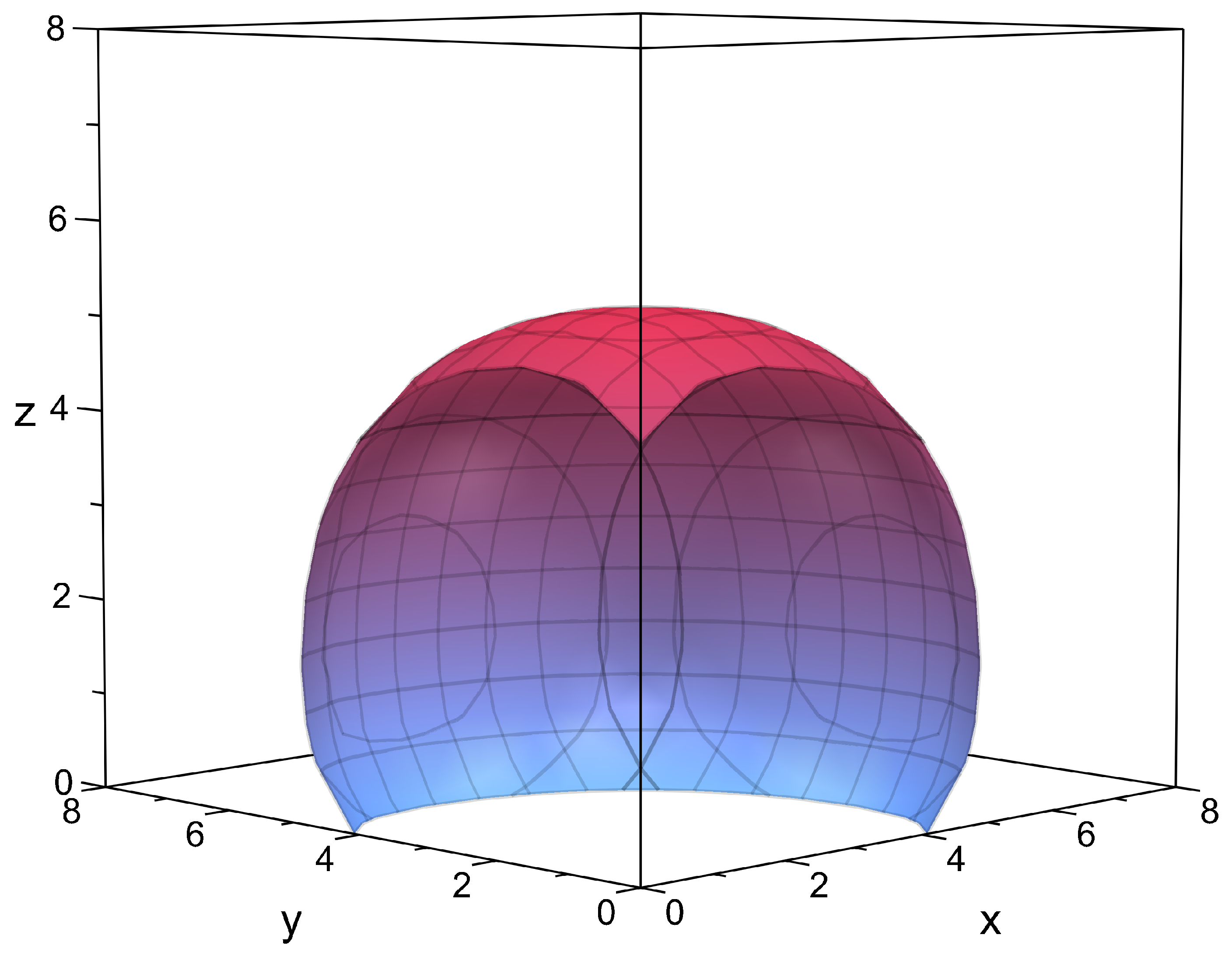
Put and assume that , and belong to interval , so Figure 1 shows the components , and of the solutions for (14) (for convenience, denote x = , y = and z = ). Clearly, the problem considered admits at least two positive solutions in X.
Figure 1.
The image of components x, y, z of the solutions for (14).
Example 2.
Consider the problem (), where , , , , and
Obviously, f is a continuous function and , , , and
So,
and
Moreover,
and
They indicate that the conditions (10), and in Corollary 3 hold, respectively. According to Corollary 3, for any
the problem considered admits at least three positive solutions in X.
In particular, take , the problem considered can be rewritten as
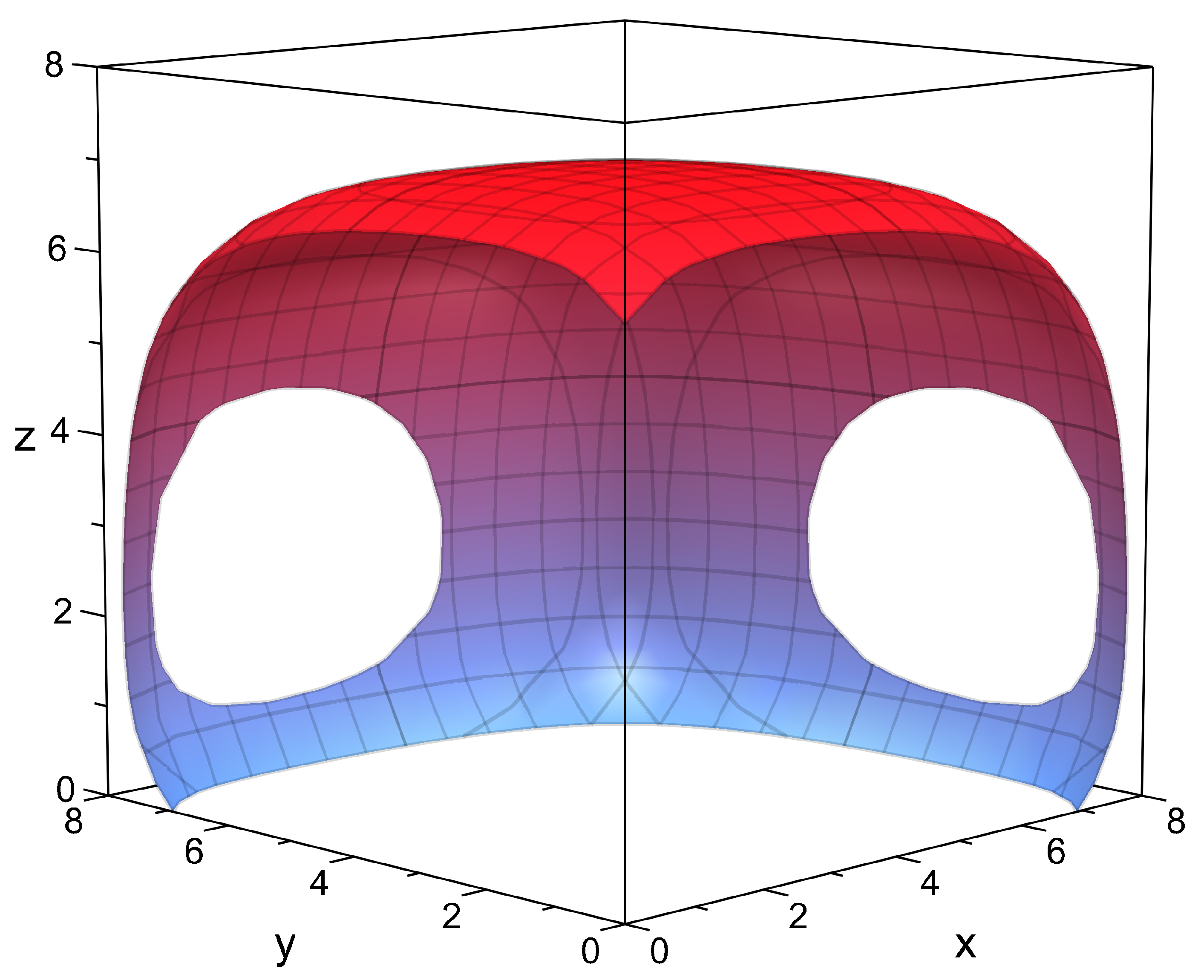
Set and assume that , and belong to interval , so Figure 2 shows the components , and of the solutions satisfying (15) (for convenience, denote x = , y = and z = ). Obviously, the problem considered admits at least three positive solutions in X.
Figure 2.
The image of components x, y, z of the solutions for (15).
5. Conclusions
Mathematical models concerned with partial difference equations play important roles in many fields. In this article, the partial discrete problem () involving the mean curvature operator is considered. In contrast to [39], by employing Theorem 2.1 in [40], some new sufficient conditions are established to ensure that problem () admits at least three solutions, as shown in Theorem 1. Furthermore, under suitable assumptions on the nonlinearity f, we prove the existence of at least two positive solutions using the established strong maximum principle, as shown in Corollaries 1 and 2. Please note that Corollary 2 is an improvement of Corollary 3.3 in [36]. Additionally, we show that problem () has at least three positive solutions in Corollary 3. Compared with [39], we prove the inequality about in Lemma 4 to obtain the coercivity of the functional , which is more complex than [39]. The ingenious definition of norm makes the proof of Lemma 4 simpler. On the other hand, to demonstrate the applicability of our results, we not only give two concrete examples, but also illustrate the existence of multiple solutions by images, which is more intuitive. How to obtain the existence and multiplicity of periodic or homoclinic solutions for the partial difference equations is a very worthy subject. This will be our future work.
Author Contributions
Conceptualization, S.W.; methodology, S.W.; formal analysis, S.W. and Z.Z.; investigation, Z.Z.; writing—original draft preparation, S.W.; writing—review and editing, Z.Z.; supervision, Z.Z.; funding acquisition, Z.Z. All authors have read and agreed to the published version of the manuscript.
Funding
This research was funded by the National Natural Science Foundation of China (Grant No. 11971126) and the Program for Changjiang Scholars and Innovative Research Team in University (Grant No. IRT 16R16).
Institutional Review Board Statement
Not applicable.
Informed Consent Statement
Not applicable.
Data Availability Statement
Not applicable.
Conflicts of Interest
The authors declare no conflict of interest.
References
- Mawhin, J. Periodic solutions of second order nonlinear difference systems with ϕ-Laplacian: A variational approach. Nonlinear Anal. 2012, 75, 4672–4687. [Google Scholar] [CrossRef]
- Agarwal, R.P. Difference Equations and Inequalities: Theory, Methods and Applications; Marcel Dekker: New York, NY, USA, 1992. [Google Scholar]
- Elaydi, S. An Introduction to Difference Equations, 3rd ed.; Springer Science & Business Media: New York, NY, USA, 2005. [Google Scholar]
- Yu, J.S.; Zheng, B. Modeling Wolbachia infection in mosquito population via discrete dynamical models. J. Differ. Equ. Appl. 2019, 25, 1549–1567. [Google Scholar] [CrossRef]
- Long, Y.H.; Wang, L. Global dynamics of a delayed two-patch discrete SIR disease model. Commun. Nonlinear Sci. Numer. Simul. 2020, 83, 105117. [Google Scholar] [CrossRef]
- Jiang, L.Q.; Zhou, Z. Three solutions to Dirichlet boundary value problems for p-Laplacian difference equations. Adv. Differ. Equ. 2008, 2008, 345916. [Google Scholar] [CrossRef] [Green Version]
- Zhou, Z.; Ling, J.X. Infinitely many positive solutions for a discrete two point nonlinear boundary value problem with ϕc-Laplacian. Appl. Math. Lett. 2019, 91, 28–34. [Google Scholar] [CrossRef]
- Ling, J.X.; Zhou, Z. Positive solutions of the discrete Dirichlet problem involving the mean curvature operator. Open Math. 2019, 17, 1055–1064. [Google Scholar] [CrossRef]
- Wang, S.H.; Long, Y.H. Multiple solutions of fourth-order functional difference equation with periodic boundary conditions. Appl. Math. Lett. 2020, 104, 106292. [Google Scholar] [CrossRef]
- Long, Y.H. Existence of multiple and sign-changing solutions for a second-order nonlinear functional difference equation with periodic coefficients. J. Differ. Equ. Appl. 2020, 26, 966–986. [Google Scholar] [CrossRef]
- Chen, Y.S.; Zhou, Z. Existence of three solutions for a nonlinear discrete boundary value problem with ϕc-Laplacian. Symmetry 2020, 12, 1839. [Google Scholar] [CrossRef]
- Guo, Z.M.; Yu, J.S. Existence of periodic and subharmonic solutions for second-order superlinear difference equations. Sci. China Ser. A 2003, 46, 506–515. [Google Scholar] [CrossRef] [Green Version]
- Liu, X.; Zhou, T.; Shi, H.P.; Long, Y.H.; Wen, Z.L. Periodic solutions with minimal period for fourth-order nonlinear difference equations. Discrete Dyn. Nat. Soc. 2018, 2018, 4376156. [Google Scholar] [CrossRef]
- Mei, P.; Zhou, Z.; Lin, G.H. Periodic and subharmonic solutions for a 2nth-order ϕc-Laplacian difference equation containing both advances and retardations. Discrete Contin. Dyn. Syst. Ser. S 2019, 12, 2085–2095. [Google Scholar]
- Tollu, D.T. Periodic solutions of a system of nonlinear difference equations with periodic coefficients. J. Math. 2020, 2020, 6636105. [Google Scholar] [CrossRef]
- Sugie, J. Number of positive periodic solutions for first-order nonlinear difference equations with feedback. Appl. Math. Comput. 2021, 391, 125626. [Google Scholar] [CrossRef]
- Zhou, Z.; Yu, J.S.; Chen, Y.M. Homoclinic solutions in periodic difference equations with saturable nonlinearity. Sci. China Math. 2011, 54, 83–93. [Google Scholar] [CrossRef]
- Tang, X.H.; Chen, J. Infinitely many homoclinic orbits for a class of discrete Hamiltonian systems. Adv. Differ. Equ. 2013, 2013, 242. [Google Scholar] [CrossRef] [Green Version]
- Zhou, Z.; Ma, D.F. Multiplicity results of breathers for the discrete nonlinear Schrödinger equations with unbounded potentials. Sci. China Math. 2015, 58, 781–790. [Google Scholar] [CrossRef]
- Lin, G.H.; Zhou, Z. Homoclinic solutions of discrete ϕ-Laplacian equations with mixed nonlinearities. Commun. Pure Appl. Anal. 2018, 17, 1723–1747. [Google Scholar]
- Zhang, Q.Q. Homoclinic orbits for discrete Hamiltonian systems with local super-quadratic conditions. Commun. Pure Appl. Anal. 2019, 18, 425–434. [Google Scholar]
- Chen, S.T.; Tang, X.H.; Yu, J.S. Sign-changing ground state solutions for discrete nonlinear Schrödinger equations. J. Differ. Equ. Appl. 2019, 25, 202–218. [Google Scholar] [CrossRef]
- Lin, G.H.; Zhou, Z.; Yu, J.S. Ground state solutions of discrete asymptotically linear Schrödinger equations with bounded and non-periodic potentials. J. Dyn. Differ. Equ. 2020, 32, 527–555. [Google Scholar] [CrossRef]
- Steglinski, R.; Nockowska-Rosiak, M. Sequences of positive homoclinic solutions to difference equations with variable exponent. Math. Slovaca 2020, 70, 417–430. [Google Scholar] [CrossRef] [Green Version]
- Chen, G.W.; Sun, J.J. Infinitely many homoclinic solutions for sublinear and nonperiodic Schrödinger lattice systems. Bound. Value Probl. 2021, 2021, 6. [Google Scholar] [CrossRef]
- Chen, G.W.; Schechter, M. Multiple homoclinic solutions for discrete Schrödinger equations with perturbed and sublinear terms. Z. Angew. Math. Phys. 2021, 72, 63. [Google Scholar] [CrossRef]
- Cabada, A.; Tersian, S. Existence of heteroclinic solutions for discrete p-Laplacian problems with a parameter. Nonlinear Anal. Real World Appl. 2011, 12, 2429–2434. [Google Scholar] [CrossRef]
- Kuang, J.H.; Guo, Z.M. Heteroclinic solutions for a class of p-Laplacian difference equations with a parameter. Appl. Math. Lett. 2020, 100, 106034. [Google Scholar] [CrossRef]
- Shi, B.E.; Chua, L.O. Resistive grid image filtering: Input/output analysis via the CNN framework. IEEE Trans. Circuits Syst. I 1992, 39, 531–548. [Google Scholar] [CrossRef]
- Cheng, S.S. Partial Difference Equations; Taylor & Francis: London, UK, 2003. [Google Scholar]
- Galewski, M.; Orpel, A. On the existence of solutions for discrete elliptic boundary value problems. Appl. Anal. 2010, 89, 1879–1891. [Google Scholar] [CrossRef]
- Heidarkhani, S.; Imbesi, M. Multiple solutions for partial discrete Dirichlet problems depending on a real parameter. J. Differ. Equ. Appl. 2015, 21, 96–110. [Google Scholar] [CrossRef]
- Imbesi, M.; Bisci, G.M. Discrete elliptic Dirichlet problems and nonlinear algebraic systems. Mediterr. J. Math. 2016, 13, 263–278. [Google Scholar] [CrossRef]
- Ji, J.; Yang, B. Eigenvalue comparisons for boundary value problems of the discrete elliptic equation. Commun. Appl. Anal. 2008, 12, 189–198. [Google Scholar]
- Du, S.J.; Zhou, Z. Multiple solutions for partial discrete Dirichlet problems involving the p-Laplacian. Mathematics 2020, 8, 2030. [Google Scholar] [CrossRef]
- Wang, S.H.; Zhou, Z. Three solutions for a partial discrete Dirichlet boundary value problem with p-Laplacian. Bound. Value Probl. 2021, 2021, 39. [Google Scholar] [CrossRef]
- Clement, P.; Manasevich, R.; Mitidieri, E. On a modified capillary equation. J. Differ. Equ. 1996, 124, 343–358. [Google Scholar] [CrossRef] [Green Version]
- Bereanu, C.; Jebelean, P.; Mawhin, J. Radial solutions for some nonlinear problems involving mean curvature operators in Euclidean and Minkowski spaces. Proc. Am. Math. Soc. 2009, 137, 161–169. [Google Scholar] [CrossRef]
- Du, S.J.; Zhou, Z. On the existence of multiple solutions for a partial discrete Dirichlet boundary value problem with mean curvature operator. Adv. Nonlinear Anal. 2022, 11, 198–211. [Google Scholar] [CrossRef]
- Bonanno, G. A critical points theorem and nonlinear differential problems. J. Glob. Optim. 2004, 28, 249–258. [Google Scholar] [CrossRef]
Publisher’s Note: MDPI stays neutral with regard to jurisdictional claims in published maps and institutional affiliations. |
© 2021 by the authors. Licensee MDPI, Basel, Switzerland. This article is an open access article distributed under the terms and conditions of the Creative Commons Attribution (CC BY) license (https://creativecommons.org/licenses/by/4.0/).