


Abstract
In this paper, we fixate on the stability of varying-time delayed memristive quaternionic neural networks (MQNNs). With the help of the closure of the convex hull of a set the theory of differential inclusion, MQNN are transformed into variable coefficient continuous quaternionic neural networks (QNNs). The existence and uniqueness of the equilibrium solution (ES) for MQNN are concluded by exploiting the fixed-point theorem. Then a derivative formula of the quaternionic function’s norm is received. By utilizing the formula, the M-matrix theory, and the inequality techniques, some algebraic standards are gained to affirm the global exponential stability (GES) of the ES for the MQNN. Notably, compared to the existing work on QNN, our direct quaternionic method operates QNN as a whole and markedly reduces computing complexity and the gained results are more apt to be verified. The two numerical simulation instances are provided to evidence the merits of the theoretical results.
1. Introduction
Research in the past decades have shown that neural networks (NNs) have a wide range of applications in many fields as detection and analysis of the biological signal, image processing, system control, and so on. The NN research has attracted the attention of many researchers [1,2].
Different from circuit components such as resistors, capacitors, and inductors, memristors have the memory characteristics of neurons in the human brain. Research has confirmed its multiple potential applications. Therefore, it is of great significance to introduce memristors into neural network design and to study memristive neural networks [3,4,5,6,7].
Undoubtedly, due to the switching speed of the amplifier and the transmission delay during communication between neurons, it is necessary to introduce time delays when designing neural networks. The existence of the time delay will cause the neural network to become unstable or oscillate. It is widely known that stability is a prerequisite for the good application of a system. Therefore, it is important to study the stability of neural network systems with time delays [1,2,3].
When processing color images, it is more partial to design systems with high storage capacity. Therefore, quaternion (regarded as the extension of a complex number) is led into NN and quaternionic neural networks (QNNs) are coined. The research shows that compared with RVNN and CVNN, QNN has better aptness and more effective information processing capacity. So the QNN has become the focus of many scholars [8,9,10].
Different from the multiplication of real numbers and complex ones, quaternionic multiplication is non-commutative. The usual ways of studying the stability of RVNN and CVNN cannot be directly applied to research the same issues of QNN. To overcome the challenge, decomposition approaches are proposed, which splits the considered QVNN into equivalent four RVNNs or two CVNNs [11,12,13,14,15,16,17,18]. However, the decomposition methods have observable limitations: (i) they require the activation functions to be decomposable; yet, not all quaternion functions are decomposable; (ii) the decomposition methods often induce a bulky computing cost.
Given the foregoing discussion, this paper focuses on developing a new direct quaternionic method to research the GES of a class of multiple time-varying delayed MQNN. We establish a newly derivative formula of the quaternionic function. Then, based on the formula, and utilizing the inequality, the M-matrix theory, some novel stability outcomes for the considered MQNN are acquired. In this way, a new direct quaternionic approach for the analyzing stability of the MQNN is proposed. The main contributions of this paper are the following three aspects:
(1) Memristors, time-varying delays, and quaternions are considered simultaneously in the neural network model, which extends some neural network models in previous papers.
(2) It is vital to estimate the norms of the quaternionic state variable through the given QNN for acquiring its stability. However, a quaternionic variable is a vector, while its norm is a real number. To deal with the challenge, a derivative formula of the quaternionic variable is established. With help of the formula, M-matrix theory and inequality techniques, a concise and efficient quaternionic method to study QNN has been established, which tackles the QNN as a whole without any decomposition and greatly reduces the computation burden.
(3) New GES criteria, coined in the form of M-matrix on quaternionic norm, are obtained. These criteria are easier to verify and have improved the some existing results. Besides, with these criteria, some restrictions on the MQNN have been removed.
In Section 2, we restate some quaternionic synopsis and define the considered model formally. We explain the new the uniqueness, existence as well as GES of the equilibrium solution (ES) in Section 3. The numerical examples and some comparisons with the previous results are given in Section 4. Concluding remarks are given in the last section.
Notations. denotes the real number set in this paper. stands for the the real matrix set. represents the continuous mapping set from to set .
2. Mathematical Fundamentals and Model Statement
2.1. Quaternionic Synopsis
is called as a quaternion, where r, , . is known as the real part of p and are known as the imaginary parts of q, where the imaginary unit i, j and k respect the following rules:
denotes the quaternionic set and represents the quaternionic matrices. For any , conjugate and norm of quaternion q are defined as and .
For , , their multiplication is defined as:
Function is a quaternionic function on t, in which , , as well as are all real-valued function on . The quaternionic function is a differential iff , , and are all differentiable, and .
The more detailed property of quaternions can be restated as follows:
Proposition 1.
In [9] Set , then the following relations hold,
2.2. Model Statement and Definitions
The MQNN model with varying-time delays is considered; i.e.,
or the matrix form
in which , , ⋯, depicts the state vector, , , ⋯, ; the self-feedback connection weight matrix , , ⋯, with ; the weight metrics and are all in ; the neuron activation function , , ⋯, and , , ⋯, are in , the external input vector includes in , the transmission delays are bounded with (constant ), .
In conformity with the memristor’s feature and the current-voltage trait, the memristive coefficient and fulfill the following conditions:
where , are said as the switching leaps, , , , are the known quaternionic constants.
The initial conditions (IC) of the MQNN model (1) are given by . Here is bounded function in , for .
Remark 1.
In [19], the Lagrange stability of the MQNN is discussed. The following switching rules of are adopted as follows [19]:
where . Clearly, the switching rule (4) requires that the quaternionic function can be decomposed into its four parts. However, not all quaternionic function can be decomposed in this way. Moreover, the switching rules (4) can be regraded as a special case of (3). The switching rule (3) can be applied in the cases whether can be decomposed or not.
Due to the discontinuous function and , the solutions of the MQNN model (1) are seen as the Filippov’s sense. On account of the theory of differential inclusion, the MQNN model (1) can be reformulated into the form below:
where denotes the closure of the convex hull of set . For all , there exist the functions , yielding
or the form of matrix,
in which , and .
The following hypothesis is necessary to gain the main results:
- (H)
- The continuous function and satisfy the following conditions:for any h, , where , , .
Definition 1.
Definition 2.
If there has constants and satisfying , then the the MQNN model (7) is known to be globally exponentially stable (GES), where , .
Definition 3.
In [20] Let matrix with (); one of the below statements ensures that B is an M-matrix.
- (i)
- Each leading principal minors of matrix B is positive.
- (ii)
- If , and there is a vector meeting .
3. Main Results
Given the MQNN model in (1), we derive the new sufficient conditions to ensure the GES of its ES.
Theorem 1.
Under hypothesis (H), supposing
is an M-matrix, there is unique equilbrium solution in the MQNN model (1), in which with , with , , , ⋯, , , , ⋯, .
Proof.
We will first prove that the below matrix equation has a unique quaternionic solution to demonstrate that (7) holds an ES.
where , , .
Define the below operator,
or matrix form,
where , , ⋯, . By (9), , , hypothesis (H) as well as Proposition 1, we have
where . That is
in where , , ⋯, , , , ⋯, , , , ⋯, .
In the light of M-matrix , there exists a positive vector , , ⋯, , which can cause that
i.e.,
Let . Clearly is a compact and convex. From (10) and (11), for any , we have . Thus, the operator has a point such that , in accordance with Brouwer’s fixed point theorem, which is the solution of Equation (8).
Next, we use the proof by contradiction to prove the uniqueness of solution of (8). Set to be another solution of (8), that is,
We get that
To explore the GES standard of system (1), we set up the below Theorem.
Theorem 2.
Let be differentiable, then the following equation is true,
Proof.
Set , where differential functions , , and : , then
□
Remark 2.
Let it be noted that is a quaternionic function while is a real-valued function. The significance of Theorem 2 is that it build a derivative relationship between a quaternionic function and its norm. The relationship lead ones to operate QNN as an entirety, which pave the way for researching the stability of QNN by utilizing direct quaternionic approaches.
Theorem 3.
The MQNN model (1) is GES, if the conditions of Theorem 1 fulfill.
Proof.
Set to be the ES of the model (6). by translation , , we can accept
where , , .
Denote , (). Computing via (14), and by using Theorem 2, yields
By using Proposition 1, hypothesis (H) as well as , we can gain the following inequality,
In the same way, we acquire that
That is equivalent to
where , .
In light of M-matrix , then there is a vector , , ⋯, , causing
that is,
Define the continuous function
By (20), we see that . as , for . We can acquire that there exists a constant meeting, according to the continuity of the function ,
Let , . By using (18), we receive
Let , then
Next, we will confirm that
holds. Actually, if (23) does not hold, then there exists an unspecified positive integer and yielding
By the initial values , , is easy to get
where . Thus, we can receive
□
Remark 3.
In the proof of Theorem 2, Formula (13) plays a fundamental role. With the help of formula (13), the MQNN (6) can be analyzed as a whole without any decomposition. This concise method for analyzing MQNN can be applied to general QNN, regardless of whether the activity function of QNN can be decomposed, which greatly reducing the computational cost. Besides, the results obtained are easy to check in the practice. This is one of the distinguishing features and dedications of this paper.
Remark 4.
If , (), the MQNN model (1) reduces into the following QNN model
By using Theorem 1 and 3, we can receive the following consequences.
Corollary 1.
Under hypothesis (H), M-matrix
can affirms that the system (27) a unique ES, which is GES, in which , , ⋯, , , , , , ⋯, , , , ⋯, .
4. Examples
We will give two instances to prove the obtained outcomes and make some comparisons with the previous works.
Example 1.
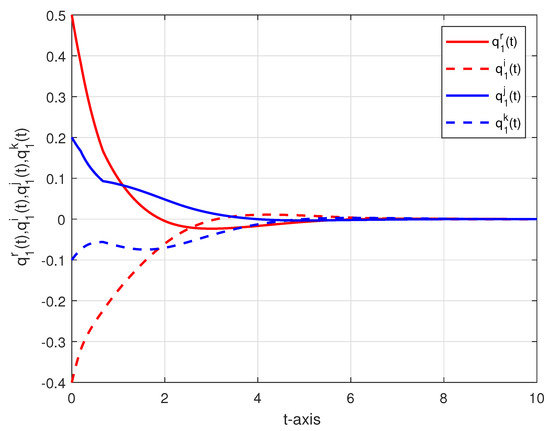
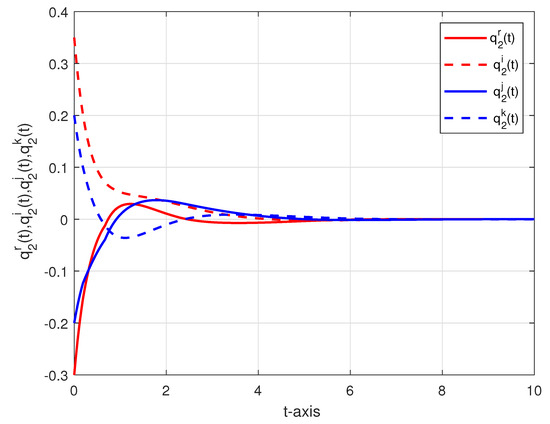
We can get, , . It is prone to verify that the matrix
is an M-matrix. Model (1) satisfies all conditions of Theorem 3, we know that model (1) is GES by mean of Theorem 3.
Taking , , , the numerical simulations with the IC , () are made by using Matlab R2018b, are exhibited in Figure 1 and Figure 2.
Figure 1.
State trajectory of four parts of for system (1).
Figure 2.
State trajectory of four parts of for system (1).
Remark 5.
Li and Cao et al have discussed the global dissipativity problem of the MQNN with proportional delay. The globally exponential dissipativity conditions of MQNN are acquired (see Theorem 3.1 in [18]. The concept of globally exponential dissipativity is the GES in the sense of Lyapunov. The bounded time-varying delay includes in the proportional delay. So, in some extent, model (1) can treated as a special case of system (2) in [18] when = constant vector. Theorem 3.1 in [18] should be able to be used to check the GES of the system (1). In fact, (), which does not meet Theorem 3.1 in [18]. Therefore, Theorem 3.1 in [18] can not be used for asserting the GES of the model (1). This shows that some improvements of Theorem 3.1 in [18] have been made.
Example 2.
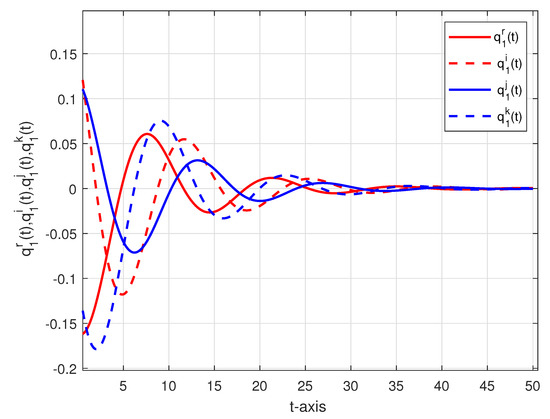
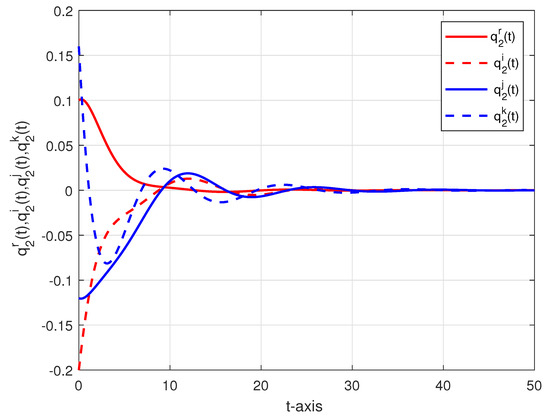
We can get,
is an M-matrix. The model (26) satisfies all conditions of Corollary 1, We know that the model (26) is GES by mean of Corollary 1.
Figure 3.
State trajectory of four parts of for system (26).
Figure 4.
State trajectory of four parts of for system (26).
Remark 6.
In [14], QNN with mixed delays were considered. Some sufficient conditions for the stability of the ES of the considered QNN system (1) were obtained by using the decomposing method (see Theorem 1 and 2 in [14]). The model (26) is a special case of the system (1) in [14]. Yet, Theorem 1 and 2 in [14] can not be used for checking the stability of the model (26), because Theorem 1 and 2 in [14] require the activity function to be decomposable, while there are not explicit real imaginary parts in the function q is a quaternion of system (26) and it is in-decomposable. This shows that the outcomes in [14] have been improved.
5. Conclusions
We have discussed the existence, uniqueness, and exponential stability of the equilibrium solution of MQNN with varying-time delays. Based on a new established derivative formula of the norm of quaternionic function, we have acquired some new GES criteria of the MQNN by employing the M-matrix theory and the inequality techniques. Conquering the shortcomings of the existing decomposition method, our direct quaternionic method can concisely analyze the MQNN. Compared with the existing decomposition method, our direct quaternionic method has a largely low computation cost. Moreover, the obtained algebraic criteria are formulated by the matrix of the quaternionic norm, which is easy to verify.
The direct quaternion method can contributed a new means to survey the dynamic behaviors for other types of QNN, such as QNN with impulses and stochastic QNN, which will be our further researches.
Author Contributions
Conceptualization, Methodology, Writing—review and editing, J.P.; Writing—review and editing, L.X. Both authors have read and agreed to the published version of the manuscript.
Funding
This research as supported by the Science Program of Sichuan Agricultural University.
Institutional Review Board Statement
Not applicable.
Informed Consent Statement
Not applicable.
Data Availability Statement
Not applicable.
Conflicts of Interest
The authors declare no conflict of interest.
References
- Chen, Y.; Fang, S. Neurocomputing with time delay analysis for solving convex quadratic programming problems. IEEE Trans. Neural Netw. 2000, 11, 230–240. [Google Scholar] [CrossRef] [PubMed]
- Deng, J.; Sundararajan, N.; Saratchandran, P. Communication channel equalization using complex-valued minimal radial basis function neural networks. IEEE Trans. Neural Netw. 2002, 13, 687–696. [Google Scholar] [CrossRef]
- Chua, L.O. Memristor-the missing circuit element. IEEE Trans. Circuit Theor. 1971, 18, 507–519. [Google Scholar] [CrossRef]
- Zhang, W.; Huang, T.; He, X.; Li, C. Global exponential stability of inertial memristor-based neural networks with time-varying delays and impulses. Neural Netw. 2017, 95, 102–109. [Google Scholar] [CrossRef] [PubMed]
- Ali, M.S.; Saravanan, S. Finite-time stability for memristor-based uncertain neural networks with time-varying delays via average dwell time approach. Chin. J. Phys. 2017, 55, 1953–1971. [Google Scholar]
- Guo, R.; Zhang, Z.; Liu, X.; Lin, C. Existence, uniqueness, and exponential stability analysis for complex-valued memristor-based bam neural networks with time delays. Appl. Math. Comput. 2017, 311, 100–117. [Google Scholar]
- Zhang, Z.; Liu, X.; Lin, C.; Zhou, S. Exponential stability analysis for delayed complex-valued memristor-based recurrent neural networks. Neural Comput. Appl. 2019, 31, 1893–1903. [Google Scholar] [CrossRef]
- Kusamichi, H.; Isokawa, T.; Matsui, N.; Ogawa, Y.; Maeda, K. A new scheme for color night vision by quaternion neural network. In Proceedings of the 2nd International Conference on Autonomous Robots and Agents (ICARA2004), Palmerston North, New Zealand, 13–15 December 2004; pp. 101–106. [Google Scholar]
- Isokawa, T.; Kusakabe, T.; Matsui, N.; Peper, F. Quaternion Neural Network and Its Application; Springer: Berlin/Heidelberg, Germany, 2003. [Google Scholar]
- Shang, F.; Hirose, A. Quaternion neural-network-based polsar land classification in poincare-sphere-parameter space. IEEE Trans. Geosci. Remote. Sens. Mag. 2014, 52, 5693–5703. [Google Scholar] [CrossRef]
- Tu, Z.; Zhao, Y.; Ding, N.; Feng, Y.; Zhang, W. Stability analysis of quaternion-valued neural networks with both discrete and distributed delays. Appl. Math. Comput. 2019, 343, 342–353. [Google Scholar] [CrossRef]
- Chen, X.; Li, Z.; Song, Q.; Hu, J.; Tan, Y. Robust stability analysis of quaternion-valued neural networks with time delays and parameter uncertainties. Neural Netw. 2017, 91, 55–65. [Google Scholar] [CrossRef] [PubMed]
- Li, Y.; Xiang, J.; Li, B. Almost periodic solutions of quaternion-valued neutral type high-order hopfield neural networks with state-dependent delays and leakage delays. Appl. Intell. 2020, 50, 1–12. [Google Scholar] [CrossRef]
- You, X.; Song, Q.; Liang, J.; Liu, Y.; Alsaadi, F. Global μ-stability of quaternion-valued neural networks with mixed time-varying delays. Neurocomputing 2018, 290, 12–25. [Google Scholar] [CrossRef]
- Wei, H.; Wu, B.; Li, R. Synchronization control of quaternion-valued neural networks with parameter uncertainties. Neural Process. Lett. 2019, 51, 1–20. [Google Scholar] [CrossRef]
- Li, Y.; Shen, S. Pseudo almost periodic synchronization of Clifford-valued fuzzy cellular neural networks with time-varying delays on time scales. Adv. Differ. Equ. 2020, 1, 1–22. [Google Scholar] [CrossRef]
- Chen, D.; Zhang, Y.; Lu, J.; Cao, J. Global μ-stability criteria for quaternion-valued neural networks with unbounded time-varying delays. Inform. Sci. 2016, 360, 273–288. [Google Scholar]
- Li, N.; Cao, J. Global dissipativity analysis of quaternion-valued memristor-based neural networks with proportional delay. Neurocomputing 2018, 321, 103–113. [Google Scholar] [CrossRef]
- Tu, Z.; Wang, D.; Yang, X.; Cao, J. Lagrange stability of memristive quaternion-valued neural networks with neutral items. Neurocomputing 2020, 399, 380–389. [Google Scholar] [CrossRef]
- Carlson, D. Nonnegative matrices in the mathematical sciences. Siam Rev. 1981, 23, 409–410. [Google Scholar] [CrossRef]
Publisher’s Note: MDPI stays neutral with regard to jurisdictional claims in published maps and institutional affiliations. |
© 2021 by the authors. Licensee MDPI, Basel, Switzerland. This article is an open access article distributed under the terms and conditions of the Creative Commons Attribution (CC BY) license (https://creativecommons.org/licenses/by/4.0/).