Abstract
In this paper, we first deduce the explicit formulas for the projector of the nth level fractional derivative and for its Laplace transform. Afterwards, the fractional relaxation equation with the nth level fractional derivative is discussed. It turns out that, under some conditions, the solutions to the initial-value problems for this equation are completely monotone functions that can be represented in form of the linear combinations of the Mittag–Leffler functions with some power law weights. Special attention is given to the case of the relaxation equation with the second level derivative.
Keywords:
second level fractional derivative; nth level fractional derivative; projector; Laplace transform; fractional relaxation equation; completely monotone functions MSC:
26A33; 26B30; 33E12; 34A08
1. Introduction
In the framework of the current discussions regarding the “right” fractional derivatives [1,2,3,4,5,6,7,8,9,10,11,12], the main suggested approach was to define the fractional derivatives via the Fundamental Theorem of Fractional Calculus (FC), i.e., as the left-inverse operators to the corresponding fractional integrals that satisfy the index low, interpolate the definite integral, and build a family of the operators continuous in a certain sense with respect to the order of integration.
According to a result that was derived in [13], under the conditions mentioned above, the only family of the fractional integrals defined on a finite interval are the Riemann-Liouville fractional integrals [14]. Until recently, three families of the fractional derivatives that are the left-inverse operators to the Riemann-Liouville fractional integrals were discussed in the literature: the Riemann-Liouville fractional derivatives [14], the Caputo fractional derivatives [15], and the Hilfer fractional derivatives [16]. However, in [7], infinitely many other families of the fractional derivatives that are the left-inverse operators to the Riemann–Liouville fractional integrals, were introduced and called the nth level fractional derivatives. These derivatives satisfy the Fundamental Theorem of FC, i.e., they are the left-inverse operators to the Riemann–Liouville fractional integrals on the appropriate nontrivial spaces of functions that justifies calling them the fractional derivatives.
In [7], some basic properties of the nth level fractional derivatives were studied, including a description of their kernels. However, the question of their applicability to some real world problems remained open. In this paper, we provide a first evidence of their usefulness for applications on an example from the linear viscoelasticity. More precisely, we show that the solution to the Cauchy problem for the fractional relaxation equation with the nth level fractional derivative is a completely monotone function that can be represented in form of a linear combination of the Mittag–Leffler functions with some power law weights. As discussed in [17], the property of complete monotonicity is characteristic for any relaxation process. Only in this case, it can be interpreted as a superposition of (infinitely many) elementary, i.e., exponential, relaxation processes. In linear viscoelasticity, the assumption of complete monotonicity of the solutions to the relaxation equations that model the relaxation processes is usually supposed to be fulfilled, see, e.g., [17] and references therein.
The rest of this paper is organized as follows: in Section 2, we discuss some new properties of the nth level fractional derivative, including the explicit formulas for the projector of the nth level fractional derivative and for its Laplace transform. Section 3 addresses the Cauchy problem for the relaxation equation with the nth level fractional derivative and properties of its solution, including complete monotonicity. In particular, we focus on an important particular case of the Cauchy problem for the relaxation equation with the second level fractional derivative.
2. The nth Level Fractional Derivative and Its Properties
2.1. Basic Definitions and Properties
In [7], the nth level fractional derivative on a finite interval (without loss of generality we proceed with the interval ) was introduced as follows: let and the parameters satisfy the conditions
The operator
is called the nth level fractional derivative of order and type .
In (2), stands for the Riemann–Liouville fractional integral ():
The nth level fractional derivative is well defined, say, on the function space
where the notation stands for the space of the absolutely continuous functions (an empty product is interpreted as the identity operator). The absolutely continuous functions allow for the following representation:
In what follows, a (weak) derivative of a function will be understood in the following sense:
The nth level fractional derivative is a linear operator that maps into (see [7]). The notation “nth level fractional derivative” is justified by the Fundamental Theorem of FC.
Theorem 1
([7]). Let be the following space of functions:
The nth level fractional derivative is a left-inverse operator to the Riemann–Liouville fractional integral on the space , i.e., the relation
holds true for any f from the space .
Remark 1.
In calculus, the formula of type (8) is usually called the first fundamental theorem of calculus. The second fundamental theorem of calculus states that . We address the second fundamental theorem of FC for the nth level fractional derivative in the next subsection.
Remark 2.
In [18], the differential operators similar to the nth level fractional derivative (in other notations and with other restrictions on the parameters) have been addressed.
However, the motivation behind the nth level fractional derivative is essentially different when compared to the one behind the Djrbashian-Nersesian differential operator introduced in [18]. The main feature of the nth level fractional derivative is its connection to the Riemann-Liouville fractional integral of order α (Theorem 1). The parameter α in its definition plays the role of the order of this fractional derivative. Moreover, the restriction is very important in this context, because only in this case the nth level fractional derivative in its present form is a left inverse operator to the Riemann-Liouville fractional integral (see the proof of Theorem 1 in [7]).
In [18], this connection was not discussed at all. The parameters of the operators from [18] do not have an explicit connection to the Riemann–Liouville integral, because there is no selected parameter that stands for the order of this operator. Another difference is the restrictions on the parameters for the nth level fractional derivative and for the operators introduced in [18]. They are essentially different, because the nth level fractional derivative is a fractional derivative in the sense of the Fundamental Theorem of FC, whereas the operators from [18] are just some general “differential operations“. Finally, the Djrbashian–Nersesian operator was introduced and employed only in the case of a finite interval, whereas, in this paper, the nth level fractional derivative is also addressed on the positive real semi-axis.
Because of the fundamental theorem of calculus and the index law for the Riemann–Liouville fractional integrals , the nth level fractional derivatives are reduced to the fractional derivatives of the level less than n if some of the parameters are equal to or grater than one or if the inequality holds valid. That is why, in the following discussions, we only address the truly nth level fractional derivatives and suppose that the conditions
hold valid.
Under these conditions, the kernel of the nth level fractional derivative is n-dimensional [7]:
Because of the conditions (1) and (9), the exponents of the basis functions of the kernel fulfill the inequalities
In the case, one or several of the conditions from (9) do not hold true, the nth level fractional derivatives degenerate to the derivatives of the level less than n and, thus, their kernels have dimensions less than n.
2.2. Projector of the nth Level Fractional Derivative
One of the most important and widely used methods for analysis of the fractional differential equations is by means of their reduction to certain integral equations of Volterra type. To perform this transformation, one acts on the fractional differential equations with the corresponding fractional integrals. Thus, for this method, the explicit formulas for the compositions of the fractional integrals and the fractional derivatives (second Fundamental Theorem of FC) are required. In this subsection, we derive a formula of this kind for the nth level fractional derivative.
Theorem 2.
We start the proof of the theorem by introducing an auxiliary function
For , the derivative is well defined and belongs to . Thus, the function g is from the space . Therefore, we can act on g with the operator and apply the Fundamental Theorem of FC for the nth level fractional derivative:
This formula means that the function belongs to the kernel of the nth level fractional derivative given by the Formula (10). Thus, we obtain the representation
Now, we determine the coefficients . To do this, we apply a sequence of some Riemann–Liouville fractional integrals to the auxiliary function g defined by (15) and employ the first fundamental theorem of calculus and the well-known formula
First, we apply the Riemann–Liouville fractional integral :
Then we apply the Riemann-Liouville fractional integral :
Now, we continue by applying the Riemann–Liouville fractional integrals and arrive at the following formula:
where the empty product is understood as the identity operator. On the other hand, we can apply the operator to the identity (16) and arrive to the relation
The coefficients are obtained by comparison of the coefficients by the same powers of x in the last two formulas:
The statement of the theorem follows from this formula and the representation (16).
Remark 3.
Theorem 2 can be rewritten in form of the second Fundamental Theorem of FC for the nth level fractional derivative:
where the coefficients depend on the function f and are given by the Formula (14).
If some of the conditions (9) do not hold true, the nth level fractional derivatives are reduced to the fractional derivatives with the level less than n and their kernels have the dimensions less than n. In this case, some of the coefficients in the representation (16) and, thus, the corresponding coefficients in the Formula (13) for the projector are equal to zero.
As an example, let us discuss the projector of the second level fractional derivative deduced in [7]. In the general case, it has the following form:
If one of the conditions
does not hold true, the second level fractional derivative is reduced to the Hilfer fractional derivative defined by
Indeed, for , we obtain the following chain of equalities:
In the case , we proceed as before:
In both cases, the kernels of the second level fractional derivatives (the Hilfer fractional derivatives) are one-dimensional and one of the coefficients or in the representation (16) and thus one of the coefficients or in the Formula (13) for the projector is equal to zero. As a result, the projector of the Hilfer fractional derivative takes the following known form [19]:
Substituting into the Formula (23), we obtain the projector of the Riemann–Liouville fractional derivative
The value corresponds to the projector of the Caputo fractional derivative:
The Riemann–Liouville and the Caputo fractional derivatives are both particular cases of the Hilfer fractional derivative:
2.3. Laplace Transform of the nth Level Fractional Derivative
In this subsection, we introduce the nth level fractional derivative on the positive real semi-axis and derive a formula for its Laplace transform.
The Riemann–Liouville fractional integral on the positive real semi-axis is given by the Formula (3) extended to the case :
The operator is well defined, say, for the functions from the space . Evidently, it can be interpreted as the Laplace convolution of the functions and , . The convolution theorem for the Laplace transform immediately leads to the well-known formula for the Laplace transform of the Riemann–Liouville fractional integral [14]
that is valid under the condition that the Laplace transform of the function f given by the integral
does exist for .
Now, we rewrite the definition (2) of the nth level fractional derivative of order and type for the case of the positive real semi-axis:
For the appropriate spaces of functions that take into consideration the behavior of the functions at (see [14] for more details regarding the case of the Riemann–Liouville fractional integral and derivative on the positive real semi-axis), both the Fundamental Theorem of FC and the projector formula that were derived for the case of a finite interval remain to be true for the operators and defined on the positive real semi-axis. The reason is that these formulas are valid point-wise. Thus, for an arbitrary point , we can choose an interval with the property . Because the Fundamental Theorem of FC and the projector formula hold true on the whole interval , they are particularly valid at the point x.
As already mentioned, for some values of the parameters, the nth level fractional derivatives are reduced to the fractional derivatives of the level less than n. In the following discussions, we restrict ourselves to the truly nth level fractional derivatives and suppose that the conditions (9) are satisfied. According to the second Fundamental Theorem of FC (Remark 3), we then have the representation
where the coefficients are given by (14).
Under the conditions (9), the exponents satisfy the inequalities . Thus we can apply the Laplace transform to the last formula and get the following equation using the Formula (29):
Now, we solve this equation for the Laplace transform of the nth level fractional derivative:
Taking into consideration the Formula (14) for the coefficients , we arrive at the final formula
where the coefficients are determined by the function f:
If some of the conditions (9) does not hold true, then the kernel of the nth level fractional derivative has a dimension less than n and the corresponding coefficients in the Laplace transform Formula (32) are equal to zero.
As an example, let us consider the Laplace transform formula for the second level fractional derivative that was derived in [7]:
with
For the Hilfer fractional derivative defined on the real positive semi-axis ( or in (31)), one of the coefficients (if ) or (if ) is zero and we arrive at the known formula
The case in (36) corresponds to the Laplace transform formula for the Riemann–Liouville fractional derivative
whereas the case leads to the Laplace transform of the Caputo fractional derivative:
3. Fractional Relaxation Equation with the nth Level Fractional Derivative
We start this section with a short discussion of the simplest fractional differential equation with the nth level fractional derivative of order , namely, the one in the form
In fact, we already considered this equation in the previous section because its solution is the kernel of . Depending on the parameters , the kernel dimension ranges from n to 1, because the nth level fractional derivative can degenerate to the fractional derivatives with the level to 1. In the case, the conditions (9) are satisfied, the kernel of is n-dimensional and the general solution to the Equation (39) is as follows:
being arbitrary constants. To guarantee uniqueness of solution to the Equation (39), n initial conditions
are required. The initial-value problem for the Equation (39) with the initial conditions (41) then has the unique solution
This situation is rather unusual for the fractional differential equations with a fractional derivative of the order and has consequences for their possible applications, as we will see in the further discussions.
Now, we consider the fractional relaxation equation with the nth level fractional derivative and prove the following result:
Theorem 3.
The fractional relaxation equation
with the initial conditions given by (41) has a unique solution given by the formula
In the formulation of the theorem, stands for the two-parameters Mittag–Leffler function that is defined by the following convergent series:
We apply the Laplace transform method to prove the theorem. First, we do this formally, but then verify that the Laplace transform of the obtained solution does exist. Using the Formula (32), the initial-value problem (41) and (43) can be transformed to the Laplace domain:
The solution in the Laplace domain is as follows:
Now, we employ the well-known formula
and immediately arrive at the Formula (44) for the solution to the fractional relaxation Equation (43) with the initial conditions (41).
As already mentioned in the previous section, under the conditions (9), the exponents fulfill the inequalities . For , the Mittag–Leffler function has the following asymptotics as :
These both facts ensure that the Laplace transform of the function at the right-hand side of (44) does exists and, thus, it is indeed the unique solution to the initial-value problem (41) and (43).
Now, let us prove that the solution (44) is a completely monotone function provided the conditions (45) hold true and the initial conditions are all non-negative.
For the reader’s convenience, we recall that a non-negative function is called completely monotone if it is from and for all and .
The Mittag–Leffler function is completely monotone if and only if and [20]. The power law function is a Bernstein function, because its derivative is completely monotone. A composition of a completely monotone function and a Bernstein function is completely monotone [21]. Therefore, the function is completely monotone for , , and . The product of two completely monotone functions is again a completely monotone function [21] that leads to the complete monotonicity of the function
under the conditions
The functions from the solution Formula (44) have the form (51). Moreover, their parameters , , and fulfill the conditions (52), because of the conditions (1), (9), and (45) we posed on the order and the type of the nth level fractional derivative. Thus, the functions are all completely monotone as well as their linear combination with non-negative coefficients that builds the solution (44). The proof of the theorem is completed.
Remark 4.
Taking into account the Formula (50) for the asymptotics of the Mittag–Leffler function, the behavior of the solution (44) as has the following form:
where the coefficients depend on both the initial values , the order α, and the type . Thus, the fractional relaxation Equation (43) can be employed to model the relaxation processes with the asymptotic behavior of type (53). Moreover, the free parameters can be used for optimal fitting of the measurements data for a concrete relaxation process with a power law asymptotics.
Remark 5.
In [18], uniqueness and existence of solutions to the Cauchy problems for the linear and non-linear fractional differential equations with the Djrbashian–Nersesian operators that are similar to the nth level fractional derivatives (see Remark 2) were addressed. In particular, an analogy of the Formula (44) on a finite interval was deduced while using the method of power series. However, no analysis of the solution properties, including their complete monotonicity was presented there.
It is worth mentioning that, in [22], the eigenfunctions and the associated functions for some boundary value problems for the special equations containing the Djrbashian–Nersesian operators were constructed in explicit form. Moreover, these functions were interpreted as the bi-orthogonal systems of vector functions and used for the interpolation expansions for some Hilbert spaces of entire functions.
In the rest of this section, we illustrate Theorem 3 on the case of the fractional relaxation equation with the truly second level derivative (the conditions (9) with hold true)
and with the initial conditions
According to Theorem 3, its solution
is completely monotone if the initial conditions are non-negative and the following restrictions on the order and type of the second level fractional derivative hold true:
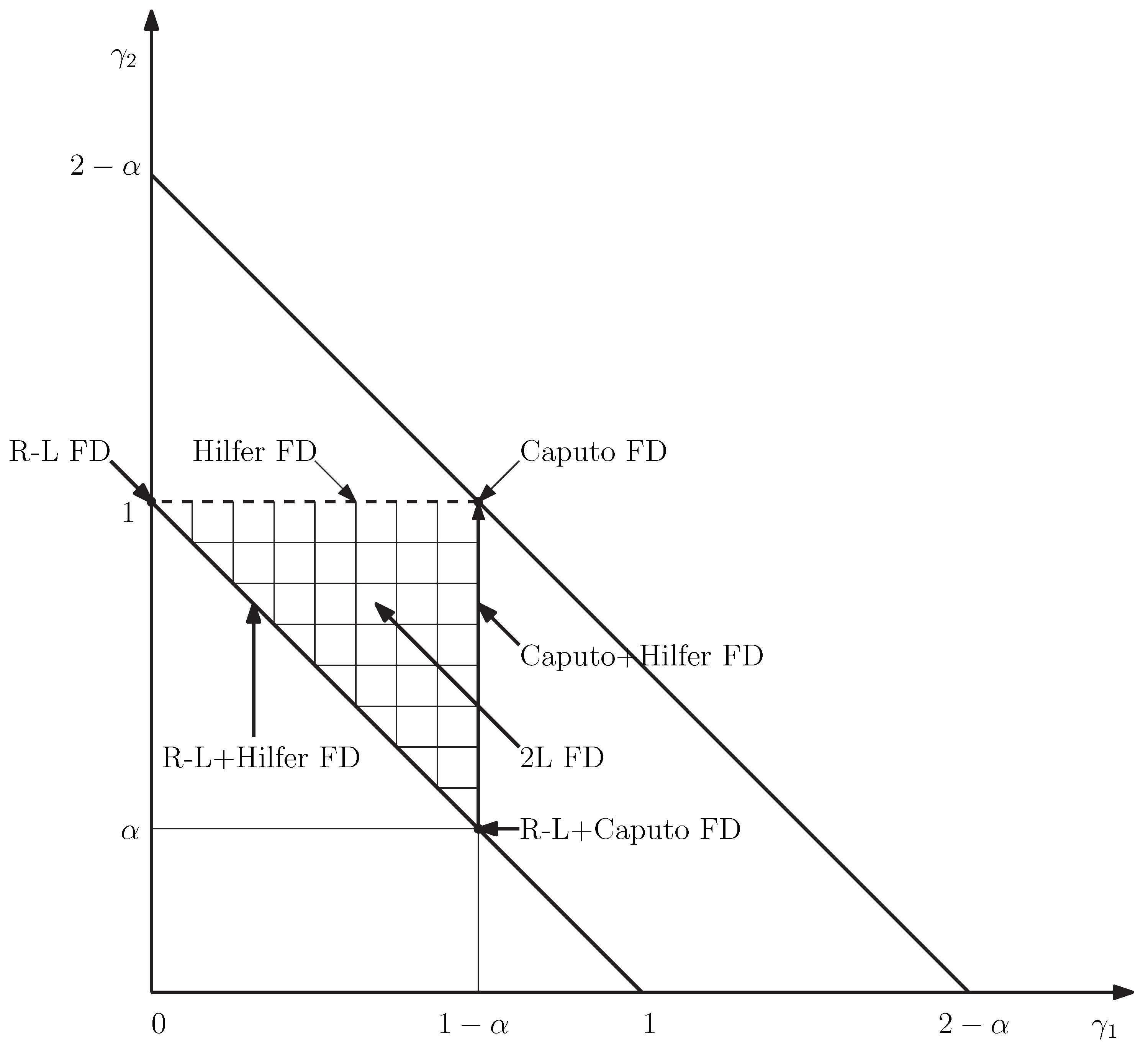
The points of the -plane that satisfy the conditions (57) are graphically represented in the plot of Figure 1.
Figure 1.
Second level fractional derivatives of order and type .
They build a triangle and, in what follows, we shortly discuss the particular cases of the fractional relaxation Equation (43) that correspond to the vertexes and edges of this triangle. As already mentioned in the previous section, the second level fractional derivatives with (upper edge of the triangle) are reduced to the first level derivatives (the Riemann–Liouville, the Caputo, and the Hilfer fractional derivatives). Still, it is instructive to include them into considerations.
We start with the vertexes and write down the types of the corresponding fractional derivatives, their form, and the solutions to the fractional relaxation Equation (43) with these derivatives:
- The Riemann-Liouville fractional derivative:
- –
- ,
- –
- ,
- –
- .
- The Caputo fractional derivative:
- –
- ,
- –
- ,
- –
- .
- A truly second level fractional derivative:
- –
- ,
- –
- ,
- –
- .
Whereas, the first two cases (the fractional relaxation equations with the Riemann-Liouville and the Caputo fractional derivatives) are well-known, the third case seems to be new. The solution to the corresponding relaxation equation is a linear combination of the solutions to the fractional relaxation equations with the Riemann–Liouville and with the Caputo fractional derivatives.
Now, let us inspect the edges of the triangle from Figure 1.
- The Hilfer fractional derivative:
- –
- ,
- –
- ,
- –
- .
- A truly second level fractional derivative:
- –
- ,
- –
- ,
- –
- .The solution to the relaxation equation with the second level fractional derivative is a linear combination of the solutions to the fractional relaxation equations with the Caputo fractional derivative and with the Hilfer fractional derivative with the type .
- A truly second level fractional derivative:
- –
- ,
- –
- ,
- –
- .The solution to the relaxation equation with the second level fractional derivative is a linear combination of the solutions to the fractional relaxation equations with the Riemann–Liouville fractional derivative and with the Hilfer fractional derivative with the type .
In all other cases, the solution to the fractional relaxation Equation (54) is given by the Formula (56). It is worth mentioning that (56) can be interpreted as a linear combination of solutions to the fractional relaxation equations with the Hilfer fractional derivatives of order and with the types and , respectively.
Finally, let us mention that the second Fundamental Theorem of FC for the nth order fractional derivative (Remark 3) can be used for the analysis of more complicated and even nonlinear fractional differential equations. Say, the fractional differential equation
subject to the initial conditions in form (41) can be transformed to the following Volterra-type integral equation of the second kind by applying the Riemann–Liouville fractional integral to the Equation (58) and by using the Formula (18):
The integral Equation (59) can be analyzed by the standard method of the fix point iterations. This problem will be considered elsewhere.

Funding
This research received no external funding.
Acknowledgments
The author acknowledges useful comments and suggestions of the anonymous referees that led to an improvement of the original manuscript.
Conflicts of Interest
The author declares no conflict of interest.
References
- Diethelm, K.; Garrappa, R.; Giusti, A.; Stynes, M. Why fractional derivatives with nonsingular kernels should not be used. Fract. Calc. Appl. Anal. 2020, 23, 610–634. [Google Scholar] [CrossRef]
- Giusti, A. A comment on some new definitions of fractional derivative. Nonlinear Dyn. 2018, 93, 1757–1763. [Google Scholar] [CrossRef]
- Hanyga, A. A comment on a controversial issue: A Generalized Fractional Derivative cannot have a regular kernel. Fract. Calc. Anal. Appl. 2020, 23, 211–223. [Google Scholar] [CrossRef]
- Hilfer, R. Mathematical and physical interpretations of fractional derivatives and integrals. In Handbook of Fractional Calculus with Applications. Vol.1: Basic Theory; Kochubei, A., Luchko, Y., Eds.; Walter de Gruyter: Berlin, Germany; Boston, MA, USA, 2019; pp. 47–86. [Google Scholar]
- Hilfer, R.; Luchko, Y. Desiderata for Fractional Derivatives and Integrals. Mathematics 2019, 7, 149. [Google Scholar] [CrossRef]
- Kochubei, A.N.; Luchko, Y. Basic FC operators and their properties. In Handbook of Fractional Calculus with Applications. Vol.1: Basic Theory; Kochubei, A., Luchko, Y., Eds.; Walter de Gruyter: Berlin, Germany; Boston, MA, USA, 2019; pp. 23–46. [Google Scholar]
- Luchko, Y. Fractional derivatives and the fundamental theorem of Fractional Calculus. Fract. Calc. Appl. Anal. 2020, 23, 939–966. [Google Scholar] [CrossRef]
- Ortigueira, M.D.; Tenreiro Machado, J.A. What is a fractional derivative? J. Comput. Phys. 2015, 293, 4–13. [Google Scholar] [CrossRef]
- Ortigueira, M.D.; Tenreiro Machado, J.A. A critical analysis of the Caputo-Fabrizio operator. Commun. Nonlinear Sci. Numer. Simul. 2018, 59, 608–611. [Google Scholar] [CrossRef]
- Stynes, M. Fractional-order derivatives defined by continuous kernels are too restrictive. Appl. Math. Lett. 2018, 85, 22–26. [Google Scholar] [CrossRef]
- Tarasov, V.E. No violation of the Leibniz rule. No fractional derivative. Commun. Nonlinear Sci. Numer. Simul. 2013, 18, 2945–2948. [Google Scholar] [CrossRef]
- Tarasov, V.E. Caputo-Fabrizio operator in terms of integer derivatives: Memory or distributed lag? Comput. Appl. Math. 2019, 38, 113. [Google Scholar] [CrossRef]
- Cartwright, D.I.; McMullen, J.R. A note on the fractional calculus. Proc. Edinb. Math. Soc. 1978, 21, 79–80. [Google Scholar] [CrossRef]
- Samko, S.G.; Kilbas, A.A.; Marichev, O.I. Fractional Integrals and Derivatives. Theory and Applications; Gordon and Breach: New York, NY, USA, 1993. [Google Scholar]
- Diethelm, K. The Analysis of Fractional Differential Equations; Springer: Berlin, Germany, 2010. [Google Scholar]
- Hilfer, R. Fractional calculus and regular variation in thermodynamics. In Applications of Fractional Calculus in Physics; Hilfer, R., Ed.; World Scientific: Singapore, 2000; pp. 429–463. [Google Scholar]
- Mainardi, F. Fractional Calculus and Waves in Linear Viscoelasticity; Imperial College Press: London, UK, 2010. [Google Scholar]
- Djrbashian, M.M.; Nersesian, A.B. Fractional derivatives and the Cauchy problem for differential equations of fractional order. Izv. Akad. Nauk Armjan. SSR. Ser. Mat. 1968, 3, 1–29. (In Russian) [Google Scholar]
- Hilfer, R.; Luchko, Y.; Tomovski, Z. Operational method for the solution of fractional differential equations with generalized Riemann-Liouville fractional derivatives. Fract. Calc. Appl. Anal. 2009, 12, 299–318. [Google Scholar]
- Schneider, W.R. Completely monotone generalized Mittag-Leffler functions. Expo. Math. 1996, 14, 3–16. [Google Scholar]
- Schilling, R.L.; Song, R.; Vondraček, Z. Bernstein Functions. Theory and Applications; De Gruyter: Berlin, Germany, 2010. [Google Scholar]
- Djrbashian, M.M. Harmonic Analysis and Boundary Value Problems in the Complex Domain; Birkhäuser: Basel, Switzerland, 1993. [Google Scholar]
© 2020 by the author. Licensee MDPI, Basel, Switzerland. This article is an open access article distributed under the terms and conditions of the Creative Commons Attribution (CC BY) license (http://creativecommons.org/licenses/by/4.0/).