


Abstract
In this work, a pair of dual associate null scrolls are defined from the Cartan Frenet frame of a null curve in Minkowski 3-space. The fundamental geometric properties of the dual associate null scrolls are investigated and they are related in terms of their Gauss maps, especially the generalized 1-type Gauss maps. At the same time, some representative examples are given and their graphs are plotted by the aid of a software programme.
1. Introduction
In differential geometry, the associate curves and associate surfaces such as the Bertrand curve, the Mannheim curve, evolute-involute pair, the parallel surfaces and the focal surfaces etc. compose a large class of fascinating subjects in the curve and surface theory not only in Euclidean space but also in pseudo-Euclidean space, such as Minkowski space [1,2,3,4]. However, due to the difference of metric between Euclidean space and Minkowski space, there are cases where there are differences. For example, the Bertrand curve could be involved by the directional associated curve of a space curve due to the causal character of vectors in Minkowski space [5].
As the simplest foliated submanifolds, ruled surfaces are divided into five types according to the causal character of the base curve and the ruling flow [6]. Among of them, for the ruled surfaces with lightlike rulings, the base curves can be null curves or non-null curves obviously. It is worth noting that the ruled surfaces with non-null base curves are equivalent to the ones with null base curves via the appropriate transformation as stated in [7]. Without loss of generality, we always can choose a null curve as the base curve of a ruled surface with lightlike ruling and the normalization condition is satisfied at the same time, which is said to be a null scroll [7,8,9,10]. Furthermore, the null scroll under Cartan Frenet frame is called a B-scroll [11].
Considering the normalization condition of a null scroll and the Frenet frame of a null curve, in the present work, a pair of null scrolls satisfying the same normalization condition are constructed, i.e., the tangent vector field of the base curve of the first null scroll is set as the ruling flow of the second null scroll and the tangent vector field of the base curve of the second null scroll is set as the ruling flow of the first null scroll. Since the 1970’s, many research works about the classification of submanifolds respect to the Laplacian of Gauss maps have been done in Euclidean space and Minkowski space, which are very useful tools in investigating and characterizing many important submanifolds [12,13,14,15]. Based on the fundamental geometric properties of the null scroll pair, we aim at the Laplacian of the Gauss maps of the dual associate null scrolls according to the current progress for the classifications of submanifolds respect to the Gauss maps proposed in [16], i.e., the generalized 1-type Gauss map, which can be regarded as a generalization of both 1-type Gauss map and pointwise 1-type Gauss map. The Gauss map of a submanifold is of generalized 1-type if the Gauss map of satisfies
for some non-zero functions on and a constant vector C, where denotes the Laplacian defined on , which is given by
where is a local coordinate system of , the components of the inverse matrix of the first fundamental form of and the determinant of the first fundamental form of [17]. Especially, if both f and g are non-zero constants, (1) can be written by , . In this case, the Gauss map is just of 1-type in the usual sense. If the function f is equal to g, (1) can be expressed by . The Gauss map is said to be of pointwise 1-type. More precisely, the pointwise 1-type Gauss map is said to be of the first kind when , or else the second kind. If f and g vanish identically, then is said to be harmonic.
The paper is organized as follows. In Section 2, some basic facts including the Frenet formula and the structure function of null curves are reviewed, then a pair of associate curves on lightlike cone and a dual associate null scrolls are defined. In Section 3, the geometric properties such as the Gaussian curvatures, mean curvatures and the Laplacians of the Gauss maps are shown and the generalized 1-type Gauss maps are discussed, respectively. The relationships between the dual associate null scrolls are explored and summarized.
Throughout this paper, all the geometric objects under consideration are smooth and all surfaces are connected unless otherwise stated.
2. Preliminaries
Let be the Minkowski 3-space with natural Lorentzian metric
in terms of the natural coordinate system . A vector v in is said to be spacelike, timelike and lightlike (null) if or , and , respectively. The norm of a vector v is defined by . An arbitrary curve r is spacelike, timelike or lightlike if its tangent vector is spacelike, timelike or lightlike, correspondingly. At the same time, a surface is said to be timelike, spacelike or lightlike if its normal vector is spacelike, timelike or lightlike, respectively.
Proposition 1
([5]). Let be a null curve parameterized by the null arc length s (i.e., )in . Then there exists a unique Cartan frame such that
where and
In the sequence, and is called the tangent, principal normal and binormal vector field of , respectively. From (3), it is easy to know that . The function is called the null curvature of , which is an invariant under Lorentzian transformations [18].
Considering the relationship between the tangent vector field and the binormal vector field of a null curve , i.e., , we could define a pair of associate curves on lightlike cone as follows:
Definition 1.
Let be a null curve framed by in . Then , is called a generalized T-associate curve and a generalized B-associate curve of for some non-zero smooth function , respectively. and are called dual associate curves of on lightlike cone.
In [5], the authors introduced the structure function and the representation formula of a null curve. Namely,
Proposition 2
([5]). Let be a null curve. Then can be written as
where is called the structure function of . And the null curvature of can be expressed by
Definition 2
([6]). Let be a null curve parameterized by null arc length and a transversal null vector field along . Then the immersion
is called a null scroll which satisfies , and the normalization condition .
According to the definitions of generalized T-associate curve, generalized B-associate curve of a null curve and the definition of null scrolls, we want to construct a pair of null scrolls which satisfy the same normalization condition. This idea motivate the following definition.
Definition 3.
Let be a null curve framed by in , and dual associate curves of . Then
is called a null scroll with generalized T-lightlike ruling;
is called a null scroll with generalized B-lightlike ruling. The null scrolls and are called dual associate null scrolls.
As the straightforward conclusion of Proposition 2, Definitions 1 and 3, we have
Proposition 3.
Let be a null curve with structure function in . Then
- the dual associate curves of can be expressed by
- the dual associate null scrolls can be expressed by
Obviously, the dual associate curves and the dual associate null scrolls are decided by the function and the structure function , completely. The following example can explain the construction of the defined dual associate null scrolls.
Example 1.
Consider a null curve with null curvature . From Proposition 2, we have
Solving the above differential equation, we have or . From Proposition 3, we have
- when the dual associate curves and the dual associate null scrolls can be written as (see Figure 1 and Figure 2)and
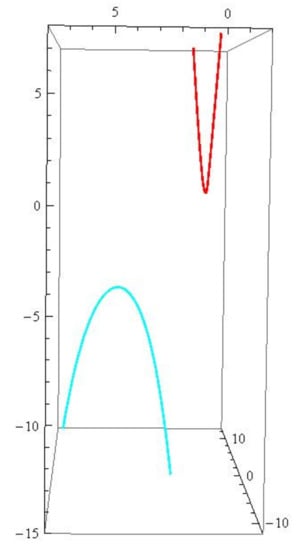 Figure 1. The red (blue) curve is the generalized -associate curve of r.
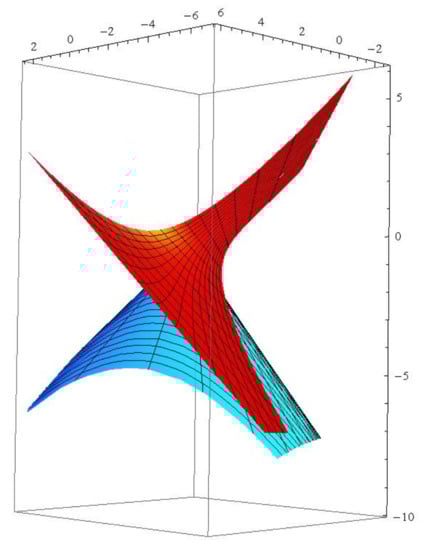 Figure 2. The red (blue) surface is the null scroll with generalized -lightlike ruling .
 - when the dual associate curves and the dual associate null scrolls can be written as (see Figure 3 and Figure 4)and
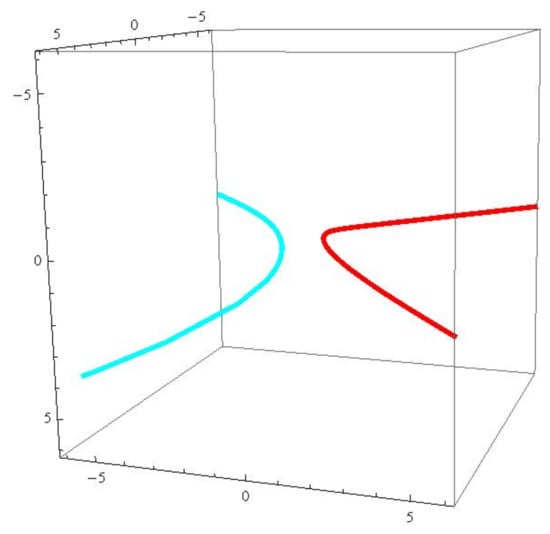 Figure 3. The red (blue) curve is the generalized -associate curve of r.
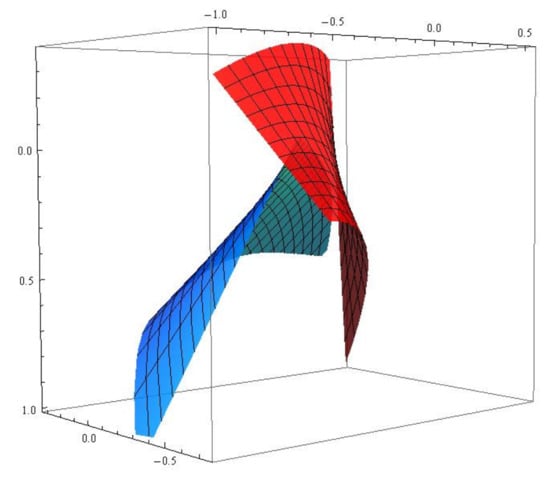 Figure 4. The red (blue) surface is the null scroll with generalized -lightlike ruling .
3. Main Result
We will discuss the geometric properties of the dual associate null scrolls and the Laplacians of their Gauss maps.
3.1. The Null Scroll with Generalized T-Lightlike Ruling
To meet the requirements of discussion, we prepare some basic elements of . Initially, from (6) and Proposition 1, we have
Based on above equations, the components of the first fundamental form are
then, we have Meanwhile, the Gauss map of is given by
which satisfies Furthermore, by (9), we have
Then, the components of the second fundamental form are
Obviously, the Gaussian curvature and the mean curvature of satisfy
From now on, we compute the Laplacian of Gauss map and discuss the null scroll with generalized 1-type Gauss map.
By (2), the Laplacian of the null scroll is obtained by
Suppose that has generalized 1-type Gauss map, i.e., . Without loss of generality, we may decompose the constant vector via the Cartan frame of the null curve as
where .
Since is a non-zero smooth function, then from the last equation of (18). Furthermore, by the first two equations of (18), we have
where Meanwhile, is a non-constant function since is a non-zero smooth function.
Conversely, if we use the above information with the given functions in (19) and the constant vector , then the null scroll satisfies .
Theorem 1.
Let be a null scroll with generalized T-lightlike ruling in . Then has generalized 1-type Gauss map if and only if the Gauss map of satisfies
for some non-zero smooth functions as
and a constant vector . Where , is a non-constant smooth function.
Remark 1.
Particularly, when , (), the functions only depend on s, i.e.,
Corollary 1.
Let be a null scroll with generalized T-lightlike ruling in . Then has pointwise 1-type Gauss map of the second kind if and only if the Gauss map of satisfies
for some non-zero smooth function as
and a constant vector , ().
Proof of Corollary 1.
Suppose that the null scroll has pointwise 1-type Gauss map of the second kind. It means that in Theorem 1. Thus, we have
From (20), we can get the following equation system
Since is a non-zero smooth function, is concluded from the first equation of (21). By the second equation of (21), we get differential equation Solving this equation, we have
By Remark 1, , (). Conversely, if we use the above information with the given function and constant vector , the null scroll satisfies . □
Corollary 2.
There does not exist the null scroll with generalized T-lightlike ruling in which has 1-type Gauss map of the second kind.
Proof of Corollary 2.
Suppose that the null scroll has 1-type Gauss map of the second kind, i.e., . It means that , then which contradicts with in Corollary 1. □
Corollary 3.
Let be a null scroll with generalized T-lightlike ruling in . Then has pointwise 1-type Gauss map of the first kind if and only if one of the following statements holds:
- has 1-type Gauss map of the first kind;
- has non-zero constant Gaussian curvature or non-zero constant mean curvature.
Proof of Corollary 3
Suppose that the null scroll has pointwise 1-type Gauss map of the first kind, i.e., . From Corollary 1, we can get and Therefore, has 1-type Gauss map of the first kind since . By (12) and (13), the Gaussian curvature and the mean curvature are non-zero constant. Conversely, if one of the statements holds, it follows that is a non-zero constant. This completes the proof. □
Corollary 4.
There does not exist the null scroll with generalized T-lightlike ruling in which has harmonic Gauss map.
Proof of Corollary 4
Suppose that the null scroll has harmonic Gauss map, i.e., . Then, we have and it is impossible. □
3.2. The Null Scroll with Generalized B-Lightlike Ruling
To meet the requirements of discussion, we prepare some basic elements of . Initially, from (7) and Proposition 1, we have
Based on above equations, the components of the first fundamental form are
then, we have Meanwhile, the Gauss map of is given by
which satisfies Furthermore, by (23), we have
Then, the components of the second fundamental form are
It is evident that the Gaussian curvature and the mean curvature of satisfy
From now on, we compute the Laplacian of Gauss map and discuss the null scroll with generalized 1-type Gauss map.
By (2), the Laplacian of the null scroll is obtained by
Suppose that has generalized 1-type Gauss map, i.e., . Without loss of generality, we may decompose the constant vector via the Cartan frame of as
where .
Since is a non-zero smooth function, from the first equation of (32), we conclude . By the last two equations of (32), we have
where . Meanwhile, is a non-constant function since is a non-zero smooth function.
Conversely, if we use the above information with the given functions in (33) and the constant vector , the null scroll satisfies .
Theorem 2.
Let be a null scroll with generalized B-lightlike ruling in . Then has generalized 1-type Gauss map if and only if the Gauss map of satisfies
for some non-zero smooth functions as
and a constant vector . Where and is a non-constant smooth function.
Remark 2.
In particular, when , (), the functions only depend on s, i.e.,
Corollary 5.
Let be a null scroll with generalized B-lightlike ruling in . Then has pointwise 1-type Gauss map of the second kind if and only if the Gauss map of satisfies
for some non-zero smooth functions as
and a constant vector , ().
Proof Corollary 5
Suppose that the null scroll has pointwise 1-type Gauss map of the second kind, i.e., . It means that in Theorem 2. Thus, we get . Since is a non-zero smooth function, then and Therefore,
Conversely, if we use the above information with the given function and constant vector , the null scroll satisfies . □
Corollary 6.
There does not exist the null scroll with generalized B-lightlike ruling in which has 1-type Gauss map of the second kind.
Proof Corollary 6
Suppose that the null scroll has 1-type Gauss map of the second kind, i.e., . It means that Obviously, is a non-zero constant. By (32), we get and which contradicts with in Corollary 5. □
Corollary 7.
Let be a null scroll with generalized B-lightlike ruling in . The has pointwise 1-type Gauss map of the first kind if and only if one of the following statements holds:
- has 1-type Gauss map of the first kind;
- has non-zero constant Gaussian curvature or non-zero constant mean curvature.
Proof Corollary 7
Suppose that the null scroll has pointwise 1-type Gauss map of the first kind, i.e., . From the last two equations of (32), we have and . Then the function is a non-zero constant function, i.e., has 1-type Gauss map of the first kind. By (26) and (27), the Gaussian curvature and the mean curvature are non-zero constant. Conversely, if one of the statements holds, then is a non-zero constant. This completes the proof. □
Corollary 8.
Let be a null scroll with generalized B-lightlike ruling in . The has harmonic Gauss map if and only if the Gaussian curvature or the mean curvature of vanishes.
3.3. The Relationship between the Dual Associate Null Scrolls
In this section, we summarize and investigate the relations between the dual associate null scrolls. Meanwhile, the representations of some dual associate null scrolls are obtained according to their Gauss maps.
Theorem 3.
The Gaussian curvatures and the mean curvatures of the dual associate null scrolls in are related by
Theorem 4.
The Laplacians of Gauss maps of the dual associate null scrolls in are related by
From Proposition 3 and Corollary 1, we can get the following result.
Corollary 9.
Let be a null scroll with generalized T-lightlike ruling which has pointwise 1-type Gauss map of the second kind in . Then the dual associate null scrolls can be expressed as
where and .
By the proof of Corollary 3, the following conclusion is obtained easily.
Corollary 10.
Let be a null scroll with generalized T-lightlike ruling which has pointwise 1-type Gauss map of the first kind in . Then the dual associate null scrolls can be expressed by
where
Theorem 5.
Let be a null scroll with generalized B-lightlike ruling which has harmonic Gauss map in . Then the dual associate null scrolls can be expressed by
where
Proof of Theorem 5
By the proof of Corollary 8, we have . From (5), we have
Solving the above equation, the structure function of is given by
By Proposition 3, the dual associate null scrolls can be expressed by
□
Example 2.
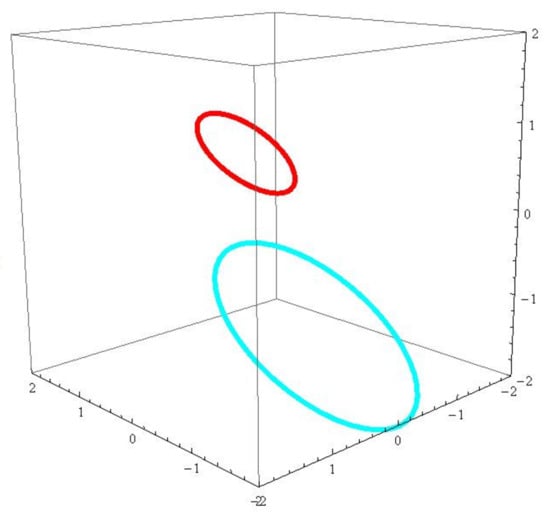
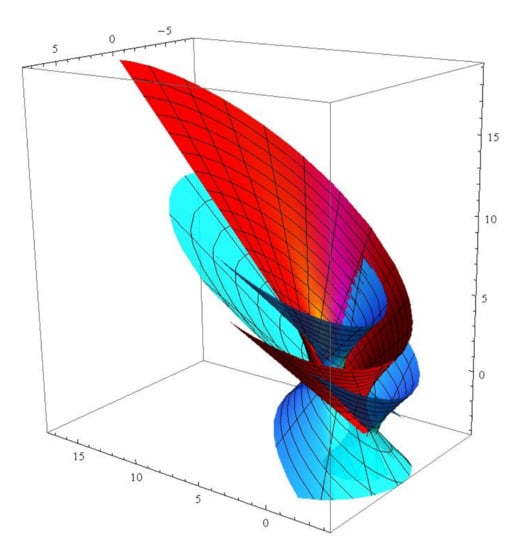
Consider a null curve with . From Proposition 2, we have
Solving the above differential equation, we have . From Proposition 3, when the dual associate curves and the dual associate null scrolls can be written as (see Figure 5 and Figure 6)
and
Figure 5.
The red (blue) curve is the generalized -associate curve of r.
Figure 6.
The red (blue) surface is the null scroll with generalized -lightlike ruling .
Example 3.
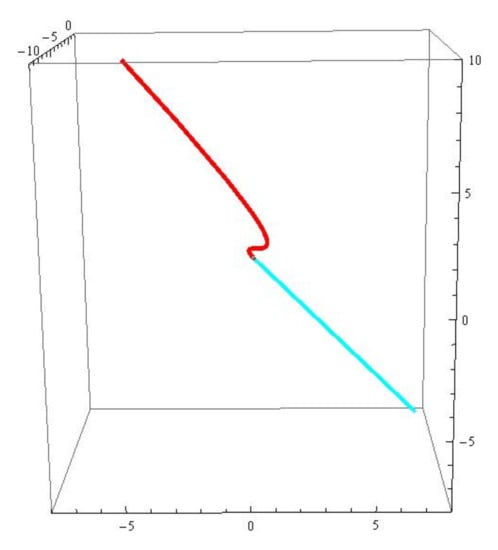
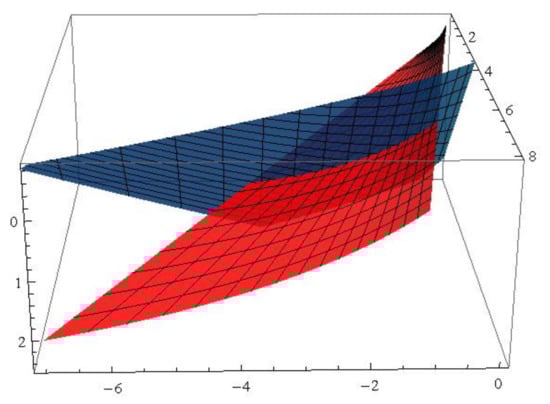
In Theorem 5, supposing and the function , then the dual associate curves and the dual associate null scrolls can be written as (see Figure 7 and Figure 8).
and
Figure 7.
The red (blue) curve is the generalized -associate curve of r.
Figure 8.
The red (blue) surface is the null scroll with generalized -lightlike ruling .
Remark 3.
In Example 2, the dual associate null scrolls have pointwise 1-type Gauss map of the first kind; in Example 3, the null scroll has pointwise 1-type Gauss map of the second kind and the null scroll has harmonic Gauss map, respectively.
Author Contributions
J.Q. and X.F. set up the problem and computed the details. S.D.J. checked and polished the draft. All authors have read and agreed to the published version of the manuscript.
Funding
The first author was supported by NSFC (11801065) and the Fundamental Research Funds for the Central Universities (N2005012). The third author was supported by the National Research Foundation of Korea (NRF) grant funded by the Korea government (MSIP) (NRF-2018R1A2B2002046) and the 2020 scientific promotion program funded by Jeju National University.
Acknowledgments
We thank H. Liu of Northeastern University and the referee for the valuable comments to improve this paper.
Conflicts of Interest
The authors declare no conflict of interest.
References
- Chen, B.Y.; Veken, J.; Nisar, S. Complete classification of parallel surfaces in 4-dimensional Lorentzian spaceforms. Tohoku Math. J. 2009, 61, 1–40. [Google Scholar] [CrossRef]
- Hanif, M.; Hou, Z.; Nisar, S. On special kinds of involute and evolute curves in 4-Dimensional Minkowski space. Symmetry 2018, 10, 317. [Google Scholar] [CrossRef]
- Izumiya, S.; Takeuchi, N. Generic properties of helices and Bertrand curves. J. Geom. 2002, 74, 97–109. [Google Scholar] [CrossRef]
- Liu, H.; Wang, F. Mannheim partner curves in 3-space. J. Geom. 2008, 88, 120–126. [Google Scholar] [CrossRef]
- Qian, J.H.; Kim, Y.H. Directional associated curves of a null curve in . Bull. Korean Math. Soc. 2015, 52, 183–200. [Google Scholar] [CrossRef]
- Kim, Y.H.; Yoon, D.W. Classification of ruled surfaces in Minkowski 3-spaces. J. Geom. Phys. 2004, 49, 89–100. [Google Scholar] [CrossRef]
- Barros, M.; Ferrandez, A. How big is the family of stationary null scrolls? J. Geom. Phys. 2013, 64, 54–60. [Google Scholar] [CrossRef]
- Choi, S.M.; Ki, U.H.; Suh, Y.J. On the Gauss map of null scrolls. Tsukuba J. Math. 1998, 22, 273–279. [Google Scholar] [CrossRef]
- Pak, J.S.; Yoon, D.W. On null scrolls satisfying the condition ΔH=AH. Comm. Korean Math. Soc. 2000, 15, 533–540. [Google Scholar]
- Qian, J.H.; Fu, X.S.; Jung, S.D. Some Characterizations of Generalized Null Scrolls. Mathematics 2019, 7, 931. [Google Scholar] [CrossRef]
- Graves, L.K. Codimension one isometric immersions between Lorentz spaces. Trans. Am. Math. Soc. 1979, 252, 367–392. [Google Scholar] [CrossRef]
- Baikoussis, C. Ruled submanifolds with finite type Gauss map. J. Geom. 1994, 49, 42–45. [Google Scholar] [CrossRef]
- Chen, B.Y.; Piccinni, P. Submanifolds with finite type Gauss map. Bull. Aust. Math. Soc. 1987, 35, 161–186. [Google Scholar] [CrossRef]
- Qian, J.H.; Kim, Y.H. Some classification of canal surfaces with the Guass map. Bull. Malays. Sci. Soc. 2019, 42, 3261–3272. [Google Scholar] [CrossRef]
- Qian, J.H.; Su, M.F.; Kim, Y.H. Canal surfaces with generalized 1-type Gauss map. Rev. Union Mat. Argent. preprint.
- Yoon, D.W.; Kim, D.S.; Kim, Y.H.; Lee, J.W. Hypersurfaces with generalized 1-type Guass maps. Mathematics 2018, 6, 130. [Google Scholar] [CrossRef]
- Ki, U.H.; Kim, D.S.; Kim, Y.H.; Roh, Y.M. Surfaces of revolution with pointwise 1-type Gauss map in Minkowski 3-space. Taiwan J. Math. 2009, 13, 317–338. [Google Scholar] [CrossRef]
- Inoguchi, J.; Lee, S. Null curves in Monkowski 3-space. Int. Electron. J. Geom. 2008, 1, 40–83. [Google Scholar]
© 2020 by the authors. Licensee MDPI, Basel, Switzerland. This article is an open access article distributed under the terms and conditions of the Creative Commons Attribution (CC BY) license (http://creativecommons.org/licenses/by/4.0/).