


Abstract
We obtain new results on independent 2- and 3-rainbow domination numbers of generalized Petersen graphs for certain values of . By suitably adjusting and applying a well established technique of tropical algebra (path algebra) we obtain exact 2-independent rainbow domination numbers of generalized Petersen graphs and thus confirming a conjecture proposed by Shao et al. In addition, we compute exact 3-independent rainbow domination numbers of generalized Petersen graphs . The method used here is developed for rainbow domination and for Petersen graphs. However, with some natural modifications, the method used can be applied to other domination type invariants, and to many other classes of graphs including grids and tori.
1. Introduction
As a combinatorial optimization problem, ordinary domination consists of determining the minimum number of places in which to keep a resource such that every place either has a resource or is adjacent to the place in which the resource exists. In practical applications, some additional constraints or desires must usually be taken into account. The following practical example is given in [1]. Consider a large computer network which consists of some clients and servers with t distinct resources , and look for the minimum number of servers each one possessing a non-empty subset of these resources in order that any client can be connected directly to a subset of servers that together have each resource (). If all the resources have an identical cost, the goal is to find the minimum value of the number of copies of such t resources. This application naturally can be modeled by the concept of t-rainbow domination. If we have an additional constraint that prevents any pair of servers from occupying adjacent locations, then we have the independent t-rainbow domination problem.
In this article we obtain new results on exact values of independent 2-rainbow domination number of generalized Petersen graphs and . We confirm a conjecture from [2] (remark after Theorems 6 and 7), where it was conjectured that the upper bounds (obtained in [2] (Theorems 6 and 7)) for the independent 2-rainbow domination number of generalized Petersen graphs and are the exact values. We confirm this by suitably adjusting and applying a well known tropical (path) algebra technique for polygraphs (see e.g., [3,4,5,6]). Moreover, by applying this technique we obtain also the exact formula for the independent 3-rainbow domination number of generalized Petersen graphs . Some of the results were announced in the extended abstract of the talk at the conference SOR19 [7], where only the main ideas without detailed proofs were pointed out.
The article is organized as follows. In Section 2 we recall some graph theoretical and tropical algebra preliminaries that we will use in our proofs. In Section 3 we provide the theoretical framework on polygraphs needed for our purposes. Then we apply these theoretical results to generalized Petersen graphs and in Section 4. In Section 5 we prove the exact formulas for independent 2-rainbow domination numbers of generalized Petersen graphs and and for independent 3-rainbow domination numbers of generalized Petersen graphs . In the concluding section we discuss the potential of the method to be generalized to other domination type invariants and to other classes of graphs.
2. Preliminaries
2.1. Graphs and Independent Rainbow Domination
For a graph F, and , let denote the open neighborhood of w in S, i.e., , and let denote the closed neighborhood of w, i.e., . If and no confusion can occur, and will be denoted shortly by and , respectively. If , then the definition is applied. The degree of a vertex w is the total number of edges incident to w. The interval of natural numbers is denoted by .
Inspired by several facility location problems, Brešar, Henning and Rall [8,9,10] initiated the study of the k-rainbow domination problem. The problem is proved to be NP-complete even if the input graph is a chordal graph or a bipartite graph (see Chang [11]). This problem has already attracted considerable attention and many other types of domination are widely applied to real-world scenarios, see for example [12,13,14]. The independent k-rainbow domination problem was studied in [2], where it was proved that also this domination problem is NP-complete, even if the input graph is a bipartite or planar graph. Note that a different but related notion of k-rainbow independent domination was studied in [15].
An independent set S of a graph F is a subset of for which vertices are pairwise non-adjacent. Given a graph F and a positive integer t, the goal is to assign a subset of the color set to every vertex of F such that every vertex with the empty set assigned has all t colors in its neighborhood. Such an assignment is called a t-rainbow dominating function () of the graph F. If in addition, the vertices assigned nonempty sets are pairwise non-adjacent, then a is called independent t-rainbow dominating function (). The weight of g, an (or a ) of a graph F, is the value . If H is a vertex induced subgraph of , the weight restricted to H is . The independent t-rainbow domination number is the minimum weight over all s in F. Let H be a subgraph of F and f a function that assigns subsets of to vertices . We say f is a partial for H if it satisfies the following three conditions: (1) f assigns subsets of to vertices of F, (2) the set of vertices assigned nonempty sets is independent set, and (3) for any vertex of H with it holds that , i.e., all colors appear in the neighborhood of v.
Note that a f can alternatively be given by an ordered -tuple of sets where ( for ) and (). We simply write . If, in addition, the set is independent, then f is an . Note that in this setting, the weight of f is the sum of cardinalities, , of course excluding .
2.2. Polygraphs and Generalized Petersen Graphs
Let be arbitrary mutually disjoint graphs and a sequence of sets of edges such that an edge of joins a vertex of with a vertex of ( for ). A polygraph over monographs has the vertex set and the edge set For convenience, we set and . Thus, , so we can write, for example, , or .
If all graphs are isomorphic to a fixed graph G (i.e., there exists an isomorphism for , and and ) and all sets are equal to a fixed set (i.e., for all i), we call such a graph rotagraph, . A polygraph is called nearly rotagraph, if of its monographs are isomorphic to a fixed graph G and consequently at most two consecutive sets are not equal to the fixed set of edges X.
For positive integers and k, , the generalized Petersen graph is defined to be the graph with the vertex set and the edge set , in which the subscripts are computed modulo n (see [2,16]).
The following results were proved in [2] (Theorems 5, 6, and 7).
Theorem 1.
(i) If , then
(ii) If , then
and
It was conjectured in [2] that the inequalities in Theorem 1(ii) are actually equalities. We confirm this conjecture in Theorems 4 and 5 by applying a well established tropical (path) algebra technique. An important observation for the application of this technique is that are in fact polygraphs. Recall that for a monograph G of (for details see Section 4), f is a partial for G if all vertices of G that are assigned the empty set have all missing colors in their open neighbourhood in , which implies that the possibly missing colors must be supplied by vertices of the neighboring monographs. In particular, this means that it is enough to consider three consecutive monographs in order to establish the set of all partial functions for G.
2.3. Tropical Algebra
Tropical algebra (min-plus algebra) is an algebra (in fact, a semialgebra) over the ordered, idempotent semiring (in fact, semifield) , equipped with the operations of addition and multiplication , with the unit elements ∞ (for addition ⊕) and 0 (for multiplication ⊙). The operations of addition and multiplication are (as in standard arithmetic) associative and commutative, and multiplication is distributive over addition. Matrix and polynomial operations can naturally be defined similarly to their standard counterparts, with the min-plus operations replacing the standard operations. In particular, for two matrices with entries from we define the product by
for all . The mth tropical power of A is denoted by . More precisely,
for all . In fact, in our application we will consider matrices over idempotent subsemiring equipped with the above operations (sometimes called path algebra, see e.g., [3,4,5,6]). For a later reference observe that the trace of a matrix in min-plus algebra is the minimum over the diagonal elements, i.e.,
For a later reference, we recall a useful property of trace in algebra and we include its short proof for the sake of completeness.
Lemma 1.
Let . Then
Proof.
We have for each and for each . Therefore , which completes the proof. □
For more information on tropical algebra we refer to the monograph of Butkovič [17]. Min-plus algebra is isomorphic to max-plus algebra, which is the semifield , where addition is replaced by maximum and multiplication by addition (see e.g., [17,18] and the references there), and also to max-times algebra , where addition is replaced by maximum and multiplication is the same as in standard arithmetic (see e.g., [19] and the references there). Tropical algebra is a part of a broader branch of mathematics, called “idempotent mathematics”, which was developed mainly by Maslov and his collaborators (see e.g., [20,21]).
3. Theoretical Framework
We proceed by providing a formal definition of the weighted digraph which can be associated with the given polygraph that allows application of the algebraic approach. Intuitively, we are going to construct a directed graph in which vertices correspond to restrictions of functions to pairs of consecutive monographs and arcs correspond to pairs of vertices which both are a restriction of the same on one monograph. Note that the construction and the results below are not equivalent to the idea proposed in [3] elaborated in [6], and applied in c.f. [4,5,22]. The main reason to introduce a new construction is due to the fact that in the case of t-rainbow domination, a vertex with neighbors in both neighboring monographs can only be evaluated when all neighbors have known colors. One possible method would be to consider larger monographs. Another alternative that is used here is to define the associated digraph based on ordered pairs of monographs. Rougly speaking, the associated digraph defined here can be seen as a line graph of the associated graph as defined in [3,4,5,6,22].
Given a polygraph G, we define an auxiliary associated digraph as follows. The vertices of are ordered tuples of subsets of vertices such that for some and there is a partial , for the subgraph induced on , defined (at least) on , such that , , … , . We denote by the set of vertices that are partial for . Obviously, .
The weight of vertex is, by definition,
For a later reference we introduce some more convenient notations. A vertex of is an ordered tuple of sets that meet some monographs, so the restriction of D to monograph is denoted by
More precisely, this means , where , , … , .
In words, vertices of are partial of two consecutive monographs. Two vertices of are connected when they exactly match on the common monograph. As the edge sets and meet on the monograph , the two partial are both defined on vertices of , and they can either match or differ on these vertices.
More formally, two vertices u, v of are connected by an arc if, (1) for some i, , , and (2) u and v match on . More precisely, , , … , . Clearly, is a partial for . (We use a brief notation for the intersection of triples, i.e., . The weight of the arc is, naturally, defined as the sum of weights of u and v, hence
Note that By induction, a walk given by consecutive arcs , has weight . In words, a walk meets some consecutive monographs. By definition, it gives rise to a partial on the union of monographs that the walk crosses, i.e., are related to the inner vertices of the walk. The weight of the walk is the sum of cardinalities over all inner monographs, plus half of the cardinalities of the first and last vertex on the walk.
Now we prove that the independent t-rainbow domination number is closely related to certain walks in the associated graph .
Theorem 2.
The independent t-rainbow domination number of the polygraph equals the minimum weight of a closed walk of length n in .
Proof.
Observe that any closed walk must meet each of the monographs (i.e., meets a vertex of for all ). Hence, if a walk is of length n, then it meets each exactly once. In the sequel we show how such a walk defines an .
Assume there is a closed walk of length n in . Without loss of generality, . By definition, and restricted to define a partial on . In general, for any , and restricted to define a partial on . Thus we can set , , and observe that is an of . Finally, the weight of the closed walk is the sum of weights of its vertices
So we have seen that any closed walk on n vertices gives rise to an . On the other hand, it is trivial to observe that any f provides arcs of a closed walk. Hence the minimal weight of a closed walk equals to the minimum weight of an . □
Consider two consecutive monographs and and the corresponding vertices in . Let and be the sets of all restrictions of arcs to the two monographs. Let be the matrix with elements , for and , where the value of is
Let us compute the product ,
where x runs over all ordered tuples of subsets of such that both and . In words, the product is the weight of a path that starts at and ends at , such that the two intersections are, respectively, the ordered tuples i and j, and has minimum weight. Therefore, by induction, the mimimum weight of a closed walk of length n on polygraph with n monographs will appear as a diagonal element of the corresponding product of matrices. The conclusion can be stated formally as
Theorem 3.
For , let be the matrices defined by (1). Then the independent t-rainbow domination number of polygraph equals
Now consider the special case when the polygraph is a rotagraph. Observe that in this case the matrices are independent of k. Thus we can define a matrix with elements , and write
Corollary 1.
The independent t-rainbow domination number of rotagraph is
Finally, we will need a version of this result for the case when the polygraph is an almost rotagraph. Recall that a polygraph is an almost rotagraph, if all monographs but one are isomorphic: . Consequently, also and may differ from other .
Corollary 2.
Let polygraph be an almost rotagraph, that is and . Then X, equals
for any , where .
Proof.
Clearly, using Theorem 1 we have X, . The other statements can be easily seen by shifting the indices of the monographs, or by applying Lemma 1. □
4. Application to Petersen Graphs
In this section, we apply the above path algebra technique to obtain exact values , and .
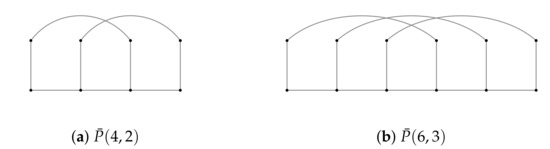
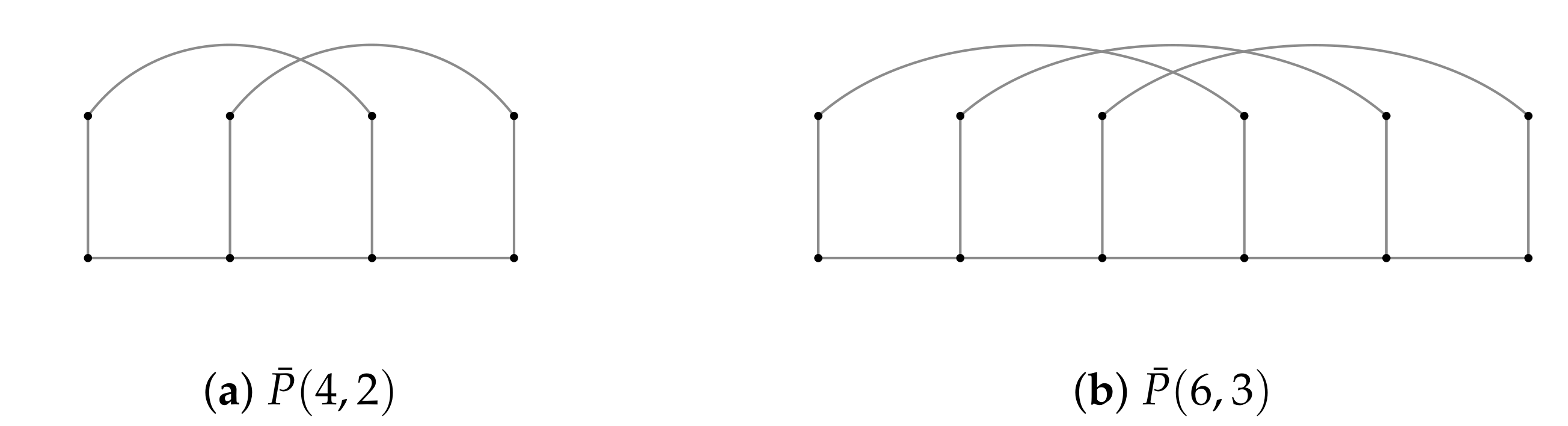
Let and . For , we define the non-cyclical version of the Petersen graph to be the subgraph of , induced on vertices . See examples in Figure 1.
Figure 1.
Non-cyclical versions of .
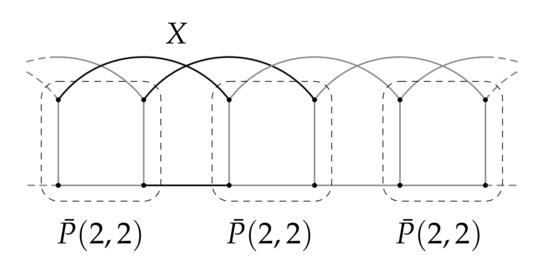
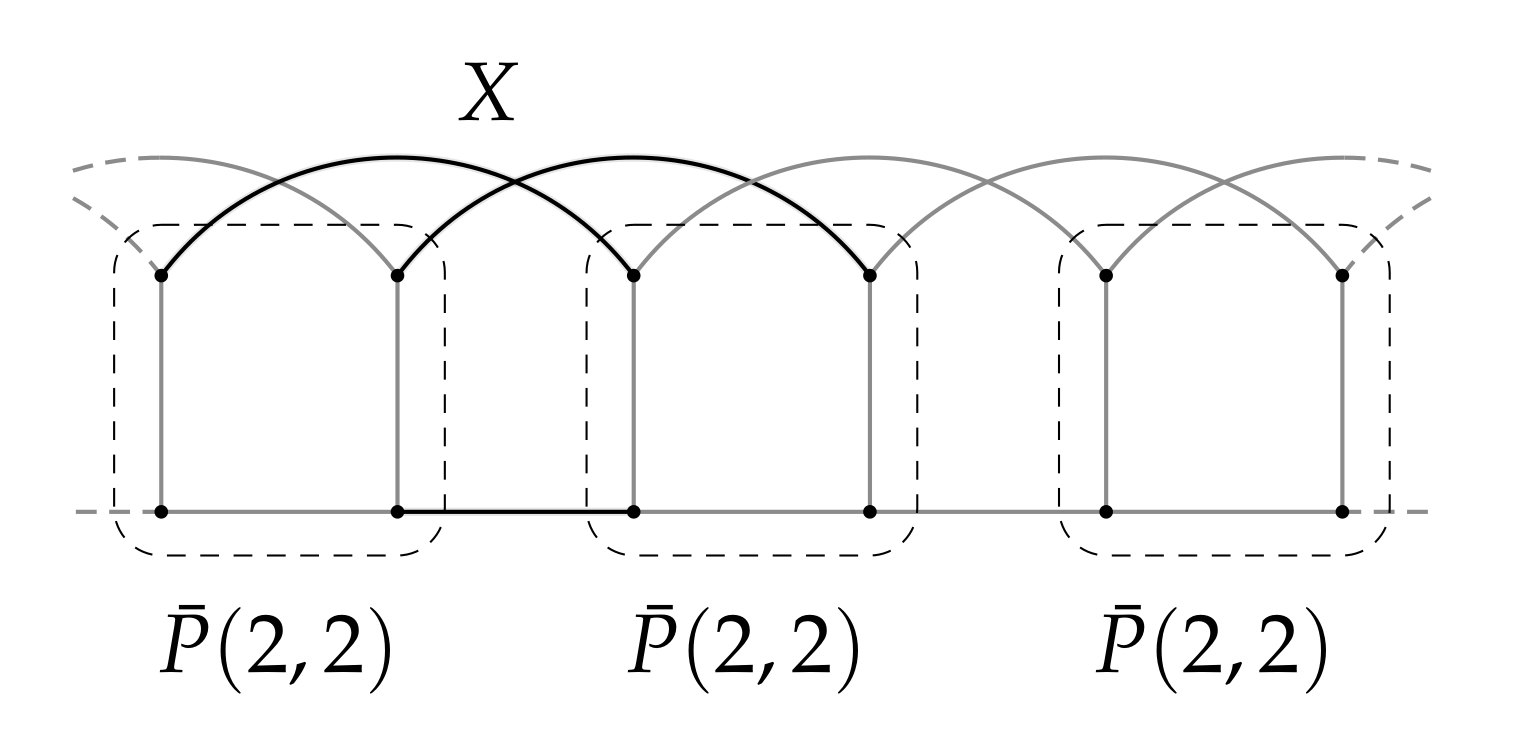
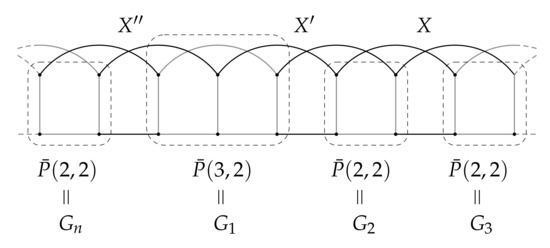
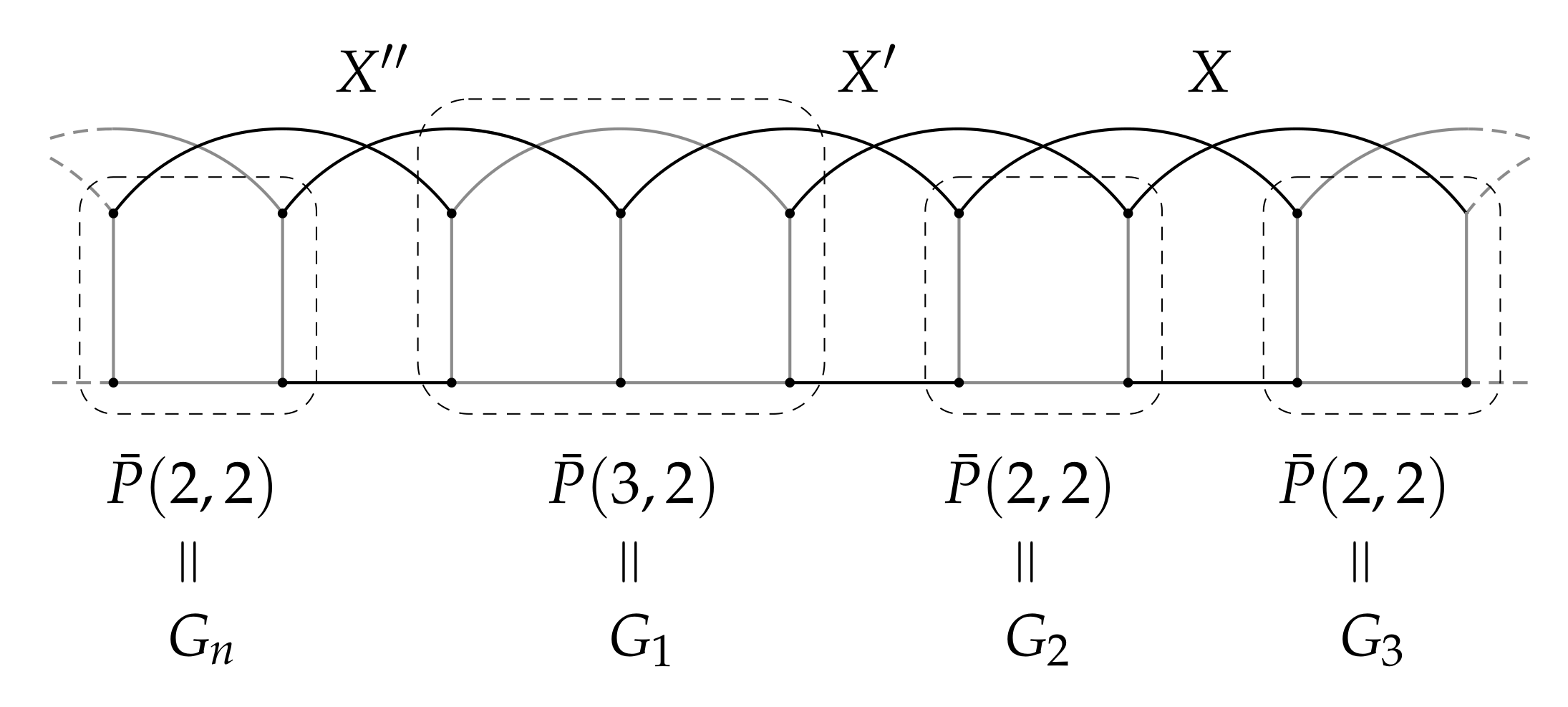
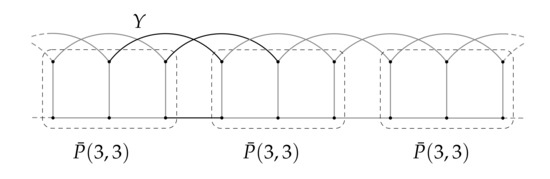
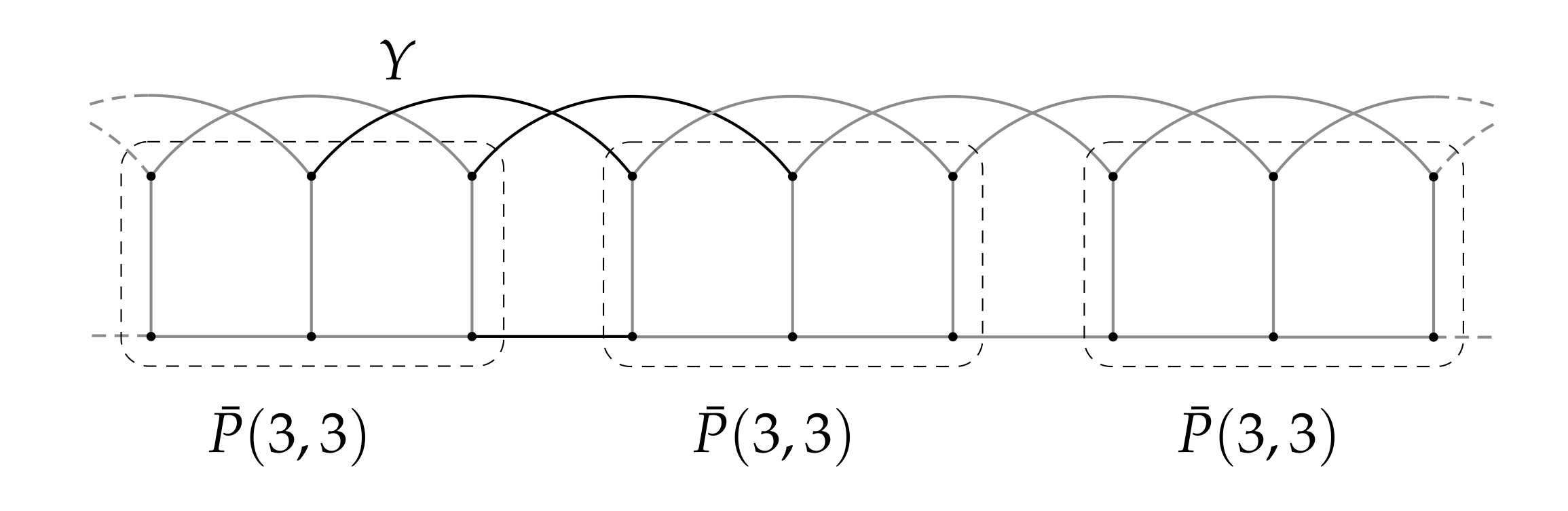
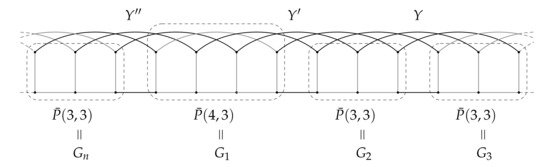
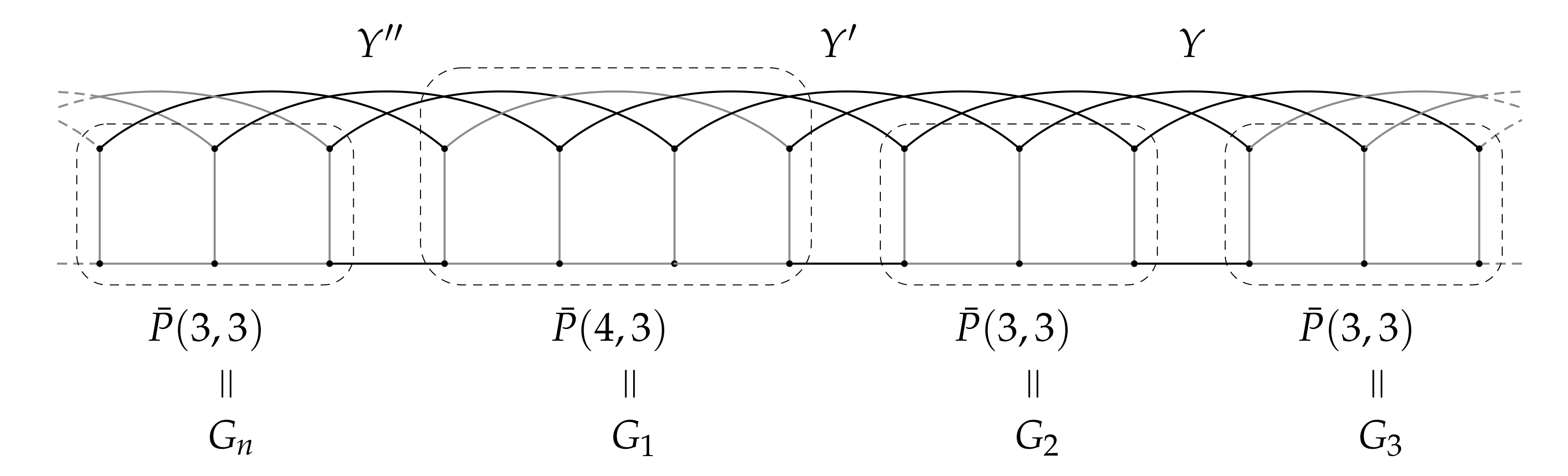
Observe that Petersen graphs of the form are rotagraphs , where X denotes the set of edges as depicted in Figure 2. Similarly, Petersen graphs of the form are nearly rotagraphs , where , X and denote the sets of edges as depicted in Figure 3. Furthermore, are rotagraphs (Figure 4) and are nearly rotagraphs for , where , Y and denote the sets of edges as depicted in Figure 5.
Figure 2.
as a rotagraph.
Figure 3.
as a nearly rotagraph.
Figure 4.
as a rotagraph.
Figure 5.
as nearly rotagraph for . Graphs for are obtained similarly.
First consider rotagraphs . Let be the set of all possible colors of a vertex and the set of colorings of (with ordered vertices). We denote by S the lexicographically ordered set of colorings from that define a partial of . By checking which of all possible colorings define a partial (the code is available at [23]), we compute that there are exactly 165 partial -s (out of the possible colorings). Note that these colorings are exactly the vertices of the graph that is associated to by construction explained in the previous section. Hence we can apply Corollary 1 and obtain
Let us continue with . Set and for all . Also, let be X and , as defined above and depicted in Figure 5. Consequently, all the matrices , for , are equal to the matrix A that was used for above. For further use we denote .
Instead of writing up and explicitly, we will directly compute the product . Consider the subgraph induced on . Let u and v be any partial on and , respectively, such that (1) u and v match on , i.e, (2) and (3) . Observe that for the matrix with elements
we have
Lemma 2.
.
By Corollary 2, it follows
We repeat an analogue procedure for . First we consider rotagraphs . Straightforward computations show that in this case, there are 4494 partial colorings for the subgraphs ([23]). Therefore, we form a matrix and denote also .
For the nearly rotagraphs , , we define the first monograph as , and set all other . As in the previous case, we can obtain the matrices , , directly, instead of computing the products . Again, Corollaries 1 and 2 are implying that
and
Similarly we calculate . Let C and , , be the associated matrices (of size ) for , defined exactly in the same way as A and , respectively, except taking (i.e., three colors).
It is well known that the tropical powers of appropriate matrices have a cyclic behaviour (see e.g., [3,5,17]). In our case, we get
Consequently,
In addition, we compute the traces for smaller powers and present the results in Table 1, Table 2 and Table 3. The source code of the Python program can be found in [23].
Table 1.
values for generalized Petersen graphs .
Table 2.
values for generalized Petersen graphs .
Table 3.
values for generalized Petersen graphs .
5. Exact Values of Independent 2- and 3-Rainbow Domination Numbers
Application of the path algebra approach described in the previous section makes it possible to write closed expressions for exact values of independent 2- and 3-rainbow domination numbers. We prove the following
Theorem 4.
Let .
Furthermore, and .
Proof.
We set . From the fact that for and for and the fact that the monographs contain 4 vertices, it follows for , or equivalently, , that
The statement of the theorem holds since and the fact that the formula holds for , which was verified by computing the traces (see the results in Table 1).
Hence the upper bounds given in [2] are indeed the exact values.
From Table 1 we also have and . □
Theorem 5.
Let .
Proof.
The proof is analogous to that of Theorem 4. We compute that the formula holds for (see Table 2). From the fact that for and for (here we again take ), it follows for , or equivalently, , that
The statement of the theorem holds, since □
Theorem 6.
Let .
Furthermore, and .
Proof.
Since it is known (see e.g., [2]) that and for all we obtain also the following consequences.
Corollary 3.
Let .
Corollary 4.
Let .
Corollary 5.
Let .
6. Conclusions and Future Work
In this article we have studied the t-independent rainbow domination number of polygraphs. For a polygraph that is formed by n monographs we have established that its t-independent rainbow domination number equals the minimum weight of a closed walk of length n of a suitably associated graph. Consequently, by applying the formalism of tropical (min-plus) algebra the of a polygraph equals the trace of product of suitably associated n matrices, all calculated in tropical algebra.
As the generalized Petersen graphs are almost rotagraphs, it is shown that the calculation of mainly depends on efficient calculation of tropical powers of a single relatively large matrix. It is well known that the tropical powers of a large class of matrices possess’ a nice cyclic behaviour, which enables to explicitly calculate all tropical powers. In other words, in time constant in n we can provide closed expressions valid for all n. In this paper we successfully established the explicit formulas for , and that were not known before.
In conclusion, we wish to emphasize that the contribution of this paper goes much further. First, the same approach can in principle be applied to other domination type problems (see c.f. [5,24] for a general definition covering a number of domination type problems that can be handled by a unified algebraic approach). For example, a slight adaptation of our computer code based on a modification of the corresponding matrices would give results for another version of independent rainbow domination [15]. Second, the implementation code of the method for our experiment was not optimized, and it is a reasonable challenge to investigate the potential of the method when implemented on a parallel supercomputer with optimized code. Next we plan calculation of t-independent rainbow domination numbers of generalized Petersen graphs for other t and k. Finally, generalized Petersen graphs are only one example of nearly rotagraphs. Popular examples of rotagraphs and fasciagraphs include grid graphs and tori that are Cartesian products of paths and cycles (see c.f. [4,5,25]). Further examples include other graph products, not to mention molecular graphs that are studied in mathematical chemistry and provide a thesaurus of fasciagraphs, rotagraphs, nearly rotagraphs and nearly fasciagraphs that are practically relevant classes of graphs.
Author Contributions
Conceptualization, J.Ž.; Formal analysis, A.P. and J.Ž.; Methodology, J.Ž.; Software, B.G.; software is coded by B.G. All authors have read and agreed to the published version of the manuscript.
Funding
This work was supported in part by the Slovenian Research Agency (grants P1-0222, J1-8133, J1-8155, N1-0071, P2-0248, and J1-1693.
Conflicts of Interest
The authors declare no conflict of interest.
References
- Kraner Šumenjak, T.; Rall, D.F.; Tepeh, A. Rainbow domination in the lexicographic product of graphs. Discret. Appl. Math. 2013, 161, 2133–2141. [Google Scholar] [CrossRef] [Scilit]
- Shao, Z.; Li, Z.; Peperko, A.; Wa, J.; Janez Žerovnik, J. Independent Rainbow Domination of Graphs. Bull. Malays. Math. Sci. Soc. 2019, 42, 417–435. [Google Scholar] [CrossRef] [Scilit]
- Klavžar, S.; Žerovnik, J. Algebraic approach to fasciagraphs and rotagraphs. Discret. Appl. Math. 1996, 68, 93–100. [Google Scholar] [CrossRef] [Scilit]
- Pavlič, P.; Žerovnik, J. A note on the domination number of the cartesian products of paths and cycles. Kragujev. J. Math. 2013, 37, 275–285. [Google Scholar]
- Repolusk, P.; Žerovnik, J. Formulas for various domination numbers of products of paths and cycles. Ars Comb. 2018, 137, 177–202. [Google Scholar]
- Žerovnik, J. Deriving formulas for domination numbers of fasciagraphs and rotagraphs. Lect. Notes Comput. Sci. 1999, 1684, 559–568. [Google Scholar]
- Gabrovšek, B.; Peperko, A.; Žerovnik, J. On the independent rainbow domination numbers of generalized Petersen graphs P(n,2) and P(n,3). In Proceedings of the SOR Conference, Bled, Slovenia, 25–27 September 2019. [Google Scholar]
- Brešar, B.; Henning, M.A.; Rall, D.F. Paired-domination of Cartesian products of graphs and rainbow domination. Electron. Notes Discret. Math. 2005, 22, 233–237. [Google Scholar] [CrossRef] [Scilit]
- Brešar, B.; Šumenjak, T.K. On the 2-rainbow domination in graphs. Discret. Appl. Math. 2007, 155, 2394–2400. [Google Scholar] [CrossRef] [Scilit]
- Brešar, B.; Henning, M.A.; Rall, D.F. Rainbow domination in graphs. Taiwan J. Math. 2008, 12, 213–225. [Google Scholar] [CrossRef] [Scilit]
- Chang, G.J.; Wu, J.; Zhu, X. Rainbow domination on trees. Discret. Appl. Math. 2010, 158, 8–12. [Google Scholar] [CrossRef] [Scilit]
- Gso, H.; Wang, P.; Liu, E.; Liu, Y. More Results on Italian Domination in Cn□Cm. Mathematics 2020, 8, 465. [Google Scholar] [CrossRef] [Scilit]
- Garey, M.R.; Johnson, D.S. Computers and Intractability: A Guide to the Theory of NP-Completeness; W. H. Freeman and Co.: San Francisco, CA, USA, 1979. [Google Scholar]
- Haynes, T.W.; Hedetniemi, S.T.; Slater, P.J. Fundamentals of Domination in Graphs; Marcel Dekker: New York, NY, USA, 1998. [Google Scholar]
- Kraner Šumenjak, T.; Rall, D.F.; Tepeh, A. On k-rainbow independent domination in graphs. Appl. Math. Comput. 2018, 333, 353–361. [Google Scholar] [CrossRef] [Scilit]
- Ebrahimi, B.J.; Jahanbakht, N.; Mahmoodianc, E.S. Vertex domination of generalized Petersen graphs. Discret. Math. 2009, 309, 4355–4361. [Google Scholar] [CrossRef] [Scilit]
- Butkovič, P. Max-Linear Systems: Theory and Algorithms; Springer: London, UK, 2010. [Google Scholar]
- Rosenmann, A.; Lehner, F.; Peperko, A. Polynomial convolutions in max-plus algebra. Lin. Alg. Appl. 2019, 578, 370–401. [Google Scholar] [CrossRef] [Scilit]
- Müller, V.; Peperko, A. On the spectrum in max-algebra. Linear Algebra Appl. 2015, 485, 250–266. [Google Scholar] [CrossRef] [Scilit]
- Kolokoltsov, V.N.; Maslov, V.P. Idempotent Analysis and Its Applications; Kluwer Acad. Publ.: Dordrecht, The Netherlands, 1997. [Google Scholar]
- Litvinov, G.L. The Maslov dequantization, idempotent and tropical mathematics: A brief introduction. J. Math. Sci. 2007, 140, 426–444. [Google Scholar] [CrossRef] [Scilit]
- Žerovnik, J. New formulas for the pentomino exclusion problem. Australas. J. Comb. 2006, 36, 197–212. [Google Scholar]
- Gabrovšek, G.; Žerovnik, J.; Peperko, A. Source Code. 2020. Available online: https://github.com/bgabrovsek/i2rdf-petersen (accessed on 1 May 2020).
- Goddard, W.; Henning, M.A. Independent domination in graphs: A survey and recent results. Discret. Math. 2013, 313, 839–854. [Google Scholar] [CrossRef] [Scilit]
- Shao, Z.; Li, Z.; Erveš, R.; Žerovnik, J. The 2-rainbow domination numbers of C4□Cn and C8□Cn. Natl. Acad. Sci. Lett. 2019, 42, 411–418. [Google Scholar] [CrossRef] [Scilit]

© 2020 by the authors. Licensee MDPI, Basel, Switzerland. This article is an open access article distributed under the terms and conditions of the Creative Commons Attribution (CC BY) license (http://creativecommons.org/licenses/by/4.0/).