


Abstract
The subshift of finite type property (also known as the Markov property) is ubiquitous in dynamical systems and the simplest and most widely studied class of dynamical systems are -shifts, namely transformations of the form acting on , where is fixed and where . Recently, it was shown, by Li et al. (Proc. Amer. Math. Soc. 147(5): 2045–2055, 2019), that the set of such that has the subshift of finite type property is dense in the parameter space . Here, they proposed the following question. Given a fixed which is the n-th root of a Perron number, does there exists a dense set of in the fiber , so that has the subshift of finite type property? We answer this question in the positive for a class of Pisot numbers. Further, we investigate if this question holds true when replacing the subshift of finite type property by the sofic property (that is a factor of a subshift of finite type). In doing so we generalise, a classical result of Schmidt (Bull. London Math. Soc., 12(4): 269–278, 1980) from the case when to the case when . That is, we examine the structure of the set of eventually periodic points of when is a Pisot number and when is the n-th root of a Pisot number.
1. Introduction, Motivation and Main Results
1.1. Introduction and Motivation
The pioneering work of Rényi [1] and Parry [2] on -shifts and expansions have motivated a wealth of results providing practical solutions to a variety of problems. For instance, they arise as Poincaré maps of the geometric model of Lorenz differential equations [3], and Daubechies et al. [4] proposed a new approach to analog-to-digital conversion using -expansion. A summary of some further applications can be found in [5]. Through their study, many new phenomena have appeared, revealing a rich combinatorial and topological structure, and unexpected connections to probability theory, ergodic theory, number theory and aperiodic order [6,7,8]. Additionally, through understanding -shifts and expansions, advances have been made in the theory of Bernoulli convolutions [9,10].
For and , an infinite word over the alphabet is said to be a -expansion of x if
When , all except a countable set of real numbers have a unique -expansion. On the other hand, Erdös, Joó and Komornik [11] showed, if is less than the golden mean, then for every , the set of -expansions of x has cardinality equal to the cardinality of the continuum. Siderov [12] extended this result by showing, if is strictly less than two, then for Lebesgue almost all , the cardinality of the set of -expansions of x is that of the continuum.
Through iterating the interval maps and defined by
one obtains subsets of known as the greedy and lazy -shifts, respectively. Each point of the greedy -shift and each point of the lazy -shift corresponds to a -expansion of a unique point in . Note, if and are -expansions of the same point, then and are not necessarily equal, see Example 1 and [6,13,14].
There are several ways in which one may generate -expansions of real numbers, other than using the greedy and lazy -shifts. For example, via intermediate -shifts . These symbolic spaces are coding spaces associated with intermediate -transformations , where and where the interval maps are defined as follows. For , set
Observe that , and if , then ; and if , then . Further, and are fixed points for and the unit interval is a trapping region for , that is if , then , for all ; and if , then there exists an such that .
Every element of is a -expansion of a unique point in the interval , see (3), and is invariant under the (left) shift map and closed in ; namely is a subshift. Here is equipped with the discrete topology and is endowed with the product topology. Further, the dynamical systems and are topologically conjugate, that is they have ‘the same’ dynamical properties.
Subshifts of finite type play an essential rôle in the study of dynamical systems, and can be completely described by a finite set of forbidden words (see Section 2.1). They also have a simple representation as a finite directed graph, and thus, dynamical and combinatorial questions concerning subshifts of finite type can be phrased in terms of an adjacency matrix, making them much more tractable. Hence, it is of interest to classify the points for which a subshift of finite type. One of our aims is to give new insights towards such a classification.
Given , the unique points in and that yield a -expansion of p are called the kneading invariants of . These invariants are extremely useful since they completely determine , see Theorem 3 due to [15,16,17]. Moreover, the -shift is a subshift of finite type if and only if the left shift of the kneading invariants are periodic, see Theorem 4 due to Ito and Takahashi [18], and Parry [19], for the case , and Li et al. [20], for the case that . These results immediately give us that the set of parameters in which give rise to -shifts of finite type is countable. In a second article [5] by Li et al., it was shown that this set of parameters is in fact dense in . In contrast, the structure of the set of in for which is topologically transitive, with respect to the (left) shift map, is notably different to the set of in for which is a subshift of finite type. It is worth noting that the former of these two sets has positive Lebesgue measure and is far from being dense in , see Theorem 6 due to Palmer [21] and Glendinning [22].
The results of [23,24] in tandem with those discussed above, yield the following.
- (i)
- If the -shift is a subshift of finite type, then .
- (ii)
- If is not the positive nth-root of a Perron number, for some , then the set of with a subshift of finite type is empty.
Indeed, we require to be a maximal root of a polynomial with coefficients in , and , for to be a subshift of finite type. This leads to the following natural question, to which we give a partial answer to in Theorem 1.
Question A.
Let denote the positive -root of a Perron number, for some . Is the set of α with a subshift of finite type dense in ?
Another class of subshifts which is of interest here are those which are factors of a subshift of finite type. Such subshifts are called sofic; indeed, every subshift of finite type is sofic, but not vise versa. Kalle and Steiner [25] proved that a -shift is sofic if and only if its kneading invariants are eventually periodic. Combining this result with those of Li et al. [5], one obtains that the set of with sofic is dense in . This naturally leads to the study of (eventually) periodic points.
Bertrand [26] and Schmidt [27], and subsequently Boyd [28,29,30] and Maia [31], addressed the following question. For a fixed , what are the values of which are eventually periodic under ? Recall, a point x is eventually periodic under if and only if the cardinality of is finite. Letting denote the set of x which are eventually periodic under , Schmidt points out that if , then there is no obvious reason why should also be an element of . In light of this, it is surprising that certain have the same behaviour as integers, in the sense that if is a Pisot number, then . A natural question to ask here is:
Question B.
What is the structure of the set of eventually periodic points under ?
In Theorem 2, we show that, if is a Pisot number and if , then , where denotes the domain of . We also obtain a partial converse and in Corollary 1, we relate these results back to Question A.
1.2. Statement of Main Results
Our main contributions in this article and to the story of periodic -expansions, is to show the following results, namely Theorems 1 and 2, and Corollaries 1 to 3.
For set and recall that the multinacci number of order is the unique real solution to the equation in the interval . Note, the sequence is strictly increasing and converges to 2, and that is the golden mean.
Theorem 1.
Fix an integer . The set of in with a subshift of finite type is dense in the fiber .
The main difficulty in proving Theorem 1 was in finding a way to compare the space and , for a fixed m and . We achieved this by embedding all -transformations into a single (multi-valued) dynamical system and carrying out our analysis in this larger system.
This result answers Question A for the class of multinacci number which belong to the wider class of algebraic numbers known as Pisôt numbers. Although many parts of our proof generalise from the class of multinacci numbers to the class of Pisot numbers, a central result (Proposition 1) which states that the upper kneading invariant is periodic if and only if the lower kneading invariant is periodic does not easily generalise, see Example 2 for examples of where this is not the case.
In the hope of circumventing this we turn our attention to Question B and examine the set of eventually periodic points under .
Theorem 2.
Let and be fixed, and let denote the domain of .
- (i)
- If , then β is either a Pisot or a Salem number.
- (ii)
- If β is a Pisot number, then .
Theorem 2(i) also hold when is replaced by , since is a trapping region for .
As indicated above, Theorem 2 generalises the results of Schmidt [27]. Indeed, our proof is motivated by that of [27], with the following crucial difference. In the setting of [27], namely when , a key fact that is used is to any point x there exists a point y arbitrarily close to x and integers m and n, such that is arbitrarily close to zero for all . However, this is not the case, when . To circumvent this, we appeal to the kneading theory of Milnor and Thurston discussed in Section 2.2. We also remark that a similar question to Question B was considered by Baker [32]; via different methods to ours, and also Schmidt’s, Theorem 2(i) may be concluded from the work of Baker and Theorem 2(ii) can be seen as a strengthening of Baker’s results.
Further, as a consequence of Theorem 2(ii) and a result of [25], see Theorem 5, we obtain the following partial solution to Question A.
Corollary 1.
Let be a Pisot number. The set of in for which is sofic is dense in the fiber .
In addition to this, combining the results of Palmer [21] and Glendinning [22] as well as Parry [21,33] with Theorems 1 and 2, we may
- (i)
- determine a set of which lie dense in a subset of positive Lebesgue measure of the fibre , for all integers m and , and
- (ii)
- classify the set , in the case that is the n-th root of a Pisot number and is non-transitive.
In order to state these results we require a few preliminaries.
Let n and with and be given, and let be such that . For , define and by , where , and by . For set
where, for ,
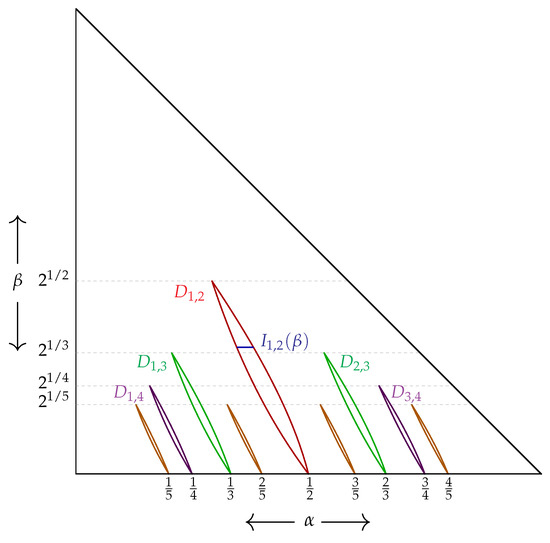
see Figure 1 for a sketch of the intervals . If , then is a single point and, if , then is an interval of positive Lebesgue measure. Further, for a fixed , in [22], it was shown that the Lebesgue measure of
remains bounded away from zero as tends to infinity.
Corollary 2.
Let m and denote two integers, and let be such that and . There exists a dense set of α in with a subshift of finite type. Moreover, if β is a Pisot number, then there exists a dense set of α in with sofic.
Before stating our final corollary we require one last preliminary. For , Parry [33] constructed an absolutely continuous -invariant probability measure, which we denote by . Halfin [34] verified that the density is non-negative and Hofbauer [16,35,36] proved that is ergodic and maximal. Further, the results of Palmer [21] and Glendinning [22] give us that has support equal to if and only if is topologically transitive.
Corollary 3.
Let n and , let β denote a Pisot number and let . Defining by
where satisfies and is as in (2), and setting , we have
1.3. Outline
In Section 2 we give necessary definitions and results we require in our proofs of Theorems 1 and 2. Section 3 and Section 4 are dedicated to proving Theorems 1 and 2, respectively. We conclude with Section 5. The aim of this final section is to provide an overview of the results of [19,21,22,33] which in combination with our results (Theorems 1 and 2) yields Corollaries 2 and 3.
2. Preliminaries
We divide this section into three parts: Section 2.1 and Section 2.2 in which we discuss aspects of symbolic dynamics and -shifts; and Section 2.3 where we review results concerning a related class of interval maps, namely uniform Lorenz maps, which are in essence scaled versions of -transformations.
2.1. Subshifts
Let denote the set infinite words over the alphabet . We endow with the topology induced by the (ultra) metric defined by
where , for and . This topology coincides with the product topology on , where is equipped with the discrete topology. For and , we set and call n the length of denoted by . We define the (left) shift on by . A closed subspace of is a subshift if , namely if is invariant under . Given a subshift and , we set
and denote by the collection of all finite words. A subshift is said to be of finite type if there exists a finite set F of finite words with
- (i)
- for all and ;
- (ii)
- if , then there exist integers and such that .
The set F is often referred to as the set of forbidden words of . If is a factor of a subshift of finite type, then it is called sofic.
We call a word periodic with period , if for all , and write . The smallest such n is called the period of . Similarly, a word is said to be pre-periodic with period , if there exists with for all , and write . The smallest such n is called the period of .
2.2. Intermediate -Shifts and Expansions
Let be fixed and set . Let be defined by
where, for ,
We refer to as expansion maps. The image of under is denoted by , and we set . We call the upper and the lower kneading invariant of .
Remark 1.
Let and respectively denote the upper and the lower kneading invariant of . By definition, and . It can also be shown, for an integer, that if and only if , and that if and only if .
The inverse map of is called the projection map and defined by
An important property of and is that the following diagram commutes.
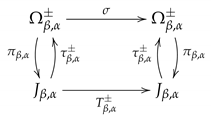
This result is verifiable from the definitions of the involved maps, see [15]. From this, one may deduce, for , that the words are -expansions of x. It is worth noting that the expansion of a point x given by , namely the greedy -expansion of x, is lexicographically the largest -expansion of x, and the expansion given by , namely the lazy -expansion of x, is lexicographically the smallest -expansion of x, see [11]. Further, for Lebesgue all most all x, the expansion lie in between the greedy and the lazy -expansions of x, with respect to the lexicographic ordering, see [37]. There also exist such that the only -expansion of one is the greedy -expansion, such are called univoque, see [14].
Example 1.
For and , we have the following.
For β the largest positive real root of , and ,
for all . In [13], it was shown, in this latter case, that β is the smallest univoque Pisot number.
Next, we recall a result which shows that is completely determined its kneading invariants.
Theorem 3.
[15,16,17] Letting denote the lexicographic orderings on , we have that
A necessary and sufficient condition on the kneading invariants of an intermediate -shift for determining when it is a subshift of finite type is as follows.
Theorem 4
([2,18,20]). For , the intermediate shift is a subshift of finite type if and only if are both periodic.
With the above at hand, it is natural to ask if and , then is true that is periodic if and only if is periodic and vice versa? In Proposition 1 we show that this is indeed the case when is a multinacci number. However, there exist values of for which this does not hold, as the following counterexample demonstrates. Thus, it would be interesting to investigate if there exists other values of , for which is periodic if and only if . In fact this idea is very closely linked to the concept of matching which has recently attracted much attention, see for instance [38,39].
Example 2.
Letting and , we have that and . Recall, denotes the second multinacci number, namely the golden mean.
Kalle and Steiner [25] developed an analogous result to Theorem 4 for determining when a -shift is sofic; this allows us to conclude Corollary 1 from Theorem 2. Their result states the following.
Theorem 5
([25]). The subshift is sofic if and only if are both pre-periodic.
Our next proposition (Proposition 1) plays a key rôle in the proof of Theorem 1. We note that after the writing of this paper we became aware of [38] in which a proof of this result also appears. However, for completeness we include a short justification for which we require an auxiliary lemma (Lemma 1).
Proposition 1.
Fix an integer and let . The kneading invariant is periodic if and only if the kneading invariant is periodic.
Lemma 1.
Under the assumptions of Proposition 1, we have
Proof.
We present the proof for ; the proof for follows analogously. From Remark 1 we know , and, since , by definition . Suppose, for some , that
Let and . It suffices to show that
To this end, observe that
The first line follows from an elementary induction argument and the definition of and ; the second line holds since ; the last and penultimate lines are a consequence of the facts is an increasing sequence and is the unique real zero of the polynomial in . □
Proof of Proposition 1.
By Lemma 1, we have
Letting and be as in the proof of Lemma 1, an elementary calculation yields the following.
Thus, is periodic if and only if is periodic. □
2.3. Uniform Lorenz Maps
A class of interval maps closely related to intermediate -transformations, and which have been well studied, are Lorenz maps. They are expanding maps with a single discontinuity. Here, we consider the sub-class of uniform Lorenz maps defined, for and , by
Let us now describe the relation between uniform Lorenz maps and -transformations. For this we require the following concept, which determines when two dynamical systems are ‘the same’. Let X and Y denote two topological spaces and let and . We call f and g topologically conjugate if there exists a homeomorphism with . The maps f and g are called topologically semi-conjugate if h is a continuous surjection.
An elementary calculation shows that and are topologically conjugate, where the conjugating homeomorphism is given by .
Similar to -transformations, Lorenz maps have associated expansion maps defined by , where, for ,
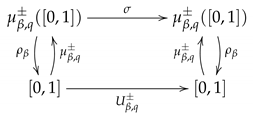
and an associated projection map given by . As in the setting of Section 2.2 we have that the following diagram commutes.
Additionally, we have the following monotonicity result.
Proposition 2.
[15,40] Let be fixed. The map is right-continuous and strictly increasing. Similarly, is left-continuous and strictly increasing. Moreover, points of discontinuity, for both maps, only occur at periodic points.
The main benefit of using uniform Lorenz maps stems from the idea that every -trnasformation has a realisation as a uniform Lorenz map, as discussed above, and that every uniform Lorenz map is defined on and has the same fixed points. Thus, it allows one to easily compare the kneading invariants of systems with the same expansion rate, namely , but with different translates, namely .
3. Fiber Denseness of Intermediate -Shifts of Finite Type: Proof of Theorem 1
The aim of this section is to prove Theorem 1. We divide the proof into two parts. We show that the sets , for a given , are dense in with respect to the Euclidean norm, and with the help of Proposition 1, we have that is periodic if and only if is periodic. Theorem 1 follows by combining these two results together with Theorem 4.
Proof of Theorem 1.
Fix with . Let , so that is topologically conjugate to . It is sufficient to show that there exists sufficiently close to q in with periodic. We present the proof for ; the proof for follows analogously. To this end, suppose is not periodic, otherwise set . Fix and set
Observe , for all . Let be the maximal integer such that
The existence of j is given by Proposition 2. Let be defined by
Proposition 2 ensures that A is a non-empty, connected and closed, in particular that . By way of contradiction, suppose that is not periodic, in which case,
By Proposition 2, there exists so that, if , then . This implies ; contradicting the fact is the supremum of A. Therefore, since , given and , there exist and with and periodic.
Proposition 1 implies that , for all integers . Thus, we have that the set is dense in with respect to the Euclidean norm. With this at hand, an application of Theorem 4 completes the proof. □
4. Periodic Expansions of Pisot and Salem Numbers: Proof of Theorem 2
Throughout this section, let denote an algebraic integer with minimal polynomial
where , and . In which case, can be written in the form
where and . We assume that the integer q in (4) is as small as possible yielding a unique representation for x. Let and and denote the corresponding terms for :
Fix and with the forms given in (4) and (5). For , let respectively denote the i-th letter of . From the commutative diagram given in (3), we have, for n a non-negative integer, that
Lemma 2.
For and , there exists a unique vector in with
For ease of notation, and when the dependency on x is clear, we write in replace of .
Proof.
The result for follows from the fact that q and are fixed and that is a basis for . An inductive argument yields the general result. □
Lemma 3.
For , and γ a Galois conjugate of β,
where . Moreover, if and if , then
Proof.
Combining (4), (6) and (7), we obtain that satisfies the polynomial equation
for all . Since is a Galois conjugate of , it is also a solution to (10), which proves (8). If and if , then the cardinality of the set is finite, and thus
Combining this with (8) we obtain
Letting n tend to infinity in the above equation yields (9). □
With the above two lemmas at hand we are ready to prove Theorem 2(i).
Proof of Theorem 2(i).
We show the result for noting that the proof is analogous for . By way of contradiction, suppose there exists a Galois conjugate of with . Let and let be such that and . Set and let . Choose with .
Let with and ; the existence of and is guaranteed by Proposition 2. By (3) and how and have been chosen, we have that , and . An application of Lemma 3 in tandem with (4), our hypothesis and the fact that is a Galois conjugate of , yields the following.
From this we obtain the following chain of inequalities.
This yields a contradiction, and concludes the proof. □
For the proof of Theorem 2(ii) we require an additional lemma.
Lemma 4.
Set and let denote the Galois conjugates of β. For , and set
The following are equivalent.
- (i)
- (ii)
- (iii)
Proof.
A similar argument to that given in the proof of Lemma 3, where we obtained (11), shows (i) implies (iii). That (iii) implies (ii) follows from (12). To complete the proof we show (ii) implies (i). To this end, assume (ii) and set
By assumption, there exists with , for all . Since the Galois group of a finite Galois extension acts transitively on the roots of any minimal polynomial, is a non-singular matrix. This implies there exists with , for all . Hence, as it follows that , and therefore , for some with and all . An application of Lemma 2 and (6) yields the required result. □
Proof of Theorem 2(ii).
5. Periodic Expansions of Pisot and Salem Numbers: Proof of Corollaries 1 and 2
The aim of this final section is to provide an overview of the results of [19,21,22,33] which in combination with our results (Theorems 1 and 2) yield Corollaries 2 and 3.
An interval map is called topologically transitive if for all open subintervals J there exists with
For , Parry [19] showed is topologically transitive if and only if . This result was later generalised by Palmer [21] and Glendinning [22] who classified the set of points with is topologically transitive.
In order to state the results of Parry, Palmer and Glendinning we require the following. Let with and , and let be as in (1). Define to be the set
see Figure 1 for an illustration of the intervals and the regions .
Figure 1.
Plot of the parameter space , together with boundary of the regions , , , , , , , , , and . Further, in blue, a sketch of the interval , where is the square root of the golden mean, is given.
Theorem 6
([19,21,22]). Let . The tuple , for some with and , if and only if is not topologically transitive.
A main ingredient in the proof of this result is to show that for given with and , there exists a one-to-one correspondence between points in and points in . More precisely, on the one hand, given , there exists a unique , namely , see Corollary 3, such that, and are topologically conjugate with conjugating map ; on the other hand, given , there exists , namely
such that and are topologically conjugate, where the conjugating map is given by and where satisfies and is as defined in (2). Moreover, in the case that and
for all with ; in the case that and is the singleton in the intersection in (14) is a singleton when and a two point set when . These observations in tandem with Theorem 1 and Corollary 1 directly yield Corollary 2. In order to prove Corollary 3, we require one final result.
Theorem 7
([21,33]). Let be fixed. The absolutely continuous measure with density
is invariant under . Moreover, the support of equals and only if or if and α is the single point of , for some with and . Further, in the case that and , the support of is contained in the disjoint union of intervals,
Corollary 3 follows from this result in tandem with the observations directly proceeding it together with Theorem 2.
Author Contributions
Authors contributed equally to the conceptualisation, methodology and writing. All authors have read and agreed to the published version of the manuscript.
Funding
Part of the work presented here was carried out during an undergraduate research project supported by the Bill and Linda Frost Fund. The second author would also like to extend thanks to the Hausdorff Research Institute for Mathematics and Institut Mittag Leffler for their kind hospitality where the final writing stages of this article took place.
Conflicts of Interest
The authors declare no conflict of interest.
References
- Rényi, A. Representations for real numbers and their ergodic properties. Acta Math. Acad. Sci. Hungar. 1957, 8, 477–493. [Google Scholar] [CrossRef] [Scilit]
- Parry, W. On the β-expansions of real numbers. Acta Math. Acad. Sci. Hungar. 1960, 11, 401–416. [Google Scholar] [CrossRef] [Scilit]
- Sparrow, C. The Lorenz Equations: Bifurcations, Chaos, and Strange Attractors; Applied Mathematical Sciences; Springer: New York, NY, USA; Berlin, Germany, 1982; Volume 41. [Google Scholar]
- Daubechies, I.; DeVore, R.; Gunturk, C.S.; Vaishampayan, V.A. Beta expansions: A new approach to digitally corrected A/D conversion. In Proceedings of the 2002 IEEE International Symposium on Circuits and Systems, Scottsdale, AZ, USA, 26–29 May 2002; Volume 2, pp. II–784–II–787. [Google Scholar]
- Li, B.; Sahlsten, T.; Samuel, T.; Steiner, W. Denseness of Intermediate β-shifts of Finite Type. Proc. Am. Math. Soc. 2019, 147, 2045–2055. [Google Scholar] [CrossRef] [Scilit]
- Komornik, V. Expansions in noninteger bases. Integers 2011, 11B, 11A63. [Google Scholar]
- Mosbach, A. Finite and Infinite Rotation Sequences and Beyond. Ph.D. Thesis, Universität Bremen, Bremen, Germany, 2019. [Google Scholar]
- Sidorov, N. Arithmetic dynamics. In Topics in Dynamics and Ergodic Theory; London Mathematical Society Lecture Note Series; Cambridge University Press: Cambridge, UK, 2003; Volume 310, pp. 145–189. [Google Scholar]
- Akiyama, S.; Feng, D.J.; Kempton, T.; Persson, T. On the Hausdorff dimension of Bernoulli convolutions. Int. Math. Res. Not. 2018. [Google Scholar] [CrossRef] [Scilit]
- Dajani, K.; Kalle, C. Local dimensions for the random β-transformation. N. Y. J. Math. 2013, 19, 285–303. [Google Scholar]
- Erdös, P.; Joó, I.; Komornik, V. Characterization of the unique expansions and related problems. Bull. Soc. Math. Fr. 1990, 118, 377–390. [Google Scholar] [CrossRef] [Scilit]
- Sidorov, N. Almost every number has a continuum of β-expansions. Am. Math. Mon. 2003, 110, 838–842. [Google Scholar]
- Allouche, J.P.; Frougny, C.; Hare, K.G. On univoque Pisot numbers. Math. Comp. 2007, 76, 1639–1660. [Google Scholar] [CrossRef] [Scilit]
- Komornik, V.; Loreti, P. Unique developments in non-integer bases. Am. Math. Mon. 1998, 105, 636–639. [Google Scholar] [CrossRef]
- Barnsley, M.; Harding, B.; Vince, A. The entropy of a special overlapping dynamical system. Ergod. Theory Dynam. Syst. 2014, 34, 483–500. [Google Scholar] [CrossRef] [Scilit]
- Hofbauer, F. Maximal measures for piecewise monotonically increasing transformations on [0,1]. In Ergodic Theory (Proc. Conf., Math. Forschungsinst., Oberwolfach, 1978); Lecture Notes in Mathematics; Springer: Berlin/Heidelberg, Germany, 1979; Volume 729, pp. 66–77. [Google Scholar]
- Hubbard, J.H.; Sparrow, C.T. The classification of topologically expansive Lorenz maps. Commun. Pure Appl. Math. 1990, 43, 431–443. [Google Scholar] [CrossRef] [Scilit]
- Ito, S.; Takahashi, Y. Markov subshifts and realization of β-expansions. J. Math. Soc. Jpn. 1974, 26, 33–55. [Google Scholar] [CrossRef] [Scilit]
- Parry, W. The Lorenz attractor and a related population model. In Ergodic Theory (Proc. Conf., Math. Forschungsinst., Oberwolfach, 1978); Lecture Notes in Mathematics; Springer: Berlin/Heidelberg, Germany, 1979; Volume 729, pp. 169–187. [Google Scholar]
- Li, B.; Sahlsten, T.; Samuel, T. Intermediate β-shifts of finite type. Discrete Contin. Dyn. Syst. 2016, 36, 323–344. [Google Scholar] [CrossRef] [Scilit]
- Palmer, R. On the Classification of Measure Preserving Transformations of Lebesgue Spaces. Ph.D. Thesis, University of Warwick, Coventry, UK, 1979. [Google Scholar]
- Glendinning, P. Topological conjugation of Lorenz maps by β-transformations. Math. Proc. Camb. Philos. Soc. 1990, 107, 401–413. [Google Scholar] [CrossRef] [Scilit]
- Glendinning, P.; Hall, T. Zeros of the kneading invariant and topological entropy for Lorenz maps. Nonlinearity 1996, 9, 999–1014. [Google Scholar] [CrossRef] [Scilit]
- Lind, D.A. The entropies of topological Markov shifts and a related class of algebraic integers. Ergod. Theory Dynam. Syst. 1984, 4, 283–300. [Google Scholar] [CrossRef] [Scilit]
- Kalle, C.; Steiner, W. Beta-expansions, natural extensions and multiple tilings associated with Pisot units. Trans. Am. Math. Soc. 2012, 364, 2281–2318. [Google Scholar] [CrossRef] [Scilit]
- Bertrand, A. Développements en base de Pisot et répartition modulo 1. C. R. Acad. Sci. Paris Sér. A-B 1977, 285, A419–A421. [Google Scholar]
- Schmidt, K. On periodic expansions of Pisot numbers and Salem numbers. Bull. Lond. Math. Soc. 1980, 12, 269–278. [Google Scholar] [CrossRef] [Scilit]
- Boyd, D.W. Salem numbers of degree four have periodic expansions. In Théorie des Nombres (Quebec, PQ, 1987); de Gruyter: Berlin, Germany, 1989; pp. 57–64. [Google Scholar]
- Boyd, D.W. On the beta expansion for Salem numbers of degree 6. Math. Comp. 1996, 65, 861–875. [Google Scholar] [CrossRef] [Scilit]
- Boyd, D.W. The beta expansion for Salem numbers. Org. Math. 1997, 20, 117–131. [Google Scholar]
- Maia, B.M. The beta-transformation’s companion map for Pisot or Salem numbers and their periodic orbits. Dyn. Syst. 2018, 33, 1–9. [Google Scholar] [CrossRef] [Scilit]
- Baker, S.; Masáková, Z.; Pelantová, E.; Vávra, T. On periodic representations in non-Pisot bases. Monatsh. Math. 2017, 184, 1–19. [Google Scholar] [CrossRef] [Scilit]
- Parry, W. Representations for real numbers. Acta Math. Acad. Sci. Hungar. 1964, 15, 95–105. [Google Scholar] [CrossRef] [Scilit]
- Halfin, S. Explicit construction of invariant measures for a class of continuous state Markov processes. Ann. Probab. 1975, 3, 859–864. [Google Scholar] [CrossRef] [Scilit]
- Hofbauer, F. On intrinsic ergodicity of piecewise monotonic transformations with positive entropy. Isr. J. Math. 1979, 34, 213–237. [Google Scholar] [CrossRef] [Scilit]
- Hofbauer, F. On intrinsic ergodicity of piecewise monotonic transformations with positive entropy. II. Isr. J. Math. 1981, 38, 107–115. [Google Scholar] [CrossRef] [Scilit]
- Dajani, K.; Kraaikamp, C. From greedy to lazy expansions and their driving dynamics. Expo. Math. 2002, 20, 315–327. [Google Scholar] [CrossRef] [Scilit]
- Bruin, H.; Carminati, C.; Kalle, C. Matching for generalised β-transformations. Indag. Math. 2017, 28, 55–73. [Google Scholar] [CrossRef] [Scilit]
- Bruin, H.; Carminati, C.; Marmi, S.; Profeti, A. Matching in a family of piecewise affine maps. Nonlinearity 2019, 32, 172. [Google Scholar] [CrossRef] [Scilit]
- Cooperband, Z.; Pearse, E.P.J.; Quackenbush, B.; Rowley, J.; Samuel, T.; West, M. Continuity of entropy for Lorenz maps. Indag. Math. 2020, 31, 96–105. [Google Scholar] [CrossRef] [Scilit]
© 2020 by the authors. Licensee MDPI, Basel, Switzerland. This article is an open access article distributed under the terms and conditions of the Creative Commons Attribution (CC BY) license (http://creativecommons.org/licenses/by/4.0/).