Abstract
The intended objective of this study is to define and investigate a new class of q-generalized tangent-based Appell polynomials by combining the families of 2-variable q-generalized tangent polynomials and q-Appell polynomials. The investigation includes derivations of generating functions, series definitions, and several important properties and identities of the hybrid q-special polynomials. Further, the analogous study for the members of this q-hybrid family are illustrated. The graphical representation of its members is shown, and the distributions of zeros are displayed.
Keywords:
q-calculus; q-generalized tangent polynomials and numbers; q-Appell polynomials and numbers; generating function MSC:
05A30; 11B68; 11B83; 33E20
1. Introduction and Preliminaries
The area of q-calculus in the last three decades act as a bridge between engineering sciences and mathematics. Recently, research in the area of q-calculus has shown worthy of attention due to its applicative diversification in various fields such as mathematics, physics, and engineering. The q-analogues of many orthogonal polynomials and functions expect a pleasant structure, and help one to remember their classical counterpart. The q-standard notations and definitions reviewed here are taken from [1].
The q-analogue of a number and factorial function are specified as
The q-binomial coefficient is specified as
The q-power basis is specified as
The q-exponential functions are specified by
and satisfy the following relation
The q-derivative of functions and are given by
The q-derivative operator for any two arbitrary functions and satisfies the following product and quotient relations:
The tangent numbers and polynomials and their q-analogue have enormous applications in analytic number theory, physics, and other related areas. Various properties of these polynomials are studied and investigated by many mathematicians, see, for example, [2,3,4]. Very recently, Yasmin et al. [5] introduced the 2-variable q-generalized tangent polynomials and established certain interesting results for them. We recall the following definition.
Definition 1.
The 2-variable q-generalized tangent polynomials (qGTP) is defined as [5]:
We have
, (2-variable q-Euler polynomials (qEP) [6])
, (2-variable q-tangent polynomials (qTP) [7])
(q-generalized tangent numbers (qGTN) [5])
The series representation of qGTP is given by
A vital class of polynomial sequences known as the Appell polynomials is introduced by Appell [8]. Later, the class of q-Appell polynomials was introduced by Al-Salam [9] and studied some of its properties. These polynomials arise in chemistry, theoretical physics, and different branches of mathematics such as numerical analysis, number theory, and in the study of polynomial expansion of analytic function.
Definition 2.
The q-Appell polynomials are defined by the following generating function [9]:
where
is an analytic function at and are q-Appell numbers.
The series representation of q-Appell polynomials is given by
A significant part of the investigation of any polynomials is to discover its determinant definition. Recently, Keleshteri et al. [10] gave the determinant definition of the q-Appell polynomials, according to which the q-Appell polynomials of degree n can be expressed in the following determinant form:
where ; and
Various members of the q-Appell family can be obtained by choosing a suitable function in the generating function expressed in Equation (13). Some of its members along with their name, generating function, and series definition, are mentioned in Table 1.
Table 1.
Certainmembers belonging to the q-Appell family.
The hybrid type q-special polynomials are a subject of recent interest. In the present work, we introduce and investigate the properties of q-generalized tangent-based Appell polynomials. Their series expansion, determinant form, summation formulae, and differential recurrence relations are obtained in Section 2. In Section 3, some identities and relations involving q-generalized tangent-based Appell numbers and polynomials are derived. In the last section, the graphical representation of its members are shown for different values of indices using Matlab. Further, the distributions of zeros of these members are displayed.
2. q-Generalized Tangent-Appell Polynomials

In this section, we introduce the q-generalized tangent-based Appell polynomials (qGTAP) by means of a generating function. Further, some properties of these polynomials are also obtained.
Using the expansion expressed in Equation (5) in the generating function expressed in Equation (13) of q-Appell polynomials and then replacing powers of u ie by the corresponding qGTP and thereafter using the generating function expressed in Equation (11) of qGTP and denoting the resultant q-generalized tangent-based Appell polynomials by , the following definition is obtained:
Definition 3.
The q-generalized tangent-Appell polynomials (qGTAP) are defined by means of the following generating function:
When , are the corresponding q-generalized tangent-Appell numbers and are defined as
Selecting suitable function and appropriate values of m in the generating function expressed in Equation (18), several members belonging to the family of qGTAP are obtained. These members are listed in Table 2.
Table 2.
Certain members belonging to the qGTAP .
Remark 1.
As for , the qGTP reduces to the qTP . Thus, for the same choice of m, the results of qGTBP and qGTEP (Table 2) reduces to the corresponding results of the q-tangent Bernoulli and q-tangent Euler polynomials.
Remark 2.
As for , the qGTP reduces to the qEP . Thus, for the same choice of m, the results of qGTBP and qGTEP (Table 2) reduces to the corresponding results of the q-Euler Bernoulli and 2-iterated q-Euler polynomials.
The determinant definitions are helpful in finding solutions to general linear interpolation problems and can likewise be valuable for calculation purposes. The recent establishment of determinant definitions for various hybrid polynomials (see, for instance, [10,13]) offers inspiration to establish the determinant definition for qGTAP is characterized as follows:
Definition 4.
The following determinant form for the qGTAP of degree n holds true:
where ; and
Remark 3.
The qGTBP and qGTEP mentioned in Table 2 are particular members of qGTAP . Thus, by making appropriate choices for the coefficients and in the determinant definition of qGTAP , the determinant definitions of qGTBP and qGTEP can be obtained.
For instance, taking and in Equation (20), the following determinant form of qGTBP is obtained:
Definition 5.
The following determinant form for the qGTBP of degree n holds true:
Next, taking and in Equation (20), the following determinant definition of qGTEP is obtained:
Definition 6.
The following determinant form for the qGTEP of degree n holds true:
Utilizing generating function of q-Appell numbers and the relation expressed in Equation (11) in the generating function expressed in Equation (18) and then employing the Cauchy product rule in the resultant expression and thereafter simplifying and comparing the coefficients of similar powers of t in the resultant equation, we obtain the following series expansion of qGTAP :
Theorem 1.
The series representation for the qGTAP is given by
Another form of series representation of qGTAP is obtained by utilizing a generating function for qGTN, the expansion expressed in Equation (6), and the generating function expressed in Equation (13) in the relation expressed in Equation (18) and then employing the Cauchy product rule in the resultant expression and thereafter comparing the coefficients of similar powers of t in the resultant equation. We then obtain the following series expansion of qGTAP :
Theorem 2.
The series representation for the qGTAP is given by
Also, utilizing the expansions expressed in Equations (5) and (6) and the generating function expressed in Equation (19) in the generating function expressed in Equation (18) and then employing the Cauchy product rule in the resultant expression and thereafter comparing the coefficients of similar powers of t in the resultant equation gives the following form of series representation of qGTAP :
Theorem 3.
The series representation for the qGTAP is given by
Next, we establish the following summation formulae.
Theorem 4.
The qGTAP satisfies the following summation formulae:
Proof.
Using the expansions expressed in Equations (5) and (6) and Equation (19) in the generating function expressed in Equation (18), we obtain
Now, applying the Cauchy product rule and the expansion expressed in Equation (4) in Equation (30) and then comparing the coefficients of similar powers of t in the resultant equation, we are led to the assertion expressed in Equation (27). Using the generating function expressed in Equation (18) (taking ) and the expansion expressed in Equation (5) in the generating function expressed in Equation (18), we obtain
which, upon employing the Cauchy product rule and the expansion expressed in Equation (3) and then comparing the coefficients of similar powers of t in the resultant equation, yields the assertion expressed in Equation (28). Using the generating function expressed in Equation (18) (taking ) and the expansion expressed in Equation (6) in the generating function expressed in Equation (18), we obtain
Theorem 5.
The following differential recurrence relations of qGTAP hold true:
Proof.
By q-differentiating the generating function expressed in Equation (18) with respect to u, using Equation (8) and then comparing the coefficients of both sides of the resultant equation, we are led to the assertion expressed in Equation (33). Further, differentiating the generating function expressed in Equation (18) r times with respect to u and proceeding on similar lines using Equation (8), we are led to the assertion expressed in Equation (34). Similarly q-differentiating the generating function expressed in Equation (18) with respect to v and using Equation (8) yield the assertion expressed in Equation (35). Again, differentiating the generating function expressed in Equation (18) r times with respect to v and using Equation (8) yield the assertion expressed in Equation (36). ☐
Table 3.
Results for qGTBP and qGTEP .
3. Identities Involving q-Generalized Tangent-Appell Polynomials
In this section, we derive some identities involving qGTAP .
Theorem 6.
The following identities of qGTAP hold true:
Proof.
Similarly q-differentiating the generating function expressed in Equation (18) with respect to v, we obtain the following result.
Theorem 7.
The following identities of qGTAP hold true:
In order to derive our next result, we first recall the 2D q-Appell polynomials .
Definition 7.
The 2D q-Appell polynomials are defined by the following generating function [10]:
where is an analytic function at given by Equation (14) and are q-Appell numbers.
Theorem 8.
The following identity of qGTAP holds true:
Proof.
Consider the identity
Multiplying both side of the above identity by , we obtain
Putting in Theorem 8, we have the following corollary.
Corollary 1.
The following identity of one variable qGTAP holds true:
Putting in Theorem 8, we have the following corollary.
Corollary 2.
The following identity of q-generalized tangent-Appell numbers holds true:
Theorem 9.
The following identity of qGTAP and q-Bernoulli polynomials holds true:
Proof.
Consider the generating function expressed in Equation (18) in the form
Making use of the generating function of q-Bernoulli polynomials in Table 1 (I) and the generating function of qGTAP expressed in Equation (18) in suitable forms gives
Simplifying and employing the Cauchy product rule and thereafter comparing the coefficients of similar powers of t gives the assertion expressed in Equation (50). ☐
Theorem 10.
The following identity of qGTAP and q-Bernoulli polynomials holds true:
Proof.
Consider the generating function expressed in Equation (18) in the form
Making use of the expansion expressed in Equation (5), the generating function of q-Bernoulli polynomials in Table 1 (I), and the generating function of qGTAP expressed in Equation (18), we obtain
Simplifying and employing the Cauchy product rule and thereafter comparing the coefficients of similar powers of t gives the assertion expressed in Equation (53). ☐
Theorem 11.
The following identity of qGTAP and q-Euler polynomials holds true:
Proof.
Consider the generating function expressed in Equation (18) in the form
Making use of the generating function of q-Euler polynomials in Table 1 (II) and the generating function of qGTAP expressed in Equation (18) in suitable forms gives
Further, employing the Cauchy product rule and comparing the coefficients of similar powers of t gives the assertion expressed in Equation (56). ☐
Theorem 12.
The following identity of qGTAP and q-Euler polynomials holds true:
Proof.
Consider the generating function expressed in Equation (18) in the form
Making use of the expansion expressed in Equation (5), the generating function of q-Euler polynomials in Table 1 (II), and the generating function of qGTAP expressed in Equation (18), we obtain
Simplifying and employing the Cauchy product rule and thereafter comparing the coefficients of similar powers of t gives the assertion expressed in Equation (59). ☐
Table 4.
Identities involving qGTBP and qGTEP .
In the next section, the graph of qGTAP are displayed by using Matlab. The analysis of the zeros of these polynomials are also carried out using numerical computations.
4. Graphical Representation and Computation of Zeros
This section intends to exhibit the benefit of employment of numerical investigation and to discover a new, interesting pattern of the zeros of the qGTAP and to support theoretical prediction. The qGTBP can be determined explicitly. A few of them are as follows:
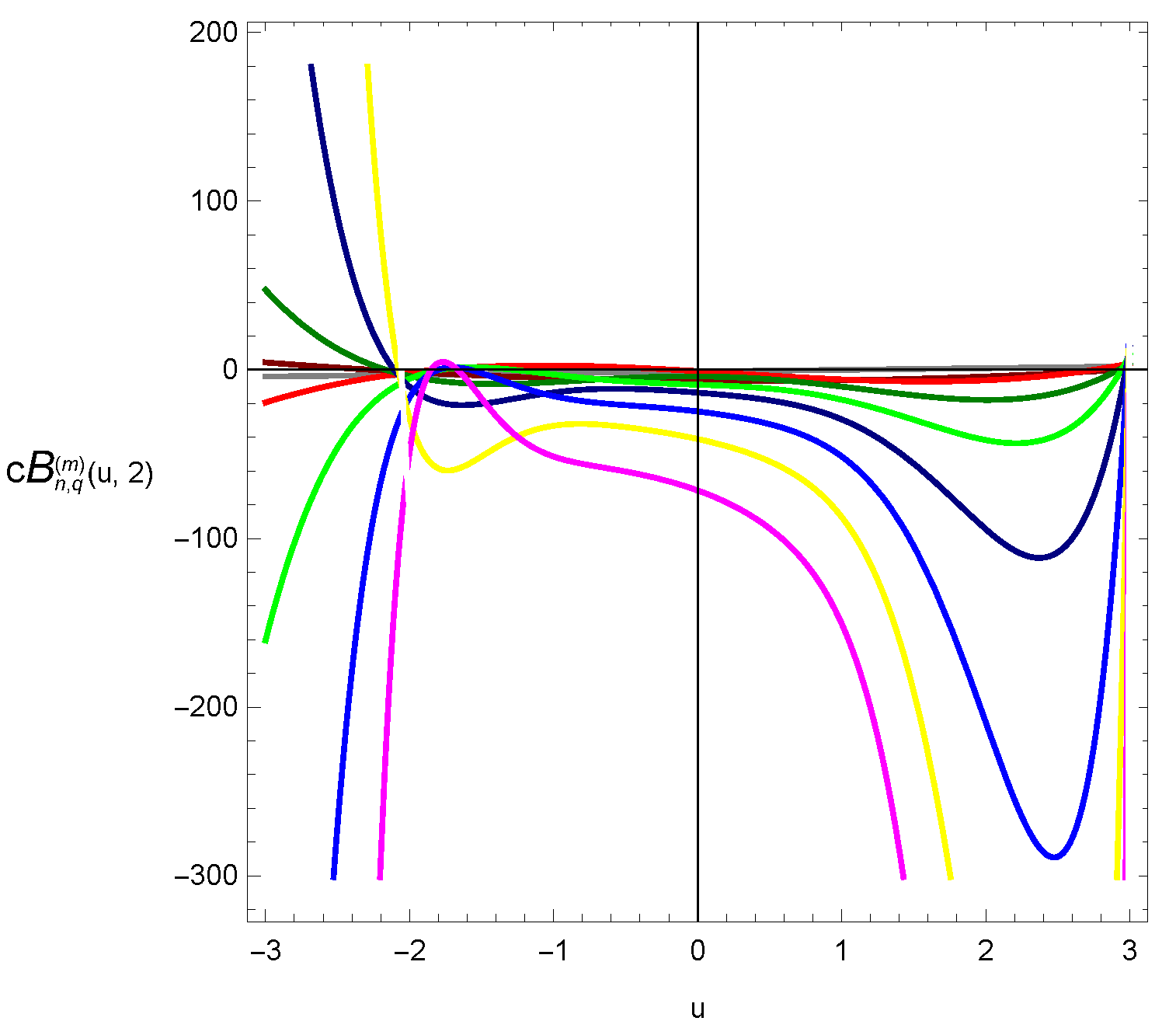
We display the shapes of the qGTBP and investigate its zeros. We plot the graph of qGTBP for combined together. The shape of qGTBP for , and are displayed in Figure 1.
Figure 1.
Curve of qGTBP .
Our numerical results for the number of real and complex zeros of the qGTBP for and are listed in Table 5.
Table 5.
The numbers of real and complex zeros of .
Next, we calculated an approximate solution satisfying the qGTBP = 0 for and . The results are given in Table 6.
Table 6.
Approximate solutions of for .
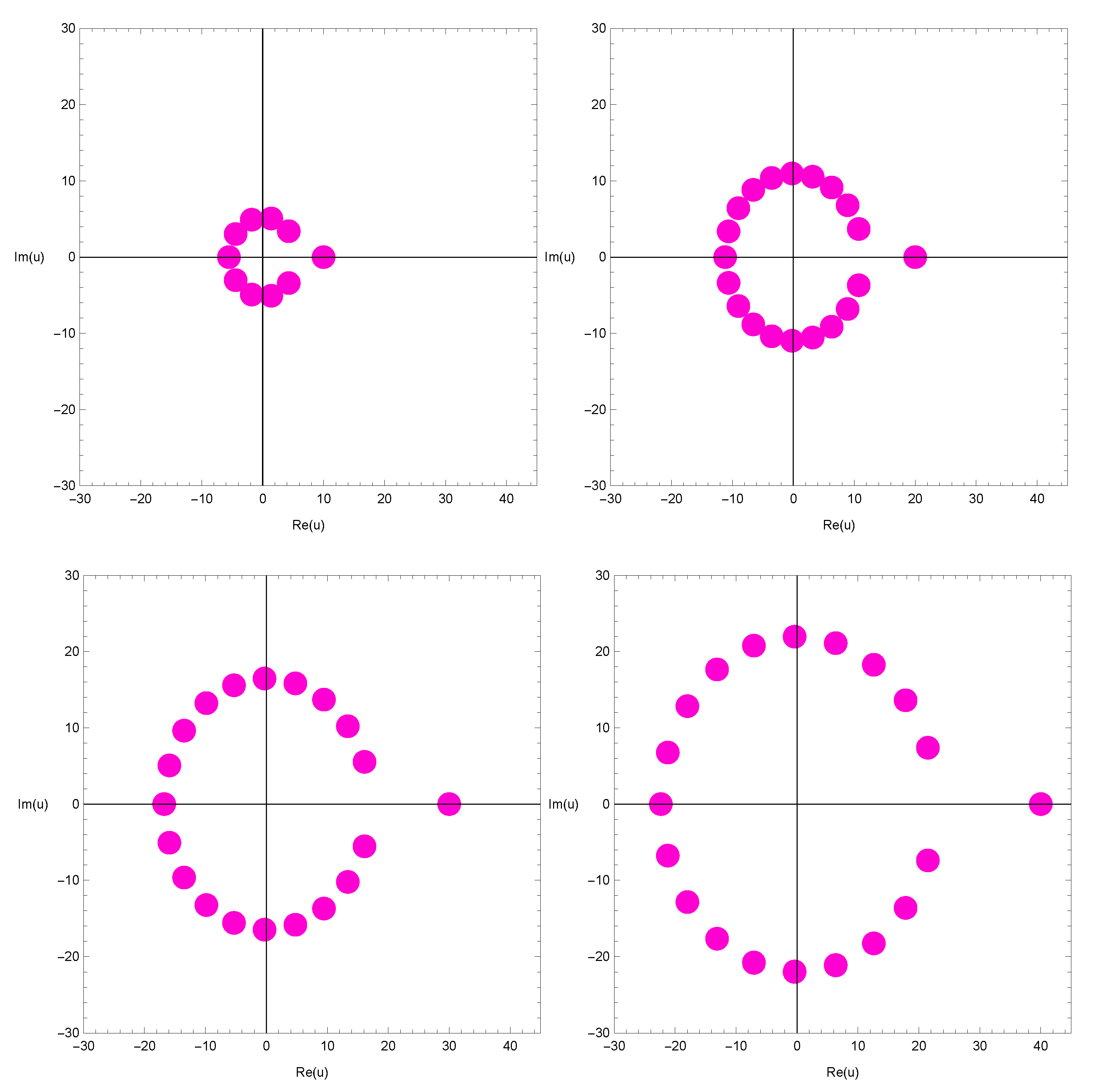
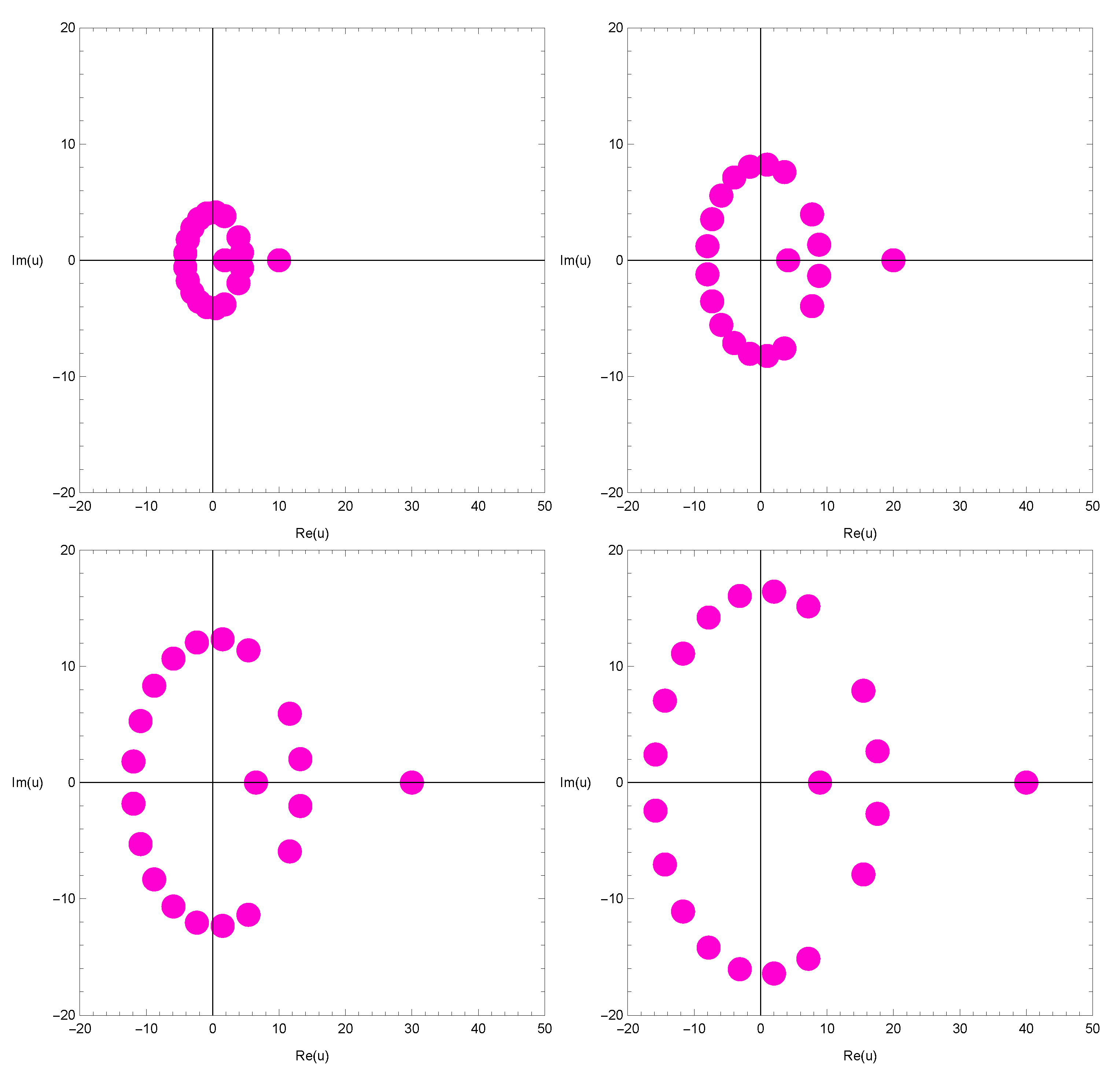
We investigated the beautiful zeros of the qGTBP by using a computer. The zeros of the qGTBP for are plotted in Figure 2.
Figure 2.
Zeros of qGTBP .
In Figure 2 (top-left), we choose , and . In Figure 2 (top-right), we choose , and . In Figure 2 (bottom-left), we choose , and . In Figure 2 (bottom-right), we choose , and .
Using computers, several values of n were verified. However, it remains unknown whether the following conjecture is true or false for all values of n (see Table 5 and Table 6 and Figure 2).
Conjecture 1.
For , prove that , has reflection symmetry. However, has no reflection symmetry for .
Conjecture 2.
For , prove that qGTBP has n distinct solutions.
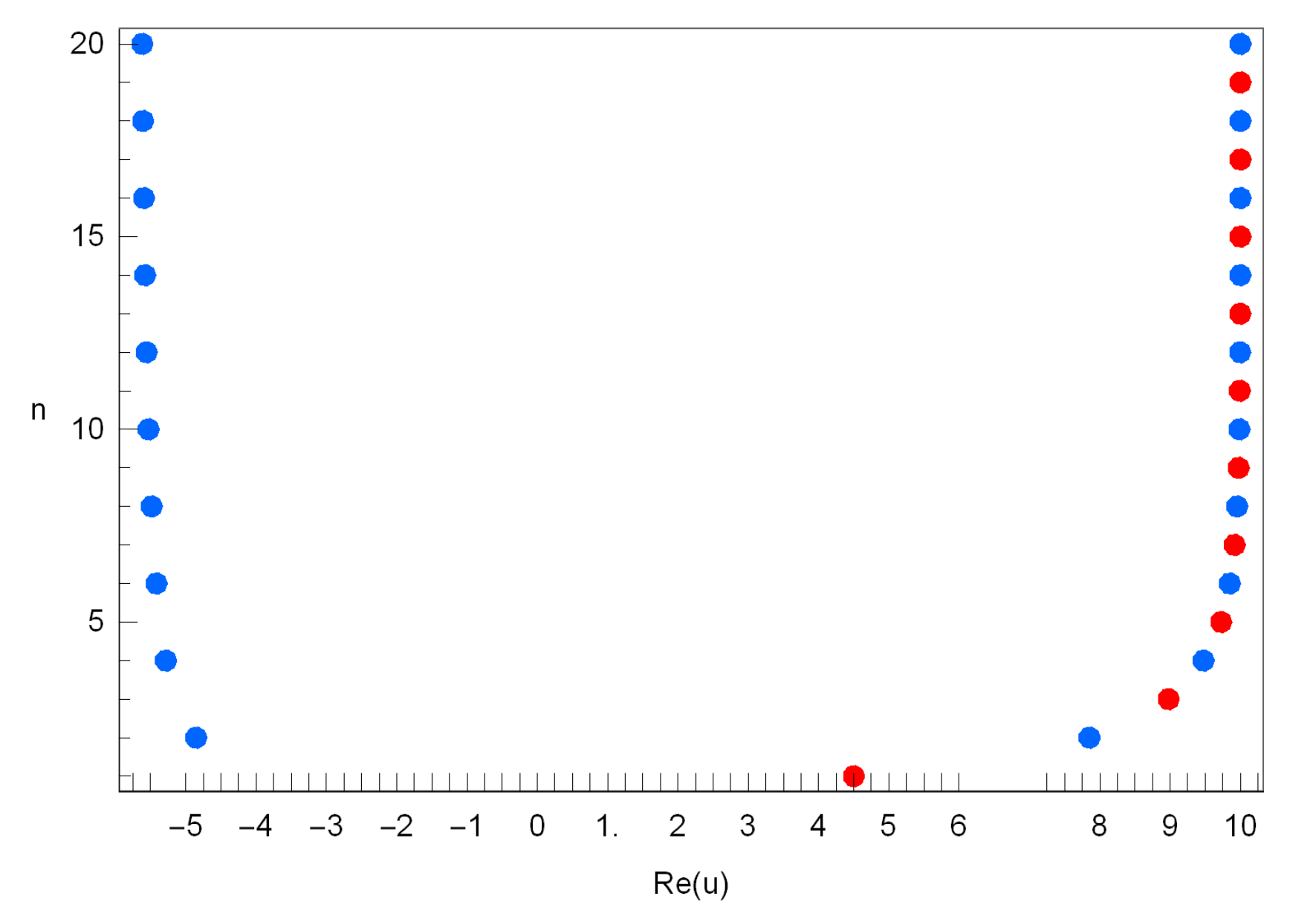
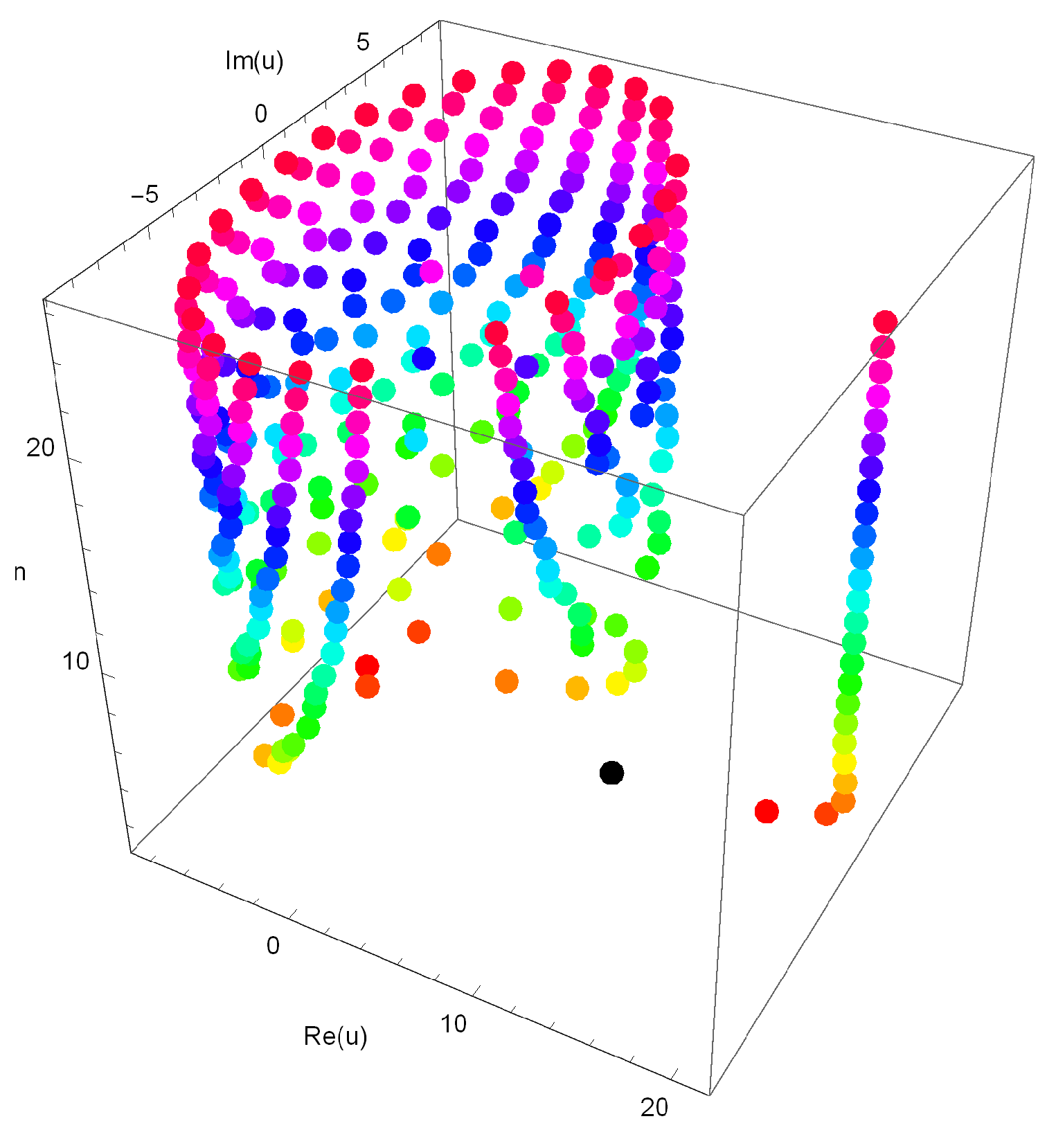
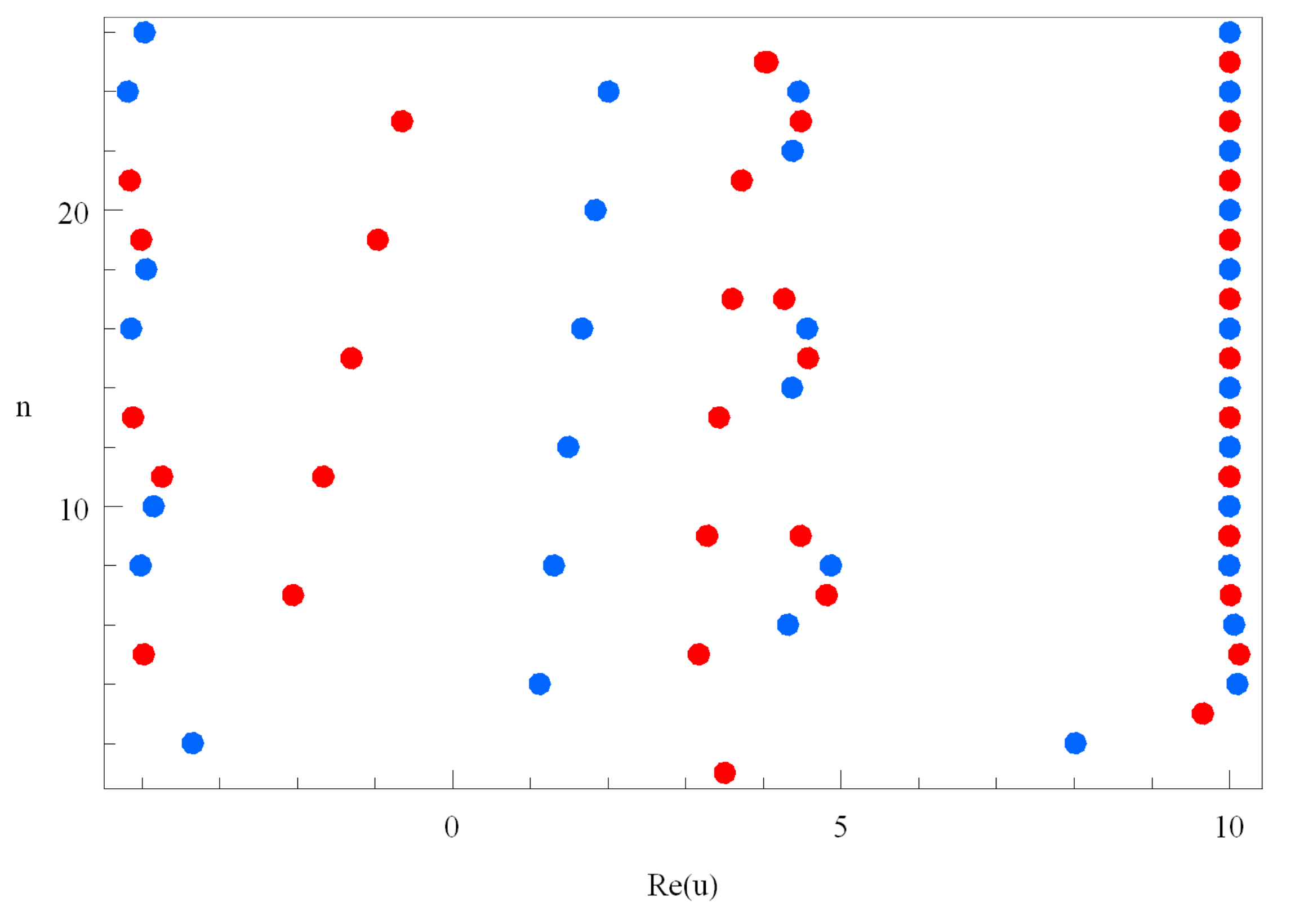
Stacks of zeros of qGTBP for and form a 3-D structure and are presented in Figure 3. Next, we plot the real zeros of the qGTBP for and in Figure 4.
Figure 3.
Stacks of zeros of qGTBP .
Figure 4.
Real zeros of .
The qGTEP can be determined explicitly. A few of them are as follows:
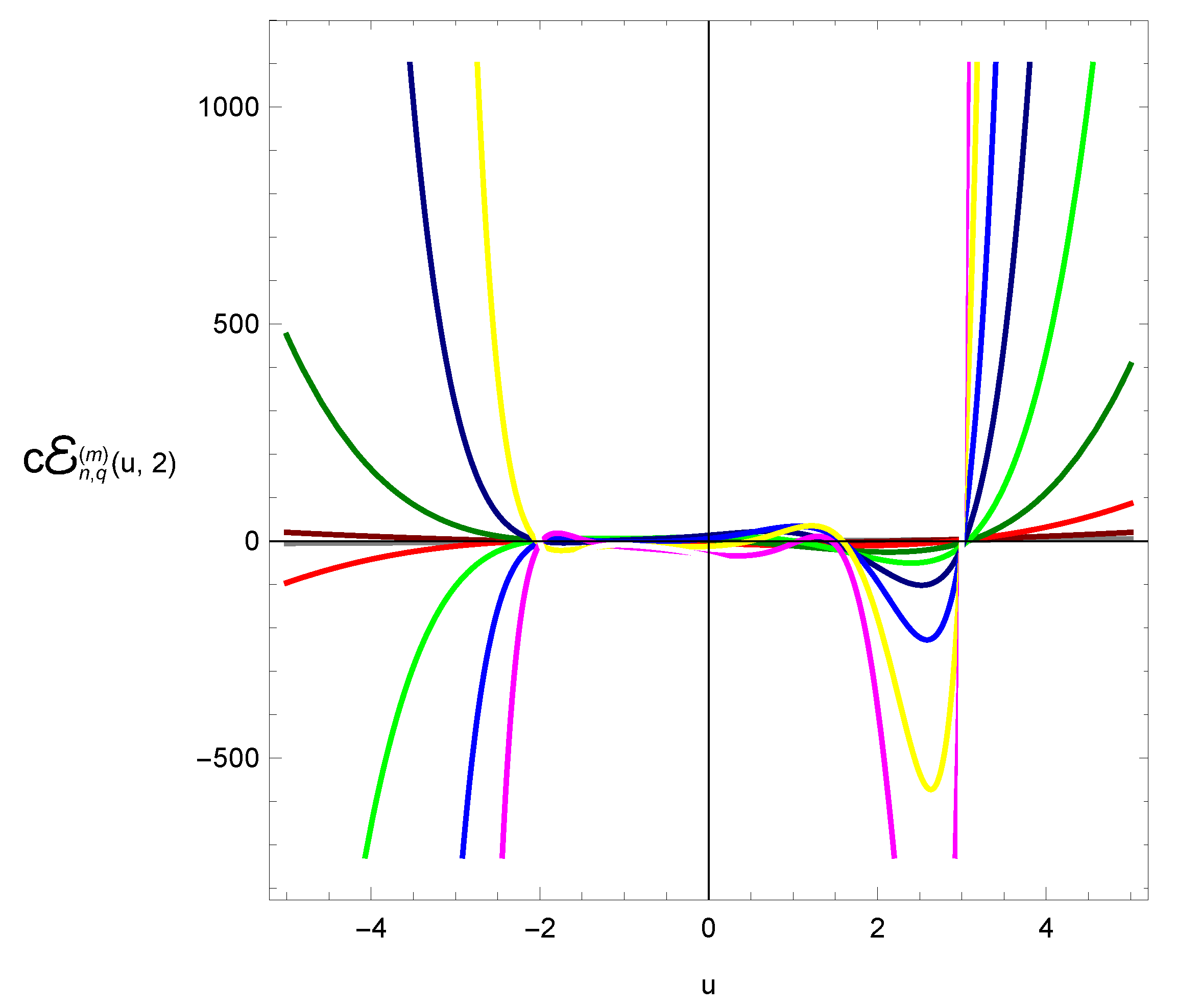
We display the shapes of the qGTEP and investigate its zeros. We plot the graph of qGTEP for combined together. The shape of qGTEP for , and are displayed in Figure 5.
Figure 5.
Curve of qGTEP .
We observed a remarkable regular structure of zeros of the qGTBP and hope to verify the same kind of remarkable regular structure of zeros of the qGTEP . Our numerical results for the number of real and complex zeros of the qGTEP are listed in Table 7 for , and .
Table 7.
Numbers of real and complex zeros of .
Next, we calculated an approximate solution satisfying the qGTEP for , , and . The results are given in Table 8.
Table 8.
Approximate solutions of for .
We investigate the beautiful zeros of the qGTEP by using a computer. The zeros of the qGTEP for are displayed in Figure 6.
Figure 6.
Zeros of qGTEP .
In Figure 6 (top-left), we choose , and . In Figure 6 (top-right), we choose , and . In Figure 6 (bottom-left), we choose , , and . In Figure 6 (bottom-right), we choose , and .
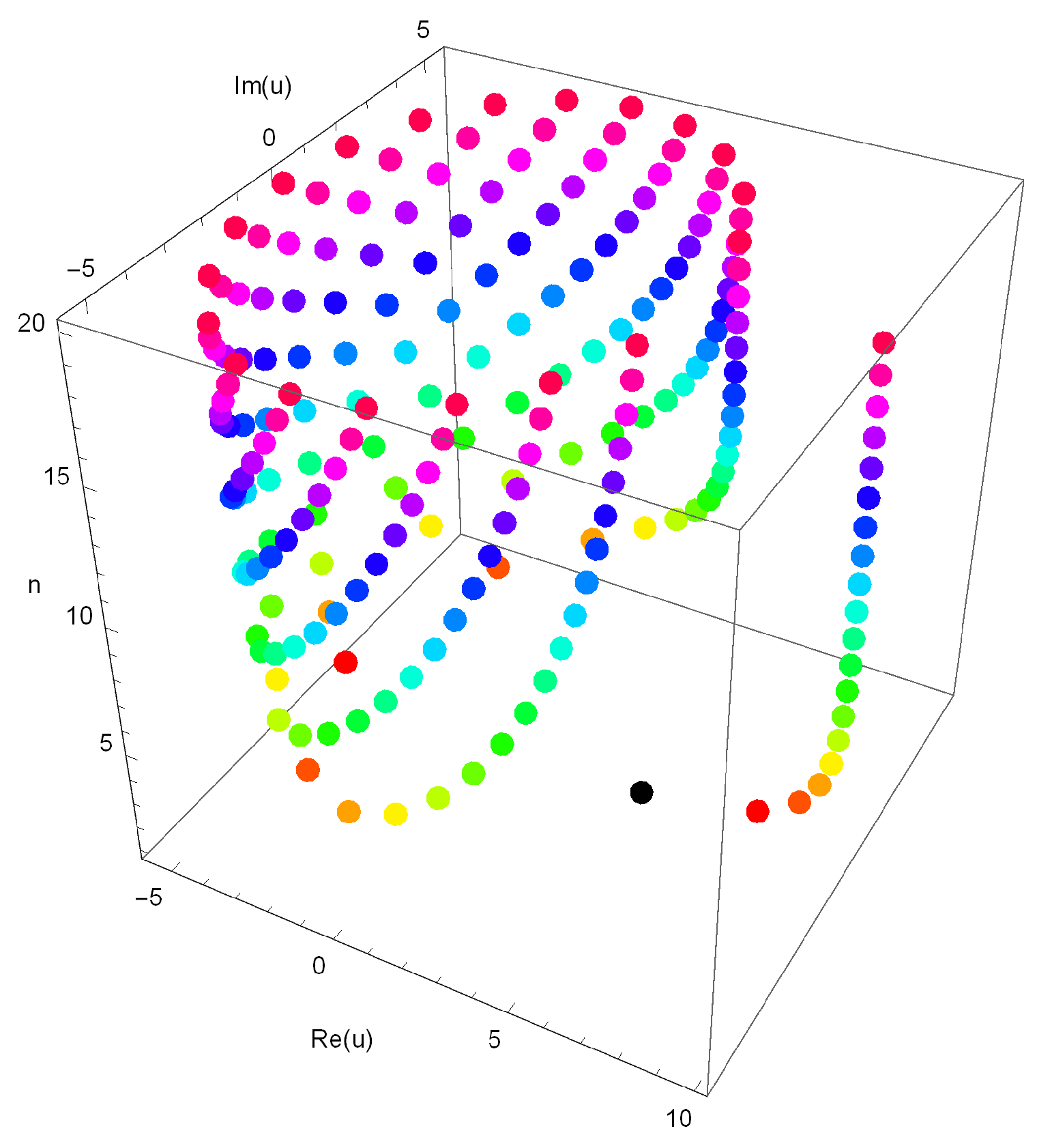
Stacks of zeros of for , and form a 3-D structure and are presented in Figure 7.
Figure 7.
Stacks of zeros of .
Next, we plot the real zeros of the qGTEP for , and in Figure 8.
Figure 8.
Real zeros of .
From all the numerical computations done in this research work, we give the following conjectures:
Conjecture 3.
For , prove that , has reflection symmetry. However, has not reflection symmetry for .
Conjecture 4.
For , prove that qGTEP has n distinct solutions.
Using computers, several values of n have been verified. However, it is still remains unknown if these conjectures hold true or not for any value of n (see Table 7 and Table 8 and Figure 6). We expect that the research in this direction will be a new approach using numerical methods for the study of the qGTAP .
Author Contributions
Conceptualization–G.Y.; software–C.S.R.; validation–G.Y., C.S.R. and H.I.; formal analysis–G.Y., C.S.R. and H.I.; investigation-H.I.; writing, review and editing–H.I.; supervision–G.Y.; funding acquisition–C.S.R. All authors have read and approved the final manuscript.
Funding
This work was supported by the National Research Foundation of Korea (NRF) grant funded by the Korea government (MEST) (No. 2017R1A2B4006092).
Conflicts of Interest
The authors declare that there is no conflict of interest.
References
- Andrews, G.E.; Askey, R.; Roy, R. Special Functions—Encyclopedia of Mathematics and its Applications; Cambridge University Press: Cambridge, UK; London, UK; New York, NY, USA, 2000; Volume 71. [Google Scholar]
- Bildirici, C.; Acikgoz, M.; Araci, S. A note on analogues of tangent polynomials. J. Algebra Number Theory Acad. 2014, 4, 21. [Google Scholar]
- Ryoo, C.S. Generalized Tangent numbers and polynomials associated with p-adic integral on zp. Appl. Math. Sci. 2013, 7, 4929–4934. [Google Scholar] [CrossRef]
- Ryoo, C.S. A note on the tangent numbers and polynomials. Adv. Studies Theor. Phys. 2013, 7, 447–454. [Google Scholar] [CrossRef]
- Yasmin, G.; Muhyi, A. Certain results of 2-variable q-generalized tangent-Apostol type polynomials. J. Math. Computer Sci. 2020, in press. [Google Scholar]
- Mahmudov, N.I. On a class of q-Bernoulli and q-Euler polynomials. Adv. Difference Equ. 2013, 2013, 108. [Google Scholar] [CrossRef]
- Ryoo, C.S. Some properties of two dimensional q-tangent numbers and polynomials. Glob. J. Pure Appl. Math. 2016, 12, 2999–3007. [Google Scholar]
- Appell, P. Sur une Classe de Polynômes; Gauthier-Villars: Paris, France, 1880. [Google Scholar]
- Al-Salam, W.A. q-Appell polynomials. Ann. Mat. Pura Appl. 1967, 77, 31–45. [Google Scholar] [CrossRef]
- Keleshteri, M.E.; Mahmudov, N.I. A study on q-Appell polynomials from determinantal point of view. Appl. Math. Comput. 2015, 260, 351–369. [Google Scholar] [CrossRef]
- Al-Salam, W.A. q-Bernoulli numbers and polynomials. Math. Nachr. 1958, 17, 239–260. [Google Scholar] [CrossRef]
- Ernst, T. q-Bernoulli and q-Euler polynomials, an umbral approach. Int. J. Difference Equ. 2006, 1, 31–80. [Google Scholar]
- Yasmin, G.; Muhyi, A.; Araci, S. Certain results of q-Sheffer-Appell polynomials. Symmetry 2019, 11, 159. [Google Scholar] [CrossRef]
© 2020 by the authors. Licensee MDPI, Basel, Switzerland. This article is an open access article distributed under the terms and conditions of the Creative Commons Attribution (CC BY) license (http://creativecommons.org/licenses/by/4.0/).