


Abstract
In this paper, a non- double set parameter finite element method is presented for the clamped Kirchhoff plate with an elastic unilateral obstacle. A new high accuracy error estimate with order in the broken energy norm is derived by use of a series of novel approaches, including some special features of the element and an incomplete biquadratic interpolation operator. At the same time, some experimental results are provided to verify the theoretical analysis.
1. Introduction
Let be a bounded convex polygonal domain with a Lipschitz continuous boundary . We consider a thin flat plate clamped on its lateral boundary , where is the thickness of the plate and assumed to be small. Assume that the plate is subject to a load and constrained unilaterally by an elastic obstacle , then displacement function u can be obtained by solving the weak formulation (cf. [1]):
where is Poisson’s ratio and describes the stiffness of the obstacle.
It was shown in [1] that the displacement function u can also be derived by the minimization problem:
with the total energy Furthermore, the problem (2) is equivalent to the following fourth-order variational inequality of the second kind:
In particular, in the limit , the obstacle becomes rigid, and the problem reduces to the constrained minimization:
with , which is the classical displacement obstacle problem of the clamped Kirchhoff plate (cf. [2]) and is equivalent to the following fourth-order variational inequality of the first kind:
It is well known that nonconforming finite element methods (FEMs) are an attractive option for solving high order differential equations since the smoothness requirement on finite element functions is weakened. As we know, nonconforming FEMs for the problem (4), the plate obstacle problem with a rigid obstacle, have achieved fruitful results [3,4,5,6,7,8,9], but very few for the elastic obstacle problem (2), except [10]. Compared with the conforming FEMs studied in [1,11], continuous and discontinuous nonconforming (i.e., and non- nonconforming) FEMs were discussed in [10], and convergence analyses were established. On the other hand, the high accuracy analysis of nonconforming FEMs has been an active research area in practical computations, and many high accuracy results have been derived for variational inequalities and the boundary value problem [12,13,14,15,16,17,18,19,20]. However, for the plate obstacle problem (4) with a rigid obstacle, the exact solution u only belongs to instead of [21,22]; thus, the lack of regularity makes it impossible to develop high accuracy analysis. Fortunately, it was shown in [10] that the solution is more regular if the obstacle is elastic. In fact, the solution of the problem (2) belongs to when the largest interior angles of the domain are smaller than , and thus, the high accuracy analysis of FEMs for the problem (2) is possible and worth exploring.
In this paper, we attempt to present a high accuracy analysis of nonconforming double set parameter FEMs for the obstacle problem (2). The double set parameter method presented in [23,24] is a useful method to construct unconventional elements, and it involves two sets of parameters. The first set is chosen to meet the convergence requirements according to the generalized patch test [25] or F-E-M-test [26], while the second set is selected to be simple so that the total number of unknowns in the resulting discrete system is small. Up to now, several nonconforming double set parameter plate elements have been successfully applied to deal with the two-sided displacement obstacle problem of the clamped plate [8], plate bending problems [16,27], the linear elasticity problem [28], the fourth-order elliptic singular perturbation problem [29,30,31] and so on. In this paper, a non- nonconforming double set parameter plate element is employed for the elastic obstacle problem (2). We develop a series of novel approaches including some special features of the element and an incomplete biquadratic interpolation operator so as to get the high accuracy result with order in the broken energy norm. Furthermore, we carry out a numerical experiment to show the performance of the proposed method.
2. A Twelve Parameter Double Set Parameter Element and Its Typical Properties
In the beginning, we introduce a twelve parameter double set parameter element briefly. The readers are referred to [27] for details.
Assume that is a regular rectangular decomposition of . For a given , let its center be , four vertices be , four edges be , and the edge length be and , respectively. Moreover, we denote . Besides, assume that is the reference element on the plane with a center point , four vertices , and , and four edges , , , and . Then, there exists an affine mapping :
satisfying
The shape function space on the element K is taken as:
where and denotes the space consisting of piecewise polynomials of degree m on element K.
The degrees of freedom are selected as:
where:
For , let:
where
It is easy to check that ; thus , i.e., it holds that:
Next, we take nodal parameters as:
where are the function values of v and its first derivatives at vertices , respectively.
Then, approximating by a linear combination of the nodal parameters as follows:
for , the numerical integrating values of cubic Hermite interpolation polynomials on the corresponding sides result in:
for , the trapezoidal rule of numerical integration giving:
The above discretizations can be rewritten in matrix form as:
where:
and:
with . From (18), it is obvious that the term does not affect the convergence properties, and we neglect it and introduce a new set of parameters:
such that:
where and and have perturbations on and , respectively. The readers are referred to [23,24] for details.
Then, using (10) and (19), we obtain:
which in conjunction with (9) leads to the real shape function v. Thus, the unknowns of the discrete system are , and the real shape function space is a subspace of :
It is easy to check that , i.e., the dimension of is 10, and can be expressed as where:
Obviously, is a cubic polynomial. In other words, is a completely cubic polynomial space. We denote the corresponding FE space by :
Lemma 1.
For any , the following properties hold:
is continuous at the vertices of elements and is zero at the vertices on Γ.
is continuous across the element edge F and is zero on .
, i.e., is a linear polynomial function defined on the element edge F, and is continuous across the element edge F and is zero on .
is a norm over , where .
3. High Accuracy Analysis
We consider the discrete approximation form of the variational inequality (3) as:
where
It was shown in [1] that the problem (26) is equivalent to the discrete approximation of the plate problem:
which is also equivalent to the minimization problem:
where the energy functional Since is coercive on , we can get the lower bound for and (as ). Then, using the elementary inequality and an argument similar to that used in [10], we have:
Theorem 1.
The problem (26) has a unique solution . Moreover, and are uniformly bounded independently of h.
In what follows, we will give error estimates for (26).
Theorem 2.
Proof.
Employing the triangle inequality yields:
where is the associated interpolation operator on . Let . We have by (27) that:
Now, we focus on the estimate of the second term on the right-hand side of (31). Obviously,
where and . In order to estimate (32), we notice that the solution u of the problem (3) satisfies (see [10]):
However, from the construction of the element and – in Lemma 1, we know that . In this situation, we need to introduce a piecewise interpolation polynomial of as follows:
Then, from and in Lemma 1, we have , which in conjunction with (32) and (33) yields:
Now, we start to estimate one by one for
Firstly, for , let be the piecewise linear Lagrange interpolation on edge F and with then the corresponding remainders are:
Applying in Lemma 1 leads to:
which follows from:
Here, the Cauchy–Schwarz inequality and interpolation theorem [32,33] are used.
Secondly, for , we have:
Employing integration by parts and (34), the first term of (37) can be estimated as:
Similarly, it holds that:
which together with interpolation theorem yields:
Thirdly, it follows from the definition of in (34) that:
Then, let and . With a similar argument as and , we obtain:
As for and , from the Cauchy–Schwarz inequality and interpolation theorem, it holds that:
and:
Finally, employing the elementary inequality and Theorem 1, we have:
Combining (31), (35), and the above bounds of – results in:
Therefore, the desired result (29) follows from (30), (46) and the interpolation theorem immediately. □
Remark 1.
plays a key role in the estimations of and in Theorem 2. If using the error estimate method in [10], we can only obtain the convergence result with the order of . In addition, it should be pointed out that the analysis presented herein is also valid for the elastic obstacle problem with , , and .
Remark 2.
Compared with the work in [10], we obtain the same high accuracy result with a non- nonconforming element instead of the nonconforming ACM’s rectangular element. Therefore, our work is an extension of [10], and the requirement for the nonconforming plate element’s smoothness from continuity to mean continuity is further reduced (– implies that the element discussed in this paper is of the mean type). It can be checked that the high accuracy result in Theorem 2 is no longer true for many classical non- nonconforming plate elements, such as the Morley triangle element, the Veubeke triangle element, and so on.
4. Numerical Experiment
In this section, we consider the elastic obstacle problem (2) with , , and an elastic obstacle defined by the function Since the exact solution is unknown, we refer the numerical solution on rectangles with as the exact solution to show the errors. The domain is divided into rectangles, and the cases with are computed, respectively. The numerical results are given in the following Table 1. Moreover, Figure 1, Figure 2 and Figure 3 illustrate the numerical solution with , and Figure 4 presents the errors in the logarithm scales. It is obvious that the errors in the energy norm are convergent at order , which coincides with the theoretical analysis in Theorem 2.

Table 1.
Errors of and the CPU time.
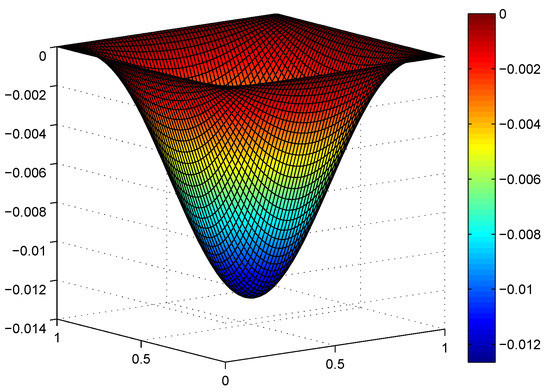
Figure 1.
The numerical solution with .
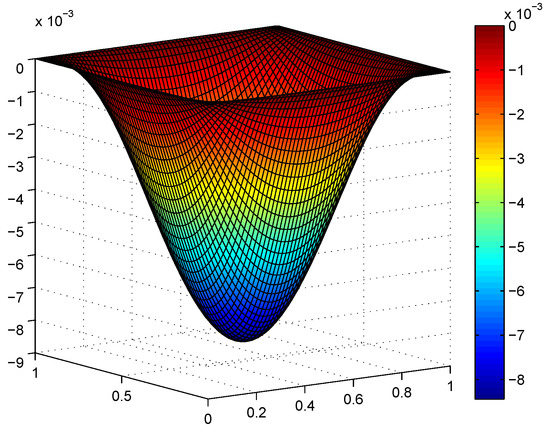
Figure 2.
The numerical solution with .
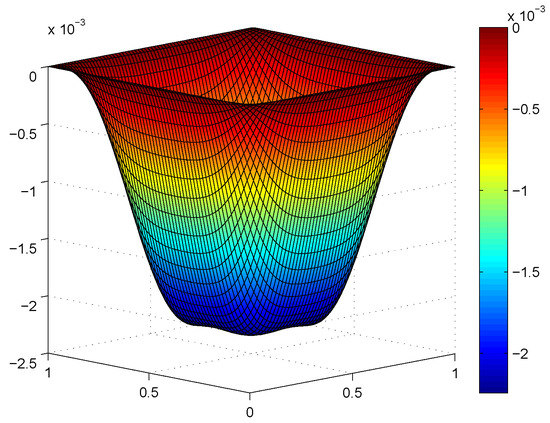
Figure 3.
The numerical solution with .
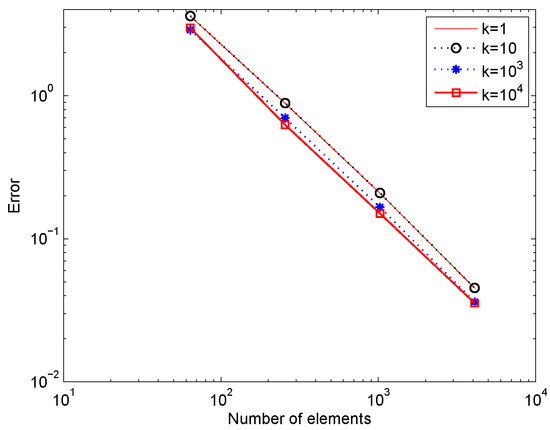
Figure 4.
Errors in the energy norm with different k.
Author Contributions
Conceptualization, L.P.; software, L.P.; methodology, L.P. and D.S.; writing, original draft preparation, L.P.; writing, review and editing, D.S. All authors read and agreed to the published version of the manuscript.
Funding
This research was supported by the National Natural Science Foundation of China (No. 11701523, No. 11671369).
Conflicts of Interest
The authors declare no conflict of interest.
References
- Tosone, C.; Maceri, A. The clamped plate with elastic unilateral obstacles: A finite element approach. Math. Model. Methods Appl. Sci. 2003, 13, 1231–1243. [Google Scholar] [CrossRef]
- Glowinski, R. Numerical Methods for Nonlinear Variational Inequality Problems; Springer: New York, NY, USA, 1984. [Google Scholar]
- Wang, L.H. Some strongly discontinuous nonconforming finite element approximations of a fourth order variational inequality with displacement obstacle. Acta. Numer. Math. 1992, 14, 98–101. [Google Scholar]
- Shi, D.Y.; Chen, S.C. Quasi conforming element approximation for a fourth order variational inequality with displacement obstacle. Acta Math. Sci. 2003, 23B, 61–66. [Google Scholar] [CrossRef]
- Shi, D.Y.; Chen, S.C. General estimates on nonconforming elements for a fourth order variational problem. Numer. Math. Sin. 2003, 25, 99–106. [Google Scholar]
- Brenner, S.C.; Sung, L.Y.; Zhang, Y. Finite element methods for the displacement obstacle problem of clamped plates. Math. Comp. 2012, 81, 1247–1262. [Google Scholar] [CrossRef]
- Brenner, S.C.; Sung, L.Y.; Zhang, H.C.; Zhang, Y. A Morley finite element method for the displacement obstacle problem of clamped Kirchhoff plates. J. Comput. Appl. Math. 2013, 254, 31–42. [Google Scholar] [CrossRef]
- Shi, D.Y.; Pei, L.F. Double set parameter finite element method for two-sided displacement obstacle problem of clamped plate. J. Math. Anal. Appl. 2016, 436, 203–216. [Google Scholar] [CrossRef]
- Shi, D.Y.; Pei, L.F. A new error analysis of Bergan’s energy-orthogonal element for two-sided displacement obstacle problem of clamped plate. J. Math. Anal. Appl. 2016, 442, 339–352. [Google Scholar] [CrossRef]
- Han, W.M.; Hua, D.Y.; Wang, L.H. Nonconforming finite element methods for a clamped plate with elastic unilateral obstacle. J. Integral Eq. Appl. 2006, 18, 267–284. [Google Scholar] [CrossRef]
- Gustafsson, T.; Stenberg, R.; Videman, J. A stabilised finite element method for the plate obstacle problem. Br. Numer. Math. 2018, 2018, 1–28. [Google Scholar] [CrossRef]
- Li, M.X.; Lin, Q.; Zhang, S.H. Superconvergence of finite element method for the Signorini problem. J. Comput. Appl. Math. 2008, 222, 284–292. [Google Scholar] [CrossRef]
- Shi, D.Y.; Ren, J.C.; Gong, W. Convergence and superconvergence analysis of a nonconforming finite element method for solving the Signorini problem. Nonlinear Anal. Theor. 2012, 75, 3493–3502. [Google Scholar] [CrossRef]
- Shi, D.Y.; Guan, H.B.; Guan, X.F. Superconvergence analysis of finite element method for a second-type variational inequality. J. Appl. Math. 2012, 2012, 1–12. [Google Scholar] [CrossRef]
- Xu, C.; Shi, D.Y. Superconvergence analysis of low order nonconforming finite element methods for variational inequality problem with displacement obstacle. Appl. Math. Comp. 2019, 348, 1–11. [Google Scholar] [CrossRef]
- Chen, S.C.; Yin, L.; Mao, S.P. An anisotropic, superconvergent nonconforming plate finite element. J. Comput. Appl. Math. 2008, 220, 96–110. [Google Scholar] [CrossRef]
- Shi, D.Y.; Wu, Y.M. Uniform superconvergent analysis of a new mixed finite element method for nonlinear Bi-wave singular perturbation problem. Appl. Math. Lett. 2019, 93, 131–138. [Google Scholar] [CrossRef]
- Hu, J.; Shi, Z.C.; Yang, X.Q. Superconvergence of both two and three dimensional rectangular Morley elements for biharmonic equations. Mathematics 2015, 132, 491–509. [Google Scholar]
- Ruggieri, M.; Speciale, M.P. Approximate analysis of a nonlinear dissipative model. Acta Appl. Math. 2014, 132, 549–559. [Google Scholar] [CrossRef]
- Shi, D.Y.; Mao, S.P.; Chen, S.C. On the anisotropic accuracy analysis of ACM’s nonconforming finite element. J. Comput. Math. 2005, 23, 185–198. [Google Scholar]
- Frehse, J. On the regularity of the solution of the biharmonic variational inequality. Manuscripta Math. 1973, 9, 91–103. [Google Scholar] [CrossRef]
- Schild, B. A regularity result for polyharmonic variational inequalities with thin obstacles. Ann. Scuola Norm. Sup. Pisa Cl. Sci. 1984, 11, 87–122. [Google Scholar]
- Chen, S.C.; Shi, Z.C. Double set parameter method of constructing stiffness matrices. Numer. Math. Sin. 1991, 3, 286–296. [Google Scholar]
- Chen, S.C.; Shi, D.Y. The error estimates for double set parameter elemet. J. Eng. Math. 2005, 22, 599–605. [Google Scholar]
- Stummel, F. The generalized patch test. SIAM J. Numer. Anal. 1979, 16, 449–471. [Google Scholar] [CrossRef]
- Shi, Z.C. The F-E-M-test for convergence of nonconforming finite element. Math. Comp. 1987, 49, 391–405. [Google Scholar]
- Shi, D.Y. Studies on Nonconforming Elements. Ph.D. Thesis, Xi’an Jiaotong University, Xi’an, China, 1997. [Google Scholar]
- Mao, S.P.; Chen, S.C. A quadrilateral nonconforming finite element for linear elasticity problem. Adv. Comput. Math. 2008, 28, 81–100. [Google Scholar] [CrossRef]
- Chen, S.C.; Zhao, Y.C.; Shi, D.Y. Non C0 nonconforming elements for elliptic fourth order singular perpurbation problem. J. Comput. Math. 2005, 23, 185–198. [Google Scholar]
- Xie, P.L.; Shi, D.Y.; Li, H. A new robust C0-type nonconforming triangular element for singular perturbation problems. Appl. Math. Comput. 2010, 217, 3832–3843. [Google Scholar] [CrossRef]
- Chen, S.C.; Liu, M.F.; Qiao, Z.H. An anisotropic nonconforming element for fourth order elliptic singular perturbation problem. Int. J. Numer. Anal. Model. 2010, 7, 766–784. [Google Scholar]
- Ciarlet, P.G. The Finite Element Method for Elliptic Problems; North-Holland: Amsterdam, The Netherlands, 1978. [Google Scholar]
- Brenner, S.C.; Scott, L.R. Mathematics Theory Finite Element Methods; Springer: New York, NY, USA, 1994. [Google Scholar]
Publisher’s Note: MDPI stays neutral with regard to jurisdictional claims in published maps and institutional affiliations. |
© 2020 by the authors. Licensee MDPI, Basel, Switzerland. This article is an open access article distributed under the terms and conditions of the Creative Commons Attribution (CC BY) license (http://creativecommons.org/licenses/by/4.0/).