1. Introduction
In the simplest case of type-I second harmonic generation (SHG) without walk-off between harmonic waves soliton evolution is described by the normalized system [
1,
2,
3,
4,
5,
6]:
where
is the rescaled soliton parameter and satisfies
the dimensionless parameter
is the normalized nonlinearity-induced shift to the propagation constant of the fundamental harmonic wave,
and
are the coefficient and phase mismatch parameter, respectively. This system represents the generic model of
solitons. There are other types of normalization also used in the literature see e.g., [
7,
8,
9]. The solutions of this system have been discussed for one dimensional in [
3,
4,
5,
10,
11,
12,
13] and multi-dimensional cases in [
14]. Under suitable assumptions, the problem of the two-wave (symbiotic) solitons can be reduced to the solution of the following coupled system [
1,
2,
3,
4,
6,
13,
15]
The properties of solitons described by system (
2) are well known see [
3,
4,
5], where the authors Buryak and Kivshar [
3,
4,
5] looked for stationary (i.e., z-independent) localized solutions of the normalized system in the form of an asymptotic series in the parameter
and found the real functions
and
in the form of asymptotic series:
for bright solitons at
and
where
for dark solitons at
Exact solutions of system (
2) have been found at
for
and
in [
10,
13]. Another solution of (
2) in the case
and
is provided in an explicit analytical form [
11]. Also, different analytical approximation methods have been proposed to deal with the system (
2). For example, an accurate approximate solution with the help of the variational method is obtained in [
13] and a family of bright (dark) solitons for
and
was also discussed in [
15] using the numerical shooting and relaxation techniques.
Recently, the authors [
16] studied this coupled system subject to the following boundary conditions:
and showed that the solutions of this system could be obtained numerically using the Green’s function method.
Since the exact analytical solutions of Equation (
2) cannot be found for arbitrary values of
then the purpose of this work is to present a result of the existence and uniqueness of solutions. Also, an exact implicit solution is derived using a useful procedure at
Thus, the paper is organized as follows: in
Section 2, we investigate the existence and uniqueness theorem of the two-wave solitons in quadratic media, where the problem is formulated in the context of two nonlinear coupled differential equations in one dimension. Then, in
Section 3, we solve the coupled system by an appropriate technique with suitable boundary conditions. A systematic numerical procedure is proposed in
Section 4. Finally, we conclude with some remarks in
Section 5.
2. An Existence and Uniqueness Theorem
Rewrite (
2) in the following system
where
are defined by
and
Existence-In this section, we shall deal with the existence of solutions of the BVP (
2) with (
7). First off all, we shall prove the following lemmas, which are useful tools in the proof of the existence and uniqueness theorem.
Lemma 1. If we assume that Then, the functions are Lipschitz continuous functions of φ and
Proof. From the definition of
we have
Since
then there exist
such that
and
for all
Similarly, we obtain
where
and
. □
Lemma 2. (See pp. 70–71 [17]). Let be a continuous function. The unique solution u of the following boundary value problem subject to the Dirichlet boundary conditions is given by where is the Green function given by and
Replacing
a and
b by
and
in Lemma 2, respectively, we obtain an equivalent integral system
Define the Banach space
with norm
where
and the operator
by
where
and
Since
and
consider the closed and convex set
Furthermore, assume that
In the theory of differential equations, there are a lot of methods to establish the existence of solutions. Theorems concerning the existence and properties of fixed points are known as fixed-point theorems. Such theorems are the most important tools for proving the existence and uniqueness of the solution. The fundamental theorem used in this theory is Schauder’ s theorem. In order to make use of this theorem, it is sufficient to prove the following lemma.
Lemma 3. For any is contained in
Proof. It follows by the definition of
that
Since is defined by the above condition, thus On account of the continuity of and it follows that is continuous. This shows that is also contained in □
In order to prove that
is equicontinuous, it is easy to see from its definition that
where
Therefore T is compact by the classical Ascoli lemma, and Schauder’s fixed point theorem yield the fixed point of Thus, we have proved:
Theorem 1. There exists a continuous solution which satisfies system Equations (2) and (7) with the condition on and Uniqueness-A uniqueness theorem can also be obtained from the Lipschitz continuous in and
Theorem 2. If then the system Equation (2) with (7) has a unique solution Proof. Let
and
be two solutions of (
2)–(
7). Then, for
Consequently,
where
We now apply the condition
to this inequality, we get
and
Therefore
□
The proof is complete.
3. On the Decoupling of the System (2)
In this section, first of all, we are concerned with the norms estimate for the functions and when
Lemma 4. Let φ and ψ be two functions in where Then where is the norm defined in the Sobolev space by Proof. Multiplying both sides of the first equation of system (
2) by
and integrating from
to
we obtain
From the second equation of system (
2), we have
By substitution into the last term of (
29), we obtain
Integrating by parts and taking into account the given boundary conditions, we obtain
Let us now consider the case
[
6,
10,
13] and in view of Lemma 6 if
then it may be shown that the two equations of system (
2) can be separated into the following nonlinear equation
The exact solution to Equation (
33) follows by simply multiplying both sides of Equation (
33) by
which can be written as follows
and integrating with respect to
we obtain
where
is an arbitrary constant of integration. Thus
In view of
we have
Consequently,
where
is also a constant of integration.
The LHS of Equation (
39) can be evaluated direct from the integrals of irrational functions. Indeed, if we choose
then
Since
Hence, a simple computation leads to the implicit solution
Thus, we have
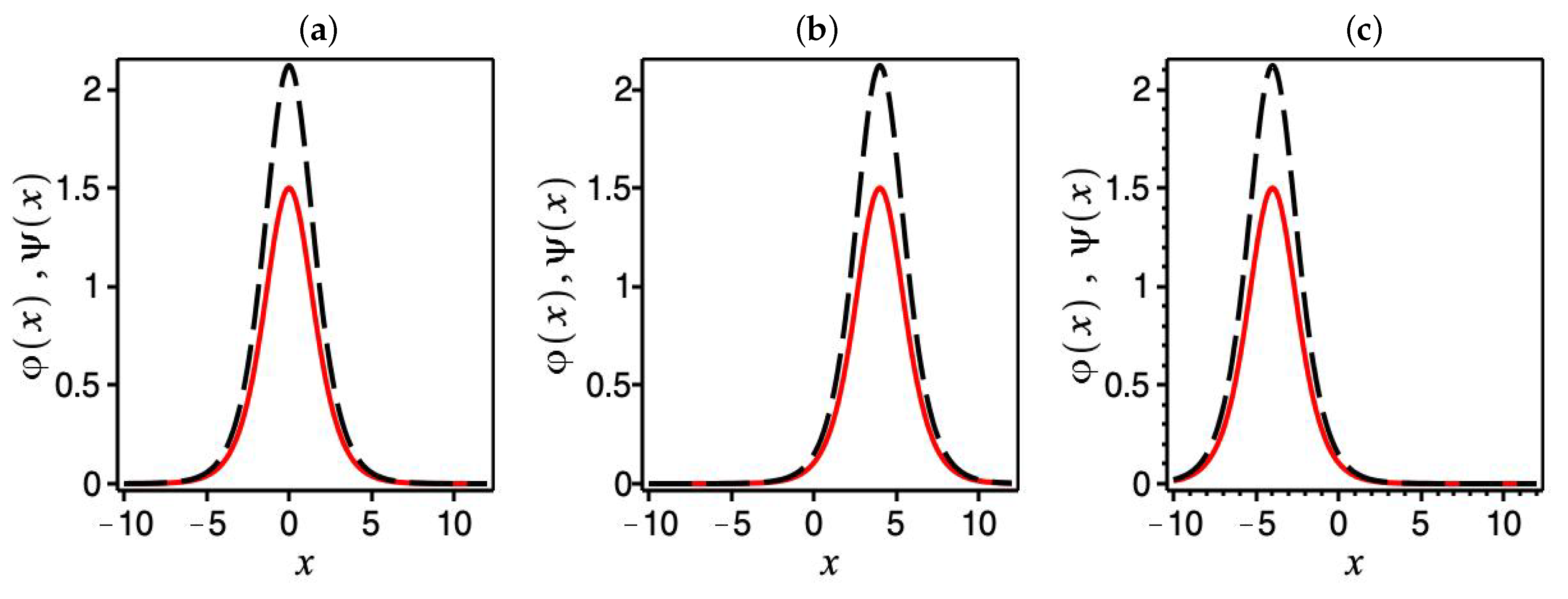
Lemma 5. The system (2) can be decoupled without increase the order of the system into the nonlinear Equation (33) when Furthermore, the solution is given by (41). In
Figure 1, we display the variation of the exact solutions Equation (
41) in terms of the independent variables
x for different values of the constant of integration
(Equation (
39)). it can be seen that this constant of integration shifted left or right the distribution away from the origin with negative or positive values of
respectively. Also, it does not affect the behavior of the solutions, and the maximum value of the solution remains unchanged. Thus it can be chosen
4. Numerical Analysis
An integral system equivalent to Equation (
2) with Equation (
7) can be derived. Indeed, integrating (
2) twice from
to
x and taking into account the boundary conditions
we obtain
where
and
are unknown constants to be determined from the second boundary conditions
We now construct a sequence of approximation of the solution that converges to the solution. The components
can be elegantly determined by setting the recursion scheme
Theorem 3. The sequence defined by (43) converges uniformly on I to the unique solution . Proof. We shall construct an upper bound for
by induction.
where
and
Proceeding in the same manner, we obtain by induction
The two series
and
are absolutely convergent series. Moreover, these series dominate the two series
and
Hence, by the Weierstrass test, the last two infinite series converge absolutely and uniformly on
If we consider the
partial sum of these series, we see that
and
that is,
converges absolutely and uniformly on
If we now define
then taking the limit as
we obtain
It follows that upon differentiation of this system that
is the solution of Equation (
2). Furthermore, it is clear that
□
In view of (
43), the numerical solutions are then given by
If we match
at
then we need to solve
we obtain
and
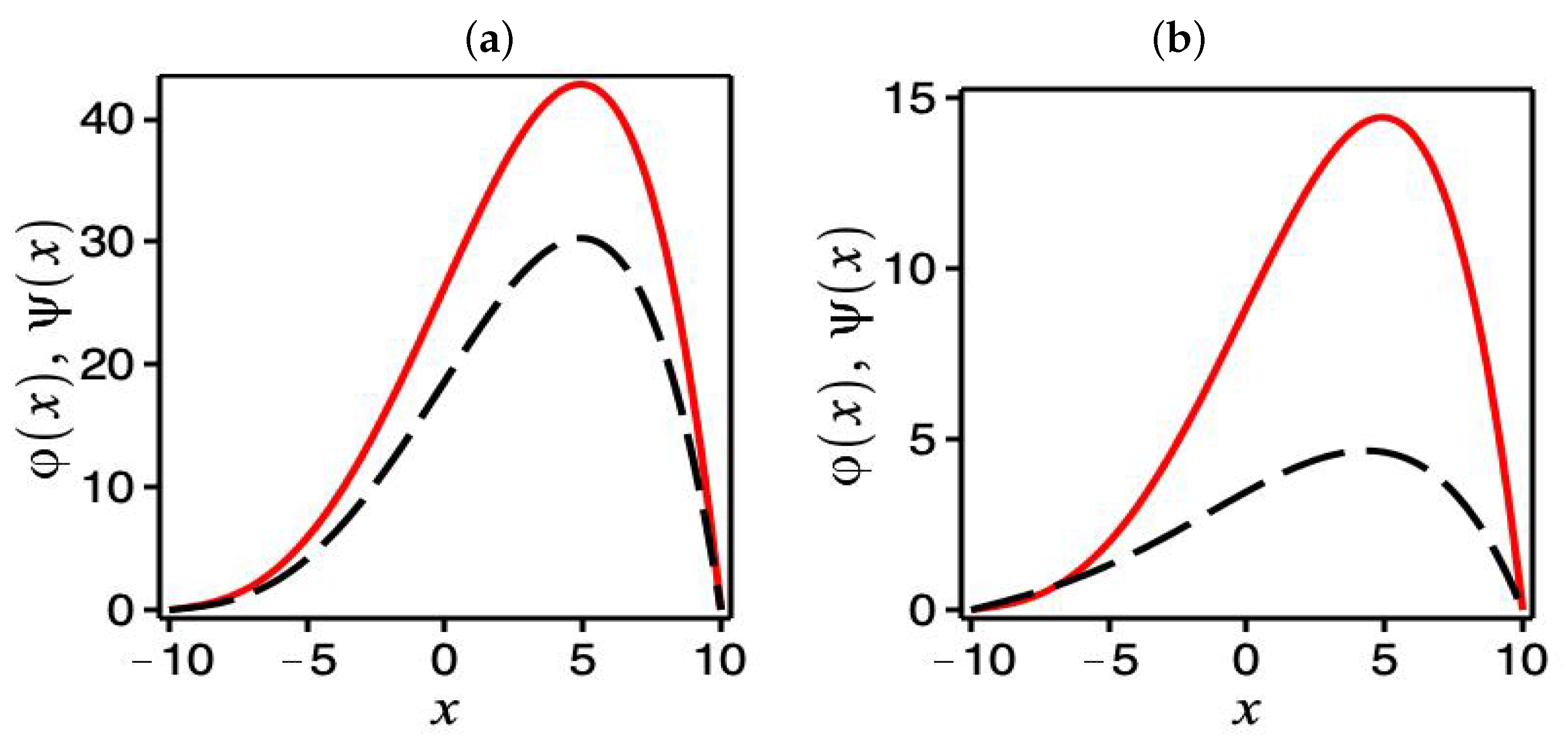
In
Figure 2, we present the variation of the numerical solutions Equation (
47) against of the independent variables
x for different values of the rescaled soliton parameter
.
Now if we insert the solutions of Equation (
47) in the second member of Equation (
43) and performing the integrals, then using the boundary condition for
at
we can obtain the second solutions
and
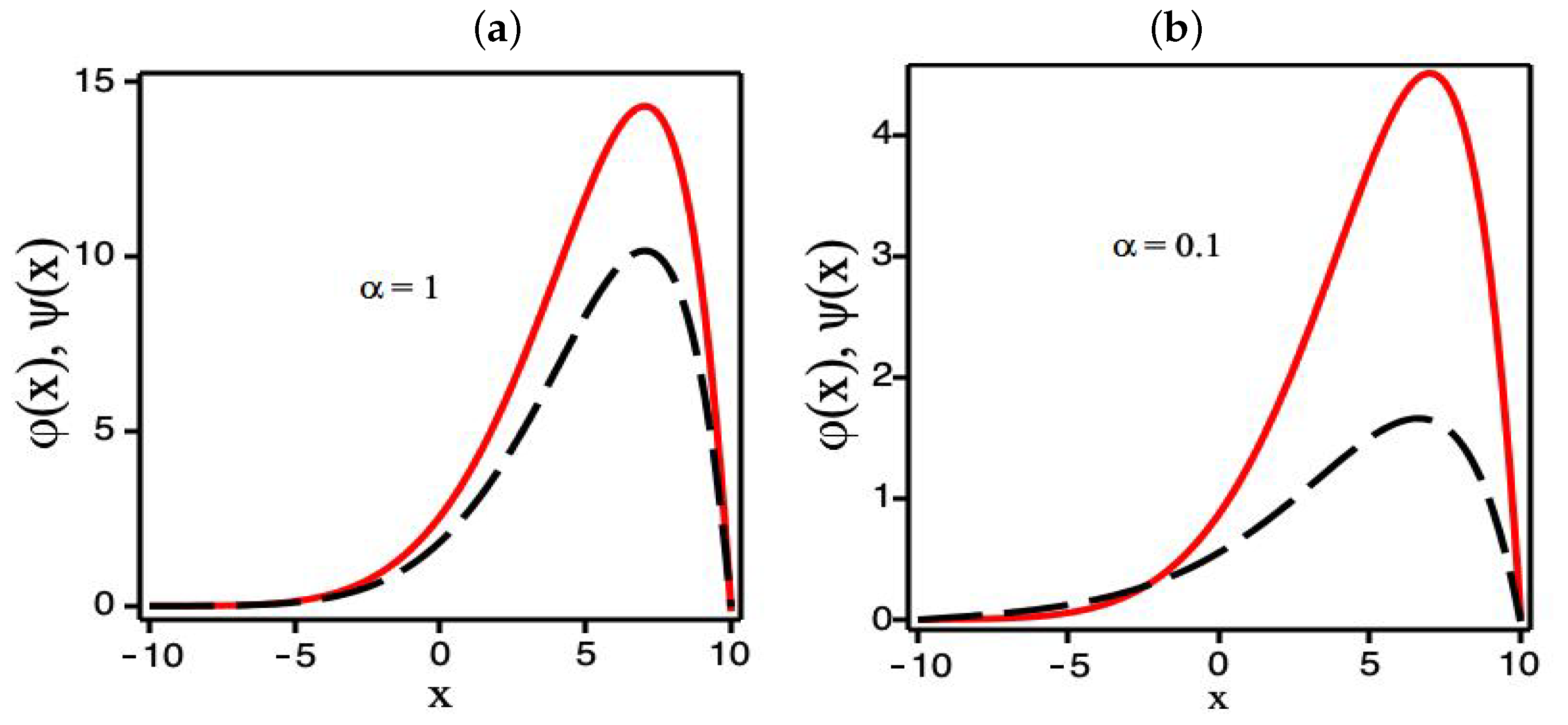
. As the mathematical expressions are more cumbersome, we plot the numerical solutions in
Figure 3. It is clear from these plots that when we increase the order of the recurrence, the numerical solutions converge rapidly to the exact solutions.
5. Conclusions
This paper is concerned with the treatment of the interaction of two-wave solitons in nonlinear quadratic media. These kinds of problems appear in different applications of nonlinear physics and play a crucial role in the stability problems of solitary waves. The problem is presented within the framework of two coupled nonlinear differential equations, which can be solved numerically with specific boundary conditions. But the generalization to any type of boundary condition constitutes a great challenge.
With concordance to real physical problems, the boundary conditions can be chosen properly. Thus, within this framework, we have proved a theorem of existence and uniqueness for the two-wave solitons in nonlinear quadratic media. Furthermore, we have suggested a useful technique of separation of the coupled system, and we have revealed that the formalism leads to analytic solutions.
Moreover, we have explored an interesting numerical technique, and we have used it to obtain the numerical solutions of the coupled system with suitable boundary conditions. The obtained results are in good agreement with those analytically achieved.
These crucial results open a novel class of investigations, which involve solitary waves with more coupled differential equations and more coupling terms. Some other examples of two or more-coupled solitary waves can be treated with the proposed techniques, and the results will be reported elsewhere.
Author Contributions
Investigation, L.B. and S.B.; Methodology, L.B.; Writing—review and editing, L.B. and S.B.; writing—original draft preparation, L.B. and S.B.; Supervision, S.B. All authors have read and agreed to the published version of the manuscript.
Funding
This research received no external funding.
Conflicts of Interest
The authors declare no conflict of interest.
References
- Buryak, A.V.; Akhmediev, N.N. Internal friction between solitons in near-integrable systems. Phys. Rev. E 1994, 50, 31263133. [Google Scholar]
- Buryak, A.V.; Akhmediev, N.N. Influence of radiation on soliton dynamics in nonlinear fibre couplers. Opt. Commun. 1994, 110, 287–292. [Google Scholar]
- Buryak, A.V.; Kivshar, Y.S. Spatial optical solitons governed by quadratic nonlinearity. Opt. Lett. 1994, 19, 1612–1614, Erratum in 1995, 20, 1080–1080. [Google Scholar]
- Buryak, A.V.; Kivshar, Y.S. Solitons due to second harmonic generation. Phys. Lett. A 1995, 197, 407–412. [Google Scholar]
- Buryak, A.V.; Kivshar, Y.S. Twin-hole dark solitons. Phys. Rev. A 1995, 51, R41–R44. [Google Scholar]
- Buryak, A.V.; Trapani, P.D.; Skryabin, D.V.; Trillo, S. Optical solitons due to quadratic nonlinearities: From basic physics to futuristic applications. Phys. Rep. 2002, 370, 63–235. [Google Scholar]
- He, H.; Werner, M.J.; Drummond, P.D. Simultaneous solitary-wave solutions in a nonlinear parametric waveguide. Phys. Rev. E 1996, 54, 896–911. [Google Scholar]
- Skryabin, D.V.; Firth, W.J. Generation and stability of optical bullets in quadratic nonlinear media. Opt. Commun. 1998, 148, 79–84. [Google Scholar]
- Peschel, T.; Peschel, U.; Lederer, F.; Malomed, B.A. Solitary waves in Bragg gratings with a quadratic nonlinearity. Phys. Rev. E 1997, 55, 4730–4739. [Google Scholar]
- Hayata, K.; Koshiba, M. Multidimensional solitons in quadratic nonlinear media. Phys. Rev. Lett. 1993, 71, 3275. [Google Scholar]
- Werner, M.J.; Drummond, P.D. Stongly coupled nonlinear parametric solitary waves. Opt. Lett. 1994, 19, 613–615. [Google Scholar]
- Torner, L.; Wright, E.M. Soliton excitation and mutual locking of light beams in bulk quadratic nonlinear crystals. J. Opt. Soc. Am. B 1996, 13, 864–875. [Google Scholar]
- Sukhorukov, A.A. Approximate solutions and scaling transformations for quadratic solitons. Phys. Rev. E 2000, 61, 4530–4539. [Google Scholar]
- Firth, W.J.; Skryabin, D.V. Optical solitons carrying orbital angular momentum. Phys. Rev. Lett. 1997, 79, 2450. [Google Scholar]
- Nikolov, N.I.; Neshev, D.; Bang, O.; Królikowski, W.Z. Quadratic solitons as nonlocal solitons. Phys. Rev. E 2003, 68, 036614. [Google Scholar]
- Chen, J.; Ge, J.; Lu, D.; Hu, W. A simple approach to study the boundary-induced trajectory evolution of spatial nonlocal quadratic solitons: Basrd on the Green’s function method. Appl. Math. Lett. 2020, 102, 106–108. [Google Scholar]
- Hunter, J.K.; Nachtergaele, B. Applied Analysis; World Scientific Publisching: Singapore, 2001. [Google Scholar]
| Publisher’s Note: MDPI stays neutral with regard to jurisdictional claims in published maps and institutional affiliations. |
© 2020 by the authors. Licensee MDPI, Basel, Switzerland. This article is an open access article distributed under the terms and conditions of the Creative Commons Attribution (CC BY) license (http://creativecommons.org/licenses/by/4.0/).