Abstract
Let be a numerical semigroup. We associate an undirected graph with a numerical semigroup with vertex set and edge set . In this article, we discuss the connectedness, diameter, girth, and some other related properties of the graph .
1. Introduction
In the last couple of decades, researchers have been assigning graphs to various kinds of algebraic structures, which opens new horizons to study algebraic structures with the help of graph theoretic properties and vice versa. In the recent past, various families of graphs associated with algebraic structures have been studied by a number of researchers (see [1,2,3,4,5,6,7,8]). The theory of the numerical semigroup is quite useful in the study of non-negative integer solutions of a linear equation in several variables with coefficients in [9,10,11,12,13]. Applications of the numerical semigroup can be found in the study of the parameters of algebraic geometry codes [14,15,16].
Algebraic combinatorics employs algebraic methods to solve combinatorial problems and vice versa. The main feature of this subject is any useful interaction between algebra and combinatorics. One of the research areas in this field is associating a graph with an algebraic structure and has attracted considerable attention. It aims at exposing the relationship between algebra and graph theory and applications of one to the other. In [17], recently, a new combinatorial problem associated with the numerical semigroup was studied. A subset of nonnegative integers is known as the numerical semigroup if it satisfies the following condition:
- ,
- is finite.
The least positive integer in , denoted by , is known as the multiplicity of the numerical semigroup. The elements of are called the gaps of , and the largest of these gaps is known as the Frobenius number, denoted by . A numerical semigroup is symmetric if and only if implies , while it is known as pseudo symmetric if and only if implies or . It is well known that every numerical semigroup is finitely generated, that is there exist such that . Moreover, every numerical semigroup has a unique minimal system of generators. The cardinality of a minimal system of generators is called the embedding dimension of numerical semigroup , denoted by . This is also well known that . For more details on e numerical semigroup, see [18].
A graph G is a pair of two sets V and E, where V is the set of vertices and E is the set of edges. The order of a set V is known as the order of the graph, while the order of the set E is known as the size of the graph. The distance between any two vertices p and q of a graph G is the length of the shortest path between them, denoted by , while the maximum distance between any two vertices of the graph G is known as the diameter, denoted by . The length of a shortest cycle in the graph is referred to as the girth of the graph. An alternate sequence of vertices and edges is known as a path, denoted by . A graph G is said to be complete if their is an edge between every pair of edges, and it is doted by . Any vertex p of a connected graph G is referred to as a cut vertex, whose removal leaves the graph disconnected. A connected graph without cut vertices is referred to as a non-separable graph. Let be a numerical semigroup. We define an undirected graph with vertex set and edge set .
The layout of this paper is as follows. Section 2 consist of four parts. We briefly describe the concept of connectedness and completeness of in Section 2.1. In Section 2.2, we present some results regarding the diameter and girth of . In Section 2.3, we discuss the concept of the cut-point and connectivity of , and in Section 2.4, we classify for some cases. Finally Section 3 concludes the article.
2. Results and Discussions
This section has been divided into four major parts: In this first part, the connectedness and completeness of are discussed. The second part consists of the diameter and girth of . The third part is about the cut-point and separability of , while in the fourth part, the classification of is presented.
2.1. Connectedness and Completeness of
In this section, we show that is always a connected graph. Moreover, we provide the sufficient and necessary condition for to be complete.
Proposition 1.
Let Γ be a numerical semigroup of multiplicity and Frobenius number . Then, is a connected graph with order at least .
Proof.
This is obvious, because is the smallest positive integer belonging to and is the largest gap of . □
Proposition 2.
Let be an integer. Then, there is a numerical semigroup Γ of multiplicity two such that .
Proof.
For an integer , consider a numerical semigroup . Then, clearly, is symmetric and As all positive even integers are in and the sum of two odd integers is an even integer, therefore, for all gives . This implies that every two vertices of has an edge, and therefore, is isomorphic to a complete graph of order n. □
Theorem 1.
Let be a graph associated with a numerical semigroup Γ. Then, is complete if and only if Γ is one of the semigroups given in Table 1.
Table 1.
List of Numerical semigroups Γ for which ) is complete.
Proof.
If is complete, then is not possible because if , then there exist such that there is no edge between and . Therefore, the only possibilities remaining are either or . If , then the only possibility is that , and if , then either or , as is complete; therefore, must be four or five, because if , then there exist such that there is no edge between and . Now, if , then or , and if , then, or . The other implication is obvious. □
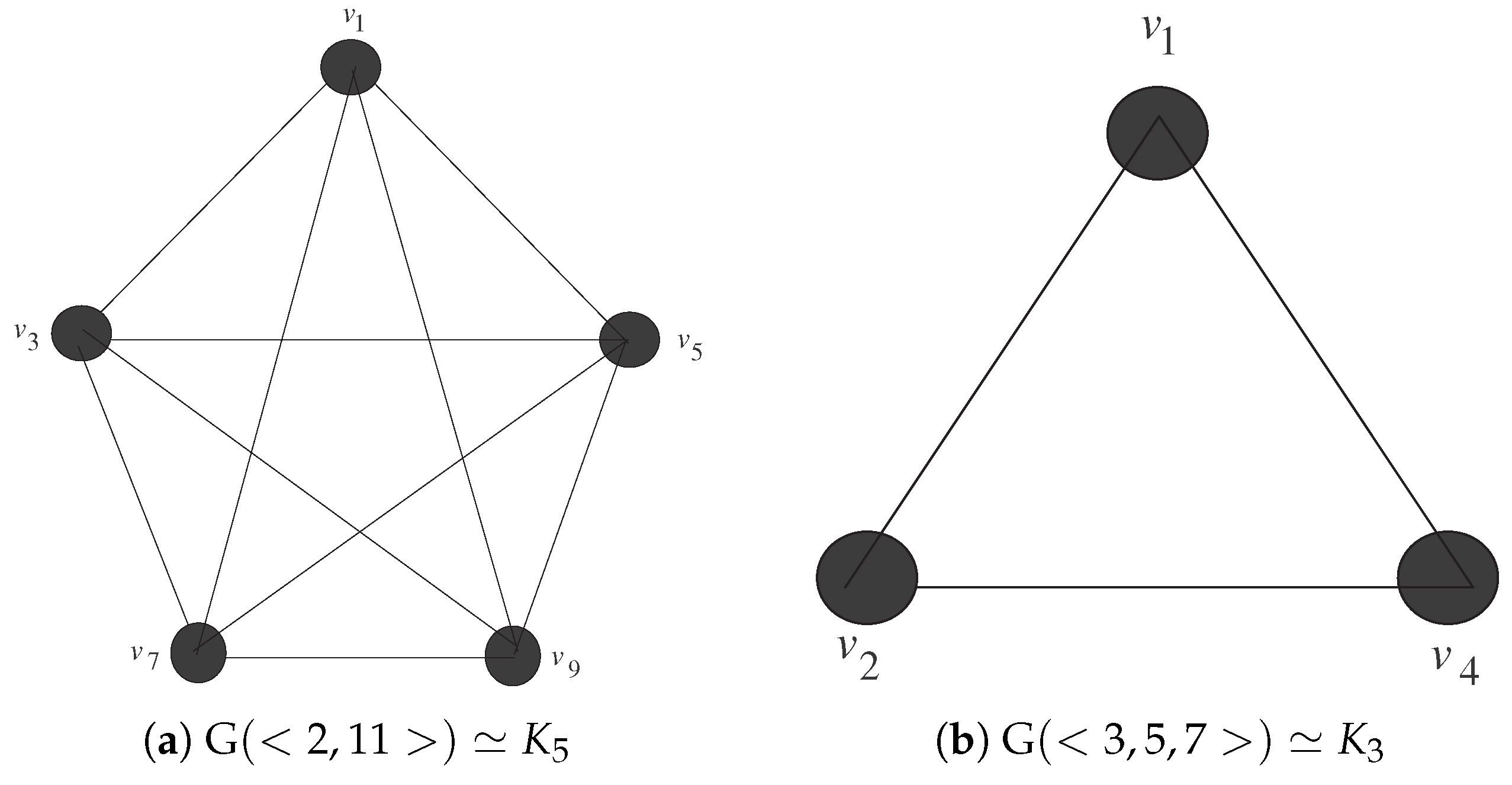
In Figure 1, we provide two examples of complete graphs corresponding to the numerical semigroups and .
Figure 1.
Two examples, when is complete.
2.2. Diameter and Girth of
In this section, we present our results on the diameter and girth of .
Proposition 3.
Let be a graph associated with a numerical semigroup Γ. Then, diam. Furthermore, if contains a cycle, then gr.
Proof.
As is the largest gap, therefore for all and . This implies that has an edge with every vertex , and therefore, . Now, for any two vertices and , we have:
this implies:
Moreover, if any undirected graph G has a cycle, then grdiam (see [19], Proposition 1.3.2). Therefore, gr. □
Proposition 4.
Let be a graph associated with a numerical semigroup Γ. If the order of then must contain a cycle of length three.
Proof.
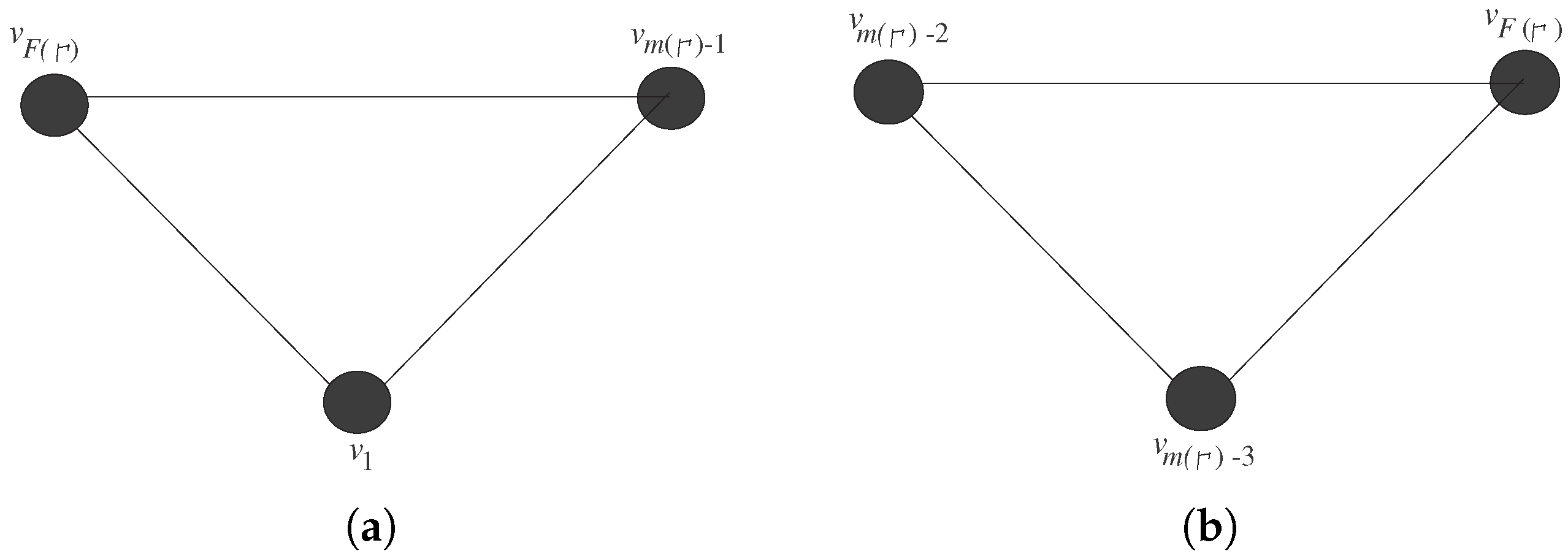
If is complete, then trivially, it contains a cycle of length three, and if is not a complete graph, then (see Theorem 1). Note that, if , then are distinct and must belong to . Since is the largest gap, therefore has an edge with vertices and . Furthermore, and are connected by an edge because . This gives that vertices , and form a cycle of length three (see Figure 2a). Now, if , then because the order of . In this case, are distinct and must belong to . Note that
Figure 2.
Induced subgraphs of for the cases (a) and (b) .
This gives that and are connected by an edge, and therefore, , , and form a cycle of length three (see Figure 2b). □
Corollary 1.
Let be a graph associated with a numerical semigroup Γ such that the order of . Then, is not a bipartite graph.
Corollary 2.
Let be a graph associated with a numerical semigroup Γ such that the order of . Then, gr.
2.3. Cut-Point and Separability of
In this section, we investigate the case when has a cut-point. Moreover, we show that if is an irreducible numerical semi-group, then has no cut-point.
Proposition 5.
Let be a graph associated with a numerical semi-group Γ such that the order of . If , then is the only cut-point of .
Proof.
If , then . This gives that is connected only with ; therefore, has at least two disconnected components. This implies that is a cut-point. Moreover, for all is connected by by an edge. Therefore, is always a connected graph. □
Remark 1.
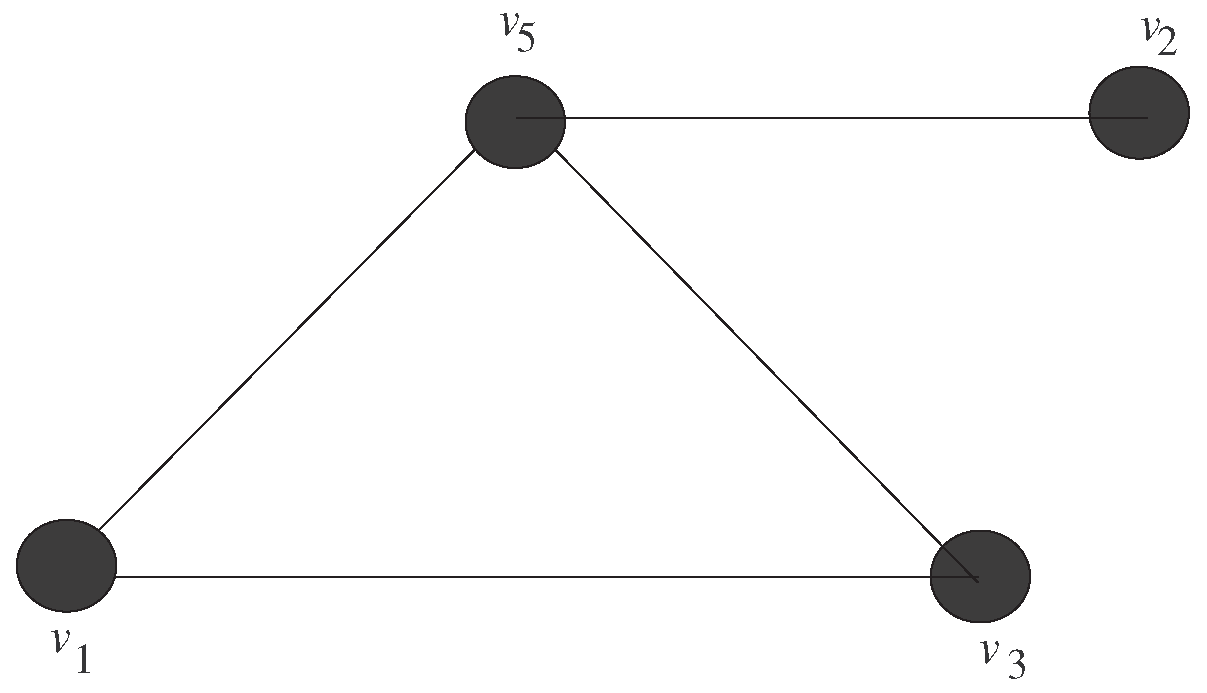
Note that even in the case of can have the cut-point. For example if , then , and is given in the following Figure 3.
Figure 3.
but has a cut-point.
Proposition 6.
Let be a graph associated with a symmetric or pseudo-symmetric numerical semigroup. If then has no cut-point.
Proof.
As and , therefore .
If is symmetric, then for any and we have:
If , then clearly , and if , then and because is symmetric. Note that because . This gives that for any vertices , must have two different paths of length two, and .
Now, if is pseudo-symmetric, then . If , then for any and we write:
If , then clearly , and if , then . Assume , then either or . Note that is not possible because and is also not possible because . Therefore, the only possibility is . This gives that for any vertices , must have two different paths of length two, and .
Now, if , then for any and consider As therefore there exist some such that Then, either or . Clearly, is not possible because , and also, is not possible because . Therefore, the only possibility is . This gives that for any vertices , must have two different paths of length two, and . □
Corollary 3.
Let be a graph associated with a symmetric or pseudo-symmetric numerical semigroup. Then, is not separable.
2.4. Classification of
In this section, we provide the sufficient and necessary condition of to be a path graph on three vertices. Moreover, we classify all graphs for the cases when the order of is equal to or .
Theorem 2.
Let be a graph associated with a numerical semigroup Γ. Then, if and only if and .
Proof.
If , then , and there are two vertices of degree one and one vertex of degree two. Note that and 3 is not possible, because if , then , and if , then where ; therefore, . Furthermore, is not possible, because the order of . This implies that the only possibility is and . The other implication is obvious. □
Corollary 4.
Let be a graph associated with a numerical semigroup Γ. If the order of , then either or .
Lemma 1.
Let Γ be a pseudo-symmetric numerical semigroup. Then, there is no of order .
Proof.
If is pseudo-symmetric and the order of is , then . This gives which is not possible. □
In the following proposition, denote that the vertices are adjacent to the vertex , and we call this the adjacency vector of vertex .
Proposition 7.
Let be a graph associated with a symmetric or pseudo-symmetric numerical semigroup. If the order of or , then can be computed as follows:
Proof.
: If the order of , then where , if is symmetric, and , if is pseudo-symmetric. Now, if is odd, then the adjacency vectors for the vertices of graph are for and and for and . If is even, then the adjacency vectors for the vertices of graph are for and and for and .
: If the order of , then there is no if is pseudo-symmetric (see Lemma 1), so the only possibility is that is symmetric; therefore, where . If is odd, then the adjacency vectors for the vertices of graph are , for , where is a vertex excluded from the adjacency vector, if and and for and . Now, if is even, then the adjacency vectors for the vertices of graph are for , where is a vertex excluded from the adjacency vector, if and for , where is a vertex excluded from the adjacency vector, and if and . □
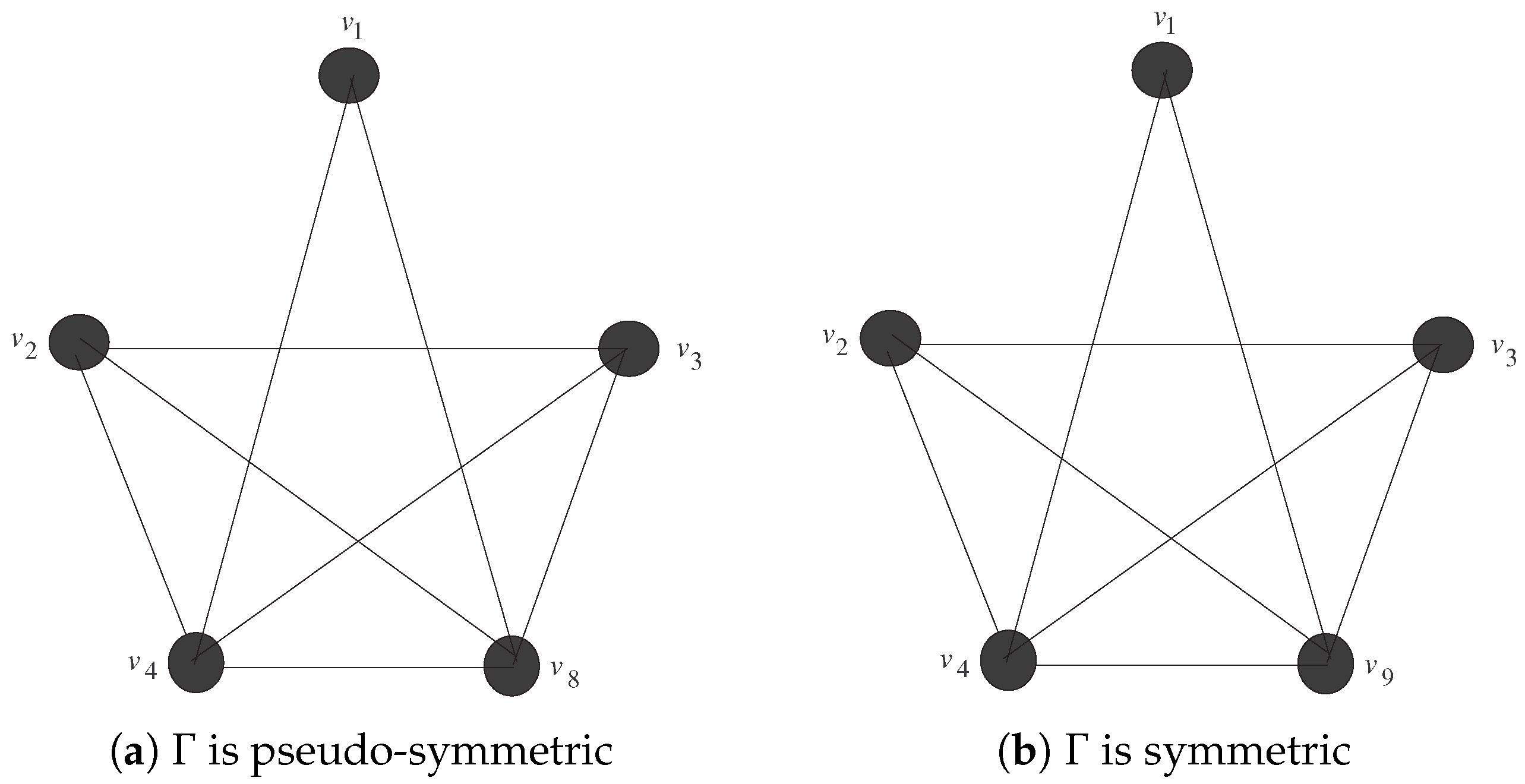
In Figure 4, we give the classification of graphs for by using Proposition 7.
Figure 4.
.
Corollary 5.
Let be a graph associated with a symmetric or pseudo-symmetric numerical semigroup. If the order of or , then , and the connectivity of is two or three.
Proof.
If the order of , then from Proposition 7, it follows that deg which is minimum. Therefore, , but from Proposition 6, it follows that
If the order of , then deg which is minimum, if and deg which is minimum, and if . Therefore, or 3. □

3. Conclusions
In this article, graphs associated with a numerical semigroup have been studied, and it was proven that these graphs are connected. We also studied some properties like girth, diameter, cut-point, etc., of these graphs. A necessary and sufficient condition has been given for a graph associated with the numerical semigroup to be complete. Furthermore, we presented the classification of these graphs for some special cases.
Author Contributions
All the author contributed equally.
Funding
This work was supported by the National Key R and D Program of China (No. 2018YFB1005100, 2018YFB1005104), Specialized Fund for Science and Technology Platform and Talent Team Project of Guizhou Province (No. QianKeHePingTaiRenCai [2016]5609) and Key Supported Disciplines of Guizhou Province Computer Application Technology (No. QianXueWeiHeZi ZDXK [2016]20).
Conflicts of Interest
The authors declare no conflict of interest.
References
- Afkhami, M.; Khashyarmanesh, K. The intersection graph of ideals of a lattice. Note Mat. 2014, 34, 135–143. [Google Scholar]
- Akbari, S.; Tavallaee, H.A.; Ghezelahmad, S.K. Intersection graph of submodules of a module. J. Algebra Appl. 2012, 11, 1–8. [Google Scholar] [CrossRef]
- Anderson, D.D.; Badawi, A. The total graph of a commutative ring. J. Algebra 2008, 320, 2706–2719. [Google Scholar] [CrossRef]
- Beck, I. Coloring of commutative rings. J. Algebra 1998, 116, 208–226. [Google Scholar] [CrossRef]
- Ebrahimi Atani, S.; Dolati, S.; Khoramdel, M.; Sedghi, M. Total graph of a 0-distributive lattice. Categ. Gen. Algebr. Struct. Appl. 2018, 9, 15–27. [Google Scholar]
- Hashemi, E.; Alhevaz, A.; Yoonesian, E. On zero divisor graph of unique product monoid rings over Noetherian reversible ring. Categ. Gen. Algebr. Struct. Appl. 2016, 4, 95–113. [Google Scholar]
- Shen, R. Intersection graphs of subgroups of finite groups. Czechoslov. Math. J. 2010, 60, 945–950. [Google Scholar] [CrossRef][Green Version]
- Yaraneri, E. Intersection graph of a module. J. Algebra Appl. 2013, 12, 1–30. [Google Scholar] [CrossRef]
- Brauer, A. On a problem of partitions. Am. J. Math. 1942, 64, 299–312. [Google Scholar] [CrossRef]
- Brauer, A. On a problem of Frobenius. J. Reine Angew. Math. 1962, 211, 215–220. [Google Scholar]
- Johnson, S.M. A linear diophantine problem. Can. J. Math. 1960, 12, 390–398. [Google Scholar] [CrossRef]
- Selmer, E.S. On a linear diophantine problem of Frobenius. J. Reine Angew. Math. 1977. [Google Scholar] [CrossRef]
- Sylvester, J.J. Mathematical questions with their solutions. Educ. Times 1884, 41, 21. [Google Scholar]
- Feng, G.L.; Rao, T.R.N. A simple approach for construction of algebraic-geometric codes from affine plane curves. IEEE Trans. Inform. Theory 1994, 40, 1003–1112. [Google Scholar] [CrossRef]
- Høholdt, T.; van Lint, J.H.; Pellikaan, R. Algebraic geometry codes. In Handbook of Coding Theory; Pless, V.S., Huffman, W.C., Brauldi, R.A., Eds.; North-Holland: Amsterdam, The Nertherlands, 1998; Volume 1, pp. 871–961. [Google Scholar]
- Kirfel, C.; Pellikaan, G.R. The minimum distance of codes in an Array coming from a telescopic semigroup. IEEE Trans. Inform. Theory 1995, 41, 1720–1732. [Google Scholar] [CrossRef]
- Robles-Pérez, A.M.; Rosales, J.C. A combinatorial problem and numerical semigroups. Ars Math. Contemp. 2018, 15, 323–336. [Google Scholar] [CrossRef]
- Rosales, J.C.; Garcia-Sanchez, P.A. Numerical Semigroups. Note Mat. 2014, 34, 135–143. [Google Scholar]
- Diestel, R. Graph Theory; Springer: New York, NY, USA, 1997. [Google Scholar]
© 2019 by the authors. Licensee MDPI, Basel, Switzerland. This article is an open access article distributed under the terms and conditions of the Creative Commons Attribution (CC BY) license (http://creativecommons.org/licenses/by/4.0/).