1. Introduction
The optimal control problems (OCPs) originate from the civil engineering of earth supplies [
1]. OCPs governed by the partial differential equations (PDEs) feature in the practical applications of electrical, mechanical, control and aerospace engineering from many decades. Some large space structures, sensitive equipment and their operating structures also require optimal control technology. Although, civil engineering assembles the applications of OCPs in an exclusive style, which offers new challenges [
2].
Since OCPs have widespread applications, so it is necessary to solve them by numerically stable methods whenever it is problematic to solve analytically. The numeric simulations of above stated applications have been performed using well known numeric techniques [
3]. No doubt, practically, in order to avoid the unappropriate disturbances, closed loop optimal controls have a leading position over the open loop controls. Under some slight conditions on the coefficients and admissible control points, Sun et al. [
4] gave the solution of closed loop OCP via Riccati equation.
It can easily be estimated from the increasing publishing trend of research articles over the last few decades that FEM has proved itself a well programmed and commonly used method in an extensive range of engineering applications in general, for example in structural analysis, heat transfer and fluid mechanics etc. Different mathematicians have presented FEM for PDEs as well as for OCPs [
5,
6,
7,
8,
9,
10,
11,
12].
Recently mathematicians used non uniform rational B-splines (NURBS) as the basis functions, instead of the customary Lagrange polynomials. Buckling analysis of thin symmetrically laminated composite plates using NURBS is done by [
13]. Valizadeh et al. [
14] studied the behaviour of functionally graded plates with NURBS as finite element basis functions. Liu et al. [
15] analyzed the homogeneous and functionally graded microplates using an isogeometric analysis and non-classical Kirchhoff plate theory. The adaptive isogeometric analysis for two dimensional elasticity problems using locally refined B-splines is done by [
16].
For optimal controls, Hinze et al. [
17] studied the optimality conditions of OCPs in 2009. Becker et al. [
18] analyzed constrained OCPs governed by the convection diffusion equations. FEM practiced the optimality conditions for approximation of problems governed by Stokes equations [
19,
20]. A variational discretization was done by [
21]. Superconvergence properties of OCPs were firstly presented by [
22]. As convergence is concerned, superconvergence for OCPs with semi-linear elliptic equations is done by [
23]. The effort of [
24] is also remarkable as it considered the elliptic OCPs with pointwise observations. Hou estimated errors of mixed FEM for elliptic OCPs [
25]. Hou also discussed the error estimates of expanded mixed FEM for OCPs obtained by hyperbolic integro differential equation [
26]. Chen et al. [
27] applied mixed multiscale FEM for the convex OCPs with oscillating coefficients. Error estimates for mixed FEM for OCPs of low regularity are discussed in [
28].
This manuscript presents FEM with WEB-splines to solve elliptic OCPs with boundary observations. The major characteristic of such optimal control problems is that the observations are the outward normal derivatives of the state variable on the boundary which decreases the regularity of solutions. There are certain limitations with standard FEM to deal with such type of inhomogeneous boundary conditions. In standard FEM, one is forced to approximate normal derivatives at boundary in the OCP by means of other numerical techniques, for example [
29]. However mixed FEM solves such type of inhomogeneous boundary on a higher cost as compared to the standard FEM [
29].
The WEB method resolves the regularity problem, relatively at a lower cost and boundary conditions are well approximated without being discontinuous. WEB method is a meshless technique defined on a usual grid over domain. Convergence rate of the WEB method depends on the degree of B-splines. A special extrapolation technique is employed to prevent the loss of stability in the presence of small cut-cell by the boundary. As a result, a new set of extended B-splines is obtained and is further stabilized by using the stabilizing factor. This stabilizing factor depends on the weight functions. Finally, the WEB-splines are obtained. For the error analysis of WEB method, a straight approach of finite element discretization could be tedious. The approximation order via quasi interpolant would be an easy approach to get the goal. Due to the standard projector property of canonical quasi interpolant, the task becomes easy because the approximation
depends on
within the support of
, see (
18). Approximation order of WEB method with elliptic boundary conditions gives the convergence of
, where
d is the degree of B-spline [
30]. But here we have an exceptional type of objective functional consisting of outward normal derivative of the state variable on boundary. Another main feature is that the adjoint state equation appears as an elliptic equation with inhomogeneous Dirichlet boundary condition whose value is the partial derivative of the state. Thus for an OCP of this type, WEB method can not approximate upto
. To the best of authors knowledge, such type of approximation to OCP with such special boundary observation has not been addressed earlier.
Let a square symmetric coefficient matrix
, defined on
be positive definite by nature. Then the OCP is to find the function
y for which
is subjected to
Equation (
2) is called the state equation, where domain
is convex and has a smooth boundary
. The fixed positive number
is a parameter of penalty. The function
and
is defined as
where
is taken as outward drawn normal to boundary,
and
is the admissible sub-domain of
.
is a continuous linear operator that maps the elements from
to
, which may be considered as a characteristic function
defined on
. The set of admissible points
, is composed of admissible control points,
such that
almost everywhere in
and
,
are real numbers.
Rest of the paper is organized in the following way.
Section 2 contains some preliminary definitions. Also the OCP, optimality conditions and approximations are explained in this section.
Section 3 represents the main hurdles in solving OCP by standard FEM and a detailed construction of WEB-splines over a bounded domain is presented in this section. Moreover, this section contains the pseudo-codes for application of WEB method over an OCP. Results regarding the approximation are given in
Section 4. To support theoretical results, the numerical examples using proposed algorithm are given in
Section 5. At last, some finishing conclusions are written in
Section 6.
2. Optimality Conditions for OCP with Boundary Observations
2.1. Preliminaries
Let
, and we consider the continuous function
, making the functional space
. Let the multiindex
such that
, and we define the space
For open and bounded domain
where
.
Classically, it is assumed that the functions in boundary value problems must have continuous derivatives. For PDEs, it is required to use Sobolev spaces
instead of the functional spaces
. The typical representation of Sobolev spaces is
The identity
clears the concept of weak derivatives where
is a set of continuous functions on a compact space
.
In Sobolev space, norm and semi norm are defined as and . It is conventional to have , i.e., this space includes all of the functions in that vanish on the boundary of . Significantly, if we fix Sobolev space can be represented as and at the boundary can be represented as . We denote the inner product defined on domain, boundary and admissible domain by and respectively.
The solution
y of the boundary value problem lies in
named as
Y with normal derivative
. The objective functional (
1) is well defined.
The weak form of the control problem (
1) is: find the solution
and
satisfying the minimization problem
subject to
Here, is the bilinear functional and is symmetric as well as positive definite by nature.
2.2. Approximation of Model
The residual form of the problem (
3) and (
4) is represented as:
Minimize
subjects to the residual
with Dirichlet boundary conditions
on
.Consider the functions
which are continuously differentiable while
and
are Banach spaces.
State equation
carries a unique solution for all
, where
Q is finite dimensional subspace of
:
The following theorem shows the necessary and sufficient conditions for OCP.
Theorem 1. The weak form Equations (3) and (4) of OCP exhibits the necessary and sufficient optimal conditions in stated as:with is the adjoint of ϝ. Equivalently Equation (8) can bewhere is the orthogonal projection on to . Proof. Consider
to be the optimal solution of OCP. To prove the theorem, we use technique of Lagrangian-based adjoint approach in [
17]. The Lagrangian operator
is defined as
where
is the residual defined in Equation (
5). The optimality conditions can be obtained by the partial derivatives of
w.r.t.
,
y and
uEquating (
10) and (
11) to zero, leads to Equations (
6) and (
7). Assuming Equation (
12) is non-negative gives Equation (
8). □
The equivalent problems of the variational form of Equations (
6)–(
8) in the sense of distribution are the set of partial differential equations together with inequality constraint:
Solving the set of Equations (
13)–(
15), we will have the solution of the control problem. It is easy to see that problem resembles to Dirichlet boundary control problem [
29]. The state equation of the Dirichlet boundary control problem can be easily handled by using standard FEM as well as by the WEB method. The difficulty arises with the fact that boundary condition of the adjoint state equation is comprised of normal derivatives of the state equation. The WEB method addresses this problem effectively by using cubic WEB-splines.
The partial derivative of the state variable
belongs to Bessel potential space lying on the boundary
. Moreover, the norm of
on
is bounded [
29], i.e.,
The above relation shows the behavior of regularity of elliptic OCP with Dirichlet boundary conditions. The next lemma proves the regularity result of OCP and gives brief properties of functions involved in OCP.
Lemma 1. Let the smooth bounded domain Ω,
assuming and and let then the solution of the state equation y and adjoint state equation σ has the properties: Proof. The properties of the Bessel potential space can easily prove the first property. For the second property,
where
is the trace operator which coincides with any usual restriction operator for continuous function. So, we may write
. By using Equation (
12), we get
. Third property can be directly obtained from Equation (
8). □
3. WEB Based Finite Element Method
In standard FEM, a solution
y is approximated by
by using variational formulation, where
is a finite dimensional linear space. The function
, which is obtained from the system of algebraic linear equations, is continuous and piecewise linear on
, where
is some polygonal subdomain of
and vanishes on
. The triangular discretization is a very common method for the discretization of a domain. The triangulation is performed in such a way that for triangles
and
,
or none of the vertex of
lying in the
and
∀
establishes
. Let
h be the largest length of sides of triangles, built in the construction of
. Triangulation becomes finer as
and the boundary
becomes closer to
. To approximate OCP, state variable
y is to be further approximated by
, as its normal derivative in boundary condition of adjoint state equation does not allow the implementation of Dirichlet boundary condition directly. Yan et al. [
29] stated the need of further approximation of
to a continuous form on the triangulation as
which may need extra calculation for the approximation of OCP. The error appearing in this interpolation will be contributed in the global error estimation of problem.
Instead of the standard FEM, we use the WEB-splines of degree . WEB-splines are stable and their approximation order for solving elliptic PDE is , where d is the degree of B-spline. Furthermore, normal derivative of WEB-splines basis function is continuous and therefore the direct implementation of the normal derivative of state variable is feasible. In this way, an additional step can be avoided in the approximation of OCP.
Weighted Extended B-Splines
The representation and topological form of a simulation domain
may play a key role in choosing the best suited tool for related problems. Intensive research over the last three decades has proved B-splines are systematic techniques in approximation, computer aided design and graphics. B-splines as finite element basis can offer better solutions for both geometry description and numerical simulation [
16]. B-splines are the piecewise continuous functions, usually represented by sequence of knots. Let
be a knot sequence, uniformly partitioning
,
is the degree of B-spline, the
-th B-spline of zero degree for the interval
is defined as
and the scaled translations of B-splines are
.
The recursion formula of the
-th B-spline of degree
d is
Linear, quadratic, cubic and higher order B-splines can be defined on this pattern. Stable and significantly more accurate approximated solutions are observed by using B-splines, especially in one dimension, as compared to classical finite element techniques. While for higher dimensions,
due to uniform support of B-splines, some limitations may arise when use them as finite element basis. Mainly, there are two reasons. Firstly, the use of Dirichlet boundary conditions is inconvenient as an approximation should be zero on the boundary and outside of a domain. The coefficients of the B-splines, whose supports have non empty intersection with boundary, must be zero to attain this task. This destroys the approximation order. Secondly, if some B-splines have very small intersection with a domain, the basis will not be uniform and become unstable near the boundary. This enlarges the condition number of system that results low convergence rate. These obscurities can be overcome by describing a new type of modified tensor product B-splines called weighted extended B-splines. WEB method was innovated and originated by Höllig et al. [
30,
31,
32,
33,
34,
35]. It has some major advantages. WEB method can be implemented on regular grids and there is no need of mesh generation as it is needed for the standard FEM. Basis functions are defined directly on grid. The domain retains its shape and is not disturbed by domain discretization or meshing. Boundary limitations are fully satisfied by this method. This method diminishes the size of the Galerkin system which ensures the accuracy of the approximated solution, fast convergence of solution algorithm, low condition number and less computation cost. For the sake of simplicity, we define here
to be analogous to writing that
, where
u and
v are the functions and
c is any constant independent of
h.
More concerned are those B-splines whose support intersects a domain. These B-splines form the spline space . Such B-splines are referred to as relevant B-splines. The set of indices of such B-splines is denoted as K. Additionally K is partitioned into inner and outer sets. The set of inner indices I is defined in such a way that the support of B-splines have at least one grid cell lying inside a domain. All other indices form the outer set O, i.e., . These outer and inner B-splines are then further coupled. We extrapolate outer B-splines to the inner ones
A selection of inner B-splines can be obtained by an array of inner indices closest to
o, i.e.,
This array corresponds to every outer index. The construction of extension coefficients, which couples the inner B-spline to the corresponding outer B-spline or vice versa, depends upon the value of Lagrangian polynomial [
31].
The extension matrix
can be formulated as:
where
is given in (
16).
This extension coefficient comprises the weighted extended B-splines defined as follows:
We can choose
as a positive weight function of order
. The weight function
should be continuous throughout the boundary and uniform on domain
, i.e., the weight function is sufficiently regular on a boundary. Ravashev et al. [
36] studied R-functions in detail in order to construct weight functions.
However, for the case “”, cannot be used as a finite element basis. To normalize the basis, we have to multiply by balancing factor , i.e., . Linear spanning of these WEB-splines , comprise the WEB space . The WEB space has less dimension than the dimension of the B-spline space and holds all basic requirements of finite element basis functions.
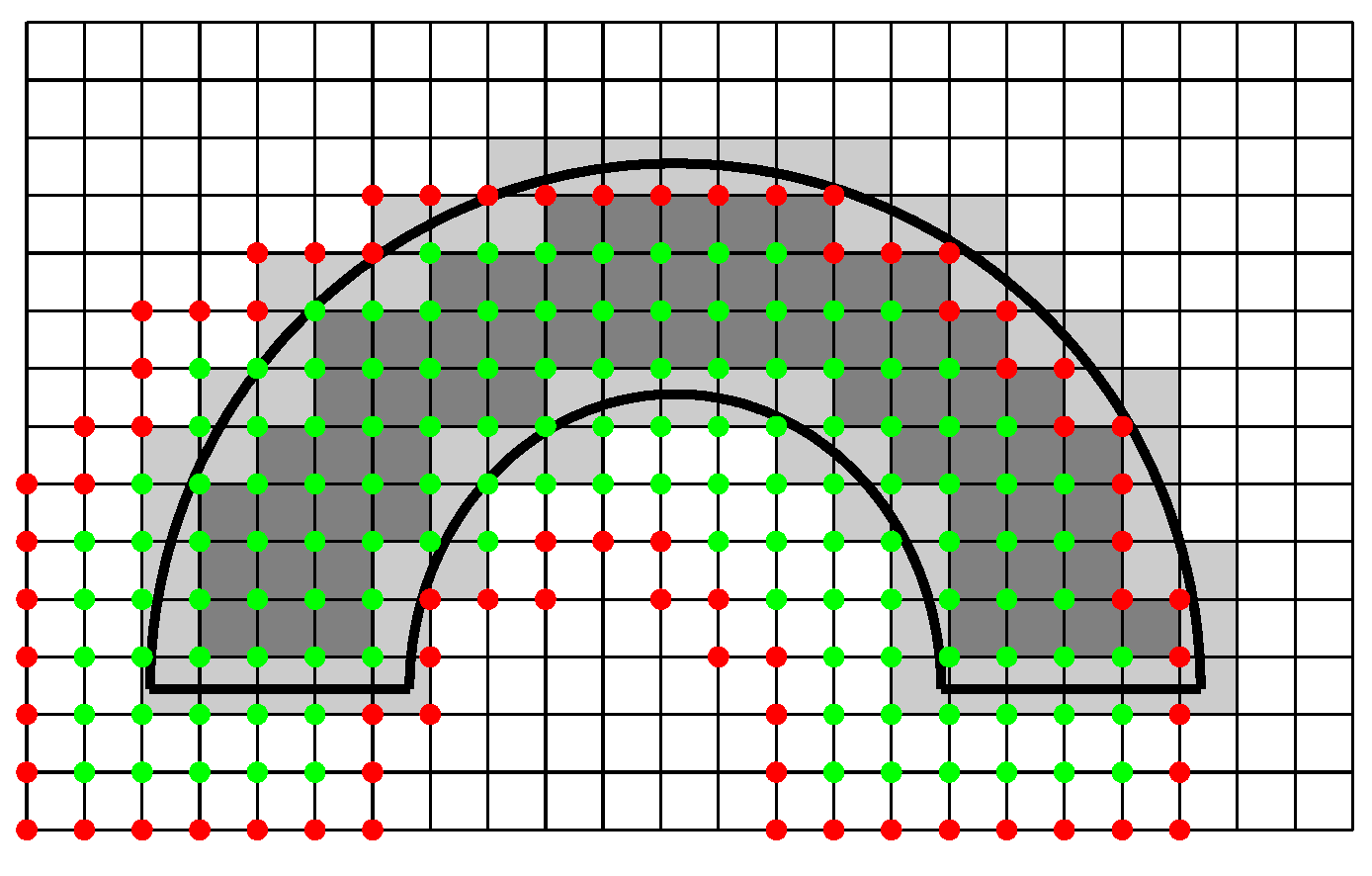
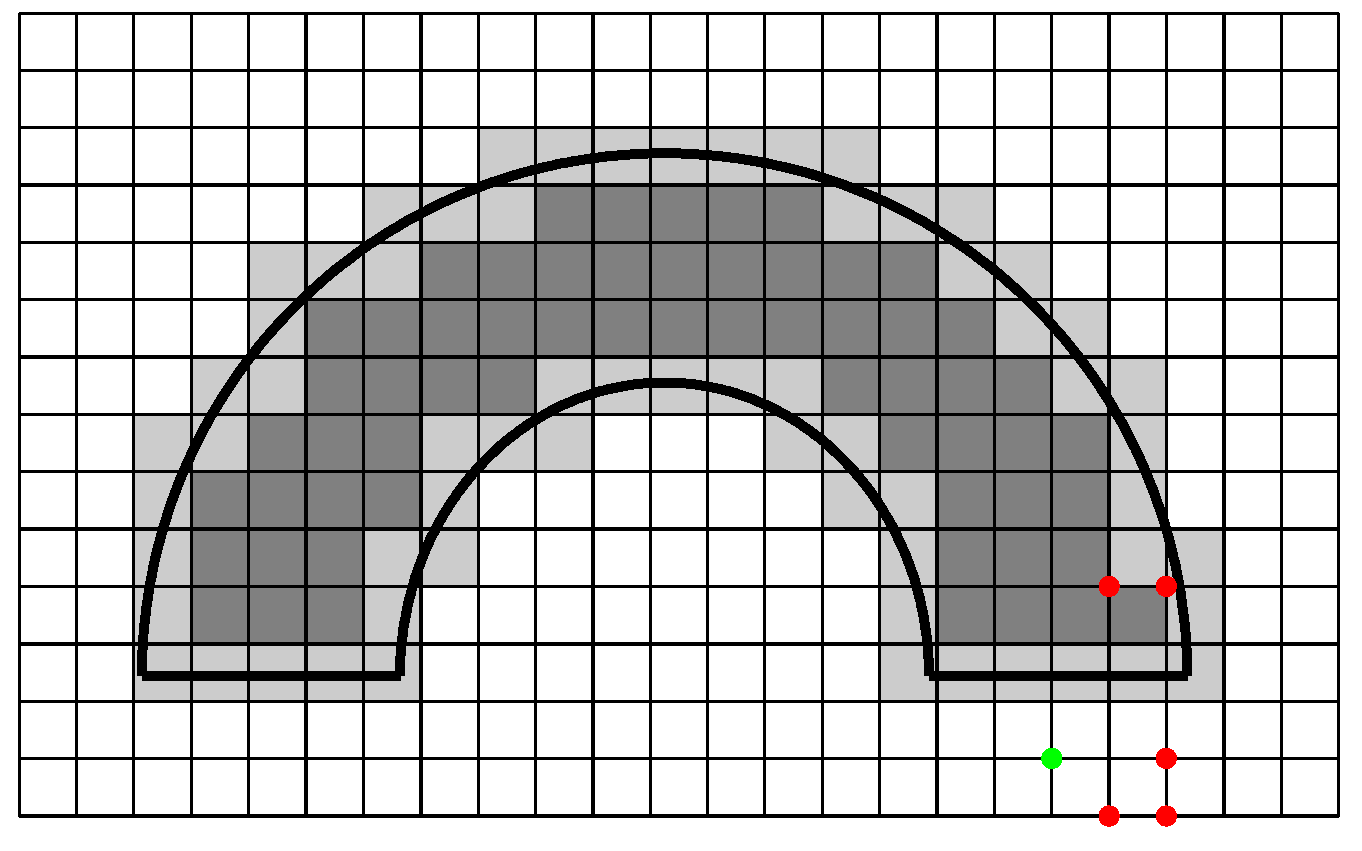
Figure 1 shows the grid description over a domain. The light grey cells are the boundary cells while the dark grey cells are referred to as the inner cells. The set of quadratic outer B-splines are shown as the red dots placed on the lower left corner of the support of the corresponding B-splines while the green dots are the inner B-splines. The quadratic B-splines are considered for the description.
Figure 2 shows the coupling of inner and outer B-splines. The inner B-splines
(green dot) have the coupling to outer B-splines
(red dots) which have non-zero entries of the extension matrix
These are the only outer B-splines that couple with the inner B-splines.
The pseudo-codes for application of WEB method for an OCP are given in Algorithm 1.
| Algorithm 1 Pseudo-codes for application of WEB method for an OCP |
- I
:
- (i)
Set the inputs (discretization/Galerkin). - (ii)
Formulate extension matrix using Equation ( 17). - (iii)
Using this extension matrix, formulate extended Galerkin matrix as: - (iv)
Solving the system by numerical technique, solution is obtained.
- II
:
- (i)
U: Set initial estimate . - (ii)
State equation:
- (a)
Formulate the weak form of Equation ( 13). - (b)
Obtain Galerkin matrix. - (c)
Go back to step 1 and get the solution y.
- (iii)
Adjoint stat equation: - (a)
Formulate the weak form of Equation ( 14). - (b)
Obtain Galerkin matrix. - (c)
Go back to step 1 and get the solution .
- III
: Assemble the solution from Equation ( 15), state equation and adjoint stat equation.
|