


Abstract
Intuitionistic fuzzy multiple attribute decision making deals with the issue of ranking alternatives based on the decision information quantified in terms of intuitionistic fuzzy values. Lexicographic orders can serve as efficient and indispensable tools for comparing intuitionistic fuzzy values. This paper introduces a number of lexicographic orders by means of several measures such as the membership, non-membership, score, accuracy and expectation score functions. Some equivalent characterizations and illustrative examples are provided, from which the relationships among these lexicographic orders are ascertained. We also propose three different compatible properties of preorders with respect to the algebraic sum and scalar product operations of intuitionistic fuzzy values, and apply them to the investigation of compatible properties of various lexicographic orders. In addition, a benchmark problem regarding risk investment is further explored to give a comparative analysis of different lexicographic orders and highlight the practical value of the obtained results for solving real-world decision-making problems.
1. Introduction
In 1965, Zadeh [1] initiated fuzzy set theory which provides a useful mathematical tool for modelling and manipulating uncertainty based on the perspective of gradualness. The notion of fuzzy sets is closely associated with soft computing which deals with imprecision, uncertainty, partial truth and approximation to achieve tractability, robustness and low solution cost [2]. Atanassov [3,4] proposed the concept of intuitionistic fuzzy sets in 1983, which is characterized by membership and non-membership functions. Atanassov’s intuitionistic fuzzy sets extend Zadeh’s fuzzy sets in a meaningful way, due to its convenience to capture uncertainty caused by indecisiveness and lack of commitment in human cognition [5]. Bustince and Burillo [6] revealed that the concept of vague sets, proposed by Gau and Buehrer [7], could be identified with intuitionistic fuzzy sets. Wang and He [8] showed that intuitionistic fuzzy sets can be seen as L-fuzzy sets. Deschrijver and Kerre further examined the relationships among fuzzy sets, L-fuzzy sets, intuitionistic fuzzy sets, interval-valued fuzzy sets and interval-valued intuitionistic fuzzy sets in [9].
In 1999, Molodtsov [10] proposed soft set theory as another formal method for handling uncertainty. The rationale of soft sets relies on the idea of parameterization, which suggests that complicated things should be perceived from various aspects, and each aspect only provides an approximate description of the whole entity of high complexity [11]. Maji et al. [12] defined a number of algebraic operations for soft sets and examined some related properties. Ali et al. [13,14] introduced several new operations in soft set theory to further consolidate theoretical aspects of soft sets. It is worth noting that soft sets are closely related to other soft computing models such as rough sets and fuzzy sets [15,16]. Maji et al. [17] introduced fuzzy soft sets, extending both fuzzy sets and soft sets in a natural way. They further combined soft sets with intuitionistic fuzzy sets, and brought forth the notion of intuitionistic fuzzy soft sets in [18]. In addition, soft sets and their extensions have been successfully applied to algebra [19,20,21,22], data analysis [11,23], decision making [24,25,26,27,28,29,30], graph theory [31] and mathematical logic [32].
The membership degree and non-membership degree of each element in an intuitionistic fuzzy set can be combined together to form an ordered pair, which was called an intuitionistic fuzzy value (IFV) by Xu and Yager in [33]. This convenient representation has been widely used in the literature. From the theoretical aspect, it provides a solid basis for constructing and investigating various measures [34,35], operations [36], aggregation operators [37], ranking methods [38,39] and generalizations [40,41] of intuitionistic fuzzy sets. From the practical aspect, the use of this representation greatly facilitates the development of decision making [5,42,43,44,45] and group decision making [46,47,48] in an intuitionistic fuzzy setting. The modelling and managing of uncertainty is of great importance for the acquisition of desirable solutions to decision making problems. IFVs can be used to describe and quantify subjective uncertainty in human cognition from the aspects of affirmation, objection and hesitation [45]. This makes them elementary components in multiple attribute decision making (MADM) based on intuitionistic fuzzy sets. As a result, it becomes vital to develop efficient methods for the computation, aggregation and comparison of IFVs. Xu and Yager [33,37] proposed some fundamental operations for IFVs, which laid a firm foundation for the aggregation of intuitionistic fuzzy information. Based on the algebraic sum and scalar product operations of IFVs, Xu [37] further developed the intuitionistic fuzzy weighted averaging (IFWA) operator. To compare IFVs, Chen [42] proposed the score function, which can synthesize both positive and negative evaluations. Later, Hong and Choi [49] indicated that the score function is unable to distinguish some apparently different IFVs with the same score. To address this issue, they proposed another useful measure called accuracy function in [49]. Using both the score function and accuracy function, Xu [33] pioneered a novel approach to the ranking of IFVs. As pointed out by Bustince et al. [50], the Xu-Yager order is a lexicographic order refining the usual partial order on the lattice of IFVs. Furthermore, Bustince et al. initiated a general notion called admissible orders and proposed a useful method to build admissible orders by virtue of aggregation functions in [50].
It is worth noting that lexicographic orders like Xu-Yager order play an indispensable role in comparing IFVs since it is impossible to represent such orders using only one real-valued function. In fact, this can trace back to a famous counter-example called the Debreu chain [51], which revealed that contrary to the inveterate belief widely held by economists, there indeed exist a preference order relation which is not representable by a utility function. Recently, we proposed two lexicographic orders and based on the expectation score function in [40]. We also showed that the order coincides with the Xu-Yager order. This paper aims to construct some new lexicographic orders by virtue of the membership, non-membership, score, accuracy and expectation score functions. We present some equivalent characterizations and illustrative examples in order to ascertain abundant relationships among various lexicographic orders. Motivated by the fact that the IFWA operator is often used together with the Xu-Yager order for solving intuitionistic fuzzy MADM problems, we endeavor to explore compatible properties of these lexicographic orders with respect to the algebraic sum and scalar product operations of IFVs. In addition, we revisit a benchmark problem, which was originally raised by Herrera and Herrera-Viedma [52], and further investigated by Wei [53], so as to give comparative analysis of different lexicographic orders and highlight the practical value of the obtained results for solving intuitionistic fuzzy MADM problems in real-world scenarios.
The rest of this paper is organized as follows. Section 2 briefly recalls some basic concepts including fuzzy sets, intuitionistic fuzzy sets and intuitionistic fuzzy soft sets. Section 3 mainly introduces binary relations and order relations. In Section 4, we define a variety of new lexicographic orders for comparing IFVs. We also give some equivalent characterizations and illustrative examples so as to ascertain the relationships among various lexicographic orders. Section 5 is devoted to the investigation of compatible properties of lexicographic orders. In Section 6, we revisit a benchmark problem regarding risk investment to compare different lexicographic orders and emphasize the pragmatic value of the obtained results for solving real-world intuitionistic fuzzy MADM problems. Finally, we summarize this study and point out possible future works in the last section.
2. Preliminaries
In this section, we recall some basic concepts regarding fuzzy sets, intuitionistic fuzzy sets and intuitionistic fuzzy soft sets. These notions will be useful for subsequent discussion.
Let U be a fixed nonempty set, known as the universe of discourse. A fuzzy set in U is defined by its membership function . For each , the membership degree specifies the grade to which the element x belongs to the fuzzy set . By , we mean that for all . Clearly if and . In what follows, the collection of all fuzzy sets in U will be denoted by .
Definition 1.
[4] An intuitionistic fuzzy set in a universe U is given by
where the functions and assign membership grade and non-membership grade of the element x to the intuitionistic fuzzy set A, respectively. In addition, it should be satisfied that for all .
Notice that is called the degree of hesitancy (or indeterminacy) of x to A. In the following, denotes the collection of all intuitionistic fuzzy sets in U.
Let . Then we have the following notions:
- ;
- ;
- if and only if and for all .
By , we mean that and . Clearly, every fuzzy set can be viewed as an intuitionistic fuzzy set. It was shown in [8,9] that intuitionistic fuzzy sets can be viewed as L-fuzzy sets with respect to the complete lattice , where , and the corresponding lattice order is defined as
for all . Each ordered pair is called an intuitionistic fuzzy value. According to this point of view, the intuitionistic fuzzy set
can be identified with the L-fuzzy set such that for all .
Let denote the power set of U and let (called the parameter space and simply denoted by E) be the set of all parameters associated with objects in U. There is no further restriction on parameters. The parameter space E might be an infinite set even if U is a finite set. To serve pragmatic purpose, attributes, criteria, or characteristics of objects in U are often chosen as parameters. Following Molodtsov [10], a soft set over U is defined as a pair , where and is a set-valued mapping, called the approximate function of the soft set S.
By combining soft sets with intuitionistic fuzzy sets, Maji et al. [18] initiated the following notion.
Definition 2.
[18] A pair is called an intuitionistic fuzzy soft set over U, where and is a mapping.
3. Binary Relations and Order Relations
In this section, let us recall some basic notions regarding binary relations and order relations.
Definition 3.
A binary relation R between two sets A and B is a subset of the direct product . In particular, is called a (homogeneous) binary relation on A.
Let R be a binary relation between A and B. If , we say that a is R-related b (or are R-related), which is denoted by . The domain of R is the set of all such that for some . The range of R is the set of all such that for some .
Definition 4.
A binary relation R on a set A is said to be:
- reflexive if for all .
- irreflexive (or strict) if for all .
- symmetric if , then for all .
- antisymmetric if and , then for all .
- asymmetric if , then for all .
- transitive if and , then for all .
- complete if , then or for all .
- total (or strong complete) if or for all .
Definition 5.
A binary relation ⪯ on a set A is called a preorder if it is reflexive and transitive.
Definition 6.
An antisymmetric preorder ⪯ on A is called a partial order.
Definition 7.
A complete preorder ⪯ on A is called a weak order.
Definition 8.
A weak order ⪯ on A is called a linear order (or total order) if it is antisymmetric.
A set A together with a partial order ⪯ on A is called a poset and is denoted by . If ⪯ is a total order, the poset is called a chain.
Definition 9.
[50] A partial order ⪯ on is said to be admissible if
- (1)
- ⪯ is a linear order on ;
- (2)
- For all , implies .
Definition 10.
Let and be two posets. The lexicographic order ⪯ on is defined by
for all .
In the above definition, means and . It is easy to show that the lexicographic order ≤ is reflexive, antisymmetric and transitive. Thus it is a partial order on the Cartesian product .
Let denote the set of all closed subintervals of the unit interval. That is,
With respect to the relation given by
the set becomes a poset with the minimum and the maximum . In order to extend the partial order to a linear order, Bustince et al. [50] introduced the following lexicographic orders of intervals.
Definition 11.
[50] The binary relation on is defined as
where and are intervals in .
Definition 12.
[50] The binary relation on is defined as
where and are intervals in .
As shown below, Bustince et al. [50] pointed out that lexicographic orders like and are indispensable since it is impossible to represent them using only one real-valued function.
Theorem 1.
[50] Let ⪯ be an admissible order on . Then it cannot be induced by means of a single continuous function .
4. Lexicographic Orders of IFVs
The following concept was pioneered by Chen and Tan [42] to solve MADM problems in an intuitionistic fuzzy setting.
Definition 13.
[42] The score function is a mapping given by for all .
The score function aims to calculate the net effect of positive and negative evaluations. Later, Hong and Choi [49] pointed out that the score function might fail to differentiate some obviously distinct IFVs with the same score. To overcome this difficulty, they developed another function as follows.
Definition 14.
[49] The accuracy function is a mapping given by for all .
Using the score function and the accuracy function, Xu and Yager [33] developed a method for comparing IFVs in the following way.
Definition 15.
[33] Let and be two IFVs. Then can be compared as follows:
- if , A is smaller than B and denoted by ;
- if , then we have:
- (1)
- if , A is equivalent to B and denoted by ;
- (2)
- if , A is smaller than B and denoted by ;
- (3)
- if , A is greater than B and denoted by .
It is worth noting that Definition 15 can be simplified as a binary relation on the lattice of IFVs:
for all . The relation is a linear order on , which will be called the Xu-Yager lexicographic order of IFVs in the following.
Xu [37] showed that for all ,
Thus the Xu-Yager lexicographic order is an admissible order on .
Definition 16.
[40] A partial order ⪯ on is said to be bounded if
- (1)
- for all ;
- (2)
- for all .
Definition 17.
[40] A partial order ⪯ on is said to be normal if
- (1)
- and implies for all ;
- (2)
- and implies for all .
It is easy to see that every admissible order on is bounded and normal.
Definition 18.
[40] The expectation score function is a mapping such that
for all .
Based on the expectation score function, Feng et al. [40] proposed the following lexicographic order of IFVs.
Definition 19.
[40] Let and be IFVs in . The binary relation on is defined as
Theorem 2.
[40] The relation is an admissible order on .
By interchanging the membership grade with the expectation score, Feng et al. [40] introduced another lexicographic order of IFVs as follows.
Definition 20.
[40] Let and be IFVs in . The binary relation on is defined as
Theorem 3.
[40] Let and be IFVs in . Then
The above assertion indicates that coincides with the Xu-Yager lexicographic order . Moreover, Feng et al. [40] established the following equivalent characterizations for the Xu-Yager lexicographic order.
Theorem 4.
[40] Let and be IFVs in . Then the following are equivalent:
- (1)
- ;
- (2)
- ;
- (3)
- ;
- (4)
- ;
- (5)
- .
Definition 21.
Let and be IFVs in . The binary relation on is given by
Definition 22.
Let and be IFVs in . The binary relation on is given by
Corollary 1.
Let and be IFVs in . Then
Proof.
This follows directly from Theorem 4. □
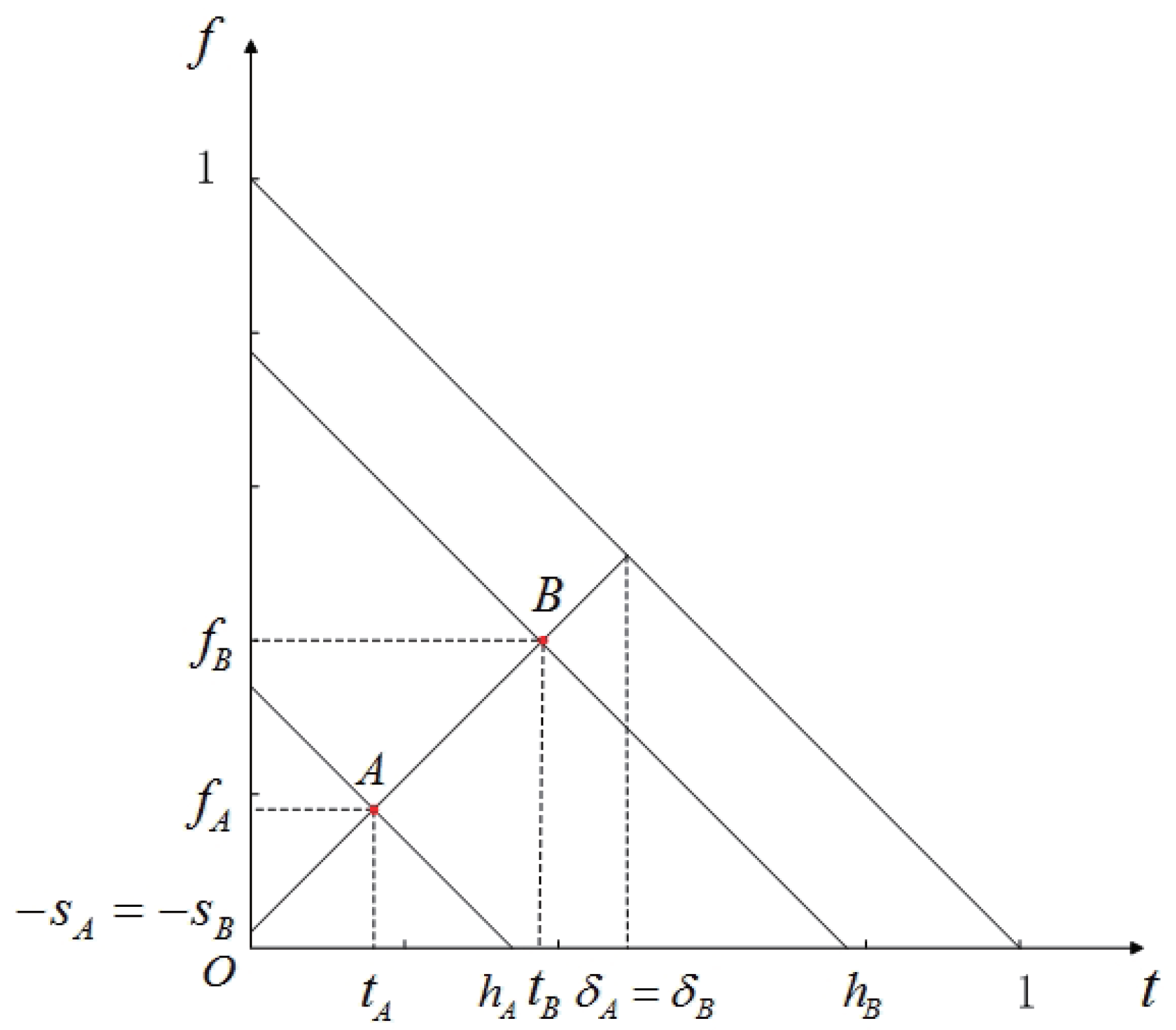
The results established in Theorem 4 and Corollary 1 indicate that the lexicographic orders , , and , in spite of being defined in terms of different measures, will always produce the same results when we use them to compare or rank IFVs. This equivalence is illustrated by Figure 1.
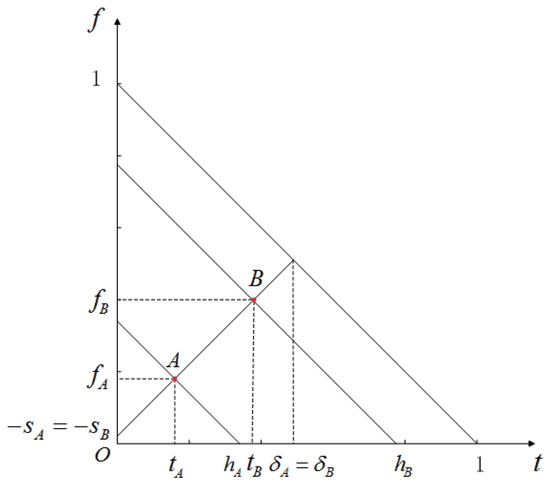
Figure 1.
The equivalence of the orders , , and .
Definition 23.
Let and be IFVs in . The binary relation on is given by
Definition 24.
Let and be IFVs in . The binary relation on is given by
Corollary 2.
Let and be IFVs in . Then
Proof.
This follows directly from Theorem 4. □
As shown in the example below, and are different lexicographic orders of IFVs.
Example 1.
Consider two IFVs
and
It is easy to see that , and . Also we have , and . Since and , we deduce that . On the other hand, is not true since and . Similarly, we can show that holds while is not true. This shows that and are different.
From Theorem 3, it follows that and are distinct. Using Corollary 1 and Corollary 2, many similar results can easily be deduced, which are no longer stated here.
Motivated by Bustince’s ordering of intervals, we introduce the following order relations for IFVs.
Definition 25.
Let and be IFVs in . The binary relation on is given by
It is interesting to see that coincides with the order relation .
Theorem 5.
Let and be IFVs in . Then if and only if .
Proof.
First, suppose that . Then the following two cases should considered.
(1) If , then .
(2) If and , we have
Thus and . That is, .
Conversely, assume that . Then we consider the following two cases.
(1) If , then .
(2) If and , we have
Thus and . That is, . □
Theorem 6.
Let and be IFVs in . Then the following are equivalent:
- (1)
- ;
- (2)
- ;
- (3)
- ;
- (4)
- .
Proof.
Note first that (1) and (2) are equivalent as shown in the proof of Theorem 5.
Next, we can also show that (1) and (3) are equivalent. In fact, suppose that and are two IFVs such that and . Then we have
Conversely, assume that and . Then we can deduce that
Thus (1) and (3) are equivalent.
Finally, it remains to prove that (1) and (4) are equivalent. To show this, assume first that and . Then we have
Conversely, assume that and . Then we can deduce that
Thus (1) and (4) are equivalent as well. This completes the entire proof. □
Definition 26.
Let and be IFVs in . The binary relation on is given by
Corollary 3.
Let and be IFVs in . Then
Proof.
This follows directly from Theorem 6. □
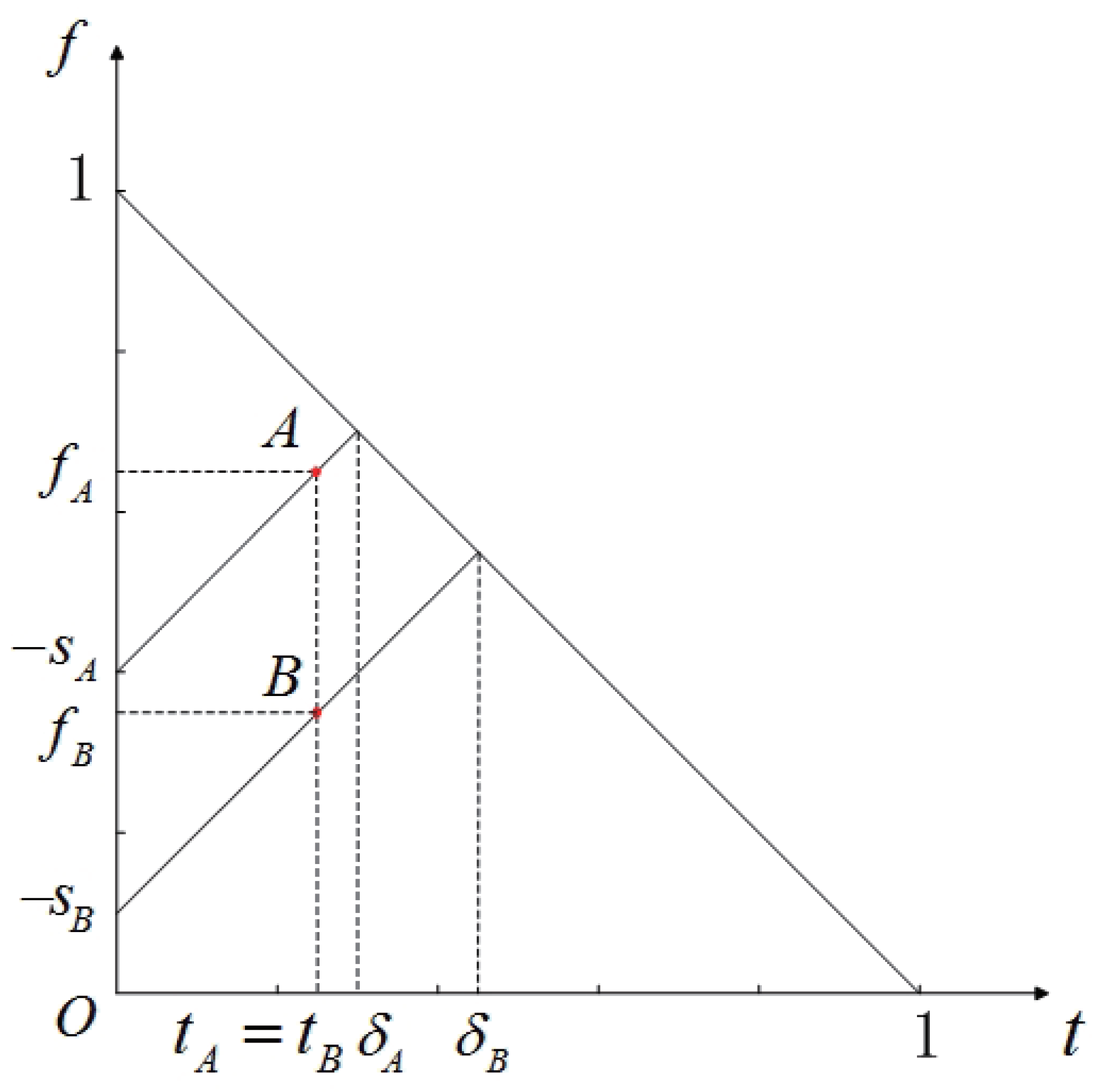
The results established in Theorem 6 and Corollary 3 indicate that the lexicographic orders , and , in spite of being defined in terms of different measures, will always produce the same results when we use them to compare or rank IFVs. This equivalence is illustrated by Figure 2.
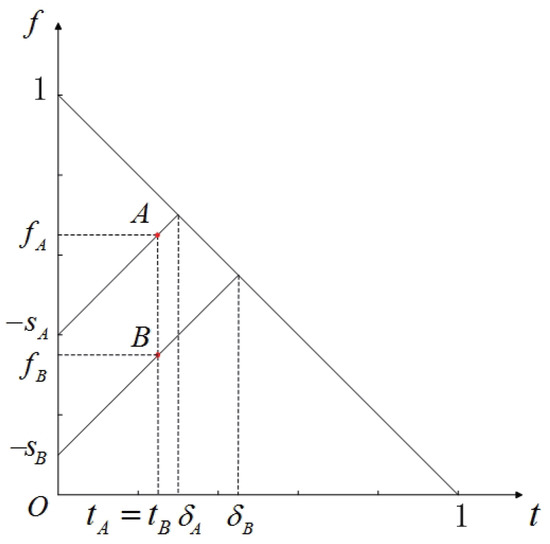
Figure 2.
The equivalence of the orders , and .
It is worth noting that and are distinct lexicographic orders of IFVs as illustrated by the following example.
Example 2.
Let and be two IFVs in . Then we have and . Thus it is clear that holds while is not true since and . In a similar fashion, we can prove that holds while is not true. Hence and are distinct.
According to Theorem 3, it follows that and are different. Using Corollary 1 and Corollary 3, a number of similar results can easily be deduced, which are no longer stated here. In addition, it should be noted that and are different lexicographic orders of IFVs as shown below.
Example 3.
Let us consider two IFVs
and
It is easy to see that and . Note first that since . On the other hand, is not true since . Similarly, we can prove that holds while is not true. This shows that and are distinct.
From Corollary 2, it follows that and are different. Using Corollary 2 and Corollary 3, other similar results can easily be deduced, which are no longer stated here.
Motivated by Bustince’s ordering of intervals, we introduce the following order relations for IFVs.
Definition 27.
Let and be IFVs in . The binary relation on is given by
Definition 28.
Let and be IFVs in . The binary relation on is given by
Theorem 7.
Let and be IFVs in . Then if and only if .
Proof.
First, assume that . The following two cases should be considered.
(1) If , then .
(2) If and , we have
Thus and . That is, .
Conversely, suppose that . Then we consider the following two cases.
(1) If , then .
(2) If and , we have
Thus and . That is, . □
Theorem 8.
Let and be IFVs in . Then the following are equivalent:
- (1)
- ;
- (2)
- ;
- (3)
- ;
- (4)
- .
Proof.
Note first that (1) and (4) are equivalent as shown in the proof of Theorem 7.
Next, we can also show that (1) and (2) are equivalent. In fact, suppose that and are two IFVs such that and . Then we have
Conversely, assume that and . Then we can deduce that
Thus (1) and (2) are equivalent.
Finally, it remains to prove that (1) and (3) are equivalent. To show this, assume first that and . Then we have
Conversely, assume that and . Then we can deduce that
Thus (1) and (3) are equivalent as well. This completes the entire proof of this theorem. □
Definition 29.
Let and be IFVs in . The binary relation on is given by
Definition 30.
Let and be IFVs in . The binary relation on is given by
Corollary 4.
Let and be IFVs in . Then
Proof.
This follows directly from Theorem 8. □
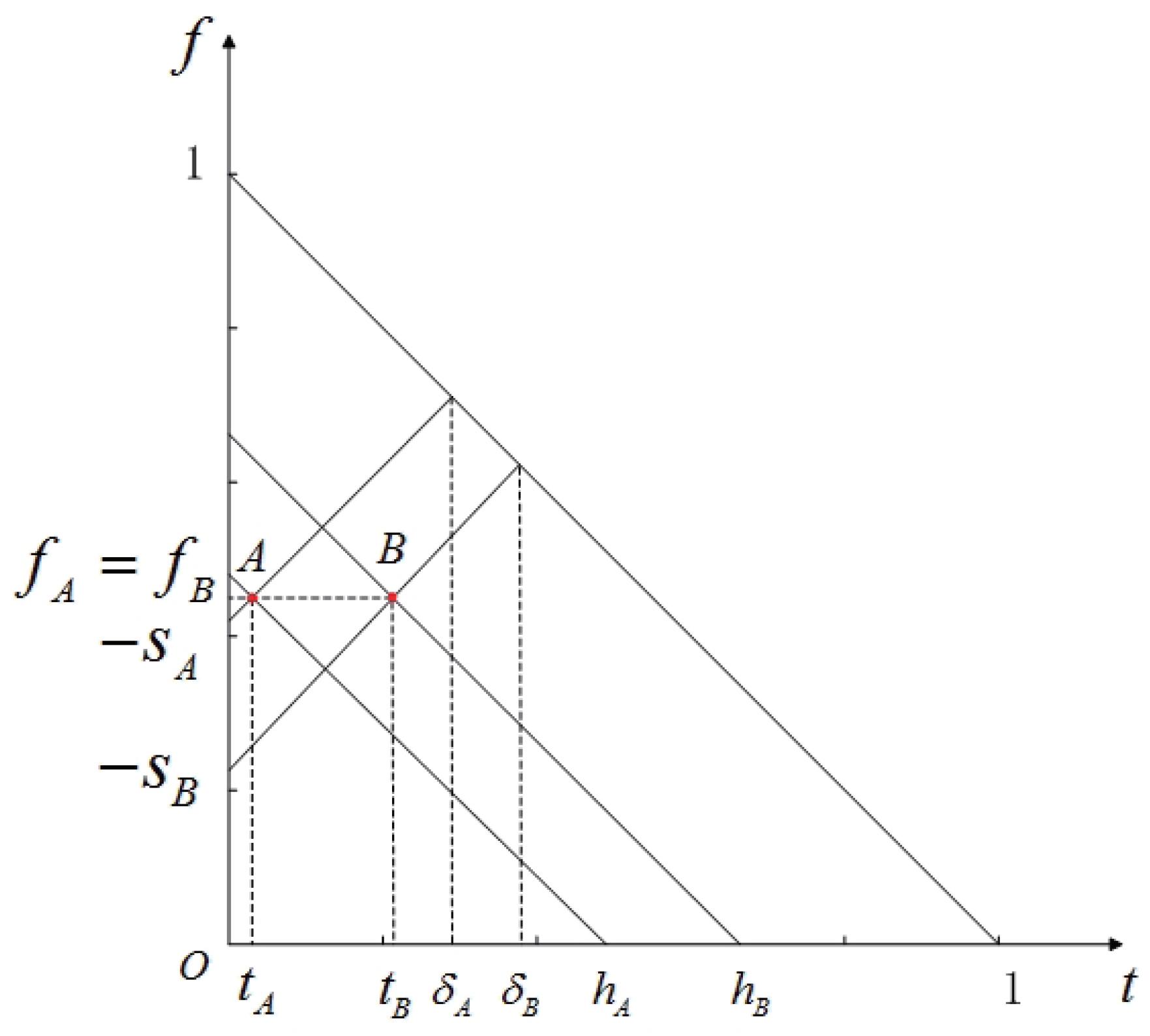
The results established in Theorem 8 and Corollary 4 indicate that the lexicographic orders , , and , in spite of being defined in terms of different measures, will always produce the same results when we use them to compare or rank IFVs. This equivalence is illustrated by Figure 3.
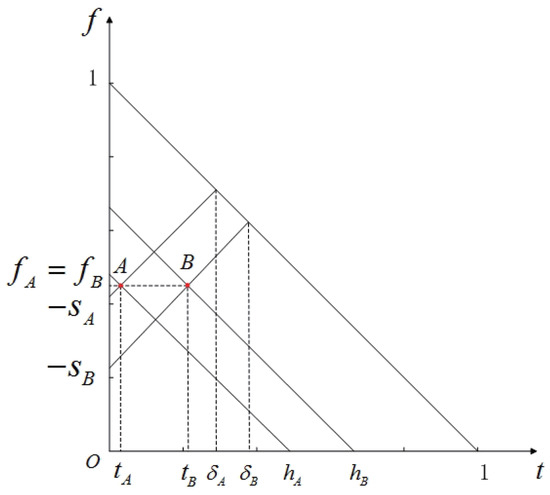
Figure 3.
The equivalence of the orders , , and .
To complete our discussion, it suffices to show the differences among the rest of lexicographic orders of IFVs by several illustrative examples as follows.
Example 4.
Consider two IFVs
and
It is clear that and . Thus it follows that holds while is not true since and . Similarly, we can deduce that holds while is false. Therefore, and are distinct.
From Theorem 3, it follows that and are different. Using Corollary 1 and Corollary 4, other similar results can easily be deduced, which are no longer stated here.
Example 5.
Let and be two IFVs in . Thus it is clear that holds while is not true since and . Similarly, we can show that holds while is false. This shows that and are distinct.
According to Theorem 5, we can see that and are different as well. Using Corollary 3 and Corollary 4, other similar results can easily be deduced, which are no longer stated here.
Example 6.
Consider two IFVs
and
Since and , it is clear that holds while is not true since and . In a similar fashion, it can be verified that is true while does not hold. Hence and are different.
From Corollary 2, it follows that and are different. By virtue of Corollary 2 and Corollary 4, other similar results can easily be deduced, which are no longer stated here.
Theorem 9.
The relation is an admissible order on .
Proof.
First, we prove that is a linear order on . Let , be two IFVs in . Then the following four cases should be considered.
(1) If , then .
(2) If , then .
(3) If and , then .
(4) If and , then .
Thus we have either or for all . This means that is a linear order on .
Next, assume that . Then we have and . Therefore, we can deduce that
If , then ; otherwise, we have and , which also implies .
Therefore, is an admissible order on . □
Theorem 10.
The relation is an admissible order on .
Proof.
The proof is similar to that of Theorem 9 and thus omitted. □
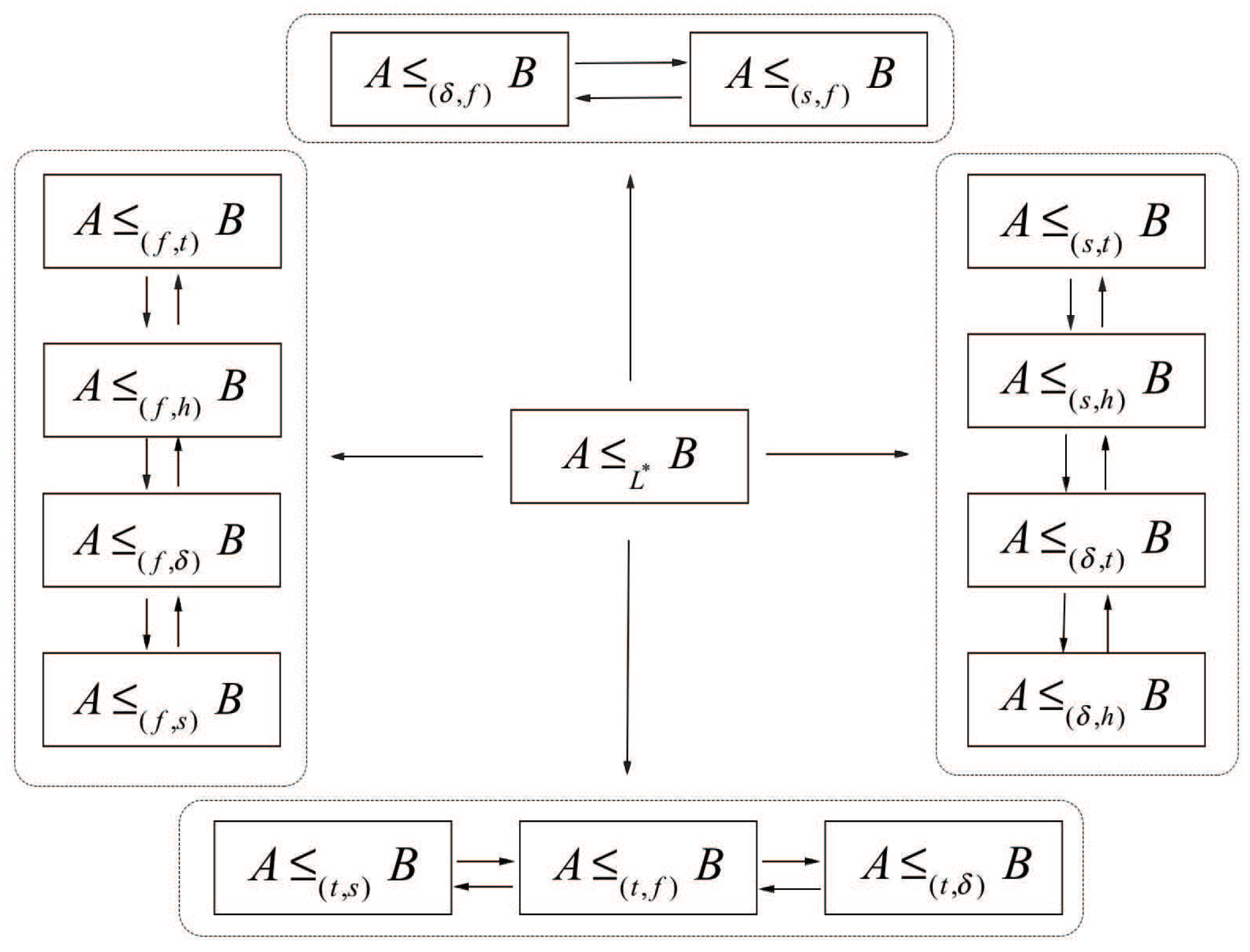
To summarize the discussion in this section, we demonstrate the relationships among thirteen lexicographic orders of IFVs with Figure 4. Note that the meaning of the symbols or graphic elements used in Figure 4 is as follows:
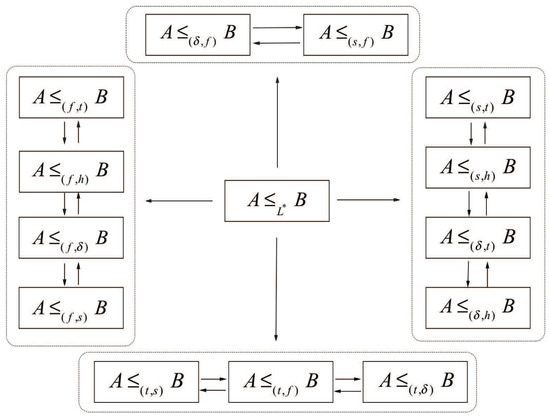
Figure 4.
Relationships among lexicographic orders of IFVs.
- The symbol → represents the logical implication;
- Each dotted box represents a category consisting of those lexicographic orders which are logically equivalent.
As shown in Figure 4, all the lexicographic orders investigated in this section are admissible orders, which can be divided into four categories. The lexicographic orders from different categories are distinct in essence, while lexicographic orders in the same category are logically equivalent, in spite of being defined in terms of different measures.
5. Compatible Lexicographic Orders
Xu and Yager [33,37] initiated some fundamental operations for IFVs, which laid a solid foundation for aggregating intuitionistic fuzzy information.
Definition 31.
[37] Let and be two IFVs in . Let λ be any positive real number. Then we have the following operations:
- ;
- .
In what follows, we refer to as the algebraic sum of the IFVs A and B. In addition, is called the scalar product of the positive real number and the IFV A.
Theorem 11.
[37] Let and be two IFVs in . Let λ, and be positive real numbers. Then we have the following:
- (1)
- ;
- (2)
- ;
- (3)
- .
Definition 32.
[37] Let () be IFVs in . The intuitionistic fuzzy weighted averaging (IFWA) operator of dimension n is a mapping given by
where is the weight vector such that () and .
Especially, if , then is simply written as and called the intuitionistic fuzzy averaging (IFA) operator. That is,
The following result is helpful for simplifying the calculation regarding IFWA operators.
Theorem 12.
[37] Let (). Then we have
where is the weight vector.
Proposition 1.
Let and λ be any positive real number. Then we have the following:
- (1)
- ;
- (2)
- ;
- (3)
- .
- (4)
- .
Proof.
Straightforward. □
Definition 33.
Let ⪯ be a preorder on . Then we say that ⪯ is left compatible with the algebraic sum operation if
where , and are IFVs in .
Definition 34.
Let ⪯ be a preorder on . Then we say that ⪯ is right compatible with the algebraic sum operation if
where , and are IFVs in .
A lexicographic order ⪯ is said to be compatible with the algebraic sum operation if it is both left and right compatible. Since the algebraic sum operation is commutative, we can immediately obtain the following result.
Proposition 2.
Let ⪯ be a preorder on . Then the following statements are equivalent:
- (1)
- ⪯ is left compatible with the algebraic sum operation;
- (2)
- ⪯ is right compatible with the algebraic sum operation;
- (3)
- ⪯ is compatible with the algebraic sum operation.
Proof.
Straightforward. □
Definition 35.
Let ⪯ be a preorder on . Then we say that ⪯ is pseudo-compatible with the scalar product operation if
where and are positive real numbers.
Definition 36.
Let ⪯ be a preorder on . Then we say that ⪯ is compatible with the scalar product operation if it satisfies:
- (1)
- ;
- (2)
- ,
where and are positive real numbers.
Now, let us investigate whether the aforementioned lexicographic orders of IFVs are compatible with the algebraic sum operation.
Theorem 13.
Let , and be IFVs in such that . Then we have the following:
- (1)
- ;
- (2)
- ;
- (3)
- ;
- (4)
- ;
- (5)
- ;
- (6)
- .
Proof.
Note that we only need to prove the first assertion. The others can be deduced from it using Corollary 3 and Theorem 11.
To show the first assertion, let us suppose that holds. Then according to Definition 31, we have
and
Hence, we consider the following two cases:
(1) If , we have
and so .
(2) If and , then and also we have
which means that .
In both cases, we can deduce that . □
Proposition 3.
Let , and be IFVs in with . Then
Proof.
By Definition 31, we have
and
Assume that and . Then the following two cases should be taken into account.
(1) If , we have
and so .
(2) If and , then and we deduce that
That is, .
In both cases, we can deduce that . □
It is worth noting that the condition cannot be removed in the above statement as demonstrated by the following example.
Example 7.
Consider two IFVs
and
Note first that holds since . Let . By calculation, we have and . Thus it is clear that
since and . This shows that is incompatible with the algebraic sum operation.
Using Corollary 4, other similar results can be obtained for lexicographic orders , and , which are no longer stated here.
The following example shows that (or equivalently ) is not compatible with the algebraic sum operation.
Example 8.
Consider two IFVs
and
Note first that and . Thus holds since . Let By calculation, we have
and
Since , it follows that
This shows that is incompatible with the algebraic sum operation.
As shown below, is incompatible with the algebraic sum operation.
Example 9.
Let us revisit the IFVs in Example 8. It is ease to see that holds since . Note also that holds since . This counterexample indicates that is not compatible with the algebraic sum operation of IFVs.
From Corollary 1, it follows that the lexicographic orders , and are incompatible with the algebraic sum operation of IFVs.
Theorem 14.
Let . Then we have
- (1)
- ;
- (2)
- ,
where are positive real numbers.
Proof.
Let and be two IFVs in . Let and be two positive real numbers. First, assume that . The following two cases should be considered.
(1) If , then , which implies that
(2) If and , then we have
and
In both cases, we can deduce that . This completes the proof of the first assertion.
Next, suppose that . If , it is clear that since is reflexive. Otherwise, let , and we consider the following three cases.
(1) If , then . It follows that
(2) If , then and so .
(3) If , then and we have
In all these cases, we can deduce that . This completes the proof of the second assertion. □
The above result shows that the lexicographic order is compatible with the scalar product operation. From Corollary 3, it follows that lexicographic orders and are compatible with the scalar product operation. In addition, we can prove the following result regarding the lexicographic order in a similar way.
Theorem 15.
The lexicographic order is compatible with the algebraic sum operation of IFVs.
Proof.
Let and be two IFVs in . Let and be two positive real numbers. First, assume that . The following two cases should be considered.
(1) If , then we have
(2) If and , then we have
and
since .
In both cases, we can deduce that . This completes the proof of the first assertion.
Next, suppose that . If , it is clear that since is reflexive. Otherwise, let , and the following three cases should be considered.
(1) If , then we have
(2) If , then and so .
(3) If , then and we have
since .
In all these cases, we can deduce that . This completes the proof of the second assertion. □
From Corollary 4 and the above result, it follows that , and are compatible with the scalar product operation.
Example 10.
Consider two IFVs
and
Note that since and . On the other hand, we have
and
Since , it is clear that . This counterexample shows that the lexicographic order is incompatible with the scalar product operation.
Nevertheless, the following result shows that is pseudo-compatible with the scalar product operation.
Theorem 16.
Let . Then we have
where are positive real numbers.
Proof.
Let be an IFV in . Let and be two positive real numbers such that . If , then since is reflexive. Otherwise, let , and we consider the following three cases.
(1) If , then . Note also that
Thus we can deduce that
which implies that .
(2) If , then and so .
(3) If , then . It follows that
If , the result follows directly. Otherwise, we have , which implies that , and so .
In all these cases, we can deduce that . This completes the proof. □
Using Corollary 1, other similar results can be obtained for lexicographic orders , and , which are no longer stated here.
Example 11.
Consider two IFVs
and
Since and , we have . Taking , we have and . It follows that since . This shows that (or equivalently ) is incompatible with the scalar product operation.
It is worth noting that (or equivalently ) is pseudo-compatible with the scalar product operation as shown below.
Theorem 17.
Let . Then we have
where are positive real numbers.
Proof.
The proof is similar to that of Theorem 16 and thus omitted. □
At the end of this section, we summarize various compatible properties of different lexicographic orders in Table 1. For the sake of convenience, we choose only one particular order as the representative in each distinct category of lexicographic orders (see Figure 4). Note also that the full terms corresponding to the acronyms in Table 1 are given below:

Table 1.
Compatible properties of lexicographic orders.
- CAS stands for compatibility with the algebraic sum operation;
- CSP stands for compatibility with the scalar product operation;
- PCSP stands for pseudo-compatibility with the scalar product operation.
From Table 1, we can see that all the lexicographic orders discussed in the previous section are pseudo-compatible with the scalar product operation. The orders and are compatible with the scalar product. It is worth noting that the order is the only lexicographic order which satisfies all the compatible properties. In this sense, the order can perfectly serve the purpose of ranking IFVs in cooperation with the IFWA operator.
6. Numerical Illustration
To demonstrate the practical value of the theoretical results obtained in previous sections, we revisit a benchmark problem regarding risk investment, which was originally raised by Herrera and Herrera-Viedma [52]. Later on, Wei [53] considered the same problem in an intuitionistic fuzzy setting. This problem was further investigated by Chen and Tu in [34]. Note that a similar problem was discussed by Wu and Chen [54] as well.
Assume that there is an investment bank B which intends to invest a sum of money to the most appropriate company. Let us denote by U the collection of five companies under the consideration of the bank B. Specifically, the alternatives in U for potential investment include:
- is a car company;
- is a food company;
- is a computer company;
- is an arms company;
- is a television company.
In order to choose the most suitable company, a committee consisting of ten experts is organized by the bank B to give the evaluation of all companies according to four criteria in . The meaning of the criterion () is as follows:
- stands for low investment risk;
- stands for high growth rate;
- stands for positive social-political impact;
- stands for low environmental pollution.
All these criteria are beneficial ones. To facilitate the comparison, the evaluation results are inherited verbatim from [53]. These results can be described by an intuitionistic fuzzy soft set over U, as shown in Table 2. For instance, the assessment result of the company with respect to the criterion is given by the IFV . This can be interpreted as “four experts in the committee think that the food company causes low environmental pollution, while five experts disagree with this opinion, and also there is one expert who declines to give his/her opinion on this issue”.
Table 2.
Intuitionistic fuzzy soft set .
Following the way of discussion in [53], we consider the following two different cases. In both cases, the IFWA operator will be used to aggregate the concerned intuitionistic fuzzy information.
Case 1: In this case, the information about the attribute weights is partly known and the weights can be determined by solving the following single-objective programming model, as established in [53].
The obtained weight vector is
Using this weight vector, we can calculate the aggregated intuitionistic fuzzy preference value (AIFPV) () as follows:
For instance, the AIFPV can be obtained by
Moreover, we calculate the score of the AIFPVs. For instance, we have . Other results regarding the AIFPVs and related measures can be found in Table 3. In addition, the ranking results of five companies respectively based on the lexicographic orders , , and are shown in Table 4.
Table 3.
AIFPVs and related measures in Case 1.
Table 4.
Ranking results given by different lexicographic orders in Case 1.
There are several important points need to be mentioned in view of the results obtained in Case 1:
Firstly, note that the ranking results given by the orders and are identical, since the scores () are all different. In such a particular situation, the orders and will definitely produce the same ranking result as only the score function is used indeed. Nevertheless, it should be noted that and are not logically equivalent in general as shown in Section 4.
Secondly, recall that Wei [53] ranked the companies () by means of the order . The result is as follows:
which is the same as the result given by the order in Table 4. In fact, we assert that the orders and will always produce the same ranking, because they are logically equivalent according to Corollary 1. It is worth noting that the IFWA operator and the order was jointly utilized to aggregate the IFVs and rank the alternatives in [53]. Nevertheless, as mentioned in Section 5, the order (or equivalently ) is only pseudo-compatible with the scalar product operation. As illustrated by Example 10, it might happen that and meanwhile for in some cases. Consequently, the order might give rise to unreasonable ranking results since it is difficult to act perfectly in cooperation with the IFWA operator.
Last but not least, as pointed out in Section 5, the order is an admissible order on which is compatible with both the algebraic sum and scalar product operations. Thus the order is able to rank IFVs jointly with the IFWA operator in a perfect manner. As a result, the ranking result given by the order is more reasonable indeed, even though it looks quite different from the results given by other orders in Case 1.
In fact, the orders and might occasionally produce the same ranking result in some other cases. This will be further illustrated in the discussion below.
Case 2: In this case, the information about the attribute weights is completely unknown. For the sake of convenience, we assume that each attribute has the equal weight. That is, the weight vector is
Note that some minor changes are made to the evaluation regarding the company . The new evaluation information can be expressed by another intuitionistic fuzzy soft set over U, as shown in Table 5.
Table 5.
Intuitionistic fuzzy soft set .
Based on the intuitionistic fuzzy soft set and new weight vector , we can calculate the corresponding AIFPVs and related measures as done in Case 1. The results are shown in Table 6. Moreover, the ranking results of five companies respectively based on the lexicographic orders , , and are shown in Table 7.
Table 6.
AIFPVs and related measures in Case 2.
Table 7.
Ranking results given by different lexicographic orders in Case 2.
We would like to point out the following two issues regarding the results obtained in Case 2.
Firstly, unlike in Case 1, the ranking results given by the orders and become different in this case. Specifically, the result given by is
while the result given by is
since , and .
Secondly, recall that the ranking result given by the order is different from the results given by other orders in Case 1. However, in this case, it is interesting to observe that the orders and can by chance bring forth the same ranking results:
even though they are distinct in essence as revealed in Section 4.
Remark 1.
To summarize the discussion in above two cases, we conclude that the lexicographic order (or equivalently and ) is most suitable for ranking IFVs in those intuitionistic fuzzy multiple attribute decision making procedures, where IFWA operator are utilized to aggregate the original decision information quantified in terms of IFVs. This is mainly due to the fact that is compatible with both the algebraic sum and scalar product operations. Thus it can cooperate with the IFWA operator and serve the purpose of ranking IFVs in a coordinated way. On the other hand, if other lexicographic orders such as , or will be used in intuitionistic fuzzy multiple attribute decision making, we should consider replacing the IFWA operator with other aggregation operators, which are consistent with the selected lexicographic order.
7. Conclusions
In this study, we introduced a number of new lexicographic orders with the aid of the membership function, non-membership function, score function, accuracy function and expectation score function. We gave some equivalent characterizations and illustrative examples to clarify the relationships among various lexicographic orders. It has been found that all these lexicographic orders are admissible and can be divided into four categories (see Figure 4). The lexicographic orders from different categories are distinct in essence, while lexicographic orders in the same category are logically equivalent. Three different compatible properties of preorders with respect to the algebraic sum and scalar product operations of IFVs were introduced as well. We have shown that all the lexicographic orders are pseudo-compatible with the scalar product operation, and (or equivalently and ) satisfies all three compatible properties (see Table 1). Moreover, we revisited a benchmark problem to give comparative analysis of different lexicographic orders and highlighted the practical value of the obtained results for solving intuitionistic fuzzy multiple attribute decision making problems in real-life scenarios. In the future, it would be interesting to consider how to define new operations and related aggregation operators which are compatible with lexicographic orders such as , or , to further promote pragmatic applications of multiple attribute decision making in an intuitionistic fuzzy setting.
Author Contributions
Conceptualization, F.F.; Formal analysis, F.F., M.L., H.F., R.R.Y. and X.L.; Writing-original draft, F.F., M.L. and X.L.; Writing-review & editing, F.F., H.F. and R.R.Y.
Funding
This work was partially supported by National Natural Science Foundation of China (Program Nos. 51875457, 11301415), Natural Science Basic Research Plan in Shaanxi Province of China (Program No. 2018JM1054), Scientific Research Program Funded by Shaanxi Provincial Education Department of China (Program No. 16JK1696), and the Special Funds Project for Key Disciplines Construction of Shaanxi Universities.
Acknowledgments
The authors are highly grateful to two anonymous reviewers for their valuable comments and helpful suggestions.
Conflicts of Interest
The authors declare no conflict of interest.
References
- Zadeh, L.A. Fuzzy sets. Inf. Control 1965, 8, 338–353. [Google Scholar] [CrossRef]
- Rahman, S. On cuts of Atanassov’s intuitionistic fuzzy sets with respect to fuzzy connectives. Inf. Sci. 2016, 340–341, 262–278. [Google Scholar] [CrossRef]
- Atanassov, K.T. Intuitionistic fuzzy sets. In Proceedings of the VII ITKR’s Session, Sofia, Bulgaria, 20–23 June 1983. Deposed in Central Sci.-Techn. Library of Bulg. Acad. of Sci., 1697/84. (In Bulgarian). [Google Scholar]
- Atanassov, K.T. Intuitionistic fuzzy sets. Fuzzy Sets Syst. 1986, 20, 87–96. [Google Scholar] [CrossRef]
- Yager, R.R. Multicriteria decision making with ordinal/linguistic intuitionistic fuzzy sets for mobile apps. IEEE Trans. Fuzzy Syst. 2016, 24, 590–599. [Google Scholar] [CrossRef]
- Bustince, H.; Burillo, P. Vague sets are intuitionistic fuzzy sets. Fuzzy Sets Syst. 1996, 79, 403–405. [Google Scholar] [CrossRef]
- Gau, W.L.; Buehrer, D.J. Vague sets. IEEE Trans. Syst. Man Cybern. 1993, 23, 610–614. [Google Scholar] [CrossRef]
- Wang, G.J.; He, Y.Y. Intuitionistic fuzzy sets and L-fuzzy sets. Fuzzy Sets Syst. 2000, 110, 271–274. [Google Scholar] [CrossRef]
- Deschrijver, G.; Kerre, E. On the relationship between some extensions of fuzzy set theory. Fuzzy Sets Syst. 2003, 133, 227–235. [Google Scholar] [CrossRef]
- Molodtsov, D.A. Soft set theory-first results. Comput. Math. Appl. 1999, 37, 19–31. [Google Scholar] [CrossRef]
- Feng, F.; Cho, J.; Pedrycz, W.; Fujita, H.; Herawan, T. Soft set based association rule mining. Knowl.-Based Syst. 2016, 111, 268–282. [Google Scholar] [CrossRef]
- Maji, P.K.; Biswas, R.; Roy, A.R. Soft set theory. Comput. Math. Appl. 2003, 45, 555–562. [Google Scholar] [CrossRef]
- Ali, M.I.; Feng, F.; Liu, X.Y.; Min, W.K.; Shabir, M. On some new operations in soft set theory. Comput. Math. Appl. 2009, 57, 1547–1553. [Google Scholar] [CrossRef]
- Ali, M.I.; Shabir, M.; Naz, M. Algebraic structures of soft sets associated with new operations. Comput. Math. Appl. 2011, 61, 2647–2654. [Google Scholar] [CrossRef]
- Feng, F.; Liu, X.Y.; Leoreanu-Fotea, V.; Jun, Y.B. Soft sets and soft rough sets. Inf. Sci. 2011, 181, 1125–1137. [Google Scholar] [CrossRef]
- Alcantud, J.C.R. Some formal relationships among soft sets, fuzzy sets, and their extensions. Int. J. Approx. Reason. 2016, 68, 45–53. [Google Scholar] [CrossRef]
- Maji, P.K.; Biswas, R.; Roy, A.R. Fuzzy soft sets. J. Fuzzy Math. 2001, 9, 589–602. [Google Scholar]
- Maji, P.K.; Biswas, R.; Roy, A.R. Intuitionistic fuzzy soft sets. J. Fuzzy Math. 2001, 9, 677–692. [Google Scholar]
- Feng, F.; Li, Y.M. Soft subsets and soft product operations. Inf. Sci. 2013, 232, 44–57. [Google Scholar] [CrossRef]
- Jun, Y.B.; Park, C.H. Applications of soft sets in ideal theory of BCK/BCI-algebras. Inf. Sci. 2008, 178, 2466–2475. [Google Scholar] [CrossRef]
- Jun, Y.B. Soft BCK/BCI-algebras. Comput. Math. Appl. 2008, 56, 1408–1413. [Google Scholar] [CrossRef]
- Jun, Y.B.; Lee, K.J.; Khan, A. Soft ordered semigroups. Math. Logic Q. 2010, 56, 42–50. [Google Scholar] [CrossRef]
- Feng, F.; Akram, M.; Davvaz, B.; Leoreanu-Fotea, V. Attribute analysis of information systems based on elementary soft implications. Knowl.-Based Syst. 2014, 70, 281–292. [Google Scholar] [CrossRef]
- Alcantud, J.C.R. A novel algorithm for fuzzy soft set based decision making from multiobserver input parameter data set. Inf. Fusion 2016, 29, 142–148. [Google Scholar] [CrossRef]
- Alcantud, J.C.R.; Mathew, T.J. Separable fuzzy soft sets and decision making with positive and negative attributes. Appl. Soft Comput. 2017, 59, 586–595. [Google Scholar] [CrossRef]
- Akram, M.; Adeel, A.; Alcantud, J.C.R. Group decision-making methods based on hesitant N-soft sets. Expert Syst. Appl. 2019, 115, 95–105. [Google Scholar] [CrossRef]
- Çağman, N.; Enginoğlu, S. Soft matrix theory and its decision making. Comput. Math. Appl. 2010, 59, 3308–3314. [Google Scholar] [CrossRef]
- Çağman, N.; Enginoğlu, S. Soft set theory and uni-int decision making. Eur. J. Oper. Res. 2010, 207, 848–855. [Google Scholar] [CrossRef]
- Deli, I.; Çağman, N. Intuitionistic fuzzy parameterized soft set theory and its decision making. Appl. Soft Comput. 2015, 28, 109–113. [Google Scholar] [CrossRef]
- Feng, F.; Li, Y.M.; Çağman, N. Generalized uni-int decision making schemes based on choice value soft sets. Eur. J. Oper. Res. 2012, 220, 162–170. [Google Scholar] [CrossRef]
- Akram, M.; Nawaz, S. Fuzzy soft graphs with applications. J. Intell. Fuzzy Syst. 2016, 30, 3619–3632. [Google Scholar] [CrossRef]
- Ali, M.I.; Shabir, M. Logic connectives for soft sets and fuzzy soft sets. IEEE Trans. Fuzzzy Syst. 2014, 22, 1431–1442. [Google Scholar] [CrossRef]
- Xu, Z.S.; Yager, R.R. Some geometric aggregation operators based on intuitionistic fuzzy sets. Int. J. Gen. Syst. 2006, 35, 417–433. [Google Scholar] [CrossRef]
- Chen, L.H.; Tu, C.C. Dual bipolar measures of Atanassov’s intuitionistic fuzzy sets. IEEE Trans. Fuzzzy Syst. 2014, 22, 966–982. [Google Scholar] [CrossRef]
- Chen, S.M.; Cheng, S.H.; Lan, T.C. A novel similarity measure between intuitionistic fuzzy sets based on the centroid points of transformed fuzzy numbers with applications to pattern recognition. Inf. Sci. 2016, 343–344, 15–40. [Google Scholar] [CrossRef]
- Dymova, L.; Sevastjanov, P. The operations on intuitionistic fuzzy values in the framework of Dempster-Shafer theory. Knowl.-Based Syst. 2012, 35, 132–143. [Google Scholar] [CrossRef]
- Xu, Z.S. Intuitionistic fuzzy aggregation operators. IEEE Trans. Fuzzy Syst. 2007, 15, 1179–1187. [Google Scholar]
- Dymova, L.; Sevastjanov, P.; Tikhonenko, A. Two-criteria method for comparing real-valued and interval-valued intuitionistic fuzzy values. Knowl.-Based Syst. 2013, 45, 166–173. [Google Scholar] [CrossRef]
- Guo, K. Amount of information and attitudinal-based method for ranking Atanassov’s intuitionistic fuzzy values. IEEE Trans. Fuzzzy Syst. 2014, 22, 177–188. [Google Scholar] [CrossRef]
- Feng, F.; Fujita, H.; Ali, M.I.; Yager, R.R.; Liu, X. Another view on generalized intuitionistic fuzzy soft sets and related multiattribute decision making methods. IEEE Trans. Fuzzzy Syst. 2018. [Google Scholar] [CrossRef]
- Yager, R.R. Generalized Orthopair Fuzzy Sets. IEEE Trans. Fuzzy Syst. 2017, 25, 1222–1230. [Google Scholar] [CrossRef]
- Chen, S.M.; Tan, J.M. Handling multicriteria fuzzy decision-making problems based on vague set theory. Fuzzy Sets Syst. 1994, 67, 163–172. [Google Scholar] [CrossRef]
- Chen, S.M.; Cheng, S.H.; Lan, T.C. Multicriteria decision making based on the TOPSIS method and similarity measures between intuitionistic fuzzy values. Inf. Sci. 2016, 367–368, 279–295. [Google Scholar] [CrossRef]
- Gupta, P.; Lin, C.T.; Mehlawat, M.K.; Grover, N. A new method for intuitionistic fuzzy multiattribute decision making. IEEE Trans. Syst. Man Cybern. 2016, 46, 1167–1179. [Google Scholar] [CrossRef]
- Xu, Z.S.; Zhao, N. Information fusion for intuitionistic fuzzy decision making: An overview. Inf. Fusion 2016, 28, 10–23. [Google Scholar] [CrossRef]
- Shen, F.; Xu, J.; Xu, Z.S. An outranking sorting method for multi-criteria group decision making using intuitionistic fuzzy sets. Inf. Sci. 2016, 334–335, 338–353. [Google Scholar] [CrossRef]
- Wan, S.P.; Wang, F.; Dong, J.Y. A preference degree for intuitionistic fuzzy values and application to multi-attribute group decision making. Inf. Sci. 2016, 370–371, 127–146. [Google Scholar] [CrossRef]
- Xu, Z.S. Multi-person multi-attribute decision making models under intuitionistic fuzzy environment. Fuzzy Optim. Decis. Mak. 2007, 6, 221–236. [Google Scholar] [CrossRef]
- Hong, D.H.; Choi, C.H. Multi-criteria fuzzy decision-making problems based on vague set theory. Fuzzy Sets Syst. 2000, 114, 103–113. [Google Scholar] [CrossRef]
- Bustince, H.; Fernandez, J.; Kolesárová, A.; Mesiar, R. Generation of linear orders for intervals by means of aggregation functions. Fuzzy Sets Syst. 2013, 220, 69–77. [Google Scholar] [CrossRef]
- Debreu, G. Representation of a preference ordering by a numerical function. In Decision Processes; Thrall, R.M., Coombs, C.H., Davies, R.L., Eds.; Wiley: New York, NY, USA, 1954; pp. 159–166. [Google Scholar]
- Herrera, F.; Herrera-Viedma, E. Linguistic decision analysis: Steps for solving decision problems under linguistic information. Fuzzy Sets Syst. 2000, 115, 67–82. [Google Scholar] [CrossRef]
- Wei, G.W. Maximizing deviation method for multiple attribute decision making in intuitionistic fuzzy setting. Knowl.-Based Syst. 2008, 21, 833–836. [Google Scholar] [CrossRef]
- Wu, Z.; Chen, Y. The maximizing deviation method for group multiple attribute decision making under linguistic environment. Fuzzy Sets Syst. 2007, 158, 1608–1617. [Google Scholar] [CrossRef]
© 2019 by the authors. Licensee MDPI, Basel, Switzerland. This article is an open access article distributed under the terms and conditions of the Creative Commons Attribution (CC BY) license (http://creativecommons.org/licenses/by/4.0/).