A Novel Bat Algorithm with Multiple Strategies Coupling for Numerical Optimization

 ,
,
Abstract
:1. Introduction
2. Bat Algorithm
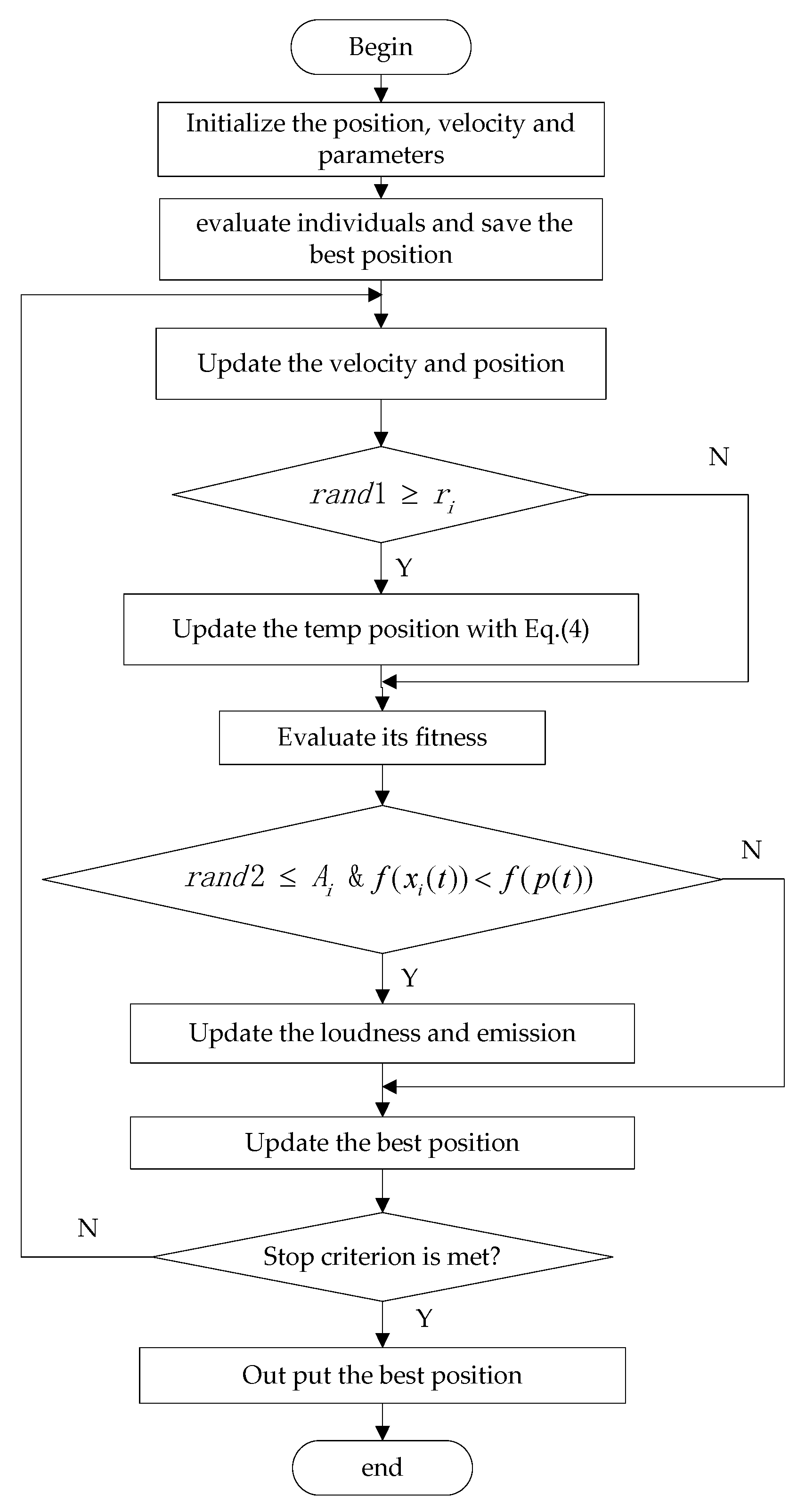
- Step 1:
- For each bat, initialize the position, velocity, and parameters and randomly generate the frequency with Equation (3).
- Step 2:
- Update the position and velocity of each bat with Equations (1) and (2).
- Step 3:
- For each bat, generate a random number (). Update the temp position and calculate the fitness value for corresponding bat with Equation (4) if .
- Step 4:
- For each bat, generate a random number (). Update and with Equations (5) and (6), respectively, if and .
- Step 5:
- Sort each individual based on fitness values and save the best position.
- Step 6:
- The algorithm is finished if the condition is met, otherwise, move on to Step 2.
3. Bat Algorithm with Multiple Strategy Coupling
- (2) The velocity and position formula of the improved algorithm are adopted [29]:where is the position of the worst individual.
- (3) The position and velocity formula of Levy flight was adopted by Xie et al. [24]:where is a random constant, is a constant, is the best position of the bat, and is the best position of those found so far. () is step length of the Levy flight and stands for dot product.
- (4) The position and velocity formula of Levy flight was adopted by Liu [26]:and are the position of bat in generation and generation, respectively.
- (5) The position and velocity formula with the idea of genetic algorithms was adopted:The formula is a two-point crossover operator in simulation genetic algorithm.
- (6) The position and velocity formula with the idea of PSO was adopted:where and are random constants and is the best position by the entire swarm.
- (7) A local disturbance strategy based on inertial parameters is adopted:where and are the maximum and minimum values, respectively, of inertia weight and is the maximum number of iterations.
- (8) The local search strategy of flight to optimal position is adopted.where is the best position by the entire swarm and is a random constant.
4. Experimental Result
4.1. Text Functions and Parameter
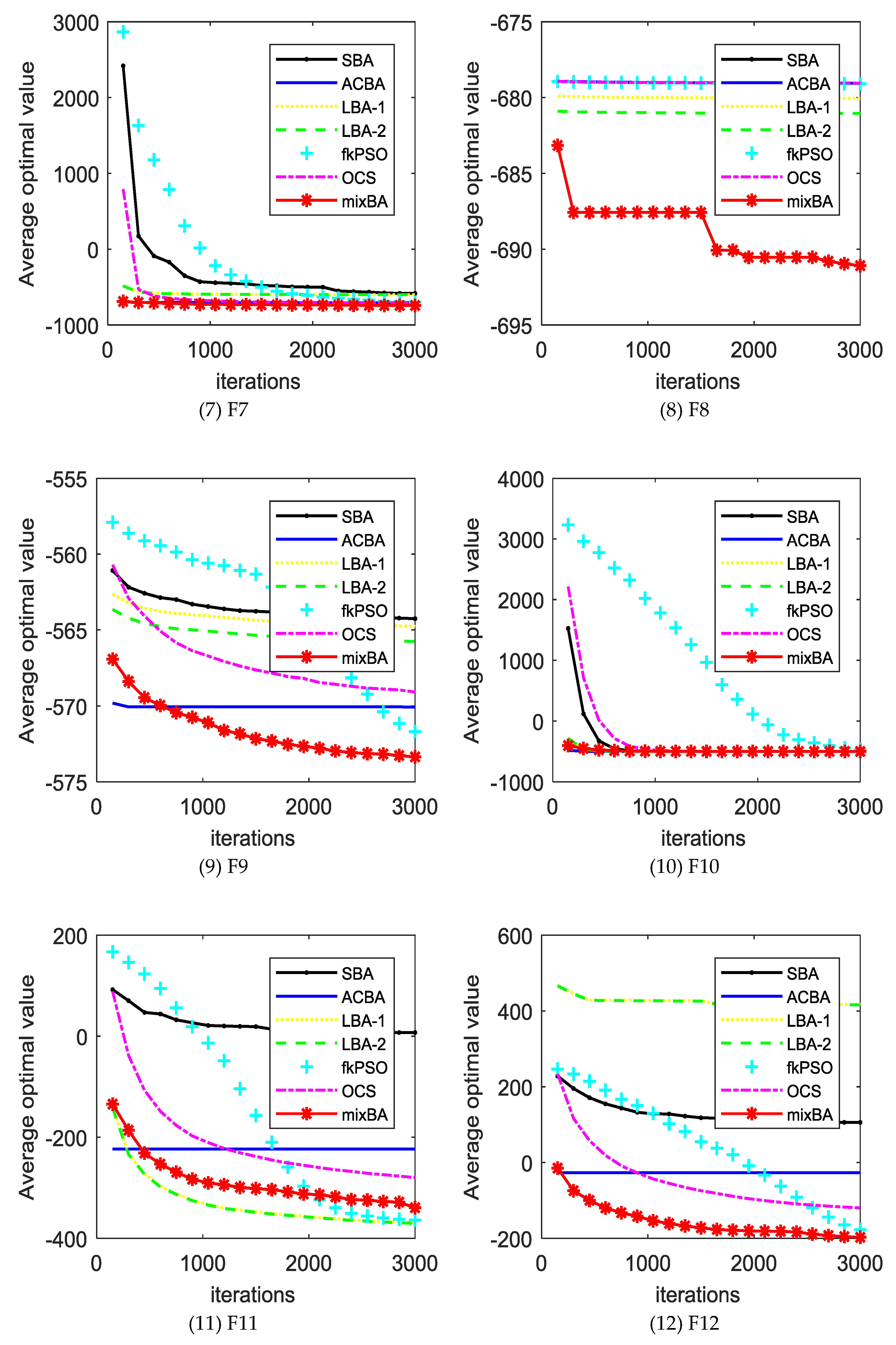
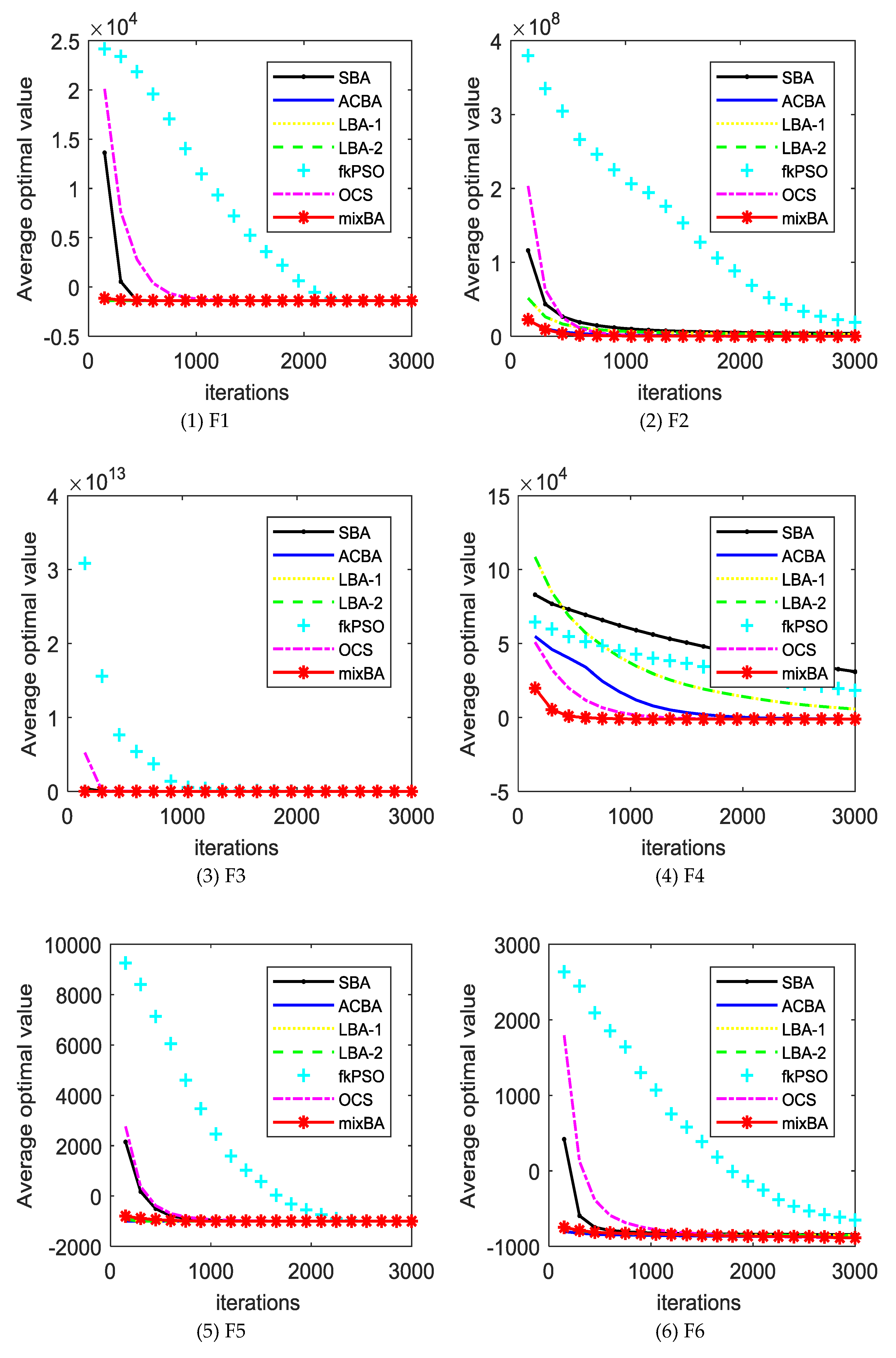
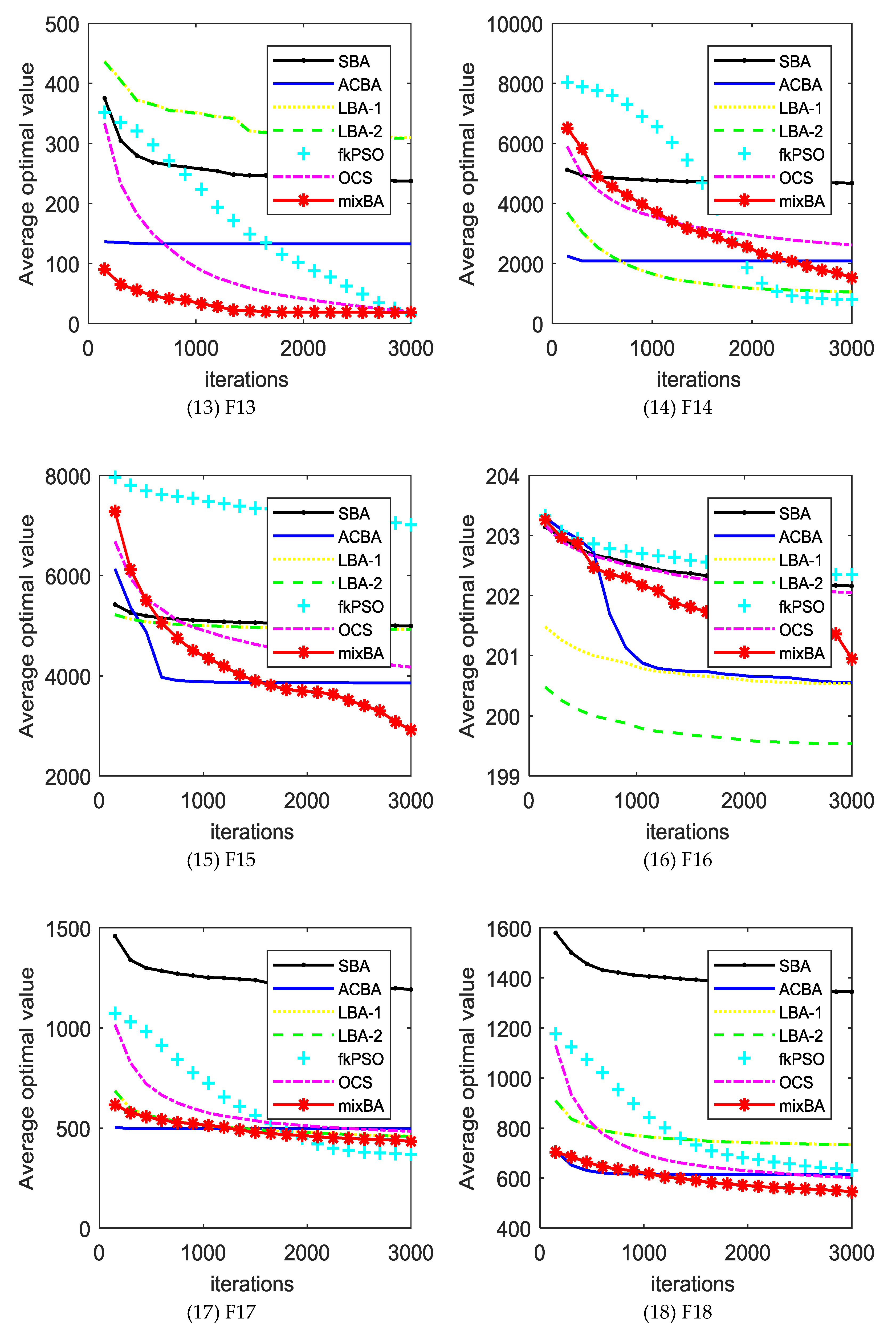
4.2. Comparison of MixBA with State-of-the-Art Algorithms
5. Conclusions
Author Contributions
Acknowledgments
Conflicts of Interest
Appendix A

| Function | SBA | ACBA | LBA1 | LBA2 | FK-PSO | OCS | mixBA |
|---|---|---|---|---|---|---|---|
| F1 | 1.96 × 100 | 0.00 × 100 | 8.24 × 10⁻¹ | 3.59 × 10⁻¹ | 0.00 × 100 | 4.51 × 10⁻⁵ | 1.98 × 10⁻⁵ |
| F2 | 3.69 × 10⁶ | 3.04 × 10⁵ | 3.54 × 10⁶ | 2.23 × 10⁶ | 1.59 × 10⁶ | 3.18 × 100 | 1.27 × 10³ |
| F3 | 3.44 × 10⁸ | 6.47 × 10⁷ | 4.78 × 10⁸ | 3.58 × 10⁸ | 2.40 × 10⁸ | 9.96 × 10⁶ | 3.38 × 10⁷ |
| F4 | 3.20 × 10⁴ | 1.22 × 10² | 1.45 × 10⁴ | 6.85 × 10³ | 4.78 × 10² | 7.53 × 10⁻³ | 6.80 × 101 |
| F5 | 5.86 × 10⁻¹ | 0.00 × 100 | 4.74 × 10⁻¹ | 2.76 × 10⁻¹ | 0.00 × 100 | 4.26 × 10⁻³ | 5.82 × 10⁻³ |
| F6 | 5.63 × 101 | 2.87 × 101 | 5.07 × 101 | 4.85 × 101 | 2.29 × 101 | 8.79 × 100 | 1.45 × 101 |
| F7 | 2.16 × 10² | 9.30 × 101 | 1.77 × 10² | 2.00 × 10² | 6.39 × 101 | 6.07 × 101 | 5.61 × 101 |
| F8 | 2.09 × 101 | 2.10 × 101 | 2.09 × 101 | 2.10 × 101 | 2.09 × 101 | 2.10 × 101 | 2.09 × 101 |
| F9 | 3.57 × 101 | 2.99 × 101 | 3.40 × 101 | 3.62 × 101 | 1.85 × 101 | 2.79 × 101 | 2.55 × 101 |
| F10 | 1.32 × 100 | 1.92 × 10⁻¹ | 1.23 × 100 | 1.07 × 100 | 2.29 × 10⁻¹ | 1.40 × 10⁻² | 1.77 × 10⁻² |
| F11 | 4.07 × 10² | 1.77 × 10² | 1.49 × 10² | 3.16 × 101 | 2.36 × 101 | 6.83 × 101 | 6.05 × 101 |
| F12 | 4.06 × 10² | 2.73 × 10² | 7.42 × 10² | 7.18 × 10² | 5.64 × 101 | 1.07 × 10² | 1.03 × 10² |
| F13 | 4.37 × 10² | 3.33 × 10² | 5.59 × 10² | 5.11 × 10² | 1.23 × 10² | 1.84 × 10² | 1.14 × 10² |
| F14 | 4.78 × 10³ | 2.18 × 10³ | 3.17 × 10³ | 1.15 × 10³ | 7.04 × 10³ | 2.39 × 10³ | 1.63 × 10² |
| F15 | 4.89 × 10³ | 3.76 × 10³ | 4.76 × 10³ | 4.83 × 10³ | 3.42 × 10³ | 3.55 × 10³ | 2.82 × 10³ |
| F16 | 2.16 × 100 | 5.61 × 10⁻¹ | 1.33 × 100 | 1.54 × 100 | 8.48 × 10⁻¹ | 1.65 × 100 | 9.50 × 10⁻¹ |
| F17 | 8.92 × 10² | 1.96 × 10² | 3.36 × 10² | 1.61 × 10² | 5.26 × 10² | 1.61 × 10² | 1.33 × 10² |
| F18 | 9.44 × 10² | 2.16 × 10² | 3.28 × 10² | 3.35 × 10² | 6.81 × 10² | 1.86 × 10² | 1.45 × 10² |
| F19 | 6.07 × 101 | 1.34 × 101 | 1.89 × 101 | 1.28 × 101 | 3.12 × 101 | 7.38 × 101 | 6.07 × 100 |
| F20 | 1.44 × 101 | 1.24 × 101 | 1.47 × 101 | 1.49 × 101 | 1.20 × 101 | 1.19 × 101 | 1.14 × 101 |
| F21 | 3.38 × 10² | 3.22 × 10² | 3.22 × 10² | 3.05 × 10² | 3.11 × 10² | 2.88 × 10² | 3.01 × 10² |
| F22 | 5.94 × 10³ | 2.70 × 10³ | 3.32 × 10³ | 1.20 × 10³ | 8.59 × 10³ | 2.81 × 10³ | 1.58 × 10³ |
| F23 | 5.77 × 10³ | 4.79 × 10³ | 6.03 × 10³ | 5.82 × 10³ | 3.57 × 10³ | 4.10 × 10³ | 3.75 × 10³ |
| F24 | 3.15 × 10² | 2.79 × 10² | 3.22 × 10² | 3.23 × 10² | 2.48 × 10² | 2.67 × 10² | 2.57 × 10² |
| F25 | 3.49 × 10² | 3.14 × 10² | 3.53 × 10² | 3.54 × 10² | 2.49 × 10² | 3.01 × 10² | 2.94 × 10² |
| F26 | 2.00 × 10² | 2.37 × 10² | 3.54 × 10² | 3.36 × 10² | 2.95 × 10² | 2.00 × 10² | 2.72 × 10² |
| F27 | 1.28 × 10³ | 1.10 × 10³ | 1.33 × 10³ | 1.35 × 10³ | 7.76 × 10² | 9.84 × 10² | 8.91 × 10² |
| F28 | 3.42 × 10³ | 2.74 × 10³ | 4.68 × 10³ | 4.34 × 10³ | 4.01 × 10² | 3.48 × 10² | 3.00 × 10² |
| w\t\l | 27\1\0 | 27\1\0 | 28\0\0 | 26\1\1 | 21\7\0 | 22\6\0 | - |
| Function | SBA | ACBA | LBA1 | LBA2 | FK-PSO | OCS | mixBA |
|---|---|---|---|---|---|---|---|
| F1 | 3.23 × 101 | 4.82 × 101 | 9.22 × 101 | 9.07 × 101 | 4.01 × 101 | 1.10 × 10² | 3.29 × 101 |
| F2 | 5.81 × 101 | 7.88 × 101 | 1.28 × 10² | 1.26 × 10² | 7.14 × 101 | 1.43 × 10² | 5.17 × 101 |
| F3 | 6.29 × 101 | 8.53 × 101 | 1.31 × 10² | 1.30 × 10² | 7.77 × 101 | 1.44 × 10² | 5.05 × 101 |
| F4 | 4.26 × 101 | 6.09 × 101 | 1.06 × 10² | 1.06 × 10² | 5.16 × 101 | 1.24 × 10² | 4.13 × 101 |
| F5 | 3.32 × 101 | 5.05 × 101 | 9.42 × 101 | 9.40 × 101 | 4.23 × 101 | 1.12 × 10² | 3.40 × 101 |
| F6 | 4.02 × 101 | 6.14 × 101 | 1.04 × 10² | 1.05 × 10² | 5.20 × 101 | 1.21 × 10² | 3.85 × 101 |
| F7 | 1.40 × 101 | 1.65 × 10² | 2.21 × 10² | 2.21 × 10² | 1.70 × 10² | 2.38 × 10² | 8.21 × 101 |
| F8 | 1.26 × 101 | 1.39 × 10² | 2.02 × 10² | 1.90 × 10² | 1.34 × 10² | 2.10 × 10² | 8.55 × 101 |
| F9 | 8.54 × 101 | 8.99 × 10² | 1.09 × 10³ | 1.10 × 10³ | 1.03 × 10³ | 1.13 × 10³ | 3.59 × 10² |
| F10 | 7.14 × 101 | 9.06 × 101 | 1.39 × 10² | 1.38 × 10² | 8.77 × 101 | 1.56 × 10² | 5.02 × 101 |
| F11 | 8.00 × 101 | 1.03 × 10² | 1.47 × 10² | 1.47 × 10² | 9.95 × 10² | 1.69 × 10² | 5.58 × 101 |
| F12 | 1.03 × 101 | 1.27 × 10² | 1.76 × 10² | 1.75 × 10² | 1.31 × 10² | 1.97 × 10² | 6.68 × 101 |
| F13 | 1.05 × 101 | 1.20 × 10² | 1.75 × 10² | 1.76 × 10² | 1.33 × 10² | 1.99 × 10² | 6.67 × 101 |
| F14 | 8.75 × 101 | 1.09 × 10² | 1.56 × 10² | 1.57 × 10² | 1.06 × 10² | 1.77 × 10² | 6.67 × 101 |
| F15 | 9.49 × 101 | 1.20 × 10² | 1.67 × 10² | 1.68 × 10² | 1.18 × 10² | 1.87 × 10² | 6.87 × 101 |
| F16 | 2.13 × 10² | 2.47 × 10² | 3.15 × 10² | 3.11 × 10² | 2.66 × 10² | 3.26 × 10² | 1.23 × 10² |
| F17 | 5.90 × 101 | 8.09 × 101 | 1.29 × 10² | 1.27 × 10² | 7.07 × 10² | 1.41 × 10² | 4.89 × 101 |
| F18 | 7.50 × 101 | 9.68 × 101 | 1.52 × 10² | 1.47 × 10² | 9.27 × 10² | 1.62 × 10² | 5.59 × 101 |
| F19 | 5.01 × 101 | 6.72 × 101 | 1.18 × 10² | 1.14 × 10² | 6.43 × 101 | 1.30 × 10² | 4.25 × 10² |
| F20 | 9.18 × 101 | 9.34 × 101 | 1.62 × 10² | 1.66 × 10² | 1.10 × 10² | 1.83 × 10² | 5.71 × 10² |
| F21 | 2.07 × 10² | 2.47 × 10² | 3.08 × 10² | 2.97 × 10² | 2.55 × 10² | 3.15 × 10² | 1.04 × 10² |
| F22 | 2.61 × 101 | 2.96 × 10² | 3.72 × 10² | 3.58 × 10² | 3.17 × 10² | 3.81 × 10² | 1.32 × 10² |
| F23 | 2.85 × 101 | 3.22 × 10² | 4.02 × 10² | 3.90 × 10² | 3.50 × 10² | 4.09 × 10² | 1.42 × 10² |
| F24 | 1.05 × 10³ | 1.11 × 10³ | 1.37 × 10³ | 1.31 × 10³ | 1.31 × 10³ | 1.33 × 10³ | 4.27 × 10² |
| F25 | 1.05 × 10³ | 1.12 × 10³ | 1.35 × 10³ | 1.33 × 10³ | 1.29 × 10³ | 1.32 × 10³ | 4.35 × 10² |
| F26 | 1.17 × 10³ | 1.25 × 10³ | 1.49 × 10³ | 1.46 × 10³ | 1.4 × 10³ | 1.47 × 10³ | 4.85 × 10² |
| F27 | 1.14 × 10³ | 1.17 × 10³ | 1.44 × 10³ | 1.42 × 10³ | 1.40 × 10³ | 1.42 × 10³ | 4.62 × 10² |
| F28 | 3.98 × 10² | 4.35 × 10² | 5.25 × 10² | 5.21 × 10² | 4.83 × 10² | 5.14 × 10² | 1.70 × 10² |
| w\t\l | 26\0\2 | 28\0\0 | 28\0\0 | 28\0\0 | 28\0\0 | 28\0\0 | - |
References
- Yang, X.S. Swarm Intelligence and Bio-Inspired Computation: Theory and Applications; Elsevier Science Publishers B. V.: New York, NY, USA, 2013. [Google Scholar] [CrossRef]
- Eberhart, R.; Kennedy, J. A new optimizer using particle swarm theory. In Proceedings of the International Symposium on MICRO Machine and Human Science, Nagoya, Japan, 4–6 October 1995; pp. 39–43. [Google Scholar] [CrossRef]
- Pan, J. Diversity enhanced particle swarm optimization with neighborhood search. Inf. Sci. 2013, 223, 119–135. [Google Scholar] [CrossRef]
- Dorigo, M.; Stützle, T. Ant Colony Optimization: Overview and Recent Advances. In Handbook of Metaheuristics; Springer: Cham, Switzerland, 2010. [Google Scholar] [CrossRef]
- Stodola, P.; Mazal, J. Applying the Ant Colony Optimization Algorithm to the Capacitated Multi-Depot Vehicle Routing Problem; Inderscience Publishers: Geneva, Switzerland, 2016. [Google Scholar] [CrossRef]
- Cai, X.; Wang, H.; Cui, Z.; Cai, J.; Xue, Y.; Wang, L. Bat algorithm with triangle-flipping strategy for numerical optimization. Int. J. Mach. Learn. Cybern. 2018, 9, 199–215. [Google Scholar] [CrossRef]
- Yang, X.S.; Deb, S. Cuckoo Search via Levy Flights. Mathematics 2010, 210–214. [Google Scholar] [CrossRef]
- Cui, Z.; Li, F.; Zhang, W. Bat algorithm with principal component analysis. Int. J. Mach. Learn. Cybern. 2018, 1–20. [Google Scholar] [CrossRef]
- Zhang, M.; Wang, H.; Cui, Z.; Chen, J. Hybrid multi-objective cuckoo search with dynamical local search. Memet. Comput. 2018, 10, 199–208. [Google Scholar] [CrossRef]
- Wang, H.; Wang, W.; Sun, H.; Rahnamayan, S. Firefly algorithm with random attraction. Int. J. Bio-Inspired Comput. 2016, 8, 33–41. [Google Scholar] [CrossRef]
- Wang, H.; Wang, W.; Zhou, X.; Sun, H.; Zhao, J.; Yu, X.; Cui, Z. Firefly algorithm with neighborhood attraction. Inf. Sci. 2017, 382, 374–387. [Google Scholar] [CrossRef]
- Iglesias, A.; Gálvez, A.; Collantes, M. Global-Support Rational Curve Method for Data Approximation with Bat Algorithm. In Proceedings of the IFIP International Conference on Artificial Intelligence Applications and Innovations, Bayonne, France, 14–17 September 2015. [Google Scholar] [CrossRef]
- Iglesias, A.; Gálvez, A. Memetic electromagnetism algorithm for surface reconstruction with rational bivariate Bernstein basis functions. Natural Comput. 2017, 16, 1–15. [Google Scholar] [CrossRef]
- Holland, J.H. Adaptation in Natural and Artificial System; MIT Press: Cambridge, MA, USA, 1992. [Google Scholar] [CrossRef]
- Zhao, S.Z.; Suganthan, P.N.; Zhang, Q. Decomposition-Based Multiobjective Evolutionary Algorithm with an Ensemble of Neighborhood Sizes. IEEE Trans. Evol. Comput. 2012, 16, 442–446. [Google Scholar] [CrossRef]
- Yang, X.S. A New Metaheuristic Bat-Inspired Algorithm. Comput. Knowl. Technol. 2010, 28, 65–74. [Google Scholar]
- Yang, X. Bat algorithm for multi-objective optimization. Int. J. Bio-Inspired Comput. 2012, 3, 267–274. [Google Scholar] [CrossRef]
- Tharakeshwar, T.K.; Seetharamu, K.N.; Prasad, B.D. Multi-objective optimization using bat algorithm for shell and tube heat exchangers. Appl. Therm. Eng. 2017, 110, 1029–1038. [Google Scholar] [CrossRef]
- Damasceno, N.C.; Filho, O.G. PI controller optimization for a heat exchanger through metaheuristic Bat Algorithm, Particle Swarm Optimization, Flower Pollination Algorithm and Cuckoo Search Algorithm. IEEE Lat. Am. Trans. 2017, 15, 1801–1807. [Google Scholar] [CrossRef]
- Hasançebi, O.; Teke, T.; Pekcan, O. A bat-inspired algorithm for structural optimization. Comput. Struct. 2013, 128, 77–90. [Google Scholar] [CrossRef]
- Gandomi, A.H.; Yang, X.S. Chaotic bat algorithm. J. Comput. Sci. 2014, 5, 224–232. [Google Scholar] [CrossRef]
- Fister, I.; Fong, S.; Brest, J. A novel hybrid self-adaptive bat algorithm. Sci. World J. 2014, 2014, 709–738. [Google Scholar] [CrossRef] [PubMed]
- Ali, E.S. Optimization of Power System Stabilizers using BAT search algorithm. Int. J. Electr. Power Energy Syst. 2014, 61, 683–690. [Google Scholar] [CrossRef]
- Xie, J.; Zhou, Y.Q.; Chen, H. A bat algorithm based on Lévy flights trajectory. Pattern Recognit. Artif. Intell. 2013, 26, 829–837. [Google Scholar] [CrossRef]
- Pérez, J.; Valdez, F.; Castillo, O. A New Bat Algorithm Augmentation Using Fuzzy Logic for Dynamical Parameter Adaptation. In Proceedings of the Mexican International Conference on Artificial Intelligence, Cuernavaca, Mexico, 25–31 October 2015; Springer: Cham, Switzerland, 2015; pp. 433–442. [Google Scholar] [CrossRef]
- Liu, C. Bat algorithm with Levy flight characteristics. CAAI Trans. Intell. Syst. 2013, 3, 240–246. [Google Scholar]
- Yilmaz, S.; Kucuksille, E.U. Improved Bat Algorithm (IBA) on Continuous Optimization Problems. Lect. Notes Softw. Eng. 2013, 1, 279. [Google Scholar] [CrossRef]
- Cai, X.; Wang, L.; Kang, Q.; Wu, Q. Adaptive bat algorithm for coverage of wireless sensor network. Int. J. Wirel. Mob. Comput. 2015, 8, 271–276. [Google Scholar] [CrossRef]
- Bahmani-Firouzi, B.; Azizipanah-Abarghooee, R. Optimal sizing of battery energy storage for micro-grid operation management using a new improved bat algorithm. Int. J. Electr. Power Energy Syst. 2014, 56, 42–54. [Google Scholar] [CrossRef]
- Yilmaz, S.; Kucuksille, E.U. A new modification approach on bat algorithm for solving optimization problems. Appl. Soft Comput. 2015, 28, 259–275. [Google Scholar] [CrossRef]
- Deng, Y.; Duan, H. Chaotic mutated bat algorithm optimized edge potential function for target matching. In Proceedings of the 10th Conference on Industrial Electronics and Applications (ICIEA), Auckland, New Zealand, 15–17 June 2015. [Google Scholar] [CrossRef]
- Xie, J.; Zhou, Y.; Chen, H. A Novel Bat Algorithm Based on Differential Operator and Lévy Flights Trajectory. Comput. Intell. Neurosci. 2013, 2013, 453–812. [Google Scholar] [CrossRef] [PubMed]
- Zhu, B.; Zhu, W.; Liu, Z.; Duan, Q.; Cao, L. A Novel Quantum-Behaved Bat Algorithm with Mean Best Position Directed for Numerical Optimization. Comput. Intell. Neurosci. 2016, 2016, 1–17. [Google Scholar] [CrossRef]
- Cui, Z.; Sun, B.; Wang, G.; Xue, Y.; Chen, J. A novel oriented cuckoo search algorithm to improve DV-Hop performance for cyber-physical systems. J. Parallel Distrib. Comput. 2017, 103, 42–52. [Google Scholar] [CrossRef]
- Yang, X.S.; Gandomi, A.H. Bat Algorithm: A Novel Approach for Global Engineering Optimization. Eng. Comput. 2012, 29, 464–483. [Google Scholar] [CrossRef]
- Bora, T.C.; Coelho, L.D.S.; Lebensztajn, L. Bat-Inspired Optimization Approach for the Brushless DC Wheel Motor Problem. IEEE Trans. Magn. 2012, 48, 947–950. [Google Scholar] [CrossRef]
- Sambariya, D.K.; Prasad, R. Robust tuning of power system stabilizer for small signal stability enhancement using metaheuristic bat algorithm. Int. J. Electr. Power Energy Syst. 2014, 61, 229–238. [Google Scholar] [CrossRef]
- Sathya, M.R.; Ansari, M.M.T. Load frequency control using Bat inspired algorithm based dual mode gain scheduling of PI controllers for interconnected power system. Int. J. Electr. Power Energy Syst. 2015, 64, 365–374. [Google Scholar] [CrossRef]
- Sun, S.; Xu, B. Node localization of wireless sensor networks based on hybrid bat-quasi-Newton algorithm. J. Comput. Appl. 2015, 11, 38–42. [Google Scholar] [CrossRef]
- Cao, Y.; Cui, Z.; Li, F.; Dai, C.; Chen, W. Improved Low Energy Adaptive Clustering Hierarchy Protocol Based on Local Centroid Bat Algorithm. Sens. Lett. 2014, 12, 1372–1377. [Google Scholar] [CrossRef]
- Cui, Z.; Cao, Y.; Cai, X.; Cai, J.; Chen, J. Optimal LEACH protocol with modified bat algorithm for big data sensing systems in Internet of Things. J. Parallel Distrib. Comput. 2017. [Google Scholar] [CrossRef]
- Cui, Z.; Xue, F.; Cai, X.; Cao, Y.; Wang, G.G.; Chen, J. Detectin of malicious code variants based on deep learning. IEEE Trans. Ind. Inform. 2018, 14, 3187–3196. [Google Scholar] [CrossRef]
- Hamidzadeh, J.; Sadeghi, R.; Namaei, N. Weighted Support Vector Data Description based on Chaotic Bat Algorithm. Appl. Soft Comput. 2017, 60, 540–551. [Google Scholar] [CrossRef]
- Alsalibi, B.; Venkat, I.; Al-Betar, M.A. A membrane-inspired bat algorithm to recognize faces in unconstrained scenarios. Eng. Appl. Artif. Intell. 2017, 64, 242–260. [Google Scholar] [CrossRef]
- Cui, Z.; Zhang, J.; Wang, Y.; Cao, Y.; Cai, X.; Zhang, W.; Chen, J. A pigeon-inspired optimization algorithm for many-objective optimization problems. Sci. China Inf. Sci 2019. [Google Scholar] [CrossRef]
- Tharwat, A.; Hassanien, A.E.; Elnaghi, B.E. A BA-based algorithm for parameter optimization of Support Vector Machine. Pattern Recognit. Lett. 2016, 93, 13–22. [Google Scholar] [CrossRef]
- Basith, S.; Manavalan, B.; Shin, T.H.; Lee, G. iGHBP: Computational identification of growth hormone binding proteins from sequences using extremely randomised tree. Comput. Struct. Biotechnol. J. 2018, 16, 412–420. [Google Scholar] [CrossRef]
- Zamuda, A.; Brest, J.; Mezura-Montes, E. Structured Population Size Reduction Differential Evolution with Multiple Mutation Strategies on CEC 2013 real parameter optimization. In Proceedings of the IEEE Congress on Evolutionary Computation, Cancun, Mexico, 20–23 June 2013; pp. 1925–1931. [Google Scholar] [CrossRef]
- Manavalan, B.; Subramaniyam, S.; Shin, T.H.; Kim, M.O.; Lee, G. Machine-learning-based prediction of cell-penetrating peptides and their uptake efficiency with improved accuracy. J. Proteome Res. 2018, 17, 2715–2726. [Google Scholar] [CrossRef]
- Friedman, J.H. Fast sparse regression and classification. Int. J. Forecast. 2012, 28, 722–738. [Google Scholar] [CrossRef]
- Sun, H.; Wang, K.; Zhao, J.; Yu, X. Artificial bee colony algorithm with improved special centre. Int. J. Comput. Sci. Math. 2017, 7, 548–553. [Google Scholar] [CrossRef]

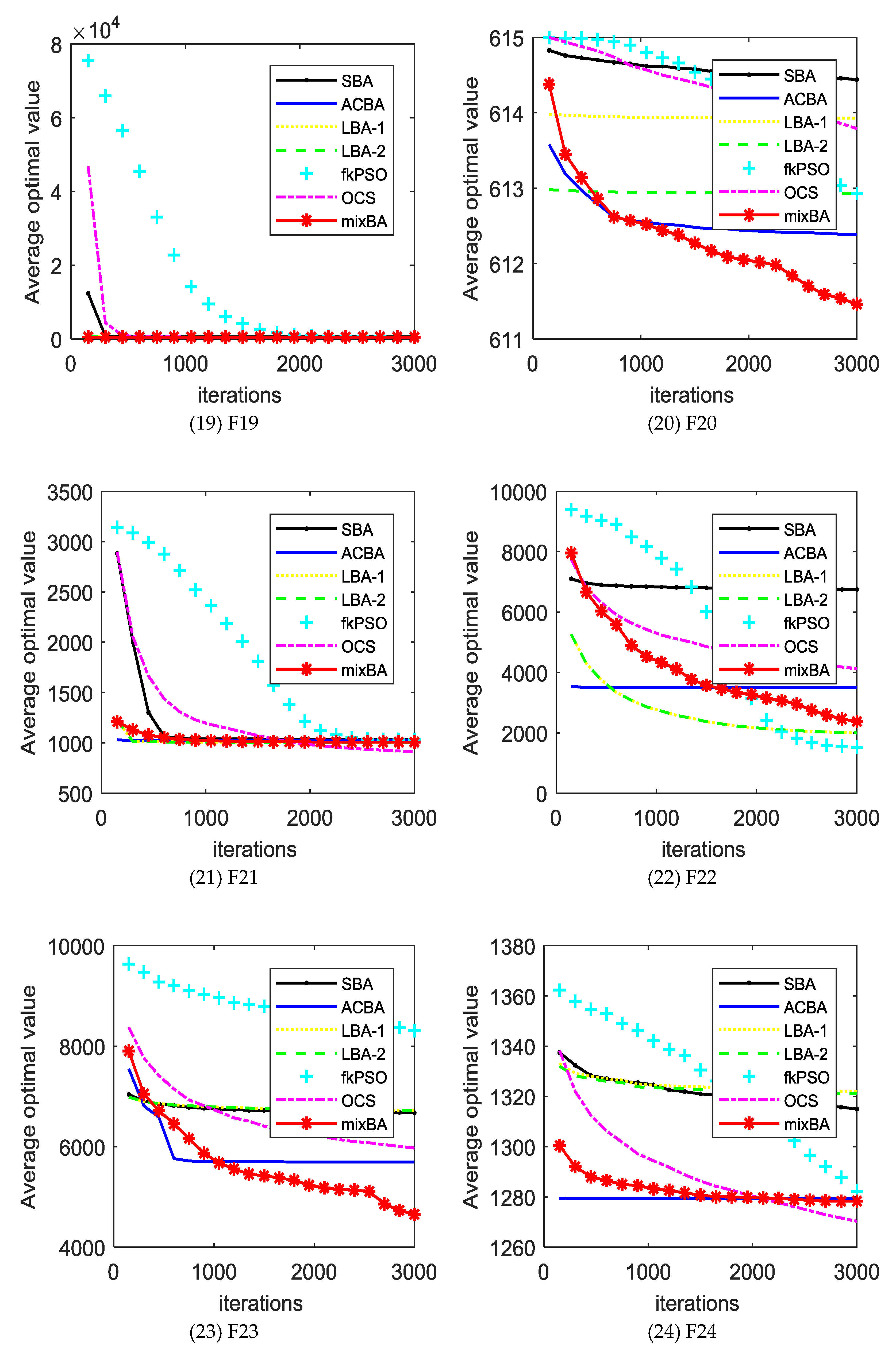
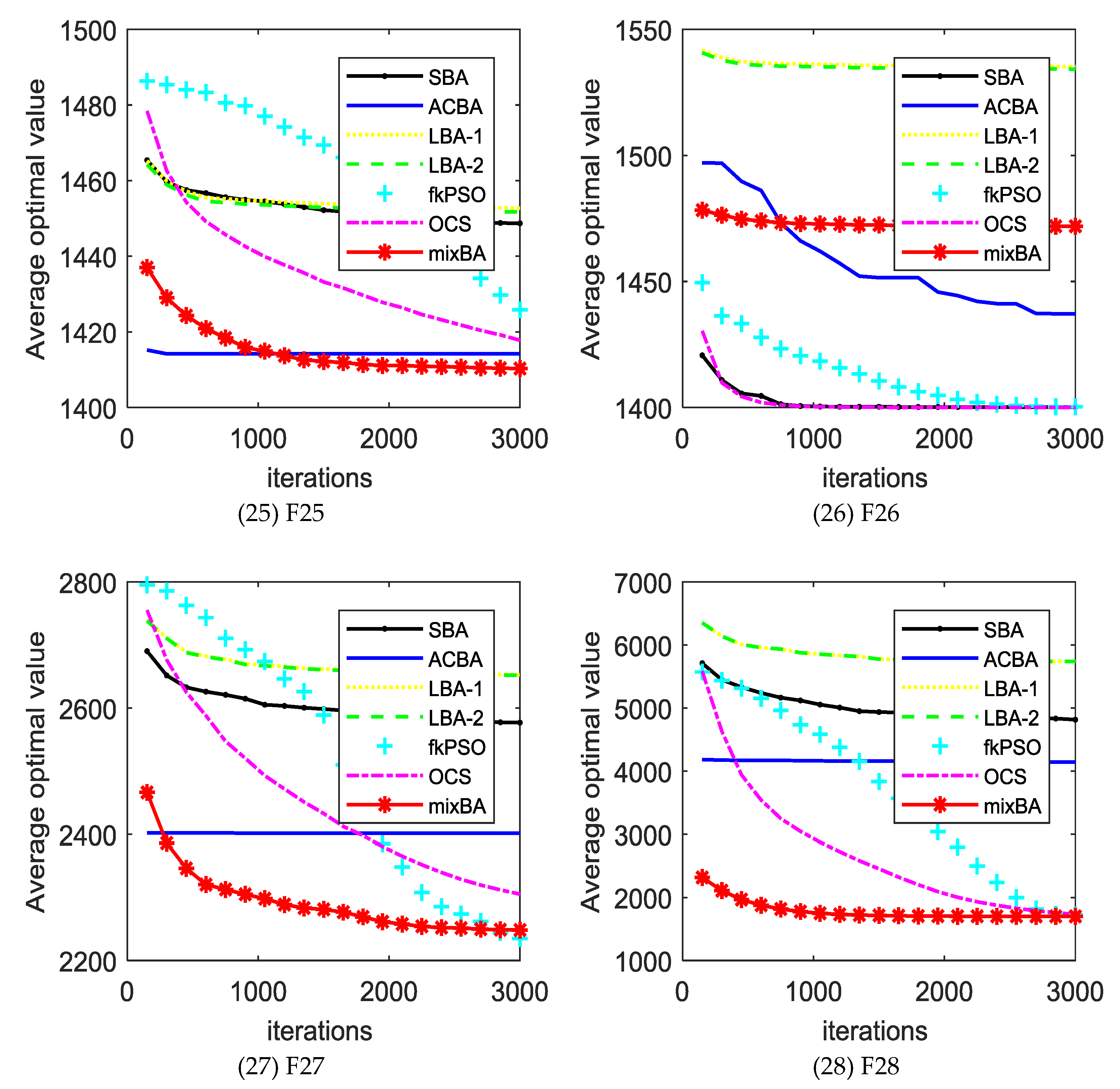
| Algorithm 1: Bat algorithm with multiple strategy coupling |
| Begin For each bat, initialize the position, velocity, parameters and probability table; While (stop criterion is met) Randomly generate the frequency for each bat with Equation 3; Evaluate its fitness; Switch num = 8 Case 1 (rand < p1) Update the velocity and position with strategy1. Case 2 (p1 < rand < p2) Update the velocity and position with strategy2 Case 3 (p2 < rand < p3) Update the velocity and position with strategy3. Case 4 (p3 < rand < p4) Update the velocity and position with strategy4. Case 5 (p4 < rand < p5) Update the velocity and position with strategy5. Case 6 (p5 < rand < p6) Update the velocity and position with strategy6. Case 7 (p6 < rand < p7) Update the velocity and position with strategy7. Case 8 (p7 < rand < p8) Update the velocity and position with strategy8. Evaluate its fitness; If the position is update Update the loudness and emission rate; Update the probability table; If pi < 0 Pi = 0.001; End End Rank the bats and save the best position; End Output the best position; End |
| F1–F5 belongs to uni-modal functions |
| F6–F20 belongs to multi-modal functions |
| F21–F28 belongs to composition functions |
| Pop size | 100 |
| Run | 51 |
| Frequency | [0, 5] |
| 0.95 | |
| 0.9 | |
| 0.99 | |
| 0.9 | |
| Search Domain | [−100, 100]D |
| Bat algorithm with multiple strategy coupling (mixBA); |
| Standard bat algorithm (SBA); |
| Self-adaptive heterogeneous particle swarm optimization (PSO) [49]; |
| Bat algorithm with Lévy distribution (LBA1) [26]; |
| Bat algorithm with Lévy distribution (LBA2) [32]; |
| Bat algorithm with arithmetic centroid strategy (ACBA) [40] |
| Oriented cuckoo search (OCS) [34] |
| Algorithm | Rankings |
|---|---|
| SBA | 5.86 |
| ACBA | 3.59 |
| LBA1 | 5.61 |
| LBA2 | 5.05 |
| FK-PSO | 3.09 |
| OCS | 2.86 |
| mixBA | 1.95 |
| mixBA vs | p-Value |
|---|---|
| SBA | 0 |
| ACBA | 0 |
| LBA1 | 0 |
| LBA2 | 0 |
| FK-PSO | 0.04 |
| OCS | 0.068 |
© 2019 by the authors. Licensee MDPI, Basel, Switzerland. This article is an open access article distributed under the terms and conditions of the Creative Commons Attribution (CC BY) license (http://creativecommons.org/licenses/by/4.0/).
Share and Cite
Wang, Y.; Wang, P.; Zhang, J.; Cui, Z.; Cai, X.; Zhang, W.; Chen, J. A Novel Bat Algorithm with Multiple Strategies Coupling for Numerical Optimization. Mathematics 2019, 7, 135. https://doi.org/10.3390/math7020135
Wang Y, Wang P, Zhang J, Cui Z, Cai X, Zhang W, Chen J. A Novel Bat Algorithm with Multiple Strategies Coupling for Numerical Optimization. Mathematics. 2019; 7(2):135. https://doi.org/10.3390/math7020135
Chicago/Turabian StyleWang, Yechuang, Penghong Wang, Jiangjiang Zhang, Zhihua Cui, Xingjuan Cai, Wensheng Zhang, and Jinjun Chen. 2019. "A Novel Bat Algorithm with Multiple Strategies Coupling for Numerical Optimization" Mathematics 7, no. 2: 135. https://doi.org/10.3390/math7020135
APA StyleWang, Y., Wang, P., Zhang, J., Cui, Z., Cai, X., Zhang, W., & Chen, J. (2019). A Novel Bat Algorithm with Multiple Strategies Coupling for Numerical Optimization. Mathematics, 7(2), 135. https://doi.org/10.3390/math7020135