1. Introduction
As the easiest parameterized surfaces, ruled surfaces are widely used in project practices, architecture, and computer-aided design [
1,
2]. However, on the ruled surfaces there may exist singular points. For that reason, many people study the classification of different types of singularities of a ruled surface. Taking advantage of Gauss curvature, ruled surfaces can be classified either as developable surfaces or as non-developable surfaces. From [
3,
4,
5,
6,
7], we know that the generic singularities of a developable surface are the cuspidal edge, the swallowtail, and the cuspidal cross-cap. We also know that the cross-cap is the only singular point of existence on the principal normal surface of regular space curves (see [
8,
9]). Meanwhile, on the binormal surface of regular space curves, there are no singular points. However, for singular curves, the situation is different, and we will study the character of the singular points on such a binormal surface.
In [
10], Müller gave the definition of two integral invariants, which are the pitch and the angle of pitch of a closed ruled surface in
(three-dimensional Euclidean space). For a general ruled surface, the base curve is not unique. In order to solve the uncertainty of a base curve on the ruled surface, Liu and Yuan used the uniqueness of the striction line on the general ruled surface. Since the derivative of the base curve does not identically vanish, this surface is a non-developable ruled surface. In [
11], they extended the definition of pitch to non-developable ruled surfaces. In [
12], Liu et al. defined structure functions, which are invariants of non-developable surfaces. They used these functions to characterize the properties of surfaces. Meanwhile, they gave the relationship between these invariants and the pitch function, the angle function of pitch of the ruled surface (see [
12,
13,
14]).
In this paper, we regard the singular curve as the Frenet-type framed base curve. In
Section 3 and
Section 4, we give the notations of the principal normal and binormal surfaces of a Frenet-type framed base curve in Euclidean 3-space and investigate the character of singular points on these surfaces. In
Section 5, we give a standard equation of a non-developable ruled surface and then study its structure functions. Moreover, we give the kinematic meanings at singular points. In
Section 6, we use an example to state the singular points on these non-developable surfaces.
Throughout this article, all manifolds and maps are smooth.
2. Preliminaries
In this section, we study the ruled surface generated by Frenet-type framed base curves (see [
15,
16,
17]). Since there exist singular points on these surfaces, in general, we cannot construct the normal vector of these surfaces. Therefore, we regard them as framed base surfaces that are smooth surfaces with a moving frame (see [
15]).
Definition 1. We call a framed surface if and for all , where , and .
If there exists
such that
is a framed surface, then we call
a framed base surface. We define
, then
is a moving frame along
. Thus, we have
where
are smooth functions. These functions are called the basic invariants of
. By the integrability conditions of the framed surface [
15], we have
. We call
a curvature of the framed surface if
We suppose that
is the framed surface and
. The surface
f is a front around
p if and only if
. More details are available from [
15].
Next, we study the first special non-developable ruled surface, that is, the principal normal surface.
3. Principal Normal Surface along Frenet-Type Framed Base Curves
If there exists a regular unit speed curve
and a
function
satisfies
for all
, then we call
a Frenet -type framed base curve (FTFB curve). We call
an orthonormal frame along
in
, where
and
. More details are available from [
16]. The FTFB curve is one special kind of framed base curve [
15,
16]. As we want to intuitively observe the properties at singular points on the ruled surface, we choose this kind curve that is similar to the Frenet curve. A principal normal surface
M is a map
given by
. By direct calculations, singular points of surface
M construct the set
. We can divide them into two classes
and
, where
From above, we know the points of
are located on the
.
Next, we consider the characters of singular points of surfaces.
Theorem 1. We suppose that is an FTFB curve and is the principal normal surface of .
- (1)
If and , then is a cross-cap at the point .
- (2)
If and , then is a cross-cap at the point .
Proof. Taking the derivative of
f, we can compute that
We have the second-order derivation of
f as follows:
Then we obtain
We have known that the union of
and
are the set of singular points of surface M. Thus, if
, then
. And if
, then
From [
9], this completes the proof. □
Since the Bertrand curve and Bertrand mate can be regard as curves on the principal normal surface, then we consider the singular point located on such curves.
Corollary 1. Let be the space Bertrand curve of an FTFB curve and be the principal normal surface of .
- (1)
If is the ordinary cusp singularity of , then is a cross-cap at the point .
- (2)
If is the ordinary cusp singularity of the Bertrand mate of , then is a cross-cap at the point .
Proof. By the definition of ordinary cusp singularity [
18], we know the ordinary cusp singularity
of
satisfying
and
. From [
17,
19],
is a space Bertrand curve of an FTFB curve if and only if there exist two constants
and
such that
and
. Reasoning
for all
, then we obtain
.
Suppose
is the Bertrand mate of
,
where
A is a non-zero constant. By differentiating
and using the Frenet equation, we obtain
If
is the ordinary cusp singularity of
, then
and
. □
Because the principal normal surface has singular points, then we regard it as the framed base surface. Next, we analyze singular points of this surface by using the criterion about a framed surface (see [
15]).
For a principal normal surface , if there exist two smooth functions satisfying , where and then we have the framed surface . We denote . Then is a moving frame along .
Because of the integrability condition, we have
By direct calculations, we know that
and
. Let
be the singular point of the principal normal surface
f. Because of
the null vector field
can be written as
. If
, then we obtain
By the criterion of the singular point on the framed surface [
15], we can get that the surface
is a cuspidal edge at a singular point if
- (i)
, , or
- (ii)
, , .
The surface is a swallowtail at a singular point if
- (iii)
, , , or
- (iv)
, , , .
The surface is a cuspidal cross-cap at a singular point if
- (v)
, , , or
- (vi)
, , , .
By the derivative of , any above case no exists. Therefore, we get the conclusion.
Theorem 2. Let M be the principal normal surface of the FTFB curve . If M is a framed base surface, then the singular points of M are non-degenerate. But the surface M at a singular point cannot be the cuspidal edge, swallowtail, or cuspidal cross-cap.
4. Binormal Surface along Frenet-Type Framed Base Curves
Let
be an FTFB curve and
be an orthonormal frame along
in
. A binormal surface
M is a map
given by
By straightforward calculations, singular points of surface
M construct the set
We can divide it into two classes
and
, where
From above, we know the points of
are located on the
and the points of
construct a ruling of
f. By direct calculations, we have
Therefore, we get the following conclusions.
Theorem 3. Let be the binormal surface of the FTFB curve . If and , then is a cross-cap at the singular point .
When
is a Mannheim mate of an FTFB curve, we know
for all
(see [
19]). Therefore, the singular points of the binormal surface of
are only located on
. Next, we consider the characters of these singular points.
Corollary 2. Let be the Mannheim mate of an FTFB curve and be the binormal surface of . If is the ordinary cusp singularity of , then is a cross-cap at a singular point of the surface.
If there exist singular points on the binormal surface of the FTFB curve, then we assume that the binormal surface is a framed base surface.
For a binormal surface,
if there exist two smooth functions
such that
, where
and
. Then we get the framed surface
, where
. The integrability condition is
By calculations, the curvature of the surface
is
, where
By using the criterion of the type of singular points of a framed surface in [
15], we obtain the following conclusions.
Theorem 4. Let f be the binormal surface of an FTFB curve . We assume that is a framed surface.
(A) Suppose that is a singular point of with , then is a cuspidal edge at if and only if
- (1)
, or
- (2)
, , , .
(B) Suppose that is a singular point of with , , then is a cuspidal cross-cap at if and only if
- (3)
, or
- (4)
, , , .
Proof. Since , the null vector field is . Suppose is a non-degenerate singular point of . Since , then should satisfy one of the following conditions:
- (a)
and or
- (b)
, and .
At first, we consider case (a). Because of
, then
, that is,
. Hence, the singular curve
is given by the form
, where
y is a
function with
. By a straightforward calculation,
and
. Thus, we have the assertion (1), (3). Next, we consider the case (b). By the above conditions, we know that
. Hence, the singular curve
can also be given by
. Therefore, we get
and
. Thus, we have the assertion (2), (4). □
Suppose is the non-degenerate singular point of . Since the integrability condition , then satisfies one of the following conditions:
- (c)
and ,
- (d)
and .
From the case (c), we know that the singular point also belongs to Thus, we omit it. In the case (d), because of , then . Hence, the surface cannot be the cuspidal edge, swallowtail, or cuspidal cross-cap at such a singular point .
5. Ruled Invariant of Ruled Surface
In [
10], Müller introduced two integral invariants that are the pitch and angle of pitch of a closed ruled surface in
In [
11], Liu and Yuan wanted to generalize these conceptions to the general ruled surface. They wanted to use the directrix line and orthogonal trajectory of the ruling to define the pitch of a general ruled surface. But the directrix line is not unique. To solve this uncertainty, they assumed that the directrix line is the striction line of the surface. In [
12,
13,
14], Liu et al. defined structure functions of a non-developable ruled surface in
. Then they verified any non-developable ruled surface for which the directrix line is the striction line of the surface and the direction of ruling can be determined by the orthonormal transformations. They gave the geometric description of the structure functions.
In this paper, we focus on the principal normal and binormal surfaces generated by FTFB curves in . They are non-developable ruled surfaces. We want to investigate the structure functions of these surfaces and observe the geometric characterization of structure functions at singular points.
Firstly, let us introduce structure functions of the non-developable ruled surface. Let
be an FTFB curve and
be a regular unit speed curve. We call
the spherical Frenet frame of the spherical curve
in
, where the tangent vector and normal vector are
and
, respectively. Then we get the following equation:
where
is the spherical curvature function of
in
.
Under the above notations, if
is a striction line of
, we call
the standard equation of the (non-developable) ruled surface in
. Because
is the striction line, we have
with two smooth functions
and
. We call
,
, and
structure functions of the (non-developable) ruled surface
in
. These functions {
,
,
} can determine the ruled surface
under a transformation in
.
Let
be the orthogonal trajectory of the ruling on the surface
passing through
, then
can be expressed as
We call
the pitch of the (non-developable) ruled surface
at
, and
the pitch function of the (non-developable) ruled surface
.
From the definition, we have and . If for any , then we call the non-pitched ruled surface.
Next, we will use {, , } to characterize the surface generated by special framed base curves and describe the singular points.
Theorem 5. Let be a non-pitched ruled surface with a structure equation. If structure functions satisfy equation with constant , then is the binormal surface of a Mannheim mate of an FTFB curve.
Proof. Because
, then
is the binormal surface of
. By direct calculations, we obtain
,
,
. From [
19], the necessary and sufficient condition about which an FTFB curve is a Mannheim mate is
then we know
. □
By the above assumptions, if is the singular point of Mannheim mate of an FTFB curve, then . This means that is the -singularity of .
Theorem 6. Let be a non-developable ruled surface and be a striction line of such that . If the structure functions of satisfy the situations
- 1.
- 2.
,
- 3.
, and
- 4.
,
where are constants, then is the principal normal surface of a Bertrand curve of an FTFB curve.
Proof. The derivative of
has the form
Put
, then
Continue taking the derivative of
, and we get
Therefore,
is the principal normal surface of
.
Put
, then
. Since the cross-product of
and
is
, then we have
Then
Hence, the condition
is equal to
Then we complete the proof. □
From the proof, we know that if is the singular point of a Bertrand curve of an FTFB curve, then and . Using the same method, we can describe the binormal surface of the Mannheim curve by using {, , }.
Theorem 7. Let be a non-pitched ruled surface with a structure equation. If structure functions satisfythen is the binormal surface of a Mannheim curve of an FTFB curve. Therefore, we know that if , then is the singular point of the Mannheim mate of .
6. Example
We give an example of the principal normal and binormal surface of an FTFB curve in Euclidean 3-space. Then we can observe the singularity type on these ruled surfaces.
Example 1. Let bewhere By straighting calculations, we have
,
,
and
Let
and
be the principal normal and binormal surfaces of the FTFB curve
, respectively. Then the sets of singularities of
and
are
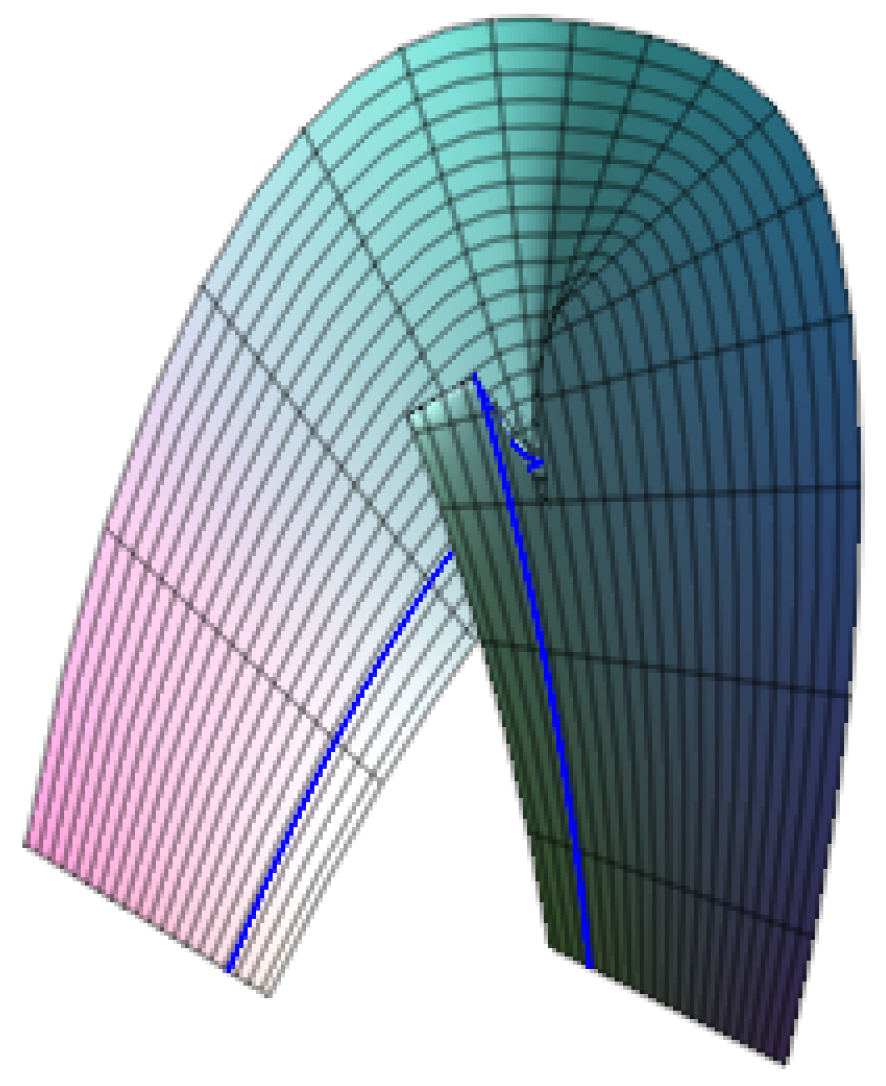
By Theorem 1,
has the cross-cap singularity at
(
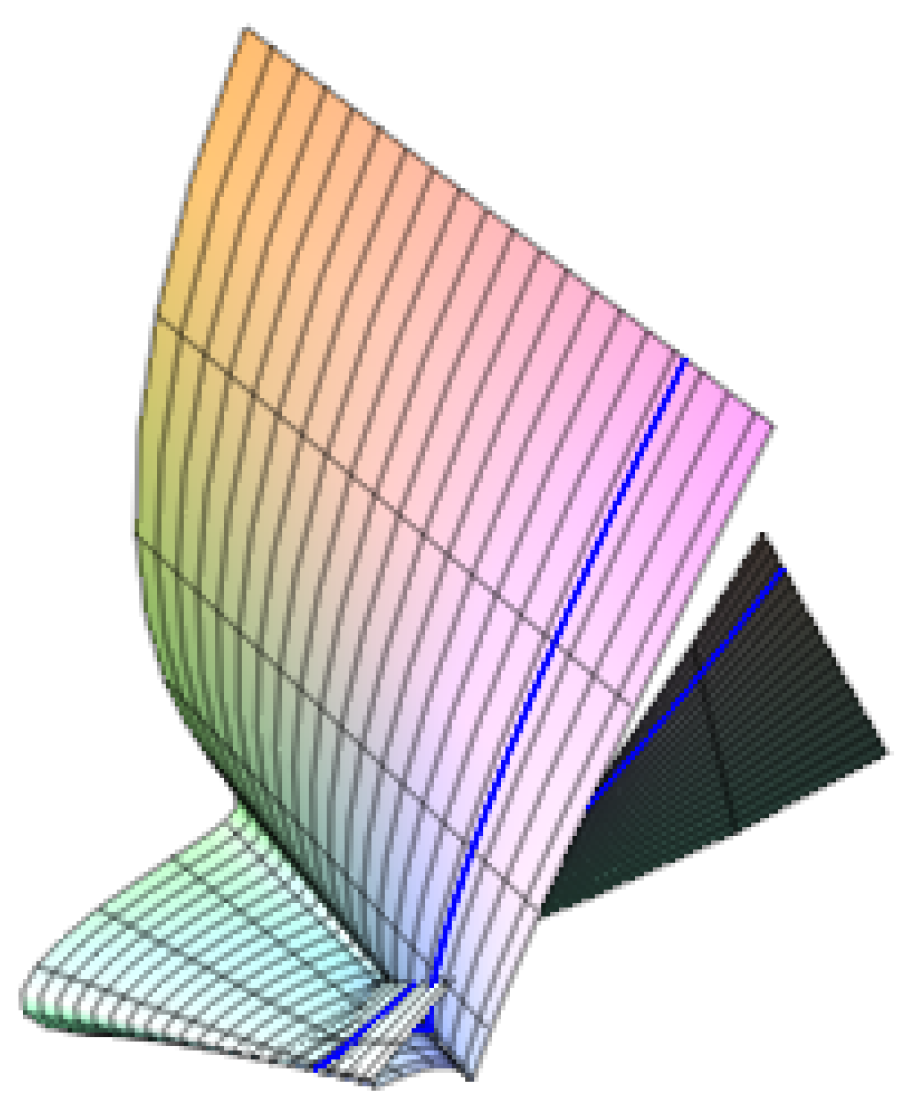
Figure 1). By Theorems 3 and 4,
has the cross-cap singularity at
and has cuspidal edge singularities at
(
Figure 2).