1. Introduction
In recent years, many mathematicians have been studying and discussing the linear and nonlinear fractional differential equations (FDEs) which arise in various fields of physical sciences, as well as in engineering. These types of equations play a significant role and also help to develop mathematical tools in order to understand fractional modelling.
However, there are many different methods to obtain exact and approximate solutions of these kinds of equations. In [
1], the author point out a major flaw in the so-called conformable calculus. Recently, many researchers have also paid much attention to study the numerical and exact methods for finding the solution of conformable differential equations. In [
2], the authors proposed so-called conformable derivatives. In [
3], the conformable heat equation was studied. Similarly, in [
4], the nonlinear conformable problems were also studied. The authors in [
5] discussed the concepts underlying the formulation of operators capable of being interpreted as fractional derivatives or fractional integrals. In a very short period of time, many mathematicians became interested and provided mathematical models related to conformable derivatives, for the details we refer reader to see [
6,
7,
8,
9]. In [
10,
11], the conformable derivatives were applied to some problems in mechanics, and in [
12] total frational derivative and directional fractional derivative of functions of several variables were studied.
In order to solve the conformable derivatives, the single Laplace transform method was first introduced and used in [
13]. In [
14], the idea was extended to the conformable double Laplace transform. In [
15], the modified Laplace transform was applied to solve some ordinary differential equations in the frame work of a certain type generalized fractional derivatives. The authors in [
16] applied the double Laplace decomposition method to solve singular linear and nonlinear one-dimensional pseudohyperbolic equations.
In this present research, the main objective is to solve linear and nonlinear singular pseudohyperbolic equations by using the conformable double Laplace transform decomposition method, which is a combination of the conformable double Laplace transformation and decomposition method.
3. Conformable Derivatives Double Laplace Transform Decomposition Method Applied to Singular Pseudohyperbolic Equation
The main aim of this section is to discuss the applicability of the conformable double Laplace transform decomposition method (CDLDM) for the linear and nonlinear singular pseudohyperbolic equation. The pseudo-hyperbolic equations arise, for example, in the description of the electron diffusion processes in a plate, and they also arise in hydrodynamics in the study of fluid motion with an alternating viscosity. In this study we define the conformable double Laplace transform of the function by To illustrate the idea of our method, let us suggest here two important problems.
The first problem:
Consider the linear pseudohyperbolic equations
subject to the condition
where
,
, and
are source term and initial conditions, respectively.
The method:
In order to obtain the solution of Equation (
9) by using conformable double Laplace transform decomposition methods, we applying the following steps:
Step 1: Multiplying both sides of Equation (
9) by the term
we have
Step 2: Applying conformable double Laplace transform for Equation (
11) we get
Step 3: On using Equations (5)–(7), we obtain
where the conformable Laplace transforms of
and
are denoted by
respectively, and
using given initial condition Equation (
13) becomes
Step 4: By applying the integral for both sides of Equation (
14), from 0 to
p with respect to
where
p is transform of the variable
we have
where
, and
are conformable Laplace transforms of the functions
, and
, respectively.
Step 5: By taking the inverse conformable double Laplace transform for Equation (
15), we can compute the solution
as follows
where
indicates the double inverse conformable derivatives double Laplace transform. Here, we assume that the double inverse Laplace transform with respect to
p and
s exists for each term in the right hand side of Equation (
16).
Step 6: The conformable double Laplace transform decomposition method (CDLDM) defines the solutions
with the help of infinite series as:
By substituting Equation (
17) into Equation (
16), we obtain
The zeroth component
, as suggested by Adomian method, is always identified by the given initial condition and the source term
, both of which are assumed to be known. Accordingly, we set
The other components
are given by using the relation
the first few components from the last recursive relation are, at
,
at
at
etc. The important terms used in infinite series depend on the problems and may be three terms or four terms, etc.
In order to give a clear overview of this method, we present the following example:
Example 3. Consider singular conformable derivatives in one dimensional pseudohyperbolic equations with the indicated initial conditionand By using the aforesaid method subject to the initial condition, we havetaking the integral for Equation (22), from 0 to p with respect to p, we get Employing the inverse conformable derivatives double Laplace transform to Equation (23), we getby substituting Equation (17) into Equation (24), we obtain: By applying the conformable double Laplace transform decomposition method, we obtaineventually, we have the general recursive relation, given bywhere thereforeby using partial fractional and inverse Laplace transform with respect to we haveand In the view of the above equations, the series solution is given by Hence, the exact solution of Equation (20) is given by: Second problem: Consider the following general form of the nonlinear singular pseudohyperbolic equations in one dimension of the form:
with initial condition
where the functions
are arbitrary. In order to obtain the solution of Equation (
25), we use the following steps:
First step: By multiplying Equation (
25) by
and taking conformable double Laplace transform, we have
where conformable Laplace transform of
and
are given by
Second step: Applying Equations (5)–(
28) into Equation (
27), one can get that
where,
Third step: By taking the integral for Equation (
29), from 0 to
p with respect to
p, where
p is a transform of
we have
Fourth step: Using CFDLDM, the solution can be written in the infinite series as in Equation (
17). By using the inverse Laplace transformation to Equation (
30), we obtain.
furthermore, the nonlinear terms
and
can be defined by:
We have a few terms of the Adomian polynomials for
and
that are denoted by
and
where
. By putting Equations (
33)–(
32) into Equation (
31), we get
the few components of the Adomian polynomials of Equations (
33) and (
34) are given as follows
and
Hence, the zeroth component
from Equation (
35) is given by
and
where
.
Example 4. Consider the nonlinear singular pseudohyperbolic equation in one dimensional is governed bysubject to the following initial conditions The conformable double Laplace transform decomposition method leads to the following schemeandproceeding in a similar manner, we haveso that the solution is given byand hence the conformable solution is given by By substituting and into Equation (42), the solution becomes Conformable double Laplace transform method and Singular conformable coupled pseudohyperbolic equation.
In this section, conformable double Laplace decomposition method is considered for the one-dimensional conformable derivatives coupled pseudohyperbolic equation since the method is much simpler and more efficient in the study of linear equations.
The thrid problem: Let us consider the conformable derivatives coupled pseudohyperbolic equations
subject to
where the linear terms
are the so-called conformable Bessel operators. Here,
,
, and
are given functions,
is the coupling parameter. One can obtain the solution of Equation (
43), by using the following steps.
(1): Multiply both sides of Equation (
43) by
we have
(2): We apply conformable double Laplace transform on both sides of Equation (
45) and single conformable Laplace transform for Equation (
44), we get
on using theorem 1 and theorem 2, we obtain
(3): By integrating both sides of Equation (
47) from 0 to
p with respect to
p, we have
where
and
are conformable Laplace transform of the functions
, and
, respectively. By applying double inverse Laplace transform for Equation (
48), we have
and
The conformable double Laplace decomposition methods represent the solutions of Equation (
43), by the infinite series
By substituting Equation (
51) into Equations (
49) and (
50), we get
and
Our method suggests that the zeroth components
and
are identified by the initial conditions and from source terms as follows
The remaining terms are given by
and
Here, we assume that the double inverse Laplace transform with respect to p and s exists for each term in the right hand side of the above equations.
To illustrate our method for solving the conformable derivatives coupled pseudohyperbolic equations, we will consider the following example:
Example 5. Consider the following homogeneous form of a conformable derivatives coupled pseudohyperbolic equationwith initial condition By applying above method for Equations (57) and (58), we obtainand By applying equations Equations (54)–(56), we haveandand so on for other components. Using Equation (51), our required solutions are given belowand hence the exact solution becomes By taking and , the conformable solution becomes 4. Numerical Result
In this section, we shall illustrate the accuracy and effciency of the double conformable Laplace transform method by numerical results of
for the exact solution when
, and approximate solutions when
and
taken different fractional values in Equations (
20) and (
40), which are depicted through
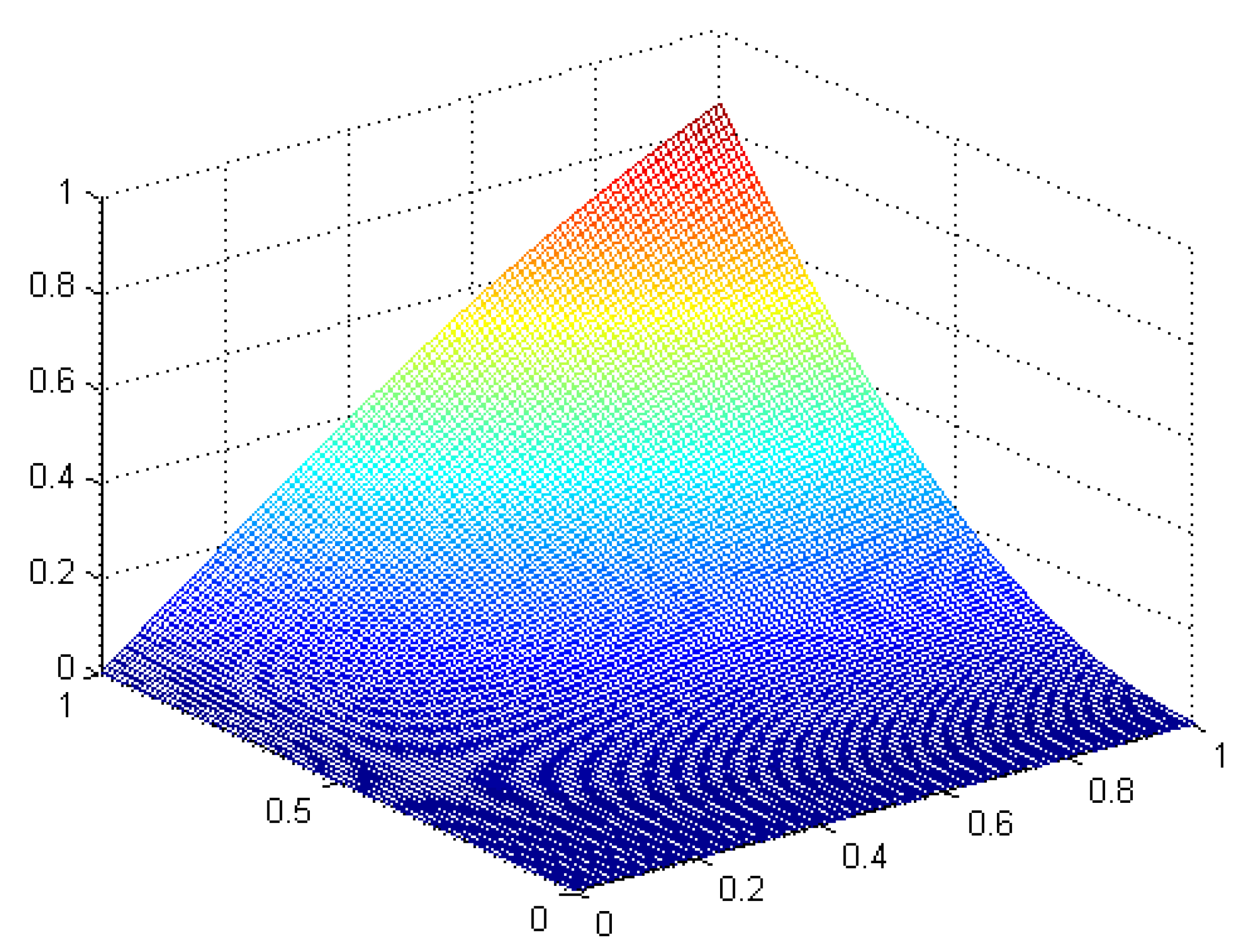
Figure 1,
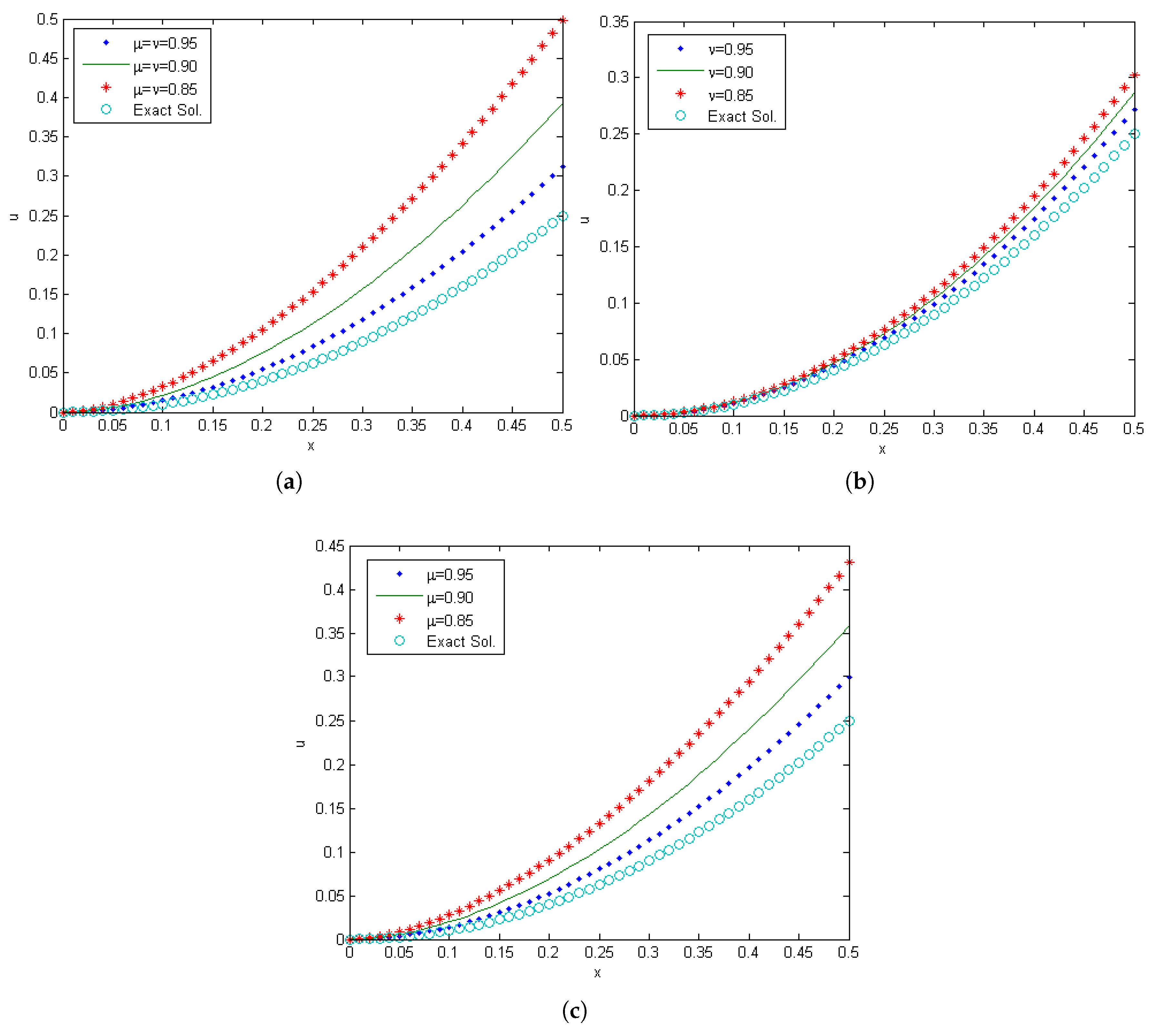
Figure 2,
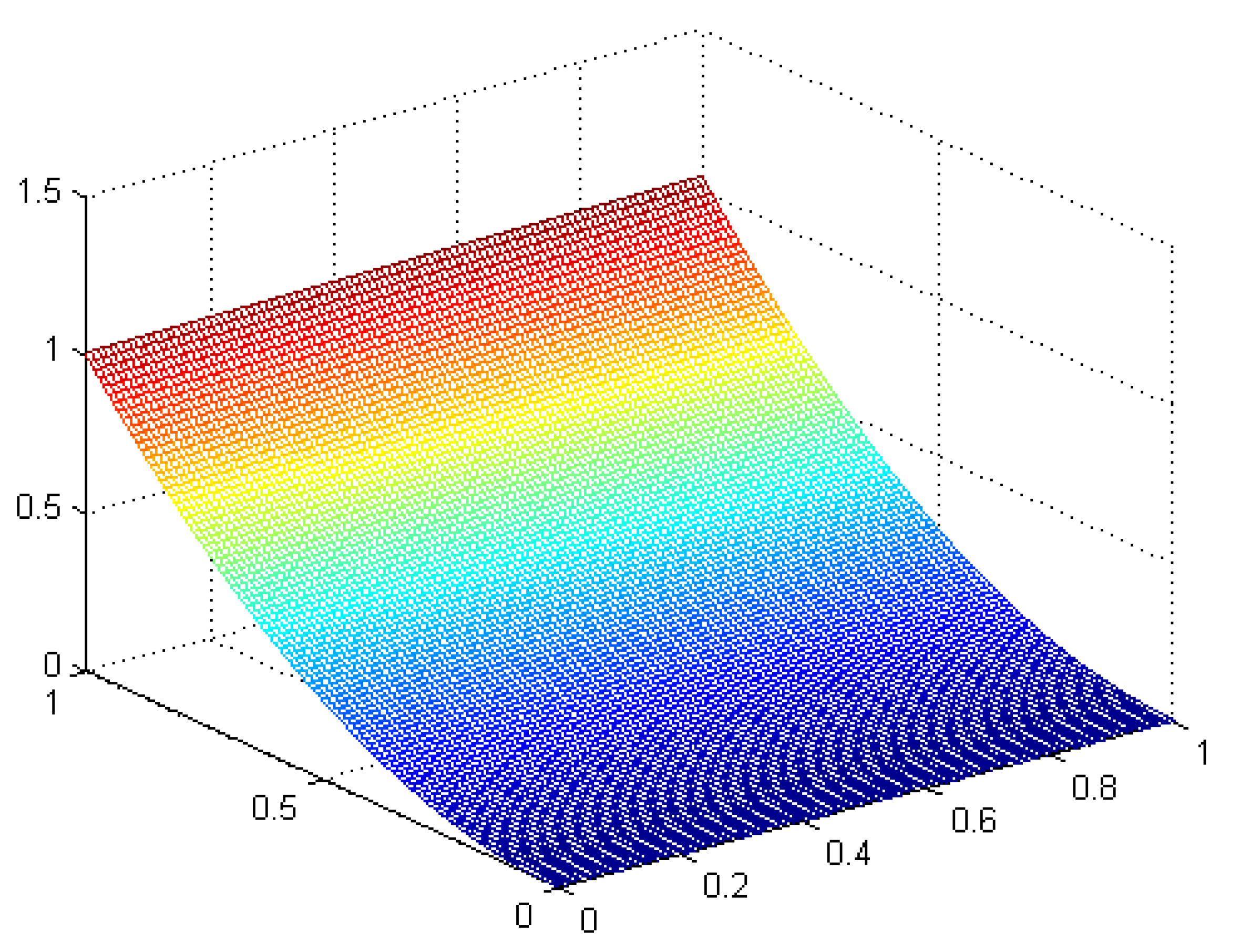
Figure 3 and
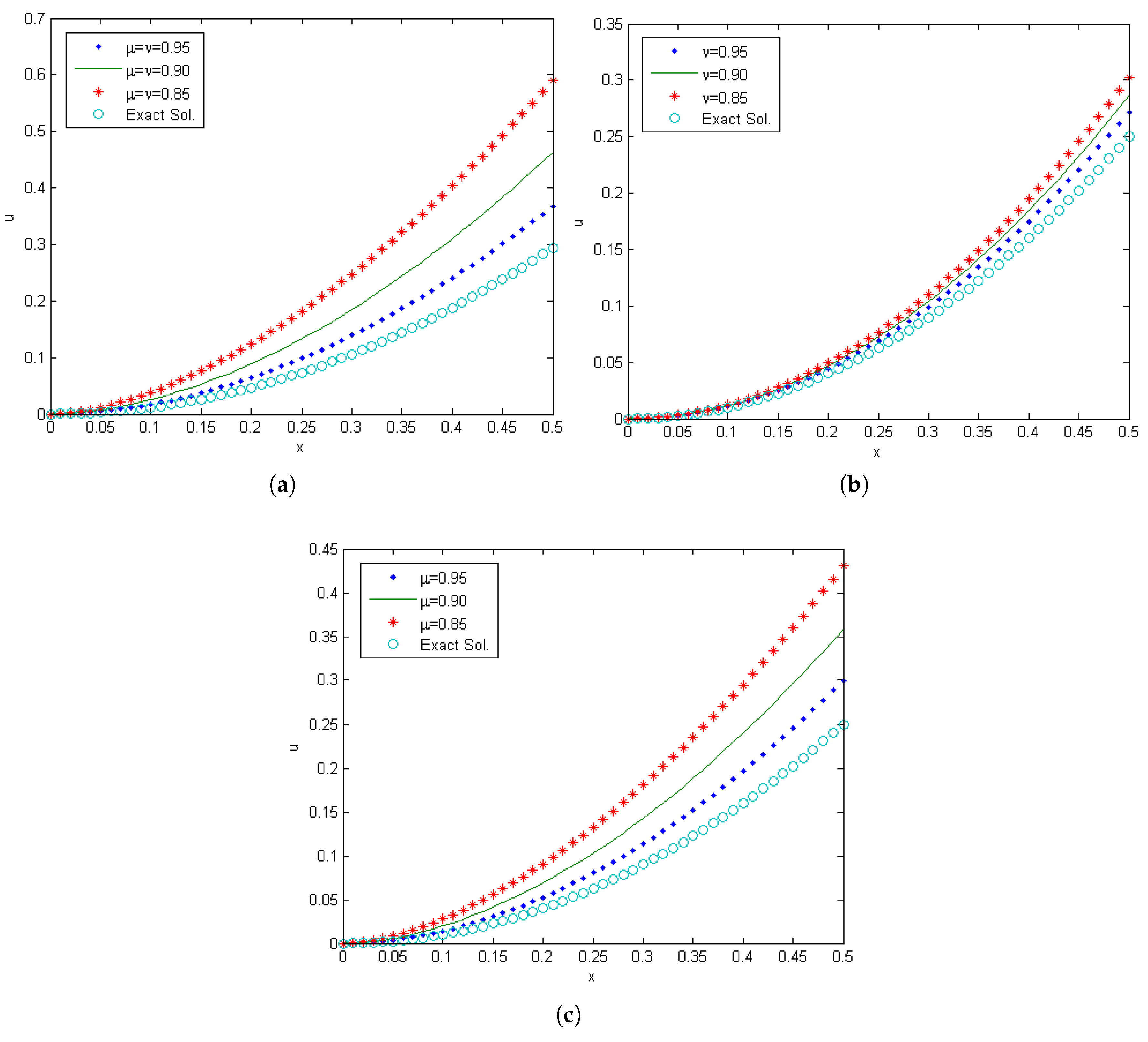
Figure 4, respectively.
The three dimensional surface in
Figure 1 shows the exact solution of Equation (
20) in standard form of singular pseudohyperbolic equation at
.
Figure 2 compares the approximate solutions of Equation (
20) when
. In
Figure 2a, the numerical solution at
, in this case
, increases hastily at fractional derivative decrease,
Figure 2b shows the solution at
and
and we see
increasing regularly when
decreases, and in
Figure 2c we can observe
increasing slowly at
and
when
decreases.
Similarly, the exact solution and approximate solution of Equation (
40) were demonstrated in
Figure 3 and
Figure 4 when
. In the case
, we get the exact solution of a singular pseudohyperbolic equation, as seen in
Figure 3.
Figure 4 shows the approximate solution of Equation (
40) with different values of
and
.
Figure 4a gives plots of the behavior of Equation (
40) when
, in this case the function
increases quickly, and in
Figure 4b we have obtained the solution for the values of
and different values of
, in this case the function
increases gradually, and
Figure 4c gives the behavior of Equation (
40) at
and different values of
, in this case the function
increasing tardily.
It is clear from the solutions of Equations (
20) and (
40) that the conformable double Laplace decomposition method has good agreement with the exact solutions of the problems. The fractional-order solution of these two problems and exact solution of integer order problems are equal at
, in this case we have no error.