


Abstract
This paper aims to present a Clenshaw–Curtis–Filon quadrature to approximate the solution of various cases of Cauchy-type singular integral equations (CSIEs) of the second kind with a highly oscillatory kernel function. We adduce that the zero case oscillation () proposed method gives more accurate results than the scheme introduced in Dezhbord et al. (2016) and Eshkuvatov et al. (2009) for small values of N. Finally, this paper illustrates some error analyses and numerical results for CSIEs.
1. Introduction
Integral equations have broad roots in branches of science and engineering [1,2,3,4,5,6]. Cauchy-type singular integral equations (CSIEs) of the second kind occur in electromagnetic scattering and quantum mechanics [7] and are defined as:
A singular integral equation with a Cauchy principal value is a generalized form of an airfoil equation [8]. Here a and b are constants such that , and are the highly oscillatory kernel function. The function is the Hölder continuous function, whereas is an unknown function. The solution to the above-mentioned Equation (1) contains boundary singularities , i.e., and is a smooth function [9,10]. Then the above Equation (1) transforms into:
where depend on a and b, such that:
Here M and N are integers in , whereas the index of the integral equation is called , analogous to a class of functions, wherein the solution is to be sought. It is pertinent to mention that to produce integrable singularities in the solution, the index is restricted to three cases, , but the addressed paper considers only two cases for , i.e., . The value of the index depends on different values for M and N[11,12,13]. A great number of real life practical problems, e.g., for , the so-called natched half-plane problem and another problem of a crack parallel to the free boundary of an isotropic semi-infinite plane, that can be reduced to Cauchy singular integral equations are addressed in [14,15,16,17]. Writing Equation (2) in operator form, we get [18]:
where:
Let us define another operator:
further:
where
It is worthy mentioning the fact that the solution for CSIE exists but unfortunately it is not unique, as CSIE has three solution cases for different values of . The aforementioned theorem appertains to the existence of the solution of CSIE for case .
Theorem 1.
[13,15] (Existence of CSIEs) Let the singular integral Equation (2) be equivalent to a Fredholm integral equation, which implies that every solution of a Fredholm integral equation is the solution of a singular integral equation and vice versa.
Proof.
Furthermore, it can be written as a Fredholm integral equation:
where:
and:
Thus the claimed theorem is proven. □
Moreover, for Equation (1) we have three cases for :
Similarly, solution cases of the CSIE of the second type depending on values of are:
- 1: The solution for is unbounded at both end points :where C is an arbitrary constant such that:Equation (2) gets infinitely many solutions but is unique for the above condition.
- 2: The solution is bounded for at and unbounded at :Equation (2) gets a unique solution.
- 3: The solution is bounded at both end points for :Equation (2) has no solution unless it satisfies the following condition:
For many decades researchers have been struggling to find an efficient method to get these solutions. The Galerkin method, polynomial collocation method, Clenshaw–Curtis–Filon method and the steepest descent method are some of the eminent methods among many others for the solution of SIEs [19,20,21,22,23,24]. Moreover, Chakarbarti and Berge [25] for a linear function gave an approximated method based on polynomial approximation and Chebyshev points. Z.K. Eshkuvatov [10] introduced the method taking Chebyshev polynomials of all four kinds for all four different solution cases of the CSIE. Reproducing the kernel Hilbert space (RKHS) method has been proposed by A. Dezhbord et al. [26]. The representation of solution u(x) is in the form of a series in reproducing kernel spaces.
This research work introduces the Clenshaw–Curtis–Filon quadrature to approximate the solution for various cases of a Cauchy singular integral equation of the second kind, Equation (1), at equally spaced points . So the integral equation takes the form:
depending on the . Furthermore, the results of the numerical example are compared with [10,26] for . Comparison reveals that the addressed method gives a more accurate approximation than these methods, Section 4 provides this phenomena. The rest of the paper is organised as follows; Section 2 defines the numerical evaluation of the Cauchy integral in CSIE and approximates the solution at equally spaced points . Section 3 represents some error analyses for CSIE. Section 4 concludes this paper by giving numerical results.
2. Description of the Method
The presented Clenshaw–Curtis–Filon quadrature to approximate the integral term
consists of replacing function by its interpolation polynomial at Clenshaw–Curtis point set, . Rewriting the interpolation in terms of the Chebyshev series:
Here is the Chebyshev polynomial of the first kind of degree n. Double prime denotes a summation, wherein the first and last terms are divided by 2. The FFT is used for proficient calculation of the coefficient [27,28], defined as:
Let it be that for any fixed x we can elect N s.t ; then the interpolation polynomial is rewritten in the form of a Chebyshev series as:
where can be computed in operations once are calculated [27,29]. The Clenshaw–Curtis–Filon quadrature rule for integral is defined as:
where are the modified moments. The forthcoming subsection defines the method to compute the moments efficiently.
Computation of Moments
A well known property for is defined as [30]:
where the prime indicates the summation whose first term is divided by 2 and is the Chebyshev polynomial of the second kind.
Piessens and Branders [31] have addressed the fourth homogenous recurrence relation for the integral without singularity .
along with four initial values:
where stands for confluent hypergeometric function of the first kind. Unfortunately the discussed recurrence relation for moments is numerically unstable in the forward direction for ; in this sense by applying Oliver’s algorithm these modified moments can be computed efficiently [31,32].
The integral is computed by the steepest descent method; the original idea was given by Huybrenchs and Vandewalle [33] for sufficiently high oscillatory integrals.
Proposition 1.
The Cauchy singular integral can be transformed into:
where:
Proof.
Readers are referred to [34] for more details. □
The generalized Gauss Laguerre quadrature rule can be used to evaluate the integrals and in the above equation by using the command lagpts in chebfun [35]. Let be the nodes and weights of the weight functions and be the nodes and weights of the weight functions in accordance with the generalized Gauss Laguerre quadrature rule. Moreover, these integrals can be approximated by:
3. Error Analysis
Lemma 1.
[36,37] Let be a Lipschitz continuous function on [−1, 1] and be the interpolation polynomial of at Clenshaw–Curtis points. Then it follows that:
In particular,
- (i) if is analytic with in an ellipse (Bernstein ellipse) with foci and major and minor semiaxis lengths summing to , then:
- (ii) if has an absolutely continuous derivative and a derivative of bounded variation on [−1,1] for some , then for :
Proposition 2.
[29] Suppose that with , then the error of the Clenshaw–Curtis–Filon quadrature rule for integral satisfies:
Theorem 2.
Suppose that is the approximate solution of of CSIE for case , then for error , , the Clenshaw–Curtis–Filon quadrature is convergent, i.e.:
Proof.
Suppose that and let
It is stated that and , in addition is a polynomial of degree at most N. Then error for solutions and to CSIE for cases is defined as:
Then:
where . □
4. Numerical Examples
Example 1.

Let us consider the CSIE of the second kind:
where For and , we get values of and from Equation (3) for . The absolute error for is presented in Table 1 and Table 2 below.
Table 1.
Absolute error for , bounded at .
Table 2.
Absolute error for , bounded at .
Example 2.
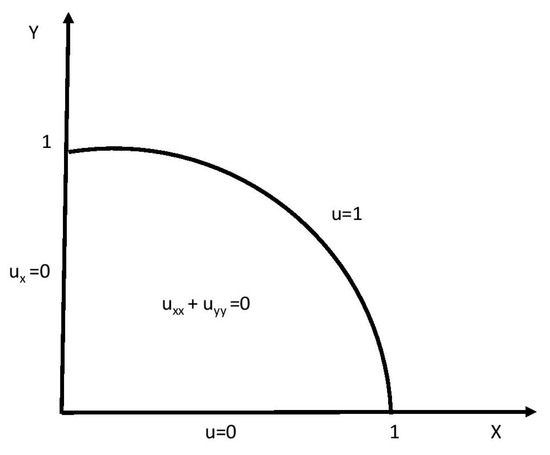
The mixed boundary value problem is described in Figure 1.
Figure 1.
The mixed boundary value problem.
Taken from [18], it has the analytic solution . It can further be reduced to the following integral equation for and for
Here is a constant defined as . Furthermore if is known, the solution of the above boundary value can be derived as:
where:
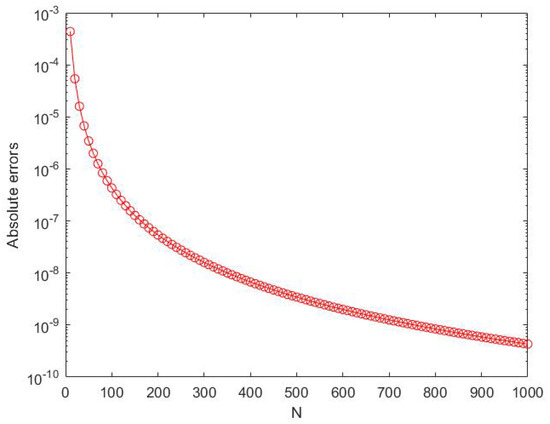
So here we just solve for simplicity. Figure 2 illustrates the absolute error for .
Figure 2.
The absolute error for , for .
Figure 2 shows that absolute error for u(x) decreases for greater values of N.
Example 3.
[10,26] For CSIE with :
in the case and , where α and β are derived from Equation (3) and the exact values of for cases for the solution bounded at are given as:
Table 3 presents the absolute error for the above three cases.
Table 3.
Absolute error for case .
Clearly, Table 3 shows that obtained absolute errors are significantly good for really small values of N, , that can never be achieved in [10,26]. The exact value for in the above examples is obtained through Mathematica 11, while the approximated results are calculated using Matlab R2018a on a 4 GHz personal laptop with 8 GB of RAM. For Example 2 Matlab code and Mathematica command is provided as supplementary material.
5. Conclusions
In the presented research work, the Clenshaw–Curtise–Filon quadrature is used to get higher order accuracy. Absolute errors are presented in Table 1 and Table 2 for solutions of highly oscillatory CSIEs for . For larger values of N, Figure 2 shows the absolute error for for mixed the boundary value problem, whereas for frequency , the proposed quadrature posseses higher accuracy than the schemes claimed in [10,26]; Table 3 addresses this very well. This shows that the quadrature rule is quite accurate with the exact solution.
Supplementary Materials
Supplementary Materials: The codes are available at https://www.mdpi.com/2227-7390/7/10/872/s1, for Example 2, Figure 2: The absolute error for u(x), for x = 0.6.
Author Contributions
Conceptualization, SAIRA, S.X. and G.L.; Methodology, SAIRA; Supervision, S.X.; Writing (original draft), SAIRA; Writing (review and editing), SAIRA, S.X. and G.L.
Funding
This research received no external funding.
Conflicts of Interest
The authors declare no conflict of interest.
References
- Polyanin, A.D.; Manzhirov, A.V. Handbook of Integral Equations; CRC Press: Boca Raton, FL, USA, 1998. [Google Scholar]
- Li, J.; Wang, X.; Xiao, S.; Wang, T. A rapid solution of a kind of 1D Fredholm oscillatory integral equation. J. Comput. Appl. Math. 2012, 236, 2696–2705. [Google Scholar] [CrossRef]
- Ursell, F. Integral equations with a rapidly oscillating kernel. J. Lond. Math. Soc. 1969, 1, 449–459. [Google Scholar] [CrossRef]
- Yalcinbas, S.; Aynigul, M. Hermite series solutions of linear Fredholm integral equations. Math. Comput. Appl. 2011, 16, 497–506. [Google Scholar]
- Fang, C.; He, G.; Xiang, S. Hermite-Type Collocation Methods to Solve Volterra Integral Equations with Highly Oscillatory Bessel Kernels. Symmetry 2019, 11, 168. [Google Scholar] [CrossRef]
- Babolian, E.; Hajikandi, A.A. The approximate solution of a class of Fredholm integral equations with a weakly singular kernel. J. Comput. Appl. Math. 2011, 235, 1148–1159. [Google Scholar] [CrossRef]
- Aimi, A.; Diligenti, M.; Monegato, G. Numerical integration schemes for the BEM solution of hypersingular integral equations. Int. J. Numer. Method Eng. 1999, 45, 1807–1830. [Google Scholar] [CrossRef]
- Beyrami, H.; Lotfi, T.; Mahdiani, K. A new efficient method with error analysis for solving the second kind Fredholm integral equation with Cauchy kernel. J. Comput. Appl. Math. 2016, 300, 385–399. [Google Scholar] [CrossRef]
- Setia, A. Numerical solution of various cases of Cauchy type singular integral equation. Appl. Math. Comput. 2014, 230, 200–207. [Google Scholar] [CrossRef]
- Eshkuvatov, Z.K.; Long, N.N.; Abdulkawi, M. Approximate solution of singular integral equations of the first kind with Cauchy kernel. Appl. Math. Lett. 2009, 22, 651–657. [Google Scholar] [CrossRef]
- Cuminato, J.A. Uniform convergence of a collocation method for the numerical solution of Cauchy-type singular integral equations: A generalization. IMA J. Numer. Anal. 1992, 12, 31–45. [Google Scholar] [CrossRef]
- Cuminato, J.A. On the uniform convergence of a perturbed collocation method for a class of Cauchy integral equations. Appl. Numer. Math. 1995, 16, 439–455. [Google Scholar] [CrossRef]
- Karczmarek, P.; Pylak, D.; Sheshko, M.A. Application of Jacobi polynomials to approximate solution of a singular integral equation with Cauchy kernel. Appl. Math. Comput. 2006, 181, 694–707. [Google Scholar] [CrossRef]
- Lifanov, I.K. Singular Integral Equations and Discrete Vortices; Walter de Gruyter GmbH: Berlin, Germany, 1996. [Google Scholar]
- Ladopoulos, E.G. Singular Integral Equations: Linear and Non-Linear Theory and Its Applications in Science and Engineering; Springer Science and Business Media: Berlin, Germany, 2013. [Google Scholar]
- Muskhelishvili, N.I. Some Basic Problems of the Mathematical Theory of Elasticity; Springer Science and Business Media: Berlin, Germany, 2013. [Google Scholar]
- Martin, P.A.; Rizzo, F.J. On boundary integral equations for crack problems. Proc. R. Soc. Lond. A Math. Phys. Sci. 1989, 421, 341–355. [Google Scholar] [CrossRef]
- Cuminato, J.A. Numerical solution of Cauchy-type integral equations of index- 1 by collocation methods. Adv. Comput. Math. 1996, 6, 47–64. [Google Scholar] [CrossRef]
- Asheim, A.; Huybrechs, D. Complex Gaussian quadrature for oscillatory integral transforms. IMA J. Num. Anal. 2013, 33, 1322–1341. [Google Scholar] [CrossRef]
- Chen, R.; An, C. On evaluation of Bessel transforms with oscillatory and algebraic singular integrands. J. Comput. Appl. Math. 2014, 264, 71–81. [Google Scholar] [CrossRef]
- Erdelyi, A. Asymptotic representations of Fourier integrals and the method of stationary phase. SIAM 1955, 3, 17–27. [Google Scholar] [CrossRef]
- Olver, S. Numerical Approximation of Highly Oscillatory Integrals. Ph.D. Thesis, University of Cambridge, Cambridge, UK, 2008. [Google Scholar]
- Milovanovic, G.V. Numerical calculation of integrals involving oscillatory and singular kernels and some applications of quadratures. Comput. Math. Appl. 1998, 36, 19–39. [Google Scholar] [CrossRef]
- Dzhishkariani, A.V. The solution of singular integral equations by approximate projection methods. USSR Comput. Math. Math. Phys. 1979, 19, 61–74. [Google Scholar] [CrossRef]
- Chakrabarti, A.; Berghe, G.V. Approximate solution of singular integral equations. Appl. Math. Lett. 2004, 17, 553–559. [Google Scholar] [CrossRef][Green Version]
- Dezhbord, A.; Lotfi, T.; Mahdiani, K. A new efficient method for cases of the singular integral equation of the first kind. J. Comput. Appl. Math. 2016, 296, 156–169. [Google Scholar] [CrossRef]
- He, G.; Xiang, S. An improved algorithm for the evaluation of Cauchy principal value integrals of oscillatory functions and its application. J. Comput. Appl. Math. 2015, 280, 1–13. [Google Scholar] [CrossRef]
- Trefethen, L.N. C hebyshev Polynomials and Series, Approximation theorey and approximation practice. Soc. Ind. Appl. Math. 2013, 128, 17–19. [Google Scholar]
- Liu, G.; Xiang, S. Clenshaw Curtis type quadrature rule for hypersingular integrals with highly oscillatory kernels. Appl. Math. Comput. 2019, 340, 251–267. [Google Scholar] [CrossRef]
- Wang, H.; Xiang, S. Uniform approximations to Cauchy principal value integrals of oscillatory functions. Appl. Math. Comput. 2009, 215, 1886–1894. [Google Scholar] [CrossRef]
- Piessens, R.; Branders, M. On the computation of Fourier transforms of singular functions. J. Comput. Appl. Math. 1992, 43, 159–169. [Google Scholar] [CrossRef]
- Oliver, J. The numerical solution of linear recurrence relations. Numer. Math. 1968, 114, 349–360. [Google Scholar] [CrossRef]
- Huybrechs, D.; Vandewalle, S. On the evaluation of highly oscillatory integrals by analytic continuation. Siam J. Numer. Anal. 2006, 44, 1026–1048. [Google Scholar] [CrossRef]
- Wang, H.; Xiang, S. On the evaluation of Cauchy principal value integrals of oscillatory functions. J. Comput. Appl. Math. 2010, 234, 95–100. [Google Scholar] [CrossRef]
- Dominguez, V.; Graham, I.G.; Smyshlyaev, V.P. Stability and error estimates for Filon Clenshaw Curtis rules for highly oscillatory integrals. IMA J. Numer. Anal. 2011, 31, 1253–1280. [Google Scholar] [CrossRef]
- Xiang, S.; Chen, X.; Wang, H. Error bounds for approximation in Chebyshev points. Numer. Math. 2010, 116, 463–491. [Google Scholar] [CrossRef]
- Xiang, S. Approximation to Logarithmic-Cauchy Type Singular Integrals with Highly Oscillatory Kernels. Symmetry 2019, 11, 728. [Google Scholar]
© 2019 by the authors. Licensee MDPI, Basel, Switzerland. This article is an open access article distributed under the terms and conditions of the Creative Commons Attribution (CC BY) license (http://creativecommons.org/licenses/by/4.0/).