


Abstract
One approach to study various stability properties of solutions of nonlinear Caputo fractional differential equations is based on using Lyapunov like functions. A basic question which arises is the definition of the derivative of the Lyapunov like function along the given fractional equation. In this paper, several definitions known in the literature for the derivative of Lyapunov functions among Caputo fractional differential equations are given. Applications and properties are discussed. Several sufficient conditions for stability, uniform stability and asymptotic stability with respect to part of the variables are established. Several examples are given to illustrate the theory.
AMS Subject Classifications:
34A34; 34A08; 34D20
1. Introduction
Recently, fractional calculus has attracted much attention since it plays an important role in many fields of science and engineering since the behavior of many systems, such as physical phenomena having memory and genetic characteristics, can be adequately modeled by fractional differential systems (see, for example, [1,2,3]). The question of stability is of interest in physical and biological systems, such as the fractional Duffing oscillator [4], fractional predator-prey and rabies models [5], etc. and stability theory of fractional differential equations(FDEs) is widely applied to chaos and chaos synchronization [6] because of its potential applications in control processing and secure communication. We refer to the book [7] about several applications in Physics, the review paper [8] about applications to Engineering and the book [9] about applications to Financial Economics. The analysis on stability of fractional differential equations is more complex than classical differential equations, since fractional derivatives are nonlocal and have weakly singular kernels. Several results were obtained such as structural stability of systems with Riemann–Liouville derivative [10]), continuous dependence of solution on initial conditions for Caputo nonautonomous fractional differential equations [11], stability in the sense of Lyapunov by using Gronwall’s inequality and Schwartz’s inequality [12], Mittag–Leffler stability [13], and local asymptotic stability [14]. Basic results on stability of fractional differential equations including linear, nonlinear, as well as with time-delay are given in [15]. There are several approaches in the literature to study stability, one of which is the Lyapunov approach. This approach is successfully applied to study various types of stability for different kinds of differential equations (see, for example, [16,17,18,19]. As is mentioned in [20], there are several difficulties encountered when one applies the Lyapunov technique to fractional differential equations. Results on stability in the literature via Lyapunov functions could be divided into two main groups:
- -
- continuously differentiable Lyapunov functions (see, for example, the papers [13,21,22,23]. Different types of stability are discussed using the Caputo derivative of Lyapunov functions which depends significantly of the unknown solution of the fractional equation.
- -
- continuous Lyapunov functions (see, for example, the papers [24,25] in which the authors use the derivative of a Lyapunov function which is similar to the Dini derivative of Lyapunov functions.
The stability theory presented here was initially developed in a series of papers [16]. The purpose of this paper is to refine the fundamental theorems and to discuss and illustrate some of these results and to present some new ones. A Caputo fractional Dini derivative of a Lyapunov function among nonlinear Caputo fractional differential equations is presented. This type of derivative was introduced in [16] and used to study stability and asymptotic stability [16] of Caputo fractional differential equations, and for stability of Caputo fractional differential equations with non-instantaneous impulses [17]. Comparison results using this definition and scalar fractional differential equations are presented and several sufficient conditions for stability, uniform stability, asymptotic stability with respect to part of the variables are given. Most of the results are illustrated with examples.
2. Notes on Fractional Calculus
Fractional calculus generalizes the derivative and the integral of a function to a non-integer order [24,26,27,28,29]. In engineering, the fractional order q is often less than 1, so we restrict our attention to .
1: The Riemann–Liouville (RL) fractional derivative of order of is given by (see, for example, Section 1.4.1.1 [26], or [28]
where denotes the Gamma function.
2: The Caputo fractional derivative of order is defined by (see, for example, Section 1.4.1.3 [26]
The properties of the Caputo derivative are quite similar to those of ordinary derivatives. In addition, the initial conditions of fractional differential equations with the Caputo derivative has a clear physical meaning and as a result the Caputo derivative is usually used in real applications.
The relations between both types of fractional derivatives are given by and iff .
3: The Grunwald−Letnikov fractional derivative is given by (see, for example, [26] (Section 1.4.1.2))
and the Grunwald−Letnikov fractional Dini derivative by
denotes the integer part of the fraction .
Proposition 1
([27] (Theorem 2.25)). Let . Then, for , .
In addition, according to [27] (Lemma 3.4), holds.
From the relation between the Caputo fractional derivative and the Grunwald−Letnikov fractional derivative using the above, we define the Caputo fractional Dini derivative as
i.e.,
Definition 1
(Ref. [30]). We say if is differentiable (i.e., exists), the Caputo derivative exists and satisfies (1) for .
Remark 1.
Definition 1 could be extended to any interval .
Remark 2.
If , then .
In this paper, we will use the following results:
Lemma 1
(Ref. [21]). Let . Then, for any , the inequality
holds.
3. Statement of the Problem and Definitions for Stability
Consider the initial value problem (IVP) for the system of fractional differential equations (FrDE) with a Caputo derivative for ,
where , for , .
Let , where are non-negative integers. Denote , where any norm in and any norm in . Then, the system (2) could be written in the form
Let the function be such that for any initial data the IVP for FrDE (2) has a solution (see, for example, [24,27,31] for existence results of solutions of IVP for FrDE (2)).
The goal of the paper is to study the stability of the system FrDE (2) or its equivalent (3). Note the change of the initial time in the fractional differential equations reflects also on the fractional derivative and the type of equation (which is different than ordinary differential equations). In connection with this, we introduce the following definition:
Definition 2.
The FrDE (3) is said to be
- stable if, for every , there exist such that, for any , the inequality implies for ;
- stable w.r.t. y if, for every , there exists such that for the inequality holds for ;
- attractive if there exists such that for every there exists such that, for any with , the inequality holds for ;
- attractive w.r.t. y if there exists such that for every there exists such that, for any with , the inequality holds for ;
- asymptotically stable if the FrDE (2) is stable and attractive.
- asymptotically stable w.r.t. y if the FrDE (2) is stable w.r.t. y and attractive w.r.t. y.
Consider the following sets:
4. Lyapunov Functions
Definition 3.
Let and . We will say that the function belongs to the class if is locally Lipschitzian with respect to its second argument and .
In the literature, there are several types of derivatives of Lyapunov functions among solutions of fractional differential equations. We will present some of them:
- I type:
- Let be a solution of IVP for FrDE (2). Then, the Caputo fractional derivative of the Lyapunov function is defined byIt is used mainly for quadratic Lyapunov functions to study several stability properties of fractional differential equations (see, for example, [13]). This type of derivative is applicable for Lyapunov functions such that exists (for example, continuously differentiable Lyapunov functions).
- II type:
- The operator defined by (6) does not depend on the fractional order q and it has no memory as is typical for fractional derivatives.Remark 3.Let be a solution of FrDE (2) for . Then, , .Now, let us recall the remark in [30] concerning definition (4) where is defined bywhere and r is a natural number.Applying this notation, we define the fractional derivative of the Lyapunov function byThe derivative (7) depends on the initial time . The derivative (7) is called the Dini fractional derivative of the Lyapunov function. It is applicable for continuous Lyapunov functions.Remark 4.In the general case, (see Example 1, Case 2.1 and Case 2.2).
- III type:
- for any the Caputo fractional Dini derivative of the Lyapunov function among IVP for FrDE (2) with initial point and initial value is defined by:or its equivalent
Remark 5.
The equality holds for any and for any initial data :
We will provide an example to illustrate the application of the above defined derivatives.
Example 1.
Consider the scalar case and the Lyapunov function where .
Case 1. Let be a solution of the IVP for FrDE (2). Then, according to Equation (5), the Caputo fractional derivative of the Lyapunov function is
In the general case, the above integral is difficult to solve and also obtaining upper bounds might not be possible.
In the special case , i.e., we consider the quadratic Lyapunov function, we could apply Lemma 1 and obtain
Case 2. Second type of derivative. Let and .
The derivative does not depend on both the order q of the fractional derivative and initial time .
In the case when the Lyapunov function is a fractional derivative of the Lyapunov function, which is a quadratic function, we get
The Dini fractional derivative depends on both the fractional order q and initial time. Similar to fractional derivatives, it has a memory.
Case 2.3: Caputo fractional Dini derivative. According to Remark 5 and Case 2.2, we get
In the special case of the quadratic Lyapunov function, i.e., , we obtain
The Caputo fractional Dini derivative depends on both the fractional order q and initial data, which is typical for the Caputo fractional operator.
Now let us consider the case , i.e., the case of ordinary derivatives. The well known Dini derivative of the Lyapunov function is . In the special case of a quadratic Lyapunov function, i.e., , all derivatives , and are equal to and coincide with the Dini derivative . Therefore, for quadratic Lyapunov functions, it is natural to consider the above given derivatives as extensions of the ordinary case . In the general case, only the Dini fractional derivative and the Caputo fractional Dini derivative satisfies . Therefore, in the general case when the Lyapunov functions depend implicitly on the time variable, it seems both Dini fractional derivative and Caputo fractional Dini derivative are extensions of the ordinary case where the ordinary derivative of is replaced by the R-L fractional derivative.
From the literature, we note that one of the sufficient conditions for stability is connected with the sign of the derivative of the Lyapunov function of the equation.
Example 2.
Consider the IVP for the scalar linear FrDE
Denote .
Using , we get where is the generalized hypergeometric functions.
Consider the Lyapunov function .
Case 1: Caputo fractional derivative. According to Example 1, Case 1, the fractional derivative of this function V is difficult to obtain so it is difficult to discuss its sign.
Case 2: According to Example 1, Case 2.1, for any , we obtain
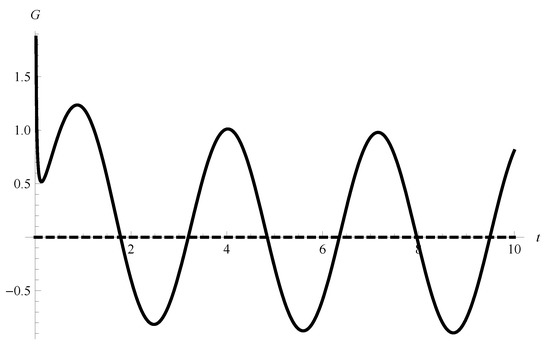
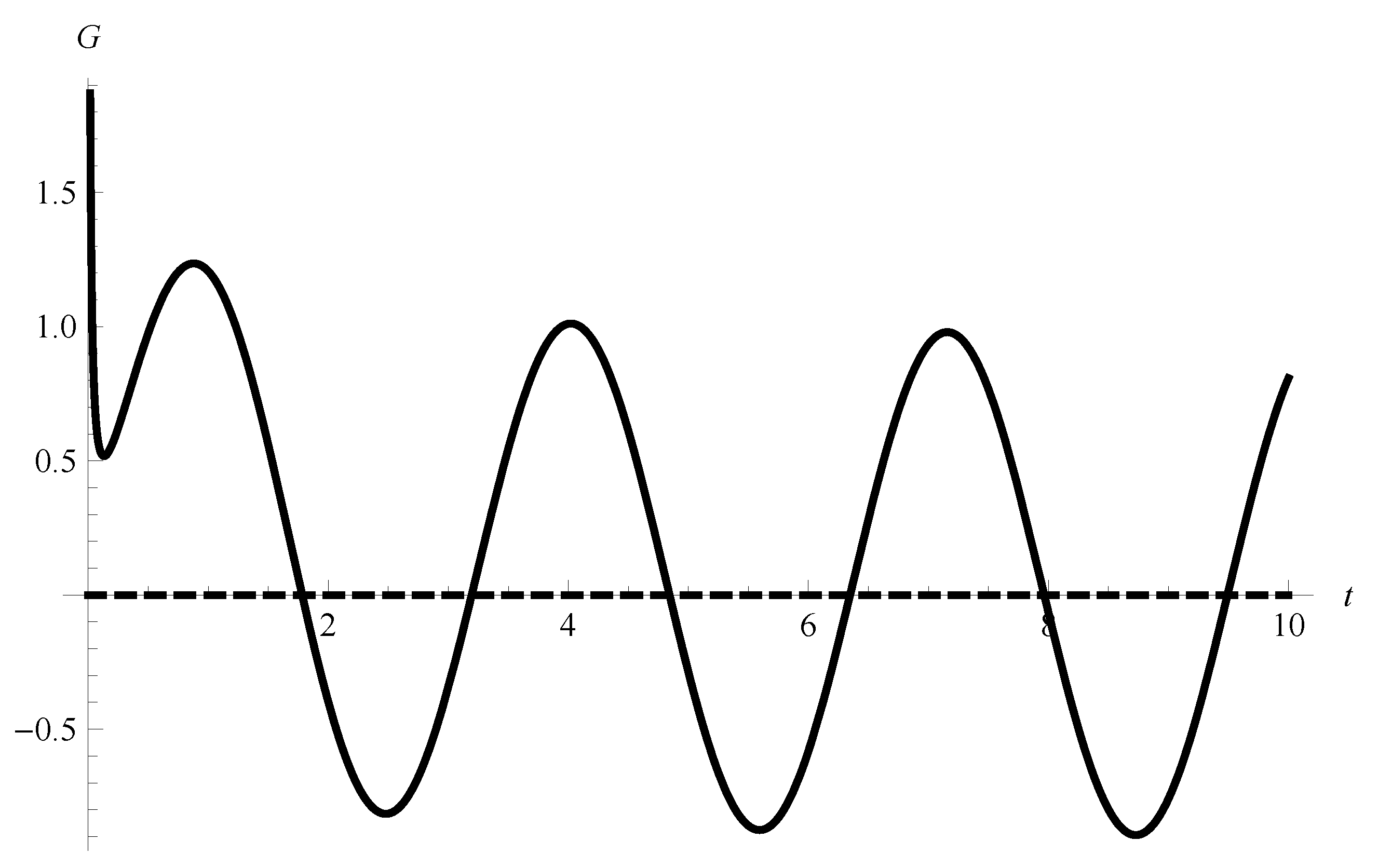
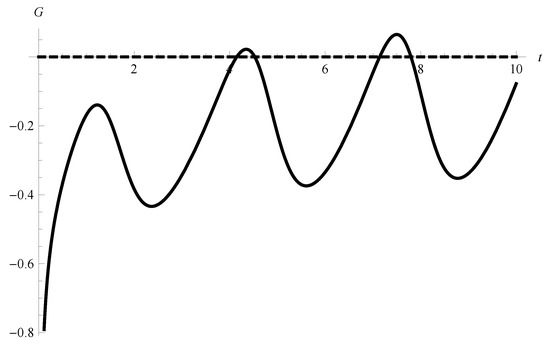
The sign of the function is changeable (see Figure 1) and, therefore, the sign of the derivative is changeable.
Figure 1.
Example 2: Graph of the function .
Case 3: Dini fractional derivative. According to Example 1, Case 2.2 for any , we apply formula (7) and obtain
Case 4: Caputo fractional Dini derivative. According to Remark 5 and Case 2.3 of Example 1, the inequality
holds.
Therefore, for (14), both the Dini fractional derivative and the Caputo fractional Dini derivative seem to be more applicable than the Caputo fractional derivative of the Lyapunov function.
Remark 6.
The above example notes that the quadratic function for studying stability properties of fractional differential equations might not be successful (especially when the right-hand side depends directly on the time variable). Formula (4) is not appropriate for applications to fractional equations. The most general derivatives for non-homogenous fractional differential equations are Dini fractional derivatives and Caputo fractional Dini derivatives.
In some papers (see, for example, [33,34] (Theorem 1)), the authors use the equality where is a solution of (2). This equality is not true and we will demonstrate this on a particular Lyapunov function and Caputo fractional deferential equation.
Example 3.
Consider the function .
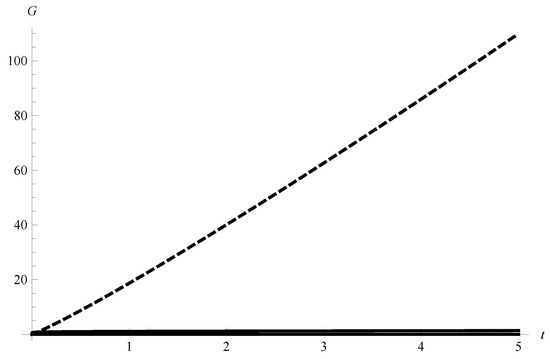
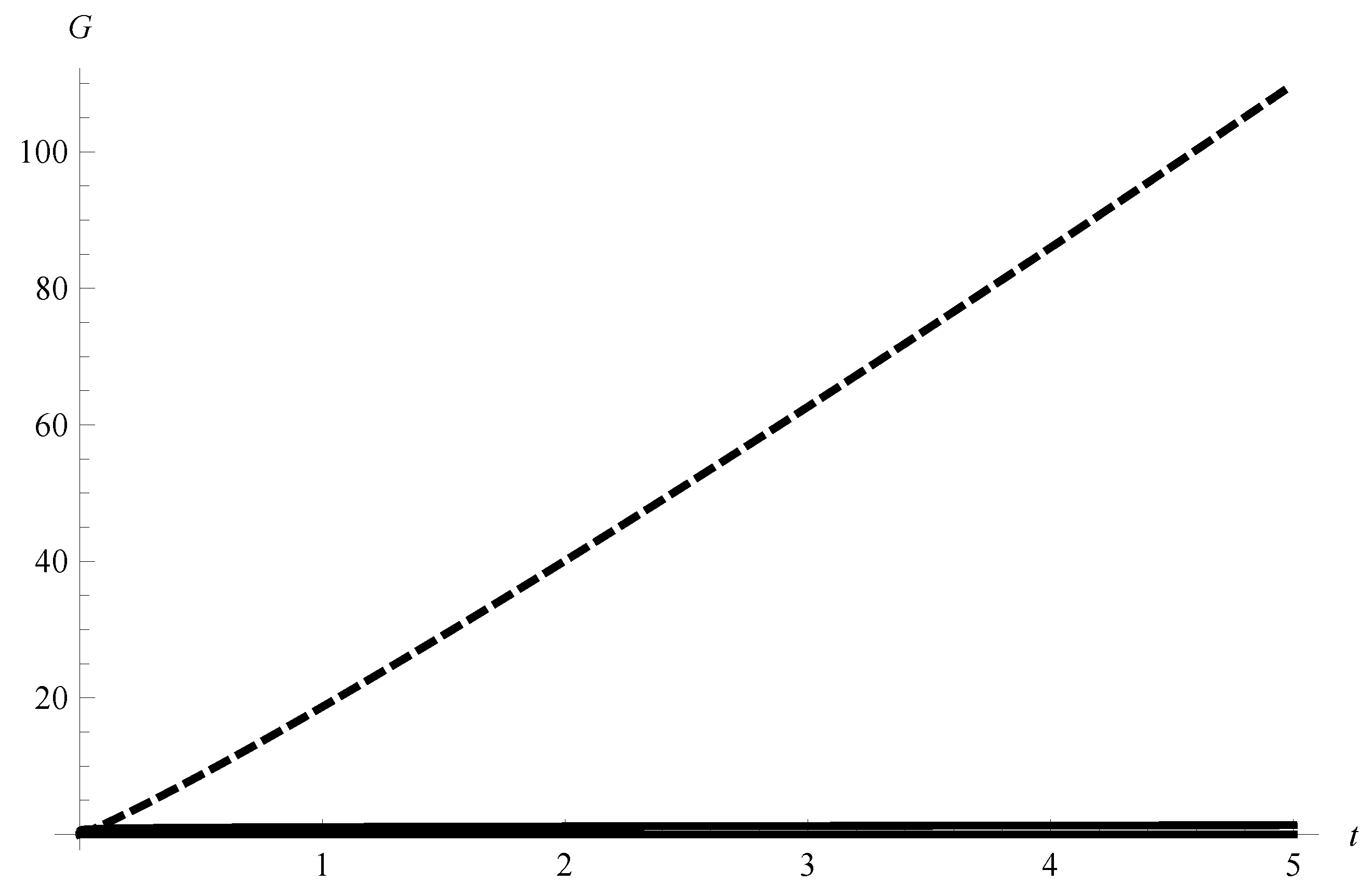
From Equations (16) and (17), it is clear that equality is not true (see Figure 2) and the replacement of the Caputo fractional derivative in any proof by is not correct.
Figure 2.
Example 3. Graph of the both derivatives of .
5. Comparison Results for Scalar FrDE
Many results about stability by the second Lyapunov method and fractional derivatives of Lyapunov functions are known in the literature. For example, in [13], the Mittag–Leffler stability as well as asymptotic stability is studied and several sufficient conditions using Caputo fractional derivatives of Lyapunov functions are obtained. In [35], the Riemann–Liouville fractional derivative of Lyapunov functions is applied which allow less restrictions for the Lyapunov functions from .
In connection with Example 1, Case 2.1 and Example 3, we will not use the derivative of Lyapunov functions given by (6).
We will provide and use some comparison results for Caputo fractional Dini derivatives.
Lemma 2
(Ref. [16]). (Comparison result). Assume the following conditions are satisfied:
Then, the inequality implies for
If in Lemma 2, we obtain the following result:
Corollary 1
(Ref. [16]). Assume:
- 1.
- The condition 1 of Lemma 2 is satisfied.
- 2.
- The function and for any the inequalityholds.
Then, for the inequality holds.
Corollary 2
(Ref. [16]). Assume:
- 1.
- The condition 1 of Lemma 2 is satisfied.
- 2.
- The function and for any the inequalityholds.
Then, for the inequality holds.
Remark 7.
The result of Lemma 2 is also true on the half line.
Lemma 3
(Ref. [16]). Assume:
- 1.
- The condition 1 of Theorem 1 is satisfied.
- 2.
- The function and for any the inequalityholds where .
Then for the inequality
holds.
6. Stability Results in the Part of Variables for Fractional Differential Equations
We are now in a position to study stability properties w.r.t. part of the variables of the nonlinear Caputo fractional differential equations of type (2). We will apply the Caputo fractional Dini derivative of Lyapunov functions. We do not use solutions to the system (2) in the sufficient conditions.
Theorem 1.
Let the following conditions be satisfied:
- 1.
- The function .
- 2.
- There exists a function such that
- (i)
- for any the inequalityholds;
- (ii)
- for where .
- 3.
- The scalar FrDE (4) is stable.
Then, the FrDE (3) is stable w.r.t. y.
Proof.
Let be an arbitrary number. According to Condition 3, there exists such that for the inequality
holds for where is a solution of scalar FrDE (4) with initial data .
Let . There exists such that the inequality implies . Let . Choose and consider . We will prove
Note the inequalities hold. Assume inequality (21) is not true. Therefore, there exists such that
Therefore, for the solution the component on .
Consider the solution of the scalar FrDE (4) with initial data . Therefore, the inequality (20) holds. According to Lemma 2 with , , condition 2(ii) and inequalities (22), we get .
The contradiction proves inequality (21). □
Corollary 3.
Now, we present some sufficient conditions for the uniform asymptotic stability w.r.t. part of the variables.
Theorem 2.
Assume there exists a function such that
- (i)
- for any the inequalityholds where ;
- (ii)
- for where .
Then, the FrDE (3) is asymptotically stable w.r.t. y.
Proof.
According to Corollary 3, the FrDE (3) is stable w.r.t. y. Therefore, for the number , there exists such that for any the inequality implies
where is a solution of (2) with initial data and .
Now, we will prove the uniformly attractivity of the zero solution. Let be an arbitrary number and choose . Choose such that .
Let . Then, the inequality (24) holds for the solution of (2) with initial data and , i.e., for . We will prove that
Assume that on the entire interval . Then, from Lemma 3 applied to the interval we obtain the inequality
Therefore, there exists a point such that . According to Lemma 3 for , we have
Therefore, for , the inequalities
hold. □
Remark 8.
Note that, in the case of continuously differentiable Lyapunov function, their Caputo fractional derivatives are applied to study stability w.r.t. part of the variables in [36].
Remark 9.
Note the above results for stability w.r.t. part of variables are generalizations of the stability results with [16]).
7. Applications
Now, we illustrate our theory on examples. We will use both Caputo fractional derivatives and Caputo fractional Dini derivatives of Lyapunov functions in particular FrDE.
Example 4.
Let and consider the IVP for the scalar linear FrDE (14).
If we apply the quadratic Lyapunov function , then, according to Example 1, Case 1 and its sign is changeable (see Example 2 and Figure 1). Therefore, the sufficient conditions in [36] are not applicable. If we use non-quadratic Lyapunov function, then obtaining the Caputo fractional derivative is difficult and again the sufficient conditions using this type of derivatives are not useful.
Now, consider the function and its Caputo fractional Dini derivative. According to Example 2, Case 3, the inequality holds. According to Corollary 3 the FrDE (14) is stable.
This example shows that, in the case of nonlinear non autonomous fractional differential equations, non-quadratic Lyapunov functions with their Caputo fractional Dini derivatives may be useful.
Example 5.
Consider the following initial value problem for the system of fractional differential equations:
where , , .
Case 1. Consider the quadratic Lyapunov function for .
Case 1.1. The Caputo fractional derivative of V satisfies
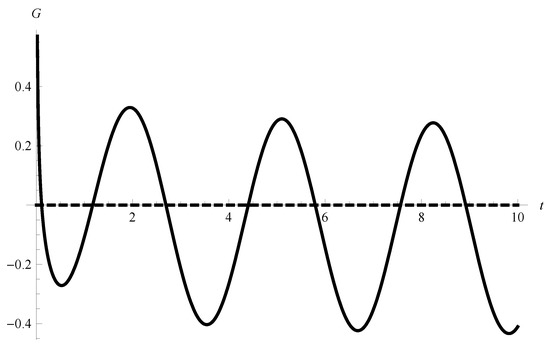
Since the sign of the function is changeable (see Figure 3), the results obtained in [36] are not applicable.
Figure 3.
Graph of the function .
Case 1.2. Dini fractional derivative. Similar to Example 1, Case 3, we obtain
where Since the sign of the function changes, so does the fractional derivative of V (see Figure 4). Therefore, the quadratic function is not applicable to the fractional equation (27).
Figure 4.
Example 5. Graph of the function .
Case 2. Consider the Lyapunov function .
Case 2.1. The Caputo derivative of the Lyapunov function is difficult to obtain so we will not use it.
Case 2.2. Dini fractional derivative. According to Example 1, Case 3 and the equalities and we obtain
According to Remark 5 and Theorem 1, the FrDE (27) is stable w.r.t. the variable x.
Note that the FrDE (27) might not be stable w.r.t. the other variable y (if, for example, ).
Fractional models describe an epidemic diseases that are more realistic because the fractional-order differential equation systems reproduce with more efficacy reality [37]. Usually, in epidemic models, all parameters such as the death removal rate, the infective class at a per capita constant rate, the number of contacts per infective, per day, which result in infection, are positive constants. Now, we will consider one SIR fractional model with time variable coefficients to illustrate our results.
Example 6.
Consider the following SIR fractional model:
where is the death removal rate, is the infective class at a per capita rate, and is the number of contacts per infective at time t which result in infection.
The point is an equilibrium point of (29).
We will apply some Lyapunov functions to study stability properties.
Case 1. Consider the quadratic Lyapunov function . Then, using Example 1, Case 1, inequalities (10) and we obtain for the Caputo fractional derivative of V:
Since the sign of the function is changeable (see Figure 3), we are not able to use the above results and to make a conclusion.
Case 2. Consider the Lyapunov function .
Case 2.1. The Caputo derivative of the Lyapunov function is difficult to obtain so we will not use it.
Case 2.2. Dini fractional derivative. Using and [38]), we obtain
From (7), Example 2, Case 3, we obtain for the Dini fractional derivative
According to Theorem 1 and Remark 5, the FrDE (27) is stable w.r.t. the variable I.
Author Contributions
All authors contributed equally to the writing of this paper. All three authors read and approved the final manuscript.
Funding
Research was partially supported by the Fund NPD, Plovdiv University, No. MU17-FMI-007.
Conflicts of Interest
The authors declare that they have no competing interests.
References
- Bagley, R.L.; Calico, R.A. Fractional order state equations for the control of viscoelasticallydamped structures. J. Guid. Contr. Dyn. 1991, 19, 304–311. [Google Scholar] [CrossRef] [Scilit]
- Laskin, N. Fractional market dynamics. Phys. A Stat. Mech. Appl. 2000, 287, 482–492. [Google Scholar] [CrossRef] [Scilit]
- Tavazoei, M.S.; Haeri, M. A note on the stability of fractional order systems. Math. Comp. Simul. 2009, 79, 1566–1576. [Google Scholar] [CrossRef] [Scilit]
- Zaslavsky, G.M.; Stanislavsky, A.A.; Edelman, M. Chaotic and pseudochaotic attractors of perturbed fractional oscillator. Chaos 2006, 16, 013102. [Google Scholar] [CrossRef] [Scilit] [PubMed]
- Ahmed, E.; El-Sayed, A.M.A.; El-Saka, H.A.A. Equilibrium points, stability and numerical solutions of fractional-order predator–prey and rabies models. J. Math. Anal. Appl. 2007, 325, 542–553. [Google Scholar] [CrossRef] [Scilit]
- Li, C.P.; Deng, W.H.; Xu, D. Chaos synchronization of the Chua system with a fractional order. Phys. A 2006, 360, 171–185. [Google Scholar] [CrossRef] [Scilit]
- Hilfer, R. Applications of Fractional Calculus in Physics; World Scientific: Singapore, 2000. [Google Scholar]
- Machado, J.A.T.; Silva, M.F.; Barbosa, R.S.; Jesus, I.S.; Reis, C.M.; Marcos, M.G.; Galhano, A.F. Some Applications of Fractional Calculus in Engineering. Math. Probl. Eng. 2010, 2010. [Google Scholar] [CrossRef] [Scilit]
- Fallahgoul, H.; Focardi, S.; Fabozzi, F. Fractional Calculus and Fractional Processes with Applications to Financial Economics; Academic Press: New York, NY, USA, 2016. [Google Scholar]
- Diethelm, K.; Ford, N.J. Analysis of fractional differential equations. J. Math. Anal. Appl. 2002, 265, 229–248. [Google Scholar] [CrossRef] [Scilit]
- Daftardar-Gejji, V.; Jafari, H. Analysis of a system of nonautonomous fractional differential equations involving Caputo derivatives. J. Math. Anal. Appl. 2007, 328, 1026–1033. [Google Scholar] [CrossRef] [Scilit]
- Momani, S.; Hadid, S. Lyapunov stability solutions of fractional integrodifferential equations. Int. J. Math. Math. Sci. 2004, 47, 2503–2507. [Google Scholar] [CrossRef] [Scilit]
- Li, Y.; Chen, Y.; Podlubny, I. Stability of fractional-order nonlinear dynamic systems: Lyapunov direct method and generalized Mittag–Leffler stability. Comput. Math. Appl. 2010, 59, 1810–1821. [Google Scholar] [CrossRef] [Scilit]
- Deng, W.H. Smoothness and stability of the solutions for nonlinear fractional differential equations. Nonlinear Anal. 2010, 72, 1768–1777. [Google Scholar] [CrossRef] [Scilit]
- Li, C.P.; Zhang, F.R. A survey on the stability of fractional differential equations. Eur. Phys. J. Spec. Top. 2011, 193, 27–47. [Google Scholar] [CrossRef] [Scilit]
- Agarwal, R.; O’Regan, D.; Hristova, S. Stability of Caputo fractional differential equations by Lyapunov functions. Appl. Math. 2015, 60, 653–676. [Google Scholar] [CrossRef] [Scilit]
- Agarwal, R.; O’Regan, D.; Hristova, S. Stability by Lyapunov like functions of nonlinear differential equations with non-instantaneous impulses. J. Appl. Math. Comput. 2017, 53, 147–168. [Google Scholar] [CrossRef] [Scilit]
- Henderson, J.; Hristova, S. Eventual Practical Stability and Cone Valued Lyapunov Functions for Differential Equations with “Maxima”. Int. Commun. Appl. Math. 2010, 14, 515–523. [Google Scholar]
- Hristova, S. Stability on a cone in terms of two measures for impulsive differential equations with “supremum”. Appl. Math. Lett. 2010, 23, 508–511. [Google Scholar] [CrossRef] [Scilit]
- Trigeassou, J.C.; Maamri, N.; Sabatier, J.; Oustaloup, A.; Lyapunov, A. Approach to the stability of fractional differential equations. Signal Process. 2011, 91, 437–445. [Google Scholar] [CrossRef] [Scilit]
- Aguila-Camacho, N.; Duarte-Mermoud, M.A.; Gallegos, J.A. Lyapunov functions for fractional order systems. Commun. Nonlinear Sci. Numer. Simul. 2014, 19, 2951–2957. [Google Scholar] [CrossRef] [Scilit]
- Duarte-Mermoud, M.A.; Aguila-Camacho, N.; Gallegos, J.A.; Castro-Linares, R. Using general quadratic Lyapunov functions to prove Lyapunov uniform stability for fractional order systems. Commun. Nonlinear Sci. Numer. Simul. 2015, 22, 650–659. [Google Scholar] [CrossRef] [Scilit]
- Hu, J.B.; Lu, G.P.; Zhang, S.B.; Zhao, L.-D. Lyapunov stability theorem about fractional system without and with delay. Commun. Nonlinear Sci. Numer. Simul. 2015, 20, 905–913. [Google Scholar] [CrossRef] [Scilit]
- Lakshmikantham, V.; Leela, S.; Devi, J.V. Theory of Fractional Dynamical Systems; Cambridge Scientific Publishers: Cambridge, UK, 2009. [Google Scholar]
- Lakshmikantham, V.; Leela, S.; Sambandham, M. Lyapunov theory for fractional differential equations. Commun. Appl. Anal. 2008, 12, 365–376. [Google Scholar]
- Das, S. Functional Fractional Calculus; Springer: Berlin/Heidelberg, Germany, 2011. [Google Scholar]
- Diethelm, K. The Analysis of Fractional Differential Equations; Springer: Berlin/Heidelberg, Germany, 2010. [Google Scholar]
- Podlubny, I. Fractional Differential Equations; Academic Press: San Diego, CA, USA, 1999. [Google Scholar]
- Samko, G.; Kilbas, A.A.; Marichev, O.I. Fractional Integrals and Derivatives: Theory and Applications; Gordon and Breach: New York, NY, USA, 1993. [Google Scholar]
- Devi, J.V.; Rae, F.A.M.; Drici, Z. Variational Lyapunov method for fractional differential equations. Comput. Math. Appl. 2012, 64, 2982–2989. [Google Scholar] [CrossRef] [Scilit]
- Baleanu, D.; Mustafa, O.G. On the global existence of solutions to a class of fractional differential equations. Comput. Math. Appl. 2010, 59, 1835–1841. [Google Scholar] [CrossRef] [Scilit]
- Agarwal, R.; O’Regan, D.; Hristova, S.; Cicek, M. Practical stability with respect to initial time difference for Caputo fractional differential equations. Commun. Nonlinear Sci. Numer. Simul. 2017, 42, 106–120. [Google Scholar] [CrossRef] [Scilit]
- Sadati, S.J.; Ghaderi, R.; Ranjbar, A. Some fractional comparison results and stability theorem for fractional time delay systems. Rom. Rep. Phys. 2013, 21, 94–102. [Google Scholar]
- Stamova, I.; Stamov, G. Stability analysis of impulsive functional systems of fractional order. Commun. Nonl. Sci. Numer. Simul. 2014, 19, 702–709. [Google Scholar] [CrossRef] [Scilit]
- Zhang, F.; Li, C.; Chen, Y. Asymptotical Stability of Nonlinear Fractional Differential System with Caputo Derivative. Int. J. Differ. Equ. 2011, 2011. [Google Scholar] [CrossRef] [Scilit]
- Makhlouf, A.B. Stability with respect to part of the variables of nonlinear Caputo fractional differential equations. Math. Commun. 2018, 23, 119–126. [Google Scholar]
- Diethelm, K. A fractional calculus based model for the simulation of an outbreak of dengue fever. Nonlinear Dyn. 2013, 71, 613–619. [Google Scholar] [CrossRef] [Scilit]
- Guce, I.K. On Fractional Derivatives: The Non-integer Order of the Derivative. Int. J. Sci. Eng. Res. 2013, 4, 1. [Google Scholar]
© 2018 by the authors. Licensee MDPI, Basel, Switzerland. This article is an open access article distributed under the terms and conditions of the Creative Commons Attribution (CC BY) license (http://creativecommons.org/licenses/by/4.0/).