


Abstract
In a certain class of graphs, a graph is called minimizing if the least eigenvalue of its adjacency matrix attains the minimum. A connected graph containing two or three cycles is called a bicyclic graph if its number of edges is equal to its number of vertices plus one. Let and be the classes of the connected graphs of order n whose complements are bicyclic with exactly two and three cycles, respectively. In this paper, we characterize the unique minimizing graph among all the graphs which belong to , a class of the connected graphs of order n whose complements are bicyclic.
MSC:
05C50; 05D05; 15A18
1. Introduction
Let G be a finite, simple and undirected graph with the vertex-set and the edge-set such that and are order and size of the graph G, respectively. The adjacency matrix of the graph G is a matrix of order n, where if is adjacent to and , otherwise. The zeros of are called the eigenvalues of , where is an identity matrix of order n. Since is real and symmetric, all the eigenvalues say that , , ..., are real and called the eigenvalues of the graph G. If is the least, then one can arrange the eigenvalues as , and the eigenvector corresponding to the least eigenvalue is called the first eigenvector. For further study, we refer [1,2].
In 1957, Collatz and Sinogowitz investigated the spectrum of an undirected graph with respect to the adjacency matrix [3]. The literature on spectra of graphs has grown enormously since that time. The investigation on the spectral radius (largest eigenvalue) of graphs is an important topic in the theory of graph spectra [1,2,4,5,6]. In literature, the least eigenvalue received less attention comparatively to the spectral radius.
In a certain class of graphs, a graph is called minimizing if the least eigenvalue of its adjacency matrix attains the minimum. A graph G is called a nested split if its vertices can be ordered so that implies , where and . Let denote the class of connected graphs of order n and size m, where . Bell et al. [7] characterized the minimizing graphs in as follows.
Theorem 1.
Let G be a minimizing graph in . Then, G is either (i) a bipartite graph; or (ii) a joining of two nested split graphs (not both totally disconnected).
It is observed that the complements of the minimizing graphs in are either disconnected or contain a clique of order greater than or equal to the half of the order of the graphs. This motivated discussion of the least eigenvalue of the graphs whose complements are connected and contain cliques of small sizes. Fan et al. [8] characterized the unique minimizing graph in the class of graphs of order n whose complements are trees. Wang et al. [9] characterized the unique minimizing graph in the class of graphs whose complements are unicyclic. Recently, the minimizing graph of the graphs which belong to is studied in [10], where is a class of the connected graphs of order n whose complements are bicyclic with exactly two cycles. In this note, we continue this study and characterize the unique minimizing graph among all the graphs which belong to a class of the connected graphs of order n whose complements are bicyclic with two or three cycles. The main result of this paper is stated as follows.
Theorem 2.
Let and be the classes of the bicyclic graphs of order n in which each bicyclic graph has exactly two and three cycles, respectively. Let be a connected graph of order n such that its complement is a bicyclic graph i.e., . Then:
where and equality holds if and only if .
The results related to the bounds of the least eigenvalue can be found in [5,11]. For further study, we refer [12,13,14,15,16,17]. The rest of the paper is organized as follows: in Section 2, we present some basic definitions and terminologies that are frequently used in the main results and Section 3 includes the main results from the minimizing graph of the connected graphs whose complements are bicyclic.
2. Preliminaries
A star of size n is a tree that is obtained by joining one specific vertex to the remaining n vertices, where the fixed vertex is called center and all other vertices are called pendent vertices. It is denoted by and its vertex-set and edge-set are defined as and , respectively. Moreover, is a graph obtained by joining any one pair of pendent vertices of . If we choose a pair of pendent vertices of consisting of and , then and are the vertex-set and the edge-set of the graph , respectively. Similarly, is a graph obtained by joining any two distinct pairs of pendent vertices of such that and , where is chosen as the second pair of pendent vertices different from . If two chosen pairs of vertices have one vertex that is the same, then, by joining these pairs of vertices, we obtain the graph with the same vertex-set and the edge-set .
Since bicyclic graphs are connected graphs in which the number of edges equals the number of vertices plus one. We conclude that is a bicyclic graph with exactly two cycles and pendent vertices and is a bicyclic graph with exactly three cycles and pendent vertices. In particular, is a bicyclic graph of order 5 with exactly two cycles and is a bicyclic graph of order 4 with three cycles. In the following definitions, we define some more graphs that are bicyclic.
Definition 1.
Let be a star and be a bicyclic graph with three cycles and four vertices. The bicyclic graph denoted by is obtained by joining one pendent vertex of with a vertex of degree 3 of the graph , where . The vertex-set and the edge-set of are defined as and
Definition 2.
Let be a star and be a bicyclic graph with three cycles and pendent vertices. The bicyclic graph denoted by is obtained by joining a pendent vertex of with a pendent vertex of the graph , where and . The vertex-set and the edge-set of are defined as and .
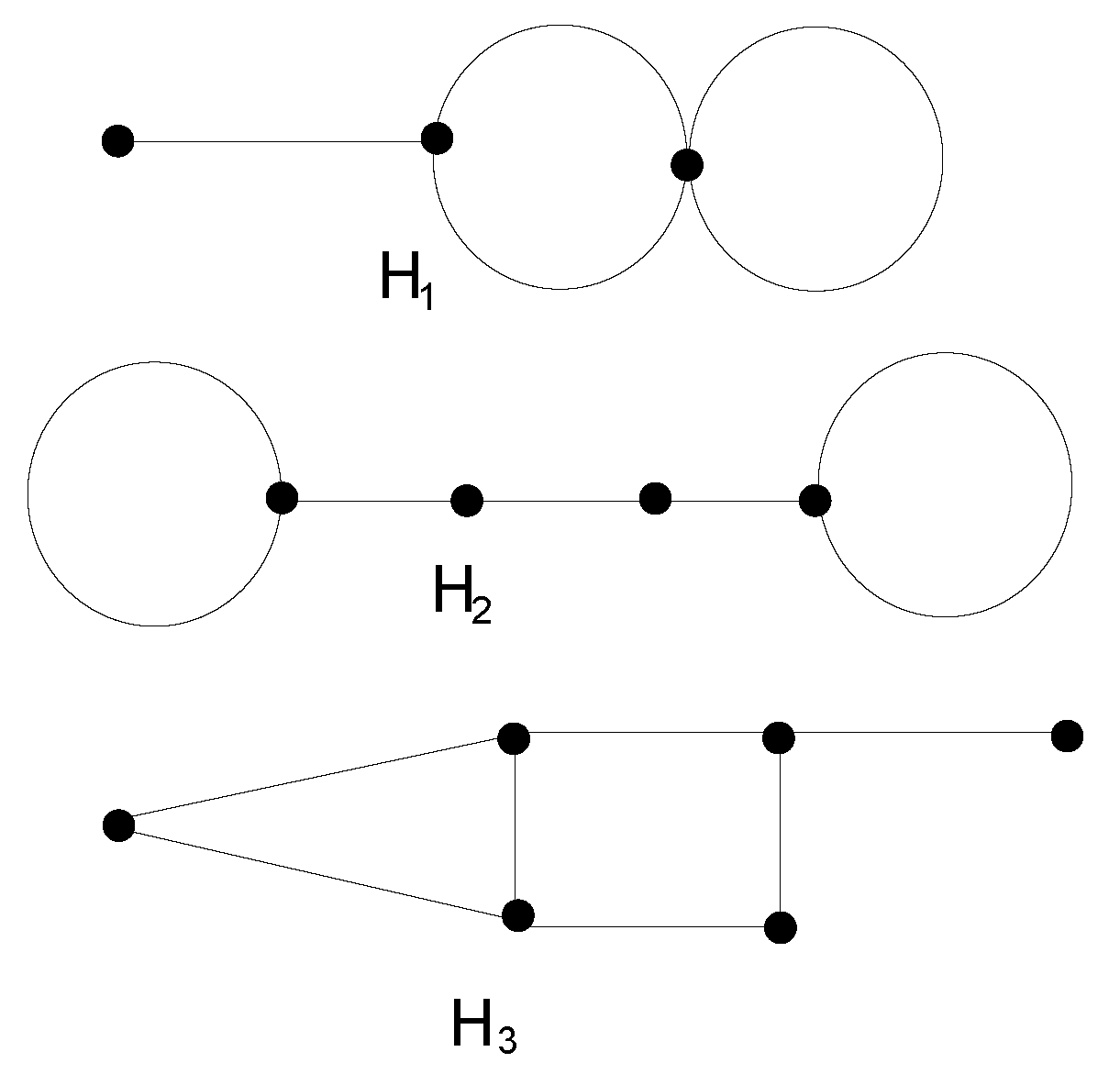
Let and be the classes of bicyclic graphs of order n such that each bicyclic graph has exactly two and three cycles, respectively. In particular, Figure 1 shows and as the examples of the bicyclic graphs with exactly two cycles that belong to , and as an example of the bicyclic graphs with exactly three cycles which belongs to . Let be a class of the connected graphs of order n whose complements are bicyclic with exactly two cycles i.e., . Let be a class of connected graphs of order n whose complements are bicyclic with exactly three cycles i.e., . Now, we define and note that and being disconnected do not belong to , where .
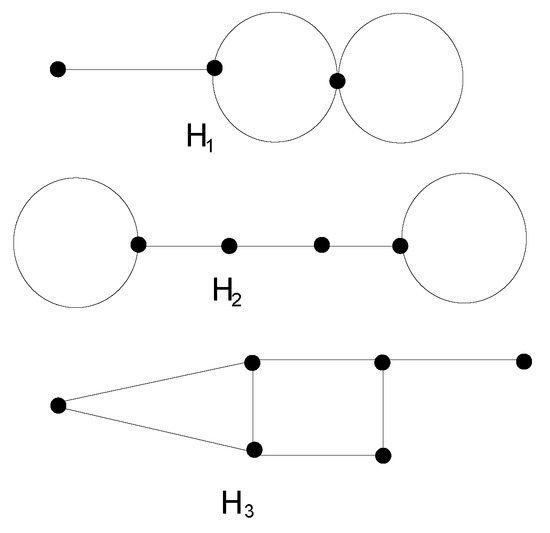
Figure 1.
Bicyclic graphs.
By interlacing theorem, for a graph G containing at least one edge, we have . In particular, if G is a complete graph or disjoint union of complete graphs with at least one non-trivial copy, then . Moreover, if G contains as an induced subgraph, then G verifies that . Thus, for a graph G (tree), if and only if G is a star. Consequently, if G being a tree is not a star, then is connected and . For a unicyclic graph G, , where equality holds if (as is , where is a path of order 2). Similarly, for a bicyclic graph G with exactly three cycles, , where equality holds if and for a bicyclic graph G with exactly two cycles, , where equality holds if for .
A vector is said to be defined on the graph G of order n, if there is a one to one map ϕ from to the entries of such that for each . If is an eigenvector of , then it is naturally defined on , i.e., is the entry of corresponding to the vertex u. Thus, it is easy to find that:
and λ is an eigenvalue of G corresponding to the eigenvector if and only if . For each , we obtain the following eigen-equation of the graph G:
where is the set of neighbors of v in G. For an arbitrary unit vector :
with equality if and only if is a first eigenvector of G.
Moreover, if is a complement of the graph G, then , where and are the all-ones matrix and the identity matrix of same size as of the adjacency matrix , respectively. Thus, for any vector
Let be the first eigenvector of the graph with entries corresponding to the vertices as defined in Definition 1. By Eigen-Equation (2), the vertices for , , , , and for have values in , say , , , , and , respectively. Moreover, if , then, we have:
Take . Then, the matrix equation of the above system of equations is , where is a matrix of order 6. Thus, is the least root of the polynomial:
Let be the first eigenvector of the graph with entries corresponding to the vertices as defined in Definition 2. By Eigen-Equation (2), the vertices for , , , , , , for and for have values in , say , , , , , , and , respectively. Moreover, if , then we have:
Take . Then, the matrix equation of the above system of equations is , where is a matrix of order 8. Thus, is the least root of the polynomial:
.
Now, we state some results that are used in the main theorem.
Lemma 1.
[8] Let be a tree with non-negative or non-positive real vectors defined on . The entries of are ordered as , where . Then:
where is defined on the star such that its central vertex of degree has value , and equality holds if and only if .
Lemma 2.
[9] Let be a unicyclic graph with non-negative or non-positive real vectors defined on . The entries of are ordered as , where . Then:
where is defined on the unicyclic graph such that the vertex of degree has value and two vertices of degree two have values and . The equality holds only if .
3. Main Results
In this section, we present the main results related to the minimizing graph of the connected graphs whose complements are bicyclic.
Lemma 3.
If , then .
Proof.
Consider and are the least roots of and , respectively. Define
Since , is the least root of . By (6) , for . Moreover, if . Then, , which implies . Now, for and ,
Consequently, for and . In particular, , which implies for .
Lemma 4.
Let p and q be positive integers such that and . Then,
with equality if and only if and , where, (a) if ; and (b) if .
Proof.
From Equation (8), we have:
(a) If , then and . Thus, (9) becomes (b) If , then and . Thus, (9) becomes . From both cases (a) and (b), for and , respectively. This shows that , where is the least root of . Moreover:
We note that if and , then . In addition, . Consequently:
It follows that , where equality holds if and only if and .
Lemma 5.
Let be a bicyclic graph of order n and be a non-negative or non-positive real vector defined on such that the entries of are ordered as :
- (a)
- If , then where is defined on such that one vertex of degree has value and four vertices of degree 2 have values , , and , respectively. The remaining values for are assigned to the pendent vertices. The above equality holds only if ,
- (b)
- where is defined on such that one vertex of degree , one vertex of degree 3 and two vertices of degree 2 have values , , and , respectively. Furthermore, the remaining values are assigned to the pendent vertices,
- (c)
- If , then , where equality holds only if .
Proof.
(a) Without loss of generality, assume that is non-negative. Otherwise, we consider . Let v be a vertex of the bicyclic graph with value assigned by the first eigenvector . Suppose that there exists a vertex u that is not adjacent with v. Since is a connected graph, there exists a neighbor of u, say w, which is on the path of containing v and u. If we delete and add a new edge in , then we have a new bicyclic graph with exactly two cycles such that:
Repeating this process on the bicyclic graph for the non-neighbor of v. Thus, we obtain a bicyclic graph which is infact a star with center v and two edges and that are non incident to the vertex v. Thus, we have:
Since and , we obtain:
The equality holds if v is adjacent to all other vertices and there are two non incident edges to the vertex v in , which implies that .
- (b)
- Since :Consequently,
- (c)
- Proof is similar to (a).
Lemma 6.
Let be a connected graph order such that its complement is a bicyclic graph and be a first eigenvector of . Then, has at least two positive and two negative entries.
Proof.
Suppose, on the contrary, that only one vertex v of has positive value assigned by . Since is connected, and . Thus, there exists a vertex u as a neighbor of the vertex v in such that , where is set of neighbors of u in . By (2) the eigen-equation of the vertex u for is:
This shows that and for each , where is set of neighbors of u in . Thus, all of the vertices of have non zero entries assigned by . Now, we discuss the following three cases:
- (a)
- When both of the vertices v and u are non-cycles. Then, we have three observations: (i) ; otherwise, is not bicyclic; (ii) each pair of vertices of the set is non adjacent; otherwise, B is not bicyclic; and (iii) at most one neighbor of u may be on any cycle; otherwise, u will be also on a cycle. Define such that for each . Thus, the eigen-equation of the vertex v for the graph , becomes . By adding to both sides, we have:Suppose that such that is non adjacent to s for each , where as observed in (ii). Thus, the eigen-equation of the vertex for the graph is , which implies:From (11) and (12), . Since , , and . Consequently, are two positive entries of which is a contradiction to our supposition.
- (b)
- When both the vertices are on the cycle(s). Here, we have two possibilities: (i) the vertex u is a common vertex of the cycles with degree of at least 4. Then, by (10), which is a contradiction, as is neither nor ; (ii) the vertex u is not a common vertex of the cycles with degree of at least 4. If u and v are on a cycle of length 3, then there is a neighbor of u that is also a neighbor of v in , say z. If , then by the eigen-equation of v for , , which is a contradiction. If , then we follow (a) and have all the vertices of with the same value as v, which is again a contradiction. If u and v are on a cycle(s) of a length of at least 4, then , and we have a contradiction using the procedure of (a).
- (c)
- When one vertex is on a cycle(s) and the other is a non-cycle, then ; otherwise, is not a bicycle. If v is on a cycle and u is non-cycle, then by repeating (a), we have a contradiction. If u is on a cycle and v is non-cycle, then we have two possibilities: (i) if u is a common vertex of the cycles with a degree of at least 4; then, by (b) (i), we have a contradiction; (ii) if u is not a common vertex of the cycles with degree at least 4. Suppose that u is on a cycle of length 3, then u has neighbors and such that is adjacent to and one is a common vertex of the cycles, say . By the eigen-equations for these two neighbors of u in , we have , which is contradiction. If u is on a cycle of a length of at least 4, then, by (a), we have a contradiction. If u is a common vertex of two cycles, then the vertex which is non adjacent to all other neighbors of u has equal value to the value of v by (a), which is again a contradiction.
Therefore, contains at least two positive entries. If we consider , then we have at least two negative entries. Consequently, has at least two positive and two negative entries.
Theorem 3.
Let and be the classes of the bicyclic graphs of order n in which each bicyclic graph has exactly two and three cycles, respectively. Let be a connected graph of order n such that its complement is a bicyclic graph i.e . Then:
where , and equality holds if and only if .
Proof.
Define and . By Lemma 6, both contain at least two elements. Suppose that and are subgraphs of induced by and , respectively. Moreover, assume that is a set of edges between and in . As is connected, is non empty. Thus, we have:
Now, for the edges of the cycles of , we have two cases: (i) all the edges of the cycles of are only in or ; and (ii) both the subgraphs and contain the edges of the cycles of .
(i) Without loss of generality, we suppose that does not include any edge of the cycles of ; otherwise, we take as a first eigenvector. Let be a graph obtained from such that the subgraph and of induced by and are tree and bicyclic, respectively (bicyclic with two cycles if or bicyclic with three cycles if ). By the deletion and addition of some edges in the tree , we have a star with center , where and has a maximum modulus value among all the values of given by . Thus, by Lemma 1, we have:
Similarly, by the deletion and addition of some edges in the bicyclic subgraph , we have if (or if ) with adjacent to all other vertices in (or ). Moreover, has maximum modulus value among all the values of and .
If , then by Lemma 5((a) and (b)), we have:
If , then by Lemma 5(c), we have:
In this case, we conclude that:
(ii) Let be a graph obtained from such that both the subgraphs and induced by the subgraphs and of are unicyclic. By the deletion and addition of some edges in , we have with adjacent to all other vertices in . Moreover, has a maximum modulus value among all the values of given by and . Thus, by Lemma 1, we have:
Similarly, by the deletion and addition of some edges in , we have with adjacent to all other vertices in . Moreover, has a maximum modulus value among all the values of given by and . Again, by Lemma 1, we have:
From the above two inequalities, we have:
Without loss of generality, assume that the modulus values of the vertices of are greater than the modulus values of the vertices of assigned by . Suppose that w and are vertices in such that the edge is non incident with . Delete the edge and the edge the edge , where r and are vertices in such that the edge is non incident with , and use Lemma 5(b). Then:
Consequently, from both the cases:
Let and be the vertices of and with minimum modulus among all the vertices of and , respectively. Then:
Using (14) and (15) in (13), we have:
Since , the vertices and can be taken from the pendent vertices of and respectively. Thus, (16) becomes:
Now, consider the following inequality:
Consequently:
where , and equality holds if and only if .
Now to complete the proof, we prove that the set consists of exactly one edge and the set does not contain any vertex with zero value given by . Before this, we prove that and .
Suppose has labeled vertices as in Definition 2. Therefore, , , and . The vertices and are unique in with maximum and minimum moduli, and and are unique in with maximum and minimum moduli, respectively. By Lemma 6, as is the first eigenvector of the minimizing graph , , are non negative and are negative values of . Now, by (7), and , which implies and . Therefore, . Similarly, , , and . Thus, .
By (13)–(16) and the above discussion, we have and . Consequently, contains exactly one edge . Now, if the value of is zero, i.e., , then because . By (7) , which is a contradiction. If value of is zero i.e., , then as . Solving the first two equations of (7), . This shows , which is again a contradiction. If the value of is zero, i.e., , then delete the edges and , and join with and one of the pendent vertexes of . Thus, we get a graph with the same such that , which is a contradiction if by Lemma 4. Consequently, does not contain any vertex with zero value given by , which completes the proof.
Now, we give the proof of the main theorem (Theorem 2) of this paper, which is stated in Section 1 (Introduction).
Proof of Theorem 2.
This proof follows Lemma 4 and Theorem 3.
4. Conclusions
Petrovi et al. [13] proved: if is any bicyclic graph of order n, then and equality holds if and only if , where . It shows that is a unique minimizing graph in , where is a class of bicyclic graphs of order n. However, in this paper, we proved that is a unique minimizing graph in , where is a class of the connected graphs of order n whose complements are bicyclic.
Acknowledgments
The author is indebted to all the anonymous referees for their valuable comments to improve the original version of this paper. Moreover, the author is supported by Chinese Academy of Science Presidents International Fellowship Initiative (CAS-PIFI), Beijing, China. Grant No: 2015 PM 035.
Conflicts of Interest
The author declares that he has no conflict of interest.
References
- Cvetković, D.; Rowlinson, P. The largest eigenvalues of a graph, a survey. Linear Multileaner Algebra 1990, 28, 3–33. [Google Scholar] [CrossRef]
- Cvetković, D.; Doob, M.; Sachs, H. Spectra of Graphs, 3rd ed.; Johann Ambrosius Barth: Heidelberg, Germany, 1995. [Google Scholar]
- Collatz, L.; Sinogowitz, U. Spektren endlicher Grafen. Abh. Math. Semin. Univ. Hambg. 1957, 21, 63–77. [Google Scholar] [CrossRef]
- Berman, A.; Zhang, X.-D. On the spectral radius of graphs with cut vertices. J. Comb. Theory Ser. B 2001, 83, 233–240. [Google Scholar] [CrossRef]
- Cvetković, D.; Rowlinson, P.; Simić, S. Spectral Generalizations of Line Graphs: On Graph with Least Eigenvalue—2 (London Mathematical Society Lecture Note Series, Vol. 314); Cambridge University Press: Cambridge, UK, 2014. [Google Scholar]
- Das, K.C.; Kumar, P. Some new bounds on the spectral radius of graphs. Discret. Math. 2004, 281, 149–161. [Google Scholar] [CrossRef]
- Bell, F.K.; Cvetković, D.; Rowlinson, P.; Simić, S. Graph for which the least eigenvalues is minimal, II. Linear Algebra Appl. 2008, 429, 2168–2179. [Google Scholar] [CrossRef]
- Fan, Y.-Z.; Zhang, F.-F.; Wang, Y. The least eigenvalue of the complements of trees. Linear Algebra Appl. 2011, 435, 2150–2155. [Google Scholar] [CrossRef]
- Wang, Y.; Fan, Y.-Z.; Li, X.-X. The least eigenvalue of graphs whose complements are unicyclic. Discuss. Math. Graph Theory 2015, 35, 249–260. [Google Scholar]
- Javaid, M. Minimizing graph of the connected graphs whose complements are bicyclic with exactly two cycles. Turk. J. Math. 2016. [Google Scholar] [CrossRef]
- Hong, Y.; Shu, J. Sharp lower bounds of the least eigenvalue of planar graphs. Linear Algebra Appl. 1999, 296, 227–232. [Google Scholar] [CrossRef]
- Bell, F.K.; Cvetković, D.; Rowlinson, P.; Simić, S. Graph for which the least eigenvalues is minimal, I. Linear Algebra Appl. 2008, 429, 234–241. [Google Scholar] [CrossRef]
- Petrović, M.; Borovićanin, B.; Aleksić, T. Bicyclic graphs for which the least eigenvalue is minimum. Linear Algebra Appl. 2009, 430, 1328–1335. [Google Scholar] [CrossRef]
- Petrović, M.; Aleksić, T.; Simić, S. Further results on the least eigenvalue of connected graphs. Linear Algebra Appl. 2011, 435, 2303–2313. [Google Scholar] [CrossRef]
- Liu, R.; Zhai, M.; Shu, J. The least eigenvalues of unicyclic graphs with n vertices and k pendant vertices. Linear Algebra Appl. 2009, 431, 657–665. [Google Scholar] [CrossRef]
- Xu, K.; Hua, H. A unified approach to extremal mutiplicative Zagreb indices for trees, unicyclic and bicyclic graphs. Match Commun. Math. Comput. Chem. 2012, 68, 241–256. [Google Scholar]
- Xu, K.; Das, K.C. Extremal unicyclic and bicyclic graphs with respect to Harary index. Bull. Malays. Math. Sci. Soc. 2013, 36, 373–383. [Google Scholar]
© 2017 by the author. Licensee MDPI, Basel, Switzerland. This article is an open access article distributed under the terms and conditions of the Creative Commons Attribution (CC BY) license ( http://creativecommons.org/licenses/by/4.0/).