1. Introduction
The efficiency of inventory management in pharmaceutical supply chains, a core component of public health systems, directly affects the accessibility of medicines [
1], the operating costs of medical institutions [
2,
3], and the timeliness of patient treatment [
4,
5]. In practice, medical institutions face multiple sources of uncertainty—such as seasonal illnesses [
6], public health emergencies [
7,
8], and fluctuations in patient volume—leading to pronounced demand volatility [
9,
10,
11]. Compared with general merchandise, pharmaceuticals also exhibit short shelf lives [
12], a wide variety of SKUs [
3], high inventory costs [
13,
14], and significant stockout risks [
15], which further complicate inventory management.
Pharmaceutical supply chains have become increasingly exposed to disruption risks, leading to recurrent drug shortages and volatile availability of essential medicines. For instance, the U.S. Food and Drug Administration (FDA) reported 55 new drug shortages in the calendar year 2023, illustrating that shortage risk remains persistent and policy-relevant even after major mitigation efforts [
16]. In the U.S. hospital sector, the American Society of Health-System Pharmacists (ASHP) tracked 323 active drug shortages in Q1 2024 and 214 active shortages as of September 2025, indicating that the shortage burden remains substantial despite recent improvements [
17]. In Europe, 136 critical shortages were reported to the European Medicines Agency (EMA) between 2022 and October 2024, and community pharmacies in many countries reported shortages of hundreds of medicines at the end of 2024 [
18].
At the same time, pharmaceuticals are typically perishable and subject to strict shelf-life and regulatory constraints. Over-ordering and poor coordination can therefore generate large amounts of expired or unused inventory and additional disposal costs; for example, a hospital-level study reported that expired/unused medications accounted for a major share of medication wastage costs over a two-year period [
19]. These two forces—shortage risk and expiration risk—make multi-institution inventory coordination a timely and practically important problem.
In recent years, China’s reforms of the drug distribution system have increased the need for coordination between manufacturers and medical institutions [
20]. Two practical issues are frequently observed in hospital networks: (i) temporary overstocking and inventory accumulation of slow-moving drugs driven by procurement guidance and minimum purchase volumes and (ii) localized stockouts during public health emergencies that force rationing or urgent redistribution. These challenges motivate a decision support model that jointly considers ordering, production, and lateral transshipment for perishable drugs under both deterministic and stochastic demands.
To address the above challenges and the research gaps identified in the literature, this study makes the following contributions: (i) We developed an integrated single-cycle model linking institutional economic order quantity (EOQ) ordering and manufacturer economic production quantity (EPQ) production for perishable drugs with a buyback contract and first-in-first-out (FIFO) issuance. (ii) We incorporated peer-to-peer transshipment among multiple institutions with shelf-life constraints and cost sharing, capturing redistribution as a practical mitigation lever for both shortages and expirations. (iii) We derived an expected-profit formulation under normally distributed demand and solved the resulting non-convex, simulation-evaluated optimization using Bayesian optimization combined with Monte Carlo evaluation. (iv) Through a numerical study with ten drugs and three institutions, we quantified the value of transshipment and provide robustness analyses on transshipment lead time, limited peer-inventory visibility, Monte Carlo stability, and scalability.
The remainder of the paper is organized as follows.
Section 2 reviews the related literature and highlights the research gaps.
Section 3 describes the problem setting and modeling assumptions.
Section 4 and
Section 5 present the deterministic-demand and stochastic-demand models, respectively.
Section 6 reports the numerical study and robustness analyses.
Section 7 provides managerial insights and practical implications.
Section 8 concludes and outlines future research directions.
2. Literature Review
Research on pharmaceutical inventory management has long emphasized perishability, strict quality requirements, and the need to jointly control shortages and expirations. Studies have investigated issuance rules and shelf-life constraints in multi-item inventory systems and show that explicit shelf-life rules can materially change replenishment and disposal decisions [
21,
22,
23,
24].
Within this stream, the role of issuance policies (e.g., first-in-first-out) and disposal/return rules has also been examined to reduce waste while maintaining service levels. For healthcare operations, these mechanisms are particularly important because expired drugs often require regulated reverse logistics and destruction, creating additional costs beyond standard holding costs [
21,
22].
A second line of work focuses on inventory pooling and lateral transshipment as mitigation tools for localized stockouts. Transshipment policies can improve system-wide service levels, especially when demand is uncertain and supplies are unevenly distributed across locations [
25]. Related work in operations research has also explored robust and stochastic approaches to address uncertainty and disruption risk in healthcare and pharmaceutical supply chains [
26].
A third stream considers coordination and integrated planning across upstream production and downstream ordering decisions. For pharmaceutical supply chains, integrated approaches have been proposed for enhancing resilience, production control, and network design under stringent quality and regulatory constraints [
27,
28,
29,
30]. However, integrating such upstream decisions with downstream transshipment and perishability constraints remains challenging in practice.
Despite these advances, three research gaps remain. First, most models treat transshipment feasibility as instantaneous and assume full visibility of peer inventories, which may be violated in real inter-hospital collaboration. Second, few studies explicitly link a manufacturer’s production decision (e.g., EPQ-type batching) with multiple institutions’ EOQ-type ordering and peer-to-peer redistribution under perishability constraints. Third, existing stochastic formulations often provide expected values but do not report estimation uncertainty (e.g., confidence intervals) or robustness to Monte Carlo randomness, which is critical for decision support.
To address these gaps, we propose an integrated manufacturer–multiple-institution model with perishable inventory, buyback/return handling, and lateral transshipment under both deterministic and stochastic demands, and we provide additional robustness and scalability analyses in the numerical study.
3. Problem Description and Assumptions
3.1. Problem Description
We study a two-echelon pharmaceutical supply chain consisting of one manufacturer and multiple medical institutions. Multiple drugs with finite shelf life are involved. Under a continuous-review policy, institutions order from the manufacturer and, following FIFO, prioritize transshipment of near-expiry drugs across peer institutions to alleviate shortages at some sites and surpluses at others. Considering inventory capacity limits, sharing of transshipment costs, contractual shelf-life constraints, and both deterministic and stochastic demand, we maximize the joint profit of the manufacturer and institutions by optimizing order quantities for each drug at each institution and the induced optimal transshipment behavior.
3.2. Modeling Assumptions
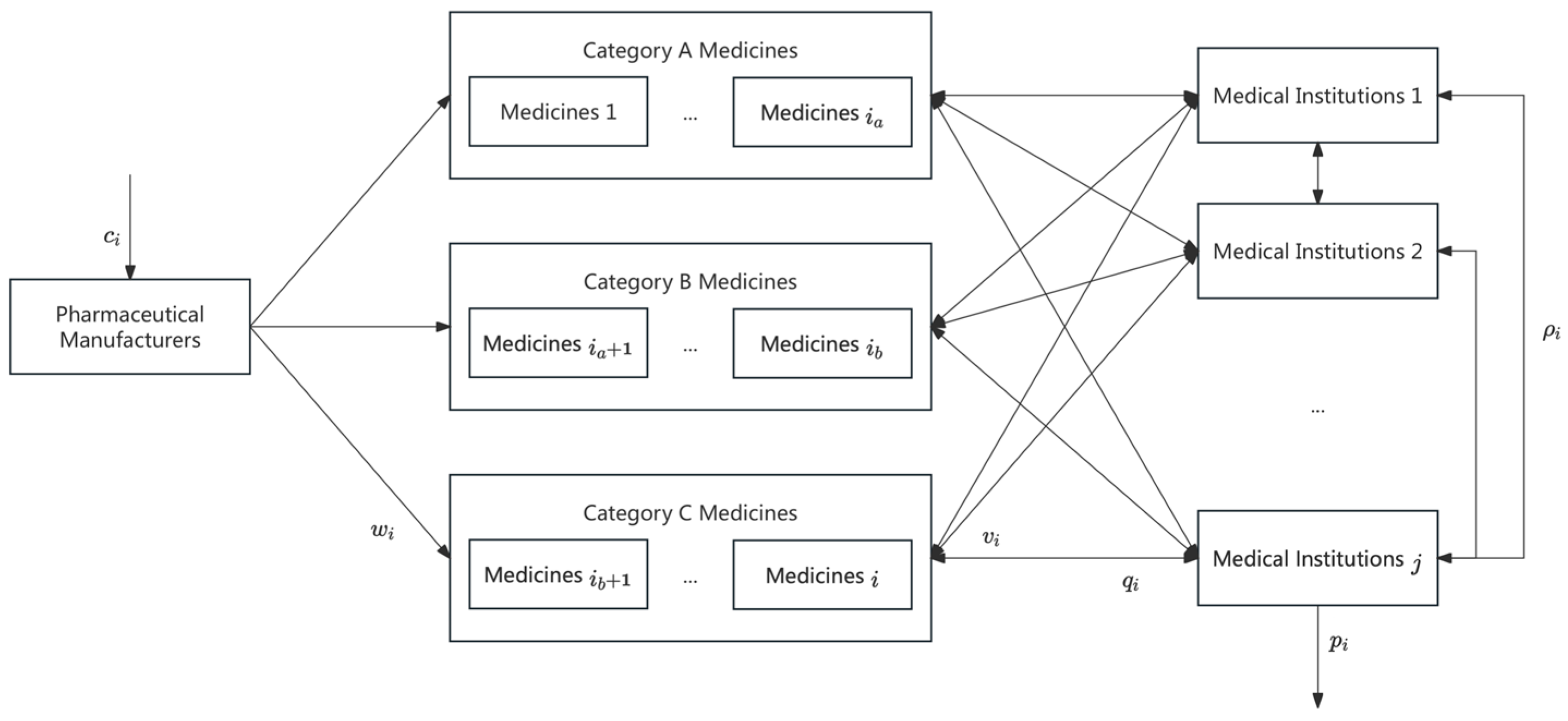
Assumption 1. A two-echelon supply chain including a pharmaceutical manufacturer and medical institutions is considered, as shown in Figure 1.
Assumption 2. A FIFO inventory policy is adopted. Transshipment exists among institutions, and near-expiry drugs are prioritized for transshipment. Information asymmetry, transportation time, and other factors in the supply chain are ignored.
Assumption 3. A continuous-review policy is used. When the inventory position reaches the reorder point, an order is immediately placed.
Assumption 4. Products exceeding the contractual shelf life are mandatorily taken back.
Assumption 5. Transshipment costs are shared by the manufacturer and the medical institutions.
Assumption 6. Holding costs are identical for the manufacturer and the institutions.
3.3. Notation
For the sake of brevity, the notation and explanations used in this paper are summarized in
Table 1.
4. Deterministic-Demand Model
4.1. Profit Function of Medical Institutions
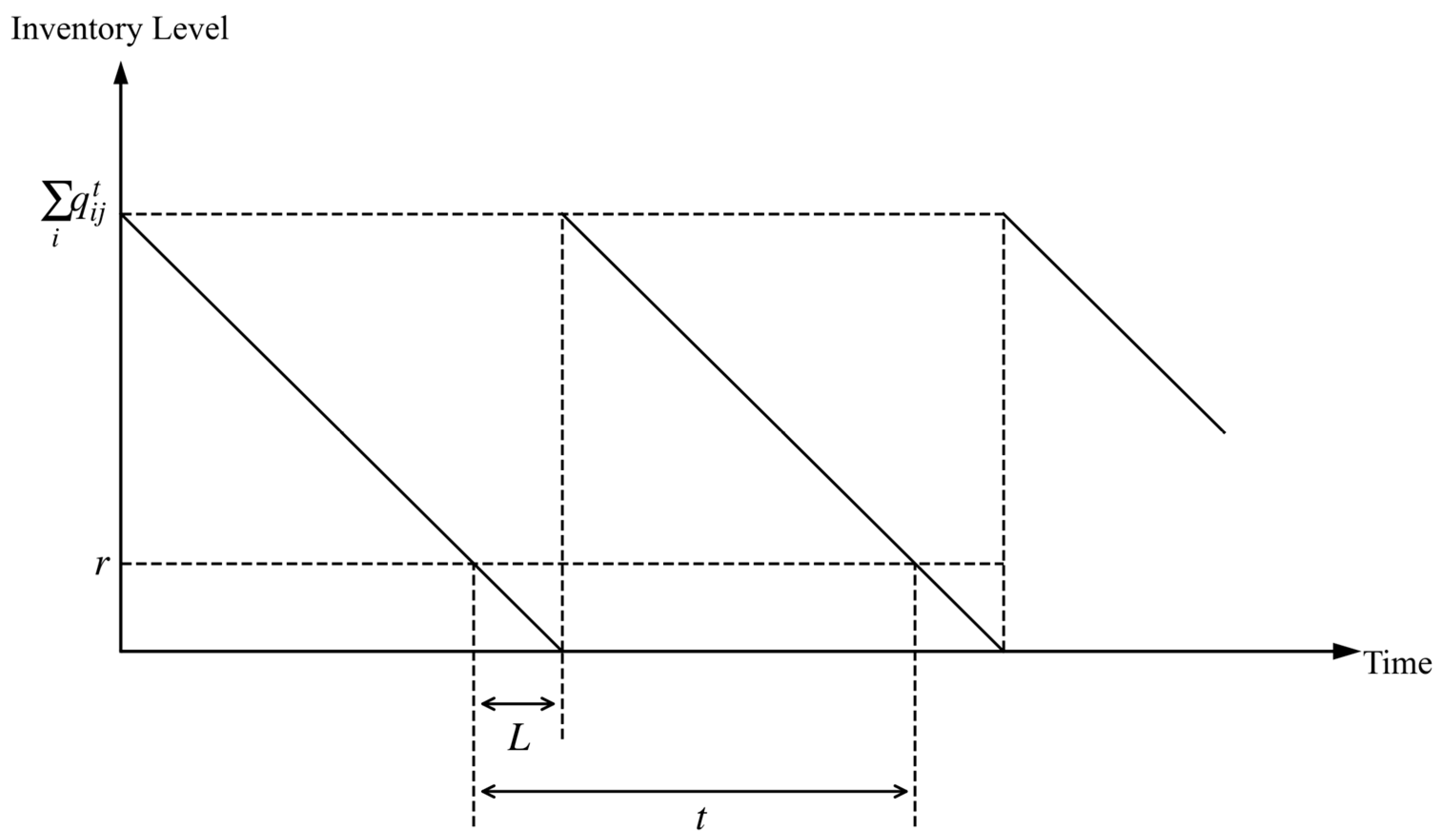
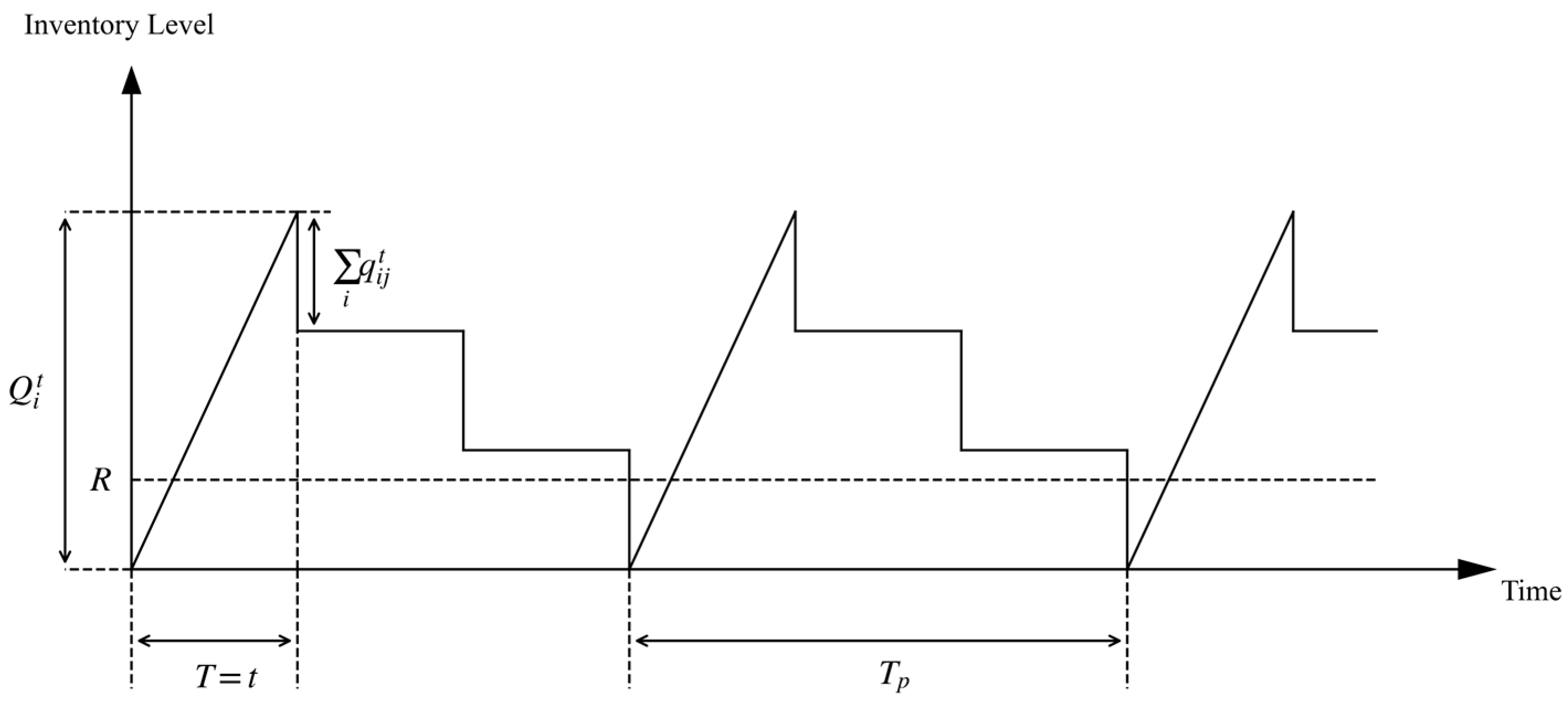
Following the EOQ model (
Figure 2), the inventory level at an institution varies cyclically, with the maximum equal to the order quantity
and the minimum equal to 0;
denotes the reorder point.
The profit of institution consists of five parts: sales profit, holding cost, stockout cost, return (buyback) cost, and transshipment cost, as follows.
4.1.1. Sales Profit of Medical Institutions
In period
, if the order quantity exceeds demand, the sales quantity of drug
at institution
equals demand
, and the sales profit is
. If the order quantity is lower than demand, the sales quantity equals
under peer-level transshipment conditions, and the sales profit is
. Hence the sales-profit function is
4.1.2. Holding Cost of Medical Institutions
In period
, the average inventory of drug
at institution
is
, and the holding cost is
. The holding-cost function is
4.1.3. Stockout Cost of Medical Institutions
In period
, if the order quantity exceeds demand, no stockout occurs. If it is lower, institution
receives
through transshipment; if it is still insufficient, the stockout is
. The stockout-cost function is
4.1.4. Return (Buyback) Cost of Medical Institutions
In period
, when the order quantity exceeds demand, institution
returns the surplus
, incurring
; otherwise, the cost is 0. The return-cost function is
4.1.5. Transshipment Cost of Medical Institutions
Given transshipment among institutions, the transshipment quantity of drug
to institution
in period
is
. With unit cost
and the institution bearing a share
, the transshipment-cost function is
The direct computation of
is complex, but the total transshipment of drug
across institutions equals the minimum of total surplus and total shortage:
Therefore, the total profit of all institutions is
4.2. Profit Function of the Manufacturer
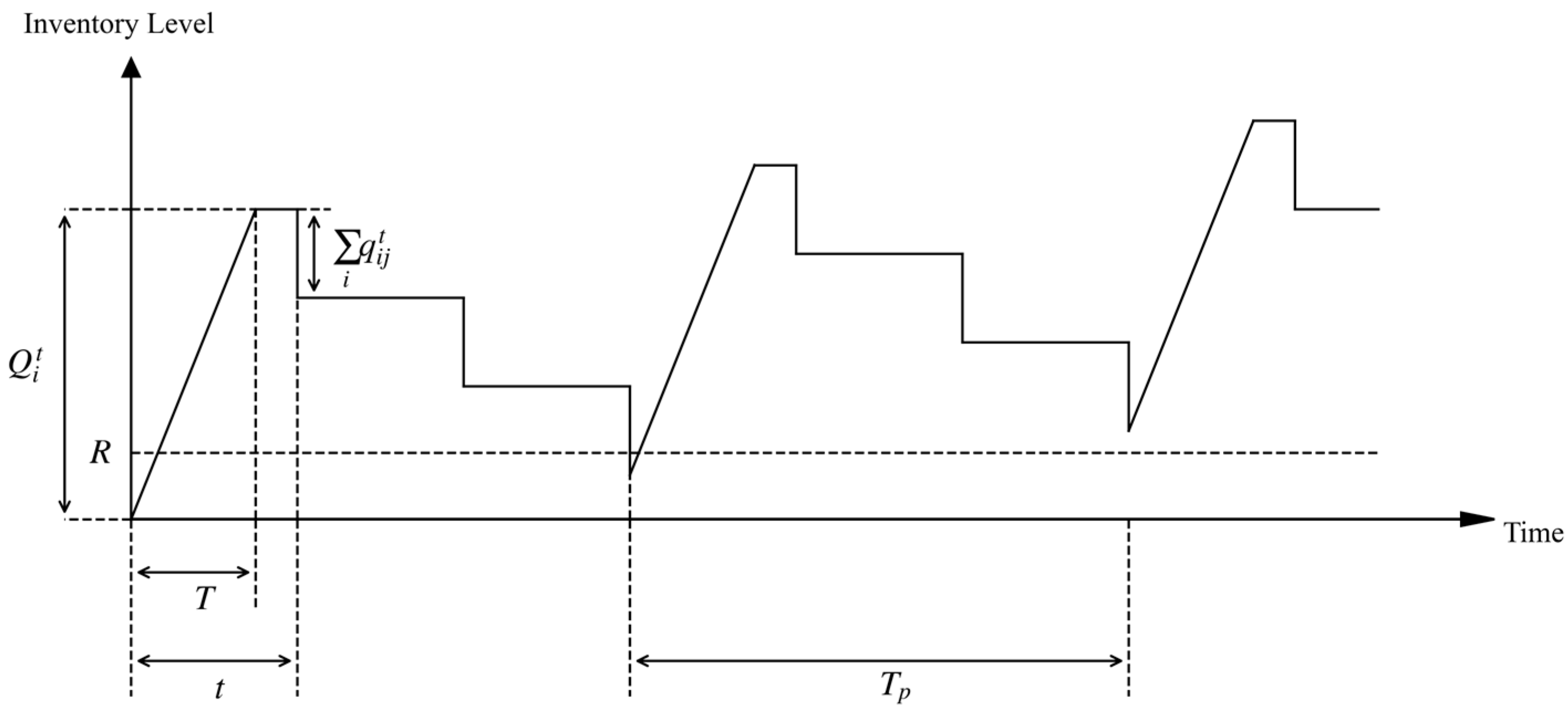
Following the EPQ model (
Figure 3), the manufacturer’s inventory varies cyclically: within a production cycle, production replenishes
during production time
and is then depleted during the subsequent non-production time until it is insufficient to satisfy one more aggregate order from institutions.
For simplicity, assume the manufacturer exactly satisfies aggregate institutional demand per cycle and holds zero inventory at the end of each cycle; production time equals sales time,
. Thus the EPQ model is simplified as in
Figure 4. Similar zero-inventory simplifications appear in Lu et al. (2018), who show that when the production lot is an integer multiple of institutions’ orders,
, the manufacturer’s total cost is minimized [
12].
The manufacturer’s profit includes sales profit, holding cost, buyback cost, and transshipment cost:
4.2.1. Sales Profit of Manufacturer
In period
, sales to institution
for drug
equal
, yielding
4.2.2. Holding Cost of Manufacturer
In period
, the average inventory of drug
consists of three parts:
during production,
during switching, and
during non-production. With
,
, and the average becomes
Hence the holding-cost function is
4.2.3. Buyback Cost of Manufacturer
In period
, the manufacturer takes back drugs exceeding contractual shelf life
. If order exceeds demand, the take-back quantity is
; otherwise, it is 0. The buyback-cost function is
4.2.4. Transshipment Cost of Manufacturer
With transshipment, the manufacturer bears share
of the transshipment cost:
Therefore, the manufacturer’s total profit is
4.3. Deterministic-Demand Model and Constraints
With decision variables
under deterministic demand, the objective is to maximize joint profit:
subject to
These enforce the economic rationality of transshipment; market-price ordering; FIFO transshipment of near-expiry items; inventory-capacity limits; and contractual shelf-life constraints at both echelons (manufacturer’s supply duration not less than the contractual shelf life and institutional sales within the contractual shelf life accounting for supply duration and lead time).
Regarding transshipment strategies within the supply chain, if transshipment costs become excessively high, pharmaceutical institutions purchase products directly from manufacturers without transshipment. Therefore, to ensure the economic viability of transshipment strategies, the constraint that transshipment costs must be lower than wholesale costs must be satisfied: .
To ensure profitability for all parties in the supply chain, the following market price constraint must be satisfied: selling price > wholesale price > recovery price > cost price, i.e., .
In the transshipment strategy, medical institutions adopt the FIFO strategy for transshipment, prioritizing the transfer of near-expiry drugs. Therefore, transferred drugs must satisfy the minimum requirement of being unexpired: . They must also meet the following FIFO constraint: . This constraint ensures transferred drugs are utilized to the greatest extent possible, maximizing profit.
Inventory levels at medical institutions are subject to upper limits, necessitating the following constraint: the sum of an institution’s ordered quantity and transferred quantity must not exceed its inventory ceiling, i.e., .
Due to drug expiration dates, usage is constrained temporally. Thus, two contract shelf-life constraints must be satisfied: (1) For pharmaceutical manufacturers, the shelf life of supplied drugs must be greater than or equal to the contract shelf life, i.e., the product shelf life minus the supply duration must be greater than or equal to the contract shelf life, . (2) For medical institutions, drug usage periods must fall within contract shelf lives. Specifically, the sum of drug supply duration, order lead time, and sales time must be less than or equal to the contract shelf life: .
5. Stochastic-Demand Model
5.1. Demand Assumptions
Under stochastic demand, the demand for drug
at institution
in period
is
where
. Hence
. Let
and
denote the standard normal CDF and PDF, respectively. The standard normal loss function
with
represents the expected loss when
exceeds
, i.e., the stockout loss at inventory level
. Introducing
simplifies expectations.
The normality assumption is motivated by (1) in practice, demand at medical institutions is influenced by many uncertainties (seasonality, outbreaks), producing randomness and volatility; (2) the normal distribution adequately describes many real-world phenomena, and by the central limit theorem, the sum of independent random variables tends toward normality, making it a reasonable approximation for institutional demand.
5.2. Expected Profit of Medical Institutions
Under stochastic demand, the holding-cost term remains as in the deterministic model:
The expected values of sales profit, stockout cost, return cost, and transshipment cost are computed as follows.
5.2.1. Expected Sales Profit of Medical Institutions
In period
, the quantity of drug
sold by pharmaceutical institution
is
. At this point,
is a random variable, so the expected value of the pharmaceutical institution’s sales profit is
5.2.2. Expected Stockout Cost of Medical Institutions
In period
, the stockout quantity for medical institution
is
. At this point,
is a random variable, so the expected value of the stockout cost for the medical institution is
5.2.3. Expected Return Cost of Medical Institutions
In period
, medical institution
must return excess medication, with the return quantity being
. At this point,
is a random variable, so the expected value of the medical institution’s return cost is
5.2.4. Expected Transshipment Cost of Medical Institutions
The expected transshipment cost for institution
is
Because total transshipment depends on
,
Therefore, total expected profit of all institutions is
5.3. Expected Profit of the Manufacturer
Under stochastic demand, sales, holding, and transshipment terms remain as in the deterministic model:
The cost of returning surplus drugs must be calculated as an expected value due to the random nature of demand, as follows:
In period
, medical institution
must return excess drugs, with the return quantity being
. Since
is a random variable, the expected value of the manufacturer’s recovery cost is
Therefore, the total expected-profit function for pharmaceutical manufacturers is
5.4. Stochastic-Demand Model and Constraints
With decision variables
, the objective is to maximize expected joint profit:
subject to
6. Numerical Study
6.1. Parameter Settings
To validate the model, we designed a case with one manufacturer and three medical institutions involving 10 drugs. By the classical ABC rule based on annual consumption value, A-items account for about 10–20% of SKUs but 70–80% of inventory value; B-items 20–30% and 15–25%; and C-items 50–70% and 5–10%. We assume proportions of 20% (A), 30% (B), and 50% (C). Prices and demands satisfy
; unit stockout costs
; and unit transshipment costs
. Parameters are shown in
Table 2. The values are simplified settings but maintain realistic logic.
Here, denotes deterministic demand. Under stochastic demand, with equal to the values in the table and , and negative realizations are truncated at zero.
The baseline institutional capacities are set to
units to represent two larger hospitals and one smaller partner institution. This asymmetric design better aligns with real-world conditions. Benchmark demand is evenly distributed among institutions. The impact of balanced capacity will be discussed in
Section 6.4.
The manufacturer is assumed to follow a zero-finished-inventory policy, so production is triggered by downstream orders. We set (production lot twice the total order). To reflect different production lot and capacity limits, we later conducted sensitivity analysis on the production lot .
The manufacturer’s cost share of transshipment also affects profit; we later analyze its sensitivity with a baseline .
6.2. Results
We compared optimal ordering and induced peer-level transshipment under deterministic versus stochastic demand. For deterministic demand we used Bayesian optimization; for stochastic demand we computed via Monte Carlo simulation and then applied Bayesian optimization.
6.2.1. Deterministic Demand
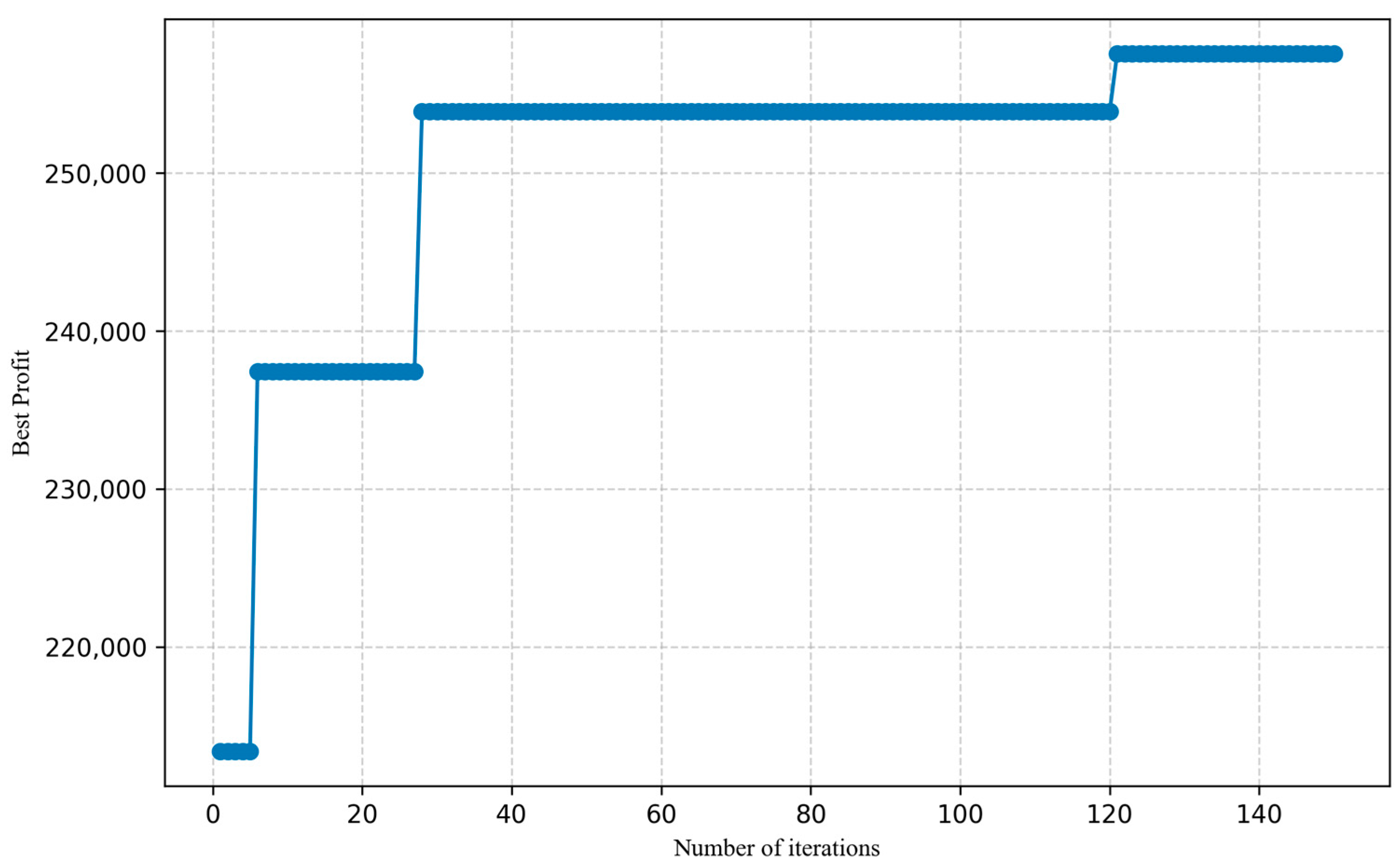
Because the stochastic objective is an expectation evaluated by Monte Carlo simulation and involves non-smooth operators, the resulting optimization problem is non-convex and does not admit reliable gradients. We therefore adopted Bayesian optimization (BO), which is designed for sample-efficient search of expensive black-box functions and is robust to noisy objective evaluations. In our implementation, BO starts from 30 Latin-hypercube random initial points and then performs 120 sequential iterations using a Gaussian-process surrogate and an expected-improvement acquisition function. Convergence is shown in
Figure 5.
Computational time and scalability are discussed in
Section 6.4. For the base case (10 drugs × 3 institutions), a single Monte Carlo evaluation with 10,000 (20,000) demand scenarios takes approximately 0.036 s (0.064 s) in our Python 3.8 implementation, and a complete BO run with 150 evaluations finishes in the order of seconds. This runtime is compatible with near-real-time decision support for periodic (e.g., daily or shift-level) replenishment planning.
We also compared BO conceptually with classical decomposition or heuristic approaches. In our setting, the objective couples institutions through transshipment and includes shelf-life constraints and piecewise terms, making closed-form decomposition difficult. Metaheuristics such as genetic algorithms typically require substantially more function evaluations, whereas BO can reach high-quality solutions with a limited evaluation budget by learning a surrogate of the objective.
The optimal ordering and transshipment allocation maximizes total profit;
Table 3 reports the details.
According to these results, total profit is 97,707.45 for institutions and 159,830.56 for the manufacturer, yielding 257,538.01 for the supply chain. Transshipment routes and quantities are in
Table 4.
6.2.2. Stochastic Demand
In the variable demand model, a direct linear relationship still exists between the production volume
of pharmaceutical manufacturers and the order quantity
of medical institutions. By calculating the expected transfer volume
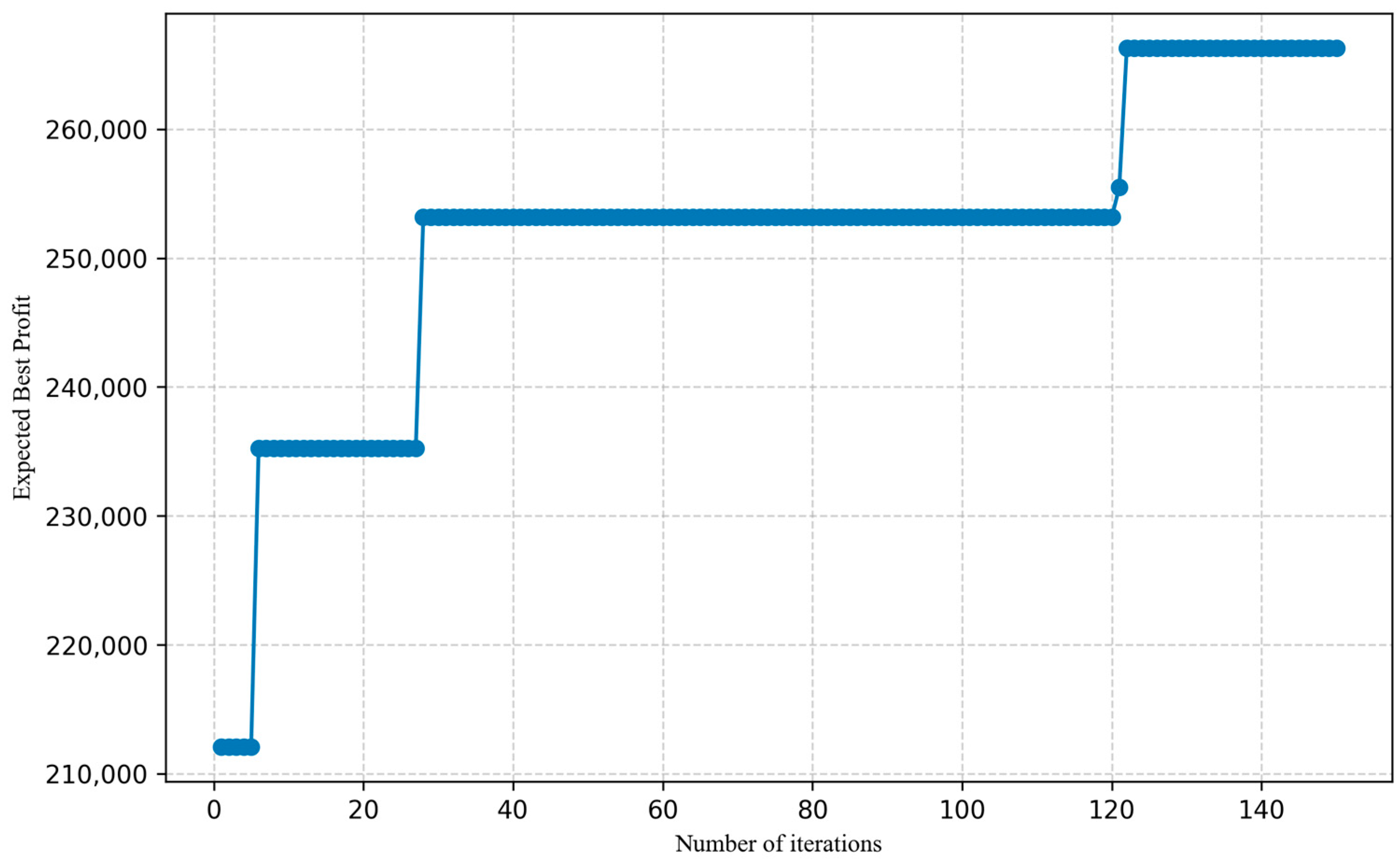
via Monte Carlo simulation and then applying a Bayesian optimization algorithm, the optimal ordering decision can be efficiently determined to maximize the pharmaceutical manufacturer’s total expected profit. The Bayesian optimization algorithm similarly employs 30 random initialization points, followed by 120 iterations of optimization based on prior knowledge, ultimately converging to the optimal solution. Convergence is shown in
Figure 6.
As iterations progress, the Bayesian optimization algorithm gradually converges toward the optimal solution, demonstrating the proposed method’s effectiveness in addressing ordering decisions under fluctuating demand conditions.
Table 5 reports the details.
Total expected profit is 105,762.40 for institutions, 160,512.67 for the manufacturer, and 266,275.07 for the supply chain. Transshipment routes and quantities appear in
Table 6.
6.2.3. Model Comparison
In fixed demand and fluctuating demand scenarios, the overall performance of the supply chain exhibits significant numerical differences. When accounting for demand randomness, overall profits increase by approximately 3.4%, with the incremental gains primarily contributed by healthcare institutions—whose profits rise by about 8.2%—while manufacturers see only modest profit growth. This indicates that, with the model’s parameters, demand uncertainty improves the operational performance of downstream institutions more significantly through inventory reallocation mechanisms.
Regarding order decision structures, the two models exhibit systematic differences in order quantities across drugs and institutions. Taking Category A drugs as an example, under fixed demand, Drug 1’s order quantities across three institutions were 245.33, 203.40, and 176.76. Under variable demand, these quantities decreased to 127.49, 149.58, and 82.97. Similarly, certain Category B and C drugs, such as Drugs 3, 4, and 5, also exhibit lower overall ordering quantities and greater inter-institutional balance in the variable demand model. This indicates that under conditions of demand fluctuation and permitted intra-level transfers, medical institutions tend to reduce their own “safety stock” levels, relying on network coordination to hedge against demand peaks. This contrasts with the fixed-demand model strategy, which primarily relies on self-held inventory.
Differences in transfer behavior more directly reveal the operational mechanisms of the two models. In the fixed demand model, the total transfer volume within the supply chain was approximately 127 units, with highly concentrated pathways. Transfers primarily flowed from Medical Institution 1 to other institutions. For instance, 36 units of Drug 2 were transferred from Institution 1 to Institution 2, while 49 and 9 units of Drug 7 were transferred from Institution 1 to Institutions 2 and 3, and Institution 2 only provides minor adjustments to Institution 1 for a few specific items. In contrast, in the variable demand model, the total expected transfer volume increases to approximately 241.68 units—nearly doubling in scale—and exhibits more multidirectional pathways. For instance, Drug 2 transfers 71.68 units from Institution 1 to Institution 3, while Drugs 3 and 4 form bidirectional mutual support flows among all three institutions. Category C Drugs 6 and 7 are simultaneously shipped in large quantities from Institution 2 to both Institutions 1 and 3. These results demonstrate that under random demand conditions, the model actively employs more frequent and broader-coverage transfers to achieve inventory rebalancing.
6.3. Sensitivity Analysis
To further investigate the impact of production volume
and the manufacturer’s transshipment ratio
on supply chain performance, sensitivity analyses were conducted for each parameter. By adjusting the ranges of
and
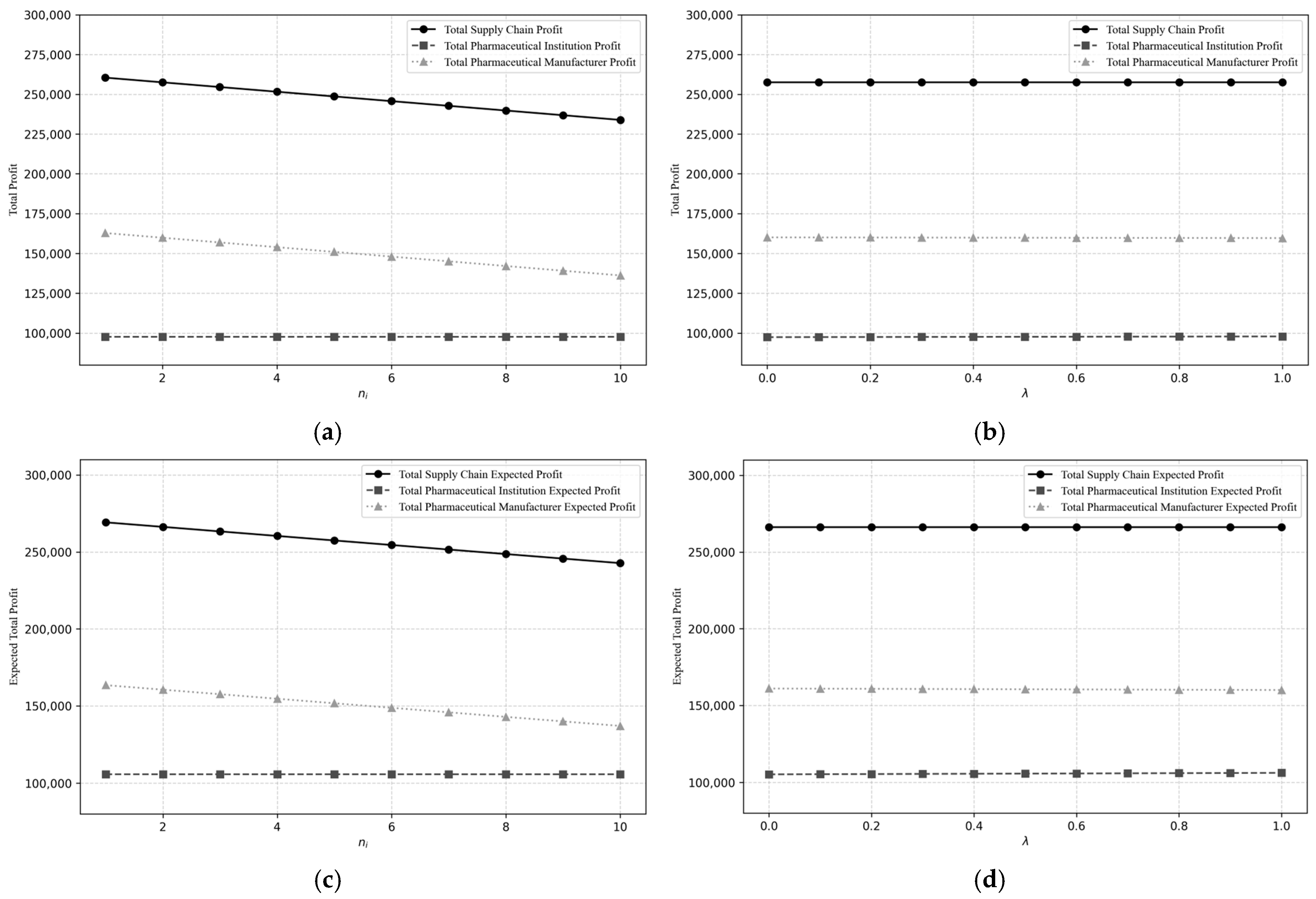
, the trends in total expected supply chain profit were observed. The results are shown in
Figure 7.
From sensitivity analysis
Figure 7a, it can be observed that in the fixed demand model, an increase in the manufacturer’s production coefficient
leads to a steady decline in total supply chain profit, with the manufacturer’s profit experiencing a significantly greater reduction. As the sole production node, the manufacturer’s output is directly tied to inventory holding costs. When
increases, production output expands accordingly, raising average inventory levels and incurring additional inventory occupancy and potential return costs. In contrast, the profit curve for medical institutions remains nearly flat, indicating that under fixed demand conditions, even if the manufacturer increases its production coefficient, the optimal ordering strategy for downstream institutions does not change significantly due to production-side redundancy.
Figure 7b illustrates the impact of the manufacturer’s share of transportation costs,
, on profit structure in the fixed demand model. The overall curve remains relatively flat, indicating that total supply chain profits exhibit little structural change despite variations in cost allocation. As
increases, manufacturer profits decline slightly while healthcare institutions’ profits rise marginally, but neither demonstrates significant sensitivity. This indicates that under stable demand and limited transfer scale, transfer costs constitute a relatively low proportion of total costs. Consequently, the cost-sharing mechanism does not significantly alter the optimal decision-making structure of the supply chain.
In the variable demand model,
Figure 7c shows that increasing the manufacturer’s production volume
still leads to a decline in total supply chain profit, but the rate of decline is slower compared to the fixed demand scenario. This difference reflects more frequent transshipment activities and inventory rebalancing mechanisms under random demand, allowing some excess production to be redistributed among institutions and thereby mitigating the negative impact of manufacturer inventory buildup. Furthermore, consistent with the fixed demand scenario, the profit of medical institutions remains nearly unchanged as
increases, further highlighting the weakened transmission of production volume changes to downstream entities.
Finally, as shown in
Figure 7d, increasing
in the variable demand model exhibits extremely weak sensitivity to profits across all parties. Although random demand elevates overall transshipment volumes, transshipment costs remain a limited proportion of total costs. Consequently, even if manufacturers bear higher or lower transshipment expenses, the structural framework of optimal ordering and transshipment behavior within the supply chain remains fundamentally unchanged. The consistent trend observed in both fixed and variable demand models indicates that, compared to ordering decisions and demand fluctuations, the transshipment cost allocation mechanism is not the primary determinant of supply chain performance.
6.4. Additional Robustness Checks and Computational Performance
Beyond parameter sensitivity, we further analyzed the statistical robustness, modeling realism, and computational feasibility of the stochastic-demand framework. Key focuses include (i) estimation uncertainty of expected profits in Monte Carlo simulations, (ii) effects of relaxing idealized assumptions on transshipment delivery times and peer inventory visibility, (iii) computational scalability relative to problem size, and (iv) robustness to capacity asymmetries across facilities.
Under stochastic demand, expected supply-chain profit was estimated via Monte Carlo simulation. With 50,000 demand scenarios, we computed the 95% confidence interval of the Monte Carlo estimator using the standard normal approximation (mean ± 1.96·SE). The resulting intervals are narrow, indicating that the reported expected-profit values are statistically stable.
In addition, to assess robustness with respect to random sampling variation, we repeated the estimation using 10 independent random seeds, each with 10,000 scenarios. Across these runs, the estimated mean profit varied within a small range (approximately CNY 435, corresponding to less than 0.2% of the mean). This confirms that the numerical results are not sensitive to Monte Carlo randomness.
The baseline model assumes instantaneous transshipment and full visibility of peer inventories. To examine the realism of these assumptions, we introduce two extensions. First, we consider a deterministic transshipment lead time (LT), expressed as a fraction of the period length, which effectively reduces the usable portion of transshipment within a period. Second, we introduce a visibility parameter
, representing the fraction of peer surplus that can be identified and mobilized in time.
Table 7 summarizes the sensitivity of expected profit with these extensions. As LT increases or
decreases, the pooling benefit of transshipment declines, leading to higher expected stockouts and lower expected profit. Nevertheless, even with non-zero or stochastic lead times and partial visibility, coordinated transshipment continues to outperform the no-coordination benchmark, indicating that its qualitative advantage is robust to these practical frictions.
To assess computational scalability, we measured the wall-clock time of one Monte Carlo objective evaluation for representative problem sizes using 20,000 scenarios.
Table 8 reports the results. The measured evaluation time increases approximately linearly with both the number of drugs and the number of institutions, confirming the theoretical complexity analysis. Combined with Bayesian optimization’s moderate evaluation budget, the proposed approach remains computationally practical for regional hospital networks of moderate size.
In the baseline setting, institutional capacities are asymmetric (2000, 2000, and 1000 units), reflecting heterogeneous hospital sizes. To test robustness to capacity structure, we additionally consider a balanced-capacity scenario in which all institutions have a common capacity of 1500 units. With this balanced setting, the optimized policies remain feasible, with total orders per institution equal to 1200, 1331, and 938 units, respectively. Both the numerical results and qualitative conclusions remain unchanged. When capacities are tightened further, the ability of institutions to act as pooling hubs diminishes, and the incremental benefit of transshipment becomes smaller, which is consistent with the trends observed in
Table 8.
7. Managerial Insights
We developed an integrated two-echelon pharmaceutical inventory optimization model accounting for shelf-life constraints, peer-level transshipment, FIFO, and demand uncertainty, and solved it in deterministic and stochastic scenarios using Bayesian optimization and Monte Carlo simulation. The analysis reveals interactions among order quantities, transshipment, holding costs, and contractual shelf life.
From a supply-chain-management perspective, moderate transshipment significantly enhances performance. Under deterministic demand, institutions rely more on their own stock and transship less. Under stochastic demand, to reduce stockout risk, institutions lower orders and rely more on transshipment to buffer volatility, leading to higher expected total profit than in deterministic settings. Thus, transshipment plays a more important role with uncertainty—reducing holding costs and buyback waste from over-ordering and enabling coordinated inventories that lessen safety-stock requirements. In our case, higher transshipment under stochastic demand coincides with higher expected total profit.
Regarding profit allocation, the sensitivity results show that the production-lot multiplier substantially affects the manufacturer but has little effect on institutions; excessive production causes inventory buildup and erodes manufacturer profit. By contrast, the manufacturer’s transshipment-cost share has limited impact on overall and member profits, implying that while cost-sharing can incentivize participation, system-level efficiency is driven more by ordering strategies and demand variability. This informs managerial design of incentives: over-emphasizing cost sharing is unnecessary; coordinated inventory policies deserve more focus.
Methodologically, Bayesian optimization demonstrates strong performance for high-dimensional, constrained black-box problems, converging effectively in both deterministic and stochastic models. Monte Carlo simulation is crucial for computing expected transshipment, making complex random transshipment behavior tractable. This combination offers a feasible pathway for similar complex supply-chain optimizations and illustrates the promise of modern intelligent optimization in operations management.
Although preliminary, this study’s modeling and numerical results elucidate core logic for coordinated pharmaceutical inventory management and provide theoretical and practical insights for policy design, coordination mechanisms, and intelligent decision-system development.
8. Conclusions
By linking institutions’ EOQ-type ordering with the manufacturer’s EPQ-type production and allowing peer-to-peer transshipment under FIFO issuance, the model explicitly captures the trade-off between mitigating shortages and avoiding expirations. For stochastic demand, we formulated an expected-profit objective evaluated by Monte Carlo simulation and solved the resulting black-box optimization using Bayesian optimization.
The numerical study demonstrates that coordinated transshipment can substantially improve system performance by reallocating surplus inventory to shortage locations, thereby increasing expected profit and reducing expected stockouts. Robustness checks further show how the value of transshipment depends on practical frictions such as non-zero transfer lead times and limited peer-inventory visibility, while the Monte Carlo confidence intervals and multi-seed tests confirm statistical stability of the reported results. In practice, these findings support the design of regional coordination mechanisms, including timely information sharing, standard operating procedures for inter-hospital transfers, and incentive-compatible cost-sharing rules.
Several directions are promising for future research. First, the current single-cycle formulation can be extended to a multi-period rolling horizon with learning-based demand updates (e.g., Bayesian updating) and adaptive transshipment triggers. Second, richer operational features such as stochastic transportation times, cold-chain constraints, and partial compliance with transfer requests could be incorporated. Third, while the case study is motivated by China, the modeling structure is transferable to other regions by adjusting contract terms, regulatory constraints on inter-institution transfers, and trace-ability requirements; evaluating such adaptations with region-specific data is an important next step.
Author Contributions
Conceptualization, S.L. and R.O.; methodology, S.L.; software, R.O.; validation, S.L., R.O., L.G. and K.G.; formal analysis, S.L.; investigation, S.L.; resources, L.G.; data curation, L.G.; writing—original draft preparation, S.L. and R.O.; writing—review and editing, S.L., R.O. and T.W.; visualization, H.L.; supervision, H.L.; project administration, K.G.; funding acquisition, T.W. All authors have read and agreed to the published version of the manuscript.
Funding
College Students’ Innovative Entrepreneurial Training Plan Program under Grant No. 202510022296; Beijing Social Science Foundation Planning Project under Grant No. 25BJ03190.
Data Availability Statement
The original contributions presented in this study are included in the article. Further inquiries can be directed to the corresponding authors.
Conflicts of Interest
The authors declare no conflicts of interest.
Appendix A
Derivations under stochastic demand.
Let
. The expected sales at institution
are
Compute
where
. Hence
The expected stockout at institution
is
The expected return amount is
For the expected total transshipment, let
. Then
With
and
,
Since
, letting
,
References
- Hansen, Z.N.L.; Andreu, C.M.; Khan, O.; Haug, A.; Hvam, L.; Hansen, N.E. Identification of key drivers for improving inventory management in pharmaceutical supply chains. Prod. Eng.-Res. Dev. 2023, 17, 763–772. [Google Scholar] [CrossRef] [Scilit]
- Elarbi, M.; Masmoudi, M.; Ayadi, O.; Masmoudi, F. Optimisation models and information sharing in a multi-echelon pharmaceutical supply chain. Int. J. Shipp. Transp. Logist. 2022, 14, 56–77. [Google Scholar] [CrossRef] [Scilit]
- Liu, M.; Yi, Y.-C. Research on Optimization Strategies for Cold Chain Inventory Management in Biopharmaceutical Enterprises. Jiangxi Soc. Sci. 2022, 42, 61–70. [Google Scholar]
- Elarbi, M.; Ayadi, O.; Masmoudi, M.; Masmoudi, F. Drug-inventory-management-model for a multi-echelon pharmaceutical supply-chain: Case study of the Tunisian pharmaceutical supply-chain. Supply Chain Forum 2021, 22, 44–56. [Google Scholar] [CrossRef] [Scilit]
- Zheng, Y.T.; Guo, X.L.; Chai, X.L.; Li, J.B. Research on optimization of horizontal inventory sharing between medical e-commerce and primary medical institutions under transport strategy. Syst. Eng.-Theory Pract. 2025, 1–26. Available online: https://link.cnki.net/urlid/11.2267.N.20250915.1017.002 (accessed on 9 January 2026).
- Qian, H. Integrated Inventory and Transportation Predictive Optimization Models for Multi-Echelon Supply Chains Based on Characteristics of Varying Demands. Ph.D. Thesis, Harbin Institute of Technology, Harbin, China, 2023. [Google Scholar]
- Mardan, E.; Amalnick, M.S.; Rabbani, M.; Jolai, F. A robust optimization approach for an inventory problem with emergency ordering and product substitution in an uncertain environment: A case study in pharmaceutical industry. Sci. Iran. 2017, 24, 1533–1546. [Google Scholar] [CrossRef] [Scilit]
- Rojas, F.; Leiva, V.; Huerta, M.; Martin-Barreiro, C. Lot-Size Models with Uncertain Demand Considering Its Skewness/Kurtosis and Stochastic Programming Applied to Hospital Pharmacy with Sensor-Related COVID-19 Data. Sensors 2021, 21, 5198. [Google Scholar] [CrossRef] [Scilit]
- Zhang, S. Research on the Location-Inventory-Route Problem of Pharmaceutical Cold Chain Under Uncertainty. Master’s Thesis, Jilin University, Changchun, China, 2025. [Google Scholar]
- Li, J.; Liu, Y.; Yang, G. Two-stage distributionally robust optimization model for a pharmaceutical cold supply chain network design problem. Int. Trans. Oper. Res. 2024, 31, 3459–3493. [Google Scholar] [CrossRef] [Scilit]
- Wu, S.; Luo, M.; Zhang, J.; Zhang, D.; Zhang, L. Pharmaceutical Supply Chain in China: Pricing and Production Decisions with Price-Sensitive and Uncertain Demand. Sustainability 2022, 14, 7551. [Google Scholar] [CrossRef] [Scilit]
- Lu, L.; Jun, W.; Jian, L.; Feng-mei, Y. Analysis of Two-echelon Supply Chain Inventory Policy for Perishable Drugs Considering Shelf Life. Oper. Res. Manag. Sci. 2018, 27, 1–9. [Google Scholar]
- Zheng, J.-Y.; Sun, Z.-L.; Yang, J.-Y.; Liang, J.-Y. Cost-benefit analysis of zero inventory in drug storage. Chin. J. Hosp. Pharm. 2020, 40, 575–578. [Google Scholar] [CrossRef]
- Wang, Y.-Z. Design and Implementation of Drug Sales Forecasting System Basedon Deep Learning. Master’s Thesis, Beijing Jiaotong University, Beijing, China, 2024. [Google Scholar]
- Kalaichelvan, K.; Ramalingam, S.; Dhandapani, P.B.; Leiva, V.; Castro, C. Optimizing the Economic Order Quantity Using Fuzzy Theory and Machine Learning Applied to a Pharmaceutical Framework. Mathematics 2024, 12, 819. [Google Scholar] [CrossRef] [Scilit]
- U.S. Food and Drug Administration (FDA). Report to Congress: Drug Shortages—Calendar Year 2023. Available online: https://www.fda.gov/media/179156/download (accessed on 25 December 2025).
- American Society of Health-System Pharmacists (ASHP). Drug Shortages Statistics. Available online: https://www.ashp.org/drug-shortages/shortage-resources/drug-shortages-statistics (accessed on 25 December 2025).
- European Court of Auditors. Special Report 19/2025: Addressing Medicine Shortages in the EU—A Step in the Right Direction but Not Enough to Solve the Structural Challenges. Available online: https://www.eca.europa.eu/en/publications/sr-2025-19 (accessed on 25 December 2025).
- Ueki, T.; Sanematsu, E.; Kawano, S.; Nakamura, Y.; Kawamichi, N.; Shinohara, Y.; Yatera, K.; Tanaka, F. Medication Wastage in a University Hospital in Japan. Biol. Pharm. Bull. 2022, 45, 118–123. [Google Scholar] [CrossRef] [Scilit] [PubMed]
- Zou, H.; Liu, X.-L.; Zhang, C.; Shao, M.-K.; Jin, L.; Zhang, Y. Alert limit of hospital drug inventory under the background of new medical reform policy. Chin. J. Hosp. Pharm. 2021, 41, 94–97. [Google Scholar] [CrossRef]
- Simonis, M.; Nickel, S. Integrated shelf-life rules for multi-level pharmaceutical tablets manufacturing processes. Int. J. Prod. Res. 2025, 63, 1046–1066. [Google Scholar] [CrossRef] [Scilit]
- Haijema, R. Optimal ordering, issuance and disposal policies for inventory management of perishable products. Int. J. Prod. Econ. 2014, 157, 158–169. [Google Scholar] [CrossRef] [Scilit]
- Lee, Y.-M.; Mu, S.; Shen, Z.; Dessouky, M. Issuing for perishable inventory management with a minimum inventory volume constraint. Comput. Ind. Eng. 2014, 76, 280–291. [Google Scholar] [CrossRef] [Scilit]
- Shen, Z.; Dessouky, M.; Ordonez, F. Perishable inventory management system with a minimum volume constraint. J. Oper. Res. Soc. 2011, 62, 2063–2082. [Google Scholar] [CrossRef] [Scilit]
- Dehghani, M.; Abbasi, B.; Oliveira, F. Proactive transshipment in the blood supply chain: A stochastic programming approach. Omega-Int. J. Manag. Sci. 2021, 98, 102112. [Google Scholar] [CrossRef] [Scilit]
- Dewi, E.K.; Dahlui, M.; Chalidyanto, D.; Rochmah, T.N. Achieving cost-efficient management of drug supply via economic order quantity and minimum-maximum stock level. Expert Rev. Pharmacoecon. Outcomes Res. 2020, 20, 289–294. [Google Scholar] [CrossRef] [Scilit]
- Badejo, O.; Ierapetritou, M. Enhancing pharmaceutical supply chain resilience: A multi-objective study with disruption management. Comput. Chem. Eng. 2024, 188, 108769. [Google Scholar] [CrossRef] [Scilit]
- Savadkoohi, E.; Mousazadeh, M.; Torabi, S.A. A possibilistic location-inventory model for multi-period perishable pharmaceutical supply chain network design. Chem. Eng. Res. Des. 2018, 138, 490–505. [Google Scholar] [CrossRef] [Scilit]
- Polotski, V.; Gharbi, A.; Kenne, J.P. Production control in manufacturing systems with perishable products under periodic demand. J. Manuf. Syst. 2022, 63, 288–303. [Google Scholar] [CrossRef] [Scilit]
- Polotski, V.; Gharbi, A.; Kenne, J.-P. Production control of unreliable manufacturing systems with perishable inventory. Int. J. Adv. Manuf. Technol. 2021, 116, 2473–2496. [Google Scholar] [CrossRef] [Scilit]
| Disclaimer/Publisher’s Note: The statements, opinions and data contained in all publications are solely those of the individual author(s) and contributor(s) and not of MDPI and/or the editor(s). MDPI and/or the editor(s) disclaim responsibility for any injury to people or property resulting from any ideas, methods, instructions or products referred to in the content. |