


Abstract
Let be a metric space. A subset A of X resolves X if every point is uniquely identified by the distances for all . The metric dimension of is the minimum integer k for which a set A of cardinality k resolves X. We consider the metric spaces of Cayley graphs of vector groups over . It was shown that for any generating set S of , the metric dimension of the metric space is, at most, . Thus, can be resolved by a finite set. Let with . We show that for any finite generating set S of , the metric space cannot be resolved by a finite set.
MSC:
05C12; 51F99
1. Cayley Graphs
Let G be a finitely generated group and let be a finite generating set of G with and . The Cayley graph is constructed by specifying its vertices and edges as follows:
This definition can be found in [1] (p. 34).
In the Cayley graph, the condition ensures the graph is undirected, while the condition ensures the absence of loops. The requirement that S is a generating set for G guarantees that X is connected. The connectivity is important because the focus of this paper is on the metric properties of this particular family of Cayley graphs. The Cayley graphs presented in this paper are defined using the additive abelian group of vector groups over the integers.
The concepts of metric spaces, distances, and geodesics are fundamental, and readers may consult any book or monograph on metric spaces or distance geometry for further details. Our sources include [2,3]. The concept of the metric dimension of a metric space was first introduced in 1953 in [2]. It gained limited attention until 1975, when it was applied to graph vertices [4,5,6,7,8,9,10,11,12,13]. This concept has been extensively studied in graph theory, often motivated by its applications in radio and telecommunications, with a recent focus on geographic positioning systems (GPS). Determining the metric dimension is shown to be an NP-complete problem in [14].
As in [15], let X be a metric space with distance function . Let D be a nonempty subset of X with finite or countably infinite cardinality, which can be written as . If for every , the condition implies for at least one index i, then D is said to resolveX and is called a resolving set or simply a resolver for X. A resolving set of minimum cardinality is called a metric basis for X. The cardinality of the minimum resolving set is called the metric dimension of X, denoted by . Note that the condition for D to be resolving can be equivalently written as follows:
In [15], the metric dimensions of the three classical geometric spaces were determined, and it was shown that for each Riemann surface R. In [16,17], the metric dimensions of geometric spaces and metric manifolds were determined.
The focus of the present paper is on Cayley graphs of . In [18], it was shown that for any generating set S of , the metric dimension of the metric space is at most . Thus, can be resolved by a finite set. Let . We will show that for any finite generating set S of , the metric space cannot be resolved by a finite set.
2. Convex Polytopes
As noted in [19] (p. 8), a set is convex if, and only if, for every pair of distinct points , the closed segment connecting and is entirely contained in K. The convex hull of a subset A of is defined as the intersection of all convex sets in that contain A.
As in [19] (p. 10), let A be a subset of and let with . We say that a hyperplane
cuts A if there exist points such that and . A hyperplane H is said to support A if H does not cut A, and . In particular, H supports A if either
As in [19] (p. 17), let K be a convex subset of . A set is called a face of K if , , or if there exists a supporting hyperplane H of K such that . ∅ and K are called the improper faces of K. For a polytope K, maximal proper faces are called facets of K.
Theorem 1
([20] (p. 59)). Let P be a polytope of dimension n in . Then, P has at least facets.
Lemma 1.
Let with and with . Let be a hyperplane of and be the closed halfspace of cut by H with 0. Let , , and . If , then .
3. Metric Spaces
Let with . In this section, we will show that for any finite generating set S of , the metric space cannot be resolved using a finite set.
Lemma 2
([18]). Let A be a finitely generated additive abelian group and S be a finite generating set of A with , and . Then, for any ,
Let A be a finitely generated additive abelian group. We assume that is a generating set of A with . Then, according to Lemma 2,
Proposition 1.
For any ,
Proof.
According to Equation (4), we have
Then, let be the nonnegative integers, such that
and
Suppose that there exists such that and . If , then let , ; if , then let , . Hence, and . If is replaced by and is replaced by , then this leads to a contradiction in the minimality of . Therefore, for any , . Hence, there exist such that and . Therefore, we have Equation (5). □
From this point on, we assume that
is a generating set of with . Hence, according to Proposition 1, we have Equation (5).
Theorem 2
([21]). Let A be a finitely generated additive abelian group and S be a finite generating set of A with and . Let T denote the group of all translations of and let , where ρ is the reflection at 0. Then, .
According to Theorem 2, any translation of is an isometry of . Then, one of the two points may be chosen to be the origin, which we denote using 0. Hence,
The convex hull of a subset S of is a convex polytopes in . If the dimension of is less than n, then S is not a generating set of . Hence, the dimension of is equal to n. Let F be a facet of . Let H be a hyperplane of with . Let . Since the dimension of F is , contains n affinely independent vertices of .
Lemma 3.
Let F be a facet of . Let H be a hyperplane of with . Then, .
Proof.
Suppose that . Then, H is a linear subspace of with dimension . This contradicts the condition that are affinely independent vertices. Therefore, . □
Let be the closed halfspace of cut by H with 0. Then . Since are affinely independent, for any , there exist unique coefficients , such that . Let
The set
is denoted by . Let . The set
is denoted by .
Lemma 4.
Let . Then, .
Proof.
Since , there exist with such that . If , then . Hence, .
Suppose that there exists such that . According to Equation (6), there exist such that and . Hence, . Since there exists such that , there exists , and such that . Then,
Hence,
According to the assumption of , F, H and , we have and . According to Lemma 1, we have . Since , we have
Therefore,
□
Here is an example of the inequality .
Example 1.
Let and . Let and . Then, the line segment is a facet of . Hence, . Then,
According to the definition of and ρ, we have .
Note that the condition is necessary.
Example 2.
Let and . Let , and . Then, the line segment is a facet of . Hence, . We have and . Then,
Lemma 5.
For any with , we have
Proof.
According to Lemma 4, we have
Therefore,
□
Lemma 6.
Let and . For any with , we have
Proof.
Let with and . By Lemma 4, we have
According to the Triangle Inequality of metric spaces and Lemma 5, we have
Therefore,
□
Lemma 7.
Let and . Then there exist such that for any with , we have
Proof.
Suppose that for any , there exist with such that
According to the Triangle Inequality of metric spaces, we have
According to (6), for any , we have . Then,
Since
we have
Let . According to the assumption of , there exist such that
Then,
Let . Then,
According to Lemma 5,
Then,
We are going to show that for any , there exists such that
The statement holds for . Assume the statement holds for . Let . According to the assumption of , there exist with such that
Then,
Let . Then,
According the assumption, we have
According to Lemma 5, we have
and
Then,
Then,
Therefore, for any , there exists such that
Let . Then,
According to Lemma 6, we have
This contradicts
Therefore, there exist such that for any with , we have
□
Lemma 8.
Let and . Let and for any with , we have
Let be a finite set. Then, there exists such that
Proof.
According to Lemma 7, there exist such that for any with , we have
Since are affinely independent, there exist such that , . Let . Then, for any , we have
Hence,
Therefore,
□
Theorem 3.
Let with . Let S be a finite generating set of . Let be a finite set. Then, C does not resolve .
Proof.
According to Lemma 7, there exist such that for any with , we have
According to Lemma 8, we have , such that
Since are affinely independent, there exist such that , . Then, for any , we have
with
According to Lemma 7, we have
and
Hence, . Therefore, C does not resolve . □
Example 3.
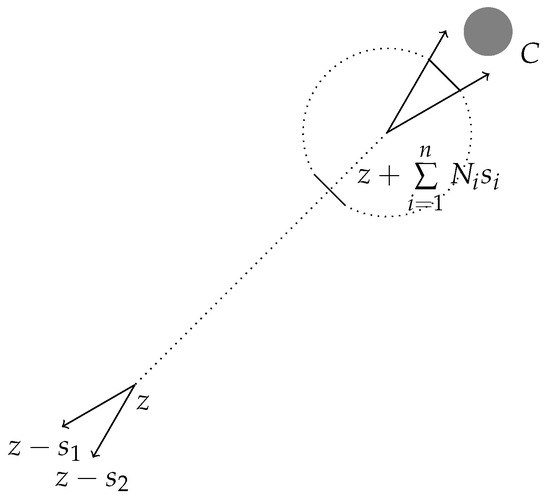
Let and , , , , , , , . Let , . Then, the line segment is a facet of . Hence, . Then,
Figure 1.
An illustration of , .
4. Conclusions
Let with . For any finite generating set S of , we proved the metric space cannot be resolved by a finite set, which means the metric dimension of is infinite. There are several kinds of generalized metric dimensions, such as the edge metric dimension, strong metric dimension, mixed metric dimension, and so on. The generalized metric dimensions of should be discussed. Finally, we ask what the metric dimension of metric spaces of Cayley graphs of any finitely generating group is and how the choice of the generating set influences the metric properties of the metric spaces of Cayley graphs.
The metric dimensions of certain subspaces of remain to be determined. Additionally, which types of isometric subspaces of cannot be resolved by a finite set remains an open question. Furthermore, the metric dimensions of the metric spaces arising from Cayley graphs of non-abelian groups remain to be determined. This problem is particularly intriguing due to the added complexity introduced by the non-commutative nature of these groups.
Author Contributions
Conceptualization, Y.L., Z.W. and B.D.; methodology, Y.L., Z.W. and B.D.; software, Y.L., Z.W. and B.D.; validation, Y.L., Z.W. and B.D.; investigation, Y.L., Z.W. and B.D.; resources, Y.L., Z.W. and B.D.; writing original draft preparation, Y.L., Z.W. and B.D.; writing review and editing, Y.L., Z.W. and B.D.; supervision, Y.L.; project administration, Y.L., Z.W. and B.D.; funding acquisition, Y.L. All authors have read and agreed to the published version of the manuscript.
Funding
This research was funded by the Ph.D. research startup foundation of Bohai University: 0522bs006 and the research foundation of Bohai University: 0522xn031.
Data Availability Statement
No new data were created or analyzed in this study.
Conflicts of Interest
The authors declare no conflicts of interest.
References
- Godsil, C.; Royle, G.F. Algebraic Graph Theory; Springer: New York, NY, USA, 2001. [Google Scholar]
- Blumenthal, L.M. Theory and Applications of Distance Geometry; Clarendon Press: Oxford, UK, 1953. [Google Scholar]
- Ratcliffe, J.G. Foundations of Hyperbolic Manifolds; Springer: New York, NY, USA, 1994. [Google Scholar]
- Bau, S.; Lei, Y. Bisectors in vector groups over integers. Bull. Aust. Math. Soc. 2019, 100, 353–361. [Google Scholar] [CrossRef]
- Boutin, D.L. Determining Sets, Resolving Sets, and the Exchange Property. Graphs Comb. 2009, 25, 789–806. [Google Scholar] [CrossRef]
- Cáceres, J.; Hernando, C.; Mora, M.; Pelayo, I.M.; Puertas, M.L. On the metric dimension of infinite graphs. Discret. Appl. Math. 2012, 160, 2618–2626. [Google Scholar] [CrossRef]
- Chappell, G.G.; Gimbel, J.; Hartman, C. Bounds on the metric and partition dimensions of a graph. Ars Comb. 2008, 88, 349–366. [Google Scholar]
- Harary, F.; Melter, R.A. On the metric dimension of a graph. Ars Comb. 1976, 2, 191–195. [Google Scholar]
- Khuller, S.; Raghavachari, B.; Rosenfeld, A. Landmarks in graphs. Discret. Appl. Math. 1996, 70, 217–229. [Google Scholar]
- Melter, R.A.; Tomescu, I. Metric bases in digital geometry. Comput. Vis. Graph. Image Process. 1984, 25, 113–121. [Google Scholar] [CrossRef]
- Siddiqui, H.M.A.; Hayat, S.; Khan, A.; Imran, M.; Razzaq, A.; Liu, J. Resolvability and fault-tolerant resolvability structures of convex polytopes. Theor. Comput. Sci. 2019, 796, 114–128. [Google Scholar]
- Slater, P.J. Leaves of Trees. Congr. Numer. 1975, 14, 549–559. [Google Scholar]
- Zhang, Y.; Gao, S. On the edge metric dimension of convex polytopes and its related graphs. J. Comb. Optim. 2020, 39, 334–350. [Google Scholar] [CrossRef]
- Garey, M.R.; Johnson, D.S. Computers and Intractability: A Guide to the Theory of NP–Completeness; W.H. Freeman and Company: New York, NY, USA, 1979. [Google Scholar]
- Bau, S.; Beardon, A. The metric dimension of metric spaces. Comput. Methods Funct. Theory 2013, 13, 295–305. [Google Scholar] [CrossRef]
- Heydarpour, M.; Maghsoudi, S. The metric dimension of geometric spaces. Topol. Its Appl. 2014, 178, 230–235. [Google Scholar] [CrossRef]
- Heydarpour, M.; Maghsoudi, S. The metric dimension of metric manifolds. Bull. Aust. Math. Soc. 2015, 91, 508–513. [Google Scholar] [CrossRef]
- Lei, Y. Metric dimensions of metric spaces over integers. Quaest. Math. 2021, 44, 187–198. [Google Scholar] [CrossRef]
- Griinbaum, B. Convex Polytopes; Springer: New York, NY, USA, 2003. [Google Scholar]
- Brondsted, A. An Introduction to Convex Polytopes; Springer: New York, NY, USA, 1983. [Google Scholar]
- Bau, S.; Lei, Y. The groups of isometries of metric spaces over vector groups. Mathematics 2022, 10, 4453. [Google Scholar] [CrossRef]
Disclaimer/Publisher’s Note: The statements, opinions and data contained in all publications are solely those of the individual author(s) and contributor(s) and not of MDPI and/or the editor(s). MDPI and/or the editor(s) disclaim responsibility for any injury to people or property resulting from any ideas, methods, instructions or products referred to in the content. |
© 2025 by the authors. Licensee MDPI, Basel, Switzerland. This article is an open access article distributed under the terms and conditions of the Creative Commons Attribution (CC BY) license (https://creativecommons.org/licenses/by/4.0/).