


Abstract
This paper presents an extensive investigation into several interrelated topics in mathematical analysis and number theory. The author revisits and builds upon known results regarding the Maclaurin power series expansions for a variety of functions and their normalized remainders, explores connections among central factorial numbers, the Stirling numbers, and specific matrix inverses, and derives several closed-form formulas and inequalities. Additionally, this paper reveals new insights into the properties of these mathematical objects, including logarithmic convexity, explicit expressions for certain quantities, and identities involving the Bell polynomials of the second kind.
Keywords:
Vandermonde matrix; inverse matrix; Stirling number; Maclaurin power series expansion; normalized remainder; central factorial number; inverse sine function; logarithmic convexity; Vieta theorem; Bell polynomial of the second kind; complete elliptic integral of the second kind MSC:
41A58; 11B73; 11B83; 15A09; 15A15; 26A48; 26A51; 26D05; 33B10; 33E05
| Contents | |||
| 1. | Brief Review, Motivations, and Aims . . . . . . . . . . . . . . . . . . . . . . . . . | 2 | |
| 1.1. | Inverse Sine Function . . . . . . . . . . . . . . . . . . . . . . . . . . . . . . . . | 2 | |
| 1.2. | Inverse Cosine Function . . . . . . . . . . . . . . . . . . . . . . . . . . . . . . | 4 | |
| 1.3. | Inverse Tangent Function . . . . . . . . . . . . . . . . . . . . . . . . . . . . . . | 4 | |
| 1.4. | Tangent Function . . . . . . . . . . . . . . . . . . . . . . . . . . . . . . . . . . | 5 | |
| 1.5. | Sine Function . . . . . . . . . . . . . . . . . . . . . . . . . . . . . . . . . . . . . | 6 | |
| 1.6. | Cosine Function . . . . . . . . . . . . . . . . . . . . . . . . . . . . . . . . . . . | 8 | |
| 1.7. | Exponential Function . . . . . . . . . . . . . . . . . . . . . . . . . . . . . . . . | 11 | |
| 1.8. | Generating Function of Bernoulli Numbers . . . . . . . . . . . . . . . . . . . | 12 | |
| 1.9. | Complete Elliptic Integrals of the Second Kind . . . . . . . . . . . . . . . . . | 12 | |
| 1.10. | A General Definition of Normalized Remainders . . . . . . . . . . . . . . . | 13 | |
| 1.11. | Connections with Generalized Hypergeometric Functions . . . . . . . . . . | 15 | |
| 1.12. | New Results on Riemann Zeta Function and Ratios of Two Bernoulli Numbers and Polynomials . . . . . . . . . . . . . . . . . . . . . . . . . . . . . | 15 | |
| 1.13. | Aims of This Paper . . . . . . . . . . . . . . . . . . . . . . . . . . . . . . . . . | 16 | |
| 2. | Known Identities and New Results . . . . . . . . . . . . . . . . . . . . . . . . . . | 17 | |
| 2.1. | The Quantity T(r; q, j; ρ) . . . . . . . . . . . . . . . . . . . . . . . . . . . . . . . | 17 | |
| 2.2. | The Quantity Q(m, k; α) . . . . . . . . . . . . . . . . . . . . . . . . . . . . . . . | 18 | |
| 2.3. | The Quantity Q(m, k) . . . . . . . . . . . . . . . . . . . . . . . . . . . . . . . . | 19 | |
| 2.4. | The Quantity . . . . . . . . . . . . . . . . . . . . . . . . . . . . . . . . | 19 | |
| 2.5. | Identities of . . . . . . . . . . . . . . . . . . . . . . . . . . . . . . . . . | 20 | |
| 2.6. | Connections Between and Central Factorial Numbers . . . . . . . . . | 20 | |
| 2.7. | Closed-Form Formulas for Central Factorial Numbers of the First Kind . . . | 24 | |
| 2.8. | Central Factorial Numbers and Related Expansions . . . . . . . . . . . . . . . | 25 | |
| 3. | Inverse of Specific Vandermonde Matrix . . . . . . . . . . . . . . . . . . . . . . . | 26 | |
| 4. | Closed-Form Formulas and Positivity of . . . . . . . . . . . . . . . . . . | 29 | |
| 5. | Logarithmic Convexity of Normalized Remainders . . . . . . . . . . . . . . . . . | 35 | |
| 6. | Ratios of Bell Polynomials and Central Factorial Numbers . . . . . . . . . . . . | 41 | |
| 7. | Maclaurin Power Series Expansion . . . . . . . . . . . . . . . . . . . . . . . . . . . | 44 | |
| 8. | Conclusions . . . . . . . . . . . . . . . . . . . . . . . . . . . . . . . . . . . . . . . . | 48 | |
| 9. | References . . . . . . . . . . . . . . . . . . . . . . . . . . . . . . . . . . . . . . . . . | 49 | |
1. Brief Review, Motivations, and Aims
We first briefly review and survey some results of the Maclaurin series expansions for the powers of several elementary functions and their normalized remainders, demonstrate our motivations for this paper, and describe the aims of this paper.
1.1. Inverse Sine Function
One of the basic elementary functions in calculus is the inverse sine function . The Maclaurin power series expansion
is common knowledge in analysis; see ([1], p. 444) and ([2], p. 229). However, the Maclaurin power series expansions
and
of the positive integer power functions for and are rare advanced knowledge in analysis. The Maclaurin power series expansions between (2) and (5) have been collected, reviewed, surveyed, traced back, and retrospected in [3,4,5], ([6], Remark 6), ([7], Remark 5.2), ([8], Section 1), ([9], Section 1), and ([10], pp. 279 and 331–333) from a number of studies since a century ago. See also the answer at the site https://math.stackexchange.com/a/4657809 (accessed on 12 March 2023).
In ([6], Theorem 1), ([7], Theorem 2.1), ([11], Section 4), and ([12], Section 6), the general Maclaurin power series expansion
for was rediscovered multiple times with different ideas and techniques, where
for , and the Stirling numbers of the first kind for can be analytically generated ([13], Theorem 3.14) by
Power series expansion (6) is the unification of the Maclaurin power series expansions beween (1)–(5) and has a better form than those in [4].
In ([11], Theorem 7) (see also ([14]), Example 3.1), the Maclaurin series expansion (6) was generalized as
for and , where the Pochhammer symbol , also known as the rising factorial, can be defined ([15], p. 256, Entry 6.1.22) by
for and ; see also related texts in papers [16,17].
In ([6], Section 4), ([7], Section 4), [8,9], and ([12], Section 7), several existing applications as well as new applications of series expansions (1)–(6) were reviewed, surveyed, traced back, and carried out.
In the manuscript titled “Monotonicity, convexity, and power series expansions of normalized remainders concerning inverse sine, cosine, and tangent functions” by Liu and Qi, among other things, the normalized remainder
for and of the Maclaurin power series expansion of at was proved to be logarithmically convex in , and its logarithm was expanded to a Maclaurin power series at . For the history, ideas, and thoughts of initially inventing and designing normalized remainders by Qi and his coauthors, please refer to ([18], Section 1) and ([19], Section 1).
1.2. Inverse Cosine Function
Theorem 6 in [11] confirms that, for and , we have
In the manuscript titled “Monotonicity, convexity, and power series expansions of normalized remainders concerning inverse sine, cosine, and tangent functions” by Liu and Qi, among other things, the normalized remainder
for and was proved to be equal to , defined by (10), while the even function was expanded to a Maclaurin power series at .
1.3. Inverse Tangent Function
Influenced by the techniques, ideas, and thoughts in papers [6,7,8,11,12,14,20], Grishaev and Sazonov established in [21] the Maclaurin power series expansions
and
for and , where
for and . See also ([11], Remark 12).
In the manuscript titled “Monotonicity, convexity, and power series expansions of normalized remainders concerning inverse sine, cosine, and tangent functions” by Liu and Qi, the normalized remainder
for and was proved to be positive and decreasing in . Its logarithm was expanded to a Maclaurin power series at , and the function was proved to be convex in , where stands for the imaginary unit.
1.4. Tangent Function
For , let
In ([22], Theorems 1 and 2), the authors presented two forms of the Maclaurin power series expansion of the function around in terms of specific determinants and the Bessel zeta functions. In [23], the decreasing property of the function was reviewed and surveyed.
In the manuscript titled “Monotonicity, convexity, and power series expansion for logarithms of normalized tails of power series expansion of tangent function” by Qi and his two coworkers, the function was generalized as
for , where denotes the classical Bernoulli numbers generated ([24], Section 1.1.1) by
The exponential function of is called the qth normalized remainder of the Maclaurin power series expansion of the tangent function at .
The idea to construct the function in (14) came from the expression in (13) and the first two terms of the Maclaurin power series expansions
and
in ([25], pp. 42 and 55), where .
In the manuscript titled “Monotonicity, convexity, and power series expansion for logarithms of normalized tails of power series expansion of tangent function” by Qi and his two collaborators, among other things, the function was not only proved to be increasing and convex in but also expanded to a Maclaurin power series around the origin with coefficients expressed in terms of determinants of a series of the Hessenberg matrices.
In ([26], p. 798), Brychkov derived the Maclaurin power series expansion
In [19], considering the Maclaurin power series expansion (17), as an analog of in (14), Zhang and Qi created the function
for and . The exponential function of is called the qth normalized remainder of the power series expansion of the square function at . From series expansion (16), it is easy to see that
for . In [19], the even function for was proved to be increasing and convex in , while it was expanded to a Maclaurin power series expansion about with coefficients expressed in terms of specific determinants of a series of the Hessenberg matrices.
For and , we define
It is clear that for . In the manuscript titled “Monotonicity results of ratio between two normalized remainders of the Maclaurin series expansion for square of tangent function”, Liu and Qi proved that the ratio for is increasing in and decreasing in .
1.5. Sine Function
In ([20], Theorem 1), the authors presented
for and , where central factorial numbers of the second kind for can be computed via
with the conventions and for ; see ([27], Proposition 2.4, (xii)) and ([28], p. 214, Equation (24)).
In ([20], Theorem 11), power series expansion (19) was generalized to the following forms:
- When , the Maclaurin series expansionis convergent in ;
- When , Maclaurin series expansion (20) is convergent in .
See also ([14], Example 3.2). The Maclaurin power series expansion of for was applied in [29], for example.
In ([30], Theorem 1), the function
was expanded to a Maclaurin power series at with coefficients expressed in terms of determinants of a series of specific Hessenberg matrices.
In ([30], Theorem 2), making use of the Maclaurin power series expansion in (19) and other techniques, the authors proved that the even function
is decreasing in z from to .
The function in (21) can be generalized as
where
is called the normalized remainder of the Maclaurin power series expansion
Accordingly, the function in (22) can be generalized as
where S denotes the closed set
The idea to introduce the functions and in (23) and (26) originated from observing and comparing the expressions of and in (21) and (22) with the Maclaurin power series expansions (25) and
collected in ([25], pp. 42 and 55).
In [31], the ratio was proved to be decreasing in , while the function for was expanded to a Maclaurin power series at with coefficients expressed in terms of determinants of a series of the Hessenberg matrices.
In [32], among other things, the normalized remainder for , defined in (24), was proved to be positive in , decreasing in , and concave in . Equivalently, the even function for , defined by (23), is negative in , decreasing in , and concave in .
In article [33], among other things, Niu and Qi investigated the monotonic properties of the ratio for and .
Some results in [32] were also discussed in ([34], Remark 7).
1.6. Cosine Function
In the proof of ([29], Theorem 8), the following conclusions were established:
- If , the Maclaurin power series expansionis convergent for ;
- If , series expansion (27) is convergent for .
In [35], Li and Qi established the following conclusions:
- The even functionwas expanded to a Maclaurin power series around the origin with coefficients expressed in terms of specific determinants of a series of the Hessenberg matrices.
- The even functionwas proved to be decreasing in z from to , where the Maclaurin series expansion (19) was employed in one of its two proofs.
In [32,36], the function in (28) was generalized as
for , where
is called the qth normalized remainder of the Maclaurin power series expansion
The construction of the function in (30) is based on the intrinsic observation and comparison of the function in (28), the ratio in (29), and the Maclaurin power series expansions (32) and
in ([25], p. 55).
In ([36], Theorem 1), the function for was expanded to a Maclaurin power series at with coefficients expressed in terms of determinants of a series of specific Hessenberg matrices.
In ([36], Theorem 2), the decreasing and concave properties of the function for were discussed.
In [36], the function in (29) was generalized as the function for , which is defined as follows:
- When , as
- When , as
- When , as
In ([36], Theorem 3), the even function defined by (34) was proved to be decreasing in .
In [32], among other things, the following statements were proved to be true:
- The normalized remainder is non-negative on and decreasing in . Consequently, the even function is decreasing in .
- For , the normalized remainder defined in (31) is positive and decreasing on . Consequently, the even function for is decreasing in .
- Both the normalized remainder and the even function are concave on , where is the first positive zero of the equation
- For , the normalized remainder and are both concave in .
Some results in [32,36] were also discussed in ([34], Remark 7).
In ([35], Remark 2), Gradimir V. Milovanović, the second author of the paper [14], pointed out that the function defined by (28) can also be expanded as
In ([35], Remark 3), based on series expansion (35), the positive and even function
for was introduced. In [37], Pei and Guo proved that the normalized remainder for is logarithmically convex in and that the ratio for given is increasing in and decreasing in , while they expanded the logarithm of for to a Maclaurin power series around the origin with coefficients expressed in terms of determinants of a series of the Hessenberg matrices.
In [38], based on Maclaurin series expansion (33), the authors considered the normalized remainder
where an empty sum is understood to be 0. Essentially, the quantity defined in (37) is also the normalized remainder for the Maclaurin power series expansion of the logarithm . They proved the following results:
- The normalized remainder for given is a logarithmically convex function in ;
- The ratio for is an increasing function of and a decreasing function of .
In [33], the authors discussed monotonic properties of the ratios and in for .
1.7. Exponential Function
In [18], the authors considered the normalized remainder
for , the logarithm for , and the ratio
for and .
It is not difficult to derive that
and
where the function is the generating function of the Howard numbers for ; see ([39], p. 979, Equation (2.9)) and related texts in [40].
In ([18], Theorem 1), the function for was expanded to a Maclaurin power series at with coefficients expressed in terms of specific determinants of a series of the Hessenberg matrices.
In ([18], Corollary 1), the function for was proved to be increasing and convex in .
In ([18], Theorem 2), the function in (39) for was proved to be increasing in .
Let be an interval. A real infinitely differentiable function defined on I is said to be absolutely monotonic in if and only if all of its derivatives satisfy for and . When or , there have been plenty of classical investigations on absolutely monotonic functions in ([41], Chapter XIII), ([42], Chapter 1), and ([43], Chapter IV). In ([44], Definition 1), the concept of logarithmically absolutely monotonic functions was first introduced; see also [45]. In ([44], Theorem 1), a stronger property than the absolute monotonicity was discovered: a logarithmically absolutely monotonic function must be absolutely monotonic on the same domain, but not conversely. It is clear that if is a logarithmically absolutely monotonic function, then is a logarithmically complete function that was first invented in [46] and significantly confirmed in [42,47].
In ([48], Theorem 1), it was proved that the ratio for is decreasing in . Theorem 2 in [48] reads that the normalized tail for is an absolutely monotonic function in .
In Theorem 2 of the manuscript titled “Decreasing ratio between two normalized remainders of the Maclaurin series expansion of exponential function”, Qi and his coauthors proved that the ratio for is decreasing in . This result extends ([48], Theorem 1) from to .
1.8. Generating Function of Bernoulli Numbers
In paper [49], based on the generating function in (15) of the Bernoulli numbers for , the function
for was invented. We call for and the normalized remainders of the Maclaurin series expansion (15) of the generating function of the classical Bernoulli numbers for .
In [49], the following properties of the normalized remainder were discovered:
- The normalized remainder for is positive and decreasing in .
- The ratio for is increasing in .
1.9. Complete Elliptic Integrals of the Second Kind
In ([18], Section 5, ([19], Section 1), and ([48], Section 1), a general definition of the normalized remainder for the Maclaurin power series expansion of a real infinitely differentiable function around the origin was defined as follows.
Definition 1.
Suppose that a real infinitely differentiable function has a formal Maclaurin power series expansion
If for some , then we call the quantity
the qth normalized remainder (or say, the qth normalized tail) of the Maclaurin power series expansion (41).
The Gauss hypergeometric function is defined by
for given complex numbers ; see ([15], Chapter 15) and ([50], Chapter 2). For , complete elliptic integrals of the second kind can be defined [51,52] by
For , let
and
In Remarks 2 and 4 of the manuscript titled “Absolute monotonicity of four functions involving the second kind of complete elliptic integrals” by Wang and Qi, the authors observed that the normalized remainder for is absolutely monotonic from to and that the normalized remainder for is absolutely monotonic from to , where
1.10. A General Definition of Normalized Remainders
In ([18], Section 1), ([19], Section 1), ([31], Section 6), and ([48], Section 1), the history, ideas, thoughts, techniques, observations, and related references of normalized remainders of the Maclaurin power series expansions of functions were revised and surveyed.
Definition 1 can be slightly generalized as follows.
Definition 2.
Let be a real infinitely differentiable function around the point . Then, its Taylor series is defined by
If for some , then the qth normalized remainder (or say, the qth normalized tail) of Taylor series (44) is denoted and defined by
It is not difficult to see that Definitions 1 and 2 are equivalent to each other.
In terms of the notation in (42) and (45), we can uniformly reformulate the normalized remainders in (10)–(12), (14), (18), (24), (31), (36)–(38), and (40) as follows:
Stimulated by these concrete examples, we concluded the following theorem.
Theorem 1.
Let α be a constant. Then, the normalized remainder satisfies
For such that , if the coefficients in (44) satisfy for , then the normalized remainder satisfies
1.11. Connections with Generalized Hypergeometric Functions
In terms of the Pochhammer symbol defined by (9), the generalized hypergeometric function is defined ([24], p. 124) by
for and . See ([25], p. 1020), ([53], Chapter II), and ([54], Chapter 14).
In ([32], p. 16), Qi and his coauthors derived two relations:
and
1.12. New Results on Riemann Zeta Function and Ratios of Two Bernoulli Numbers and Polynomials
According to ([55], Fact 13.3), for such that , the Riemann zeta function can be defined by
where is called the Dirichlet eta function. In ([24], Section 3.5, pp. 57–58), the Riemann zeta function is analytically extended from , such that , to the punctured complex plane , such that the only singularity is a simple pole with residue 1. In other words, the Riemann zeta function is meromorphic with a simple pole at . See also ([56], Chapter 6).
While studying the normalized remainders mentioned above, we derived some new results on the Riemann zeta function and the ratios and , where the classical Bernoulli polynomials are generated ([24], p. 3) by
and satisfy for .
In ([19], Lemma 1) and the manuscript titled “Monotonicity, convexity, and power series expansion for logarithms of normalized tails of power series expansion of tangent function” by Qi and his two collaborators, the function was proved to be logarithmically convex on , and the sequence
was verified to be increasing in . The first result was also employed in ([38], Lemma 2).
In Lemma 1 of the manuscript titled “Monotonicity results of ratio between two normalized remainders of Maclaurin series expansion for square of tangent function” by Liu and Qi, the function was proved to be logarithmically concave in . Consequently, the sequence
is decreasing in .
In ([37], Lemma 2), the sequence
was verified to be increasing in . In ([37], Remark 1), it was guessed that the function is decreasing and logarithmically convex in .
In ([49], Proposition 1), the ratio for was proved to be increasing in and decreasing in . In paper [57], plenty of properties related to the ratios for and were presented, and some known results were derived. See also paper [58] and several closely related references therein.
1.13. Aims of This Paper
In this paper, based on the first six Maclaurin power series expansions from (1) to (6), motivated by the normalized remainder (10) and the above-mentioned results, and considering Definitions 1 and 2, we invent the function
for , , and , where is defined by (7). We call the quantity in (53) the normalized remainder of the Maclaurin power series expansion at of the power function . For simplicity, we denote
When and , we have
The normalized remainder defined by (53) can be written as a series expansion
for and .
It is clear that the normalized remainder is an even function in . We guess that the quantity for should be positive. If this guess were true, the normalized remainder for and would be positive, increasing, convex, and absolutely monotonic in .
More strongly, if the quantity for is positive, we guess that the normalized remainder for and would be logarithmically absolutely monotonic in .
In this paper, we aim to prove the last guesses.
2. Known Identities and New Results
In this section, we retrospect some properties of the quantity defined in (7) and establish some new results.
We guess that the quantity for should be positive.
2.1. The Quantity
In ([7], Theorem 1.1), the quantity
was defined for and such that , where denotes the Stirling numbers of the first kind, which can be analytically generated with (8). In ([7], Remark 5.5), two identities
were derived for .
2.2. The Quantity
In ([6], Theorem 1.1), the quantity
was introduced for , , and such that . Moreover, we assume
and
Corollary 3 in [6] reads that
for . The identities in (59) were also proved in the proof of ([6], Theorem 4). We can unify two identities in (59) as
In the proof of ([6], Theorem 4), two identities
were deduced for . In ([6], Remark 6), the identity
was derived. In ([6], Remark 16), the quantity defined in (57) was further discussed.
2.3. The Quantity
In ([12], Theorem 2.1), the quantity defined in (57) for was written as
with the assumptions and , for and .
In ([12], Remark 3.3), identity (61) was recovered, and another two identities
and
were established.
Proposition 1.
The quantity defined by (64) satisfies
This proposition was also verified in ([11], Theorem 4) via the Bell polynomials of the second kind , which can be found in ([59], Chapter 11).
2.4. The Quantity
Due to Proposition 1, for determining , it suffices to consider the quantities for . Observing the coefficients in the power series expansions (1)–(5), we guess that the coefficients
in the series expansion (6) should be positive.
Comparing the coefficients in the power series expansions (1)–(5) with the coefficients in the power series expansion (6) for , respectively, we determine that
and
for . The first two of the above five formulas obviously recover identities (65) and (61) in sequence.
The first few numerical values of for are listed in Table 1.

Table 1.
The first few values of for .
Remark 1.
Table 1 motivates us to guess that the quantities for are positive integers, but for are not.
2.5. Identities of
Some identities expressed in terms of in paper [11] can be reformulated as
and
where denotes the Bell polynomials of the second kind ([60], p. 134).
2.6. Connections Between and Central Factorial Numbers
At the site https://mathoverflow.net/q/456136/#comment1181306_456136 (accessed on 9 October 2023), Ho Boon Suan pointed out that the quantities are essentially the central factorial numbers of the first kind defined and studied in ([28], pp. 212–217, Section 6.5).
Usually, as in ([28], pp. 212–217, Section 6.5), central factorial numbers of the first kind are defined by
In ([61], p. 44), it was given that
From the oddness of the function , it follows that
and
Comparing the thirty-six numerical values in Table 1 with those values in ([28], p. 217, Table 6.1) (see Figure 1) reveals that, just as pointed out by Ho Boon Suan at https://mathoverflow.net/q/456136/#comment1181306_456136 (accessed on 9 October 2023), there must exist some connection between and central factorial numbers of the first kind .
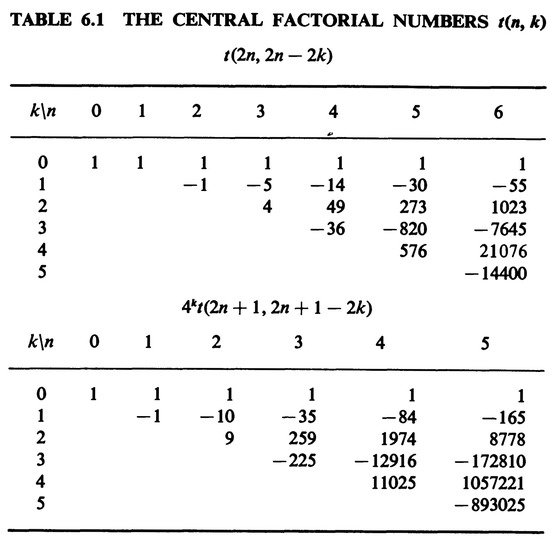
Figure 1.
Table 6.1 in ([28], p. 217).
Proposition 2.
For , we have
and
Consequently, for , we have
First Proof.
Let be the imaginary unit. Replacing with in (69) and rearranging give
Since
(see ([62], p. 119, Entry 4.23.19)), we deduce
Comparing this series expansion with the one in (6) results in
and
for . Accordingly, we derive identities (72) and (73). Series expansion (74) comes from combining (73) with (6). The first proof of Proposition 2 is complete. □
Second Proof
In ([11], Theorem 4 and Remark 10), the first result reads that the Bell polynomials of the second kind satisfy
and
for . From (75) and the identity
for and in ([59], p. 412) and ([60], p. 135), it follows that
It is standard that
From the derivatives
and by virtue of the Faà di Bruno formula in ([59], p. 412) and ([60], pp. 134–135 and p. 139), we arrive at
as for and , where as , and we use identities (76)–(78). This implies that
Replacing z with in the last series expansion gives
Comparing this with (69) leads to
Equating the coefficients of for results in
for and . Identities (72) and (73) are proved once again. The second proof of Proposition 2 is complete. □
Identity (72) is a unification of (70) and (71) and recovers the last displayed formula in ([28], p. 216).
Corollary 1.
For , central factorial numbers of the first kind can be explicitly computed by
where is defined by (64) with two assumptions and for and .
2.7. Closed-Form Formulas for Central Factorial Numbers of the First Kind
Formula (79) is a closed-form formula for computing central factorial numbers of the first kind . We now present two alternative closed-form formulas for computing central factorial numbers of the first kind .
Proposition 3.
2.8. Central Factorial Numbers and Related Expansions
In ([63], p. 455), Charalambides pointed out that
and
where and denote central factorial numbers of the first and second kinds, respectively.
3. Inverse of Specific Vandermonde Matrix
We now give a detailed proof of the problem posted at https://mathoverflow.net/q/456311 (accessed 12 October 2023): What is the inverse of the interesting integer Vandermonde matrix
for ? The inverse of a general square Vandermonde matrix
is known in the literature (see [64,65] or read the texts at https://en.wikipedia.org/wiki/Vandermonde_matrix#Inverse_Vandermonde_matrix (accessed on 11 October 2023)). We hope to find a simpler form of the inverse of the specific Vandermonde matrix for .
Proposition 4.
For , the inverse of the specific Vandermonde matrix defined in (90) is
where T stands for the transpose notation, and
where denotes the Stirling numbers of the first kind.
Proof.
In ([66], pp. 97–98), Macon and Spitzbart established that
See also an unpublished manuscript titled “Inverse of a Vandermonde matrix” by C. M. Bender, D. C. Brody, and B. K. Meister, 2001 (available online: https://www.researchgate.net/publication/240061354 (accessed on 11 October 2023)).
Let be partitioned as a 2-by-2 block matrix, with and being square matrices. In ([67], Section 0.7.3), it was stated that if and are invertible, then the inverse of A is
According to this, we obtain
The proof of Proposition 4 is thus complete. □
Remark 2.
For special cases of , simple but long practical computation shows
Based on these three special inverse matrices, the author observed and examined that the sum of all elements in each row, except the first row, of inverse matrices , , and is 0:
These observations and examinations can be easily seen through from concrete expression (91).
Furthermore, the author also observed and examined that the sum of all elements in each column, except the second column, of inverse matrices , , and is also 0, but the sum of all elements in the second column of inverse matrices , , and is 1:
By virtue of explicit expression (91), we can verify these observations as follows. The sum of all elements in the first column of the inverse for is
and the sum of all elements in the ℓth column for is
In other words, those observations in three comments on the problem at https://mathoverflow.net/q/456311 (accessed 12 October 2023) by the author are all verified to be true.
4. Closed-Form Formulas and Positivity of
A number of clues motivate us to guess that, for , the quantity defined by (7) is positive. This guess was also posted on the web site https://mathoverflow.net/q/456136 (accessed on 9 October 2023). In the comment at https://mathoverflow.net/q/456136/#comment1181306_456136 (accessed on 9 October 2023), Ho Boon Suan pointed out that the positivity of follows from ([28], p. 233, Problem 8).
From ([28], p. 233, Problem 8), we derive two closed-form formulas for central factorial numbers of the first kind: and .
Proposition 5.
Central factorial numbers of the first kind can be explicitly computed by
for and
for .
Proof.
Letting for with and in (83) yields
and
Let
Then, Equations (94) and (95) can be written as
Accordingly, setting , we obtain
In view of the closed-form expression (91) in Proposition 4, we acquire
As a result, we find
for . The closed-form formula (97) is thus proved for .
Letting for with and in (85) yields
and
Let
Then, the equations in (98) and (99) can be combined as
Therefore, letting , we acquire
By means of the closed-form expression (91) in Proposition 4, we determine that
This implies that
for , as discussed about (97). Combining (101) with (100) yields (93). The proof of Proposition 5 is complete. □
Remark 3.
If in the proof of Proposition 5, what will happen?
Remark 4.
Different from the manner in ([28], p. 217, Table 6.1) (see Figure 1), we list several values of in a new manner in Table 2 and Table 3.
Table 2.
The values of for .
Table 3.
The values of for .
Proposition 6.
For , central factorial numbers of the first kind can be computed by
and
Consequently, for , we have
Proof.
The idea of this proof originates from the hint in the comment at https://mathoverflow.net/q/456136/#comment1182208_456481 (accessed on 15 October 2023) by Fedor Petrov.
Corollary 2.
For , the quantity defined by (7) is positive.
Proof.
Corollary 3.
Proof.
From the proof of Proposition 5, we conclude that
for and
for , where
and
for . Therefore, the positivity for and for are equivalent to
for and
for . The required proof is complete. □
5. Logarithmic Convexity of Normalized Remainders
In this section, we demonstrate the logarithmic convexity of the normalized remainder in for and , and derive five inequalities involving the power functions for .
Theorem 2.
For and , the normalized remainder defined by (53) is positive, increasing, convex, absolutely monotonic, and logarithmically convex in , with the inequalities
and
for and .
Proof.
The positivity, increasing property, convexity, and absolute monotonicity of the normalized remainder follow from series expression (54) and the positivity of the quantity in Corollary 2.
Let and for be real numbers and the power series
be convergent on for some . If and the ratio is increasing for , then the function is also increasing on . This statement was first established in [69] and is called the monotonicity rule for the ratio of two power series.
Making use of series expansion (1) yields
Its logarithmic derivative is
Hence, it follows that
for . The inequality is equivalent to
which can be rearranged as
for . As a result, the sequence is increasing in for given . Combining this monotonicity of the sequence in for given with the monotonicity rule stated around (112), we see that the function , and then the logarithmic derivative , is increasing in for given . Consequently, the normalized remainder is logarithmically convex in for any given .
It is obvious that
Using the first expression in (113), taking its logarithm, and differentiating give
Accordingly, we acquire
for and . Consequently, we obtain the inequality
for and . This inequality can be reformulated as (107).
From series expansion (2), it follows that
for and . Taking the logarithm and differentiating give
and
Regarding ℓ as a variable and differentiating yield
for . This means that the sequence is increasing in for fixed . Hence, by the monotonicity rule stated around equation (112), we see that the function , and then the function , is increasing in for fixed . Consequently, the normalized remainder is logarithmically convex in for all , as well as
Because
we derive the inequality
which can be reformulated as inequality (108).
From series expansion (3), we derive
and
for . The inequality is equivalent to
for . Because
replacing with a smaller scalar 1 in (117) leads to
for . As a result, the sequence is increasing in ℓ for fixed . Hence, by the monotonicity rule stated around Equation (112), we see that the function , and then the function , is increasing in for fixed . Consequently, the normalized remainder is logarithmically convex in for all , as well as
for and . On the other hand, it is standard that
Consequently, we derive inequality (109).
From series expansion (4), it follows that
and
for . The inequality is equivalent to
for . It is apparent that
Replacing with in (119) leads to
for . This means that the sequence is increasing in for any fixed . Using the monotonicity rule stated around equation (112), we acquire that the function , and then the function , is increasing in for fixed . Accordingly, the normalized remainder is logarithmically convex in for all and
for and . Combining this inequality with
results in
which can be reformulated as inequality (110).
By similar arguments as above, we can obtain the logarithmic convexity of the normalized remainder in for all and inequality (111). □
Remark 5.
Taking in Theorem 2 results in the following inequalities:
and
for . These inequalities appear to be quite elegant.
Remark 6.
For given and , is the ratio
an increasing sequence in ? See “one more problem” at https://mathoverflow.net/q/456136 (accessed on 9 October 2023).
6. Ratios of Bell Polynomials and Central Factorial Numbers
In this section, from the proof of Theorem 2, we derive several identities for two consecutive ratios of specific Bell polynomials of the second kind:
Theorem 3.
The identities
and
are valid for .
Proof.
By relation (67), the ratio can be rewritten as
for and .
Combining (114) and (115) reveals that the identity
for and is valid. Accordingly, comparing with (124), we deduce that the identity
for and , that is, the identity
for and , is valid. This identity was announced on the web site https://mathoverflow.net/q/456701 (accessed on 18 October 2023).
Comparing (116) with (124) for yields
which can be reformulated as
for . Further replacing with m gives identity (121). Identity (121) was announced at the site https://mathoverflow.net/a/456784 (accessed on 20 October 2023).
Similarly, we acquire
which can be rearranged as (123). The proof of Theorem 3 is finished. □
Theorem 4.
For and , central factorial numbers satisfy the identities
and
Proof.
Using the relation (73) in Proposition 2, we write
for and . Comparing this for with expressions (114)–(116), and (118) results in
for . Further replacing with gives those identities in (126).
Comparing (124) with (128) and simplifying lead to
for and . Further taking in (129) and employing identity (125) produce
Hence, identity (127) follows. The proof of Theorem 4 is complete. □
Corollary 4.
For , we have the relation
Proof.
This follows from replacing with m in (129). □
7. Maclaurin Power Series Expansion
In this section, we expand the logarithm of the normalized remainder into the Maclaurin power series.
Theorem 5.
For and , let
and
where the quantity is defined by (7). Then, the logarithm of the normalized remainder for and can be expanded to the Maclaurin power series
Proof.
Employing series expression (54), we obtain the logarithmic derivative
for , , and . Furthermore, for , we have
and
as , where the falling factorial for and is defined by
Let and be two m-time differentiable functions on an interval I for given integer . Exercise 5 in ([70], p. 40) can be formulated as
where the matrix
the matrix is an matrix whose elements satisfy for , the matrix is an matrix whose elements are for and , and the notation denotes the determinant of the matrix . By virtue of derivative formula (131), we acquire
for and . Consequently, we derive the series expansion
where we considered the evenness of the normalized remainder . The proof of Theorem 5 is complete. □
Remark 7.
Numerical computation shows that
and
Accordingly, the first few terms of series expansion (130) for are
for .
Remark 8.
In order to prove the logarithmically absolute monotonicity of the normalized remainder in for and , an alternative approach is to prove that all coefficients of the Maclaurin power series expansion (130) of around are positive. This is equivalent to the negativity of the determinant for and .
Remark 9.
On 28 December 2024, Izán Péraz asked the author to find the exact value of the improper integral
It is common knowledge that finding the exact values of improper integrals is conventionally important and interesting in calculus, mathematical analysis, the theory of single-variable complex functions, the theory of special functions, and the like.
Glasser’s master theorem in [71,72] (or see the web sites https://en.wikipedia.org/wiki/Glasser%27s_master_theorem (accessed on 30 December 2024) and https://mathworld.wolfram.com/GlassersMasterTheorem.html (accessed on 30 December 2024)) reads that the identity
holds for any integrable function and of the form
with a, , and arbitrary constants, where the notation PV denotes a Cauchy principal value. Using Glasser’s master theorem, we easily derive that
where the last equality in (132) follows from the formula
in ([25], p. 339), and the Euler gamma function can be defined ([24], Chapter 3) by
The formula in (133) can be verified by
where we used another definition of the gamma function
and the recursive relation for ; see ([15], Section 6.4).
8. Conclusions
In the first section, the author briefly reviewed recent works on the Maclaurin power series expansions for the powers of the inverse sine, inverse cosine, inverse tangent, sine, and cosine functions; concisely surveyed some properties for (the logarithms of) the normalized remainders of the Maclaurin power series expansions for the inverse sine, inverse cosine, inverse tangent, tangent, square of tangent, sine, cosine, exponential function, complete elliptic integrals of the second kind, and the generating function of the Bernoulli numbers; and simply restated those results associated with the sine and cosine functions in terms of the generalized hypergeometric functions.
In the second section, the author retrospected the origin and several known identities of the quantity for , determined connections between and central factorial numbers of the first kind, and derived several closed-form formulas for central factorial numbers of the first kind.
In the third section, the author deduced an elegant inverse of a specific square Vandermonde matrix, relating to the central factorial numbers of the first kind and involving the Stirling numbers of the first kind, and revealed several interesting observations about the elements of the inverse matrix.
In the fourth section, by virtue of the Vieta theorem and the inverse matrix deduced in the third section, the author established several explicit expressions for central factorial numbers of the first kind and proved the positivity of the quantity .
In the fifth section, the author proved the logarithmic convexity of the normalized remainders for , , and , and derived five inequalities involving the power functions for and .
In the sixth section, the author discovered several identities for the ratios of the Bell polynomials of the second kind and central factorial numbers of the first kind.
In the seventh section, the author expanded the logarithm of the normalized remainder into a Maclaurin power series in terms of determinants of specific Hessenberg matrices whose elements involve the quantity .
This paper introduced several interesting results and explored connections among important mathematical objects. Several results in this paper appear to be novel, particularly the inverse of the specific Vandermonde matrix, the explicit expressions for central factorial numbers, and the logarithmic convexity properties. These findings may provide new tools and perspectives for researchers working with these mathematical structures. The author has presented many detailed derivations, identities, and observations, showcasing a comprehensive understanding of the topics discussed.
Funding
This research received no external funding.
Data Availability Statement
Data sharing is not applicable to this article as no new data were created or analyzed in this study.
Acknowledgments
The author is grateful to 1. Ho Boon Suan (Singapore, boonsuan1@gmail.com, https://orcid.org/0000-0002-8928-9052, https://stackexchange.com/users/10692259/ho-boon-suan, http://boonsuan.github.io) for his comment at https://mathoverflow.net/q/456136/#comment1181306_456136 (accessed on 9 October 2023) and for providing an electronic copy of the monograph [28]; 2. Tao Zhang (Inner Mongolia University, China) and Jing-Feng Tian (North China Electric Power University, China) for providing an electronic copy of the monograph [28]; 3. Fedor Petrov (Saint-Petersburg, Russian, http://www.pdmi.ras.ru/eng/perso/petrov.php) for his mention of the Vieta theorem in a comment at https://mathoverflow.net/q/456136/#comment1182208_456481 (accessed on 15 October 2023); 4. Peter Taylor (the second author of the paper [20], Valencia, Spain, https://orcid.org/0000-0002-0556-5524) for his counter-example at https://mathoverflow.net/a/456761 (accessed on 19 October 2023); and 5. the anonymous referees for their careful corrections, valuable comments, and helpful suggestions with the original version of this paper.
Conflicts of Interest
The author declares no conflicts of interest.
References
- Apostol, T.M. Calculus. One-Variable Calculus, with an Introduction to Linear Algebra, 2nd ed.; Blaisdell Publishing Co. [Ginn and Co.]: Waltham, MA, USA; Toronto, ON, Canada; London, UK, 1967; Volume 1. [Google Scholar]
- Zorich, V.A. Mathematical Analysis I, 2nd ed.; Translated from the 6th corrected Russian edition, Part I, 2012 by Roger Cooke. With Appendices A–F and new problems translated by Octavio Paniagua T. Universitext; Springer: Berlin, Germany, 2015. [Google Scholar] [CrossRef]
- Bailey, D.H.; Borwein, J.M.; Calkin, N.J.; Girgensohn, R.; Luke, D.R.; Moll, V.H. Experimental Mathematics in Action; A K Peters, Ltd.: Wellesley, MA, USA, 2007. [Google Scholar]
- Borwein, J.M.; Chamberland, M. Integer powers of arcsin. Int. J. Math. Math. Sci. 2007, 2007, 19381. [Google Scholar] [CrossRef]
- Spivey, M.Z. The Art of Proving Binomial Identities. In Discrete Mathematics and Its Applications; CRC Press: Boca Raton, FL, USA, 2019. [Google Scholar] [CrossRef]
- Guo, B.-N.; Lim, D.; Qi, F. Maclaurin’s series expansions for positive integer powers of inverse (hyperbolic) sine and tangent functions, closed-form formula of specific partial Bell polynomials, and series representation of generalized logsine function. Appl. Anal. Discret. Math. 2022, 16, 427–466. [Google Scholar] [CrossRef]
- Guo, B.-N.; Lim, D.; Qi, F. Series expansions of powers of arcsine, closed forms for special values of Bell polynomials, and series representations of generalized logsine functions. AIMS Math. 2021, 6, 7494–7517. [Google Scholar] [CrossRef]
- Qi, F.; Chen, C.-P.; Lim, D. Several identities containing central binomial coefficients and derived from series expansions of powers of the arcsine function. Results Nonlinear Anal. 2021, 4, 57–64. [Google Scholar] [CrossRef]
- Qi, F.; Niu, D.-W.; Lim, D. Some combinatorial identities containing central binomial coefficients or Catalan numbers. Appl. Math. Sci. Eng. 2023, 31, 2204233. [Google Scholar] [CrossRef]
- Vălean, C.I. (Almost) Impossible Integrals, Sums, and Series. With a Foreword by Paul J. Nahin, Problem Books in Mathematics; Springer: Cham, Switzerland, 2019. [Google Scholar] [CrossRef]
- Qi, F. Power series expansions of real powers of inverse cosine and sine functions, closed-form formulas of partial Bell polynomials at specific arguments, and series representations of real powers of circular constant. Symmetry 2024, 16, 1145. [Google Scholar] [CrossRef]
- Qi, F. Taylor’s series expansions for real powers of two functions containing squares of inverse cosine function, closed-form formula for specific partial Bell polynomials, and series representations for real powers of Pi. Demonstr. Math. 2022, 55, 710–736. [Google Scholar] [CrossRef]
- Mansour, T.; Schork, M. Commutation Relations, Normal Ordering, and Stirling Numbers. Discrete Mathematics and Its Applications; CRC Press: Boca Raton, FL, USA, 2016. [Google Scholar]
- Qi, F.; Milovanović, G.V.; Lim, D. Specific values of partial Bell polynomials and series expansions for real powers of functions and for composite functions. Filomat 2023, 37, 9469–9485. [Google Scholar] [CrossRef]
- Abramowitz, M.; Stegun, I.A. (Eds). Handbook of Mathematical Functions with Formulas, Graphs, and Mathematical Tables; Reprint of the 1972 ed.; National Bureau of Standards, Applied Mathematics Series 55; Dover Publications, Inc.: New York, NY, USA, 1992. [Google Scholar]
- Chammam, W.; Khlifi, M. Several formulas and identities related to the Pochhammer k-symbol and application to a case of the Fuss–Catalan–Qi numbers. Indian J. Pure Appl. Math. 2025, 56. in press. [Google Scholar] [CrossRef]
- Khlifi, M.; Chammam, W.; Guo, B.-N. Several identities and relations related to q-analogues of Pochhammer k-symbol with applications to Fuss–Catalan–Qi numbers. Afr. Mat. 2024, 35, 21. [Google Scholar] [CrossRef]
- Bao, Z.-H.; Agarwal, R.P.; Qi, F.; Du, W.-S. Some properties on normalized tails of Maclaurin power series expansion of exponential function. Symmetry 2024, 16, 989. [Google Scholar] [CrossRef]
- Zhang, G.-Z.; Qi, F. On convexity and power series expansion for logarithm of normalized tail of power series expansion for square of tangent. J. Math. Inequal. 2024, 18, 937–952. [Google Scholar] [CrossRef]
- Qi, F.; Taylor, P. Series expansions for powers of sinc function and closed-form expressions for specific partial Bell polynomials. Appl. Anal. Discret. Math. 2024, 18, 92–115. [Google Scholar] [CrossRef]
- Grishaev, A.V.; Sazonov, V.F. New formulas for Maclaurin’s series expansions of powers of arctangent and other related topics. Integral Transforms Spec. Funct. 2024, 36, 39–52. [Google Scholar] [CrossRef]
- Li, Y.-W.; Qi, F.; Du, W.-S. Two forms for Maclaurin power series expansion of logarithmic expression involving tangent function. Symmetry 2023, 15, 1686. [Google Scholar] [CrossRef]
- Qi, F.; Agarwal, R.P.; Lim, D. Decreasing property of ratio of two logarithmic expressions involving tangent function. Math. Comput. Model. Dyn. Syst. 2025. [Google Scholar] [CrossRef]
- Temme, N.M. Special Functions: An Introduction to Classical Functions of Mathematical Physics; A Wiley-Interscience Publication; John Wiley & Sons, Inc.: New York, NY, USA, 1996. [Google Scholar] [CrossRef]
- Gradshteyn, I.S.; Ryzhik, I.M. Table of Integrals, Series, and Products; Translated from the Russian, Translation edited and with a preface by Daniel Zwillinger and Victor Moll, Eighth edition, Revised from the seventh edition; Elsevier/Academic Press: Amsterdam, The Netherlands, 2015. [Google Scholar] [CrossRef]
- Brychkov, Y.A. Power expansions of powers of trigonometric functions and series containing Bernoulli and Euler polynomials. Integral Transform. Spec. Funct. 2009, 20, 797–804. [Google Scholar] [CrossRef]
- Butzer, P.L.; Schmidt, M.; Stark, E.L.; Vogt, L. Central factorial numbers; their main properties and some applications. Numer. Funct. Anal. Optim. 1989, 10, 419–488. [Google Scholar] [CrossRef]
- Riordan, J. Combinatorial Identities; Reprint of the 1968 original; Robert E. Krieger Publishing Co.: Huntington, NY, USA, 1979. [Google Scholar]
- He, C.-Y.; Qi, F. Reformulations and generalizations of Hoffman’s and Genčev’s combinatorial identities. Results Math. 2024, 79, 131. [Google Scholar] [CrossRef]
- Liu, X.-L.; Long, H.-X.; Qi, F. A series expansion of a logarithmic expression and a decreasing property of the ratio of two logarithmic expressions containing sine. Mathematics 2023, 11, 3107. [Google Scholar] [CrossRef]
- Wang, F.; Qi, F. Power series expansion and decreasing property related to normalized remainders of power series expansion of sine. Filomat 2024, 38, 10447–10462. [Google Scholar] [CrossRef]
- Zhang, T.; Yang, Z.-H.; Qi, F.; Du, W.-S. Some properties of normalized tails of Maclaurin power series expansions of sine and cosine. Fractal Fract. 2024, 8, 257. [Google Scholar] [CrossRef]
- Niu, D.-W.; Qi, F. Monotonicity results of ratios between normalized tails of Maclaurin power series expansions of sine and cosine. Mathematics 2024, 12, 1781. [Google Scholar] [CrossRef]
- Li, Y.-W.; Qi, F. A new closed-form formula of the Gauss hypergeometric function at specific arguments. Axioms 2024, 13, 317. [Google Scholar] [CrossRef]
- Li, Y.-F.; Qi, F. A series expansion of a logarithmic expression and a decreasing property of the ratio of two logarithmic expressions containing cosine. Open Math. 2023, 21, 20230159. [Google Scholar] [CrossRef]
- Wan, A.; Qi, F. Power series expansion, decreasing property, and concavity related to logarithm of normalized tail of power series expansion of cosine. Electron. Res. Arch. 2024, 32, 3130–3144. [Google Scholar] [CrossRef]
- Pei, W.-J.; Guo, B.-N. Monotonicity, convexity, and Maclaurin series expansion of Qi’s normalized remainder of Maclaurin series expansion with relation to cosine. Open Math. 2024, 22, 20240095. [Google Scholar] [CrossRef]
- Zhang, H.-C.; Guo, B.-N.; Du, W.-S. On Qi’s normalized remainder of Maclaurin power series expansion of logarithm of secant function. Axioms 2024, 13, 860. [Google Scholar] [CrossRef]
- Howard, F.T. A special class of Bell polynomials. Math. Comp. 1980, 35, 977–989. [Google Scholar] [CrossRef]
- Qi, F.; Niu, D.-W.; Lim, D.; Yao, Y.-H. Special values of the Bell polynomials of the second kind for some sequences and functions. J. Math. Anal. Appl. 2020, 491, 124382. [Google Scholar] [CrossRef]
- Mitrinovi, D.S.; Pe, J.E.; Fink, A.M. Classical and New Inequalities in Analysis; Kluwer Academic Publishers: Dordrecht, The Netherlands; Boston, MA, USA; London, UK, 1993. [Google Scholar] [CrossRef]
- Schilling, R.L.; Song, R.; Vondra, Z. Bernstein Functions, 2nd ed.; de Gruyter Studies in Mathematics 37; Walter de Gruyter: Berlin, Germany, 2012. [Google Scholar] [CrossRef]
- Widder, D.V. The Laplace Transform; Princeton Mathematical Series 6; Princeton University Press: Princeton, NJ, USA, 1946. [Google Scholar]
- Guo, B.-N.; Qi, F. A property of logarithmically absolutely monotonic functions and the logarithmically complete monotonicity of a power-exponential function. Politehn. Univ. Buchar. Sci. Bull. Ser. A Appl. Math. Phys. 2010, 72, 21–30. [Google Scholar]
- Vinogradov, O.L. Logarithmically absolutely monotone trigonometric functions. J. Math. Sci. 2022, 268, 773–782. [Google Scholar] [CrossRef]
- Qi, F.; Chen, C.-P. A complete monotonicity property of the gamma function. J. Math. Anal. Appl. 2004, 296, 603–607. [Google Scholar] [CrossRef]
- Berg, C. Integral representation of some functions related to the gamma function. Mediterr. J. Math. 2004, 1, 433–439. [Google Scholar] [CrossRef]
- Qi, F. Absolute monotonicity of normalized tail of power series expansion of exponential function. Mathematics 2024, 12, 2859. [Google Scholar] [CrossRef]
- Zhang, G.-Z.; Yang, Z.-H.; Qi, F. On normalized tails of series expansion of generating function of Bernoulli numbers. Proc. Amer. Math. Soc. 2025, 153, 131–141. [Google Scholar] [CrossRef]
- Andrews, G.E.; Askey, R.; Roy, R. Special Functions; Encyclopedia of Mathematics and Its Applications 71; Cambridge University Press: Cambridge, MA, USA, 1999. [Google Scholar] [CrossRef]
- Qiu, S.-L.; Ma, X.-Y.; Chu, Y.-M. Sharp Landen transformation inequalities for hypergeometric functions, with applications. J. Math. Anal. Appl. 2019, 474, 1306–1337. [Google Scholar] [CrossRef]
- Qiu, S.-L.; Vuorinen, M. Infinite products and normalized quotients of hypergeometric functions. SIAM J. Math. Anal. 1999, 30, 1057–1075. [Google Scholar] [CrossRef]
- Erdélyi, A.; Magnus, W.; Oberhettinger, F.; Tricomi, F.G. Higher Transcendental Functions; Vol. I. Based on notes left by Harry Bateman. With a preface by Mina Rees. With a foreword by E. C. Watson. Reprint of the 1953 original; Robert E. Krieger Publishing Co., Inc.: Melbourne, FL, USA, 1981. [Google Scholar]
- Whittaker, E.T.; Watson, G.N. A Course of Modern Analysis—An Introduction to the General Theory of Infinite Processes and of Analytic Functions with an Account of the Principal Transcendental Functions, 5th ed.; Moll, V.H., Ed.; With a foreword by S. J. Patterson; Cambridge University Press: Cambridge, MA, USA, 2021. [Google Scholar]
- Bernstein, D.S. Scalar, Vector, and Matrix Mathematics: Theory, Facts, and Formulas; Revised and Expanded edition; Princeton University Press: Princeton, NJ, USA, 2018. [Google Scholar]
- Bateman, P.T.; Diamond, H.G. Analytic Number Theory; An Introductory Course. Monographs in Number Theory; World Scientific Publishing Co. Pte. Ltd.: Hackensack, NJ, USA, 2004; Volume 1. [Google Scholar] [CrossRef]
- Yang, Z.-H.; Qi, F. Monotonicity and inequalities for the ratios of two Bernoulli polynomials. arXiv 2024, arXiv:2405.05280. [Google Scholar] [CrossRef]
- Pinelis, I. Monotonicity of ratios of Bernoulli polynomials. Math. Inequal. Appl. 2024, 27, 949–953. [Google Scholar] [CrossRef]
- Charalambides, C.A. Enumerative Combinatorics; CRC Press Series on Discrete Mathematics and Its Applications; Chapman & Hall/CRC: Boca Raton, FL, USA, 2002. [Google Scholar]
- Comtet, L. Advanced Combinatorics: The Art of Finite and Infinite Expansions; Revised and Enlarged Edition; D. Reidel Publishing Co.: Dordrecht, The Netherlands, 1974. [Google Scholar] [CrossRef]
- Liu, G. The D numbers and the central factorial numbers. Publ. Math. Debr. 2011, 79, 41–53. [Google Scholar] [CrossRef]
- Olver, F.W.J.; Lozier, D.W.; Boisvert, R.F.; Clark, C.W. (Eds.) NIST Handbook of Mathematical Functions; Cambridge University Press: New York, NY, USA, 2010. Available online: http://dlmf.nist.gov (accessed on 18 October 2023).
- Charalambides, C.A. Central factorial numbers and related expansions. Fibonacci Quart. 1981, 19, 451–456. Available online: https://fq.math.ca/Scanned/19-5/charalambides.pdf (accessed on 18 October 2023). [CrossRef]
- Sanna, C.; Shallit, J.; Zhang, S. The largest entry in the inverse of a Vandermonde matrix. Linear-Multi Algebra 2022, 70, 5634–5641. [Google Scholar] [CrossRef]
- Turner, L.R. Inverse of the Vandermonde Matrix with Applications; NASA Technical Note (Document ID 19660023042); National Aeronautics and Space Administration: Washington, DC, USA, 1966. Available online: https://ntrs.nasa.gov/citations/19660023042 (accessed on 19 December 2024).
- Macon, N.; Spitzbart, A. Inverses of Vandermonde matrices. Amer. Math. Mon. 1958, 65, 95–100. [Google Scholar] [CrossRef]
- Horn, R.A.; Johnson, C.R. Matrix Analysis, 2nd ed.; Cambridge University Press: Cambridge, MA, USA, 2013. [Google Scholar]
- Wu, X. On zeros of polynomial and vector solutions of associated polynomial system from Vieta theo-rem. Appl. Numer. Math. 2003, 44, 415–423. [Google Scholar] [CrossRef]
- Biernacki, M.; Krzyż, J. On the monotonity of certain functionals in the theory of analytic functions. Ann. Univ. Mariae Curie-Skłodowska Sect. A 1955, 9, 135–147. [Google Scholar]
- Bourbaki, N. Elements of Mathematics: Functions of a Real Variable: Elementary Theory; Translated from the 1976 French original by Philip Spain. Elements of Mathematics (Berlin); Springer: Berlin, Germany, 2004. [Google Scholar] [CrossRef]
- Glasser, M.L. A remarkable property of definite integrals. Math. Comp. 1983, 40, 561–563. [Google Scholar] [CrossRef]
- Milgram, M. An extension of Glasser’s master theorem and a collection of improper integrals many of which involve Riemann’s zeta function. arXiv 2024, arXiv:2402.17586. [Google Scholar] [CrossRef]
Disclaimer/Publisher’s Note: The statements, opinions and data contained in all publications are solely those of the individual author(s) and contributor(s) and not of MDPI and/or the editor(s). MDPI and/or the editor(s) disclaim responsibility for any injury to people or property resulting from any ideas, methods, instructions or products referred to in the content. |
© 2025 by the author. Licensee MDPI, Basel, Switzerland. This article is an open access article distributed under the terms and conditions of the Creative Commons Attribution (CC BY) license (https://creativecommons.org/licenses/by/4.0/).