1. Introduction
The concept of incidence algebras of partially ordered sets was first introduced by Rota in the 1960s [
1] as a tool for solving combinatorial problems. Incidence algebras are fascinating objects that have been the subject of extensive research since their inception. For instance, Pierre and John [
2] describe the relationships between the algebraic properties of incidence algebras and the combinatorial features of the partially ordered sets. In [
3], Spiegel and O’Donnell provide a detailed analysis of the maximal and prime ideals, derivations and isomorphisms, radicals, and additional ring-theoretic properties of incidence algebras. Further developments on the structure of incidence algebras can be found in [
4,
5,
6,
7].
The study of derivations in the context of algebras is a valuable and significant endeavor. Yang provides a detailed account of the structure of nonlinear derivations on incidence algebras in [
8], specifically decomposing the nonlinear derivations into three more specific forms. Regarding the decomposition of derivations, two significant findings pertaining to their structure have been established. Notably, Baclawski demonstrated that every derivation of the incidence algebra
, when
is a field and
P is a finite locally poset, can be expressed as the sum of an inner derivation and an additive induced derivation [
9]. This result was extended by Spiegel and O’Donnell [
3] to cases where
is a commutative ring. Additional insights into the structure of other special derivations on incidence algebra can be found in [
10,
11,
12,
13].
Building upon the aforementioned studies of derivations on incidence algebras, it is natural to investigate biderivations in this context. Kaygorodov and Khrypchenko delineate the structure of antisymmetric biderivations of finitary incidence algebras
, where
P is an arbitrary poset and
is a commutative ring with unity, in [
14]. In [
15], Benkovič proves that every biderivation of a triangular algebra is the sum of an inner biderivation and an external biderivation. Later, Ghosseiri demonstrates that every biderivation of upper triangular matrix rings is the sum of an inner biderivation, an external biderivation, and a distinct category of biderivations [
16]. Ghosseiri also presents particular instances where every biderivation is inner.
In the literature, many biderivations on different algebras have been shown to decompose into the sum of inner and extremal ones. Motivated by this, we ask whether general biderivations on incidence algebras admit a similar decomposition. Compared with [
14], which characterizes antisymmetric biderivations on finitary incidence algebras
, our work extends the type of biderivations under consideration from antisymmetric to general ones, while the algebraic framework is more restrictive. Moreover, although most existing studies assume linearity, we find this condition unnecessarily strong. Therefore, in this paper, we focus on additive biderivations of incidence algebras and determine their precise structure. Specifically, let
be a commutative ring with unity, and
P a locally finite poset such that any maximal chain in
P contains at least three elements. The additive biderivation
b is the exact sum of several inner biderivations and extremal biderivations. Furthermore, we give that when the number of elements in any maximal chain in
P is infinite,
b is an inner biderivation.
3. Additive Derivations of
In the study of additive biderivations, it is necessary to discuss some properties of additive derivations of , since an additive biderivation becomes an additive derivation when one of its arguments is fixed. Let P be a locally finite poset, let be a commutative ring with unity, and let be the incidence algebra of P over . Suppose d is an additive derivation of .
We will denote to represent for any and . We begin by demonstrating a lemma that shows the structure of the value of .
Lemma 2. Let and , then Proof. Consider a fixed pair
and an arbitrary element
. Suppose
with
and
. We examine the expression
by multiplying
on the left by
and on the right by
:
Since
, it follows that
unless
or
. This establishes the desired equality (
13). □
The proof of the aforementioned lemma allows us to derive the following corollary.
Corollary 2. Let , , then unless the elements satisfy one of the following cases: (1) , ; (2) , .
In describing the structure of biderivations, we will try to prove that some of them are equivalent. To do this, we introduce a number of instrumental lemmas as described below.
Lemma 3. Let and , then
- (1)
For any , ;
- (2)
For any , .
Proof. We will demonstrate part (1), and the proof of part (2) follows analogously. Consider fixed elements
and
. For any
, using Equation (
4), we obtain
Therefore, we deduce that . Setting r to be the unity element of yields , thereby establishing part (1). □
Lemma 4. Let , then .
Proof. Let
be fixed. Observe that
Since the above expression equals zero and is a non-zero element of the incidence algebra, it follows that . □
Lemma 5. Let , then .
Proof. Let
be fixed. Then,
Since
is a non-zero element of the incidence algebra, we deduce that
. □
4. Additive Biderivations of
In this section, we will employ the properties of additive derivations derived in
Section 3 to prove our main theorem (Theorem 4), which elucidates the structure of additive biderivations on the incidence algebra
. Let
P be a locally finite poset, and let
be a commutative ring with unity. In this section, we will use the notation
to denote the value
for any
and
.
We begin by considering a corollary that can be readily extended from Lemma 2.
Corollary 3. Let , , and , then The preliminary stage will entail a reduction in the complexity of the structure of b. This will be achieved by establishing a sufficient condition that characterizes the circumstances under which b is equal to zero.
Lemma 6. Let , ; if at least one pair among is not comparable, then for any .
Proof. Consider , . Suppose at least one pair among is not comparable. This situation can be divided into four cases: (1) ; (2) ; (3) ; (4) .
- Case 1:
Suppose . We consider two subcases: and .
If
, by Corollary 3, we have
According to Corollary 2, both and are zero because .
If
, we obtain that
In (
20), both
and
are zero by Corollary 2. For the remaining terms in (
20), using Lemma 3 on the first argument of each term, we have
Noting that
and
(if
, we obtain
, which contradicts
),
in (
21) is zero by Corollary 2. Therefore, the lemma is proved when
.
- Case 2:
If
, then
and
. From Corollary 3, we have
We assert that either
or
, because if
, then
, which contradicts
. For
, it is zero by Lemma 2 if
. If
, by Lemma 2, we get
Therefore, the lemma is proved when .
- Cases 3 and 4:
If or , the proof is similar to Cases 1 and 2.
Thus, the lemma is proved. □
Remark 1. Intuitively, the lemma asserts that an additive biderivation must vanish on any pair of basis elements that are incomparable. The multiplication rules of incidence basis elements (where for many incomparable configurations), together with the derivation property in each argument, force all such coefficients to be zero. Hence, nontrivial behavior can only occur along comparable pairs (chains), which is the crucial reduction used in the sequel.
According to the decomposition (
8), we can suppose that for any
,
where
. By applying the decomposition of
P, as defined in (
7), and the aforementioned lemma, it is straightforward to conclude that
if
, thereby yielding the following result:
Accordingly, this decomposition permits us to limit our analysis to the case where P is connected, as will be discussed subsequently. We will subsequently present the theorem, in the case where P is connected, which describes the conditions under which certain terms in Equation (
18) are equal to zero. Prior to this, we will present an instrumental lemma.
Lemma 7. Let , then Proof. Let
be arbitrary. Since
b is a biderivation, it satisfies the derivation property in each argument separately. We begin by applying the derivation property to the first argument of
, followed by applying it to the second argument. This yields
Conversely, we first apply the derivation property to the second argument and then to the first argument, obtaining
Subtracting Equation (
26) from Equation (
27) gives
which rearranges to the desired identity:
The proof is completed. □
In accordance with the aforementioned lemma, it is possible to select specific values for in order to demonstrate that . For that are comparable with each other and have , the following two subcases can be identified: (1) ; (2) . The following two theorems will address these subcases in greater detail.
Proof. We prove the lemma by considering three cases based on the position of x in P: minimal, maximal, and neither.
- Case 1:
x is a minimal element in
P. By Corollary 3, we have
For any pair
where
y is not a maximal element, let
. By Lemma 7, we know that
Thus, when
x is a minimal element,
reduces to the given form
- Case 2:
x is a maximal element in P. The procedure is similar to Case 1.
- Case 3:
x is neither a minimal nor maximal element. In this case, there exist
such that
. For any
, we have
This implies . Similarly, for any , we can deduce . Hence, when x is neither a minimal nor maximal element, we have .
Combining the three cases, the lemma is proven. □
Remark 2. The theorem implies that the values of a biderivation on diagonal basis elements can be non-zero only at boundary points of the poset, that is, at minimal or maximal elements. Intuitively, this follows from inserting between other basis elements and applying the commutation identities, which eliminate contributions from interior points: whenever a third comparable element exists, the corresponding terms vanish. Thus, the diagonal component of a biderivation is necessarily supported at the endpoints of the poset, providing the foundation for the extremal components constructed later.
Theorem 2. Let P be a connected poset such that any maximal chain has at least three elements. For any and that are comparable with each other and have . The additive biderivation b satisfies , except in the case where and one of x and u is the maximal element in P and the other is the minimal element.
Proof. Let and satisfy the conditions of the theorem. We further divide this case into four subcases:
- Case 1:
If
and
, except in the case where
and one of
x and
u is the maximal element in
P and the other is the minimal element, then by Corollary 3, we have
We have
by using Lemma 3 in its first argument when
. If
, it is also correct because
by Corollary 3. By the same reasoning in its second argument, we obtain
. Without loss of generality, we can assume that
. It is evident that
y is not minimal or
u is not maximal; otherwise, the case is excluded. Thus, by Lemma 4 and Theorem 1, we have
Similarly, is also equal to 0. Therefore, we have in this case.
- Case 2:
If and . We consider two subcases: and .
- (a)
Since and , by Lemma 2 and Corollary 2. Therefore, .
- (b)
If , the proof is similar.
- Case 3:
If and .
The proof is similar to subcase 2.
- Case 4:
If
and
, implying
. By Corollary 3, we have
For any pair
, the term
is equal to
by Lemma 3. Let us consider its second argument, whereby because
and
, it is equal to 0 by Corollary 2. In the same way, for any
, we have
. Thus,
By the assumption on P, there exists an element such that z is comparable with x and y. We consider three cases:
If
, applying Lemma 7, we obtain
The left-hand side is zero, and the right-hand side equals , implying .
If , the proof is similar to (a).
If
, applying Lemma 5, we have
Consider the second argument of and , respectively Because , we have by Corollary 2. This implies .
Considering all the above cases, the theorem is proved. □
Remark 3. The theorem shows—after a case-by-case analysis—that most configurations of comparable indices force the corresponding biderivation entries to vanish; only special “endpoint–endpoint” configurations, where one index is minimal and the other maximal, may yield nontrivial terms. The underlying mechanism is the repeated application of the commutation identity (Lemma 7) together with the vanishing on incomparable pairs: whenever an auxiliary comparable element exists, the relevant coefficients are forced to zero. Consequently, the theorem confines all possible non-zero patterns to the finite boundary situations that generate the extremal biderivations.
The objective of the forthcoming project is to provide evidence that certain components of Equation (
18) are equal. In particular, it will be demonstrated that
when
satisfy specified conditions. Prior to this, two lemmas will be proven.
Proof. For any
, applying Lemma 3 to the left or right argument of
separately, we have
Thus, we have . Using a similar process for , we obtain the other equality. □
Lemma 9. Let , then
- (1)
;
- (2)
.
Proof. Let
. For
and
, using Lemma 5 for its first argument, we obtain
noting that
by Corollary 3. Additionally, we have
by Lemma 4. Plugging the results from (
43) into this, we find that
which implies
. Then
. Similarly, we can obtain the other equality. □
Corollary 4. Let , then .
Proof. Let . There exists that is comparable with x and y by the assumption that any maximal chain in P has at least three elements. We consider three cases.
If
, according to Lemma 8, we have
From Lemma 9, we have
Considering (
45) and (
46), we have
For the remaining two cases and , a similar process yields the same result. □
Theorem 3. Let , in , where is the index set defined in (10), then Proof. Let
,
,
. If
is a totally ordered set, it is evident from Lemma 9 that
. If
is not a totally ordered set, according to the construction of
, there exist chains
defined in (
10) such that
,
, and
for any
. Therefore, there exist
. Because
is a totally ordered set, using Lemma 9, we thus have
Remark 4. The theorem shows that a certain family of coefficients (for instance, ) remains constant along any connected chain component. Intuitively, this follows from propagating local equalities along adjacent links of a chain using Lemmas 8 and 9, so that the local relations, through this chain-wise propagation, ultimately yield a global constancy on the entire component. Consequently, one can associate a single scalar with each chain component, and these scalars serve as the weights for the inner biderivation contributions.
For any
, let
, and define
A crucial conclusion is that for any pair in , where , the value , as demonstrated by the aforementioned theorem.
Now that the requisite preparations have been completed, we may proceed with the proof of the final theorem.
Theorem 4. Let be a commutative ring with unity, and let P be a locally finite poset such that any maximal chain in P contains at least three elements. The additive biderivation b of the incidence algebra is the sum of several inner biderivations and extremal biderivations.
Proof. We proceed by first considering the case where P is connected. The general case will follow by extending this result to each connected component of P.
Case 1: P is connected.
By the decomposition (
12), we can write
P as a union of subsets
:
For any
, we can decompose them as follows:
Using these decompositions, we expand the biderivation
:
- I.
Evaluating :
From Lemma 6 and Theorem 2, we have
By Corollary 3 and Lemma 4, the part of each term in (
54) can be expressed as
By Theorems 1 and 4, the other part of each term in (
54) can be expressed as
Substituting (
55) and (
56) back into Equation (
54), we obtain
where
,
and
- II.
Evaluating ,
Consider elements
and
, where each pair in
is comparable. A maximal chain, denoted by
, exists in
P that contains
. There exist
and
, where
are defined in (
10), such that
and
. It is obvious that
, then
l would belong to both
and
. Thus, we get
, which contradicts Lemma 1.
Hence, the existing pair of elements among
is not comparable, and by Lemma 6, it follows that
- III.
Evaluating ,
From Lemmas 2 and 6, the
part in above equation is non-zero only when any pair in
is compared and
, which implies either
or
. Thus, the sum simplifies to
Applying Lemmas 3 and 8, we obtain
where
is defined by (
50). Consequently, Equation (
59) becomes
- IV.
Evaluating :
First, consider
:
From Lemma 2,
unless
or
. Therefore,
Similarly, for
, we obtain
Combining these results, we have
Combining All Components:
Substituting Equations (
57), (
58), (
61), and (
63) into Equation (
53), we obtain
where
.
Consider the aforementioned points; we thus deduce the following result:
Case 2: P is not connected.
When
P is disconnected, we utilize the decomposition (
7):
where each
is a connected component of
P. Further, each connected component
can be decomposed as
using decomposition (
11).
For any
, write
where
, as per decomposition (
8).
By Equation (
24), the biderivation
b satisfies
Since each
is connected, applying the result from Case 1, we obtain
Therefore, combining all components, we conclude that
as desired. It is evident that
b is the sum of several inner biderivations and extremal biderivations. □
Remark 5. The decomposition in the main theorem can be understood in three intuitive steps. First, Lemma 6 reduces the problem to comparable pairs, so the analysis localizes to connected chain components of the poset. Second, on each chain component, the constancy result (Theorem 3) produces scalar weights that result in the inner biderivation terms. Third, Theorems 1 and 2 show that only finite maximal chains produce additional terms that cannot be absorbed into inner parts; these survive as , i.e., the extremal biderivations. Thus, the "inner + extremal" decomposition reflects a structural constraint imposed by the chain decomposition of the poset.
It is evident that if there are no where x is the minimal element and y is the maximal element, . Consequently, the next corollary holds.
Corollary 5. Let P be a poset that has at least three elements, and let be a commutative ring with unity. In the incidence algebra of P over , if the number of elements in any maximal chain in P is infinite, every additive biderivation is the sum of several inner biderivations.
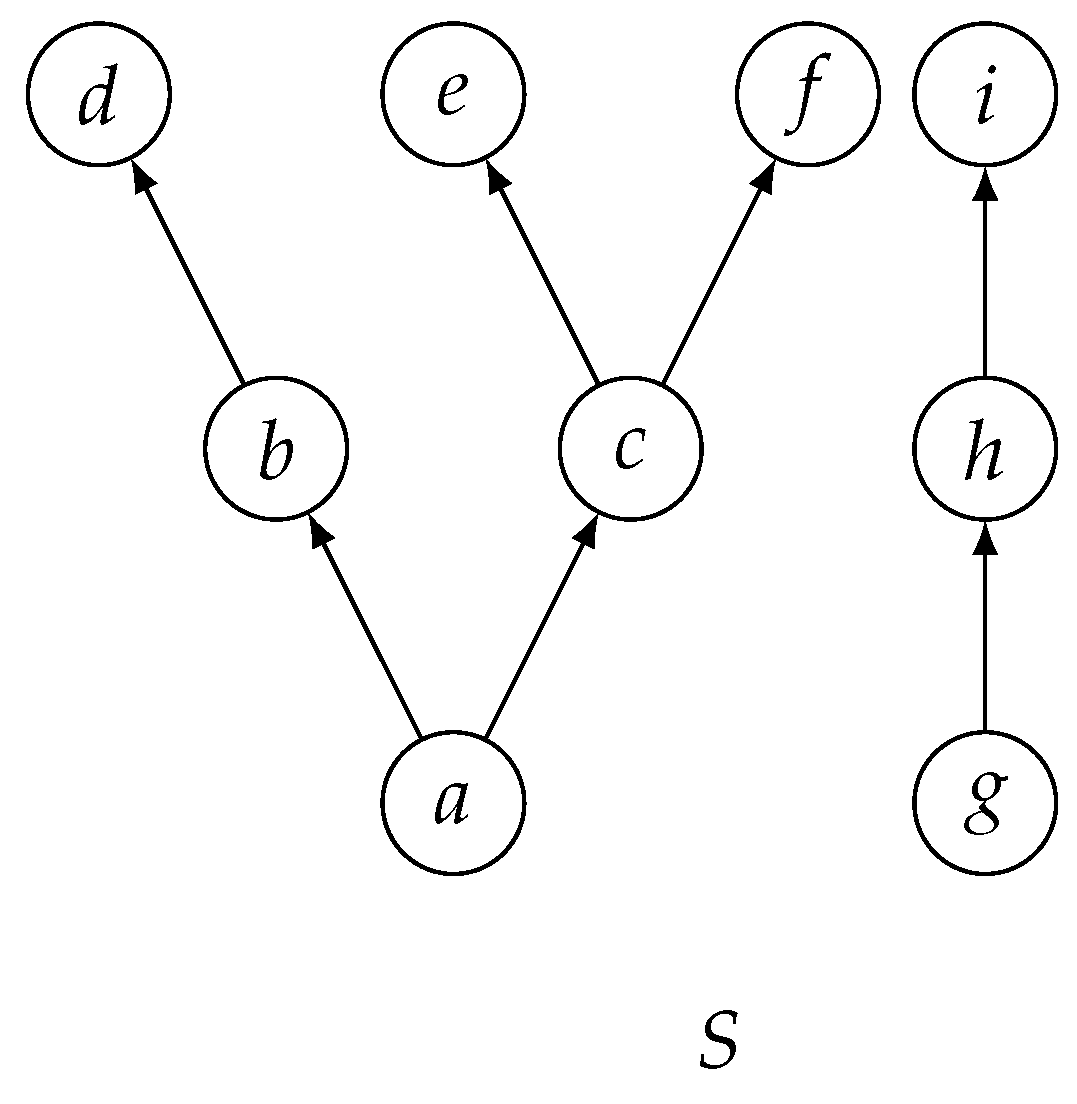
Example 4. We conclude by describing the structure of an arbitrary additive biderivation b on , where is the poset introduced in Example 3. Recall that For any , the biderivation takes the form