1. Introduction
Let
be a simple, connected, finite, and undirected graph, where
n is the number of its vertices and
m is the number of its edges. An edge labeling of
G is an allocation of symbols (integers) to the edges of
G, governed by specific criteria. Graph labeling, whether it is vertex or edge labeling, plays a significant role in understanding and resolving issues associated with graphs and networks across a wide range of fields. It facilitates effective representation, identification of patterns, optimization, and communication in diverse applications. As a fundamental tool in graph theory, graph labeling holds important practical implications (see [
1,
2,
3]). Although graph labeling is crucial for applications, it remains an active area of research within graph theory. Two fundamental questions for edge labeling are: What is the family of graphs that admit an edge labeling? What are the necessary and sufficient conditions for these graphs to have such labeling?
The paper is organized into two main sections and multiple subsections to ensure a clear structure of the content. The introductory part offers contextual information concerning graph labeling, elucidating the importance of the present study and introducing the research problem, which focuses on investigating the edge odd graceful labeling in diverse graph families. The results section is further divided into subsections numbered
Section 2.1,
Section 2.2,
Section 2.3,
Section 2.4 and
Section 2.5. Within each of these subsections, we define specific categories of graphs, namely, closed flower graphs, cog wheel graphs, triangulated wheel graphs, double crown-wheel graphs, and crown-triangulated wheel graphs, respectively. For every graph family, we provide comprehensive conditions that are both necessary and sufficient to establish their edge odd graceful nature. It is worth noting that all the graphs examined in this paper have no loops, no multi-edges, and no weighted edges.
Most of the references in the literature attribute the beginning of graph labeling to the work of Rosa [
4] in 1967. In Rosa’s paper, a labeling of
G called
-valuation was introduced as an injection
from the set of vertices
to the set
such that when each edge
is designated as
, the derived edges are assigned distinct symbols. The same labeling is named “graceful labeling” by Solomon W. Golomb [
5].
Another kind of labeling was defined in 1991 by Gnanajothi [
6]. It is called an odd graceful labeling, which is an injection
from the set of vertices
to the set
such that when each edge
is designated as
, the derived edges are assigned
.
In 1985, Lo [
7] considered a modified version of the graceful labeling of a graph
G and called it edge graceful labeling. It is defined as a bijection
from the set of edges
to the set
in a way that the derived transformation
from the set of vertices
to
given by
is a bijection.
In 2009, Solairaju and Chithra [
8] defined a new labeling of
G by combining the ideas of Gnanajothi and Lo and they call it edge odd graceful labeling. This labeling is a bijection
from the set of edges
to the set
in a way that the derived transformation
from the vertex-set
to the set
given by
is injective. A graph is named an edge odd graceful if it admits an edge odd graceful labeling. A graph is called graceful (resp. odd graceful, edge graceful) if it admits a labeling that is graceful (resp. odd graceful, edge graceful). For more results on edge odd graceful graphs, see [
9,
10,
11,
12,
13].
It is not difficult to see that not all graphs are edge odd graceful. For instance, not all stars are edge odd graceful, as we can observe in the following:
Observation 1. For the star graph is edge odd graceful if and only if n is an even integer.
Proof. Let be a star graph with the vertex set , where . Then . Each edge in is incident with and exactly one leaf vertex for . All the ways to label the edges of are equivalent.
Now, each leaf vertex has the same labeling as the edge incident with it. Therefore, the outer vertices receive distinct labels from , while the central vertex is labeled as . Therefore, is labeled as 0 if n is even, which means that is edge odd graceful in this case. However, if n is odd, , where k is an odd positive integer less than , this means that is not edge odd graceful in this case. □
Note that identifying the outer vertices
of a star
with the vertices of an
n-cycle,
, with vertex set
, results in the wheel
. For the graph
, the vertices
and
are combined into a single vertex
. It was shown in [
14] that the wheel graph
is edge odd graceful. This manuscript investigates some graphs that are defined in a similar way.
2. Results
2.1. Closed Flower Graphs
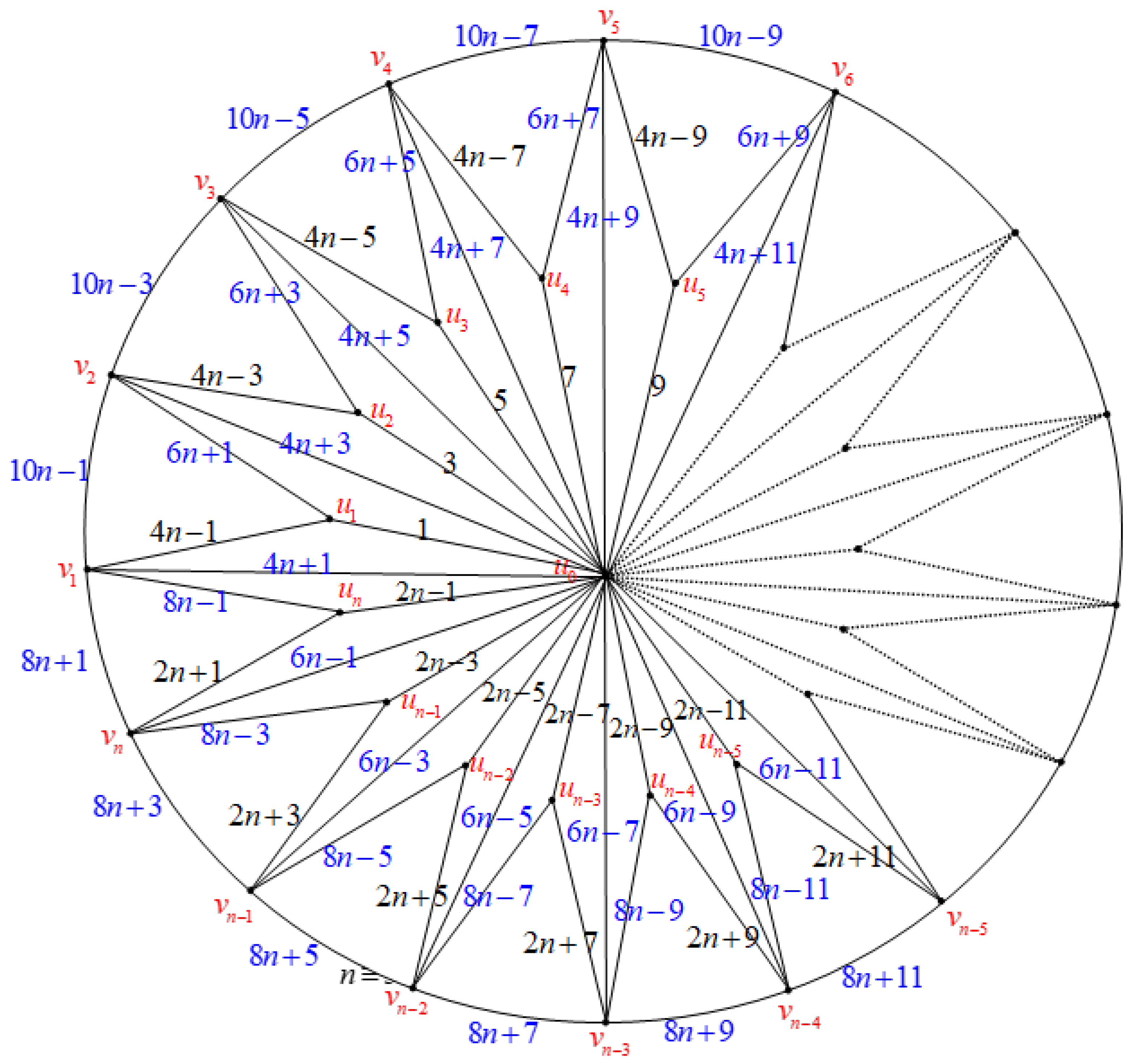
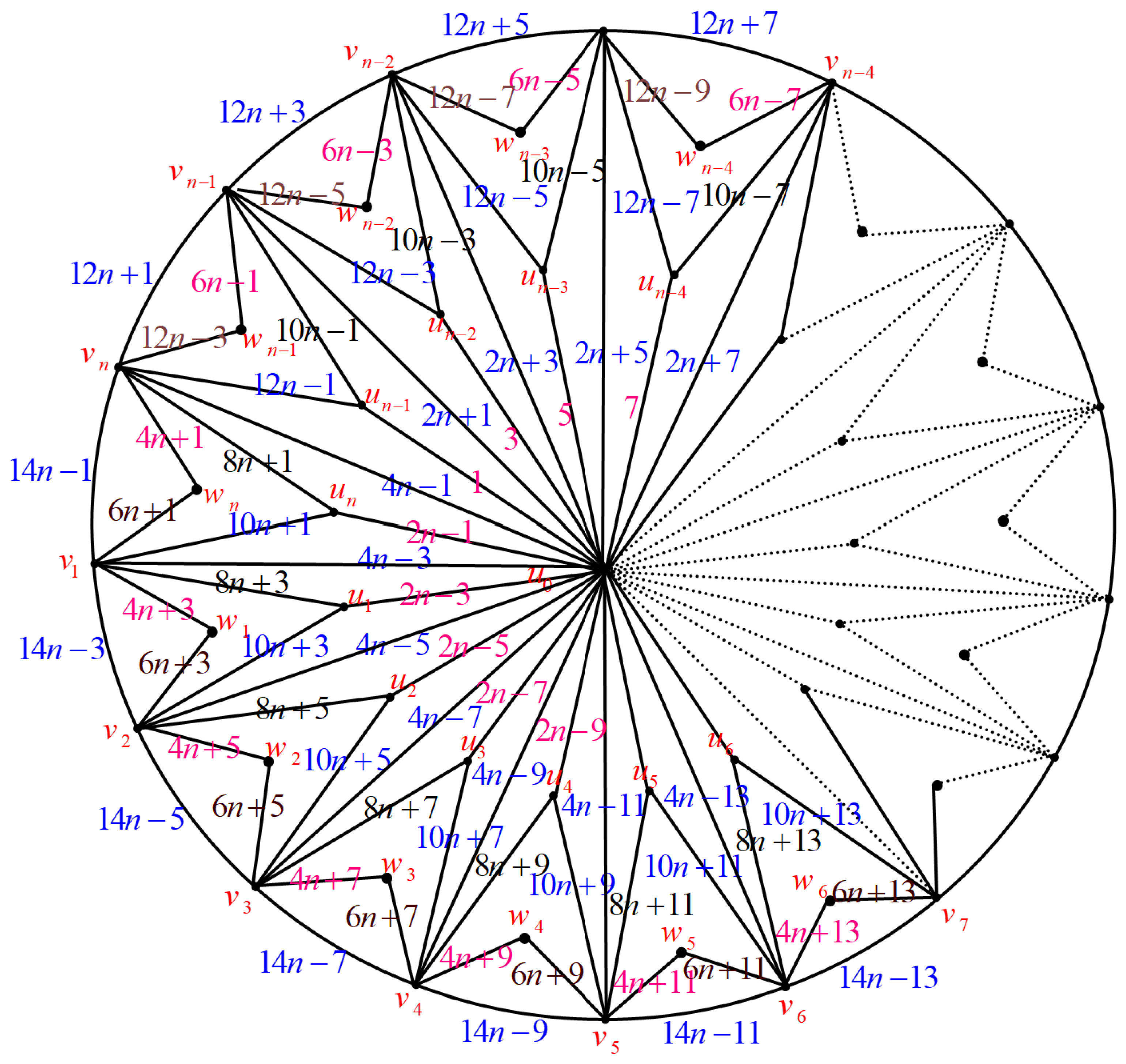
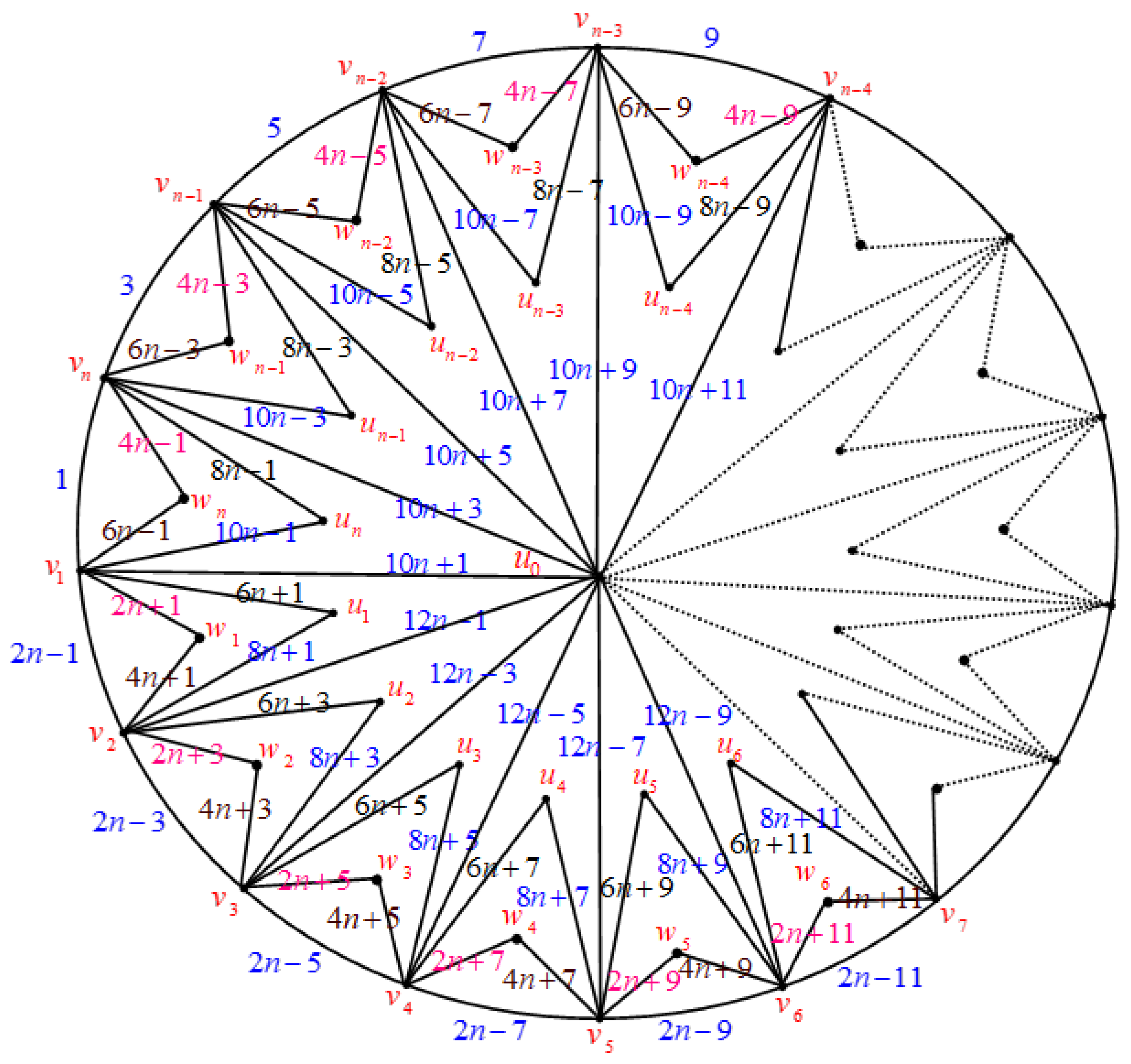
The first graph is the closed flower graph, error. It is obtained by connecting a cycle with vertex set and a star graph with vertex set , such that each vertex is connected to vertices and for . In addition the vertex is adjacent to and .
Theorem 1. The closed flower graph, , is edge odd graceful for n greater than or equal to 3.
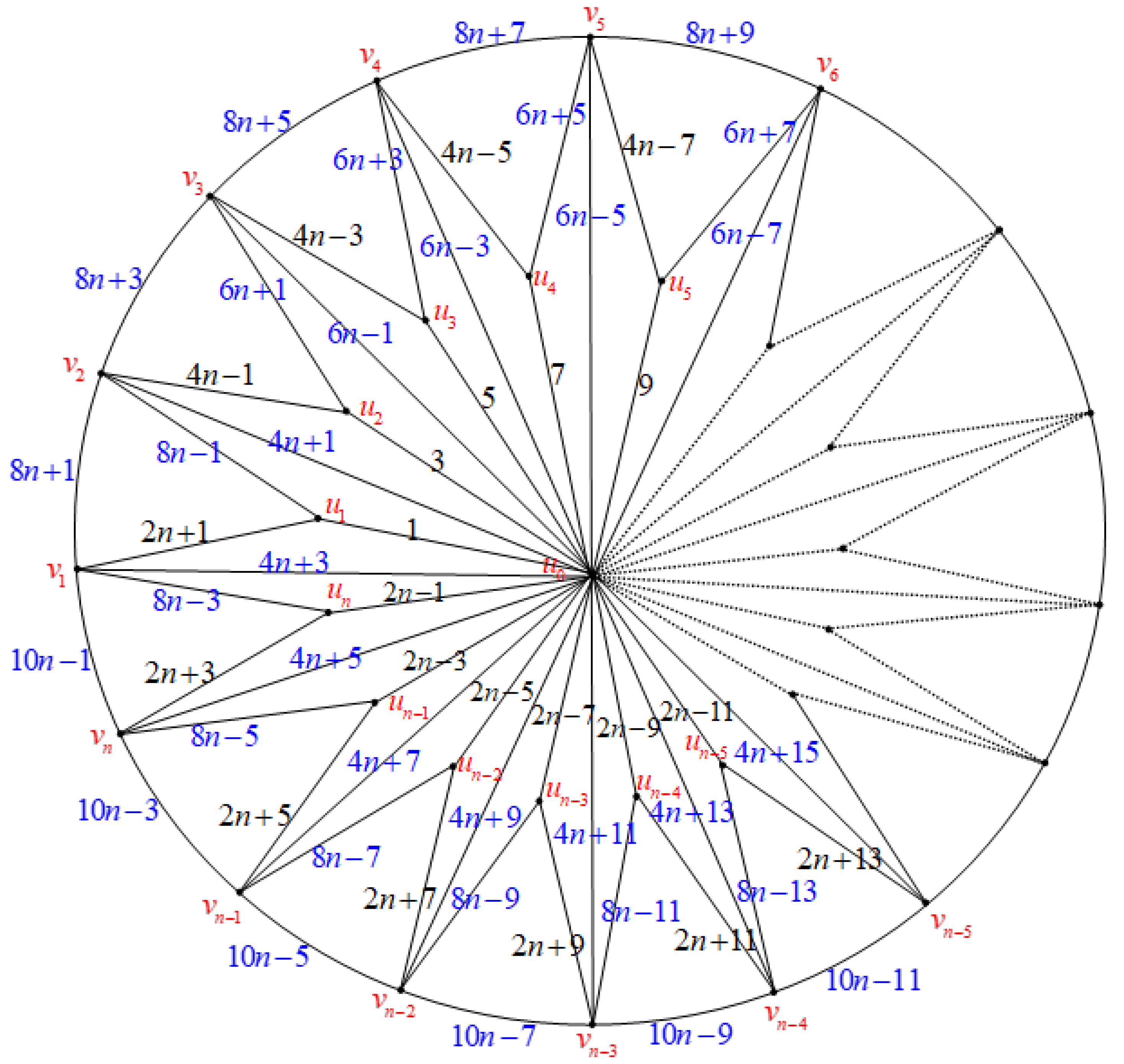
Proof. Let be a closed flower graph, where n is an integer greater than or equal to 3. The size of is . Assume that the vertex set of is . We show that this graph is edge odd graceful by considering three different cases:
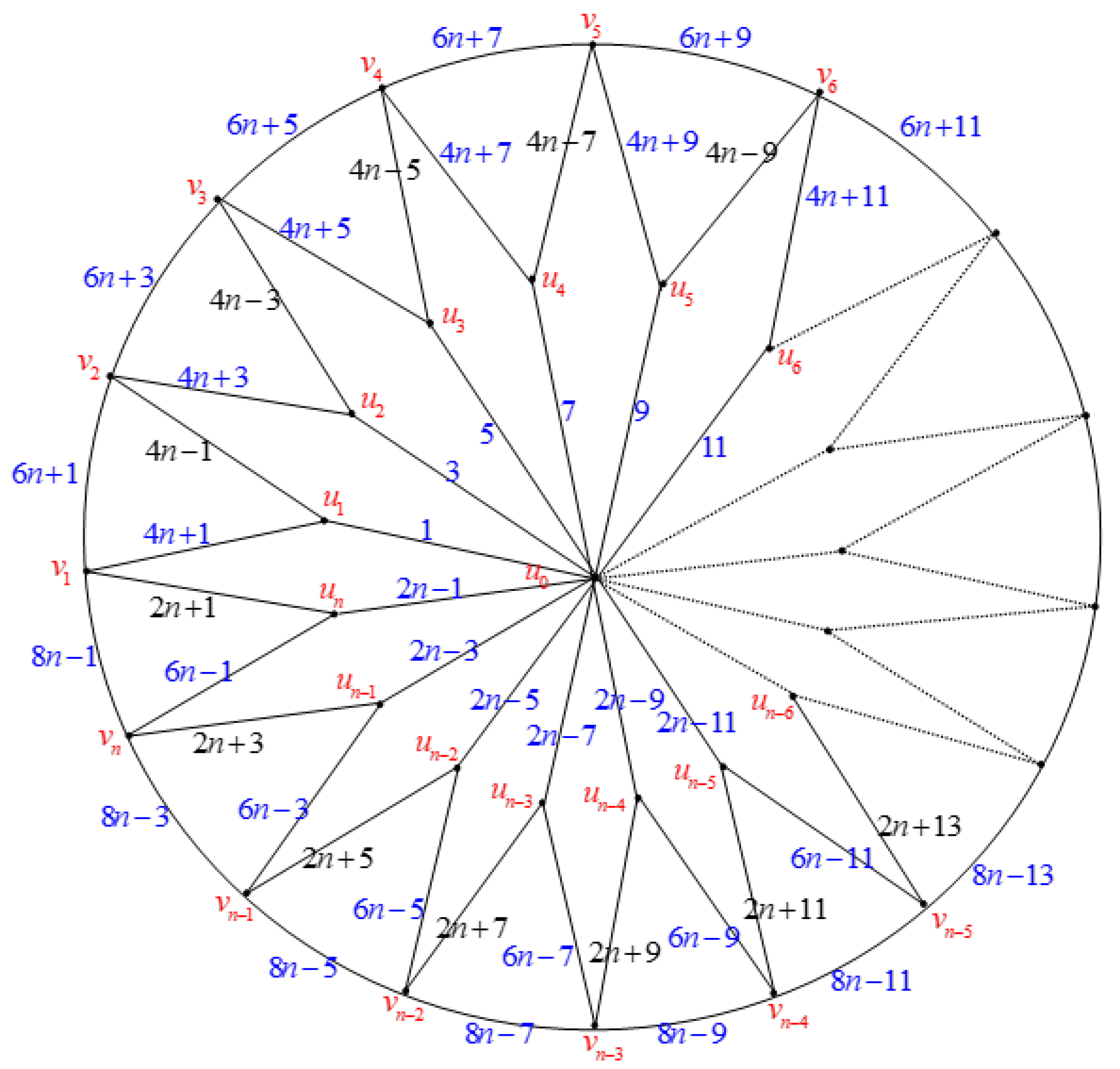
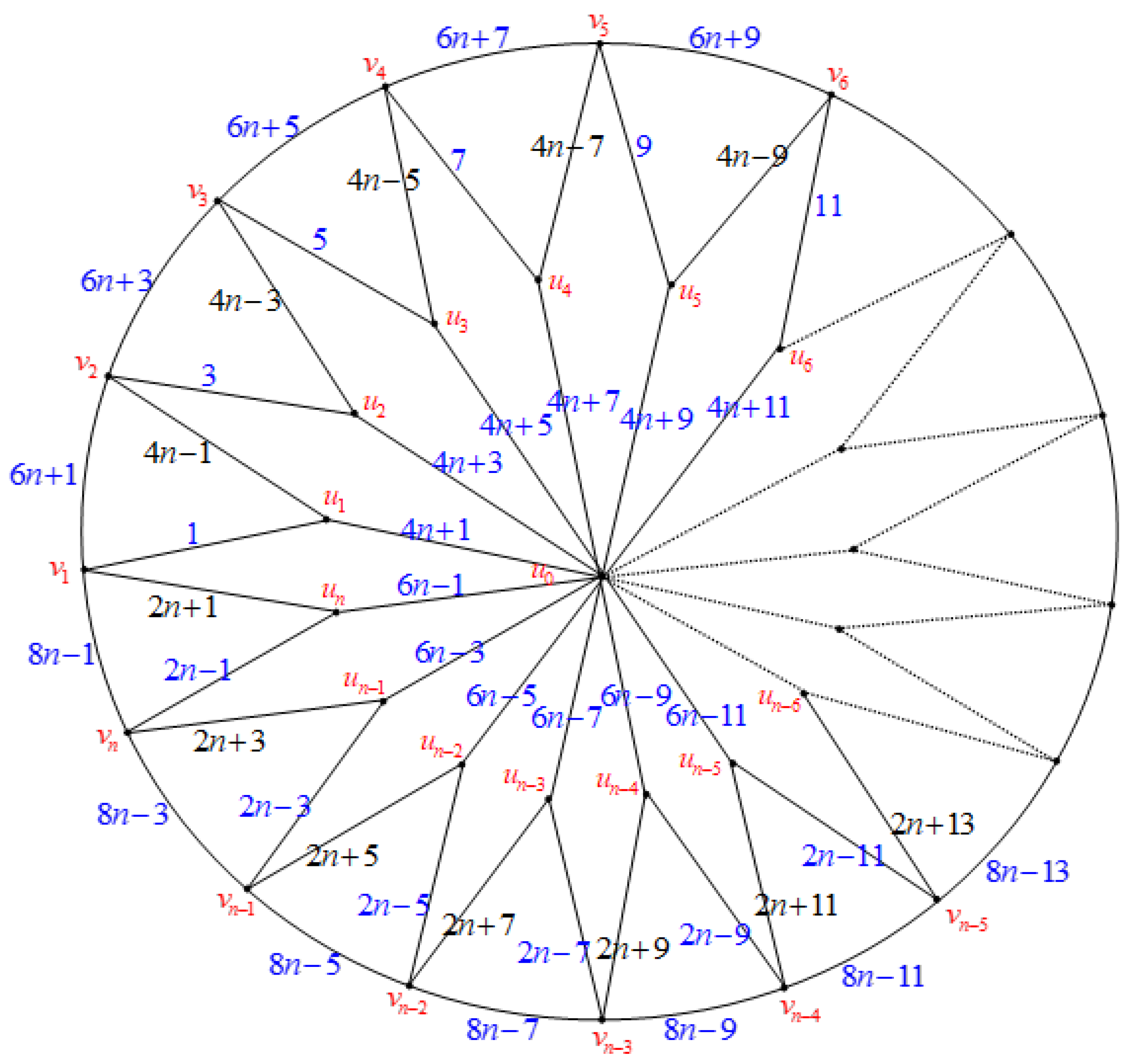
Case (1): Let
be as in
Figure 1 and
.
Define the map
Therefore, the derived transformation
on the set of vertices is given in the following manner:
Furthermore,
In this case, the map
from
to
, respectively, is one to one. Additionally, it is a one to one map from
to
, respectively. It is evident that
and
do not share any common elements. Moreover,
belongs to
, and
has no elements in common with
or
. Consequently,
is a bijective function, and the closed flower graph is edge odd graceful when
.
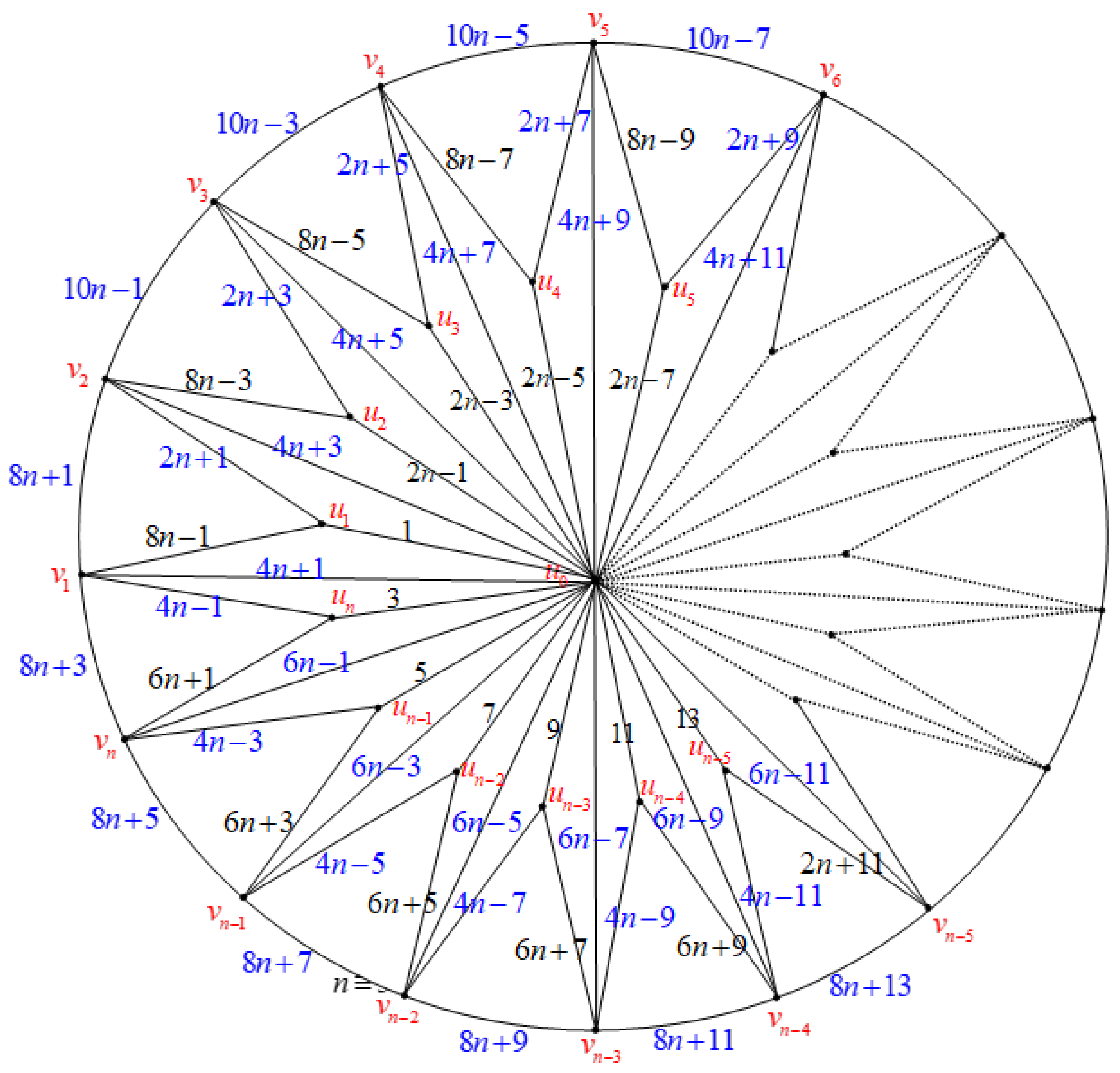
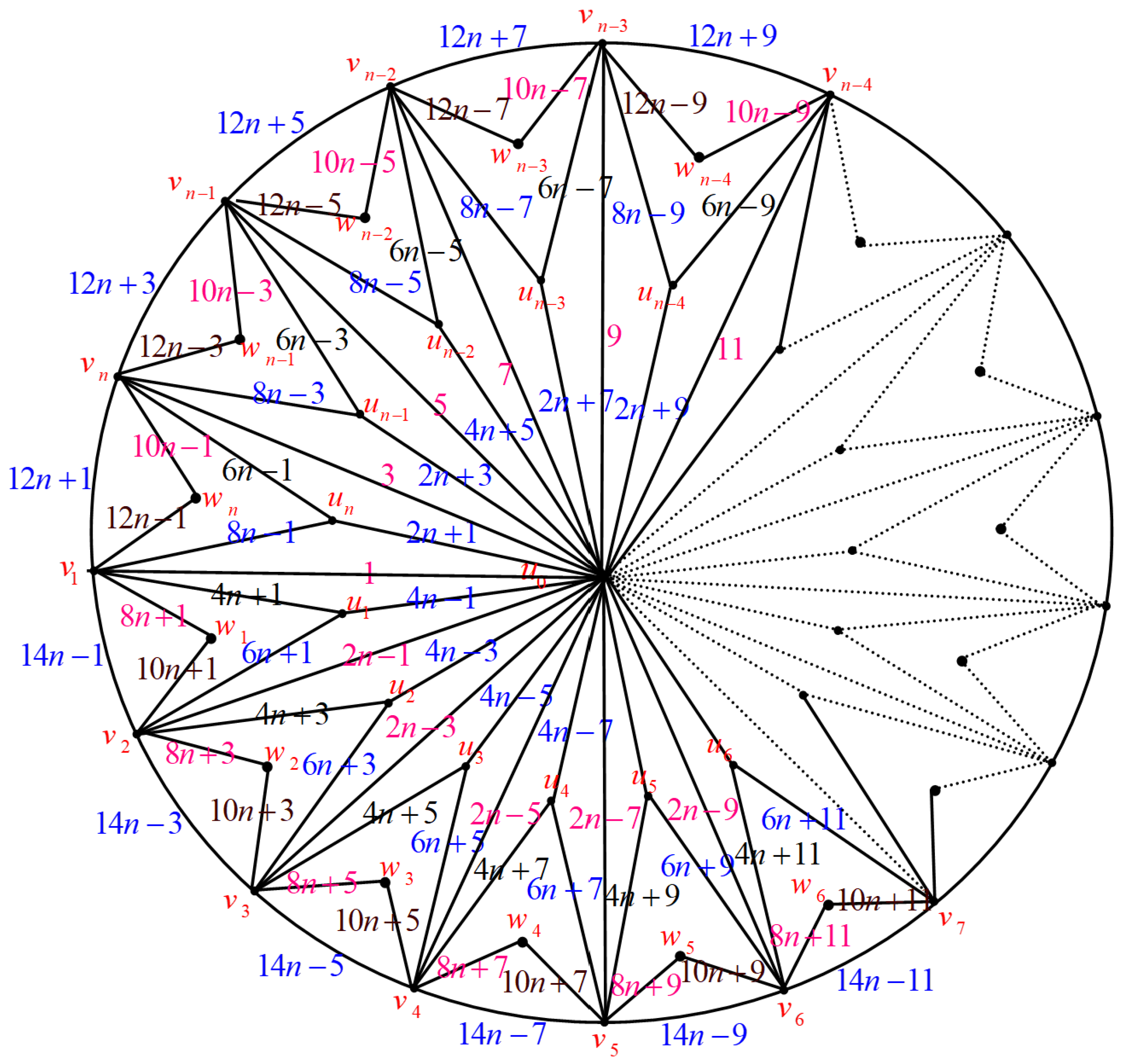
Case (2): Let
be as in
Figure 2 and
.
Therefore, the derived transformation
on the set of vertices is given in the following manner:
In this case, the map from to , respectively, is one to one. Additionally, it is a one to one map from to , respectively. It is evident that and do not share any common elements. Consequently, is a bijective function, and the closed flower graph exhibits an edge odd graceful property when . After considering case (1) and case (2), it can be concluded that every closed flower graph possesses the property of being edge odd graceful for values of n greater than or equal to □
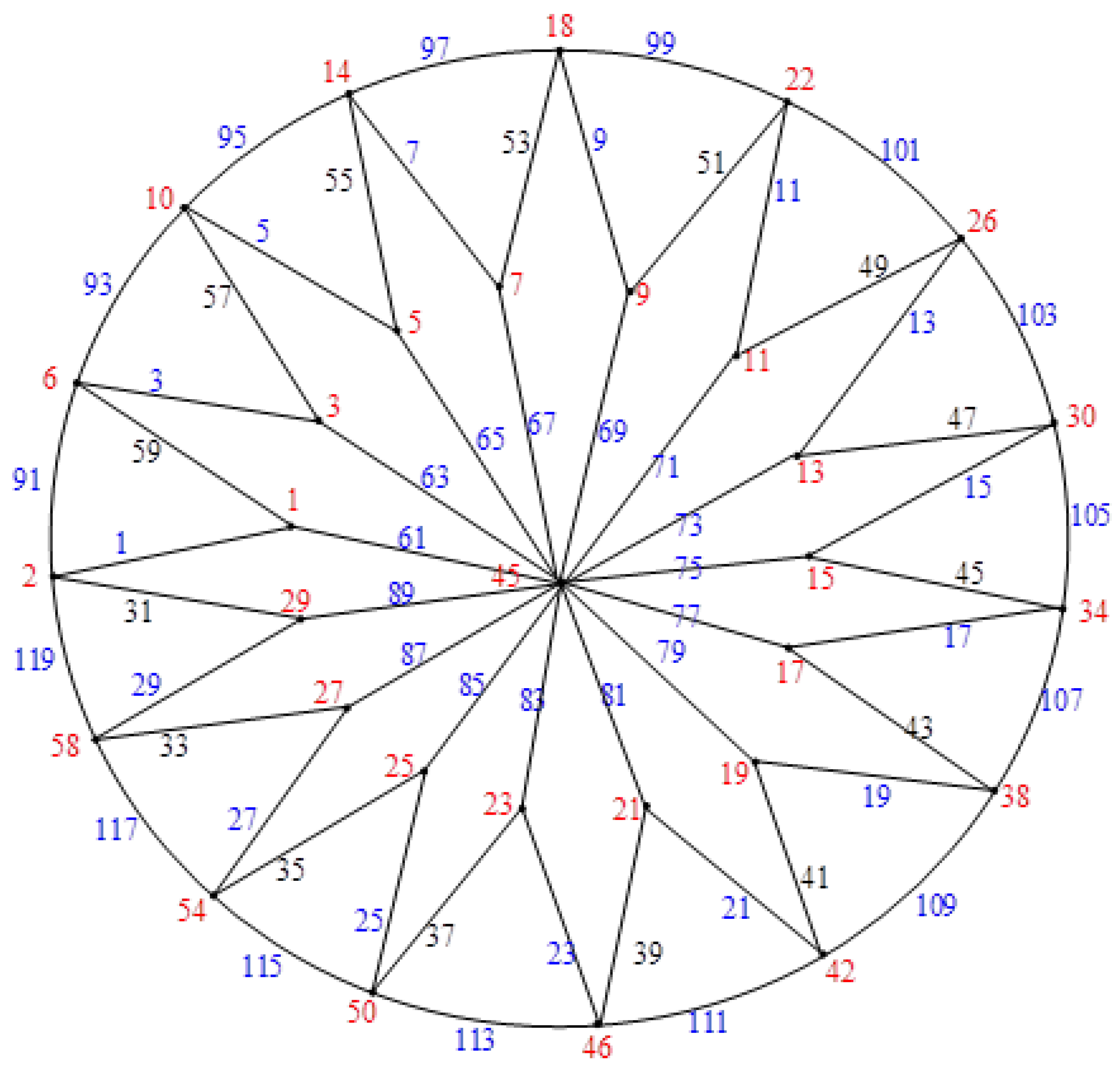
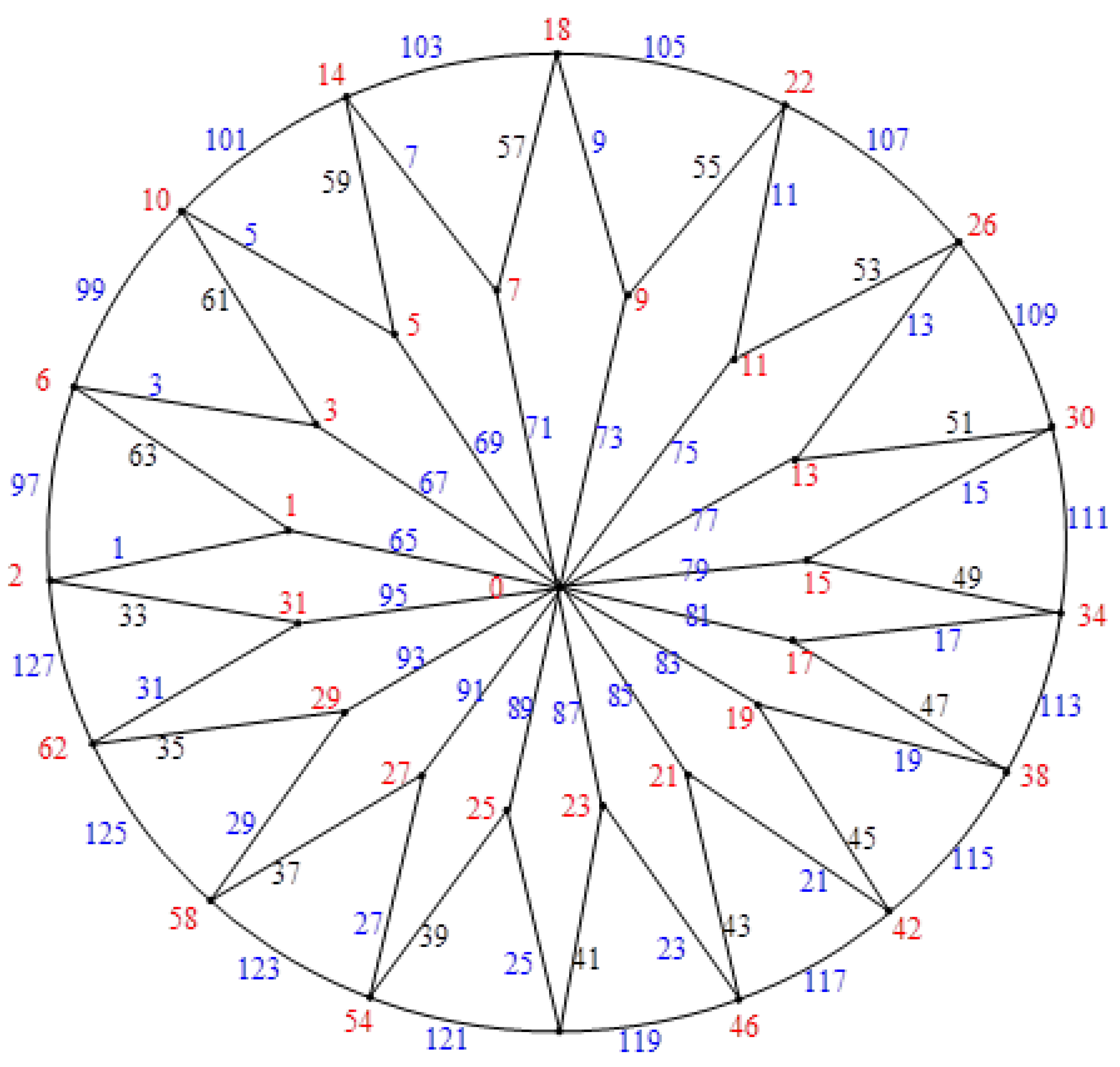
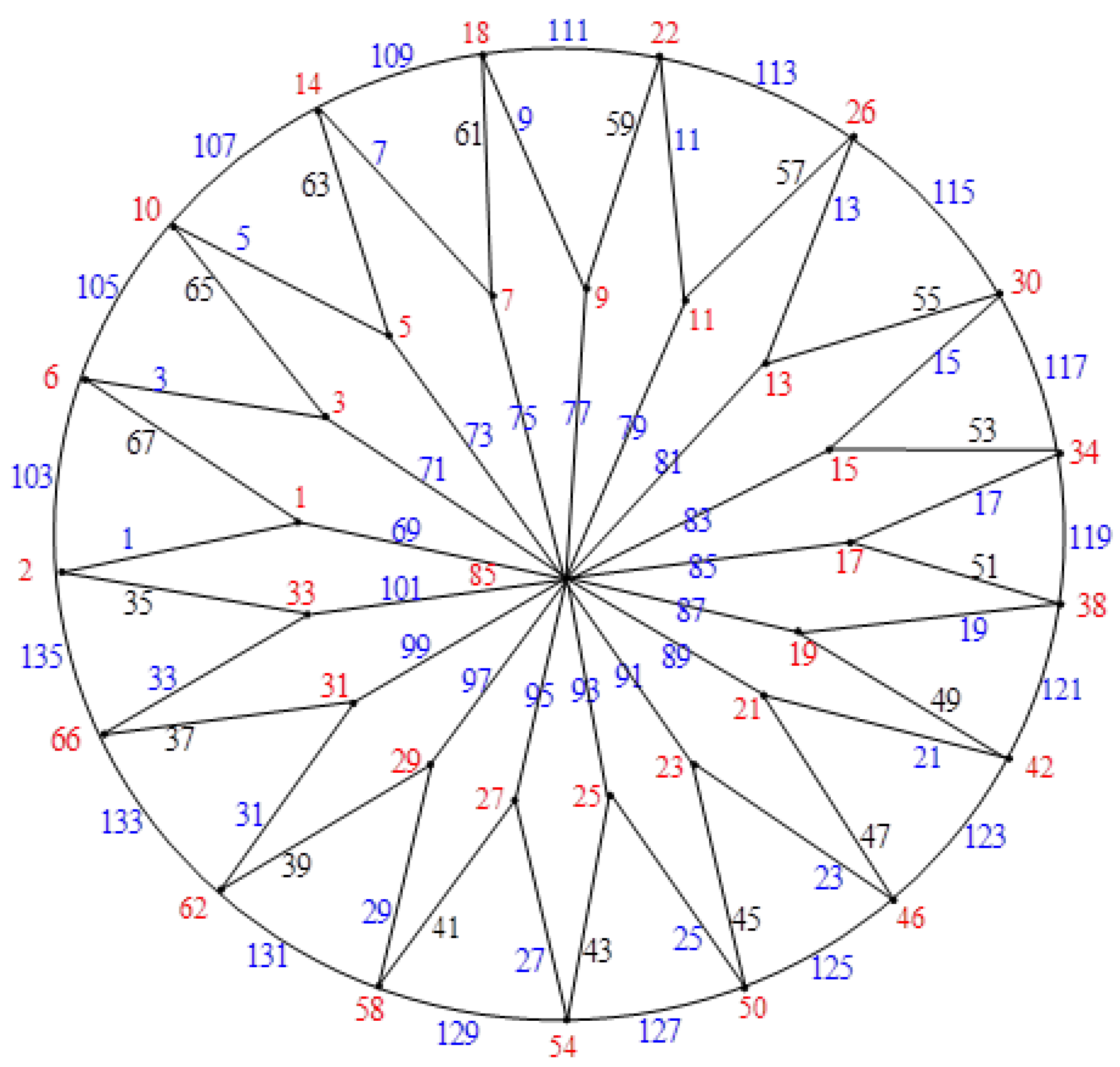
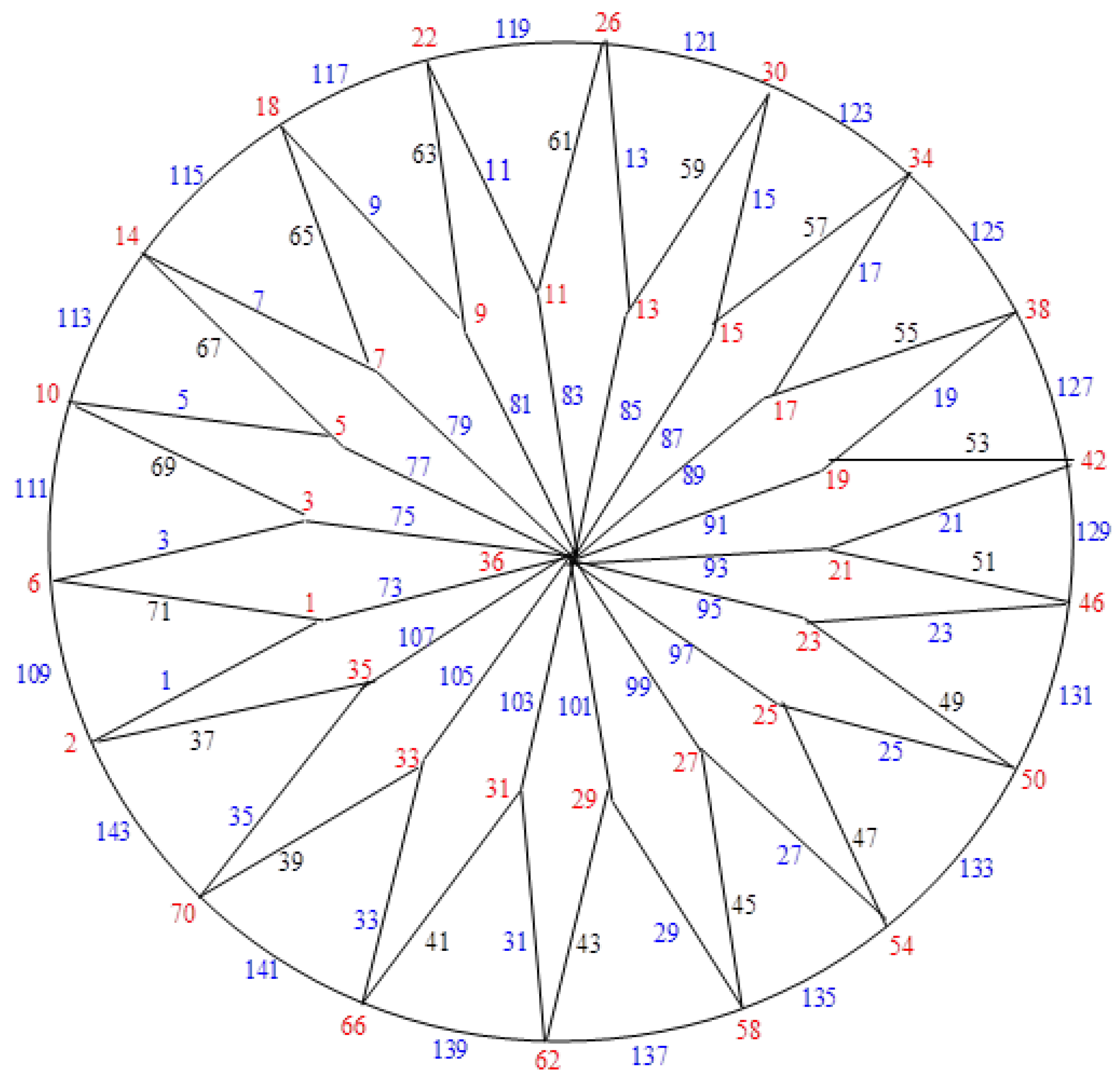
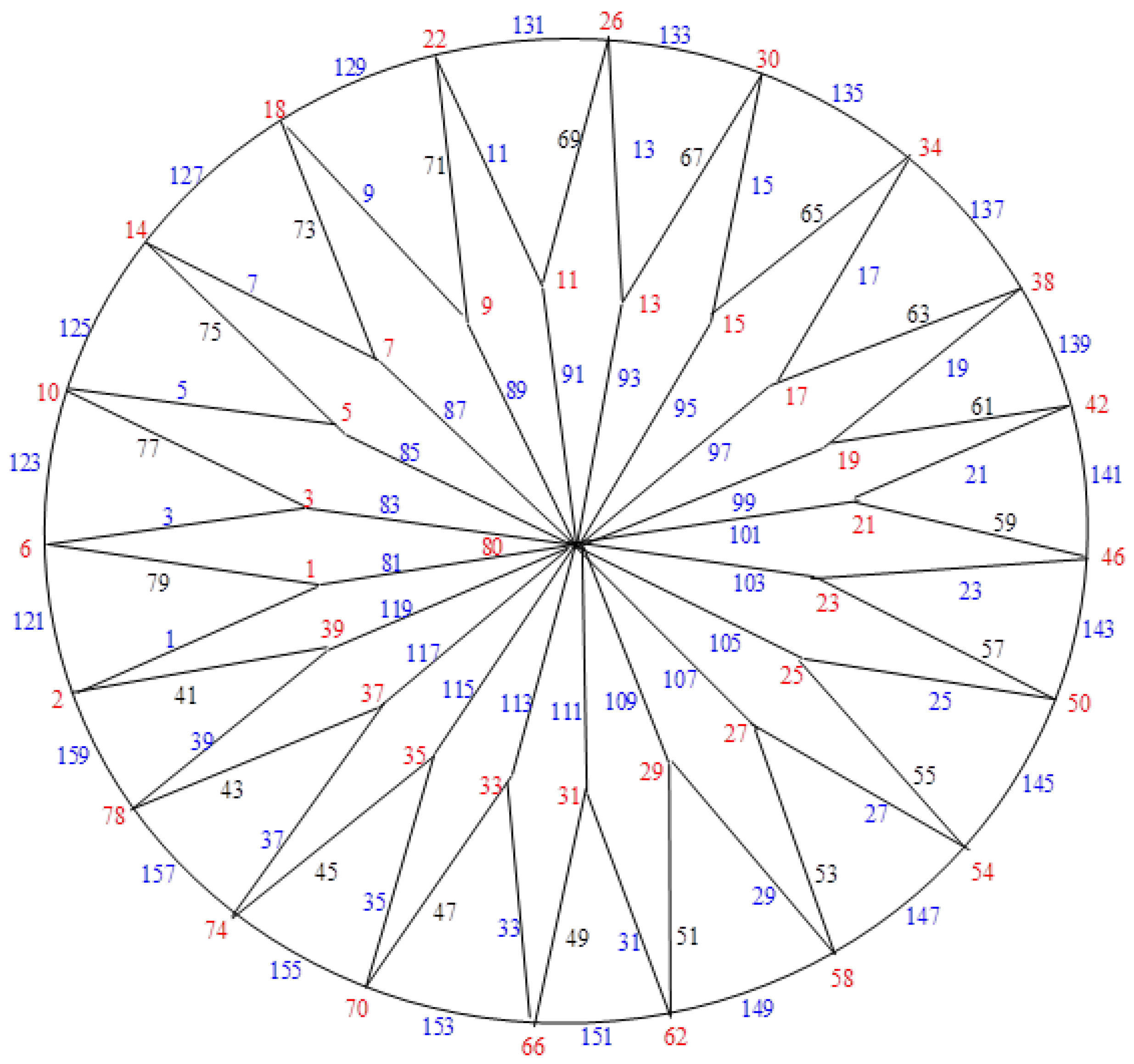
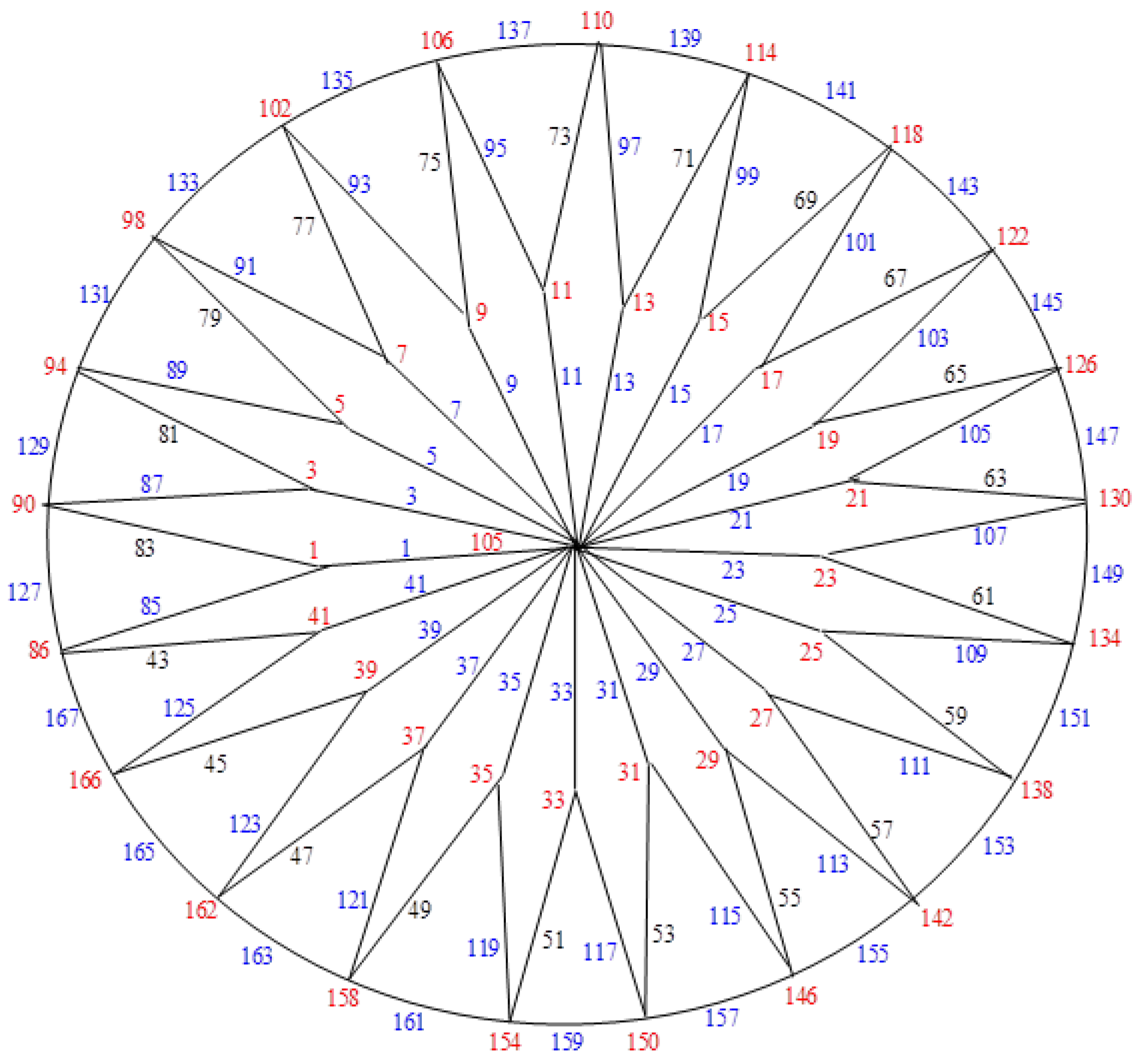
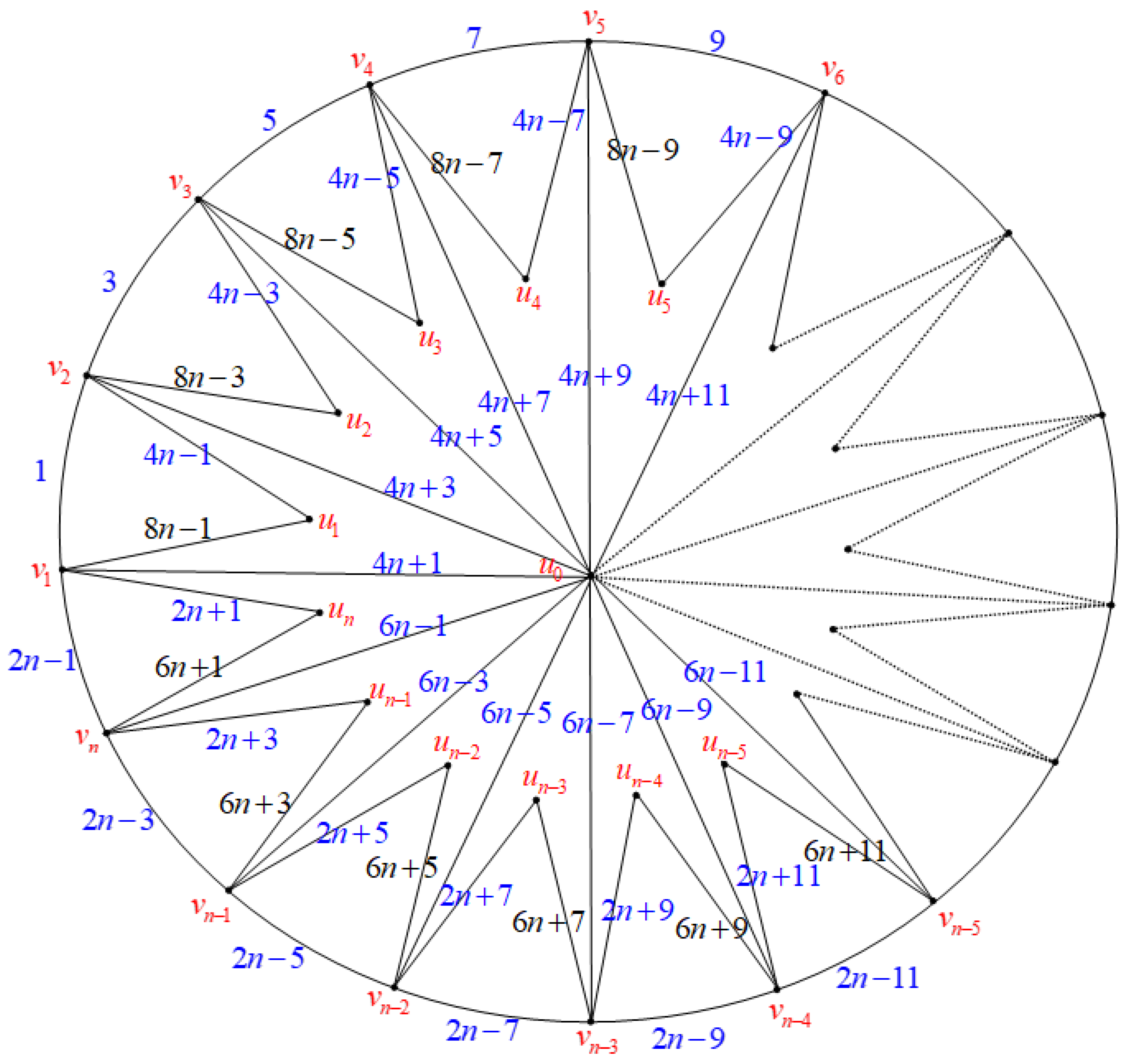
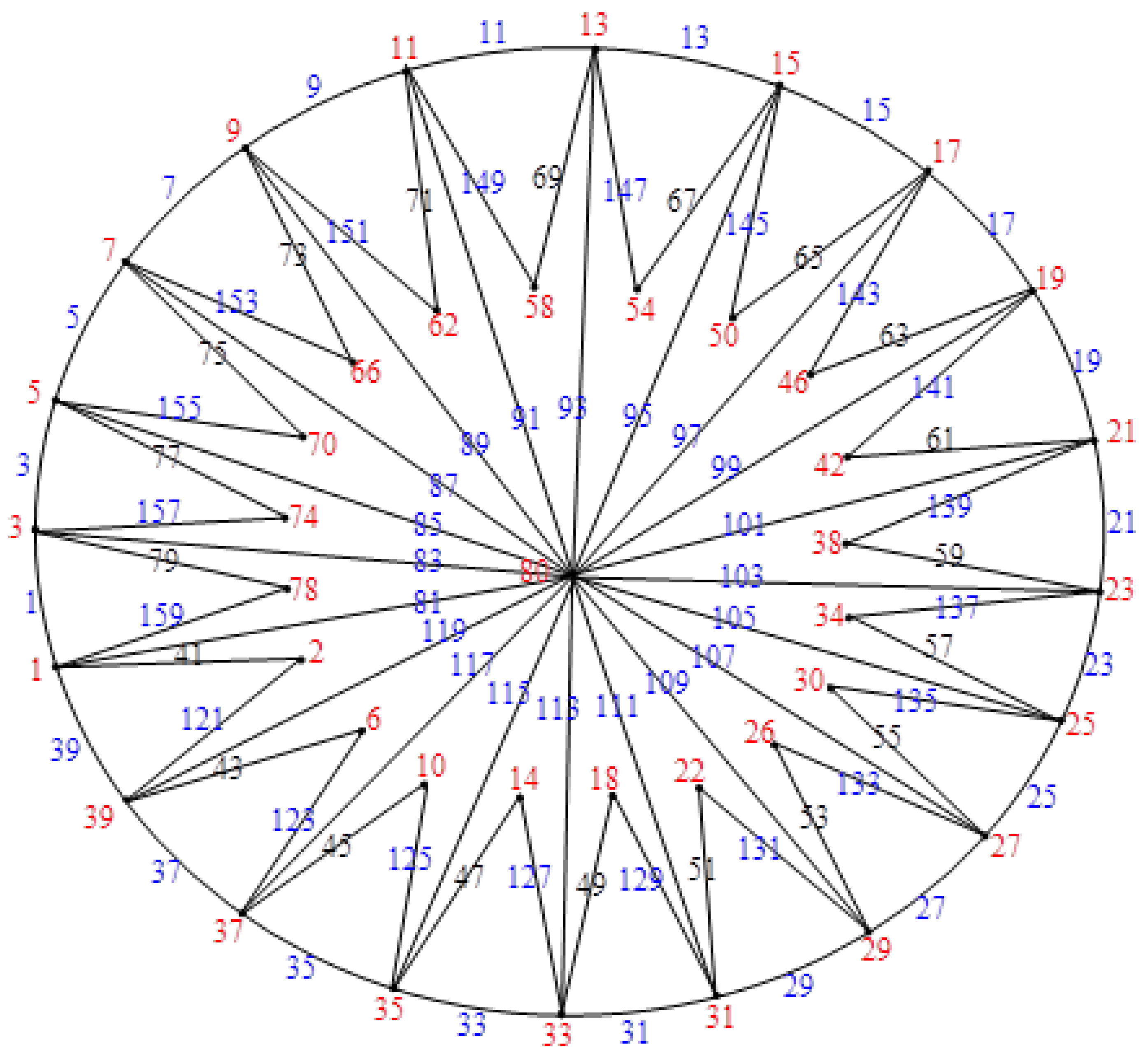
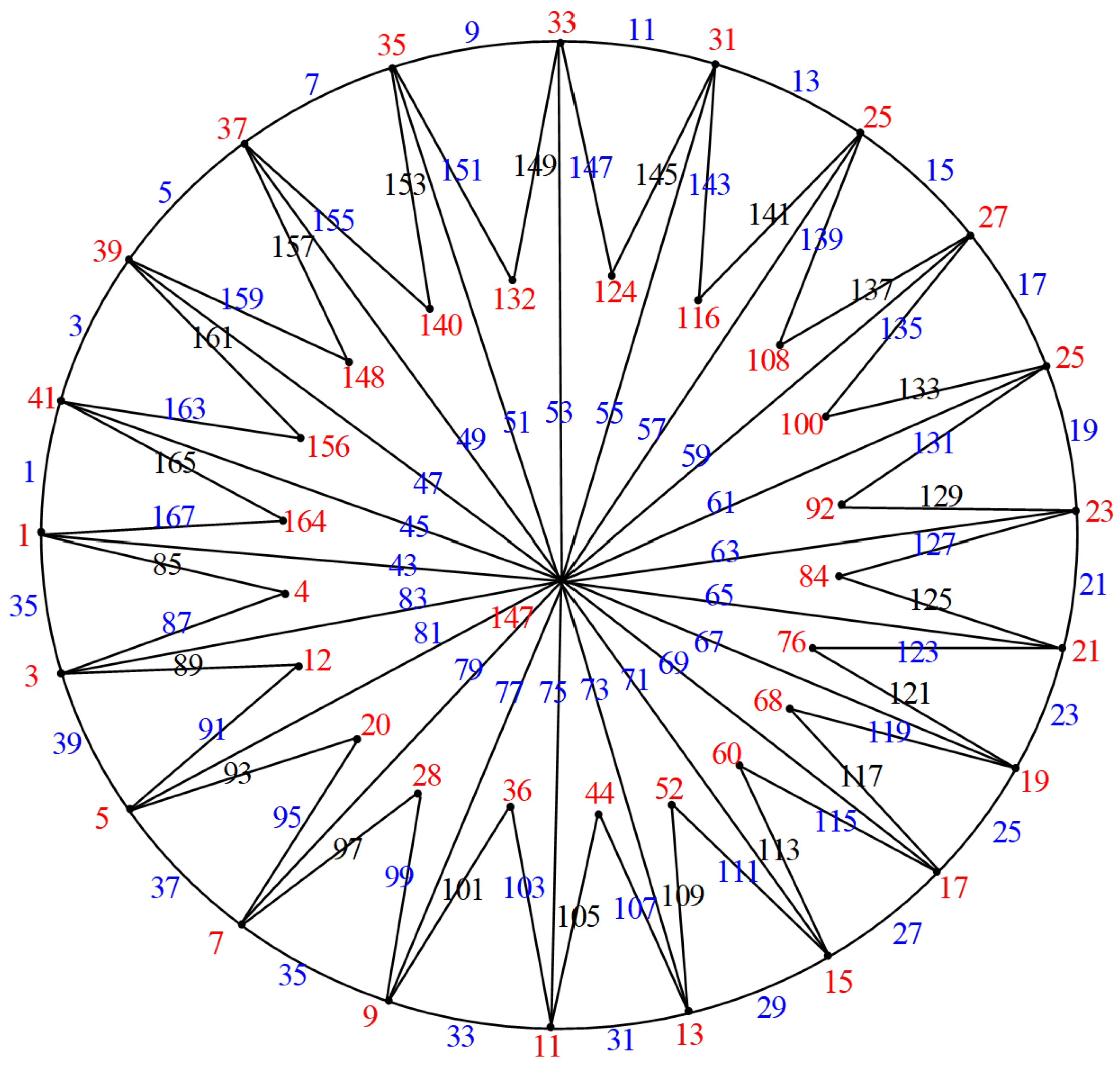
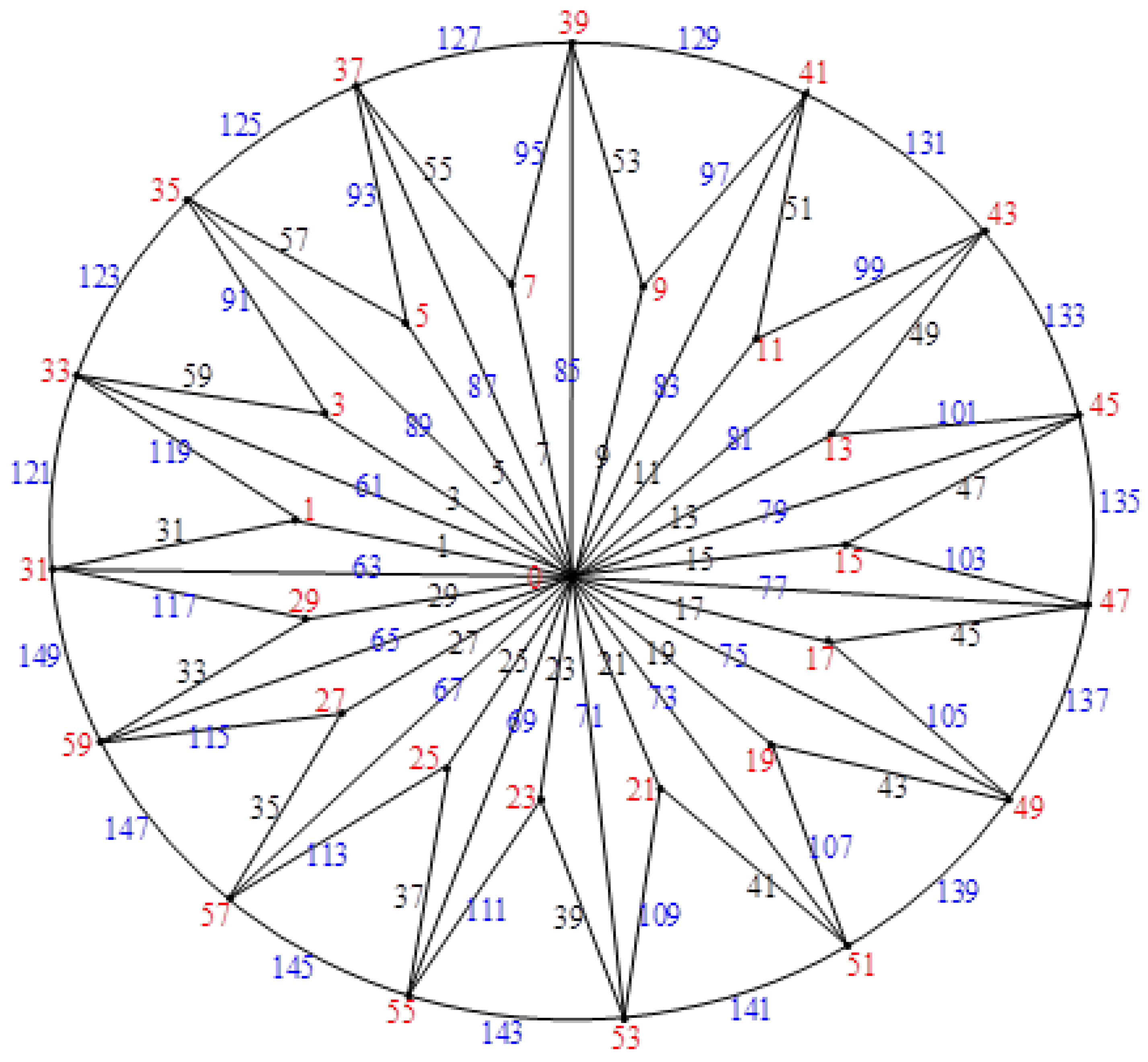
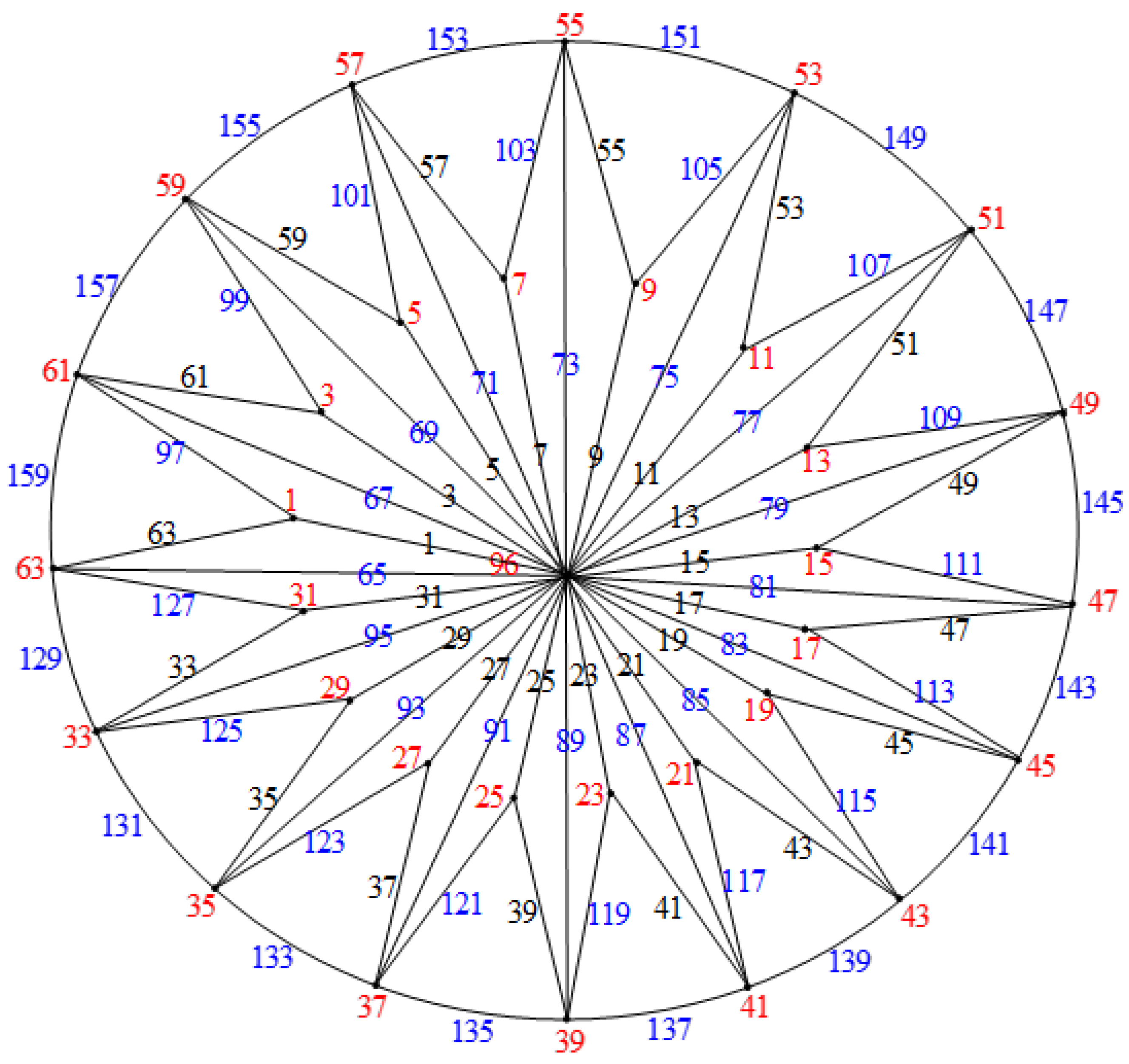
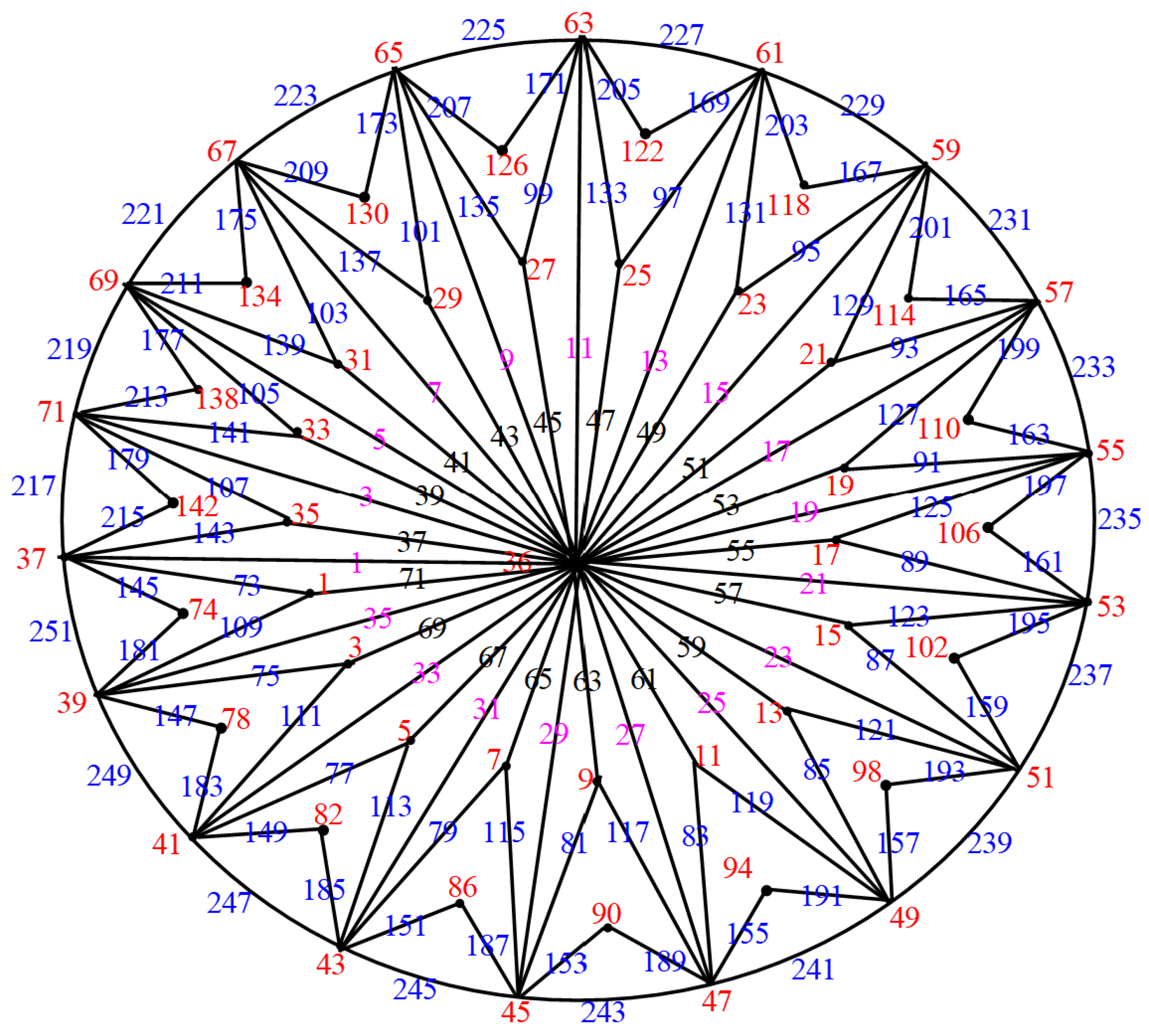
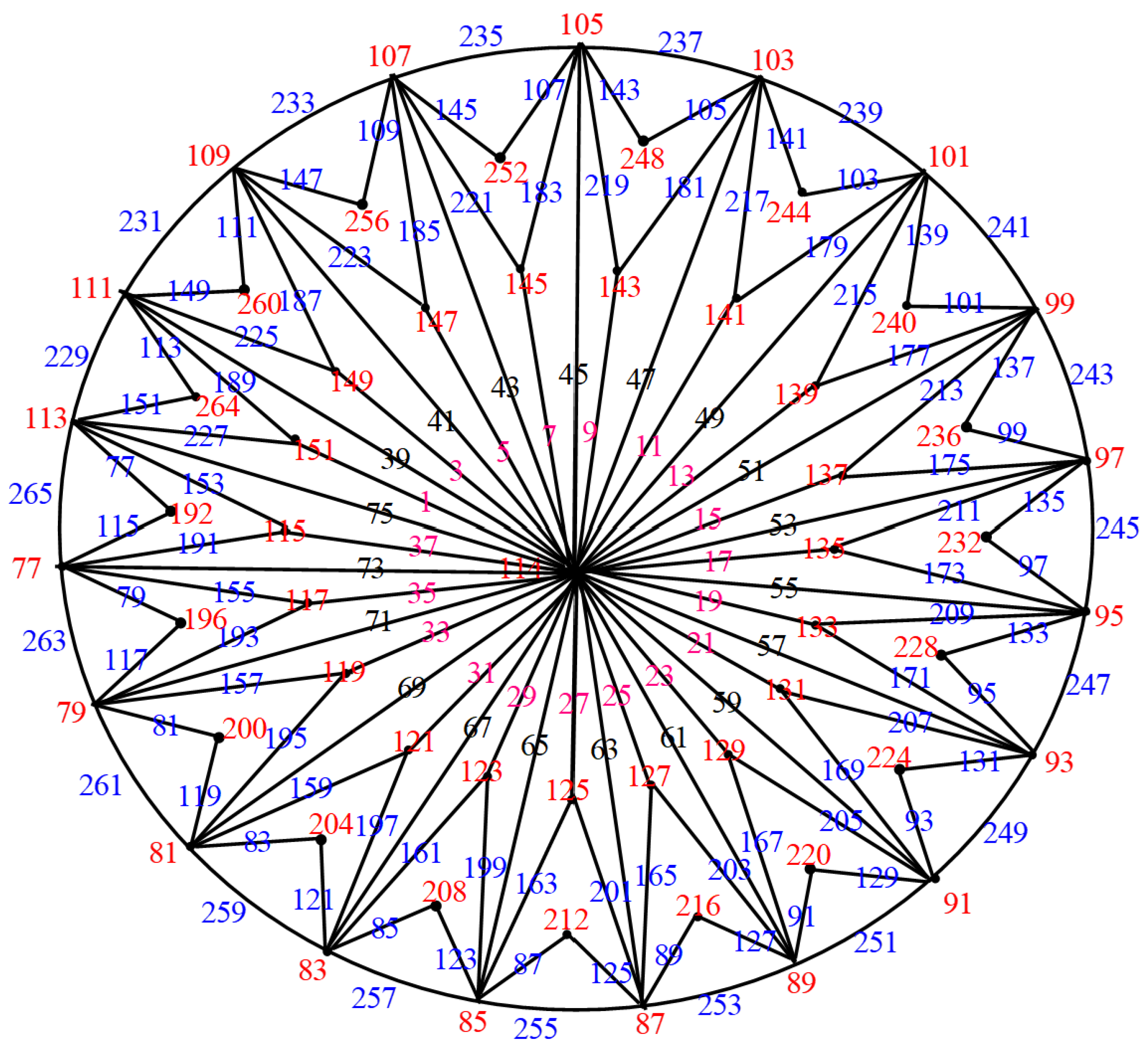
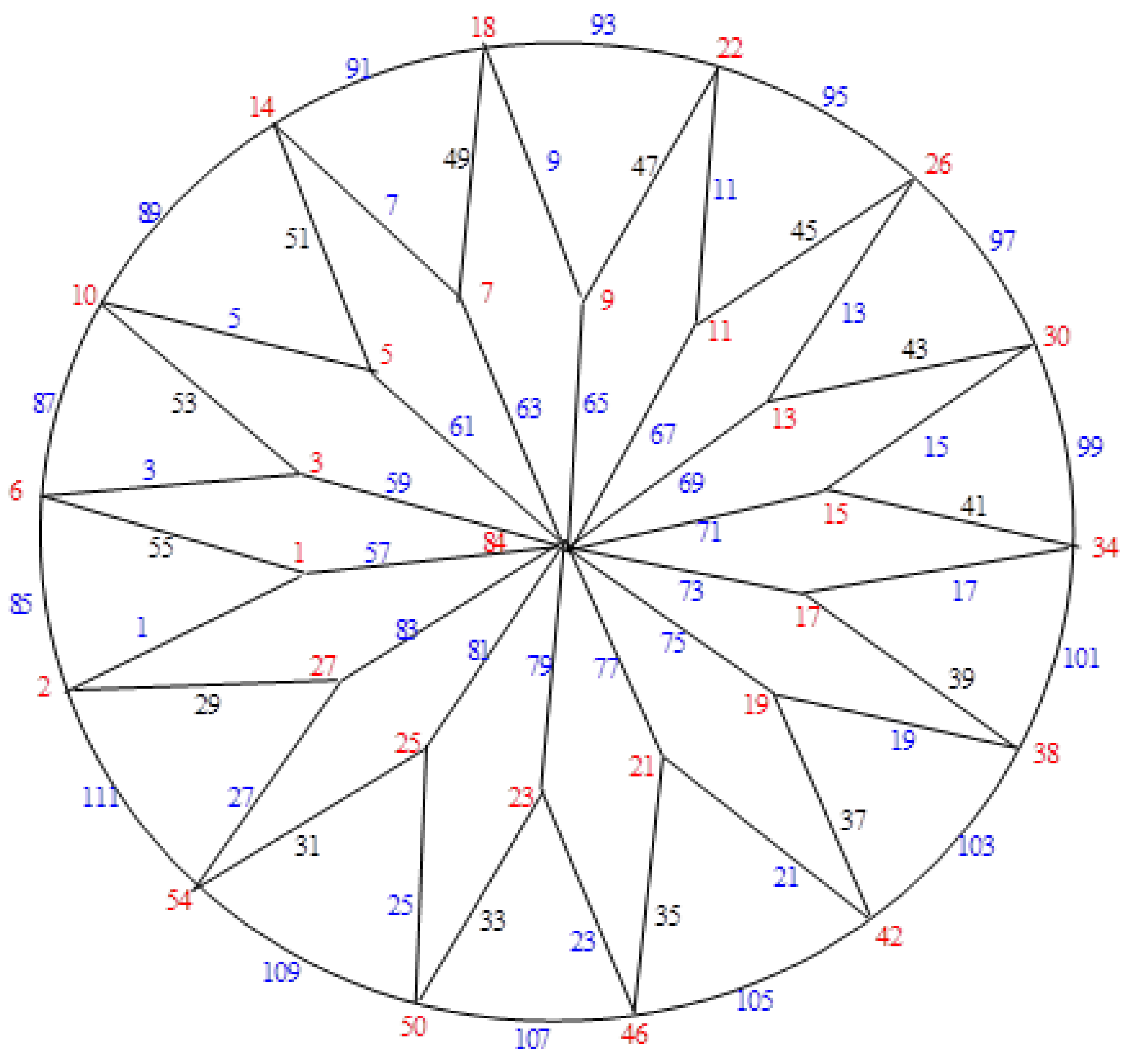
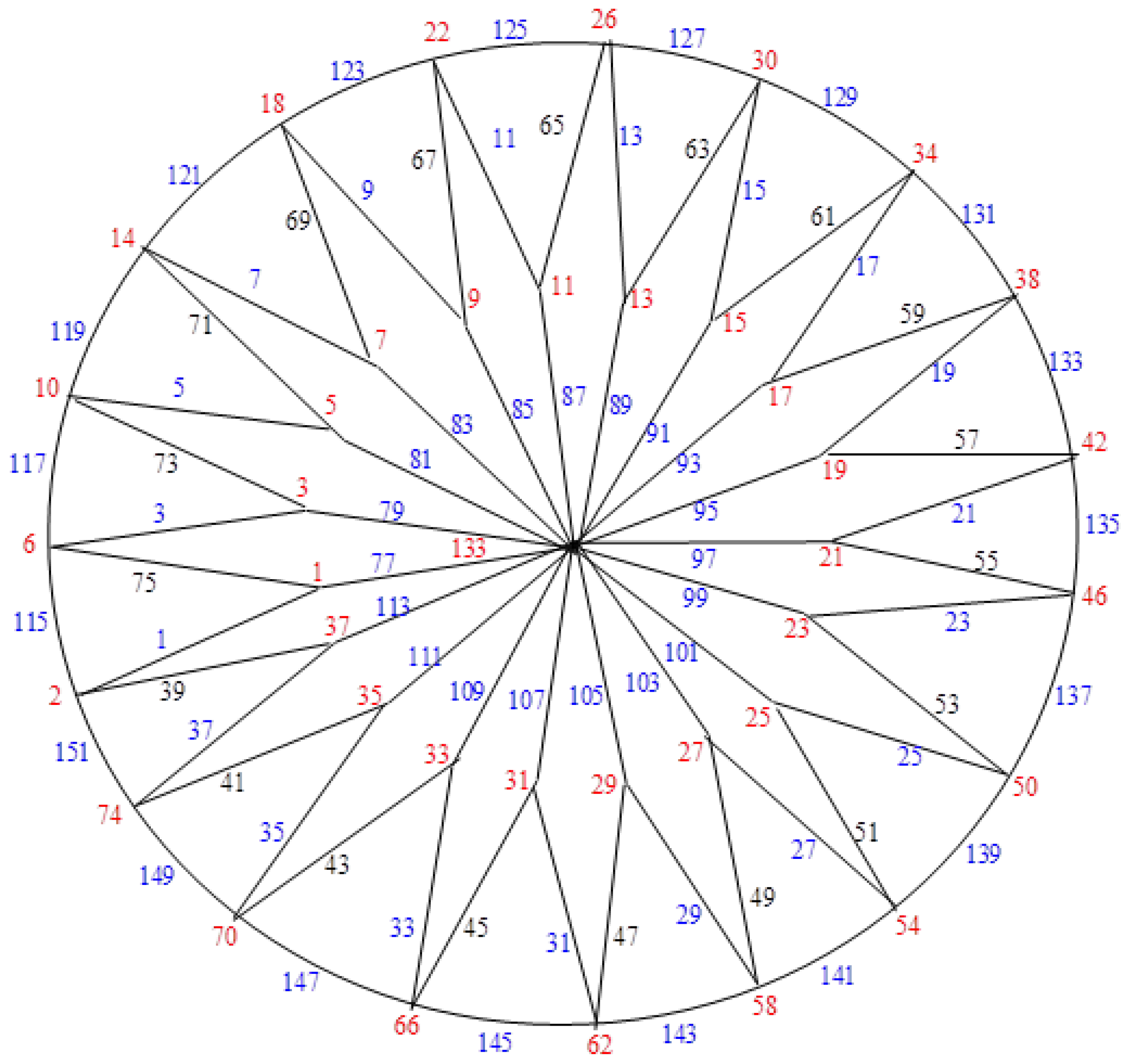
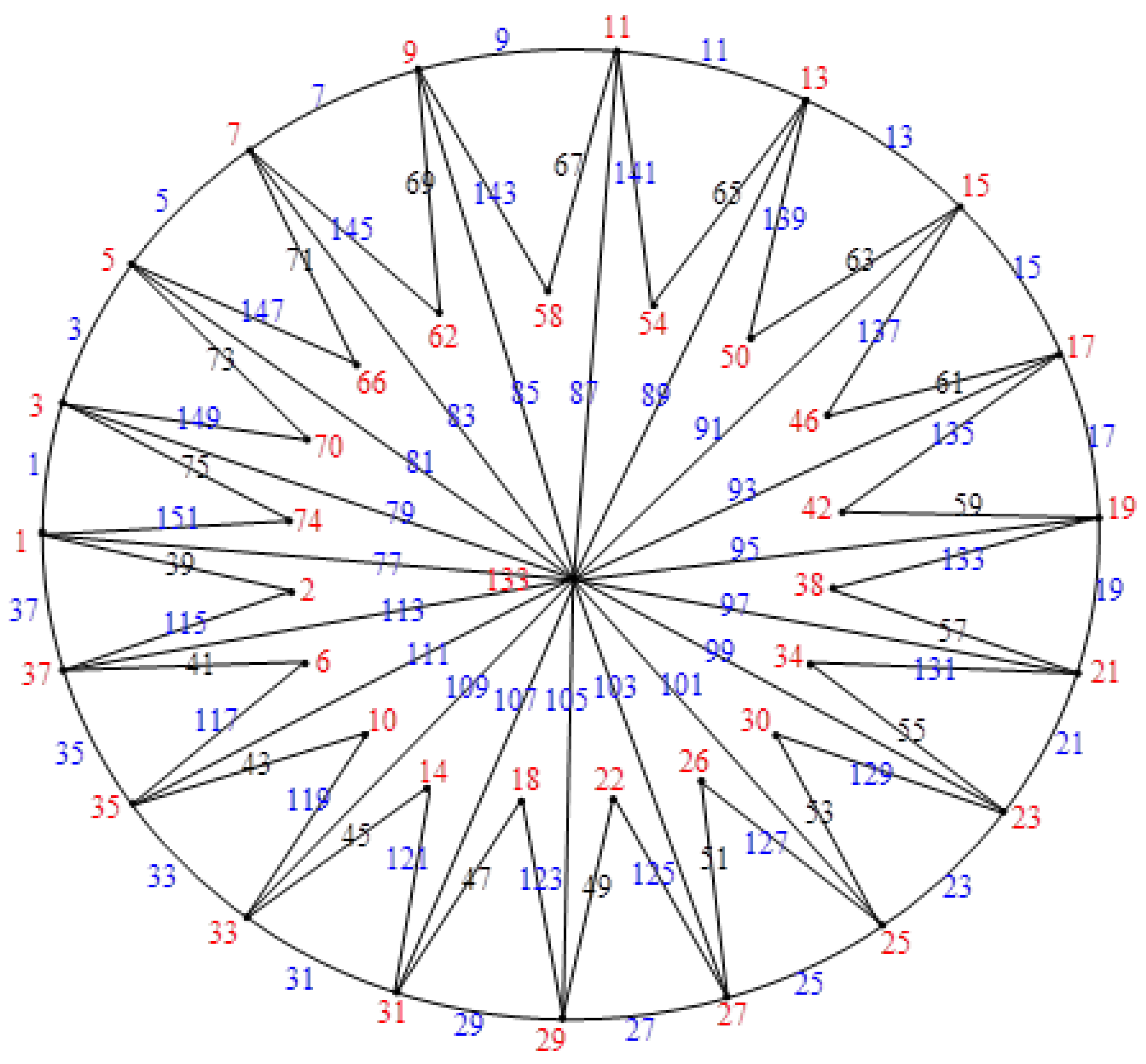
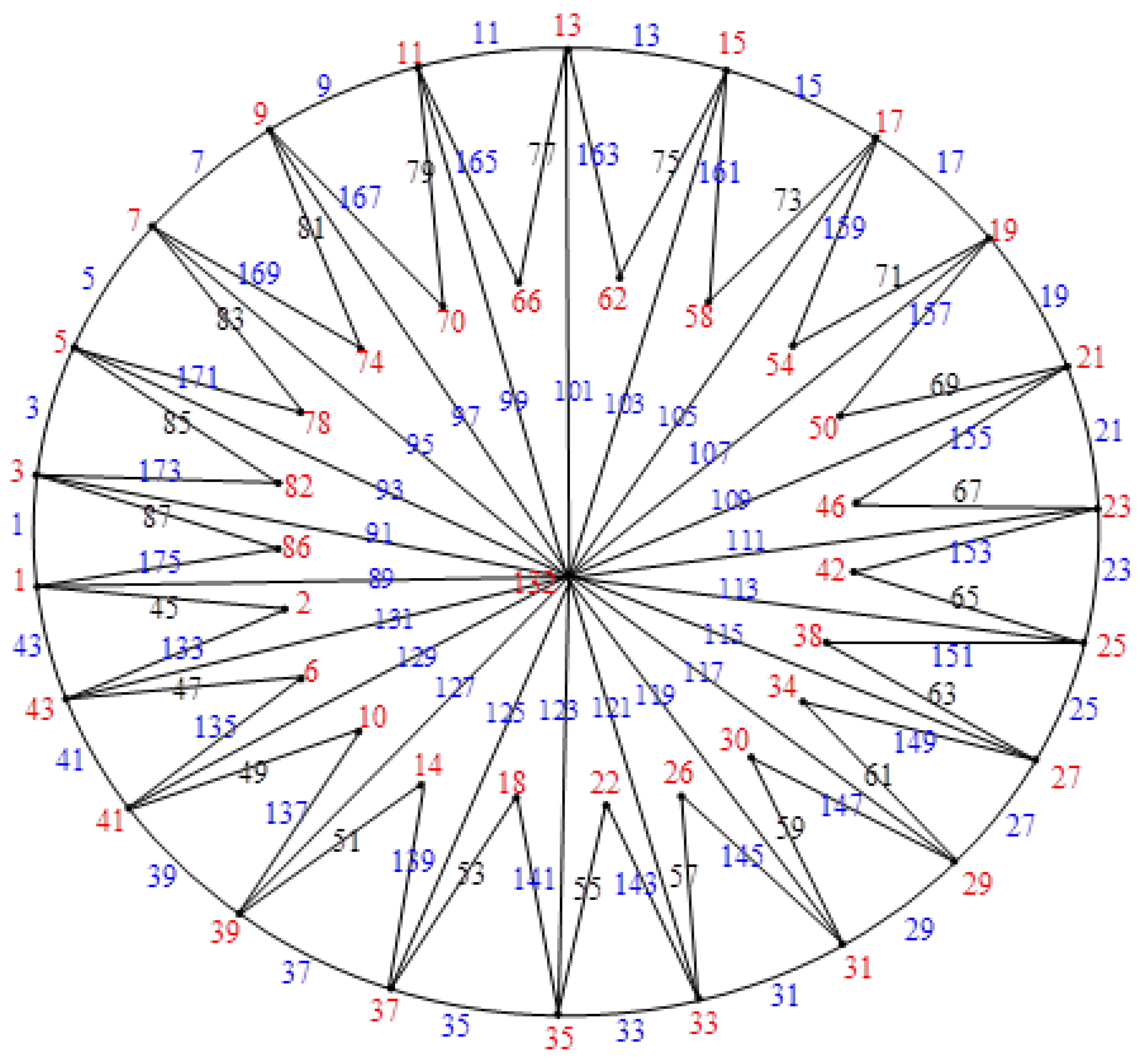
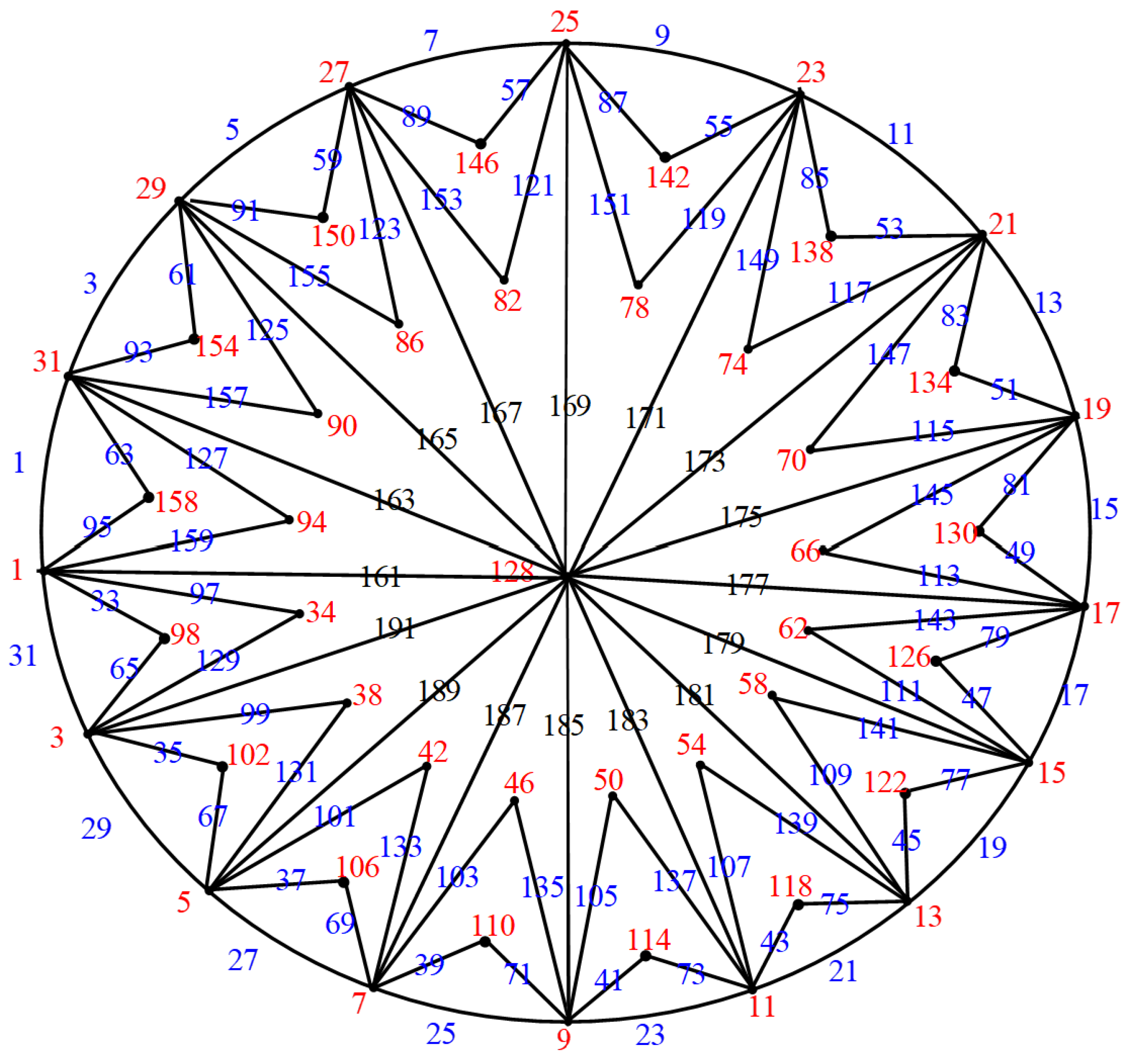
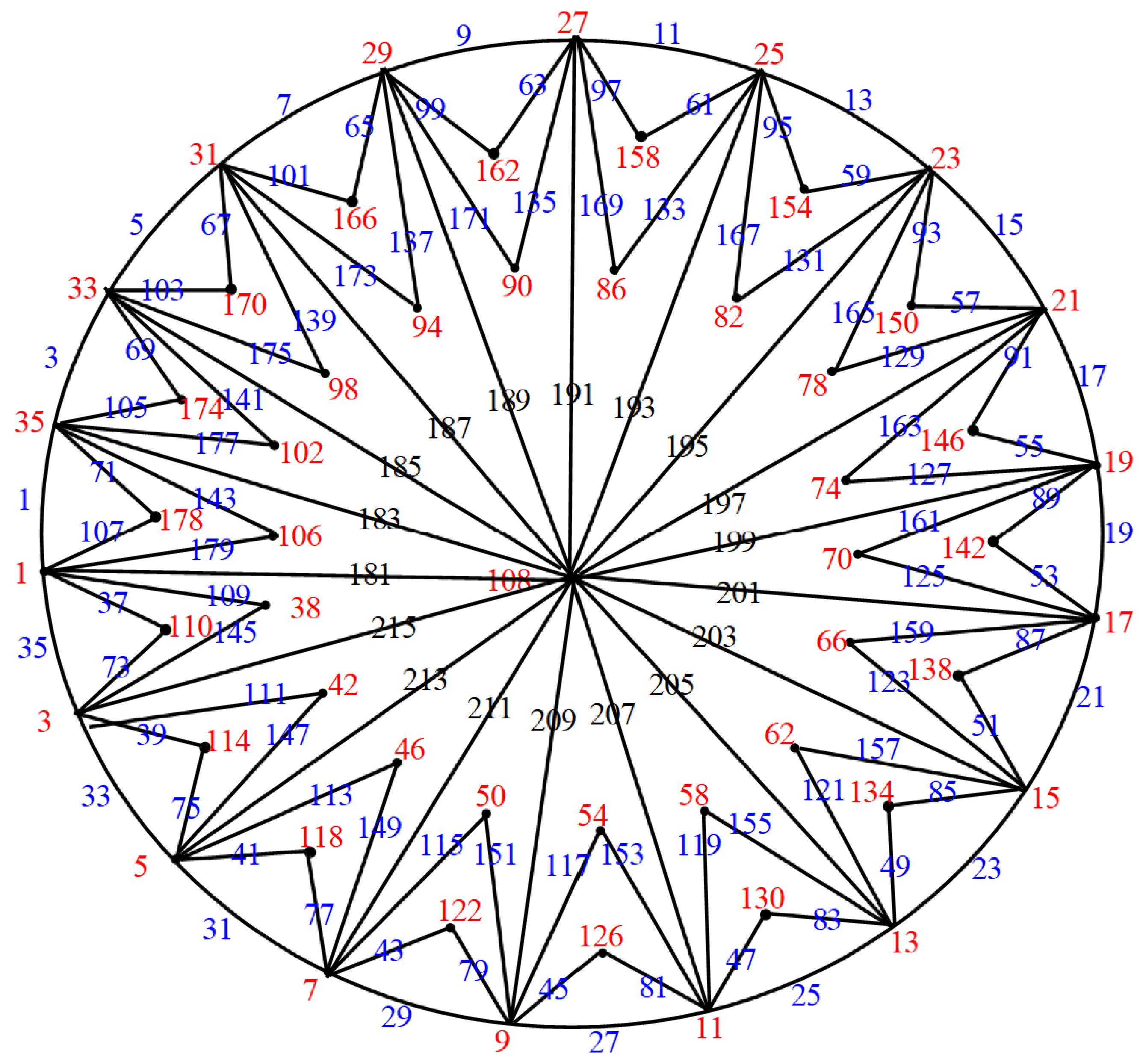
Examples: The closed flower graphs , , …, and their explicit labeling are depicted in Figure 3, Figure 4, Figure 5, Figure 6, Figure 7, Figure 8, Figure 9 and Figure 10, respectively. 2.2. Cog Wheel Graphs
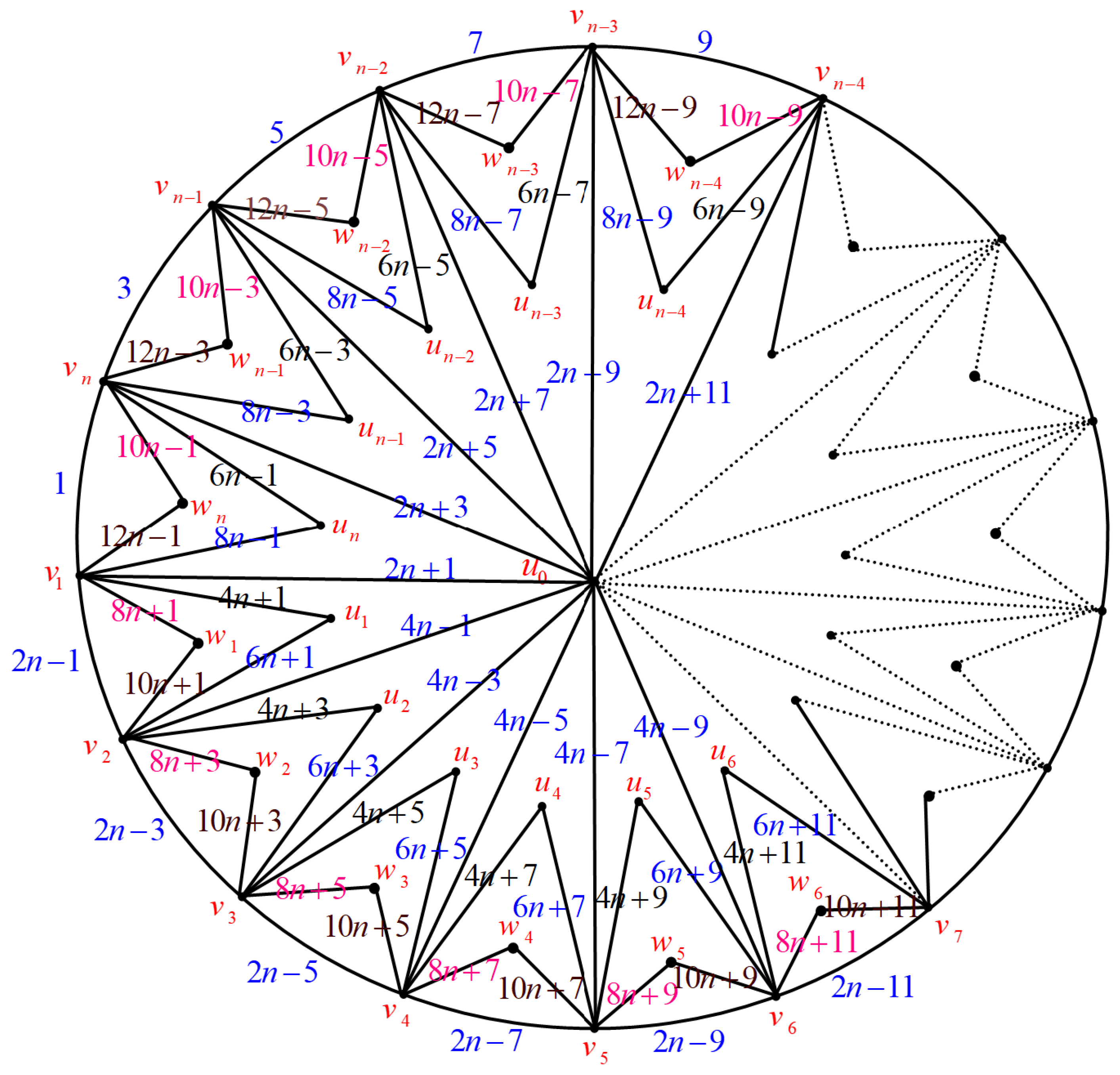
The second graph is the cog wheel graph, . It is obtained by combining a wheel graph with a set of vertices such that a vertex is adjacent to vertices and , for Furthermore, the vertex is adjacent to vertices and .
Theorem 2. The Cog wheel graph, , is edge odd graceful for n greater than or equal to 3.
Proof. Let be a cog wheel graph where n is an integer greater than or equal to 3. It has a size of . Assuming that the vertex set of is , we divide the proof into two cases and provide explicit edge labeling in each case.
Case (1): Let
be as in
Figure 11 and
.
Therefore, the derived transformation
on the set of vertices is given in the following manner:
Furthermore,
In this case, the map
from
to
, respectively, is one to one. Additionally, it is a one to one map from
to
, respectively. It is evident that
and
do not share any common elements. Moreover,
belongs to
, and
has no elements in common with
or
. Consequently,
is a bijective function, and the cog wheel graph is edge odd graceful when
.
Case (2): Let
be as in
Figure 12 and
.
Therefore, the derived transformation
on the set of vertices is given in the following manner:
In this case, the map from to , respectively, is one to one. Additionally, it is a one to one map from to , respectively. It is evident that and do not share any common elements. Consequently, is a bijective function, and the cog wheel graph exhibits an edge odd graceful property when . After considering case (1) and case (2), it can be concluded that every cog wheel graph possesses the property of being edge odd graceful for values of n greater than or equal to □
Examples: The cog wheel graphs and their explicit labeling are depicted in Figure 9, Figure 13, Figure 14, Figure 15, Figure 16, Figure 17, Figure 18, Figure 19 and Figure 20, respectively. 2.3. Triangulated Wheel Graphs
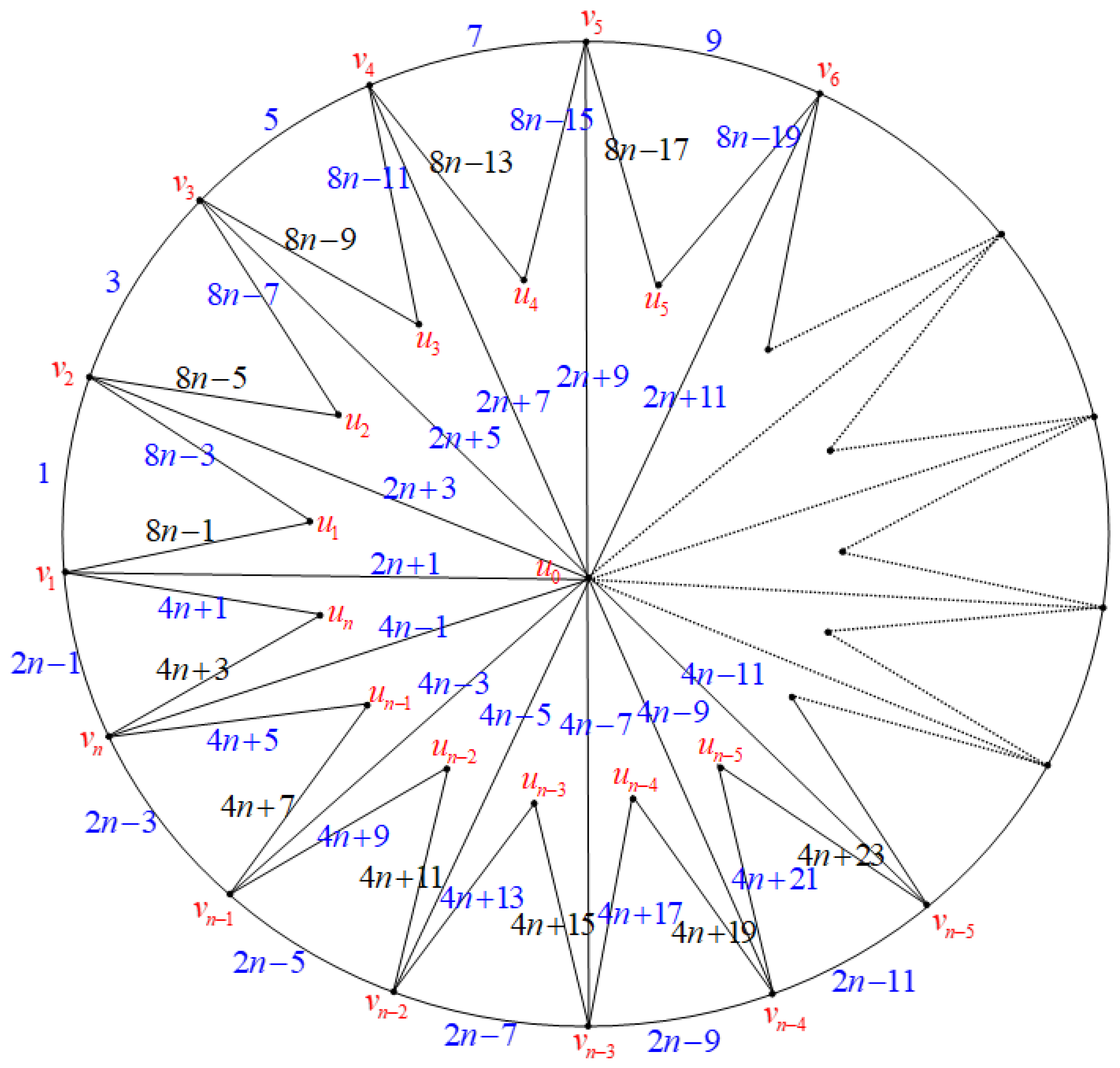
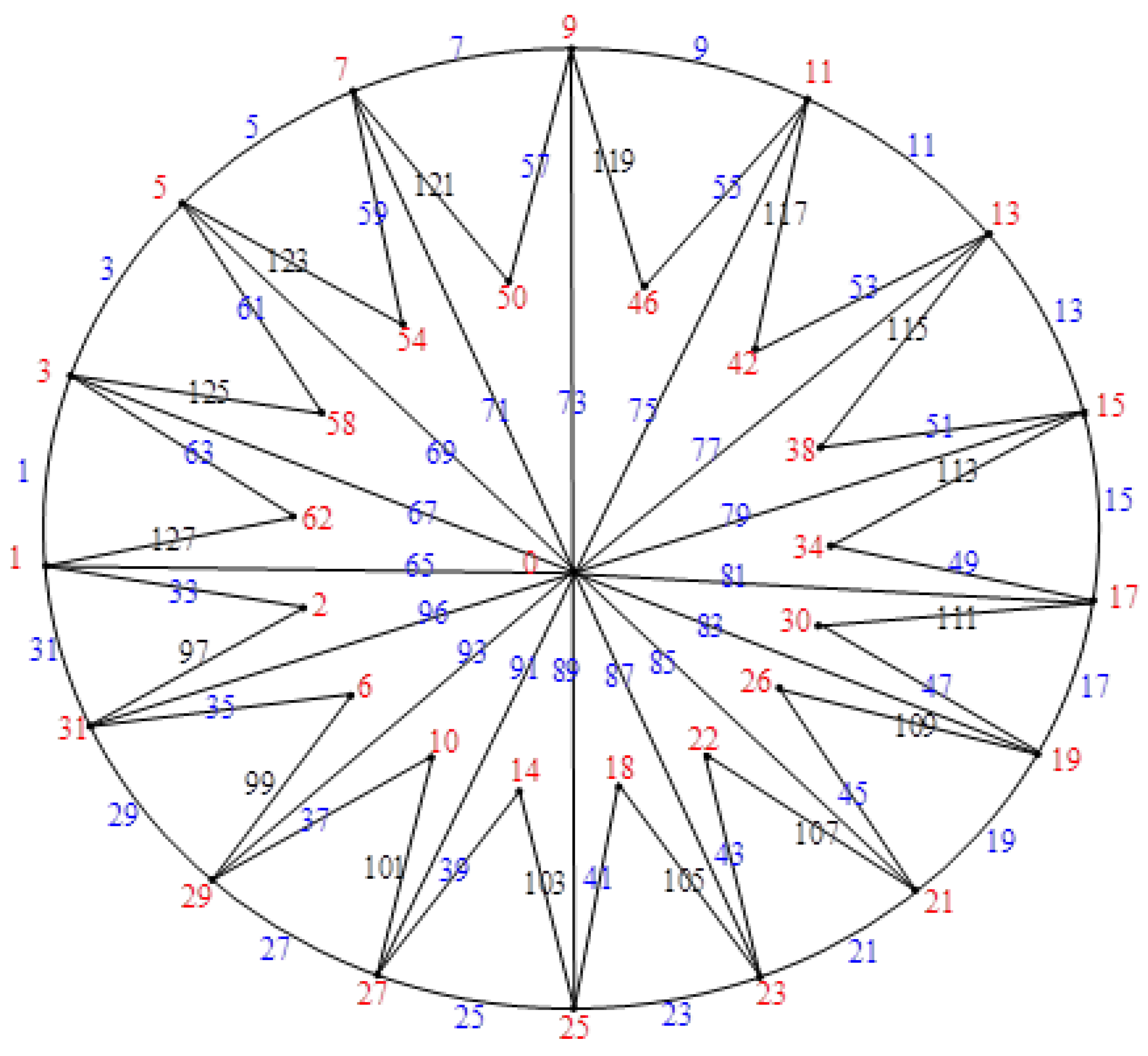
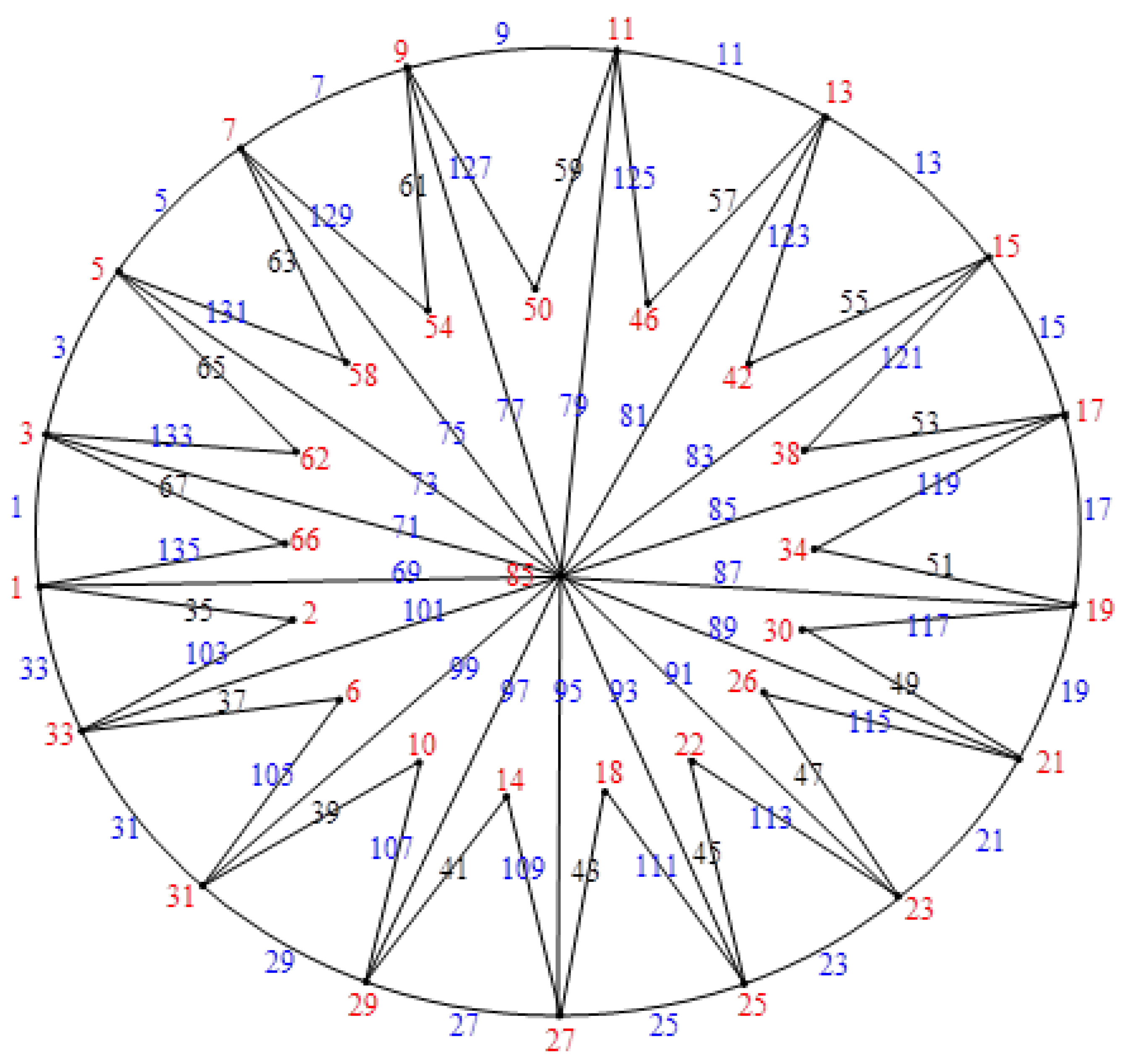
The third graph is the triangulated wheel graph,. It is obtained by combining the wheel graph with a set of vertices such that vertex is adjacent to vertices and , and vertex is adjacent to vertices and . Additionally, each vertex is adjacent to the vertex .
Theorem 3. The triangulated wheel graph, is edge odd graceful for n greater than or equal to 3.
Proof. Let be a triangulated wheel graph where n is an integer greater than or equal to 3. It has a size of . Assuming that the vertex set of is , we provide an explicit edge odd labeling in three different cases based on the number of vertices.
Case (1): Let
be as in
Figure 21 and
.
Define the map
Therefore, the derived transformation
on the set of vertices is given in the following manner:
Furthermore
In this case, the map
from
to
, respectively, is one to one. Additionally, it is a one to one map from
to
, respectively. It is evident that
and
do not share any common elements. Moreover,
belongs to
, and
has no elements in common with
or
. Consequently,
is a bijective function, and the triangulated wheel graph is edge odd graceful when
.
Case (2): Let
be as in
Figure 22 and
.
Therefore, the derived transformation
on the set of vertices is given in the following manner:
Furthermore,
In this case, the map
from
to
, respectively, is one to one. Additionally, it is a one to one map from
to
, respectively. It is evident that
and
do not share any common elements. Moreover,
belongs to
, and
has no elements in common with
or
. Consequently,
is a bijective function, and the triangulated wheel graph is edge odd graceful when
.
Case (3): Let
be as in
Figure 23 and
.
Therefore, the derived transformation
on the set of vertices is given in the following manner:
In this case, the map from to , respectively, is one to one. Additionally, it is a one to one map from to , respectively. It is evident that and do not share any common elements. Moreover, belongs to , and has no elements in common with or . Consequently, is a bijective function, and the triangulated wheel graph is edge odd graceful when . After considering case (1), case (2), and case (3), it can be concluded that every triangulated wheel graph possesses the property of being edge odd graceful for values of n greater than or equal to □
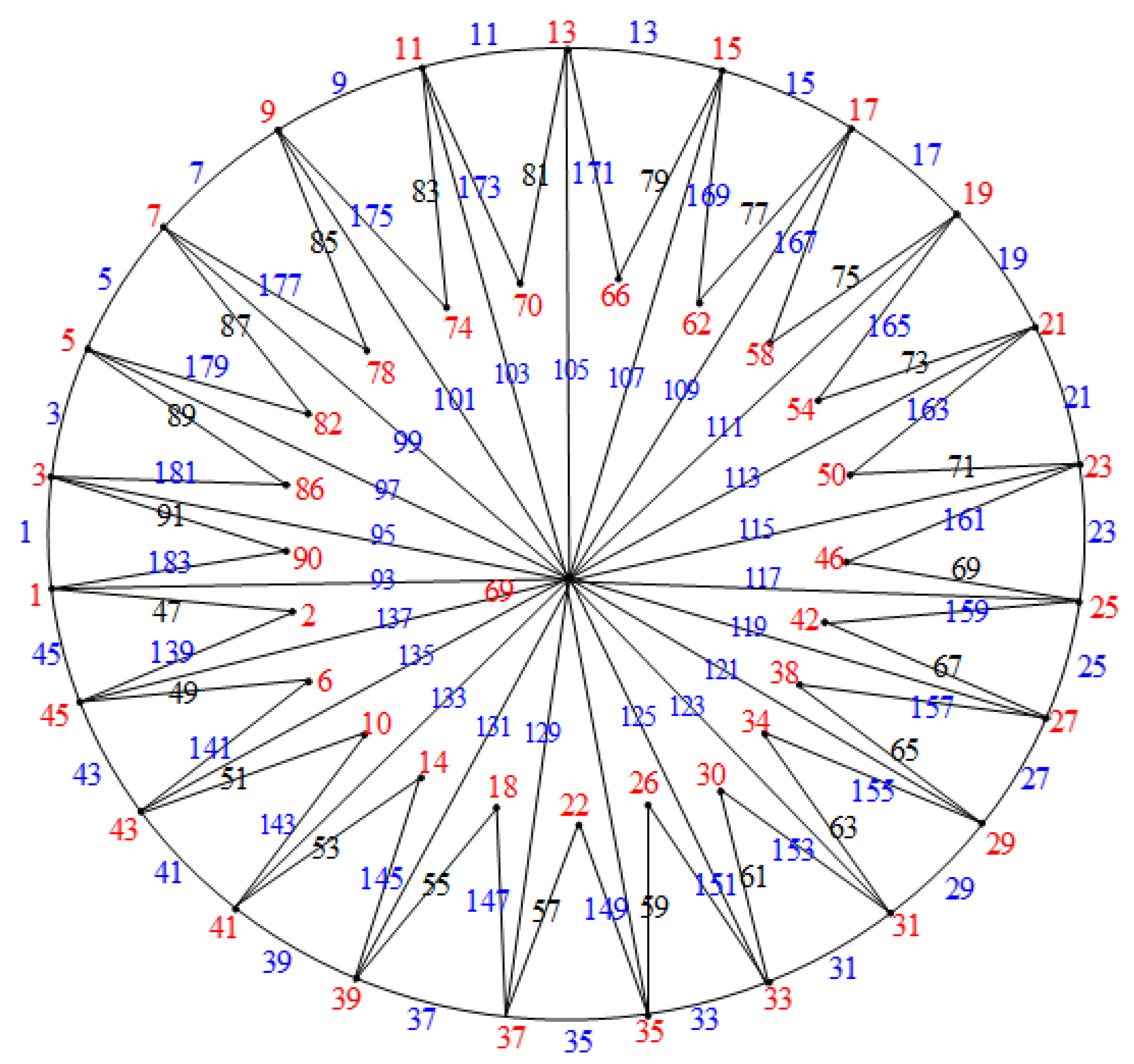
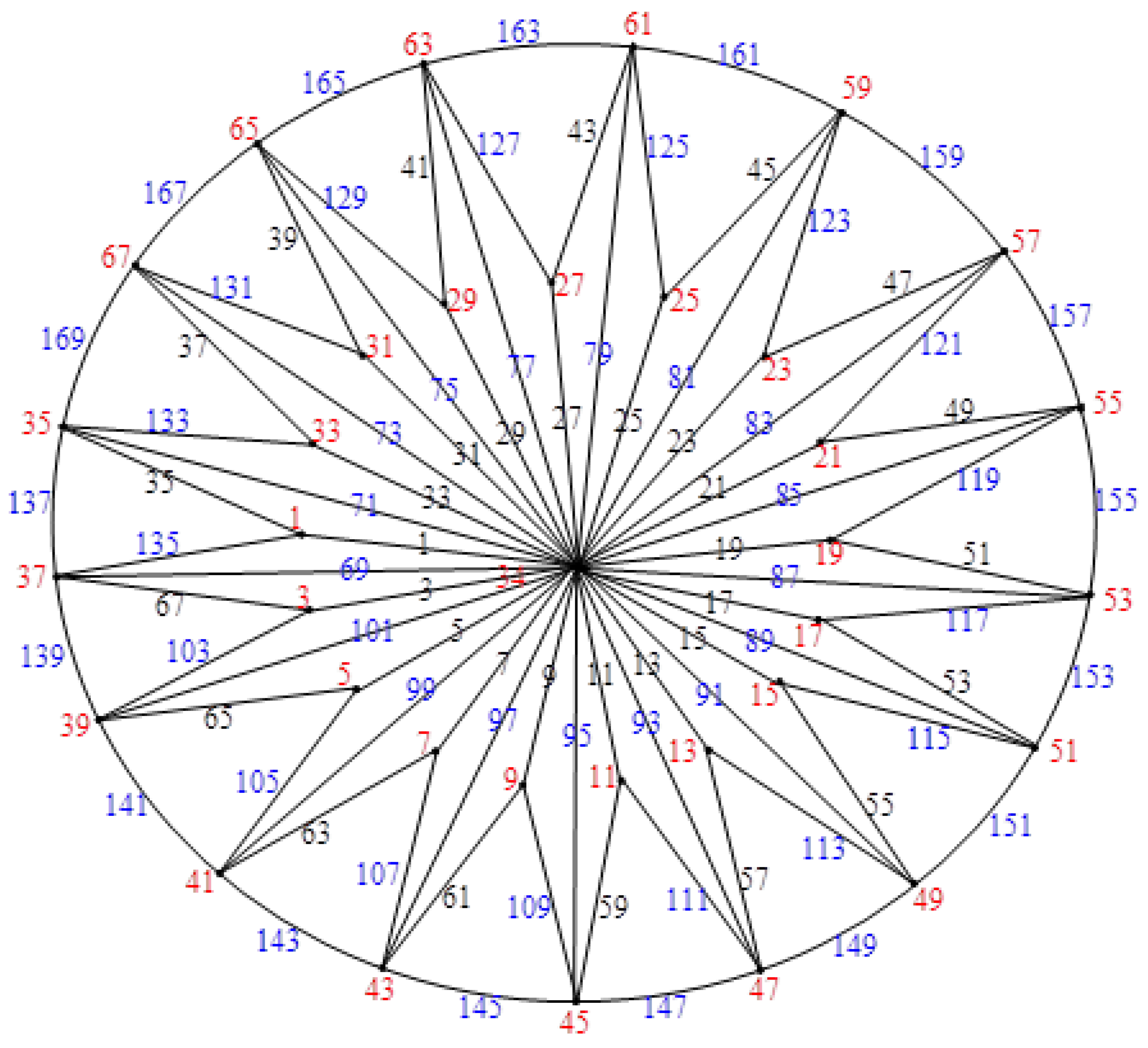
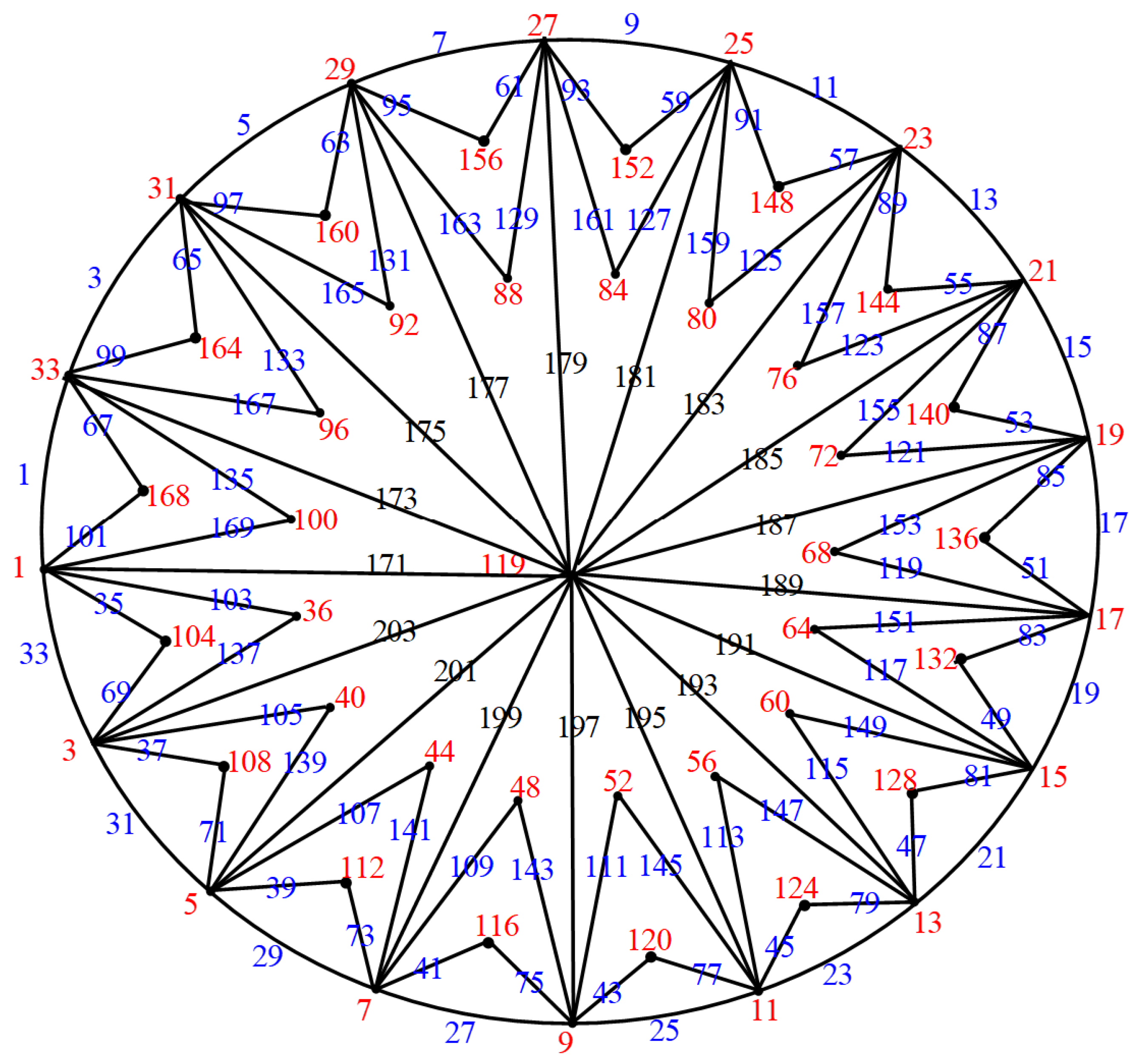
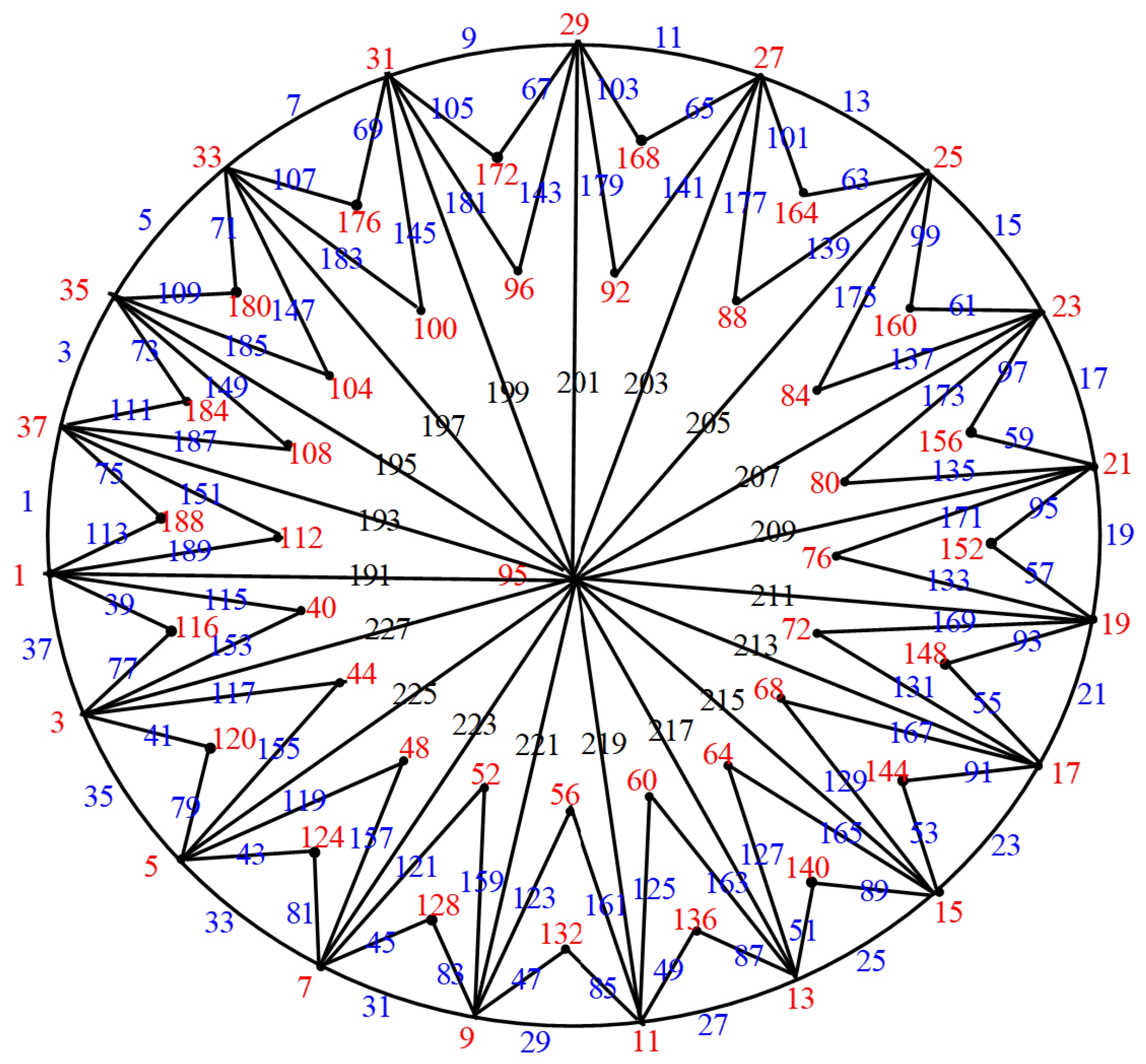
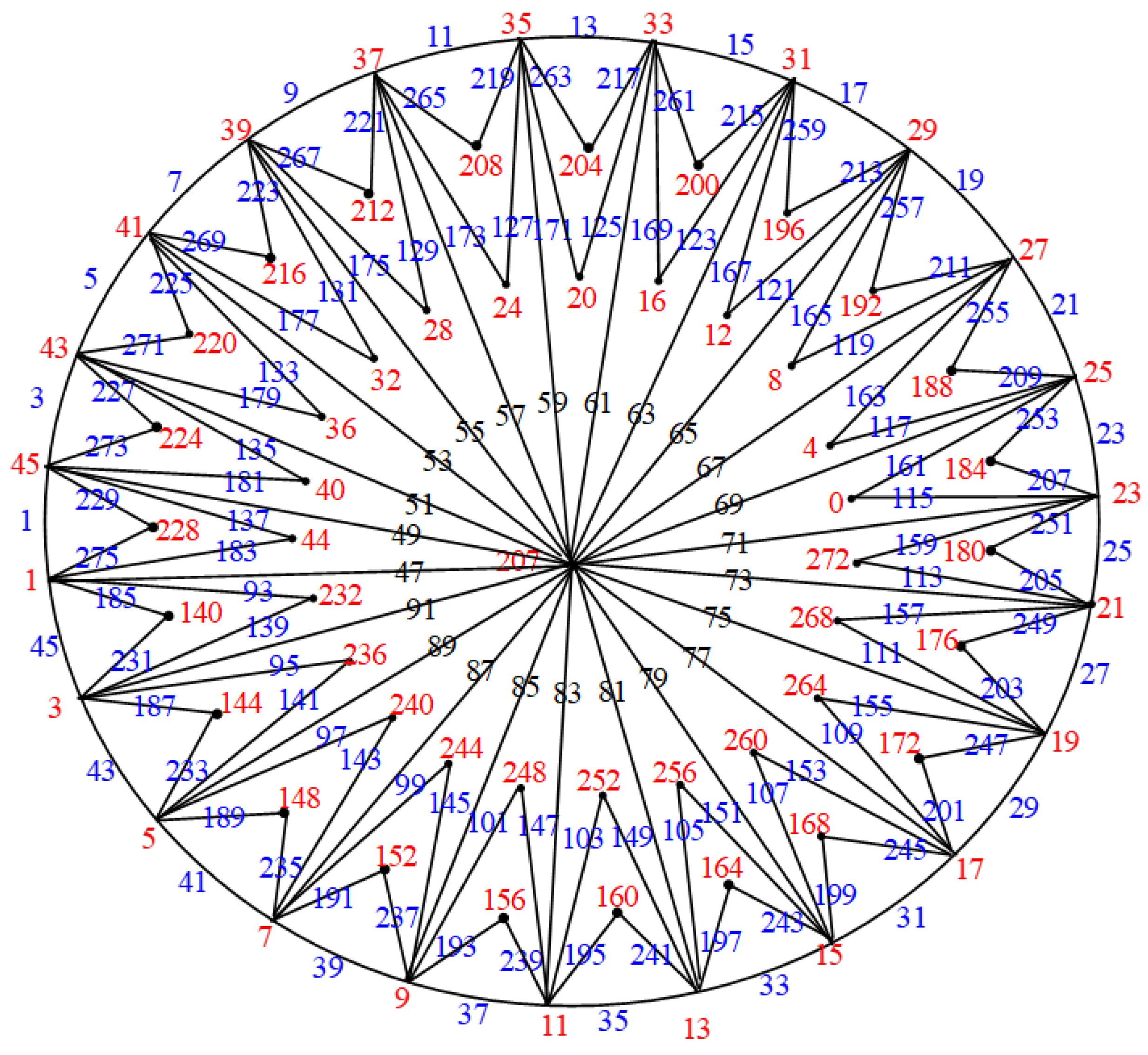
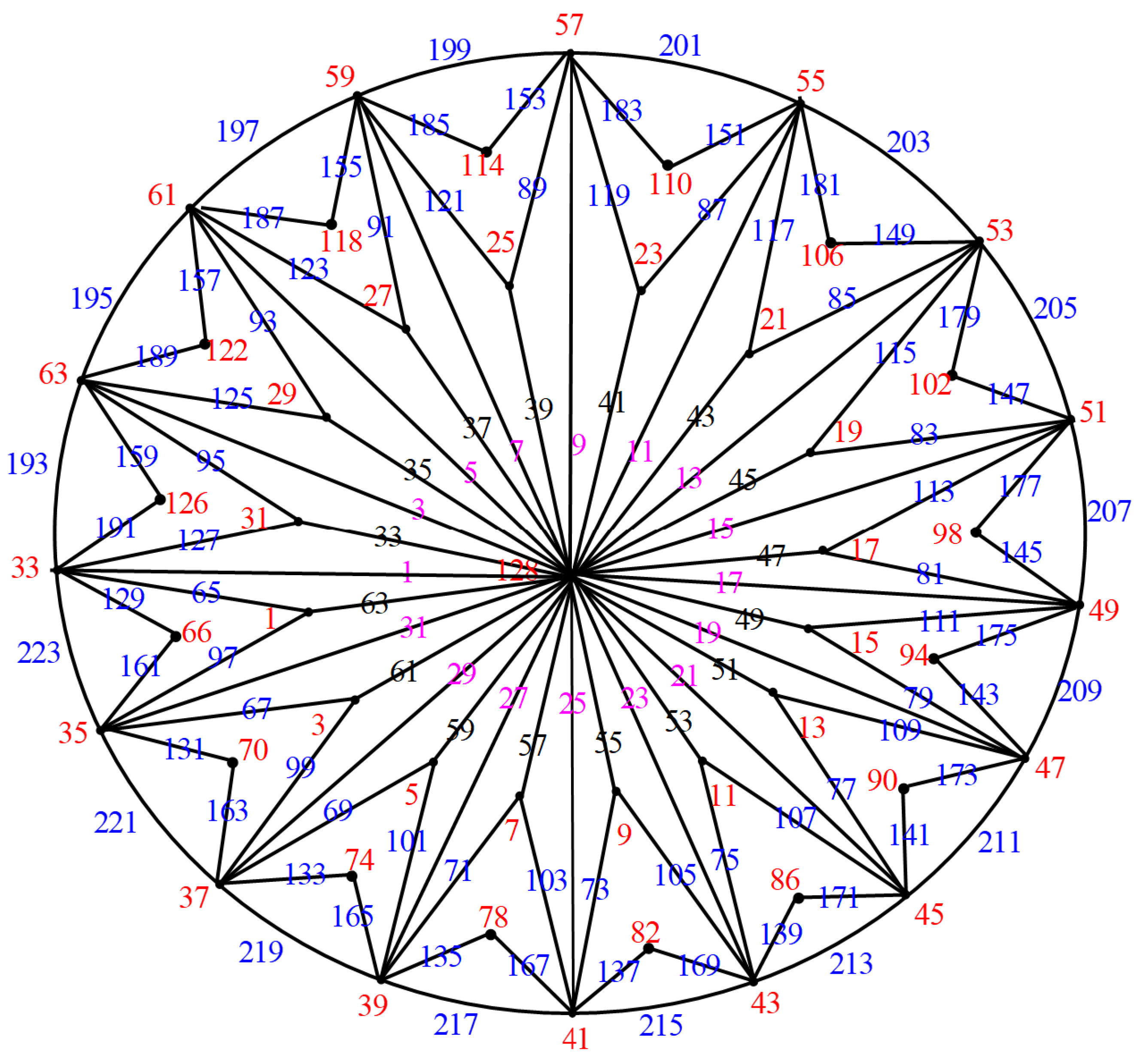
Examples: The triangulated wheel graphs and , and their explicit labeling are depicted in Figure 24, Figure 25 and Figure 26, respectively. 2.4. Double Crown-Wheel Graphs
The fourth graph is the double crown-wheel graph, . It is obtained by combining a wheel graph with two sets of vertices. The first set is , where each vertex is adjacent to vertices and , for , and the vertex is adjacent to vertices and . The second set is , where each vertex is adjacent to vertices and , for , and the vertex is adjacent to vertices and .
Theorem 4. The double crown-wheel graph, is edge odd graceful for n greater than or equal to 3.
Proof. Clearly, ; assuming that the set of vertices of is , we provide an explicit edge odd labeling in two different cases based on the number of vertices.
Case (1): Let
be as in
Figure 27 and
.
Therefore, the derived transformation
on the set of vertices is given in the following manner:
In this case, the map
from
to
, respectively is one to one. Additionally, it is one to one map from
to
, respectively. It is evident that
and
do not share any common elements. Consequently,
is a bijective function, and the double crown-wheel graph is edge odd graceful when
.
Case (2): Let
be as in
Figure 28 and
.
Therefore, the derived transformation
on the set of vertices is given in the following manner:
In this case, the map from to , respectively, is one to one. Additionally, it is a one to one map from to , respectively. It is evident that and do not share any common elements. Moreover, belongs to , and has no elements in common with or . Consequently, is a bijective function, and the double crown-wheel graph is edge odd graceful when . After considering case (1) and case (2), it can be concluded that every double crown-wheel graph possesses the property of being edge odd graceful for values of n greater than or equal to □
2.5. Crown-Triangulated Wheel Graphs
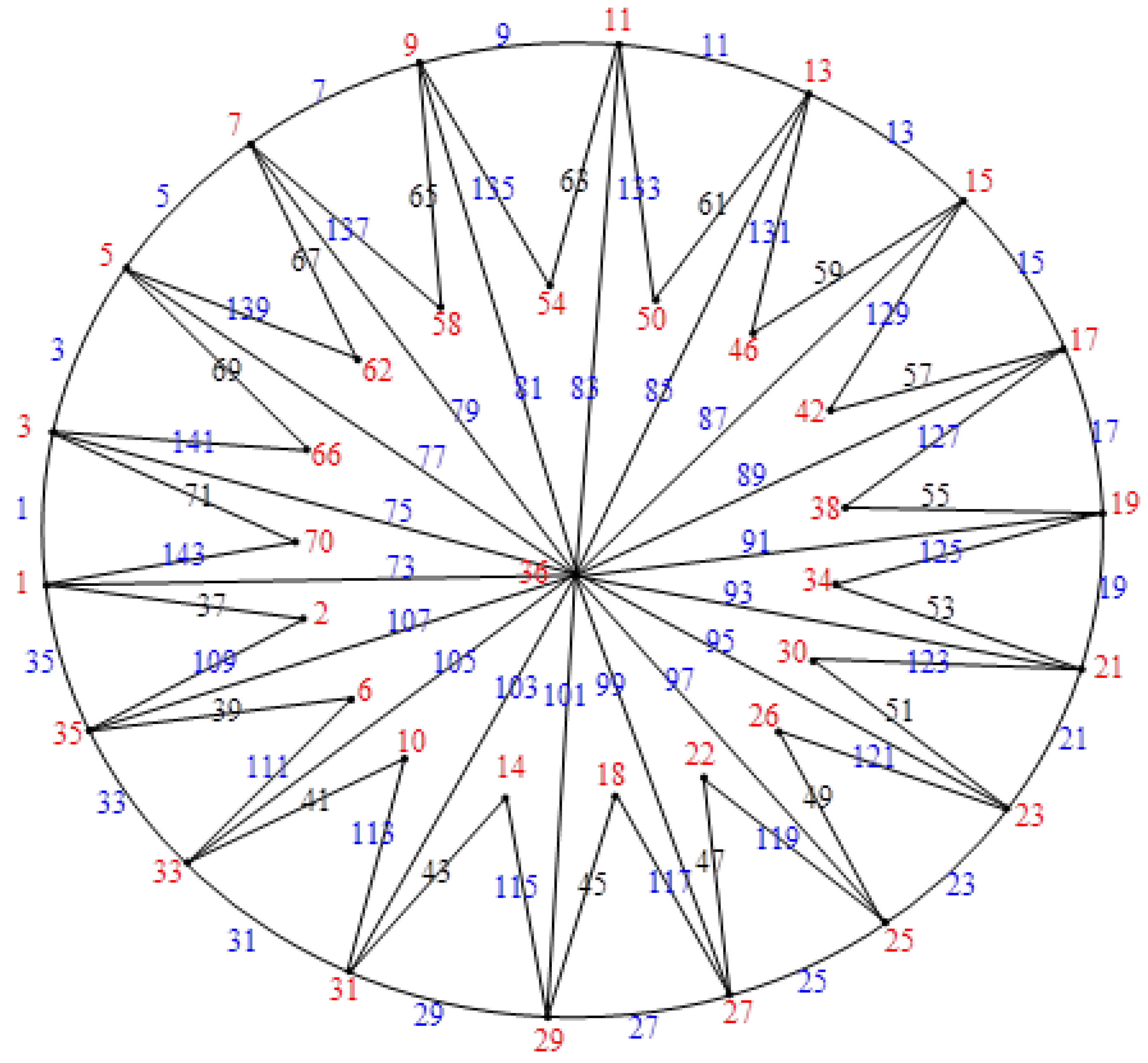
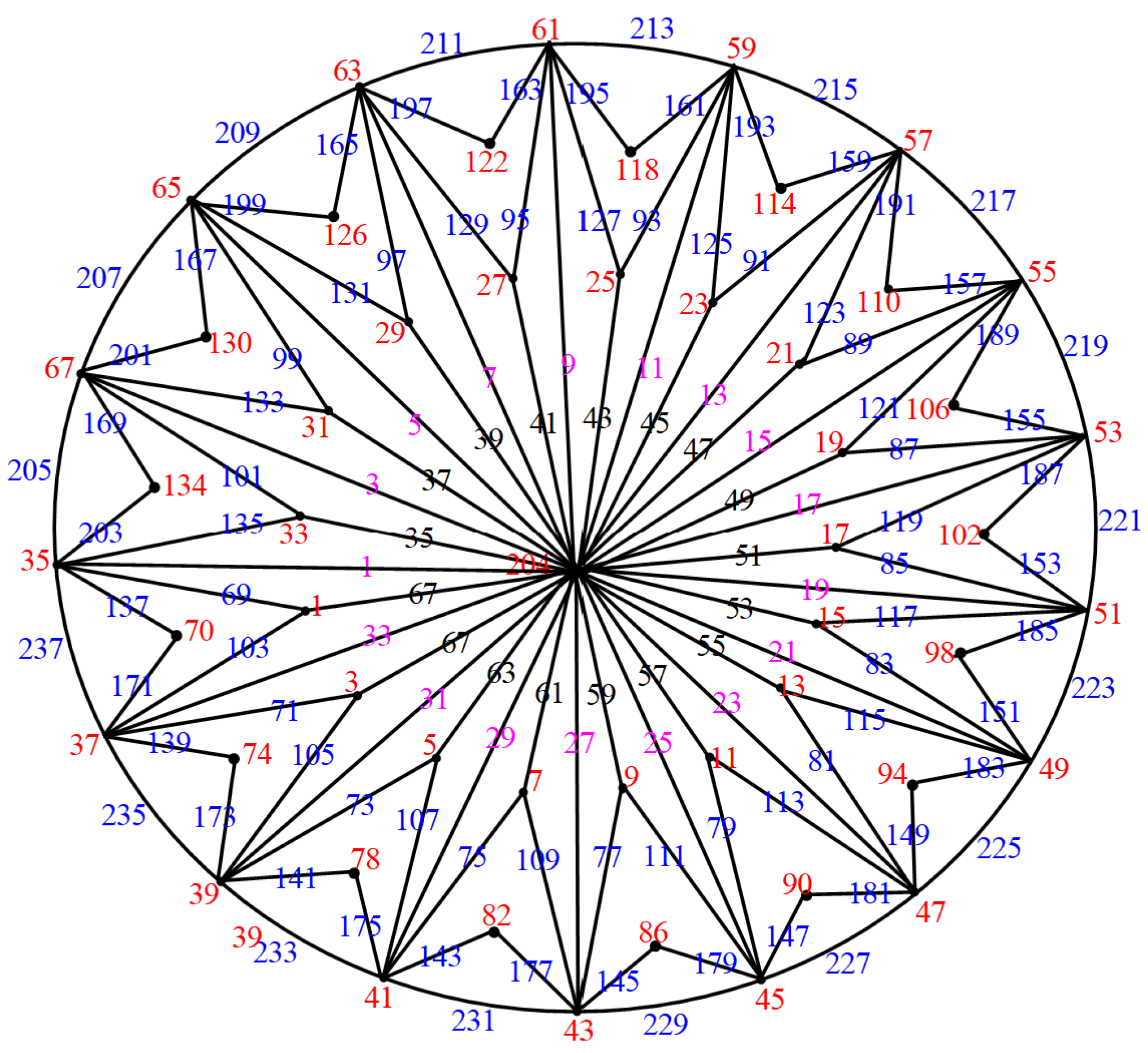
The fifth graph is the crown-triangulated wheel graph, . It is obtained by combining the triangulated wheel graphs with the set , where each vertex is adjacent to vertices and , for , and the vertex is adjacent to vertices and .
Theorem 5. The crown-triangulated wheel graph, is edge odd graceful for n greater than or equal to 3.
Proof. Clearly, , the set of vertices of is
There are two cases:
Case (1): Let
be as in
Figure 34 and
.
Therefore, the derived transformation
on the set of vertices is given in the following manner:
Furthermore,
In this case, the map
from
to
, respectively, is one to one. Additionally, it is one to one map from
to
, respectively. It is evident that
and
do not share any common elements. Consequently,
is a bijective function, and the crown-triangulated wheel graph is edge odd graceful when
.
Case (2): Let
be as in
Figure 35 and
.
Therefore, the derived transformation
on the set of vertices is given in the following manner:
In this case, the map from to , respectively, is one to one. Additionally, it is a one to one map from to , respectively. It is evident that and do not share any common elements. Moreover, belongs to , and has no elements in common with or . Consequently, is a bijective function, and the crown-triangulated wheel graph is edge odd graceful when . After considering case (1) and case (2), it can be concluded that every crown-triangulated wheel graph possesses the property of being edge odd graceful for values of n greater than or equal to □