


Studies on Ionic Flows via Poisson–Nernst–Planck Systems with Bikerman’s Local Hard-Sphere Potentials under Relaxed Neutral Boundary Conditions



Abstract
1. Introduction
1.1. One-Dimensional Poisson–Nernst–Planck System
1.2. Excess Chemical Potentials and Bikerman’s Model
1.3. Electroneutrality Conditions and Boundary Layers
2. Problem Setup and Previous Results
2.1. Assumptions and a Dimensionless PNP-Type System
- (A1)
- Two ion species (), one positively charged () and one negatively charged ().
- (A2)
- We assume the permanent charge .
- (A3)
- Both the ideal component, , and the Bikerman’s excess potential, , are considered in the electrochemical potential, .
- (A4)
- We assume the relative dielectric coefficient to be a constant, and the diffusion coefficients to be some constants.
2.2. Some Previous Results
3. Qualitative Properties of Ionic Flows under Relaxed Neutral Conditions
3.1. Studies of the Individual Fluxes
- (i)
- For , if , while if ;
- (ii)
- For , for and if .
- If , one has . It follows that there is a unique zero, , of . Consequently, is increasing for and decreasing for .
- If , then , which implies that is decreasing on .
- (i)
- For ,
- (i1)
- If , then ;
- (i2)
- If , then there exists a unique , such that for and for .
- (ii)
- For ,
- (ii1)
- If and , then , where is identified in Lemma 3;
- (ii2)
- If , then there exists a unique , such that for and for .
- (iii)
- For ,
- (iii1)
- If , then ;
- (iii2)
- If , then there exists a unique , such that for and for .
- (iv)
- For ,
- (iv1)
- If and , where is identified in Lemma 3, then ;
- (iv2)
- If , then there exists a unique , such that for and for .
- (i1)
- If , one has , and, hence, is increasing in x for . Taking into account that , one has and for .
- (i2)
- If , we have . Therefore, the function has a unique zero . Furthermore, on while on . Together with , there exists a unique zero, , of with , and for , while for . Correspondingly, decreases for and increases for . Recall that and for . There exists a unique root, , of , such that for and for .
- (i)
- For ,
- (i1)
- If , then for .
- (i2)
- If , then has a unique root, , such that for and for .
- (ii)
- For ,
- (ii1)
- If , and (where ), one has for .
- (ii2)
- If , then has a unique root, , such that for and for .
- and . Clearly, has a unique positive root, say given byIt is easy to check that, for , one has
- for , which implies that is increasing in x for .
- (i1)
- For , one has . Therefore, for all with . Together with , one has and for .
- (i2)
- For , then there exists a unique root, , of , such that for and for . This implies that is decreasing for and increasing for . Note that . There is a unique root, , of , such that for and for . Note also that . Similar argument leads to the conclusion that there exists a unique root, , of , such that for and for .
- (i)
- If and , then , while . Furthermore,
- (i1)
- The ion size reduces the individual flux for and enhances it for . Equivalently, for , while for ;
- (i2)
- The ion size enhances (resp. reduces) the individual flux if (resp. ), that is, if (resp. if ).
- (ii)
- For , , and , one has , while . Furthermore,
- (ii1)
- The ion size reduces the individual flux for and enhances it for . Equivalently, for , while for ;
- (ii2)
- The ion size enhances the individual flux for and reduces it for . Equivalently, for , while for .
- (iii)
- For and , one has , while . Furthermore,
- (iii1)
- The ion size enhances the individual flux for and reduces it for . Equivalently, for , while for ;
- (iii2)
- The ion size reduces the individual flux for and enhances it for . Equivalently, for , while for .
- (iv)
- For and , one has , while . Furthermore,
- (iv1)
- The ion size reduces the individual flux for and enhances it for . Equivalently, for , while for ;
- (iv2)
- The ion size enhances the individual flux for and reduces it for ). Equivalently, for , while for .
- (i)
- If and , one has for .
- (ii)
- If , there exists a unique root, , of , such that (resp. ) as (resp. ).
- (i)
- If and , then , and . Furthermore,
- (i1)
- The individual flux is decreasing (resp. increasing) in λ for (resp. ).
- (i2)
- The individual flux is increasing (resp. decreasing) in λ for (resp. ).
- (ii)
- If and , then , and . Furthermore,
- (ii1)
- The individual flux is increasing (resp. decreasing) in λ for (resp. ).
- (ii2)
- The individual flux is decreasing (resp. increasing) in λ for (resp. ).
- (iii)
- If and , then , and . Furthermore,
- (iii1)
- The individual flux is decreasing (resp. increasing) in λ for (resp. ).
- (iii2)
- The individual flux is increasing (resp. decreasing) in λ for (resp. ).
3.2. Finite Ion Size Effects on the I-V Relations under Relaxed Neutral Conditions
- (i)
- For and , one has . Furthermore, the ion size reduces (resp. enhances) the current if (resp. ). Equivalently, (resp. ) if (resp. );
- (ii)
- For , and , one has . Furthermore, the ion size reduces (resp. enhances) the current if (resp. ). Equivalently, (resp. ) if (resp. );
- (iii)
- For and , one has . Furthermore, the ion size enhances (resp. reduces) the current if (resp. ), that is, (resp. ) if (resp. );
- (iv)
- For and , one has . Furthermore, the ion size reduces (resp. enhances) the current if (resp. ), that is, (resp. ) if (resp. ).
- (i)
- If and , one has . Furthermore, the current is decreasing (resp. increasing) in λ if (resp. ).
- (ii)
- If , one has
- (ii1)
- For , one has . Furthermore, the current is increasing (resp. decreasing) in λ if (resp. );
- (ii2)
- For , one has . Furthermore, the current is decreasing (resp. increasing) in λ if (resp. ).
3.3. Effects Due to the Relaxation of Electroneutrality Boundary Conditions: Further Discussion
3.3.1. Partial Orders of Some Critical Potentials
- (i)
- If and with , then .
- (ii)
- If and with , then there exists an , such that for and for .
- (iii)
- If and with , then .
- (i)
- and if , with and .
- (ii)
- and if , with and .
- (i)
- if , with and .
- (ii)
- if , with and .
- (i)
- For the individual flux with , one has
- (i1)
- If , then , while . Equivalently, the finite ion size reduces , while it enhances ;
- (i2)
- If , then and . Equivalently, the finite ion size enhances both and ;
- (i3)
- If , then , while . Equivalently, the finite ion size enhances , while it reduces .
- (ii)
- For the individual flux with , one has
- (ii1)
- If , then , while . Equivalently, the finite ion size enhances , while it reduces ;
- (ii2)
- If , then and . Equivalently, the finite ion size reduces both and ;
- (ii3)
- If , then , while . Equivalently, the finite ion size reduces , while it enhances .
- (iii)
- For the current I with , one has
- (iii1)
- If , then , while . Equivalently, the finite ion size reduces , while it enhances ;
- (iii2)
- If , then and . Equivalently, the finite ion size enhances both and ;
- (iii3)
- If , then , while . Equivalently, the finite ion size enhances , while it reduces .
- With electroneutrality conditions, one always has for all , that is, is increasing in the membrane potential V and (resp. ) for (resp. );
- However, with boundary layers, can be either positive or negative, as discussed in Theorem 1, which further depends on the nonlinear interplays among other system parameters. With , the dynamics of the leading terms and is quite different over the subregions and (see statement (i) in Theorem 5).
- (1)
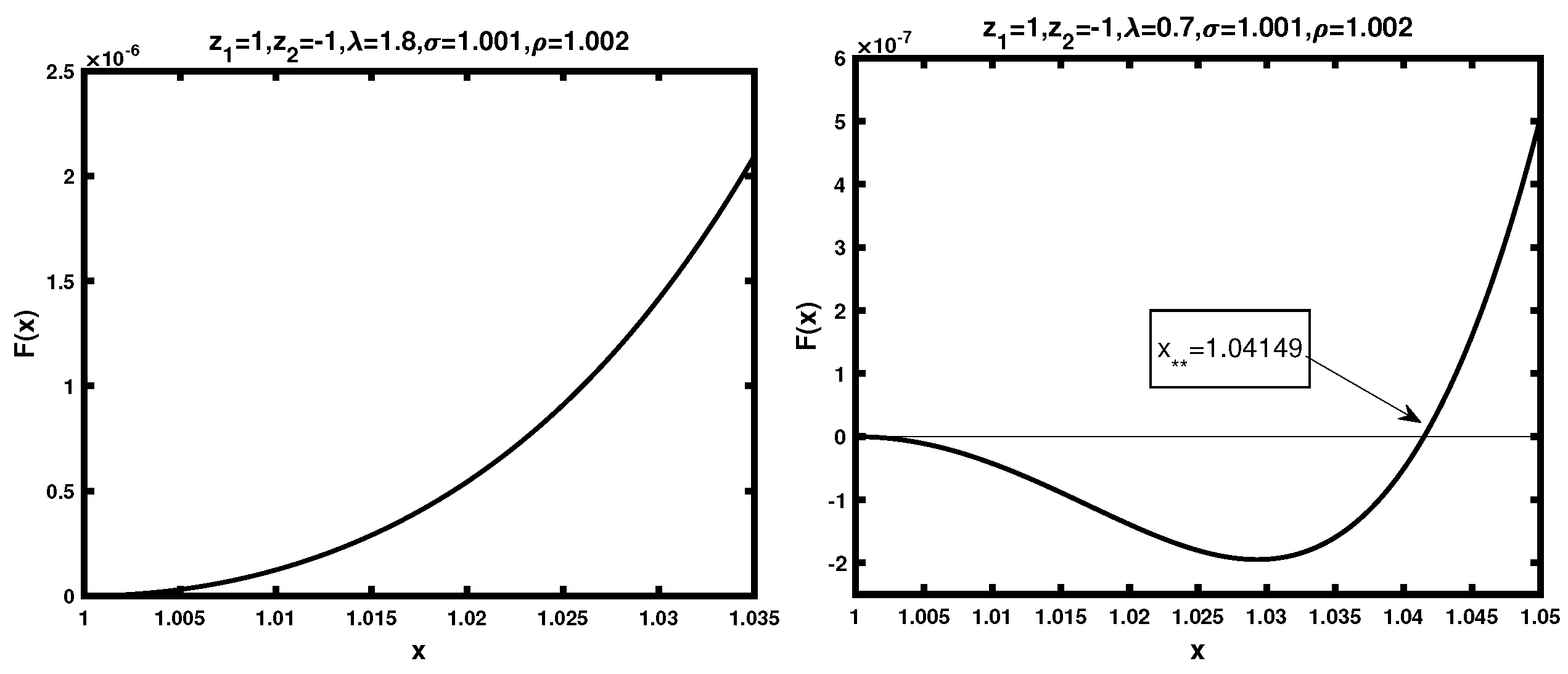
- Numerically identify , the root of introduced in statement (ii) of the Lemma 5, which helps better understand the analytical result, in particular, the proof (see Figure 1);
- (2)
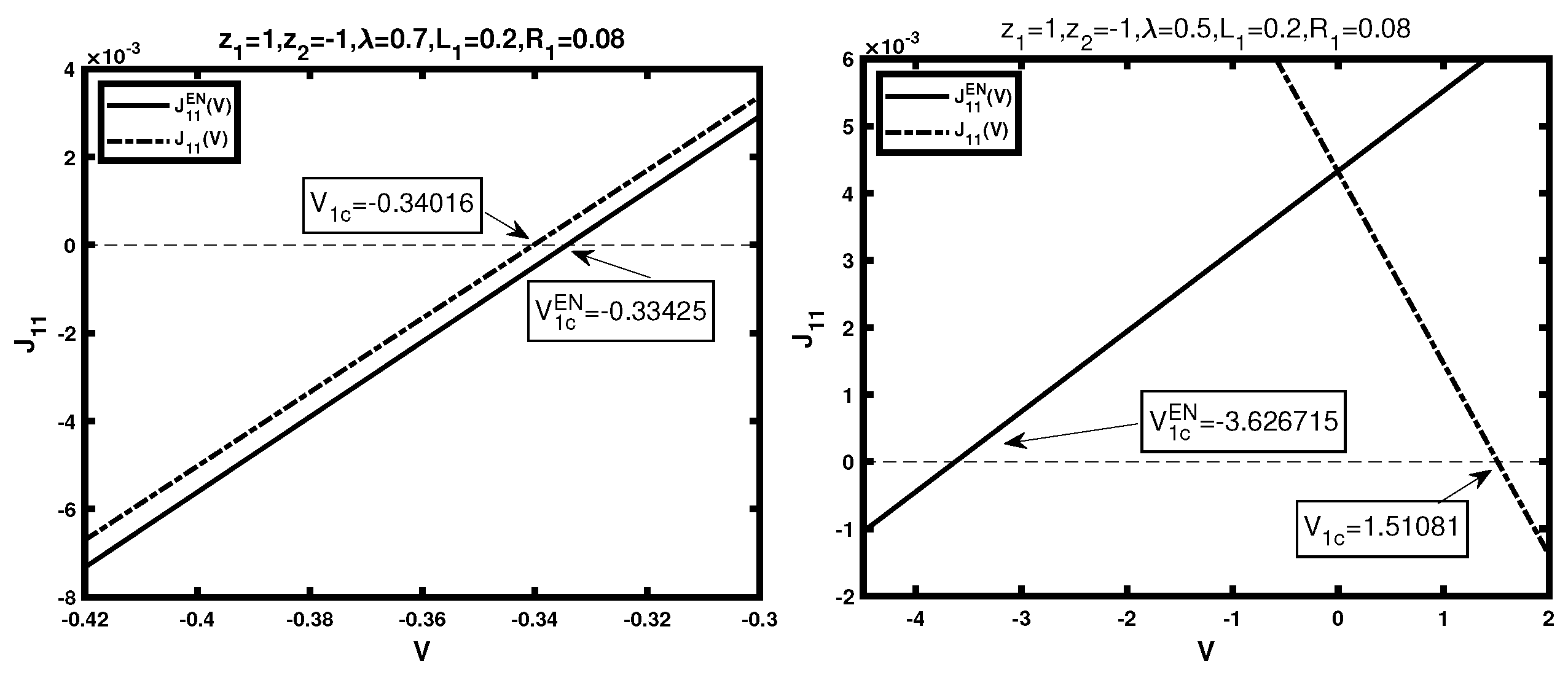
- Identify the critical potentials and defined in Definition 1 for different setups in boundary conditions, and observe the monotonicity of and , respectively, viewed as functions of the potential V, which also indicates the effects on the individual flux from the boundary layers (see Figure 2);
- (3)
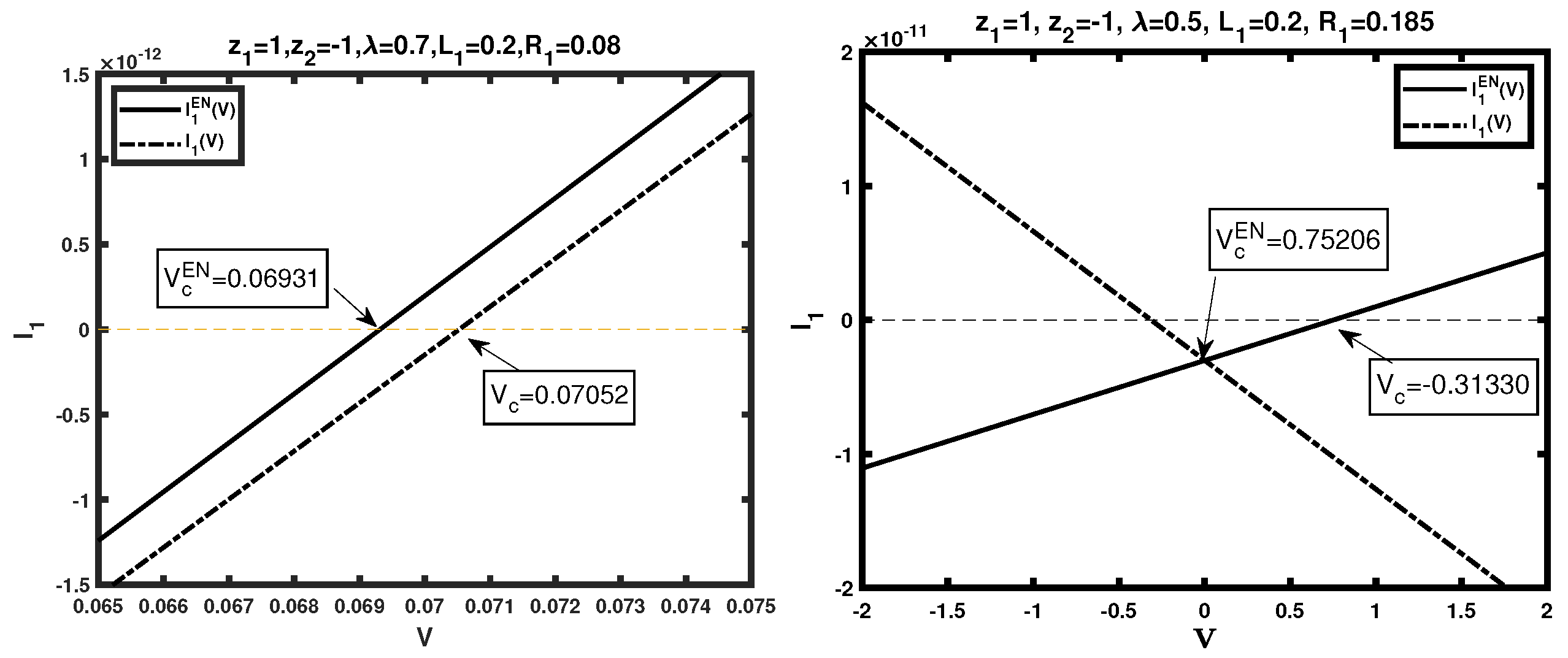
- Identify the critical potentials and defined in Definition 1 for different setups in boundary conditions, and observe the monotonicity of and , respectively, viewed as functions of the potential V, which also indicates the effects on the I–V relations from the boundary layers (see Figure 3).
3.3.2. Direct Description of Boundary Layer Effects on Ionic Flows
- (i)
- (resp. ) for (resp. ). In other words, the boundary layers reduce (resp. enhance) the effect on the individual flux from the finite ion size for (resp. ).
- (ii)
- (resp. ) for (resp. ). In other words, the boundary layers enhance (resp. reduce) the effect on the individual flux from the finite ion size for (resp. ).
- (iii)
- (resp. ) for (resp. ). In other words, the boundary layers reduce (resp. enhance) the effect on the current I from the finite ion size for (resp. ).
4. Conclusions
- We study the signs of and with boundary layers, from which one can tell whether the finite ion size enhances or reduces the individual fluxes, , and the I–V relation, I.
- We characterize the monotonicity of and with boundary layers about the potential V, from which one can efficiently adjust/control the boundary conditions to enhance or reduce the finite ion size effects.
- We examine the boundary layer effects on ionic flows by considering
- As linear functions of the potential V (fixing other system parameters)
- –
- and (resp. ) can be negative (resp. positive), while they are always positive (resp. negative) under the electroneutrality boundary conditions (see Theorems 1 and 3);
- –
- and (resp. ) can be negative (resp. positive), while they are always positive (negative) under the electroneutrality boundary conditions (see Theorems 2 and 4).
- Critical potentials that either balance the ion size effects (such as , and ) or separate the relative ion size effects (such as , and ) on individual fluxes, I–V relations, and the total flow rate of matter, respectively, are identified (Definition 1), which play critical roles in studying ionic flow properties of interest and characterizing the effects from boundary layers (discussed in Section 3).
Author Contributions
Funding
Data Availability Statement
Acknowledgments
Conflicts of Interest
References
- Gillespie, D. A Singular Perturbation Analysis of the Poisson-Nernst-Planck System: Applications to Ionic Channels. Ph.D. Thesis, College of Nursing, Rush University, Chicago, IL, USA, 1999. [Google Scholar]
- Barcilon, V. Ion flow through narrow membrane channels: Part I. SIAM J. Appl. Math. 1992, 52, 1391–1404. [Google Scholar] [CrossRef]
- Barcilon, V.; Chen, D.-P.; Eisenberg, R.S. Ion flow through narrow membrane channels: Part II. SIAM J. Appl. Math. 1992, 52, 1405–1425. [Google Scholar] [CrossRef]
- Eisenberg, R.S. Channels as enzymes. J. Memb. Biol. 1990, 115, 1–12. [Google Scholar] [CrossRef] [PubMed]
- Eisenberg, R.S. Atomic biology, electrostatics and ionic channels. Adv. Ser. Phys. Chem. Recent Dev. Theor. Stud. Proteins 1996, 7, 269–357. [Google Scholar]
- Abaid, N.; Eisenberg, R.S.; Liu, W. Asymptotic expansions of I-V relations via a Poisson-Nernst-Planck system. SIAM J. Appl. Dyn. Syst. 2008, 7, 1507–1526. [Google Scholar] [CrossRef][Green Version]
- Barcilon, V.; Chen, D.-P.; Eisenberg, R.S.; Jerome, J.W. Qualitative properties of steady-state Poisson-Nernst-Planck systems: Perturbation and simulation study. SIAM J. Appl. Math. 1997, 57, 631–648. [Google Scholar]
- Chen, D.P.; Eisenberg, R.S. Charges, currents and potentials in ionic channels of one conformation. Biophys. J. 1993, 64, 1405–1421. [Google Scholar] [CrossRef] [PubMed]
- Eisenberg, B. Proteins, channels, and crowded ions. Biophys. Chem. 2003, 100, 507–517. [Google Scholar] [CrossRef] [PubMed]
- Gillespie, D.; Eisenberg, R.S. Physical descriptions of experimental selectivity measurements in ion channels. Eur. Biophys. J. 2002, 31, 454–466. [Google Scholar] [CrossRef]
- Gillespie, D.; Nonner, W.; Eisenberg, R.S. Coupling Poisson-Nernst-Planck and density functional theory to calculate ion flux. J. Phys. Condens. Matter 2002, 14, 12129–12145. [Google Scholar] [CrossRef]
- Gillespie, D.; Nonner, W.; Eisenberg, R.S. Density functional theory of charged, hard-sphere fluids. Phys. Rev. E 2003, 68, 0313503. [Google Scholar] [CrossRef] [PubMed]
- Im, W.; Roux, B. Ion permeation and selectivity of OmpF porin: A theoretical study based on molecular dynamics, Brownian dynamics, and continuum electrodiffusion theory. J. Mol. Biol. 2002, 322, 851–869. [Google Scholar] [CrossRef] [PubMed]
- Roux, B.; Allen, T.W.; Berneche, S.; Im, W. Theoretical and computational models of biological ion channels. Quat. Rev. Biophys. 2004, 37, 15–103. [Google Scholar] [CrossRef]
- Liu, W.; Wang, B. Poisson-Nernst-Planck systems for narrow tubular-like membrane channels. J. Dyn. Diff. Equ. 2010, 22, 413–437. [Google Scholar] [CrossRef]
- Nonner, W.; Eisenberg, R.S. Ion permeation and glutamate residues linked by Poisson-Nernst-Planck theory in L-type Calcium channels. Biophys. J. 1998, 75, 1287–1305. [Google Scholar] [CrossRef] [PubMed]
- Eisenberg, B.; Liu, W. Poisson-Nernst-Planck systems for ion channels with permanent charges. SIAM J. Math. Anal. 2007, 38, 1932–1966. [Google Scholar] [CrossRef]
- Bates, P.W.; Wen, Z.; Zhang, M. Small permanent charge effects on individual fluxes via Poisson-Nernst-Planck models with multiple cations. J. Nonlinear Sci. 2021, 31, 62. [Google Scholar] [CrossRef]
- Burger, M.; Eisenberg, R.S.; Engl, H.W. Inverse problems related to ion channel selectivity. SIAM J. Appl. Math. 2007, 67, 960–989. [Google Scholar] [CrossRef][Green Version]
- Cardenas, A.E.; Coalson, R.D.; Kurnikova, M.G. Three-Dimensional Poisson-Nernst-Planck Theory Studies: Influence of Membrane Electrostatics on Gramicidin A Channel Conductance. Biophys. J. 2000, 79, 80–93. [Google Scholar] [CrossRef]
- Chen, J.; Zhang, M. Geometric singular perturbation approach to Poisson-Nernst-Planck systems with local hard-sphere potential: Studies on zero-current ionic flows with boundary layers. Qual. Theory Dyn. Syst. 2022, 21, 139. [Google Scholar] [CrossRef]
- Coalson, R.; Kurnikova, M. Poisson-Nernst-Planck theory approach to the calculation of current through biological ion channels. IEEE Trans. Nanobiosci. 2005, 4, 81–93. [Google Scholar] [CrossRef]
- Graf, P.; Kurnikova, M.G.; Coalson, R.D.; Nitzan, A. Comparison of Dynamic Lattice Monte-Carlo Simulations and Dielectric Self Energy Poisson-Nernst-Planck Continuum Theory for Model Ion Channels. J. Phys. Chem. B 2004, 108, 2006–2015. [Google Scholar] [CrossRef]
- Hollerbach, U.; Chen, D.-P.; Eisenberg, R.S. Two- and Three-Dimensional Poisson-Nernst-Planck Simulations of Current Flow through Gramicidin-A. J. Comp. Sci. 2002, 16, 373–409. [Google Scholar] [CrossRef]
- Hollerbach, U.; Chen, D.; Nonner, W.; Eisenberg, B. Three-dimensional Poisson-Nernst-Planck Theory of Open Channels. Biophys. J. 1999, 76, A205. [Google Scholar]
- Hyon, Y.; Fonseca, J.; Eisenberg, B.; Liu, C. A new Poisson-Nernst-Planck equation (PNP-FS-IF) for charge inversion near walls. Biophys. J. 2011, 100, 578a. [Google Scholar] [CrossRef]
- Jerome, J.W. Mathematical Theory and Approximation of Semiconductor Models; Springer: New York, NY, USA, 1995. [Google Scholar]
- Jerome, J.W.; Kerkhoven, T. A finite element approximation theory for the drift-diffusion semiconductor model. SIAM J. Numer. Anal. 1991, 28, 403–422. [Google Scholar] [CrossRef]
- Ji, S.; Eisenberg, B.; Liu, W. Flux ratios and channel structures. J. Dyn. Diff. Equ. 2019, 31, 1141–1183. [Google Scholar] [CrossRef]
- Kurnikova, M.G.; Coalson, R.D.; Graf, P.; Nitzan, A. A Lattice Relaxation Algorithm for 3D Poisson-Nernst-Planck Theory with Application to Ion Transport Through the Gramicidin A Channel. Biophys. J. 1999, 76, 642–656. [Google Scholar] [CrossRef]
- Liu, W.; Sun, N. Flux ratios for effects of permanent charges on ionic flows with three ion species: New phenomena from a case study. J. Dyn. Diff. Equ. 2004, 26, 27–62. [Google Scholar] [CrossRef]
- Liu, W.; Xu, H. A complete analysis of a classical Poisson-Nernst-Planck model for ionic flow. J. Diff. Equ. 2015, 258, 1192–1228. [Google Scholar] [CrossRef]
- Liu, C.; Wang, C.; Wise, S.; Yue, X.; Zhou, S. A positivity preserving, energy stable and convergent numerical scheme for the Poisson-Nernst-Planck system. Math. Comput. 2021, 90, 2071–2106. [Google Scholar] [CrossRef]
- Park, J.-K.; Jerome, J.W. Qualitative properties of steady-state Poisson-Nernst-Planck systems: Mathematical study. SIAM J. Appl. Math. 1997, 57, 609–630. [Google Scholar] [CrossRef]
- Rubinstein, I. Multiple steady states in one-dimensional electrodiffusion with local electroneutrality. SIAM J. Appl. Math. 1987, 47, 1076–1093. [Google Scholar] [CrossRef]
- Rubinstein, I. Electro-Diffusion of Ions. In SIAM Studies in Applied Mathematics; SIAM: Philadelphia, PA, USA, 1990. [Google Scholar]
- Singer, A.; Norbury, J. A Poisson-Nernst-Planck model for biological ion channels–an asymptotic analysis in a three-dimensional narrow funnel. SIAM J. Appl. Math. 2009, 70, 949–968. [Google Scholar] [CrossRef]
- Singer, A.; Gillespie, D.; Norbury, J.; Eisenberg, R.S. Singular perturbation analysis of the steady-state Poisson-Nernst-Planck system: Applications to ion channels. Eur. J. Appl. Math. 2008, 19, 541–560. [Google Scholar] [CrossRef] [PubMed]
- Steinrück, H. Asymptotic analysis of the current-voltage curve of a pnpn semiconductor device. IMA J. Appl. Math. 1989, 43, 243–259. [Google Scholar] [CrossRef]
- Steinrück, H. A bifurcation analysis of the one-dimensional steady-state semiconductor device equations. SIAM J. Appl. Math. 1989, 49, 1102–1121. [Google Scholar] [CrossRef]
- Wang, X.-S.; He, D.; Wylie, J.; Huang, H. Singular perturbation solutions of steady-state Poisson-Nernst-Planck systems. Phys. Rev. E 2014, 89, 022722. [Google Scholar] [CrossRef] [PubMed]
- Wen, Z.; Bates, P.W.; Zhang, M. Effects on I-V relations from small permanent charge and channel geometry via classical Poisson-Nernst-Planck equations with multiple cations. Nonlinearity 2021, 34, 4464–4502. [Google Scholar] [CrossRef]
- Wen, Z.; Zhang, L.; Zhang, M. Dynamics of classical Poisson-Nernst-Planck systems with multiple cations and boundary layers. J. Dyn. Diff. Equ. 2021, 33, 211–234. [Google Scholar] [CrossRef]
- Zhang, M. Boundary layer effects on ionic flows via classical Poisson-Nernst-Planck systems. Comput. Math. Biophys. 2018, 6, 14–27. [Google Scholar] [CrossRef]
- Zheng, Q.; Chen, D.; Wei, W. Second-order Poisson-Nernst-Planck solver for ion transport. J. Comput. Phys. 2011, 230, 5239–5262. [Google Scholar] [CrossRef] [PubMed]
- Zheng, Q.; Wei, G.W. Poisson-Boltzmann-Nernst-Planck model. J. Chem. Phys. 2011, 134, 1–17. [Google Scholar] [CrossRef] [PubMed]
- Zhang, L.; Liu, W. Effects of large permanent charges on ionic flows via Poisson-Nernst-Planck models. SIAM J. Appl. Dyn. Syst. 2020, 19, 1993–2029. [Google Scholar] [CrossRef]
- Jia, Y.; Liu, W.; Zhang, M. Qualitative properties of ionic flows via Poisson-Nernst-Planck systems with Bikerman’s local hard-sphere potential: Ion size effects. Discret. Contin. Dyn. Syst. Ser. B 2016, 21, 1775–1802. [Google Scholar] [CrossRef]
- Ding, J.; Wang, Z.; Zhou, S. Positivity preserving finite difference methods for Poisson-Nernst-Planck equations with steric interactions: Application to slit-shaped nanopore conductance. J. Comput. Phys. 2019, 397, 108864. [Google Scholar] [CrossRef]
- Eisenberg, B.; Hyon, Y.; Liu, C. Energy variational analysis of ions in water and channels: Field theory for primitive models of complex ionic fluids. J. Chem. Phys. 2010, 133, 104104. [Google Scholar] [CrossRef] [PubMed]
- Hyon, Y.; Eisenberg, B.; Liu, C. A mathematical model for the hard sphere repulsion in ionic solutions. Commun. Math. Sci. 2011, 9, 459–475. [Google Scholar]
- Hyon, Y.; Liu, C.; Eisenberg, B. PNP equations with steric effects: A model of ion flow through channels. J. Phys. Chem. B 2012, 116, 11422–11441. [Google Scholar]
- Kilic, M.S.; Bazant, M.Z.; Ajdari, A. Steric effects in the dynamics of electrolytes at large applied voltages. II. Modified Poisson-Nernst-Planck equations. Phys. Rev. E 2007, 75, 021503. [Google Scholar] [CrossRef]
- Sun, L.; Liu, W. Non-localness of excess potentials and boundary value problems of Poisson-Nernst-Planck systems for ionic flow: A case study. J. Dyn. Diff. Equ. 2018, 30, 779–797. [Google Scholar] [CrossRef]
- Zhou, S.; Wang, Z.; Li, B. Mean-field description of ionic size effects with nonuniform ionic sizes: A numerical approach. Phy. Rev. E 2011, 84, 1–13. [Google Scholar] [CrossRef] [PubMed]
- Bikerman, J.J. Structure and capacity of the electrical double layer. Philos. Mag. 1942, 33, 384. [Google Scholar] [CrossRef]
- Eisenberg, B.; Liu, W.; Xu, H. Reversal charge and reversal potential: Case studies via classical Poisson-Nernst-Planck models. Nonlinearity 2015, 28, 103–127. [Google Scholar] [CrossRef]
- Ji, S.; Liu, W. Poisson-Nernst-Planck systems for ion flow with density functional theory for hard-sphere potential: I–V relations and critical potentials. Part I: Analysis. J. Dyn. Diff. Equ. 2012, 24, 955–983. [Google Scholar] [CrossRef]
- Liu, W. Geometric singular perturbation approach to steady-state Poisson-Nernst-Planck systems. SIAM J. Appl. Math. 2005, 65, 754–766. [Google Scholar] [CrossRef]
- Liu, W. One-dimensional steady-state Poisson-Nernst-Planck systems for ion channels with multiple ion species. J. Diff. Equ. 2009, 246, 428–451. [Google Scholar] [CrossRef]
- Aitbayev, R.; Bates, P.W.; Lu, H.; Zhang, L.; Zhang, M. Mathematical studies of Poisson-Nernst-Planck systems: Dynamics of ionic flows without electroneutrality conditions. J. Comput. Appl. Math. 2019, 362, 510–527. [Google Scholar] [CrossRef]
- Chen, J.; Wang, Y.; Zhang, L.; Zhang, M. Mathematical analysis of Poisson-Nernst-Planck models with permanent charges and boundary layers: Studies on individual fluxes. Nonlinearity 2021, 34, 3879–3906. [Google Scholar] [CrossRef]
- Lu, H.; Li, J.; Shackelford, J.; Vorenberg, J.; Zhang, M. Ion size effects on individual fluxes via Poisson-Nernst-Planck systems with Bikerman’s local hard-sphere potential: Analysis without electroneutrality boundary conditions. Discret. Contin. Dyn. Syst. Ser. B 2018, 23, 1623–1643. [Google Scholar] [CrossRef]
- Wang, Y.; Zhang, L.; Zhang, M. Studies on individual fluxes via Poisson-Nernst-Planck models with small permanent charges and partial electroneutrality conditions. J. Appl. Anal. Comput. 2022, 12, 87–105. [Google Scholar] [CrossRef] [PubMed]
Disclaimer/Publisher’s Note: The statements, opinions and data contained in all publications are solely those of the individual author(s) and contributor(s) and not of MDPI and/or the editor(s). MDPI and/or the editor(s) disclaim responsibility for any injury to people or property resulting from any ideas, methods, instructions or products referred to in the content. |
© 2024 by the authors. Licensee MDPI, Basel, Switzerland. This article is an open access article distributed under the terms and conditions of the Creative Commons Attribution (CC BY) license (https://creativecommons.org/licenses/by/4.0/).
Share and Cite
Liu, X.; Zhang, L.; Zhang, M. Studies on Ionic Flows via Poisson–Nernst–Planck Systems with Bikerman’s Local Hard-Sphere Potentials under Relaxed Neutral Boundary Conditions. Mathematics 2024, 12, 1182. https://doi.org/10.3390/math12081182
Liu X, Zhang L, Zhang M. Studies on Ionic Flows via Poisson–Nernst–Planck Systems with Bikerman’s Local Hard-Sphere Potentials under Relaxed Neutral Boundary Conditions. Mathematics. 2024; 12(8):1182. https://doi.org/10.3390/math12081182
Chicago/Turabian StyleLiu, Xiangshuo, Lijun Zhang, and Mingji Zhang. 2024. "Studies on Ionic Flows via Poisson–Nernst–Planck Systems with Bikerman’s Local Hard-Sphere Potentials under Relaxed Neutral Boundary Conditions" Mathematics 12, no. 8: 1182. https://doi.org/10.3390/math12081182
APA StyleLiu, X., Zhang, L., & Zhang, M. (2024). Studies on Ionic Flows via Poisson–Nernst–Planck Systems with Bikerman’s Local Hard-Sphere Potentials under Relaxed Neutral Boundary Conditions. Mathematics, 12(8), 1182. https://doi.org/10.3390/math12081182