Abstract
This paper develops and validates a modified backstepping control scheme for hypersonic vehicles (HSVs) with uncertain dynamics and angle-of-attack (AOA) constraint, which incorporates a novel finite-time extended state observer (FTESO) and a time-varying barrier Lyapunov function (BLF)-based controller. In order to ensure that observation errors converge before the controller reaches the steady states, the “adding a power integrator” (AAPI) technique is utilized to design the FTESO by transforming the observation problem of the traditional extended state observer (ESO) into a stabilization problem. Combining time-varying constraints and tracking errors to construct the BLF, the backstepping control law that can adapt to large initial tracking errors is derived. Theoretical and comparative simulation results show that the proposed FTESO performs well in terms of speed and accuracy, and AOA is constrained within the prescribed region.
Keywords:
hypersonic vehicles; angle-of-attack constraint; finite-time extended state observer; barrier Lyapunov function MSC:
93D40
1. Introduction
Hypersonic vehicles, which are fitted with ramjets and have speeds exceeding Mach five, acquire remarkable attention from various aerospace powers because of their high military and civil values [1,2]. However, complex flight environments lead to large model parameter perturbations of HSVs and unknown environmental disturbances, and these uncertainties contain matched and mismatched terms. In addition, the HSVs are required to make exact attitude movements to ensure that the ramjets work in optimal operating conditions. Consequently, complex dynamic characteristics, unknown flight environments and strict control requirements bring great challenges to the controller design of HSVs, where high maneuverability, strong robustness, and adaptability are needed [3]. The backstepping control method provides a more structured and systematic approach of controller design, relieving the limitations of mismatched items by introducing virtual control, which shows its unique advantages in dealing with mismatched uncertain problems. Therefore, many researchers combine advanced control techniques, such as input-output feedback linearization [4], fuzzy control [5], sliding-mode technique [6], robust technique [7], disturbance observer technique [8,9], etc., within the framework of backstepping control design for handling mismatched uncertainties of the HSVs.
Backstepping control based on disturbance observer can compensate the matched and mismatched disturbances by using disturbance observation, which greatly improves the tracking accuracy and robustness of the control systems. Zhang et al. combine sliding manifolds and the disturbance observer to improve the backstepping control method, and the proposed control scheme strengthens the robustness of control systems [10]. To reduce the detrimental impacts of lumped disturbance on output channels, An et al. provide a nonlinear dynamic inversion technology based on the observer [11]. By introducing a reduced-order observer into the controller, Yin et al. propose a novel control strategy for three-phase three-level NPC power converters [12]. Yu et al. design a switched observer in the sliding-mode control scheme to ensure that the state trajectories of the system can be driven into a predefined sliding-mode region in a finite time [13]. In addition, the neural network can also be regarded as a special observer to estimate uncertainties in the system dynamics, and the transient response and steady-state error of the system are improved [14,15]. As a new disturbance estimation technique that has emerged in recent years [16], the ESO technique is widely used because of its efficiency and simplicity of disturbance estimations [17,18]. Xia et al. design an integration scheme of ESO and adaptive law to estimate the disturbance, and the improved sliding-mode controller obtains better performance [19]. But the observer has too many parameters which are difficult to adjust. Gao implements ESO in linear form, which reduces the observer parameters that need to be adjusted [20]. Because the adjusted parameters are of clear physical significance, it is very convenient and effective for engineering applications. Zhao et al. further improve the linear extended state observer (LESO) by using time-varying gains that increase over time to reduce the peak of estimation errors [21]. If the disturbances on HSVs cannot be compensated quickly and accurately, the attitudes of HSVs (especially AOA) may deviate from the constraint range due to the uncompensated disturbances, causing the ramjets to operate out of order. Thus, the rapidity and accuracy of disturbance estimations are extremely crucial. Unfortunately, the above methods only guarantee the convergence of the observer errors, and its convergence time is endless. The convergence time requirements of observer errors on HSVs are ignored. Therefore, ensuring the convergence of estimation errors in finite time is one of the important motivations of this paper. Many studies provide significant contributions in terms of finite-time observers. Shen et al. apply the finite-time stability theorem to study the global and finite-time stable observers [22]. Wu et al. develop nonlinear finite-time observers to estimate the unsteady aerodynamic disturbances of aircraft longitudinal motion [23]. Chen et al. propose the design method of observers using the terminal sliding mode to achieve finite-time estimation performance [24]. However, the periodic wind disturbances to HSVs will reduce the observation accuracy, which poses a challenge to the above observers. The effectiveness of the AAPI technique in the field of finite-time control is fully proved in [25,26], which provides a reference to improve FTESO for time optimization. But the extended states (i.e., disturbances) are unknown, which is inhospitable to the AAPI technique that relies on state feedback to generate control laws. One of our goals is to improve FTESO with the AAPI technique and solve the problem of the unknown extended states being unavailable as feedback.
In practical applications, good working conditions of ramjet propulsion systems are vital for HSVs to realize hypersonic flights. This requires the AOA to be kept within a reasonable range. Dong et al. consider the case when the AOA is physically constrained as an intermediate term of backstepping control and use a smooth saturation function to deal with the AOA saturation problem [27]. Recently, control methods based on the BLF have been effectively applied in output constrained problems [28,29,30]. To deal with the AOA constrained problem, BLF is used for the controller design of HSV longitudinal motional models. Liu et al. introduce BLF into controller design, which can ensure that the states of HSV comply with prescribed tracking performance and state constraints [31]. By using the saturation function to restrict the AOA command and the BLF to restrict the tracking error, Dong et al. achieve the constraint control on AOA [32]. Guo et al. directly restrict AOA within a predefined interval without setting the tracking error and virtual control constraints separately [33]. To ensure tracking accuracy, the boundary of BLF is set to a small constant value. For HSVs, a difficulty is that the initial tracking error of the system is also required to be on this narrow boundary. This drives us to further promote the application of BLF for HSVs with attitude constraints.
Motivated by the aforementioned discussions, we develop a novel observer-based backstepping control scheme for HSVs with uncertain dynamics and AOA constraint. The compensation speed of unknown disturbances and the constraints of output states are taken as significant considerations. Firstly, FTESO based on the AAPI technique is designed to estimate matched and mismatched disturbances in the HSV systems. Then, the backstepping control law is derived by selecting a time-varying barrier function as a candidate Lyapunov function to remove the restrictions on initial tracking errors, and tracking differentiators (TDs) are introduced to avoid the “differential explosion” phenomenon. Finally, the stability of the closed-loop system is proven. The main contributions of this paper are summarized as follows.
- (i)
- In order to achieve the constrained control of disturbance estimation and compensation for HSVs, we design an integrated observation and control scheme. The matched and mismatched disturbances can be estimated by FTESO, and the disturbance observations are compensated into the backstepping controller based on BLF.
- (ii)
- By utilizing the AAPI technique and ESO technique synthetically, a novel FTESO is firstly established to estimate time-varying disturbances. Compared with another FTESO [34,35], the proposed FTESO has more advantages in restraining fluctuations. In particular, we propose an auxiliary observer to solve the problem that extended internal states (i.e., the observation errors of disturbances) are unavailable as feedback to the virtual observation controller. The FTESO constructed on the above basis can achieve bounded estimated errors in finite time.
- (iii)
- In constructing the BLF, we develop a novel monotone decreasing boundary to replace the constant boundary of traditional BLF. The proposed time-varying barrier function can adapt to various initial tracking errors by setting reasonable parameters. It is guaranteed that the tracking errors are bounded while the constraint of AOA can be proved theoretically.
The paper is structured as follows. Section 2 describes the dynamic model of HSVs and formulates the problem. In Section 3, the AAPI technique is introduced into the ESO to design an FTESO which guarantees that estimation errors converge in finite time, and the backstepping control scheme with FTESO and the BLF-based controller is proposed. The stability of the controlled system is analyzed. Section 4 presents comparative simulation results. Section 5 concludes the paper.
Notation.
We use the following notations throughout the paper: denotes the n-dimensional Euclidean space; for a given vector define , where and denotes the sign function.
2. Problem Formulation
The 3DoF attitude dynamics of HSVs are usually described as [36]
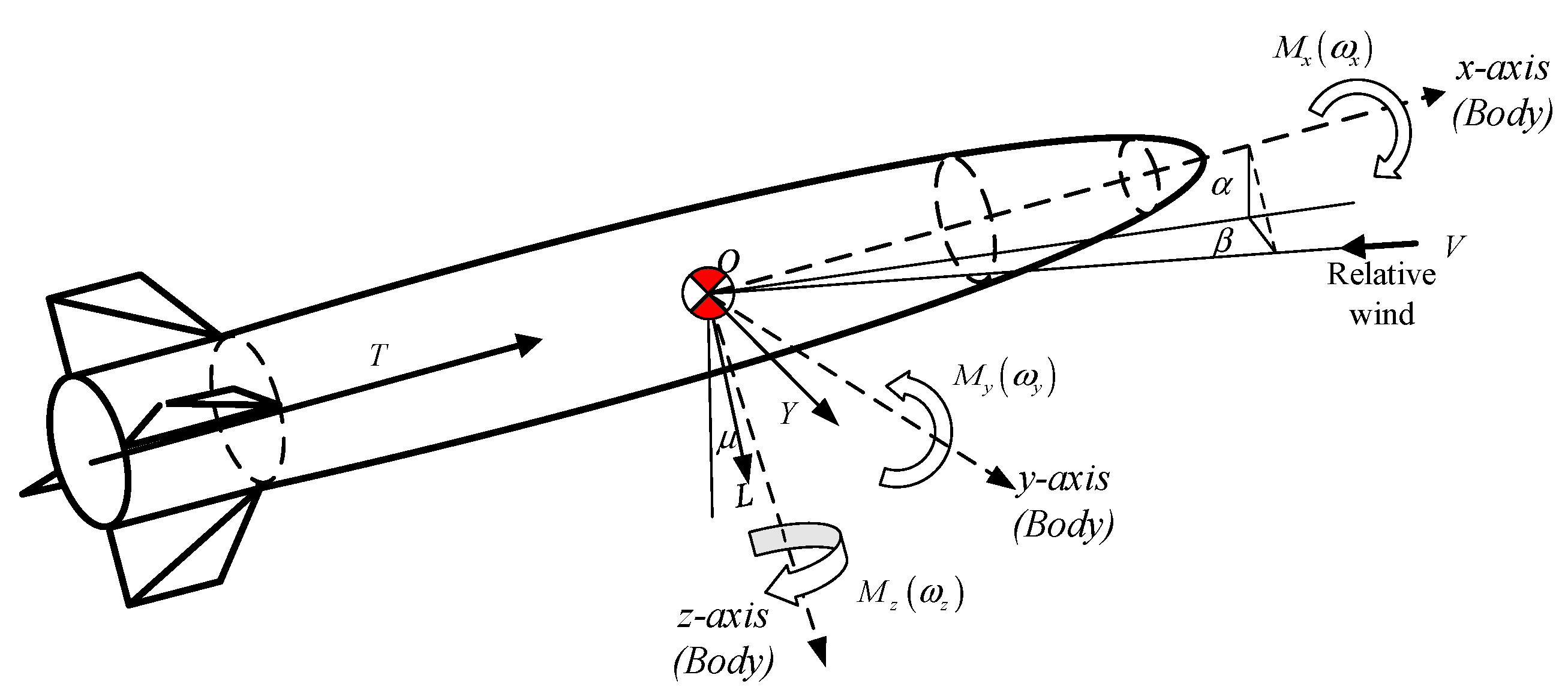
where , , and denote the angles of attack, sideslip, and bank, respectively. denote the roll, pitch, and yaw rate, in that order. represent the moments of inertia in the body frame. Mass is , gravitational acceleration is , and and are the velocity and flight-path angle, respectively. represents engine thrust. The lift force , side force , and aerodynamic moments are expressed as
where , and are dynamic pressure, reference area and reference length, respectively. denote the control inputs. are obtained by interpolating or fitting the aerodynamic characteristic data. denote the derivatives of aerodynamic moment coefficients with respect to control inputs . The disturbances are mainly generated by parameter uncertainties and can be expressed as and , where and denote the uncertainty degree of model parameters.
The schematic diagram of the HSV model is shown in Figure 1.
Figure 1.
Geometry of HSV.
Substituting (2) into (1), gives
The state vectors are and , and the control vector is . The functions , , , are
respectively. The disturbances and in (3) have the forms
where are the wind disturbances to each channel including angles and angular velocities.
The problem discussed in this article is formulated as below.
Consider a hypersonic vehicle modeled by (3) with system parameters given in (4)–(7); matched and mismatched disturbances on the hypersonic vehicle are described in (8) and (9). Using the states and , design disturbance observers and attitude tracking controllers such that
- (i)
- Disturbance observation errors are uniformly ultimately bounded in finite time, i.e., there exists a constant , which holds , where are small residual sets;
- (ii)
- Attitude tracking errors satisfy the boundary constraints, where represents a reference attitude angle, i.e., given error system bounds , we have ;
- (iii)
- All signals in the closed-loop control system of the HSV are guaranteed to be uniformly ultimately bounded.
Remark 1.
It is difficult to analyze the finite-time stability of disturbance estimation errors when real-time disturbances are not available as feedback directly or indirectly.
Remark 2.
We replace the constant boundaries with time-varying boundaries . The functional forms of time-varying boundaries require special selection to ensure the existence of the backstepping control law that constraints tracking errors within the prescribed region.
Remark 3.
The controller and observer in the above problem are integrated. In order to reduce the influence of the dynamic observing process on the controller, we expect the convergence time and overshoot of observation errors to be as small as possible. Furthermore, when , we need to set reasonable bounds to avoid tracking errors exceeding constraint bounds.
To facilitate the discussions, we make the following assumptions.
Assumption 1.
The derivatives of the lumped disturbances with respect to time, which are defined as , are existent, and bounded with the boundaries are unknown positive constants, i.e., .
Assumption 2.
There exist positive constants such that the time-varying constraints satisfy .
Remark 4.
Since the energy of external environmental changes is finite and the parameter perturbations have physical limits, the lumped disturbances acting on HSVs are unknown and time-varying signals have finite change rates. Assumption 1 is reasonable.
3. Attitude Controller Design
3.1. Control Scheme
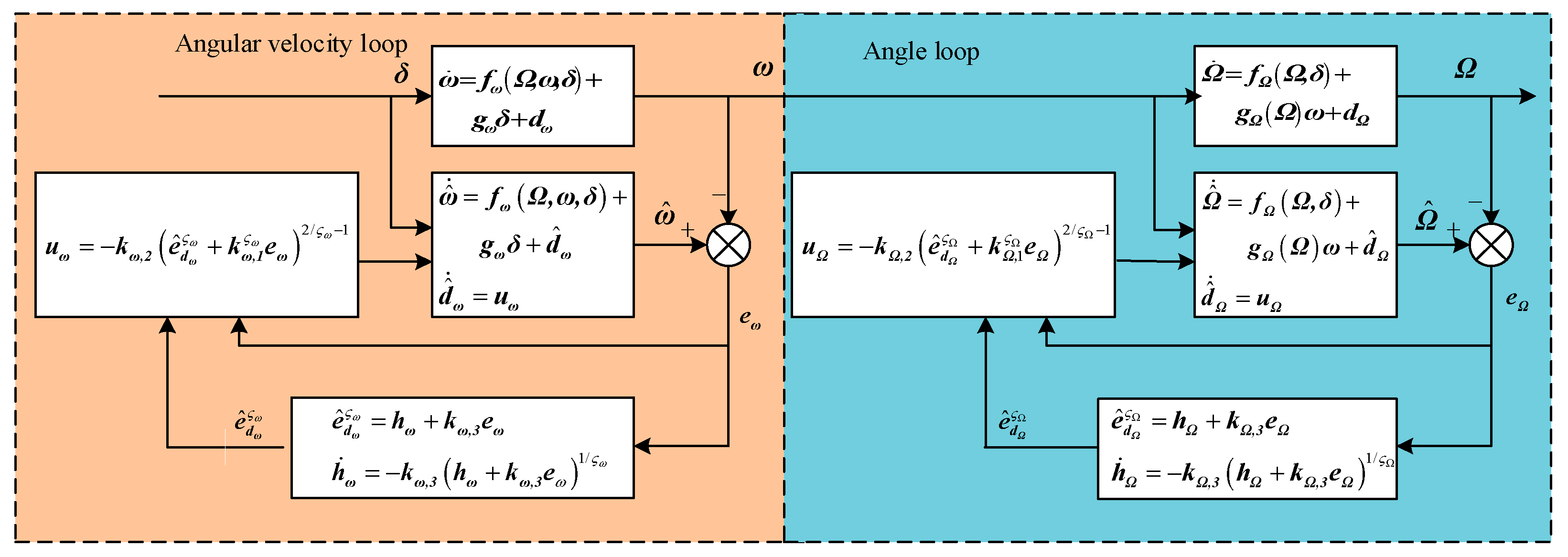
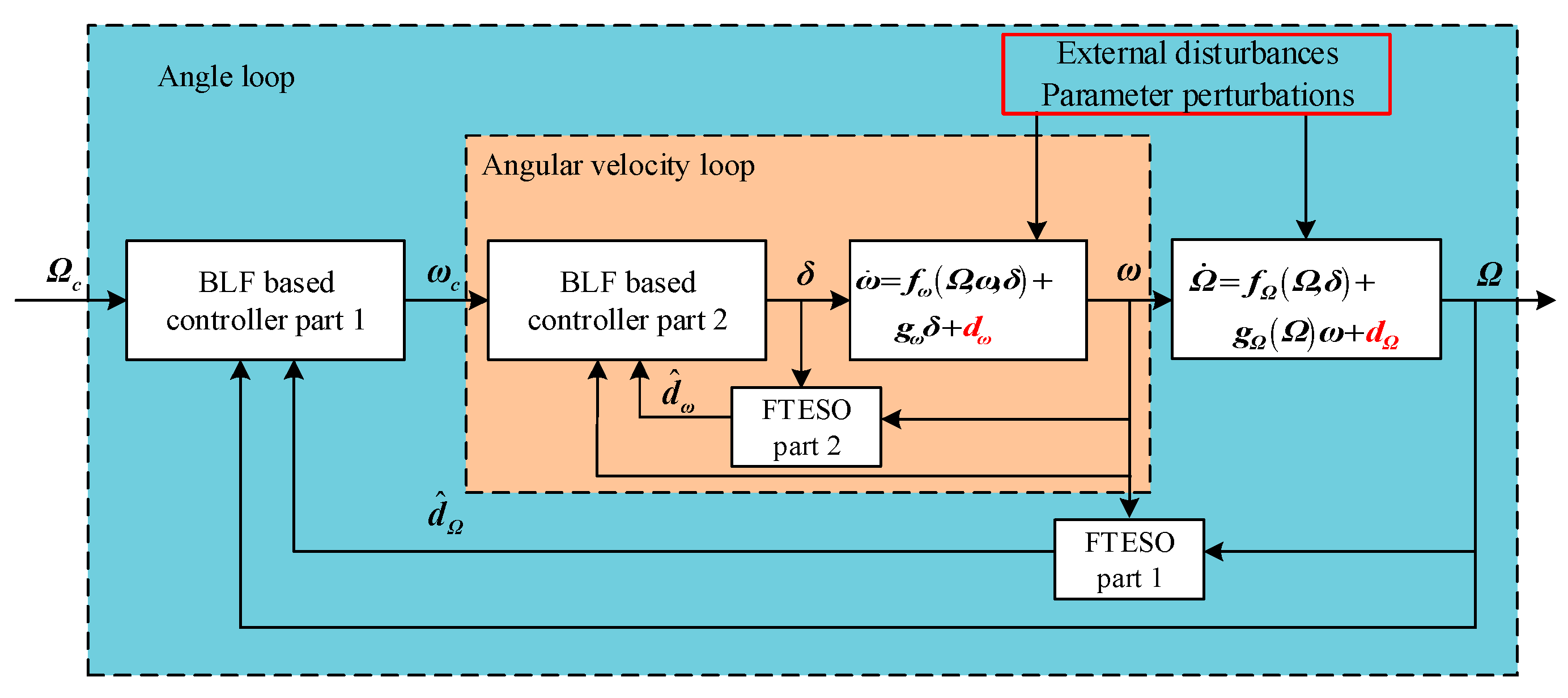
Following the previous discussions, the control structure of HSVs is presented in Figure 2, which is divided into an angle loop and an angular-velocity loop. Each loop contains an observer and a controller. The observer design is to achieve the disturbance observations , in terms of the system states , and control inputs . In Section 3.2, we develop the FTESO to ensure that observation errors converge before the controller reaches the steady states, and reduce the influence of dynamic observing process on the controlled system. In Section 3.3, an improved backstepping control scheme is developed based on BLF, which compensates the disturbances and constrains the attitude angles of HSVs.
Figure 2.
Controller structure of HSVs.
3.2. Finite-Time Extended State Observer
According to the idea of equalizing system disturbances with extended states proposed by [16], the disturbances in (3) are extended to the new states, and the new system is as follows
The form of the proposed disturbance observer is designed as
where are observation inputs that drive the estimation errors to converge to a certain region and denote the observations of states .
Further, the error system as follows can be obtained by transforming (11)
where .
Remark 5.
The observation problem of (11) is transformed into a stabilization problem through establishing the error system (12). Then, we only need to stabilize the system (12) in finite time, and the FTESO is achieved. The finite-time stabilization methods mainly include the homogeneous approach and the AAPI technique. Since system (12) is inhomogeneous, the homogeneous approach is not applicable. We apply the AAPI technique to realize the convergence of estimation errors in finite time. But two difficulties are faced: (1) since the disturbances are unknown, the estimation errors of disturbances are unknown, and the AAPI technique based on state feedback cannot be applied. (2) The boundaries of the disturbance derivatives are unknown, which puts forward requirements on the robustness of the designed observation controller.
For the error system (12), we need to design the observation inputs to stabilize the system states , which can be achieved by the simple linear combination of system states. The system states converge to zero as time approaches infinity, by this method. However, we hope that the error system states can converge within a finite time. For this purpose, we adopt the AAPI technique from [26] to increase the state feedback to a fractional power. The virtual observation control laws are given as follows
where are the ratios of two odd integers, and are diagonal matrices to be determined. The virtual observation control laws (13) require that the states of the error system (12) are all known. In fact, the disturbance estimation errors are unknown in (13), since actual disturbances are unavailable. The auxiliary observers are used to obtain the observations of disturbance estimation errors , as below
where are auxiliary variables in the above observer, and are diagonal matrices to be determined. The virtual observation control laws are rewritten as
To introduce the proposed FTESO more intuitively, its structure is shown in Figure 3. The observer is divided into an angular-velocity loop and an angle loop, both of which have the same structure. The auxiliary observer utilizes state observation errors to estimate disturbance observation errors . Then, observation control inputs are obtained by combining observation errors , in the form of the AAPI, which can stabilize the error system in finite time.
Figure 3.
Structure of FTESO.
Based on the above FTESO design, the following Theorem 1 is given.
Theorem 1.
Under Assumption 1, the observation inputs adopt (14) and (15), and error system (12) is finite-time uniformly ultimately bounded by selecting the appropriate gain matrices .
Proof of Theorem 1.
Take the angle loop as an example; the Lyapunov direct method is adopted and the proof follows four steps:
Step 1.
Choose the Lyapunov candidate . Hence, the derivative of with respect to time gives
where
. Substituting it into Equation (16) gives
The inequality as follows can be obtained by introducing Lemma A.1 of [37]
Moreover, let ; (17) can be derived further by introducing Lemma A.2 of [37]
where , , and is an arbitrary positive constant.
Step 2. Choose the Lyapunov candidate . Hence, the derivative of with respect to time is shown below
Through simple derivation, we have
where . Observation control law is designed as
where . Next, we process successively the elements in (21). First, we have inequality as
where is an arbitrary positive constant. Using a similar approach, the following inequalities can be obtained:
where is an arbitrary positive constant. After substituting (23)–(25) into (21), the following result is obtained
where
Step 3. Choose the Lyapunov candidate . Hence, the derivative of with respect to time is shown below
By introducing Lemma 2.7 of [38], we have
when , the above equation holds, obviously. Therefore,
In the same way as step 2, we deal successively with the elements in (30). First, we obtain the inequality as below by introducing Lemma 2.6 of [24]
Further, we have
Following the same method, it holds that
It is further derived that
The following formula is also readily available:
Substituting (31)–(38) into (30), we have
where
Step 4. Let , hence,
where , , , . After further processing of the inequality (41), we have
where
Obviously,
Hence,
Obviously,
Finally,
where , . Considering the conditions of Proposition 2 in [39], and need to satisfy certain conditions: , . It can be easily deduced that . Therefore, if and , the angle loop of the error system is finite-time uniformly ultimately bounded by Proposition 2 in [39]. The proof of Theorem 1 is completed. □
Remark 6.
From the above proof, we can see that the observer gains must satisfy and ; the details are implied in (19), (37), (40), (41), and (43). Following the same approach as above, it can be proved that the angular-velocity loop of the error system is also finite-time uniformly ultimately bounded.
3.3. Controller Design
Benefitting from the disturbance observation scheme designed in the previous subsection, the idea of backstepping control including BLF to constrain outputs can be applied in this subsection. The entire control system is divided into two sub-loops. One is the angle control loop, in which the angular velocities are used as the control inputs, and the virtual commands need to counteract mismatched disturbances estimated by the observer. The other one is the angular-velocity control loop, in which rudder deflections are used as the control inputs to counteract matched disturbances estimated by the observer to track angle commands. The controller design is divided into two steps.
Step 1. Based on Assumption 2, we choose the following symmetric-barrier Lyapunov function candidate
where denotes the natural logarithm of , and is a vector of the attitude angle tracking errors. The time-varying boundaries are
where , and . are initial boundaries, and satisfy , are terminal boundaries, and indicate the descent speed of boundaries. The time derivative of is given by
Design the stabilizing function as
where is the diagonal matrix that needs to be adjusted, and satisfies the diagonal elements that are positive.
Step 2. Since the angular velocities are not constrained, we choose a Lyapunov function candidate by augmenting with a quadratic function
where is a vector of angular-velocity tracking errors. The time derivative of is given by
Let . If , then
The angular-velocity loop control law is designed as
Remark 7.
By setting the appropriate parameters l, , and , the time-vary boundary allows large initial tracking errors caused by command mutation and estimation errors before the observer converges. The initial boundary can be set to where . The derivative of commands and are obtained by using TD, avoiding the differential expansion phenomenon in the conventional BLF process. Specific forms of TDs are presented in [40].
Remark 8.
The disturbance estimations are used instead of disturbances in (52) and (56), obviously, if the disturbances and are known, such that the closed-loop system satisfies the stability Lemma 1 in [30]. However, the observed values of disturbances are used in real control laws, and there are estimation errors with the real disturbances, which causes difficulties in proving the stability of the closed-loop system consisting of (3), (52) and (56).
Theorem 2.
For the hypersonic missile system (3) under Assumption 1, the control gains meet , and the BLF-based backstepping control laws (52) and (56) can ensure that the tracking errors of attitude angles do not violate the boundary constraints and will ultimately enter a compact set, where disturbance observations and are provided by the FTESO consisting of (11), (13), and (14).
Proof of Theorem 2.
Considering , the backstepping control law adopts (52) and (56), and the time derivative of is given by
Further,
where are the minimum of the eigenvalues of the control gain matrix , respectively, , and . Furthermore, it can be expressed uniformly as
where . Define a compact set , when holds it is easy to verify that
Thus, using Lemma 1 in [30], the system output tracking errors do not violate the boundary constraints, and will ultimately enter a compact set . The proof of Theorem 2 is completed. □
4. Simulations and Comparisons
In this section, numerical simulations are given to validate the efficacy of the proposed FTESO and BLF-based controller. Firstly, we compare the estimation effects of the FTESO and other observers on disturbances of HSVs through simulation, where disturbances include model parameter uncertainties and wind disturbances. Then, the proposed control scheme is compared with the other two schemes, which are also based on backstepping control, to verify the performance of the control systems on command tracking and attitude constraints.
4.1. Observer-Effect Verification
The initial states of the HSV are and . The mass and velocity of the HSV are and , respectively, and the engine thrust is . The moments of inertia are , , and , and the reference area and reference length are and .
By fitting the aerodynamic data, we obtain
Further, , and . As we all know, wind disturbances are caused by atmospheric turbulence, and it is usually a random process containing different frequencies. Simultaneously, the performance of the HSV control system is mainly influenced by low-frequency disturbances, so we primarily consider wind disturbances as
The uncertainty degree of the model parameters is 30%. The commands are set as , , and .
The observer parameters are designed as
The controller parameters are designed as
In order to validate the effectiveness of the proposed FTESO, comparative simulations with LESO [20], another form of FTESO [34,35] and the sliding-mode disturbance observer (SMDO) [41] are conducted.
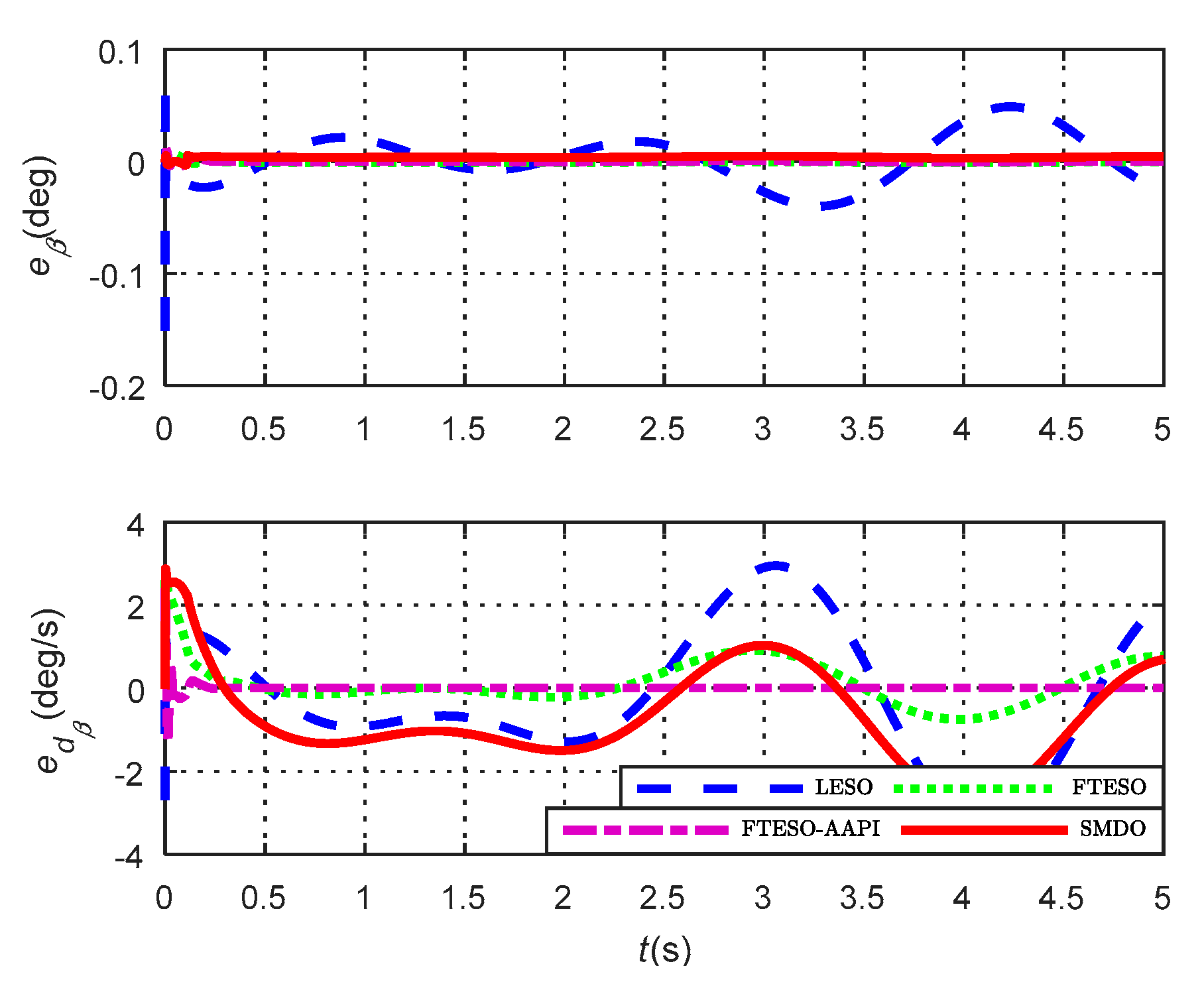
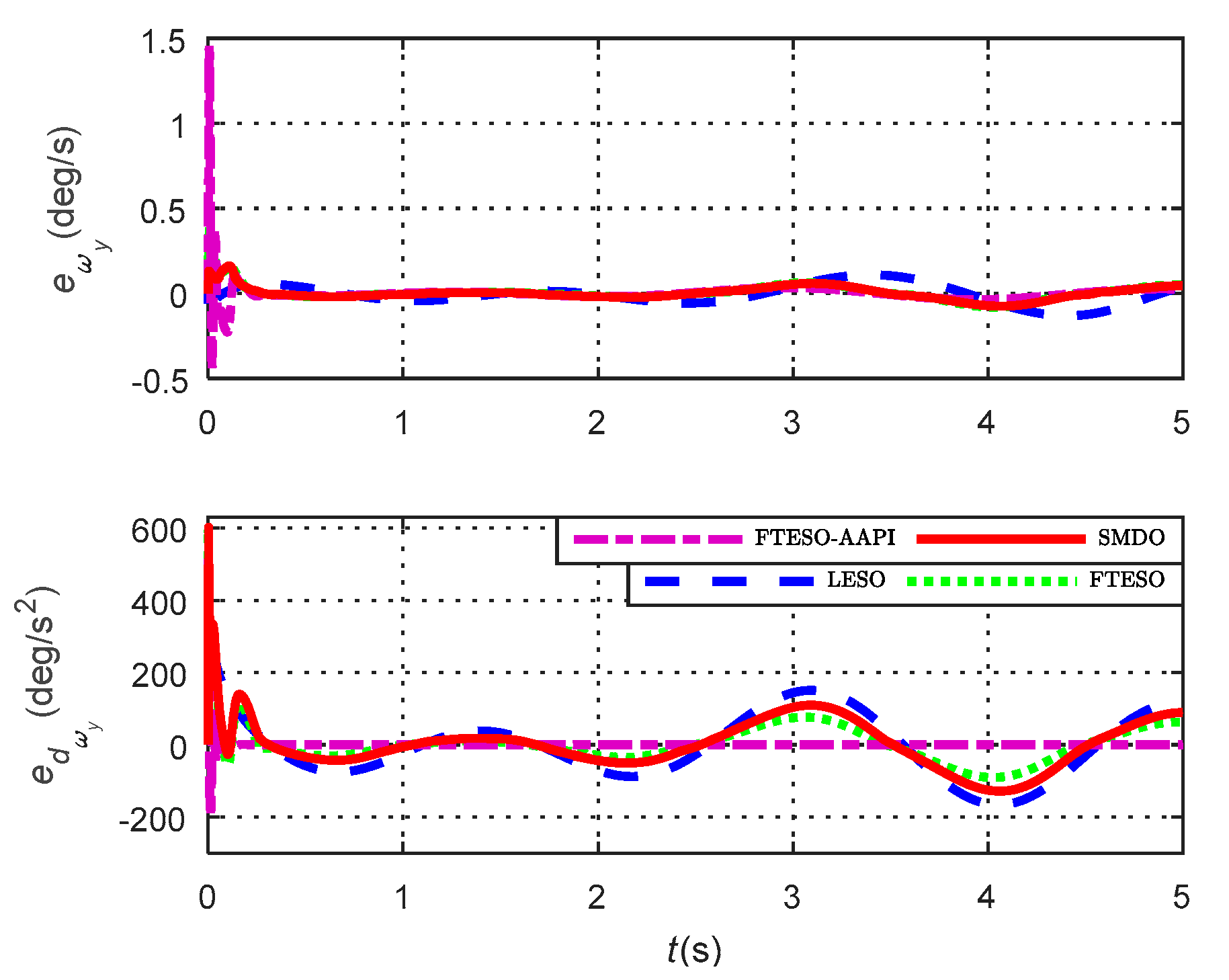
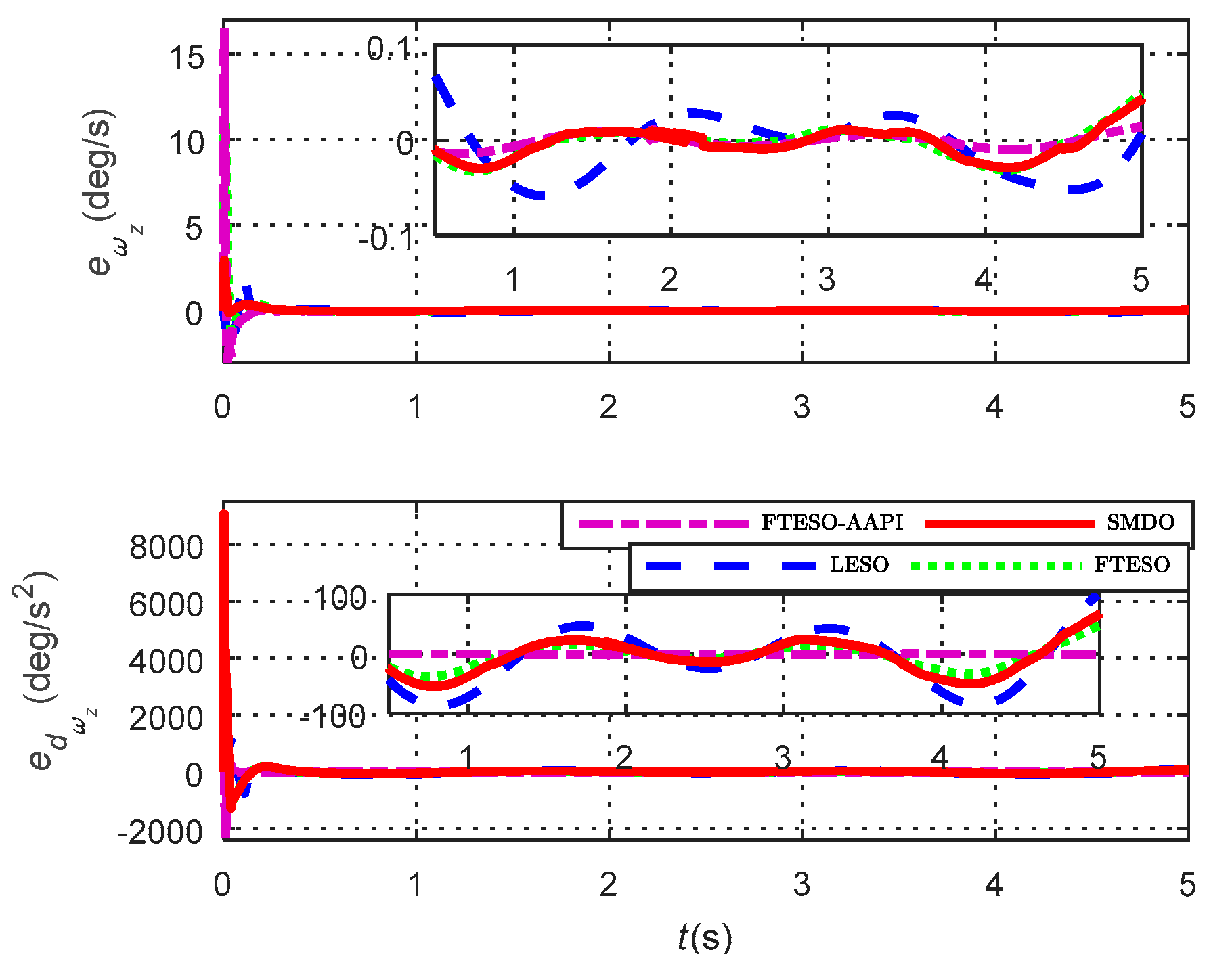
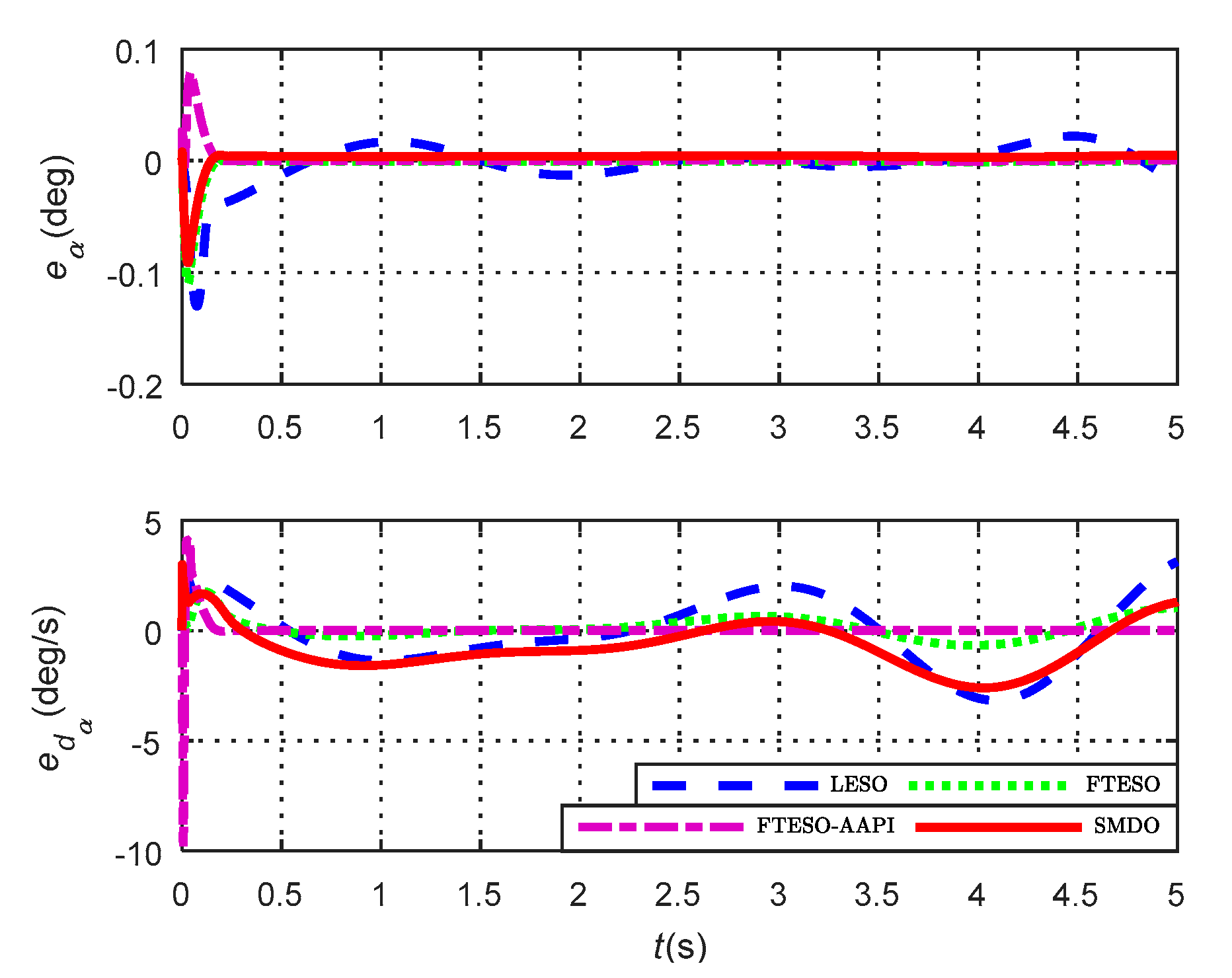
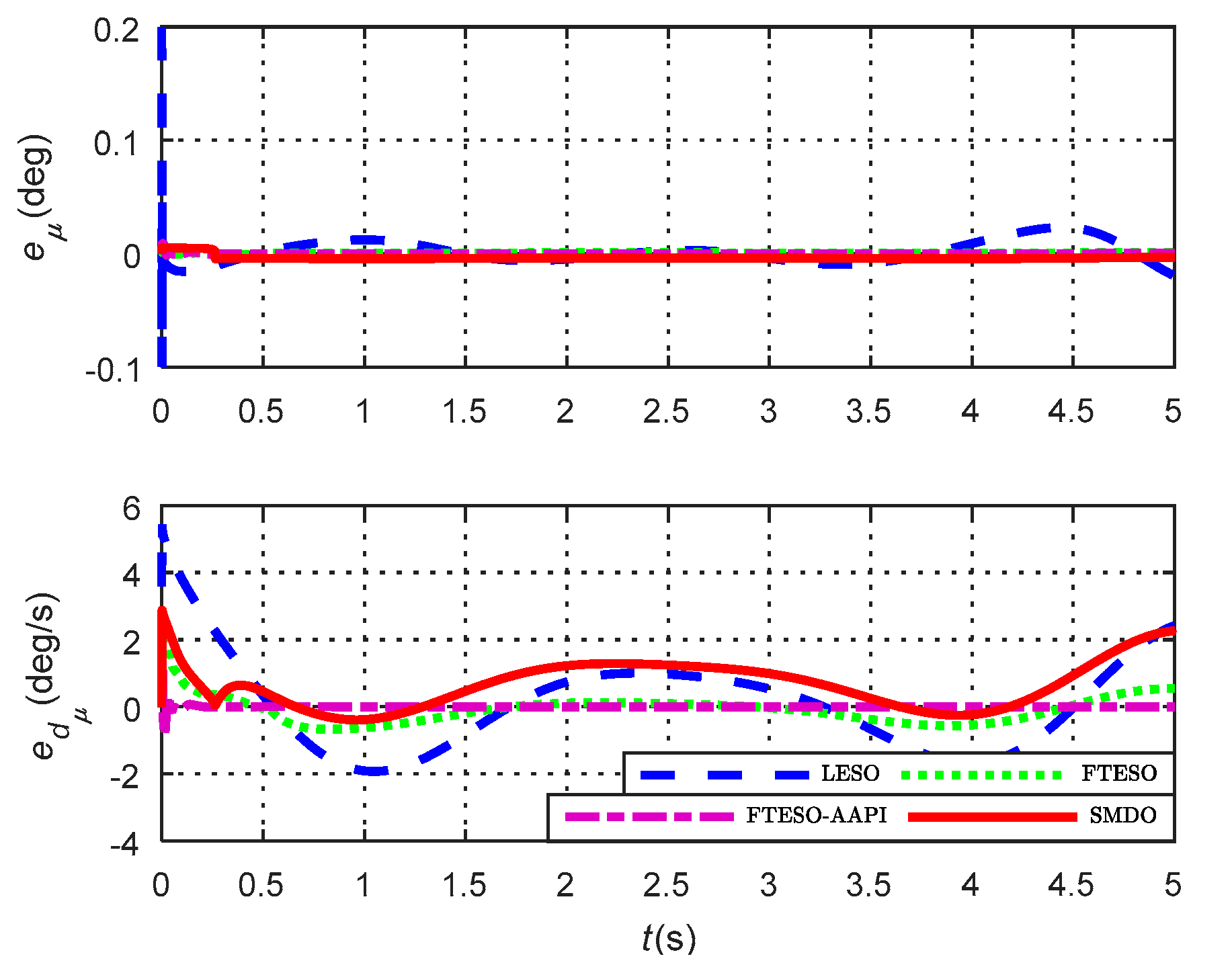
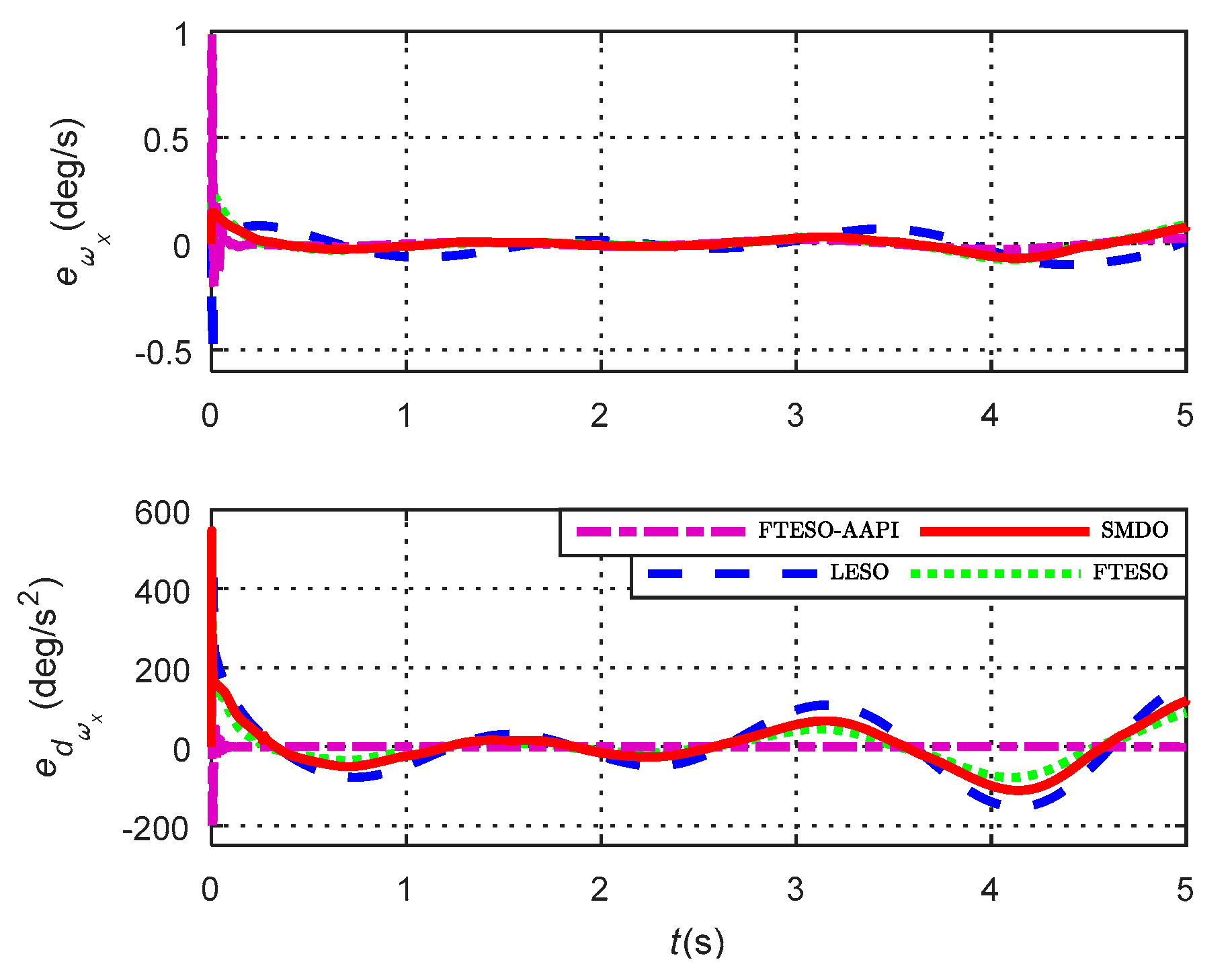
The comparison of estimation results is shown in Figure 4, Figure 5, Figure 6, Figure 7, Figure 8 and Figure 9. It can be found that both FTESOs estimate system disturbances with better accuracy than LESO. The proposed FTESO has a shorter convergence time and smaller observation error than other observers. Furthermore, the proposed FTESO has almost no fluctuations after convergence. This is because the observation controller of the FTESO designed according to the AAPI technique is more robust to the periodic signal added in disturbances.
Figure 4.
Estimation errors of the angle-of-attack channel.
Figure 5.
Estimation errors of the angle-of-sideslip channel.
Figure 6.
Estimation errors of the angle-of-bank channel.
Figure 7.
Estimation errors of the roll-rate channel.
Figure 8.
Estimation errors of the pitch-rate channel.
Figure 9.
Estimation errors of the yaw-rate channel.
4.2. Controller-Effect Verification
The initial states of the HSV are and . The mass and velocity of the HSV are and , respectively, and the engine thrust is . The moments of inertia are , , and , and the reference area and reference length are and .
By fitting the aerodynamic data, we obtain
Further, , and . Disturbances and uncertainties are the same as in Section 4.1.
In this subsection, we develop three cases based on backstepping control: (1) with linear extended state observer and dynamic inversion-based controller (LESO-DI), (2) with finite-time extended state observer and dynamic inversion-based controller (FTESO-DI), and (3) with finite-time extended state observer and time-varying BLF-based adaptive backstepping controller (FTESO-TVBLF); the parameters of observer and controller are the same as those in Section 4.1. The detailed form of the above dynamic inversion-based controller is given as follows:
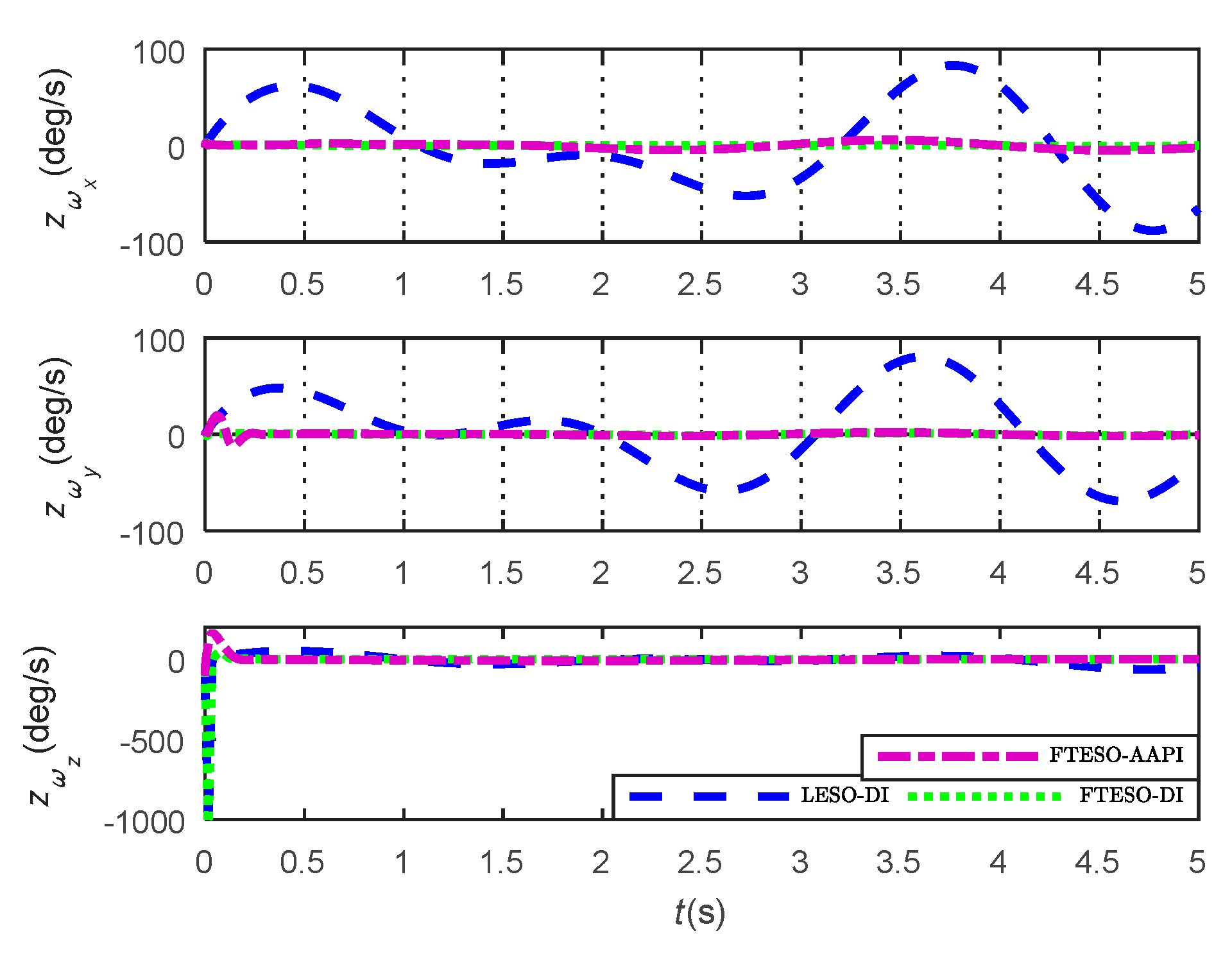
The angular-velocity control loop: (1) it can be seen from Figure 10 that LESO-DI cannot accurately track the angular-velocity virtual commands. Combined with the simulation results in the previous subsection, it is extrapolated that this phenomenon is caused due to the inability of LESO to accurately estimate the matched disturbances, leading to its inability to be effectively compensated. (2) It can also be seen from Figure 10 that although both FTESO-DI and FTESO-TVBLF methods can accurately track the angular-velocity virtual command, FTESO-TVBLF has a better performance in reducing the response peaks.
Figure 10.
Tracking error of angle rates.
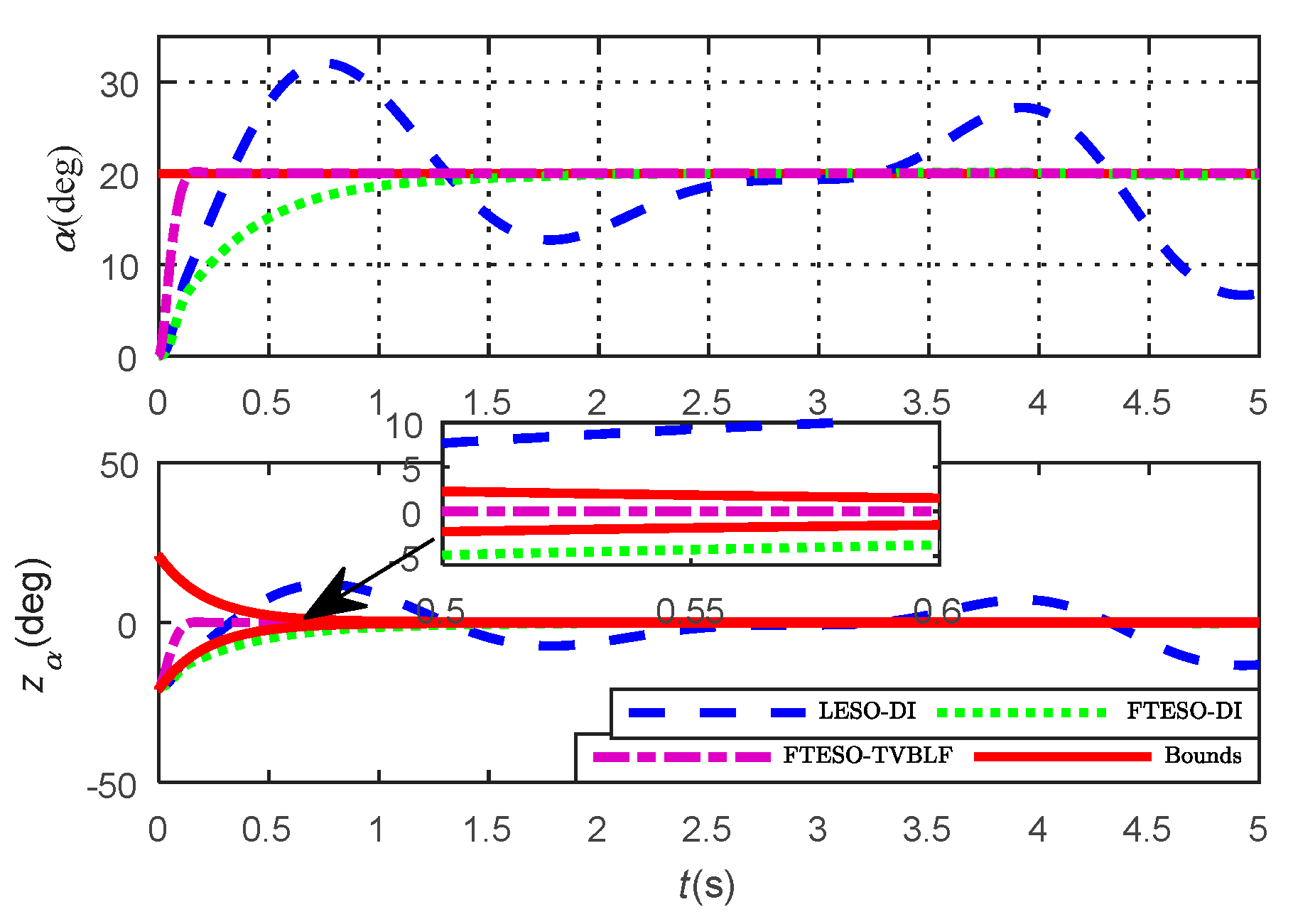
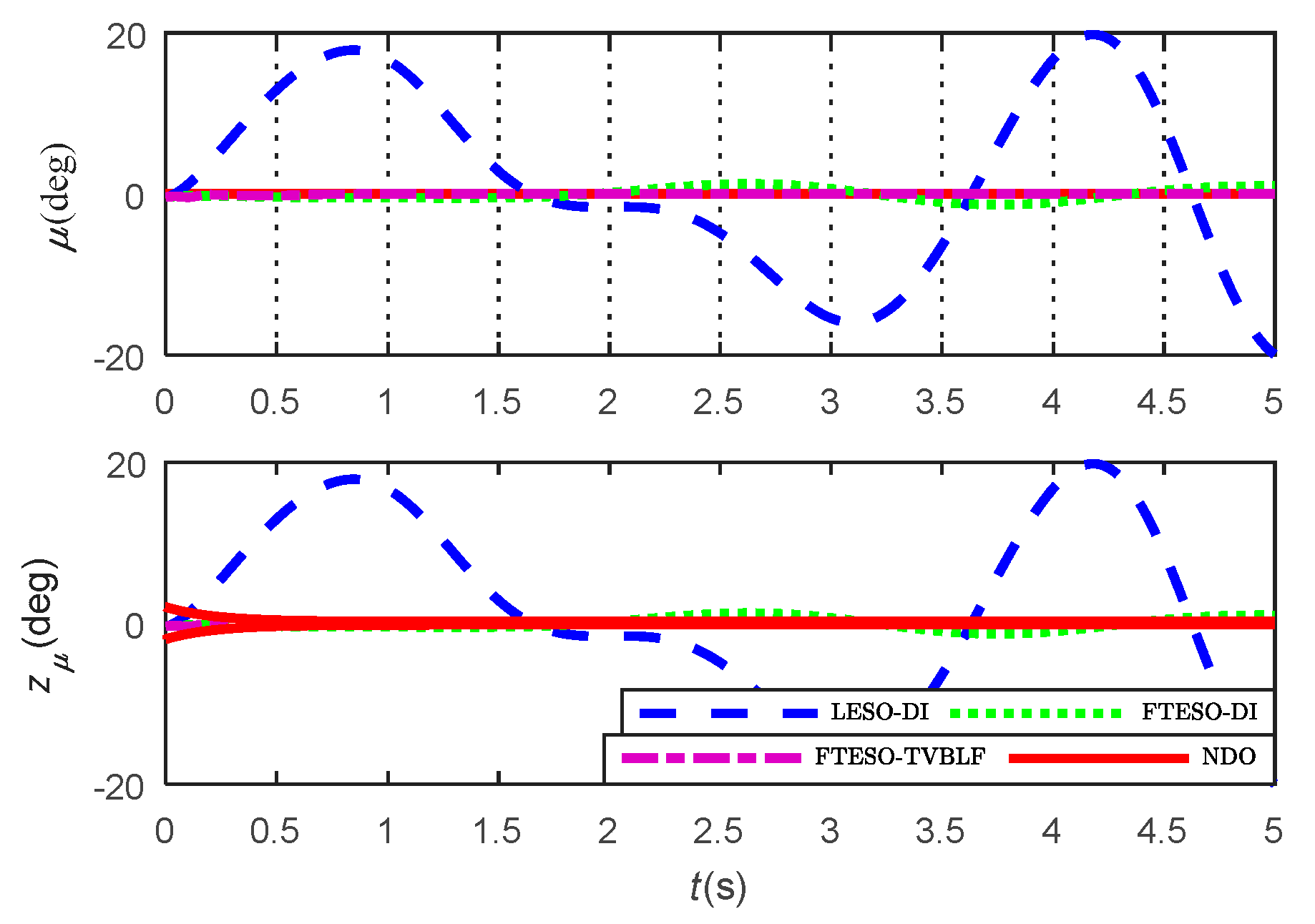
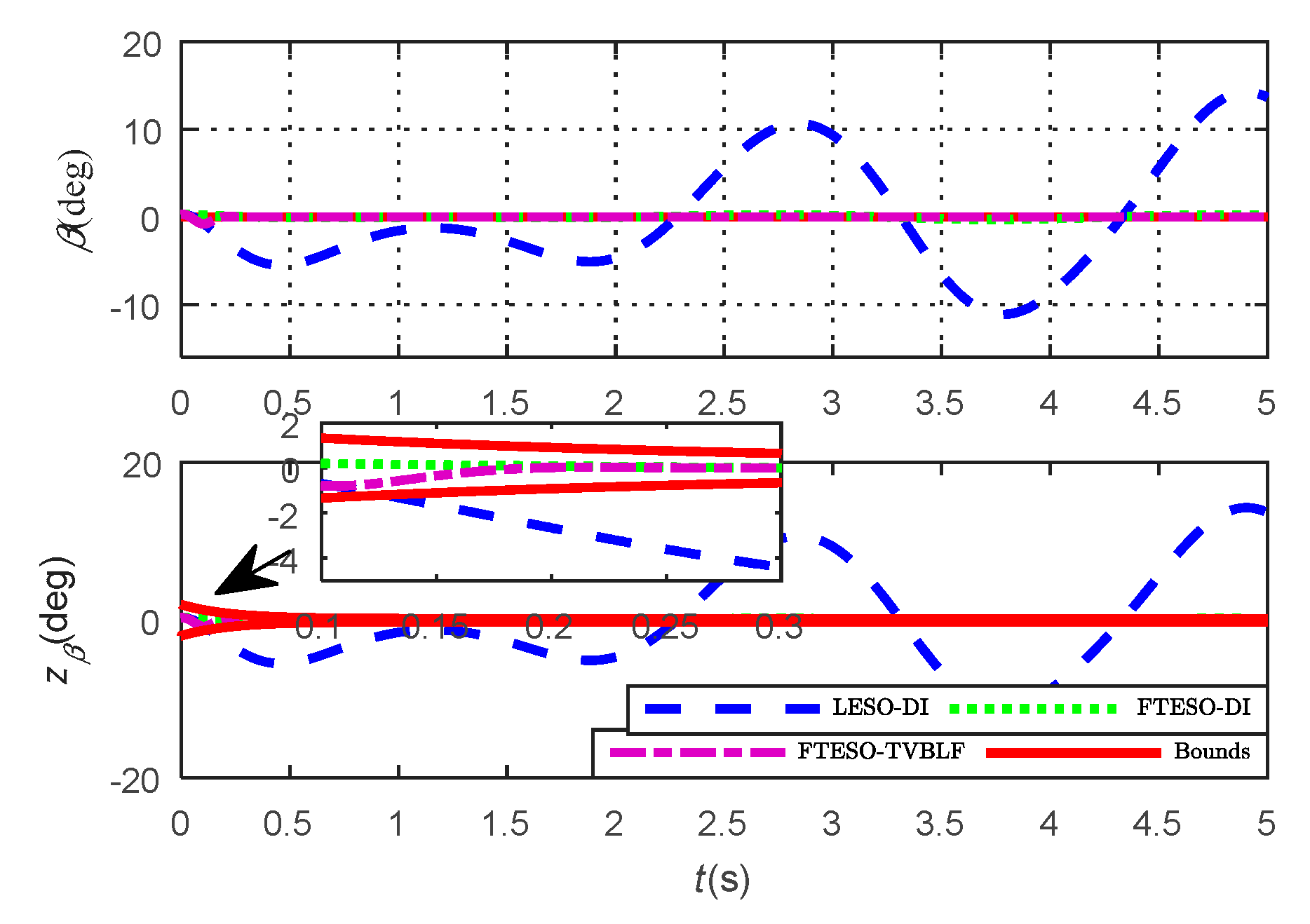
The angle control loop: (1) it can be seen from Figure 11, Figure 12 and Figure 13 that the LESO-DI does not accurately track the angular commands, which is caused by the estimation errors of the observers and is due to the tracking errors of the controller tracking the angular-velocity virtual commands being larger than the acceptable ranges. (2) The tracking errors of FTESO-DI: although they can converge eventually, the tracking accuracies during the convergence to steady states are outside the boundaries. (3) FTESO-TVBLF does not violate the output constraints during the total tracking commands and the steady-state tracking error is almost zero. We observe from the control law (56) of FTESO-TVBLF the nonlinear gain term , which guarantees constraints on the outputs. As the tracking errors approach the bounds, this term grows rapidly to offer the control ability to prevent from increasing.
Figure 11.
Tracking performance of the angle of attack.
Figure 12.
Tracking performance of the angle of sideslip.
Figure 13.
Tracking performance of the angle of bank.
5. Conclusions
In this paper, we solve the attitude-control problem of hypersonic vehicles with uncertain dynamics and AOA constraint. The proposed FTESO is used to improve the estimation speed of the system lumped disturbances, and the time-varying BLF-based controller is used to constrain the attitude angles of HSVs. Simulations and comparison results show that better attitude-tracking performances can be achieved for HSVs with the proposed control scheme, mainly benefiting from two aspects: (i) FTESO is superior to traditional ESO in terms of speed and accuracy, enabling disturbances to be compensated more accurately. (ii)The additional item in the control law provides an opposite control force when AOA approaches the bound, such that AOA is constrained within the prescribed region.
Author Contributions
Conceptualization, Q.L. and R.S.; methodology, Q.L. and Y.L.; software, Q.L. and R.S.; validation, Q.L., Y.L. and X.L.; formal analysis, Q.L. and Y.L.; investigation, Q.L. and R.S.; resources, Q.L. and X.L.; data curation, R.S. and Y.L.; writing—original draft preparation, Q.L.; writing—review and editing, Q.L. and R.S.; visualization, Q.L.; supervision, R.S.; project administration, Q.L.; funding acquisition, R.S. All authors have read and agreed to the published version of the manuscript.
Funding
This research was funded by the Natural Science Foundation of Jiangsu Province under Grant BK20220945.
Data Availability Statement
Data is contained within the article.
Acknowledgments
The authors thank their colleagues for their constructive suggestions and research assistance throughout this study.
Conflicts of Interest
The authors declare no conflicts of interest.
References
- Ding, H.; Xu, B.; Wu, X. Research progress and prospects on intelligent control methods for hypersonic flight vehicles. In Proceedings of the 4th International Conference on Computer Engineering and Intelligent Control, Zhuhai, China, 20–22 October 2023; pp. 507–514. [Google Scholar]
- Xu, B.; Shi, Z. An overview on flight dynamics and control approaches for hypersonic vehicles. Sci. China Inf. Sci. 2015, 58, 070201. [Google Scholar] [CrossRef]
- Zhen, W.B.; Wang, Y.H.; Wu, Q.X.; Shao, P. Coordinated attitude control of hypersonic flight vehicles based on the coupling analysis. Proc. Inst. Mech. Eng. Part G J. Aerosp. Eng. 2018, 232, 1002–1011. [Google Scholar] [CrossRef]
- Rehman, O.U.; Petersen, I.R.; Fidan, B. Feedback linearization-based robust nonlinear control design for hypersonic flight vehicles. Proc. Inst. Mech. Eng. Part I J. Syst. Control Eng. 2013, 227, 3–11. [Google Scholar] [CrossRef]
- Hu, X.; Wu, L.; Hu, C.; Gao, H. Fuzzy guaranteed cost tracking control for a flexible air-breathing hypersonic vehicle. IET Control Theory Appl. 2012, 6, 1238–1249. [Google Scholar] [CrossRef]
- Wang, S.; Jiang, J.; Yu, C. Adaptive backstepping sliding mode control of air-breathing hypersonic vehicles. Int. J. Aerosp. Eng. 2020, 2020, 1–11. [Google Scholar] [CrossRef]
- Xu, B.; Wang, X.; Shi, Z. Robust adaptive neural control of nonminimum phase hypersonic vehicle model. IEEE Trans. Syst. Man Cybern. Syst. 2021, 51, 1107–1115. [Google Scholar] [CrossRef]
- An, H.; Wang, C.; Fidan, B. Sliding mode disturbance observer-enhanced adaptive control for the air-breathing hypersonic flight vehicle. Acta Astronaut. 2017, 139, 111–121. [Google Scholar] [CrossRef]
- Guo, Z.Y.; Chang, J.; Guo, J.G.; Zhou, J. Adaptive twisting sliding mode algorithm for hypersonic reentry vehicle attitude control based on finite-time observer. ISA Trans. 2018, 77, 20–29. [Google Scholar] [CrossRef] [PubMed]
- Zhang, J.; Sun, T. Disturbance observer-based sliding manifold predictive control for reentry hypersonic vehicles with multi-constraint. Proc. Inst. Mech. Eng. Part G J. Aerosp. Eng. 2016, 230, 485–495. [Google Scholar] [CrossRef]
- An, H.; Wu, Q.Q. Disturbance rejection dynamic inverse control of air-breathing hypersonic vehicles. Acta Astronaut. 2018, 151, 348–356. [Google Scholar] [CrossRef]
- Yin, Y.; Liu, J.; Sanchez, J.A.; Wu, L.; Vazquez, S.; Leon, J.I.; Franquelo, L.G. Observer-based adaptive sliding mode control of NPC converters: An RBF neural network approach. IEEE Trans. Power Electron. 2019, 34, 3831–3841. [Google Scholar] [CrossRef]
- Yu, T.; Zhao, Y.; Wang, J.; Liu, J. Event-triggered sliding mode control for switched genetic regulatory networks with persistent dwell time. Nonlinear Anal. Hybrid Syst. 2022, 44, 101135. [Google Scholar] [CrossRef]
- Sun, Y.; Gao, Y.; Zhao, Y.; Liu, Z.; Wang, J.; Kuang, J.; Yan, F.; Liu, J. Neural network-based tracking control of uncertain robotic systems: Predefined-time nonsingular terminal sliding-mode approach. IEEE Trans. Ind. Electrons. 2022, 69, 10510–10520. [Google Scholar] [CrossRef]
- Sun, Y.; Liu, J.; Gao, Y.; Liu, Z.; Zhao, Y. Adaptive neural tracking control for manipulators with prescribed performance under input saturation. IEEE/ASME Trans. Mech. 2022, 28, 1037–1046. [Google Scholar] [CrossRef]
- Han, J. From PID technique to active disturbances rejection control technique. Control Eng. China 2002, 9, 13–18. [Google Scholar]
- Sun, Y.; Xu, J.; Wu, H.; Lin, G.; Mumtaz, S. Deep learning based semi-supervised control for vertical security of maglev vehicle with guaranteed bounded airgap. IEEE Trans. Intell. Transp. Syst. 2021, 22, 4431–4442. [Google Scholar] [CrossRef]
- Zhao, L.; Zheng, C.; Wang, Y.; Liu, B. A finite-time control for a pneumatic cylinder servo system based on a super-twisting extended state observer. IEEE Trans. Syst. Man Cybern. Syst. 2021, 51, 1164–1173. [Google Scholar] [CrossRef]
- Xia, Y.; Zhu, Z.; Fu, M. Back-stepping sliding mode control for missile systems based on an extended state observer. IET Control Theory Appl. 2011, 5, 93–102. [Google Scholar] [CrossRef]
- Gao, Z.Q. Scaling and bandwidth-parameterization based controller tuning. In Proceedings of the American Control Conference, Denver, CO, USA, 4–6 June 2003; pp. 4989–4996. [Google Scholar]
- Zhao, Z.L.; Guo, B.Z. On active disturbance rejection control for nonlinear systems using time-varying gain. Eur. J. Control. 2015, 23, 62–70. [Google Scholar] [CrossRef]
- Shen, Y.J.; Huang, Y.H.; Gu, J. Global finite-time observers for lipschitz nonlinear systems. IEEE Trans. Autom. Control. 2011, 56, 418–424. [Google Scholar] [CrossRef]
- Wu, D.; Chen, M.; Gong, H. Robust control of post-stall pitching maneuver based on finite-time observer. ISA Trans. 2017, 70, 53–63. [Google Scholar] [CrossRef]
- Chen, M.; Wu, Q.X.; Cui, R.X. Terminal sliding mode tracking control for a class of SISO uncertain nonlinear systems. ISA Trans. 2013, 52, 198–206. [Google Scholar] [CrossRef] [PubMed]
- Jiang, B.; Li, C.; Ma, G. Finite-time output feedback attitude control for spacecraft using “Adding a power integrator” technique. Aerosp. Sci. Technol. 2017, 66, 342–354. [Google Scholar] [CrossRef]
- Lin, W.; Qian, C. Adding one power integrator: A tool for global stabilization of high-order lower-triangular systems. Syst. Control Lett. 2000, 39, 339–351. [Google Scholar] [CrossRef]
- Dong, C.Y.; Liu, Y.; Wang, Q. Adaptive backstepping controller design for hypersonic vehicle with limited angle of attack. J. Astronaut. 2020, 41, 174. [Google Scholar]
- He, W.; Yin, Z.; Sun, C. Adaptive neural network control of a marine vessel with constraints using the asymmetric barrier Lyapunov function. IEEE Trans. Cybern. 2016, 47, 1641–1651. [Google Scholar] [CrossRef] [PubMed]
- Liu, Y.J.; Tong, S. Barrier Lyapunov functions for Nussbaum gain adaptive control of full state constrained nonlinear systems. Autom. 2017, 76, 143–152. [Google Scholar] [CrossRef]
- Tee, K.; Ge, S.S.; Tay, E. Barrier Lyapunov functions for the control of output-constrained nonlinear systems. Automatica 2009, 45, 918–927. [Google Scholar] [CrossRef]
- Liu, C.; Dong, C.Y.; Zhou, Z.J.; Wang, Z.L. Barrier Lyapunov function based reinforcement learning control for air-breathing hypersonic vehicle with variable geometry inlet. Aerosp. Sci. Technol. 2020, 96, 105537. [Google Scholar] [CrossRef]
- Dong, C.Y.; Liu, Y.; Wang, Q. Barrier Lyapunov function based adaptive finite-time control for hypersonic flight vehicles with state constraints. ISA Trans. 2020, 96, 163–176. [Google Scholar] [CrossRef]
- Guo, Y.; Yan, T.; Xu, B.; Tao, G.; Sun, S. Asymmetric integral BLF based state-constrained flight control using NN and DOB. Int. J. Robust Nonlinear Control 2022, 32, 3021–3038. [Google Scholar] [CrossRef]
- Li, B.; Liu, W.; Qin, K.; Xiao, B.; Yang, Y. Finite-time extended state observer based fault tolerant output feedback control for UAV attitude stabilization under actuator failures and disturbances. In Fundamental Design and Automation Technologies in Offshore Robotics; Academic Press: Cambridge, MA, USA, 2020; pp. 309–336. [Google Scholar]
- Zhao, J.; Feng, D.; Cui, J.; Wang, X. Finite-time extended state observer-based fixed-time attitude control for hypersonic vehicles. Mathematics 2022, 10, 3162. [Google Scholar] [CrossRef]
- Snell, S.A. Nonlinear Dynamic-Inversion Flight Control of Supermaneuverable Aircraft; University of Minnesota: Minneapolis, MN, USA, 1991. [Google Scholar]
- Qian, C.; Lin, W. A continuous feedback approach to global strong stabilization of nonlinear systems. IEEE Trans. Autom. Control 2001, 46, 1061–1079. [Google Scholar] [CrossRef]
- Qian, C.; Ji, L. Global finite-time stabilization by output feedback for planar systems without observable linearization. IEEE Trans. Autom. Control 2005, 50, 885–890. [Google Scholar] [CrossRef]
- Hu, Q.; Jiang, B.; Zhang, Y. Observer-based output feedback attitude stabilization for spacecraft with finite-time convergence. IEEE Trans. Control Syst. Technol. 2017, 27, 781–789. [Google Scholar] [CrossRef]
- Guo, B.Z.; Zhao, Z.L. On convergence of tracking differentiator. Int. J. Control 2011, 84, 693–701. [Google Scholar] [CrossRef]
- Sun, J.; Yi, J.; Pu, Z.; Tan, X. Fixed-time sliding mode disturbance observer-based nonsmooth backstepping control for hypersonic vehicles. IEEE Trans. Syst. Man, Cybern. Syst. 2020, 50, 4377–4386. [Google Scholar] [CrossRef]
Disclaimer/Publisher’s Note: The statements, opinions and data contained in all publications are solely those of the individual author(s) and contributor(s) and not of MDPI and/or the editor(s). MDPI and/or the editor(s) disclaim responsibility for any injury to people or property resulting from any ideas, methods, instructions or products referred to in the content. |
© 2024 by the authors. Licensee MDPI, Basel, Switzerland. This article is an open access article distributed under the terms and conditions of the Creative Commons Attribution (CC BY) license (https://creativecommons.org/licenses/by/4.0/).