


Abstract
In this article, we establish certain time-scale-retarded dynamic inequalities that contain nonlinear retarded integral equations on various time scales. These inequalities extend and generalize some significant inequalities existing in the literature to their more general forms. The qualitative and quantitative characteristics of solutions to various dynamic equations on time scales involving retarded integrals can be studied using these inequalities. The results presented in this manuscript furnish a powerful tool to analyze the boundedness of nonlinear integral equations with retarded integrals on several time scales. In the end, we also include numerical illustrations to signify the applicability of these results to power nonlinear retarded integral equations on real and quantum time scales.
MSC:
26D10; 26D15; 26D20; 34A12; 34A40
1. Introduction
Throughout the history of mathematics, inequality has been a major factor in its growth. The primary factor behind the effective development of inequalities in the theory of fractional difference equations, integral equations, partial differential equations, and ordinary differential equations is their capacity to analyze the unknown function that appears in the aforementioned equations for both qualitative and quantitative properties.
In the annals of mathematics, integral equations have acquired immense importance. In the year 1812, Abel shaped notable research by developing an integral equation for a certain mechanical problem, signifying the beginning of the theory of integral equations. This branch further witnessed a huge growth due to several mathematicians, with the remarkable contributions of Volterra (1895) and Fredholm (1900). Integral equations have shown to be quite helpful in a variety of applied domains, including control theory, network theory, nuclear reactor dynamics, etc. However, it remained a difficult task for many years to find an exact analytical solution for such an equation. In 1919, Gronwall [1] made a revolutionary discovery of an inequality to obtain an explicit bound for a class of integral and differential equations. Since then, several mathematicians contributed remarkably to the development and exploration of new inequalities to study certain properties like boundedness, existence, and stability of the solutions of the aforementioned equation, viz., Bellman (1943), Bihari (1956), Pachpatte (1973), to mention a few.
Similarly, a number of mathematicians have explored integral equations, integro-differential equations, and partial integro-differential equations with retarded arguments, and numerous approaches have been brought forward for the investigation of their various characteristics on the real domain.
A general integral equation with retarded arguments is of the form
If we consider the same equation on a certain time-scale, it is regarded as a retarded dynamic equation.
However, considering the methods and resources at hand, it is not always possible to determine the precise solution of the integral equations in question. Integral inequalities are essential in this situation because they provide a clear bound on the unknown function and help to analyze the solution for boundedness, stability, and continuous dependency on initial data.
In 2000, Lipovan [2] obtained the bound on the Gronwall-type retarded inequality, which reads as
where k is a constant, and
In 2006, Pachpatte [3] studied and obtained the bound on the Volterra–Fredholm-type integral inequality of the form
Further, in 2014, Kendre et al. [4] extended Pachpatte’s inequality and studied the bound on an integral inequality of the type
Later, in 2017, El-Deeb and A. Ahmed [5] used Lipovan’s inequality as the base and established a bound on retarded integral inequality of the kind
Recently, there has been a great deal of interest in the research of time scale calculus and related dynamic inequalities, a branch of mathematics that can be traced all the way back to Stefan Hilger [6,7]. The goal is to demonstrate a solution of dynamic equations on arbitrary time scales, which are any nonempty and closed subset of the (see [8,9]). The merging of continuous and discrete analysis is one goal of the theory of time scales. Differential calculus (), difference calculus (), and quantum calculus () are the three most common applications of calculus over time scales (see [9,10,11]). Time scale calculus is largely organized and summarized in Agarwal, Bohner, and Peterson’s books [9,10] on the subject. A number of dynamic inequalities have been created during the past decade by many researchers, who were inspired by various applications. As an example, we recommend the reader review [5,12,13,14,15,16,17] for contributions and the references included therein.
Recently, in 2022, Wang et al. [12] extended and presented a time scale version of inequality attributed to El-Deeb and Ahmed [5], which reads as
Nevertheless, Wang et al.’s inequalities [12] are insufficient to derive explicit bounds on the retarded dynamic equations; within which, the integrals on the right-hand side of Wang’s inequality (1), which involve nonlinear unknown functions, are either raised to additional powers or, in the case of nonlinear unknown functions linked to another function, raised to yet another power. With this shortcoming in mind, the main goal of this manuscript is to present several inequalities to solve some important delayed dynamic equations that contain the aforementioned scenarios. Our findings not only expand and broaden Wang’s inequalities, but they also offer a powerful instrument for analyzing important delayed dynamic equations that are beyond the scope of Wang’s existing inequalities.
2. An Overview of Time Scales and Some Fundamental Theorems
Any nonempty and closed subset of is regarded as a time scale Further, for any is referred as a forward jump operator on and . A point is classified as right-scattered and right-dense if and where respectively. Similar definitions apply to the left-scattered and left-dense points as well as the backward jump operator. Furthermore, where is referred as a graininess operator. We symbolize , and as
- , where is the left scattered maximum of
- , where is the right scattered minimum of
Definition 1.
(delta derivative of ) A number (provided it exists) such that for one can determine some neighorhood of τ (nbd) wherein
is called a delta derivative of .
Let be real-valued mappings on . We note the following for
- (i)
- is continuous at if it is differentiable at .
- (ii)
- The delta derivative of a continuous function at right-scattered point is and the delta derivative of a differentiable function at right-dense point is
- (iii)
- If both are delta-differentiable, then for any where and
Definition 2.
(rd-continuous function) A real-valued function defined on , which is continuous at every right-dense point in and has finite left limit at every left-dense point in is referred to as an rd-continuous function. In this manuscript, we symbolize the collection of all rd-continuous functions on as .
Definition 3.
An antiderivative of a real-valued function on is F wherein for and we write
Definition 4.
If for for a real valued function on , then is regarded as a regressive function. The set of all regressive and rd-continuous functions is denoted by .
Definition 5.
If for for a real valued function on , then is regarded as a positively regressive function. The collection of all positively regressive functions is denoted by .
Definition 6.
For any the addition (), additive inverse of (), and subtraction () on are defined as
respectively.
Remark 1.
If we consider an initial value problem on as
where is rd-continuous and a regressive function, then it has a unique solution, and it is denoted by the exponential function for any fixed .
The Four Theorems of Bohner and Peterson [9] are now listed, followed by a fundamental dynamic inequality on time scales and lemmas due to Zhao [18]. These results are important for our discussion because they are used in the technique of proofs of our main theorems to establish an explicit bound on the unknown function of concerned inequality.
Theorem 1.
If then
- (i)
- The value of and is 1;
- (ii)
- ;
- (iii)
- ;
- (iv)
- ;
- (v)
- ;
- (vi)
- for .
Theorem 2.
Let and , then
Theorem 3.
If and such that for all , then
Theorem 4.
Let be a continuous map at where and for fixed If is rd-continuous on an interval and for one can determine a neighborhood of s (nbd), not depending on such that
where is delta-derivative of with respect to t then
Theorem 5.
(Fundamental dynamic inequality on time scales)
implies
where and .
Lemma 1
(Zhao [18]).
for
Lemma 2
(Zhao [18]).
for
Let us begin with our main findings.
3. Main Results
In the subsequent discussion, we present the main findings of our research. In order to establish the proofs for our main results, we have used Zhao’s lemmas coupled with a fundamental inequality on various time scales. Through the combination of these mathematical tools, we have systematically established the framework of our inequalities.
Theorem 6.
Let be provided such that the delta-derivatives of , and exist on and are non-negative with wherein with constants . If on satisfies
then
where
Proof.
Let indicate the right-side of Equation (2). The nondecreasing nature of on is immediately apparent. We derive from that
Applying Theorem 5 to (5) gives
As , from inequality (6), we get
From the expression of and (7), we deduce that
So,
Remark 2.
Some Important Remarks:
- (1)
- For and the inequality in Theorem 6 reduces to the inequality by Pachpatte [3] (p. 40, Theorem 1.5.1).
- (2)
- If we substitute , then the inequality by G. Wang ([12], Theorem 3.2) turns out as a particular case of the above inequality.
- (3)
- For and the inequality proved above can be shrinked to the inequality due to Kendre et al. ([4], Theorem 2.1).
Theorem 7.
Let us assume considering For some constants and suppose wherein delta-derivatives of exist and are non-negative on such that , and If on is such that
then
where
and
Proof.
Let symbolize the right-side of (9). It is instantly clear that on is nondecreasing and From , we infer that
We can derive from (9) that , and for . On differentiating and using Lemmas 1 and 2, we find that
Theorem 5 applied to (12) provides that
After simplification, it gives
Theorem 8.
Assume in such that . Consider constants wherein and suppose where delta-derivatives of exist and are nonnegative on with and If on satisfies
then
where
wherein are the same values as in Theorem 6 and .
Proof.
Let us set as the RHS of inequality (15), then . It is immediately clear that on , is nondecreasing. It is straightforward that
Since and for we can infer from the delta derivative of and Lemmas 1 and 2 that
When Theorem 5 is applied to (18), it yields
Upon further simplification, it gives
Remark 3.
If we assume and in Theorem 8, then Theorem 7, under the circumstance that , constitutes a specific case of Theorem 7.
Theorem 9.
Let us assume , and for some constants consider wherein delta-derivatives of exist and are non-negative on such that and If for , on satisfies
then
where
wherein and are the same values as in Theorem 6.
Proof.
Assign
Then,
We utilize Theorem 5 on inequality (25) and deduce that
So, from (27), we acquire that
Theorem 10.
Consider that and correspond to their respective definitions in Theorem 9, and let wherein . If for on is such that
then
where
wherein
and
where and are the same values as in Theorem 9.
4. Applications
Example 1.
Take into consideration the dynamic equation on a time scale ,
We observe that, on
Thus, from (38), we obtain
The inequality shown in Theorem 6 may be used to obtain the exact bound on solution of (39), letting and . We find that
Assuming we obtain
The outcome is the bound
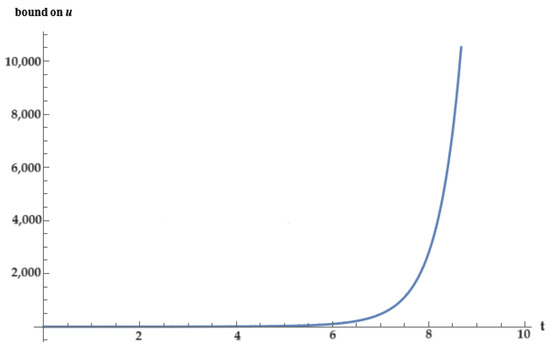
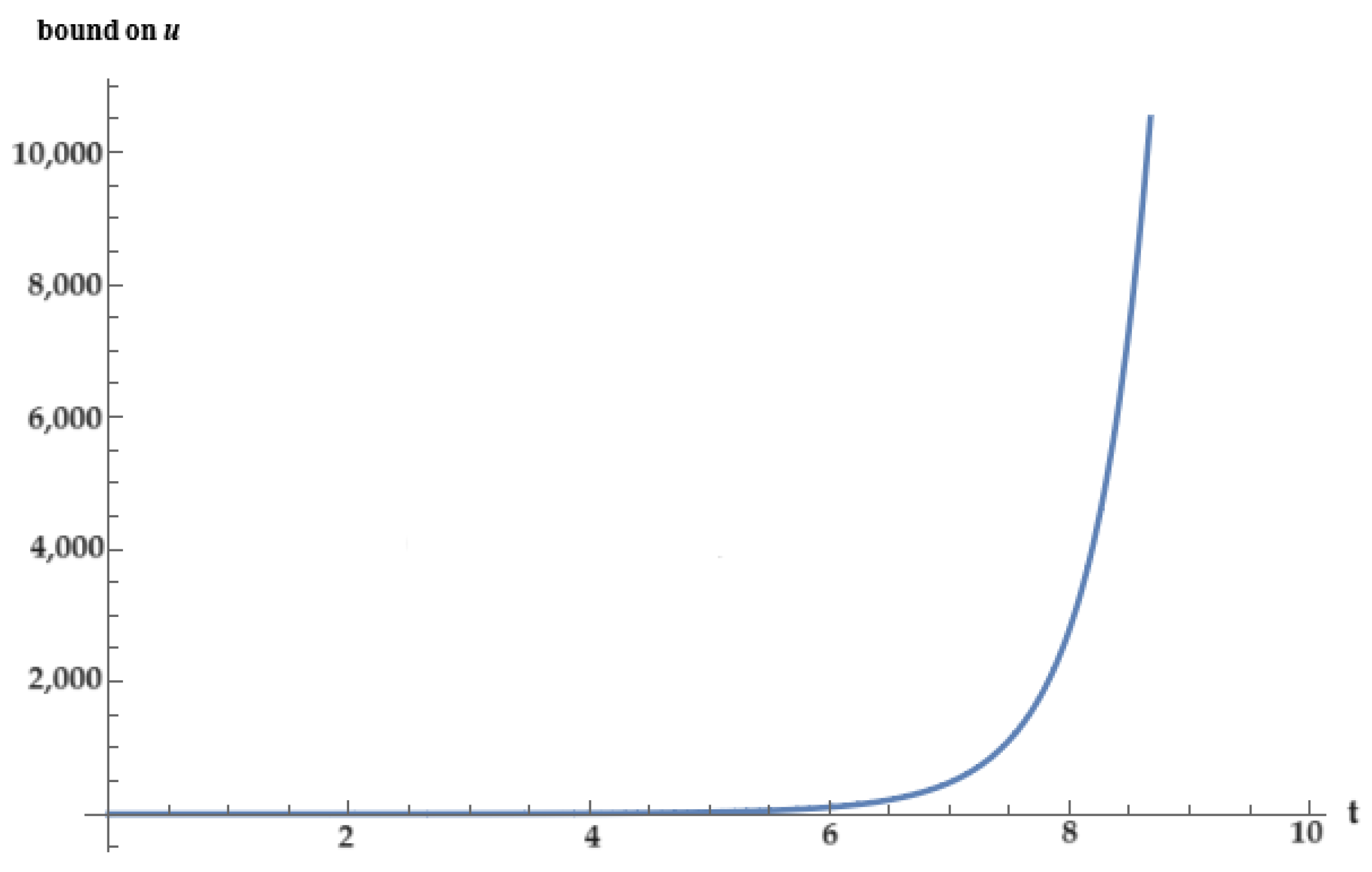
where erf is the error funtion of x. This further results in the plot below.
We can infer from Figure 1 that the solution does not attain an undefined value at any point of the domain. Thus, there is never a blow-up at any ; hence, the solution is always constrained.
Figure 1.
Blow-up analysis of the bound of the solution of (38).
Example 2.
Suppose On ,
and
are noted. Take a retarded dynamic equation
Equation (41) may be transformed into equation
by setting . We obtain for
By subsequently adopting Theorem 7 to (42), and hence, the bound by using Theorem 7 in this situation is
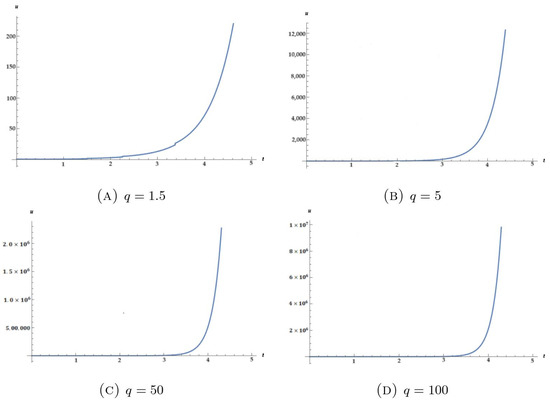
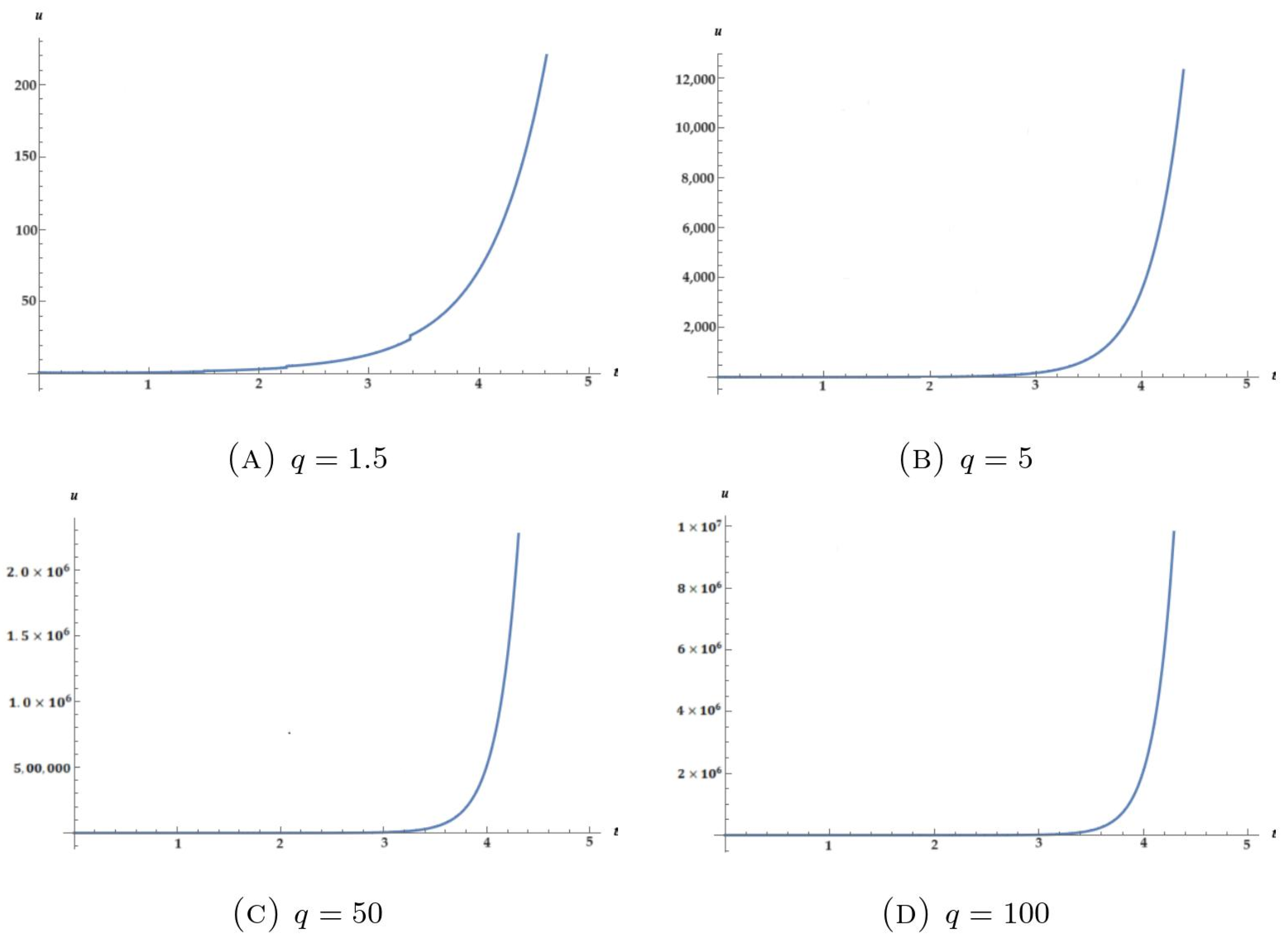
where is the Pochhmmer symbol, certainly referred to as a rising factorial. The plots of the above-mentioned bound for various q values are shown below.
We have assumed specific values of q in accordance with the requirements of quantum calculus, and we have examined the boundedness of the solution in each of these scenarios. We derive from the plots in the Figure 2 that does not take an undefined value for any of the values of q. This demonstrates that for every q, Equation (42) does not reach a blow. Thus, for any q and τ in , the solution of (42) is bounded. Furthermore, we may determine that the boundedness of the solution relies on the time scale under consideration by comparing the blow-up analyses of Examples 1 and 2.
Figure 2.
Blow-up analysis of the bound of the solution of (41).
5. Conclusions
In conclusion, this study has investigated a class of new nonlinear retarded dynamic inequalities in which powers of delayed integrals with unknown functions and the association of function with an unknown function raised to a nonlinear power are involved. These inequalities generalize and improve upon recent and important findings in the literature on dynamic inequalities within time scales. Our study’s main findings offer a reliable instrument for handling a certain class of nonlinear retarded dynamic equations. These inequalities can be used to examine both qualitative and quantitative properties of solutions to different nonlinear delayed dynamic equations, including boundedness, stability, and continuous dependence on initial data. Furthermore, by altering the base time scale, these conclusions can be easily applied to integrodifferential and difference equations. Looking ahead, these inequalities can be extended and generalized for more nonlinear delayed dynamic equations over time scales in this field of study. Furthermore, the practical application of these results to real-world issues continues to be a fascinating area of research.
Author Contributions
Conceptualization, S.K. and S.B.; methodology, S.K. and N.K.; software, N.K.; validation, S.K., N.K., and J.P.; formal analysis, S.K. and S.B.; investigation, S.K. and N.K.; resources, S.K., N.K., and J.P.; writing—original draft preparation, S.B. and N.K.; writing—review and editing, S.K. and J.P.; visualization, N.K.; supervision, S.K. and J.P. All authors have read and agreed to the published version of the manuscript.
Funding
This research received no external funding.
Data Availability Statement
Data are contained within the article.
Acknowledgments
Authors would like to thank the reviewers for their thoughtful comments and valuable feedback toward improving a manuscript.
Conflicts of Interest
The authors declare no conflicts of interest.
References
- Gronwall, T.H. Note on the Derivatives with Respect to a Parameter of the Solutions of a System of Differential Equations. Ann. Math. 1919, 20, 292–296. [Google Scholar] [CrossRef] [Scilit]
- Lipovan, O. A Retarded Gronwall-Like Inequality and Its Applications. J. Math. Anal. Appl. 2000, 252, 389–401. [Google Scholar] [CrossRef] [Scilit]
- Pachpatte, B.G. Integral and Finite Difference Inequalities and Applications; North-Holland Mathematics Studies; Elsevier: Amsterdam, The Netherlands, 2006. [Google Scholar]
- Kendre, S.D.; Latpate, S.G.; Ranmal, S.S. Some Nonlinear Integral Inequalities For Volterra–Fredholm integral equations. Adv. Inequal. Appl. 2014, 2014, 21. [Google Scholar]
- El-Deeb, A.A.; Ahmed, R.G. On some generalizations of certain nonlinear retarded integral inequalities for Volterra–Fredholm integral equations and their applications in delay differential equations. J. Egypt. Math. Soc. 2017, 25, 279–285. [Google Scholar] [CrossRef] [Scilit]
- Hilger, S. Analysis on measure chains—A unified approach to continuous and discrete calculus. Results Math. 1990, 18, 18–56. [Google Scholar] [CrossRef] [Scilit]
- Hilger, S. Special functions, Laplace and Fourier transform on measure chains. Dyn. Syst. Appl. 1999, 8, 471–488. [Google Scholar]
- Bohner, M.; Peterson, A. First and second order linear dynamic equations on time scales. J. Differ. Equ. Appl. 2001, 7, 767–792. [Google Scholar] [CrossRef] [Scilit]
- Bohner, M.; Peterson, A. Dynamic Equations on Time Scales; Birkhouser: Boston, MA, USA, 2001. [Google Scholar]
- Agarwal, R.; Bohner, M. Basic calculus on time scales and some of its applications. Results Math. 1999, 35, 3–22. [Google Scholar] [CrossRef] [Scilit]
- Agarwal, R.; Bohner, M.; O’Regan, D.; Peterson, A. Dynamic equations on time scales: A survey. J. Comput. Appl. Math. 2002, 141, 1–26. [Google Scholar] [CrossRef] [Scilit]
- Wang, G.; El-Deeb, A.A.; Sennary, H.A. New Retarded Dynamic inequalities on time scales with applications. J. Math. Inequal. 2022, 16, 561–574. [Google Scholar] [CrossRef] [Scilit]
- Ozgun, S.A.; Zafer, A.; Kaymakcalan, B. Gronwall-Bihari type inequalities on time scales. In Proceedings of the Second International Conference on Difference Equations, Veszprém, Hungary, 7–11 August 1995; pp. 481–490. [Google Scholar]
- Agarwal, R.; Bohner, M.; Peterson, A. Inequalities on time scales: A survey. Math. Inequal. Appl. 2001, 4, 535–557. [Google Scholar] [CrossRef] [Scilit]
- Akin-Bohner, E.; Bohner, M.; Akin, F. Pachpatte Inequalities on Time Scales. J. Inequal. Pure Appl. Math. 2005, 6, 6. [Google Scholar]
- Thabet, H.; Kendre, S.; Peters, J.F. Advances in solving conformable nonlinear partial differential equations and new exact wave solutions for Oskolkov-type equations. Math. Methods Appl. Sci. 2022, 45, 2658–2673. [Google Scholar] [CrossRef] [Scilit]
- Li, W.N. Some Pachpatte type inequalities on time-scales. Comput. Math. Appl. 2009, 57, 275–282. [Google Scholar] [CrossRef] [Scilit]
- Zhao, C.J. Some integral inequalities for differential equations. J. Binzhou Teach. Coll. 2001, 17, 41–46. [Google Scholar]
Disclaimer/Publisher’s Note: The statements, opinions and data contained in all publications are solely those of the individual author(s) and contributor(s) and not of MDPI and/or the editor(s). MDPI and/or the editor(s) disclaim responsibility for any injury to people or property resulting from any ideas, methods, instructions or products referred to in the content. |
© 2024 by the authors. Licensee MDPI, Basel, Switzerland. This article is an open access article distributed under the terms and conditions of the Creative Commons Attribution (CC BY) license (https://creativecommons.org/licenses/by/4.0/).