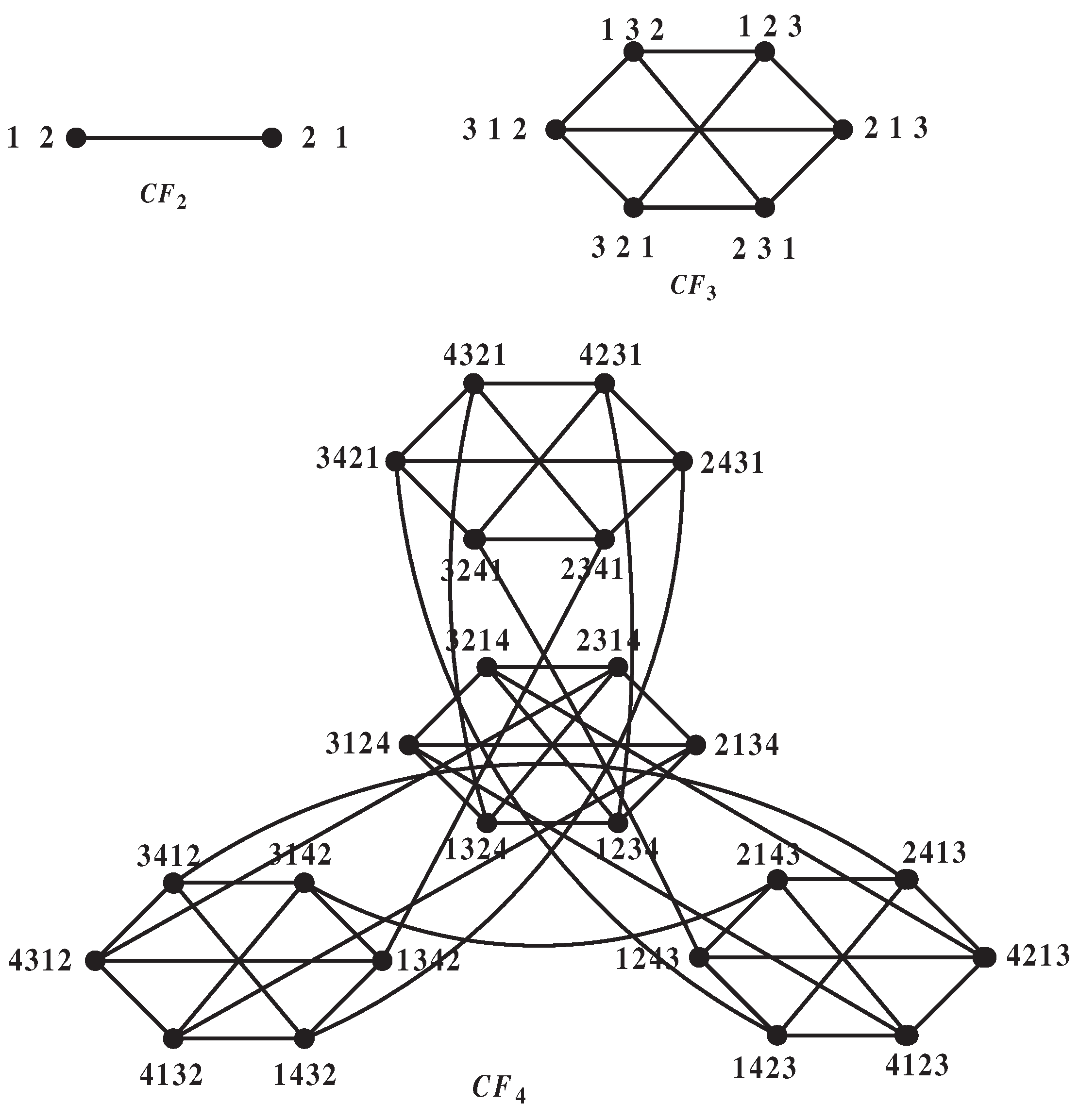
3. The 3-Component Connectivity of
In this section, we will discuss the 3-component connectivity of , and will prove that, when n is odd, for ; when n is even, for . Before proving our main results, we prove some useful lemmas firstly. Let S be a subset of (i.e., ; S is called an independent set if any two vertices are nonadjacent.
Lemma 2. When n is odd, if , then there exists only vertices in , which can satisfy that ; when n is even, if , then there exists only vertices in such that . In addition, these vertices are all regular.
Proof. Note that . When n is odd, is even, . Since , by Corollary 1 we know that must belong to a common subgraph in ; otherwise, if belong to different subgraphs in , then . So we can assume , . Now, we let , , then , , is odd. Since , by the proof process of Proposition 5, we now have two different situations:
Case 1. belong to two different subgraphs in , and or .
In this case, we have . If , then ,…,. Thus, . If , then . Thus, .
Case 2. belong to the same subgraph in .
In this case, we have , , . As , is even, , we can obtain belonging to a common subgraph in . Then, . Let , , then , and . As is odd, there are two different situations:
Subcase 2.1. belong to two different subgraphs in , and or .
If , we can get . Thus, . If , then . Thus, .
Subcase 2.2. belong to a same subgraph in .
This case is similar to case 2; this is a finite cycle process.
Finally, when n is odd, we can obtain vertices such that , they are , , , ,…,, .
When n is even, is odd, . Let , , . Assume , , then , ; similarly, we can also divide it into two different situations:
Case 1. belong to two different subgraphs in , and or .
In this case, we have . If , then . Thus, . If , then . Thus, .
Case 2. belong to a same subgraph in .
In this case, . Since and , and are in a same subgraph in . So . Let , , then , , is odd. As , we can also consider the following two situations:
Subcase 2.1. and belong to two different subgraphs in , and or .
If , then . Thus . If , then . Thus .
Subcase 2.2. and belong to a same subgraph in .
This case is similar to case 2; this is also a finite cycle process.
Finally, when n is even, we can obtain vertices such that , they are , , , ,…, , . □
Corollary 3. Let is an n-dimension leaf-sort graph, . If , and , then .
Lemma 3. For , let S is an -set and , then when n is odd, ; when n is even, .
Proof. Let , as S is an -set, so and are nonadjacent. By Proposition 5 and the definition of , we know that and is a -regular graph is odd) or -regular graph is even). So, when n is odd, . When n is even, . □
Corollary 4. For , let F be a subset of (i.e., ) and when n is odd, ; when n is even, , then contains a big component C, which satisfies .
Theorem 1. For , when n is odd, ; when n is even, .
Proof. For , since , we can obtain by Proposition 6. For , by Corollary 4, we can also obtain when n is odd and when n is even. Next, we will prove that, when n is odd, and when n is even, . Since , we can choose two different vertices , such that . From the definition of , we know that is a -regular is odd) and -regular graph is even), so when n is odd, ; when n is even, . Let ; we know contains three components and two of them only have a singleton. So we can obtain is odd) and is even). □
4. The 4-Component Connectivity of
Lemma 4. When , let S be an -set and , .
Proof. Let ; since S is an -set, are nonadjacent with each other. Note that , . Next, we will think about the following three cases.
Case 1. belong to the same subgraph .
In this case, since and S is an -set, . By Proposition 3, we know the outgoing neighbors of are different. Thus, .
Case 2. belong to two different subgraphs , .
In this case, we can let
,
. Since
and
are nonadjacent, we can obtain
,
. By the definition of
, we know
only has one outgoing neighbor. If the structure shown in
Figure 2a exists,
. Now, we can show that this structure does not exist. As
and
, we assume
, then
or
. Thus,
,
, and the structure shown in
Figure 2a does not exist. Thus,
.
Case 3. belong to three different subgraphs , , are different from each other).
In this case, we can let . By the definition of , we know , thus .
Combining the above three situations, we can obtain . □
Lemma 5. When , let S be an -set and , .
Proof. Let , since S is an -set, are nonadjacent with each other. Note that . We think about the following three cases.
Case 1. belong to the same subgraph .
Since , by Lemma 4, we can obtain . By the definition of and Proposition 3, we know the outgoing neighbors of are different and every vertex has two different outgoing neighbors. Thus, .
Case 2. belong to two different subgraphs , .
In this case, we can let
,
. Since
, by Lemma 3, we know that
. By the definition of
, we can obtain
. By Proposition 2, we can ascertain that
and
have, at most, two neighbors which belong to
. In other words, there are at least two neighbors of
and
belonging to
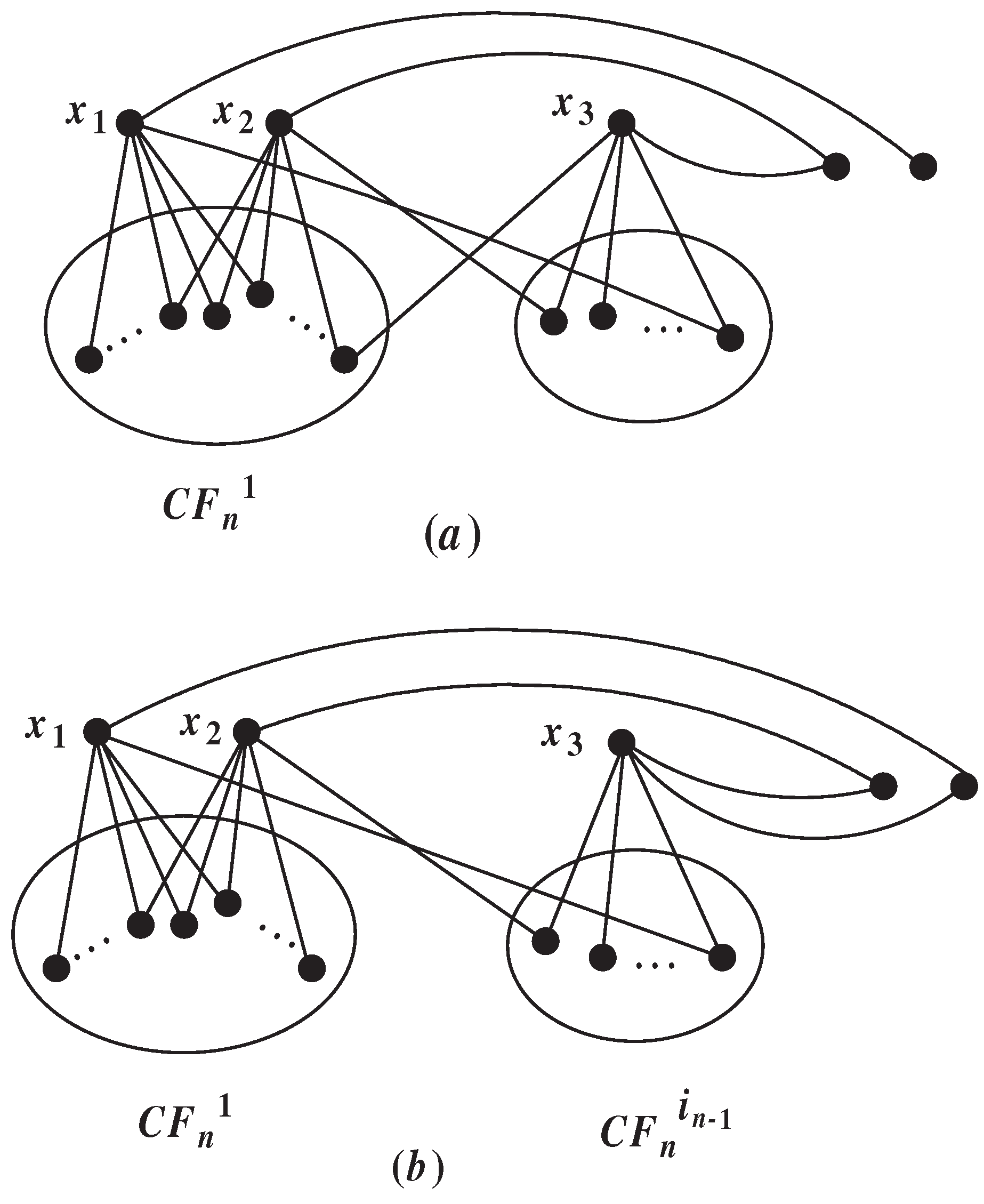
. If the structure shown in
Figure 2b exists, then
. Furthermore,
holds if and only if this structure exists. Now, we can prove this structure does not exist.
Since and , by Lemma 2, we can ascertain whether , or are different from each other).
If , then , . Since , and one of the two outgoing neighbors of belong to , we can obtain . Thus, . As are adjacent to , so or or . When , , , and is adjacent to . Since , , , . Thus, this structure does not exist. When , , , and is adjacent to . Since , and , , . When , , , and is adjacent to . Since , and , , . So this structure does not exist.
If , then , . Since , and one of the two outgoing neighbors of belong to , we can obtain . Thus, . As are adjacent to , so or or . As discussed above, we can also conclude that this structure does not exist.
Thus, the structure shown in
Figure 2b does not exist,
.
Case 3. belong to three different subgraphs , , are different from each other).
Without loss of generality, we can let , , . By the definition of , we can obtain , thus .
Combining the above three situations, we can obtain . □
Lemma 6. When n is odd, let be an -set, where , and . Then, .
Proof. When
n is odd,
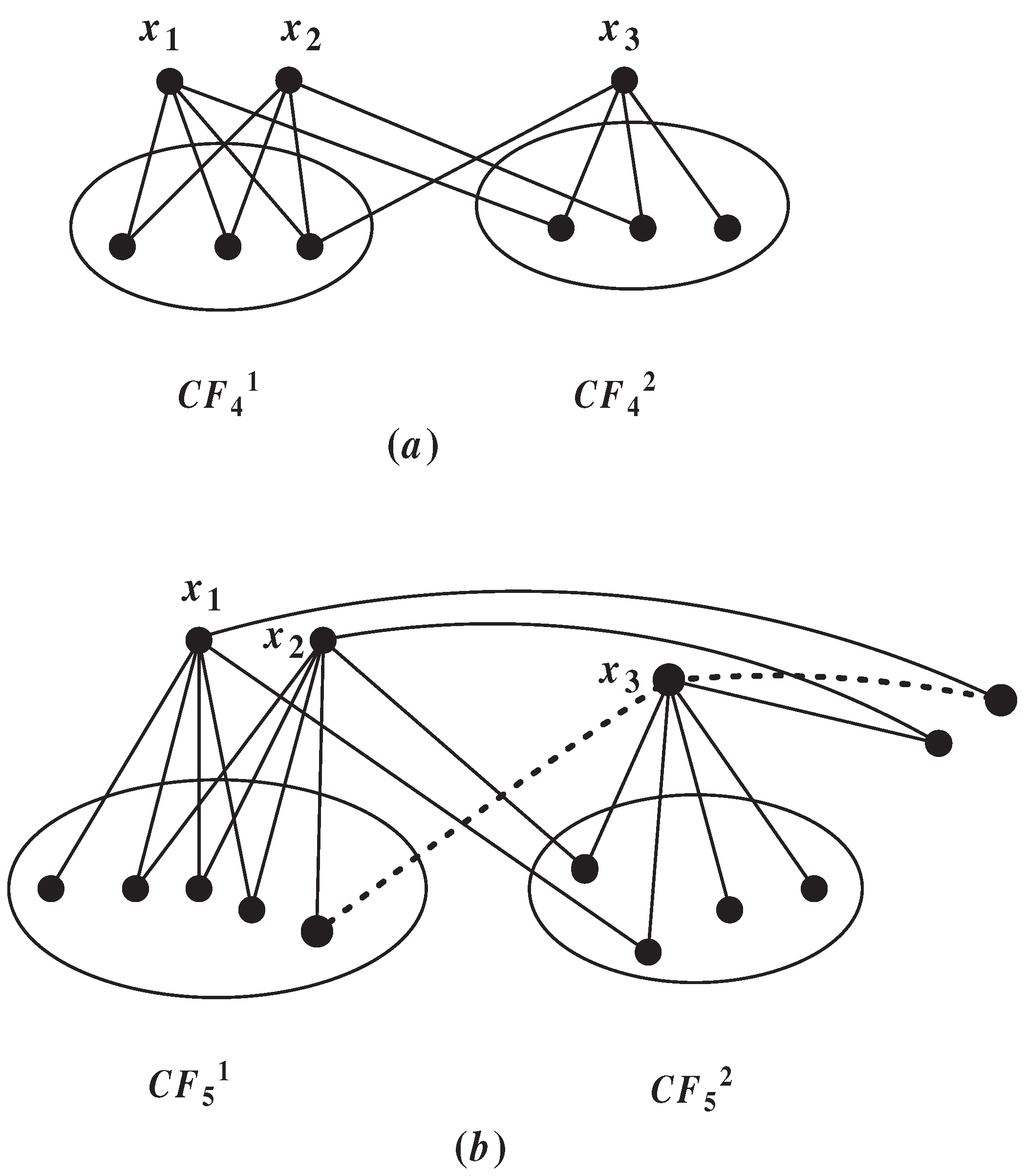
occurs if and only if the structure in
Figure 3 appears. Next, we will prove that these structures cannot appear.
Firstly, we prove that the structure shown in
Figure 3a does not exist. Suppose, on the contrary, we assume this structure exists and
, then
,
. As
, by the proof process of Lemma 3, we can know that
must have three common neighbors in
. Note that
n is odd, then
is even, and
. By Corollary 1, we can ascertain that
must belong to a common subgraph in
; otherwise, if
belongs to two different subgraphs in
, then
, which is a contradiction. So
,
,
,
,
. By Corollary 3, we know
. As one of the two outgoing neighbors of
and
belong to a common subgraph with
,
and
. Now, we assume
. As one of the two outgoing neighbors of
belongs to
,
or
. When
,
,
. In this situation,
,
, since
, we have
,
. Thus, this structure does not exist. When
, as
are adjacent to
, we can obtain
,
; this contradicts the fact that
, thus this structure does not exist.
Next, we will prove that the structure in
Figure 3b does not exist. Similarly, we know that
,
,
and
. We let
, then
,
. Thus,
and
; the structure in
Figure 3b does not exist. □
Lemma 7. When n is even, let be an -set, where , and . Then, .
Proof. When
n is even,
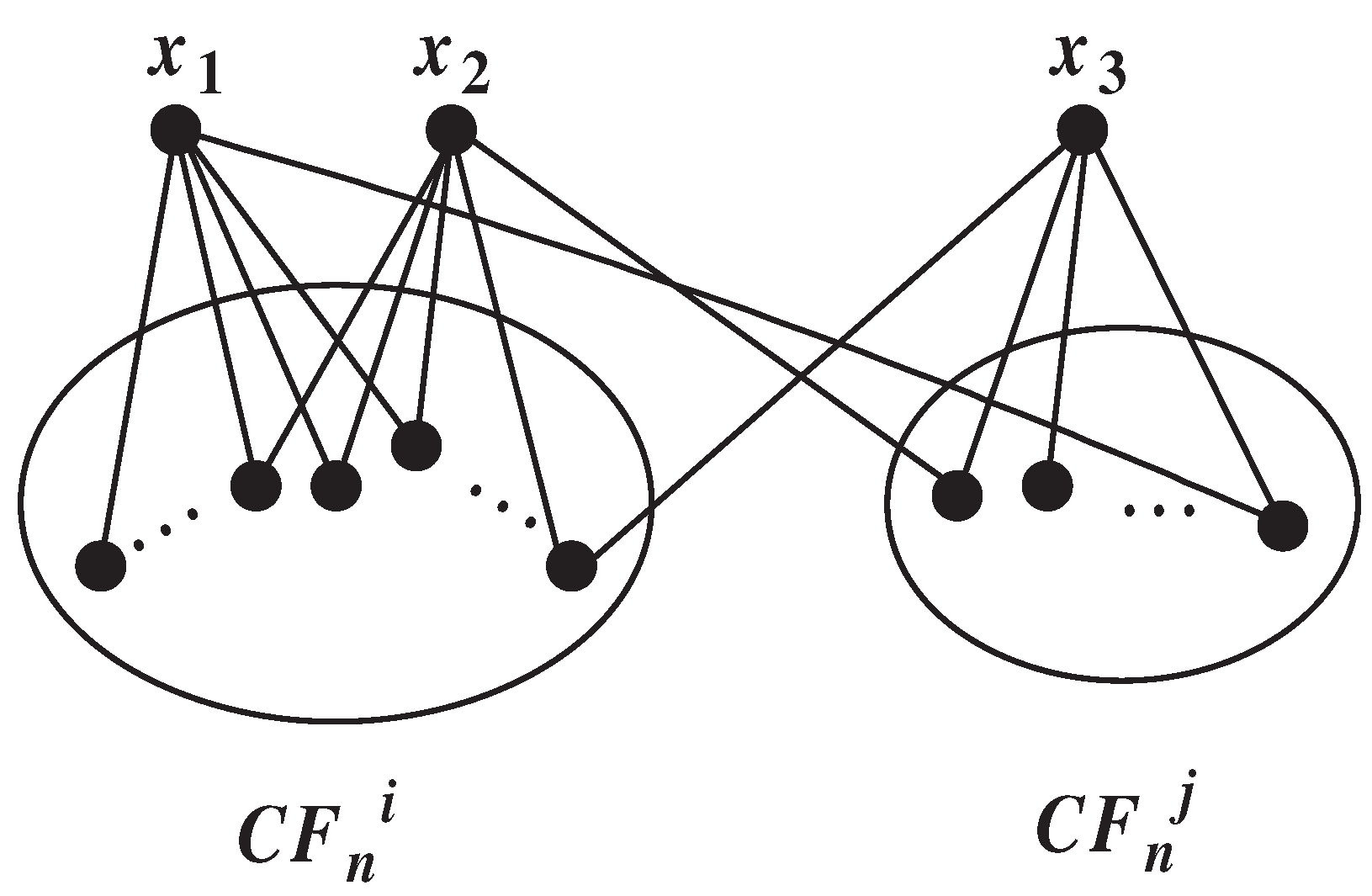
occurs if and only if the structure in
Figure 4 appears. Next, we will prove that this structure does not exist. Note that
;
is odd.
Suppose, on the contrary, we assume this structure exists; as , we know must have three common neighbors in by Lemma 3. Now, we let , . By Corollary 3, we know and . Thus, , , and can not belong to a common subgraph in ; this contradicts this structure. Thus, . □
Lemma 8. When , let S be an -set and , then when n is odd, ; when n is even, .
Proof. Let ; since S is an -set, are nonadjacent to each other. We prove this result by induction on n. By Lemmas 4 and 5, we know when , this result holds. Now, we assume that and the result holds for . Note that . Next, we think about the following three cases:
Case 1. belong to a same subgraph .
When n is odd, by the induction hypothesis, we have . By Proposition 3 and the definition of , we know the neighbors of in are different and every vertex has two outgoing neighbors. Thus, .
When n is even, by the induction hypothesis, we have . By Proposition 3 and the definition of , we know the neighbors of in are different and every vertex has only one outgoing neighbor. Thus, .
Case 2. belong to two different subgraphs , .
In this case, we can let
,
. By Lemma 3, we can obtain the following: when
n is odd,
; when
n is even,
. By the definition of
, we know that, when
n is odd,
; when
n is even,
. When
n is odd, by Proposition 2, we know
that, at most, two outgoing neighbors can belong to
; in other words, there are at least two outgoing neighbors of
that can belong to
. So
. By Lemma 6, we know
, thus
. When
n is even, if the structure of
Figure 4 exists, then
. By Lemma 7, we know this structure does not exist, so
.
Case 3. belong to three different subgraphs , , are different from each other).
Without loss of generality, we can let , , . By Proposition 6, we have, when n is odd, ; when n is even, . Thus, when n is odd, ; when n is even, .
Thus, the result holds. □
Corollary 5. When n is even, let be an -set, if , then belong to the same subgraph in .
Lemma 9. For , if , then contains a big component C, which satisfies the result . In other words, satisfies one of the following conditions: has two components, one of which is a singleton or an edge; has three components, two of which are singletons.
Proof. We are not going to think about being connected for the moment, so we assume that is disconnected. Let for with , where . If , then and is connected. By Proposition 2, we know every vertex in has an neighbor in . So is connected, which is a contradiction. Hence, we consider . Since , we have , , , , . Firstly, we prove the following claim is correct. □
Claim 1. If for some , then is connected.
Proof of Claim 1. By Proposition 6, we can ascertain that is connected for each . On the other hand, as , we can obtain , which implies for . Hence, is connected.
Since , by Claim 1, we can ascertain that is connected. If and are all connected, we know is connected. As , is connected. As , we establish that is connected. Since is disconnected, at least one of is disconnected, which leads to the following two cases.
Note that, if , by Proposition 3, we can ascertain that has a big component and, at most, one vertices, which has a neighbor in . Thus, if or is connected, then satisfies the condition . If and are all disconnected, then satisfies the condition . Hence, we only think about this situation: .
Case 1. Both and are disconnected.
In this case, we know . Since , . Hence, , . By Corollary 4, we know has a big component and a singleton . By Lemma 1, should consider the following two situations: has two components, one of which is a singleton. has three components, two of which are singletons. For , let be the big component and be the singleton of ; since and , by Proposition 3, we can ascertain that is connected. Similarly, we can also ascertain that is connected. Thus, the result holds. For , let be the big component and , be singletons of . If is nonadjacent to , then are three singletons in . By Lemma 5, we can obtain ; this contradicts the fact that . If is adjacent to , say , then only has two components; otherwise, we let have three components, then is a singleton in . By Proposition 5, we have , which is a contradiction. Thus, the result holds.
Case 2. Only is disconnected.
Since , . As is disconnected, we have and then . If , then , , which is a contradiction. Thus, . Since , is connected. As , by Corollary 4, we know has a big component S and, at most, one singleton. By the same argument as that of Case 1, we can ascertain that is connected. Then, must satisfy condition .
Case 3. Only is disconnected.
By Proposition 6, we have . Since and , . As , we can see that is connected.
If , by Lemma 1, has a big component S and one single and two singletons. By the same argument as that of Case 1, we can see that is connected. Then, must be one of conditions and .
Now, we suppose . Then, . Let W be the union of components of , whose vertices, which are totally contained in , are not connected with . By Propositions 2 and 3, we know , which implies . Thus, satisfies or .
Combining the above three cases, we know this result holds. □
Lemma 10. For , if , then contains a big component C, which satisfies the result . In other words, satisfies one of the following conditions: has two components, one of which is a singleton or an edge; has three components, two of which are singletons.
Proof. Similarly, we do not think about the situation being connected, so we let be disconnected. Let for with , where . If , then and is connected. By Proposition 2, we can ascertain that is connected. So we assume . Since , we have , , , , , . Firstly, we prove the following claim is correct. □
Claim 2. If , then is connected.
Proof of Claim 2. By Proposition 6, we know is connected for each . On the other hand, since for , we can obtain . Thus, is connected.
By Claim 2, we know is connected. If both and are connected, we can establish that is connected, which is a contradiction. Thus, at least one of is disconnected, which leads to the following cases.
Case 1. Both and are disconnected.
In this case, we know . By Corollary 4, we know that has a big component and one singleton . As , thus is connected. Similarly, we can see that is also connected. Thus, the result holds.
Case 2. Only is disconnected.
As is disconnected, we have and then . Since , is connected. Since , by Corollary 4, has a big component C and one singleton. Since , we can ascertain that is connected. Then, must be one of the conditions .
Case 3. Only is disconnected.
In this case, , . As , we can see that is connected.
If , by Lemma 9, has a big component C with . By the same argument as that of Case 2, we can see that is connected. Thus, the result holds.
If , then . Let W be the union of components of , whose vertices, which are totally contained in , and are not connected with . By Propositions 2 and 3, we have . Thus, the result holds. □
Lemma 11. Let for odd n and for even n, then contains a big component C, which satisfies that . In other words, satisfies one of the following conditions: has two components, one of which is a singleton or an edge; has three components, two of which are singletons.
Proof. By Lemmas 9 and 10, the result holds for . We prove this result by induction on n. Assume and that the result holds for . Now, we suppose is disconnected for any with or . Let for with , where .
When n is odd, if , then and is connected; thus, by Proposition 2, we can establish that is connected. Now, we assume ; when n is even, if , then and is connected, and thus, by Proposition 2, we can see that is connected. Now, we assume . □
Claim 3. When n is even, if , then is connected; when n is odd, if , then is connected.
Proof of Claim 3. By Proposition 6, we know is connected for each . On the other hand, since for is even) and for is odd), we can obtain . Thus, is connected.
Since is even) and is odd), we have for even n and for odd n. By Claim 3, we can ascertain that is connected. If and are all connected, as is even) and is odd), then is connected. Similarly, we can also see that is connected. So, at least one of is disconnected, which leads to the following cases.
Note that, when n is odd, if , by the same argument of Lemma 9, we know satisfies condition or . Hence, we assume that .
Case 1. Both and are disconnected.
When n is even, we have . By Corollary 4, we know and all have a big component and one singleton. As , . Thus, is connected and the result holds.
When n is odd, we have . So, by Lemma 1, we would consider the following three subcases: both and have three components, two of which are singletons; only one of and has three components, two of which are singletons; and both and have two components, one of which is a singleton. Now, we just prove the first subcase and the other two subcases can be proved by the same argument. Let (resp., ) be the two singletons and the other big component of (resp., ). Since and , by Proposition 3, we know is connected. Similarly, we can ascertain that is connected.
If are four singletons in , then by Proposition 5, we know , which is a contradiction.
If has three singletons, then by Lemma 8, we can obtain ; this contradicts the fact that . So, has two singletons or only one singleton. □
Claim 4. If has at least one edge, say , then only has two components.
Proof of Claim 4. Suppose has at least three components. Then, is a singleton or . If is a singleton, then , which is a contradiction. If , then , which is a contradiction.
Case 2. Only is disconnected.
As is disconnected, we have for even n and for odd n, then is even) and is odd). Since is even) and is odd), is connected. Since , when n is even, by Corollary 4, we know has a big component C and one singleton; when n is odd, by Lemma 1, we know has a big component C and at most two singletons. By the same argument as that of Case 1, we can establish that is connected. Then, must be one of conditions and .
Case 3. Only is disconnected.
In this case, for even n and for odd n. As is even) and is odd), we know that is connected.
When n is even, if , by introduction, we know has a big component C with . By the same argument as that of Case 1, we can establish that is connected. Thus, the result holds. If , then . Let W be the union of components of , whose vertices are totally contained in and are not connected with . By Propositions 2 and 3, we have . Thus, the result holds.
When n is odd, if , by introduction, has a big component C with . By the same argument as that of Case 1, we can see that is connected. Thus, the result holds. If , then . Let W be the union of components of , whose vertices are totally contained in and are not connected with . By Proposition 3, . Then, we have . Thus, the result holds. □
Theorem 2. For , when n is odd, ; when n is even, .
Proof. By Lemma 1, we have . For , by Lemma 11, we can obtain, when n is odd, ; when n is even, . Next, we will prove that and . For , if we let , then has three singletons: . Thus, . For , when n is odd, let , where , , , then and there are three singletons in . Thus when n is odd, . When n is even, let , where , , , then and . As belong to a common subgraph, by Proposition 3, we know have different outgoing neighbors. So, and are three singletons in . Thus, when n is even, . □