


Abstract
Brauer configuration algebras are path algebras induced by appropriated multiset systems. Since their structures underlie combinatorial data, the general description of some of their algebraic invariants (e.g., their dimensions or the dimensions of their centers) is a hard problem. Integer partitions and compositions of a given integer number are examples of multiset systems which can be used to define Brauer configuration algebras. This paper gives formulas for the dimensions of Brauer configuration algebras (and their centers) induced by some integer partitions. As an application of these results, we give examples of Brauer configurations, which can be realized as branch data of suitable branched coverings over different surfaces.
Keywords:
branched covering; Brauer configuration algebra (BCA); Hurwitz condition; integer partition; path algebra; quiver representation; realizable branch data MSC:
05A17; 11P83; 16G20; 16G30; 16G60
1. Introduction
Green and Schroll [1] introduced Brauer configuration algebras to investigate algebras of the wild representation type. These algebras are generalizations of some biserial algebras introduced previously by them, named Brauer graph algebras [2]. Afterward, Espinosa [3] used Brauer configuration algebras to obtain applications in different fields of science and mathematics.
In particular, Espinosa [3] introduced the notion of the message of a Brauer configuration. He used this concept to give formulas for the number of perfect matchings of some snake graphs or to describe the determinant of a given matrix as the specialized message of a Brauer configuration.
The study of the algebraic invariants associated with Brauer configuration algebras gives rise to the so-called Brauer analysis or Brauer data analysis [4]. It was used to describe the dimensions of Brauer configuration algebras induced by special settings designed by Zeilinger et al. [5] to model some quantum entangled states. In [4], Brauer analysis is also applied to some real-world network architecture models.
Brauer analysis was extended and applied by Cañadas et al. [6] to define Dynkin functions introduced previously by Ringel [7] to study algebraic invariants of Dynkin algebras, i.e., path algebras defined by Dynkin diagrams of the types , and .
A relationship between Brauer configuration algebras and the theory of branched coverings arises from the fact that any branched covering of a degree of an integer d between closed surfaces determines a collection (branch data) of integer partitions of d.
This paper gives examples of a question (the realizability problem) proposed by Edmonds et al. [8], which asks for conditions for a collection of integer partitions to be realized as branch data of a suitable branched covering. This problem goes back to Hurwitz [9], who introduced the well-known Hurwitz necessary condition for the realization of branch data.
Gonçalves et al. [10] studied the problem from a purely algebraic point of view, an approach that has been intensively studied in the last few years. For instance, in [11], it was proven that an indecomposable primitive branched covering on a connected closed surface N with Euler characteristic realizes any branch data, and their decomposability property was studied in [12]. Similarly, characterizations of primitive branched coverings with minimal defects over the projective plane have been explored in [13].
It is worth noting that finding formulas for the dimensions of Brauer configuration algebras induced by particular subsets of partitions of an integer n is an open problem. For instance, to date, there is no known formula for the dimension of a Brauer configuration algebra induced by the set of binary partitions of an integer n (i.e., partitions of n into parts of the form , ). An additional invariant associated with the proposed Brauer analysis is the defect of subsets of partitions defined by a suitable branched covering. Computing this defect allows for a straight connection between Brauer configuration algebras and the theory of branched coverings.
This paper gives formulas for the dimensions of Brauer configuration algebras induced by some restricted integer partitions and compositions (according to Andrews [14], integer compositions are partitions for which the order of the parts matters). In particular, Brauer analysis is applied to some subsets of binary compositions.
Contributions
This paper defines Brauer configuration algebras induced by integer partitions and compositions describing their Brauer quivers, dimensions, and centers. The analysis of these invariants is said to be a Brauer data analysis. This analysis allows for classifying integer partitions as branch data of suitable branched coverings over the projective plane and the sphere .
The main results of this paper are Theorems 5–12 and Corollary 2.
Theorems 5, 7, 8 and 10 and Corollary 2 are devoted to giving formulas for the dimensions of Brauer configuration algebras induced by several kinds of integer partitions and compositions.
Theorems 6, 9, 11 and 12 give criteria for restricted integer compositions to be realizable as branched data over the projective plane or the sphere .
The organization of this paper is as follows: the background, main definitions, and notations are given in Section 2; we remind the reader of the definitions of multisets (Section 2.4), integer partitions, compositions (Section 2.2), and Brauer configuration algebras (Section Brauer Configuration Algebras). We present the main results in Section 3. The concluding remarks are given in Section 4.
2. Preliminaries
In this section, we describe the developments in the research of the realization problem and basic definitions and notations regarding integer partitions, compositions, multisets, and Brauer configuration algebras.
2.1. Background
Green and Schroll [1] introduced Brauer configuration algebras to study algebras of the wild representation type. They gave some of their main properties, which describe algebraic invariants, such as their dimensions, the structure of the corresponding indecomposable projective modules, and their Jacobson radicals. Afterward, Sierra [15] found a formula for the dimension of the Brauer configuration algebras centers.
Espinosa [3] defined an appropriate message (Brauer message) induced by a Brauer configuration and used it to give alternative formulas for the number of perfect matchings of snake graphs. These ideas allowed Cañadas et al. [16,17,18,19,20] to obtain applications of the Brauer configuration algebras theory in different fields of mathematics and sciences. For example, they used Brauer messages to study the trace norm of some -matrices [16] or implement some cybersecurity applications [17]. In [18], the structure of Brauer configuration algebras is used to design Human Interaction Proofs (HIPs), whose development allows for the construction of CAPTCHAs (Completely Automated Public Turing Test to Tell Computers and Humans Apart). In [19], mutations of Brauer configuration algebras were introduced for cryptanalysis of the Advanced Encryption Standard (AES), a well-known tool for enabling Wi-Fi security. In [20], the authors used Brauer messages to describe set-theoretical solutions of the Yang–Baxter equation.
Brauer configuration algebra theory embraces the hypergraph theory used recently to model cyber network data. These structures can be used to analyze data using techniques similar to those presented in topological data analysis [21].
The analysis of algebraic invariants associated with Brauer configuration algebras is said to be a Brauer analysis of the data given by the multisets inducing such algebras [4]. This analysis was extended by adding tools such as the covering graph and some graph degree-based entropies [6].
According to Edmonds et al. [8], if M and N denote closed connected surfaces, then a smooth map is a degree d branched covering if for each , there is a partition of d such that over a neighborhood of x in N, is equivalent to the map where and x corresponds to 0 in . The set of points for which is not the trivial partition of d constitutes the branch set of . The collection is called the branch data of (repetitions allowed).
Edmonds et al. [8] proposed the following problem called the realizability problem:
Given a closed, connected surface N and a collection of partitions of a positive integer d, is there a branched covering with as its branch data?
The problem goes back to Hurwitz [9], who reformulated the question to one regarding integer partitions. In fact, there are well-known necessary conditions based on the Riemann–Hurwitz formula:
If is a degree d branched covering of closed, connected surfaces with branch data , then the total branching or defect of the branched covering is even; where is a partition of d and for each , it holds that .
Gonçalves et al. [10,11,12,13] also studied the realizability problem. In [10], the authors followed the Hurwitz approach to study the problem of primitive branched coverings. In particular, they studied the problem of the torus and the Klein bottle. In [11], it is proven that any branch data set can be realized by an indecomposable primitive branched covering over a closed surface S with Euler characteristic . In [12], the decomposability property of a branched covering over the projective plane with a covering surface having Euler characteristic zero was studied. In [13], the authors characterized primitive branched coverings with minimal defects over the projective plane with respect to the decomposability property of primitive branched coverings.
This paper applies Brauer analysis to some integer partitions and compositions. Such an analysis allows formulas for the dimensions of the corresponding Brauer configuration algebras. As an application, we present Brauer configurations as examples of branch data of some branched coverings.
2.2. Integer Partitions and Compositions
This section reminds the reader of the notation, definitions, and facts regarding integer partitions and compositions and their enumeration. The authors refer to [14,22] for more insights regarding these subjects.
An integer partition of a positive integer n is a nonincreasing sequence of positive integers such that . denotes the number of partitions of an integer n. If , it is considered that and , , if [14]. If denotes the set of all partitions, then denotes the number of partitions of n that belong to a subset S of [14].
Elements are said to be parts of the partition. Particularly, if is a partition of n, then we write . Sometimes, it is possible to write
to specify the number of times that a given part occurs in , in such a way that .
If the order of the parts matters, then a partition is said to be a composition [14,22]. For example, are partitions of 3, whereas are its compositions.
Hardy, Ramanujan, and Rademacher (see [14], Theorem 5.1, and [23] Theorem (1.71)) gave the following formula for :
where
where with , there is a certain 24th root of unity.
For instance, the number of partitions of n into, at most, two parts is and the number of partitions of n into, at most, three parts is , where is the largest integer not exceeding x ( the nearest integer to x). In particular, there are compositions of n [14].
The following formula gives the number of compositions of n into exactly m parts, each .
Particularly, the number of compositions of n, with exactly m parts is given by the following formula:
According to Andrews [14], Meinardus gave the following asymptotic formula for , which includes numerous partition formulas.
The following result is known as the Elder’s theorem [24]:
Theorem 1
([24] Result 2, [25] Corollary 2). The total number of occurrences of an integer j among all unordered partitions of n equals the number of occasions that a part occurs j or more times in a partition.
We let denote the number of occurrences of the part j in all partitions of n. denotes the sum of distinct numbers in the partitions of n [24].
We note that
The generating function of is given by the following identity [24]:
Let be the number of partitions of n into, at most, parts, each , and the number of permutations of in which there are exactly n pairs such that and [14].
The following result holds:
Theorem 2
([14] Theorem 3.5). .
As an example, we note that the sequence 111211221111122122 corresponds to the partition of type , where the number of 1s after the first 2 tells us the first part of the partition, the number of 1s after the second 2 tells us the second part of the partition, and so on.
Cañadas et al. [26] defined integer compositions of type of an integer m with and . In such a case, is the hth octahedral number, .
A composition of type satisfies the following conditions:
- .
- where ; , for some positive integer h.
- The ith partial sum is of the form , , with . Furthermore, if , then is either or ().
- is a trivial composition of m.
Example 1.
As an example, the following are the compositions of type of :
39,
,
,
,
,
,
,
.
2.3. Branched Coverings of the Sphere and the Projective Plane
This section reminds the reader of the criteria for a branched datum to be realizable over connected surfaces such as the sphere and the projective plane.
Theorem 3
([8], Theorem 5.1). Let be a collection of partitions of a positive integer d. Then, there is a branched covering of degree d, with M connected, and with branch data if and only if and is even. Moreover, M can be chosen to be nonorientable.
According to Desmond et al. [8], a collection of partitions of d is said to be realizable if arises as the branch data of a connected branched covering of . They proved the following results (Propositions 1 and 2, Theorem 4, and Corollary 1) regarding these types of coverings.
Proposition 1
([8], Proposition 5.2). A collection of partitions of d, with some is realizable if and only if and .
Proposition 2
([8], Proposition 5.3). A collection of partitions of d, with some , is realizable if and only if , and is not
- 1.
- (, );
- 2.
- (, ).
Theorem 4
([8], Theorem 5.4). A collection of partitions of , , is realizable provided and .
Corollary 1
([8], Corollary 6.4). If , then the data {{x, 2r − x}, {2,…, 2}, {2,…, 2} } with are realizable as the branch data for a connected branched covering of if and only if .
Table 1 shows the examples given by Desmond et al. [8] of realizable branch data described by Corollary 1.

Table 1.
Examples of realizable branch data given by Corollary 1.
2.4. Multisets
In this section, we recall the basic definitions associated with multisets. For more details about them, their messages, and their operations, we refer the interested reader to [3,14,22,27].
Intuitively, a multiset is a set with repeated elements. Formally speaking, a finite multiset M on a set S is a function such that . One regards as the number of repetitions of x [22]. Thus, integer partitions and compositions are examples of multisets.
The integer is called the cardinality or number of elements of M and is denoted as , or . This paper assumes that for any multiset M.
If and , then we write [22].
Andrews [14] gives an alternative definition of a multiset. According to him, a multiset is an ordered pair where M is a set and is a function from M to the non-negative integers .
For each , would be called the multiplicity of m. When M is a finite set, a multiset can be written as a word w whose letters are the elements of M with letter occurrences given by the map . In this paper, we assume that words associated with multisets have the following form:
Let be a collection of nonempty finite sets, , and be a collection of multisets defined by the collection . Then, the valency of an element is given by the following identity [1]:
If , then we let denote the set of all the multisets with . In other words, .
The collection of multisets as described above is said to be a multiset system of type M, if it is endowed with a map such that for each . And for any , the set is endowed with a linear order <.
The elements of M are named vertices by Green and Schroll [1]. The integer in a pair associated with a vertex m corresponds to the multiplicity value in their work. Note that does not say anything about the multiplicity of m as an element of a multiset. A vertex is nontruncated (truncated) if (). Therefore, the multiplicity function permits us to classify the set of vertices M into the set of truncated and nontruncated vertices. In this paper, if , then , otherwise, . Thus, the considered vertices are nontruncated [6].
Each has an expansion of the following form:
Note that, if is a covering in , then the following identity holds:
Since is a well-ordered set each element has a unique successor and the following identities hold:
For each , the chain can be written as follows:
is said to be the compressed successor sequence at vertex y and is the successor sequence at vertex y. Note that .
Each successor sequence of type induces a circular ordering by adding a relation of the form . In such a case, .
This paper assumes that if and , and with the usual order of the natural numbers, then .
Example 2.
As an example, let us consider the following partitions of 10 as branch data over given in Table 1. Where
Vertices are nontruncated in this case. Note that the successor sequences associated with the set are
Furthermore,
Brauer Configuration Algebras
In this section, we recall the basic definitions and notation of the Brauer configurations and their induced Brauer configuration algebras. See [1,2,3,4] for more details on those topics.
Following Green and Schroll [1], a Brauer configuration is a combinatorial data , with being the (finite) set of vertices of ; is a finite collection of finite labeled multisets; the polygons, whose elements are in , is a map known as the multiplicity function; and is an orientation for . In this case, every vertex in is a vertex in at least one polygon, and every polygon in has at least two vertices. Every polygon in has at least one nontruncated vertex with the condition that . The role of the function was already described.
An orientation for is a selection for each vertex of a cycling ordering of the polygons in which is a vertex, including repetitions. In such a case, if occurs in polygons or multisets of the form , then the polygon occurs times in the list. The cyclic order at vertex is obtained by linearly ordering the list, say , and by adding the relation , .
As stated by Green and Schroll [1], the cyclic ordered list of polygons or just is the succesor sequence at α. In that case, if is the successor sequence at a nontruncated vertex such that , then is the successor of at , for , with . For a vertex in a polygon U such that , the successor sequence at is U.
The concepts defined in this section let us conclude that multiset systems of type M are Brauer configurations, known as Brauer configurations of type M (or Brauer configurations, for simplicity), with vertices given by a set and being the set of polygons. The multiplicity function is given by the first coordinate of the function (see Section 2.4). In this case, the orientation is provided by successor sequences (15).
Given that the function associated with multiset systems of type M includes the multiplicity function , we can accept the notation (19) for this type of configuration.
The message or Brauer message of a Brauer configuration is the concatenation of the fixed words [3], i.e.,
Remark 1.
Desmond et al. [8] gave the following result where word concatenation is used to characterize branch data of some branched coverings:
Proposition 3
([8] Proposition 2.7). Let d be an even integer, , a collection of partitions of d, and N is a closed, connected, nonorientable surface. Then, a necessary and sufficient condition that there exists a degree d branched covering with branch data and M orientable is that for each i, , one can express as a concatenation of two partitions of , such that is the branch data of a degree branched covering of the orientable double covering of N.
The Brauer quiver (or simply Q) induced by a Brauer configuration is obtained through a bijective correspondence between its set of vertices and the collection of polygons . In other words, vertices in a Brauer quiver are given by the multisets in . Furthermore, each pair in a circular ordering defines an arrow from to in . In particular, if , then a covering of the form defines an arrow from to in [1].
Henceforth, if no confusion arises, we will write instead of to denote a multiset with multiplicity function .
The covering graph or nerve of a Brauer quiver gotten from a fixed Brauer configuration (or the covering graph of a Brauer configuration ) is a graph with a set of vertices consisting of polygons in . We define an edge to connect the polygons if and only if there exists and a covering at vertex y. Note that has no multiple edges nor loops. Thus, we write only one edge to represent all the coverings of a given form [6]. Alternative conditions for the vertices and edges of a covering graph are given in (21).
Example 3.

A Brauer configuration is said to be reduced if the set M has no truncated vertices. It is connected if the corresponding Brauer quiver is. A Brauer configuration algebra (or simply , if no confusion arises) is a bound quiver algebra induced by a Brauer quiver bounded by an admissible ideal generated by a set of relations of the following types [1,2]:
- if i and j are vertices in the same polygon and is a cycle (starting and ending at ) defined by an appropriate circular ordering. These cycles are said to be special cycles.
- if a is the first arrow of a special cycle associated with a vertex i. In particular, if .
- if are arrows of different special cycles and is an element of the path algebra induced by .
We say that a Brauer configuration algebra is indecomposable (as an algebra) and reduced if it is induced by a connected and reduced Brauer configuration.
Example 4.
As an example, the Brauer configuration algebra induced by the Brauer configuration defined in Example 2 by identities (16) and (17) and the Brauer quiver shown in Figure 1 is bounded by an admissible ideal . The following are examples of generators:
- 1.
- ; , , , .
- 2.
- ; , for all possible values of j if .
- 3.
- ; ; ; .
- 4.
- ; ; ; .
We remind [1] that a multiserial algebra is defined to be a finite-dimensional algebra such that, for every indecomposable projective left and right -module P, the corresponding radical is a sum of uniserial modules (an -module M is said to be uniserial if it has a unique composition series), i.e., , where for some integer m and uniserial modules , it holds that if , then is either 0 or a simple -module.
Remark 2.
The following results were found by Green and Schroll [1] and Sierra [15] (see [1] Theorem B, Proposition 2.7, Theorem 3.10, Corollary 3.12, and [15] Theorem 4.9). For all of them, we assume the notation for a Brauer configuration algebra induced by a Brauer configuration .
- There is a bijection between the set of indecomposable projective -modules and the polygons in .
- If P is an indecomposable projective -module corresponding to a polygon V in , then the Jacobson radical is a sum of r indecomposable uniserial modules, where r is the number of (nontruncated) vertices of V and where the intersection of any two of the uniserial modules is a simple -module.
- A Brauer configuration algebra is a multiserial algebra.
- The number of summands in the heart of an indecomposable projective -module P such that equals the number of nontruncated vertices of the polygons in corresponding to P counting repetitions.
- Let be the Brauer configuration algebra induced by a connected Brauer configuration . The algebra has a length grading induced from the path algebra if and only if there is a positive integer N such that for each nontruncated vertex , it holds that . In such a case, we say that the algebra satisfies the length grading property.
- Sierra [15] gave the following Formula (23) for the center of a Brauer configuration algebra induced by a connected and reduced Brauer configuration .where and the number of vertices of the Brauer quiver is given by the number of multisets or polygons in .
Example 5.
According to Remark 2, the analysis of the data (known as Brauer analysis) inducing the Brauer configuration algebra and the Brauer quiver (see Figure 1) gives the following information (see Examples 2–4):
- 1.
- is multiserial. Particularly, the Jacobson radical of the indecomposable projective -modules, , and induced by partitions , and , respectively, is a sum of and 5 indecomposable uniserial modules, respectively.
- 2.
- does not satisfy the length grading property.
- 3.
- The Brauer quiver has two components and four vertices , and 4 with , , , ; , and , .
- 4.
- .
- 5.
- .
- 6.
- .
3. Main Results
This section provides a Brauer analysis of some integer partitions and compositions and defines Brauer configurations as realizable branch data over some surfaces.
Table 2 gives a Brauer analysis of realizable branch data over defined by Corollary 1. Note that the defect deals with the number of summands in the heart , of the corresponding indecomposable projective modules and () is the number of components (covering graph) of the corresponding Brauer quiver .
Table 2.
Brauer analysis of Brauer configuration induced by realizable branch data over . See Table 1 and Corollary 1.
Let be the Brauer configuration defined by the integer partitions of a positive integer n ( excluded as a partition). We assume that ; therefore, is the number of polygons (see Formula (22)). We also assume that if in successor sequences. Then, the following result holds:
Theorem 5.
Let be the Brauer configuration algebra induced by the Brauer configuration ; then, is indecomposable as an algebra and
where denotes the number of occurrences of the part j in the partitions of n (see (8)).
Proof.
The covering graph induced by the Brauer configuration is connected. Note that, if , then by definition, there is an edge in connecting and . On the other hand, if and the largest parts of and are and , respectively, with , then and there exists a partition of n. Thus, there exists an edge connecting with ; if , then there is an edge connecting and . Therefore, there exists a path connecting and . If and is the less part of , then there exists a partition of n, such that . Then, there is an edge connecting and and a path of the form connecting and . Thus, the Brauer quiver is connected and the induced Brauer configuration algebra is indecomposable as an algebra.
Since the number of polygons in equals and is the only vertex j in the Brauer configuration with and for the remaining vertices, then the Formula (25) holds. □
Let be the Brauer configuration induced by the compositions of a positive integer n (), with and if in successor sequences.
The following result regarding integer compositions holds:
Corollary 2.
Let be the Brauer configuration algebra induced by the Brauer configuration ; then, is indecomposable as an algebra and
where is the size of the largest family of compositions of n induced by a fixed partition with the form .
Proof.
The arguments posed in Theorem 5 prove that is indecomposable as an algebra. On the other hand, we note that and that is the number of compositions of n defined by . Each composition is associated with a unique partition; then, each composition of n gives rise to at most copies of its corresponding partition. Thus, the compositions of n define at most repetitions of since each part occurs times in each of these copies. We conclude that for each , it holds that . Therefore, the inequality (2) holds, and we are finished. □
Let be the Brauer configuration induced by the compositions of a positive integer n into exactly parts. Then, the following result holds:
Theorem 6.
If is even, then there exists a branched covering over the projective plane of degree n with M connected and as branch data.
Proof.
. Moreover, . Since , with , it holds that . We are finished. □
Let be the Brauer configuration induced by permutations of in which there are exactly n pairs such that and . In this case, and the words associated with the polygons in are permutations of (see Theorem 2). If the orientation is given for partitions and compositions of an integer n, then the following result holds:
Theorem 7.
Let be the Brauer configuration algebra induced by the Brauer configuration . Then,
Proof.
The number of polygons in is (see Theorem 2) and , . □
Let be the Brauer configuration defined by the compositions of type of , where denotes the ith octahedral number, . Furthermore, any composition ( excluded as composition) is a sequence of the form with , , .
We let denote the -entry of the Catalan triangle encoded as A001263 in the On-Line Encyclopedia of Integer Sequences (OEIS) [28].
The following result gives the properties of a Brauer configuration algebra induced by compositions of type .
Theorem 8.
Let be the Brauer configuration algebra induced by the Brauer configuration . Then, the following identities hold:
where
where denotes the ith triangular number.
Proof.

We let denote the poset , where and are chains or linear ordered sets with 2 and n points, respectively. Furthermore, for positive integers , it holds that
is a lattice and there exists a bijection between the set of lattice paths connecting points and the maximal point . And the set of compositions of type of . In such a case, if , then
Sets are given by the set of edges of the lattice path P. In such a case, an edge of the form has assigned a two-point set consisting of consecutive squares of the form . If the edge is of the form , then elements of are of the form . Particularly, . Note that compositions associated with a given lattice path P with the same starting point have the same parts. Thus, the first identity (27) holds provided that consecutive squares occur consecutively, the square numbers and occur just once, and the remaining parts occur twice.
The second identity (28) holds taking into account that each point gives rise to the entry in the Catalan triangle, which is the number of lattice paths connecting with . This is also the number of compositions of type .
The third identity (29) and fourth identity (30) hold as consequences of Formulas (22) and (23) and the valency values given above. Note that is indecomposable as an algebra, the number of compositions of type is , and the number of loops is given by parts of the form and provided that , . Figure 2 shows the poset labeled by compositions of type . We are finished. □
Figure 2.
Poset labeled with compositions of type .
For the following result, we assume that the parts of compositions of type consist of parts of the forms , where is a sum of two suitable consecutive square numbers, .
Theorem 9.
If and , then the collection of polygons associated with the Brauer configuration is realizable as the branch data of a branched covering of degree n over the projective plane with M connected.
Proof.
Note that if L is a composition of type , then L has the form , where for some and . Therefore, for any . That is, , for some suitable and , for some . Since is an even number, we conclude that is an even number and ; then, the result holds as a consequence of Theorem 3. We are finished. □
Let be the Brauer configuration algebra induced by the Brauer configuration defined by compositions of a positive integer with the form . Note that and .
Example 6.
The following are compositions of type :
- 1.
- {4,4,2};
- 2.
- {4,4,1,1};
- 3.
- {4,2,2,2};
- 4.
- {4,2,2,1,1};
- 5.
- {4,1,1,2,1,1};
- 6.
- {4,1,1,1,1,1,1}.
For fixed, we let denote the positive integer with the following form:
We let denote a sequence of positive integers, such that
where
We let denote the sequence of positive integers, such that
For , it holds that
Particularly, .
We let denote a map with the domain being the sequence and such that
The following result gives the dimensions of Brauer configuration algebras induced by compositions of type .
Theorem 10.
Let be the Brauer configuration algebra induced by the Brauer configuration ; then, is indecomposable as an algebra and
Proof.
If and are compositions of type such that , then there is an arrow in the corresponding Brauer quiver connecting and . On the other hand, if and and are the smallest parts of and , respectively, then there are partitions and with 1 as the smallest part. It occurs () times in (). Then, there is a path in connecting and . Thus, is connected and the algebra is indecomposable.
Since equals the number of compositions of n into m parts of the form , i parts of the form and , 1s. Then, is the number of vertices of the Brauer quiver induced by compositions of type and, by definition, is the valency of j for any j and the identity (37) holds.
Finally, note that, by definition, is the number of loops in and for any vertex . Thus, the identity (38) holds. We are finished. □
The following result is a consequence of Theorem 3, which regards branched coverings over the projective plane.
Theorem 11.
If is even, then there is a branched covering of degree n with M connected and with compositions of type of an integer as branch data.
Proof.
According to Theorem 3, it suffices to note that . Thus, . We are finished. □
Example 7.
The following are compositions of type :
- , , , , , .
The following are compositions of type :
- , , , , , .
and . Then, there is not a branched covering of degree 6 provided that the compositions of this type do not satisfy the Hurwitz condition. According to Theorem 3, such a branched covering exists with as branch data.
Figure 3 shows the Brauer quiver induced by the compositions whose defect satisfies the Hurwitz condition, since , is a branch data of a branched covering of degree 7 over the projective plane.Note that the collection of compositions does not satisfy the Hurwitz condition, provided that .
Note that the Brauer configuration algebra induced by the quiver shown in Figure 3 is bounded by relations of the following forms:
- , where denotes a special cycle at the vertex x, , .
- , if f is the first arrow of the special cycle .
- , if for any .
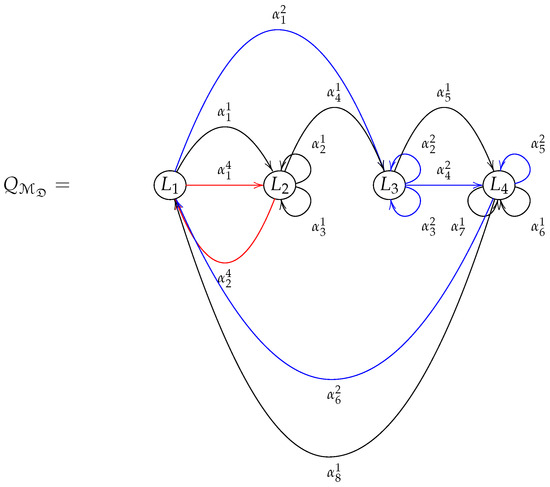
Figure 3.
Brauer quiver induced by branch data realizable as branched covering of the projective plane.

Figure 4.
Covering graph defined by the Brauer quiver (see Figure 3).
Table 3.
Brauer analysis of the Brauer configuration induced by compositions , and .
Table 3.
Brauer analysis of the Brauer configuration induced by compositions , and .
| Brauer Analysis of Branch Data | |||||
|---|---|---|---|---|---|
| Degree | |||||
| 7 | 96 | 7 | 12 | 12 | |
The following result is a consequence of Proposition 2.
Theorem 12.
If , , and is even. Then, any composition of type with is realizable.
Proof.
Note that is an odd number , and the number of compositions of type is greater than 3. Furthermore, there are two compositions and of type , such that , . Then, . Thus, . Therefore, the result follows as a consequence of Proposition 2. We are finished. □
Example 8.
Suppose that is a subset of binary partitions of a fixed integer h with the form , , , , if ; then, if is the Brauer configuration algebra induced by , then .
For instance, if , then , , , and . Therefore, .
Theorem 13.
If is a collection of partitions of a fixed integer with , , , , and is the Brauer configuration algebra induced by , then . Where
Proof.
The number of loops contained in the induced Brauer quiver is given by a sum of the form . Thus, , with (, if (). Therefore, . Thus, . We are finished. □
Example 9.
Note that, if , then , , , , , and , and then . Thus, according to Theorem 13, it holds that .
4. Concluding Remarks
This paper gives formulas for the dimensions of Brauer configuration algebras induced by restricted partitions and compositions, which makes it possible to give formulas for the number of occurrences of their parts.
Elder’s theorem, the Hardy–Ramanujan–Rademacher formula, and the Catalan triangle allow for finding formulas for the dimension of Brauer configuration algebras induced by integer partitions. It is an open problem, giving a closed formula for the center of these algebras.
We classify the defined integer partitions and compositions as realizable branch data of branched coverings over the projective plane and the sphere via the Hurwitz condition and some restrictions imposed on the associated defects. Giving a criterion to determine the parity of the defect of general integer partitions or compositions is still an open problem.
5. Future Work
The following are interesting problems to be addressed in the future:
- The first problem is giving a closed formula for the center of Brauer configuration algebras induced by general integer partitions and compositions.
- Another interesting task consists of giving formulas for the defect of general integer compositions of type and , establishing for them some parity criteria.
Author Contributions
Investigation, writing—review and editing, A.M.C., J.G.R.-N. and O.P.S.D. All authors have read and agreed to the published version of the manuscript.
Funding
This research is supported by Convocatoria Nacional para el Establecimiento de Redes de Cooperación bajo el Marco del Modelo Intersedes 2022–2024, Universidad Nacional de Colombia. Cod Hermes 59773.
Data Availability Statement
The original contributions presented in the study are included in the article, further inquiries can be directed to the corresponding author.
Conflicts of Interest
The authors declare no conflicts of interest.
Abbreviations
The following abbreviations and formulas are used in this manuscript:
| BCA | (Brauer configuration algebra) |
| (Dimension of a Brauer configuration algebra; Formula (22)) | |
| (Dimension of the center of a Brauer configuration algebra; Formula (23)) | |
| (Euler characteristic of a surface N) | |
| k | (Field) |
| (; ith octahedral number) | |
| (Sum of three octahedral numbers) | |
| OEIS | (On-Line Encyclopedia of Integer Sequences) |
| (Projective plane) | |
| (Sphere) | |
| (; nth triangular number) | |
| (; defect of an integer partition ). |
References
- Green, E.L.; Schroll, S. Brauer configuration algebras: A generalization of Brauer graph algebras. Inf. Sci. 2011, 181, 57–78. [Google Scholar] [CrossRef]
- Schroll, S. Brauer Graph Algebras. In Homological Methods, Representation Theory, and Cluster Algebras, CRM Short Courses; Assem, I., Trepode, S., Eds.; Springer: Cham, Switzerland, 2018; pp. 177–223. [Google Scholar]
- Espinosa, P.F.F. Categorification of Some Integer Sequences and Its Applications. Ph.D. Thesis, Universidad Nacional de Colombia, Bogotá, Colombia, 2020. [Google Scholar]
- Cañadas, A.M.; Gutierrez, I.; Mendez, O.M. Brauer Analysis of Some Cayley and Nilpotent Graphs and Its Application in Quantum Entanglement Theory. Symmetry 2024, 16, 570. [Google Scholar] [CrossRef]
- Krenn, M.; Gu, X.; Zeilinger, A. Quantum experiments and graphs I: Multipartite states as coherent superpositions of perfect matchings. Phys. Rev. Lett. 2017, 119, 240403. [Google Scholar] [CrossRef]
- Cañadas, A.M.; Espinosa, P.F.F.; Nieto, J.G.R.; Mendez, O.M.; Arteaga-Bastidas, R.H. Extended Brauer Analysis of Some Dynkin and Euclidean Diagrams. Electron. Res. Arch. 2024, 32, 5752–5782. [Google Scholar] [CrossRef]
- Ringel, C.M. Catalan combinatorics of the hereditary Artin algebras. In Developments in Representation Theory; Contemp Math, 673; AMS: Providence, RI, USA, 2016; pp. 51–177. [Google Scholar]
- Edmonds, A.L.; Kulkarni, R.S.; Stong, R.E. Realizability of Branched Coverings of Surfaces. Trans. Am. Math. Soc. 1984, 282, 773–790. [Google Scholar] [CrossRef]
- Hurwitz, A. Über Riemannische Fläche mit Gegebenen Verzweigungspunkten. Math. Ann. 1891, 39, 1–60. [Google Scholar] [CrossRef]
- Bogatyi, S.; Gonçalves, D.L.; Kudryavtseva, E.; Zieschang, H. Realization of primitive branched coverings over closed surfaces. CEJM 2003, 2, 184–197. [Google Scholar]
- Bedoya, N.A.V.; Gonçalves, D.L. Decomposability problem on branched coverings. Sb. Math. 2010, 201, 1715. [Google Scholar] [CrossRef]
- Bedoya, N.A.V.; Gonçalves, D.L.; Kudryavtseva, E.A. Indecomposable branched coverings over the projective plane by surfaces with χ(M)≤0. J. Knot Theory Ramif. 2018, 27, 1850030. [Google Scholar] [CrossRef]
- Bedoya, N.A.V.; Gonçalves, D.L. Decomposability of minimal defect branched coverings over the projective plane. arXiv 2023, arXiv:2310.09390v1. [Google Scholar]
- Andrews, G.E. The Theory of Partitions; Cambridge University Press: Cambridge, UK, 2010. [Google Scholar]
- Sierra, A. The dimension of the center of a Brauer configuration algebra. J. Algebra 2018, 510, 289–318. [Google Scholar] [CrossRef]
- Agudelo, N.; Cañadas, A.M.C.; Gaviria, I.D.M.; Espinosa, P.F.F. {0,1}-Brauer configuration algebras and their applications in the graph energy theory. Mathematics 2021, 9, 3042. [Google Scholar] [CrossRef]
- Cañadas, A.M.; Angarita, M.A.O. Brauer configuration algebras for multimedia based cryptography and security applications. Multimed. Tools. Appl. 2021, 80, 23485–23510. [Google Scholar]
- Angarita, M.A.O.; Izquierdo, E.; Cañadas, A.M. Human interaction proofs (HIPs) based on multistable images and Brauer configuration algebras (BCA). In Proceedings of the 9th International Conference on Imaging for Crime Detection and Prevention (ICDP-2019), London, UK, 16–18 December 2019; pp. 13–18. [Google Scholar]
- Cañadas, A.M.; Gaviria, I.D.M.; Vega, J.D.C. Relationships between the Chicken McNugget Problem, Mutations of Brauer Configuration Algebras and the Advanced Encryption Standard. Mathematics 2021, 9, 1937. [Google Scholar] [CrossRef]
- Cañadas, A.M.; Ballester-Bolinches, A.; Gaviria, I.D.M. Solutions of the Yang-Baxter equation arising from Brauer configuration algebras. Computation 2022, 11, 2. [Google Scholar] [CrossRef]
- Jenne, H. Stepping Out of Flatland: Discovering behavior patterns as topological structures in Cyber hypergraphs. Next Wave 2024, 25, 4–16. [Google Scholar]
- Stanley, R.P. Enumerative Combinatorics; Cambridge University Press: Cambridge, UK, 1999; Volume 2. [Google Scholar]
- Hardy, G.H.; Ramanujan, S. Asymptotic formulæ in combinatory analysis. Proc. Lond. Math. Soc. 1918, 2, 75–115. [Google Scholar] [CrossRef]
- Dastidar, M.G.; Gupta, S.S. Generalization of a few results in integer partitions. Notes Number Theory Discret. Math. 2013, 19, 69–76. [Google Scholar]
- Andrews, G.E.; Deutsch, E. A note on a method of Erdös and the Stanley-Elder theorem. Integers 2016, 16, A24. [Google Scholar]
- Cañadas, A.M.; Angarita, M.A.O. On sums of three squares and compositions into squares and triangular numbers. JP J. Algebr. Number Theory Appl. 2011, 23, 25–59. [Google Scholar]
- da Costa, F.L. An introduction to multisets. arXiv 2021, arXiv:2110.12902. [Google Scholar]
- Sloane, N.J.A. The On-Line Encyclopedia of Integer Sequences. Sequence A001263. Available online: http://oeis.org/A001263 (accessed on 13 June 2024).
Disclaimer/Publisher’s Note: The statements, opinions and data contained in all publications are solely those of the individual author(s) and contributor(s) and not of MDPI and/or the editor(s). MDPI and/or the editor(s) disclaim responsibility for any injury to people or property resulting from any ideas, methods, instructions or products referred to in the content. |
© 2024 by the authors. Licensee MDPI, Basel, Switzerland. This article is an open access article distributed under the terms and conditions of the Creative Commons Attribution (CC BY) license (https://creativecommons.org/licenses/by/4.0/).