Abstract
In this manuscript, for the purpose of investigating the coincidence best proximity point, best proximity point, and fixed point results via alternating distance , we discuss some multivalued and proximal contractions in the context of rectangular metric spaces. To ascertain the coincidence best proximity point, best proximity point, and the fixed point for single-valued mappings, we reduce these findings using and proximal contractions. To make our work more understandable, examples of both single- and multivalued mappings are provided. These examples support our core findings, which rely on coincidence points, as well as the corollaries that address fixed point conclusions. In the final phase of our study, we use the obtained results to verify that a solution to a Fredholm integral equation exists. This application highlights the theoretical framework we built throughout our study.
Keywords:
rectangular metric space; alternating distance; ℱ-contraction; coincidence best proximity point MSC:
47H10; 46N20
1. Introduction
An essential tool for solving equations of the kind is fixed point theory, in which denotes a mapping that is defined on a subset of a topological vector space or a metric space. However, it should be noted that not all mappings have a fixed point, for example, when under restricted conditions, and some other mappings (such as translation mappings and non-self-mappings with two distinct sets) may not have fixed points. While it might be difficult to locate exact fixed points in some situations, under some conditions, it is possible to find an approximation of fixed points. The application of the best approximation theory facilitates the study of these approximate fixed points. Recent advancements in fixed point theory have introduced several innovative approaches and applications, as discussed in [1,2].
It is possible that a non-self-mapping lacks a fixed point by nature. Fundamentally, though, an element closer to always advances. In this scenario, the importance of the best proximity theorem and the idea of the best proximity point become quite apparent. The essence of the best proximity point theorem resides in achieving a globally optimized solution of factual components, symbolized by . This property indicates the degree of inaccuracy in the approximate solution of the operator . The metric for a non-self-mapping is at least for every in . The condition is imposed by limiting an approximate solution , to the equation .
The concept of the best proximity point had initially been laid out by Sadiq Basha et al. [3,4] in 1997. Eldred et al. [5] proposed a technique for identifying the best proximity point for non-self-mappings in the framework of a uniformly convex Banach space. Baria gave the concept of a new type of contraction named Cyclic Meir–Keeler contractions in [6], whereas Kikkawa et al. [7] characterized the connections between contractions and Kannan mappings. The concept of proximal pointwise contraction was initially introduced by Anuradha et al. [8], and the UC property was introduced by Suzuki et al. [9]. The presence of the best proximity points and the convergence of asymptotic cyclic contractions with the UC property were established by Abkar et al. [10]. Theorems on the best proximity points were initially given by Basha et al. in [11,12], offering the best possible approximation solutions. Samet et al. [13] introduced the notion of -admissible mappings, while the investigation of -proximal admissible mapping was started by Jleli et al. [14].
A foundational theorem on best approximation, initially presented by Fan [15], states that there exists an element in a compact convex subset of a Hausdorff locally convex topological vector space , where is a semi-norm. The theorem states that for a continuous mapping , the distance between and equals the distance between and , i.e., In the investigation of generalized Geraghty proximal cyclic contractions, Komal et al. [16] established results pertaining to coincidence best proximity points within the structure of a complete metric space. In their work [17], Latif et al. gave the idea of partially ordered metric space and produced findings for coincidence best approximation points for -weak contractive mappings. Fan’s theory has been the subject of several subsequent changes and adaptations, as evidenced by publications like [18], wherein Ahmad et al. utilized rational-type Ćirić-contractive-type contractions in the context of controlled metric-type spaces to generate novel fixed point results with an application to a second-order differential equation. In [19], Kirk et al. presented best proximity pair theorems in hyperconvex metric spaces and in Hilbert spaces. In [20], Naeem et al. discussed some (coincidence) best proximity point results for generalized proximal contractions and proximal Geraghty contractions in controlled metric-type spaces. In [21], Suzuki et al. proved three generalizations of Matkowski’s fixed point theorems for weakly contractions. In [22], Wani et al. established the approximation by Durrmeyer-type Jakimovski–Leviatan operators involving the Brenke-type polynomials. The positive linear operators are constructed for the Brenke polynomials, and thus, approximation properties for these polynomials are obtained.
Recently, numerous authors have made valuable contributions to the best proximity theory. In [23], S. Laha introduced concepts such as topologically Berinde weak proximal contractions and topologically proximal weakly contractive mappings with respect to , providing conditions for the existence and uniqueness of best proximity points for these mappings. In [24], M. Asim generalized the metric and metric spaces through a partial idempotent-valued metric space, establishing a fixed point and best proximity point theorem. In [25], A. Das applied the metric to measure distances on non-planar surfaces, extending best proximity point concepts to metric spaces and proving corresponding proximity point results.
Building upon the insights gleaned from our extensive literature review, we have derived notable coincidence best proximity point results within rectangular metric space. Distinguished by our innovative approach, we apply -type proximal contractions paired with an alternating distance function for multivalued mappings. Additionally, we improve upon our contributions by obtaining findings for fixed points, which we summarize as corollaries to the concept of optimum proximity points. Importantly, we advance the concept of multivalued coincidence points to single-valued coincidence points. We give descriptive instances of the change from coincidence points to fixed points to support the importance of our main results. These illustrations not only help to make sense of our results but also strengthen the validity and relevance of the findings we give in this manuscript.
Imagine that there are two nonempty subsets in the complete rectangular metric space , which are and . The distance between the elements in this space is determined by the metric . The sets and are defined as
where
which represents the distance from set to set .
2. Preliminaries
We introduce essential definitions to start off our conversation that contribute to the development of our results. Our starting point is the definition of a metric space.
Definition 1
([26]). Upon satisfying the given conditions, a function , with a range of non-negative real numbers, is considered a metric, such that the following occur:
- 1.
- ;
- 2.
- iff ;
- 3.
- ;
- 4.
- , for each
Here, is a metric on , and the pair defines the metric space, with identified as the ground set. The individual elements are recognized as points within this metric space. Consequently, the notation encompasses the metric space .
Few examples are also presented from the literature [26] to explain the distance or metric.
Example 1.
We have few functions given as
where and are metrics defined by the set of real numbers, . Furthermore, is a metric defined by the real numbers excluding zero, denoted as .
Example 2.
Suppose and for each then is defined as
where is a metric on
Example 3.
Let be a nonempty set furnished with a metric space structure, denoted as . In the present case, the function is defined as follows:
The metric establishes a discrete metric and the pair represents a discrete metric space.
A unique generalization of metric spaces was established by Branciari [27] in 2000. It is explained as follows.
Definition 2.
Consider a set that is not empty. If a function meets the following criteria, it is referred to as a rectangular metric:
- 1.
- 2.
- if and only if
- 3.
- 4.
- for all then the space is known to be a rectangular metric space.
Definition 3
([27]). Consider a rectangular metric space . If and possesses a sequence , then the following holds:
- (i)
- The sequence converges to point if and only if
- (ii)
- The sequence is known to be a Cauchy sequence if and only if .
- (iii)
- The rectangular metric space is complete if and only if every Cauchy sequence in is convergent.
- (iv)
- Every convergent sequence in a rectangular metric space has a unique limit.
Definition 4
([28]). In a rectangular metric space with nonempty subsets represented by the pair , where is nonempty, is said to satisfy the -property if
implies that
where and .
Definition 5
([29]). Let be a function. If ϕ satisfies the given axioms:
- (i)
- is continuous.
- (ii)
- If , then
- (iii)
- For all , .
Then, we say that it is an alternating distance function.
Definition 6
([30]). Given that the mapping is considered as an contraction if it adheres to the specified criteria:
- (F1)
- For all positive real numbers, is a strictly increasing function.
- (F2)
- For all , if and only if
- (F3)
- For there exists .
The set of all functions that fulfill the above given conditions is denoted by
A mapping defined on a rectangular metric space is known to be an contraction with and such that
where and are elements of
Example 4.
Let be a function, given as
and the mapping be constructed on a complete rectangular metric space, with the metric
by Clearly, satisfies the contraction condition.
Definition 7
([31]). Consider a set of all closed and bounded subsets of , denoted as within the space . Assume that represents the Pompeiu–Hausdorff metric with metric , defined as
for where
and in this manuscript, we will denote
for and
From the beginning to the end of this manuscript, we suspect that the rectangular metric is a continuous mapping.
3. For Multivalued Mappings
In this section, we introduce new definitions and theorems pertaining to best proximity points, fixed points, and multivalued coincidence points within the framework of a complete rectangular metric space , utilizing the concepts and results established in the previous section.
Furthermore, given that , which is a subset of , and that is within this suggests that there is an element in such that
Using the property . Since, provides the proximal contraction condition, we obtain
where
and so, we can say that
If we choose then the inequality (1) becomes
which is impossible.
Definition 8.
In a rectangular metric space consider closed nonempty subsets and . Let be a pair of mappings such that is a multivalued mapping and is a self-mapping. The mappings here satisfy the following:
Then, is known as a coincidence best proximity point for
Remark 1.
The coincidence-best-proximity-point results refer to a wider notion that includes fixed points and best proximity points. When is taken into account, this becomes clear since any closest proximity point that coincides becomes the closest proximity point for mapping . Moreover, the idea of a best proximity point reduces to that of a fixed point in the scenario, where is a self-mapping.
Definition 9.
Let be a multivalued mapping and be a self-mapping. The pair of mappings is known to be satisfied proximal contraction if there is a non-negative real number τ and for all in such that
implies that
where
Definition 10.
A multivalued mapping is known to be satisfied proximal contraction if there exists a non-negative real number τ and for all in , such that
implies that
where
Observe that each -proximal contraction simplifies to a -proximal contraction upon selecting (where indicates the identity mapping on ). Furthermore, we see that if
and ϕ is an identity map, then our contraction is reduced to contraction for multivalued mappings.
Theorem 1.
Consider nonempty closed subsets and in the complete rectangular metric space , both of which fulfill the -property, where . Let and be continuous mappings with and . Additionally, assume that is an injective continuous mapping, and fulfill the -proximal contraction condition with alternating distance ϕ. Then, the pair attains a coincidence best proximity point.
Proof.
Select an arbitrary element Given that is a subset of and is within there exists an element such that
If then the inequality (1) will be
then we obtain
Now, an arbitrary element Given that is a subset of and is within there exists an element such that
Furthermore, given that , which is a subset of , and that being within this suggests that there is an element in such that:
Using the property .
Since fulfills the proximal contraction condition, we obtain
where
so we can say that
If we choose then the inequality (2) becomes
which is impossible.
If then the inequality (2) will be
then we obtain
Similarly, for with there exists such that
Having selected and satisfying the condition, there is an element that fulfills the condition that
for all n (where n represents positive integers).
Using the property .
Since fulfills the proximal contraction condition, from Equations (3) and (4), we obtain
where
So, we can say that
If we choose then the inequality (5) becomes
which is impossible.
If then the inequality (5) will be
then we obtain
Hence, the sequence is monotonic nonincreasing and bounded below. Therefore, we have a such that
Consider , and, by using (6) and (7), we obtain
Continuing the procedure, we obtain
We can conclude from the previous equation that
Using (F2) of Definition 6 gives
Again, using (F3) of Definition 6, there exists , such that
By using (8), we obtain
Assume that from the above inequality is given as
From Equations (9) and (10) and we have
so, the above inequality is
It is clear from the Equation (11) that we obtain an such that, for each given ,
Now, we want to show that is a Cauchy sequence, where is a complete rectangular metric space for all :
Hence, for all non-negative integers and , the above inequality will be as follows:
By using the P-series test, we can determine that is convergent for . Consequently, the Cauchy sequence converges in the complete rectangular metric space . Let us assume that it converges to within (given that the set is closed), implying that the sequence as . Since are continuous mappings, it follows that
Thus, is a coincidence point of the pair of mappings . □
Example 5.
Consider the set with the metric defined as
Clearly, is a complete rectangular metric space. Assuming the nonempty closed subsets and of the given rectangular metric space and fulfill the property condition, where , . After a few simple steps of calculation, we obtain The mapping is given as follows:
and , given as
Clearly, and Then, satisfy the proximal contraction condition
for all elements . Since,
where , and . After simple calculation, we obtain
and
Let the function be as follows:
For and , we obtain , , and then the inequality (12) will be
As a result, all of the circumstances of Theorem 1 are fulfilled, where the two points 1 and 2 are the coincidence points for
| 0 | 1 | 2 | 3 | 4 | 5 | |
| 0 | 0 | 3 | 4 | 2 | 6 | 7 |
| 1 | 3 | 0 | 5 | 8 | 2 | 6 |
| 2 | 4 | 5 | 0 | 7 | 8 | 2 |
| 3 | 2 | 8 | 7 | 0 | 3 | 4 |
| 4 | 6 | 2 | 8 | 3 | 0 | 5 |
| 5 | 7 | 6 | 2 | 4 | 5 | 0 |
Corollary 1.
Within a complete rectangular metric space , consider nonempty closed subsets and , both of which fulfill the -property with a nonempty set . Let be a continuous mapping with . We can say that permits a best proximity point if it fulfills the proximal contraction condition with an alternating distance function ϕ.
Proof.
Assuming that ( is an identity on then the remainder of the proof follows Theorem 1.
Example 6.
Consider , then is a complete rectangular metric space, where is defined as
Now, and are clearly closed sets, and Further, and , and the pair has property. A multivalued mapping , such that
Now, the mapping satisfies proximal contraction
for all . Let the function be as follows:
For and , we have the following simple calculation:
Let , then and we choose . Then, clearly, , and we take . So,
Equation (13) is satisfied by this. All of the requirements listed in Corollary 1 are therefore satisfied, identifying 1 as the fixed point of the mapping .
Note that in Theorem 1, if we embrace we obtain the corresponding findings described below. □
Corollary 2.
Consider a multivalued mapping defined on a complete rectangular metric space. Suppose that it fulfilled the -proximal contraction condition with the alternating distance function ϕ. Under these conditions, the existence of a fixed point for the mapping is guaranteed.
Proof.
Consider . The remaining part of the proof precisely matches Theorem 1. □
Example 7.
Consider , then is a complete rectangular metric space, where is defined as
A multivalued mapping , such that
Now, the mapping satisfies the proximal contraction
for all . Let the function be as follows:
For and , we have the following simple calculation:
Let and , then, clearly, , and . So, . On the other hand, we obtain the following:
Therefore,
and
Now, apply , and we obtain
and
Equation (14) is satisfied by this. All of the requirements listed in Corollary 2 are therefore satisfied, identifying 1 as the fixed point of the mapping .
4. For Single-Valued Mappings
This section is devoted to examining coincidence best proximity point results in complete rectangular metric spaces, specifically for single-valued mappings. Recognizing that multivalued mappings produce sets as outputs, which behave as single-valued mappings when these outputs are singleton sets, we leverage this property to establish new results for single-valued mappings. These results are developed in relation to those introduced in the previous section.
Definition 11.
A pair of mappings where and is said to be a proximal contraction, if there exists a such that
then this implies that
where
for all in
Definition 12.
A mapping is said to be proximal contraction if there exists a such that
which implies that
where
for all in
When is selected as , signaling the identity mapping on , it results in the transformation of all -proximal contractions into a unified form of -proximal contractions. Furthermore, we see that if
and is an identity map, then our contraction is reduced to contraction for single-valued mappings.
Theorem 2.
Consider the mappings and , where both and are nonempty closed subsets of a complete rectangular metric space . These mappings fulfill the -property, with and . If the pair of continuous mappings , where is an injective mapping, the -proximal contraction condition is fulfilled with an alternating distance function ϕ. Under these conditions, it follows that admits a coincidence point.
Proof.
Multivalued mappings produce sets as outputs. When the output is a singleton set, the mapping behaves like a single-valued mapping. Since all single-valued mappings fall into the category known as multivalued mappings, the rest of the proof aligns with the methodology outlined in Theorem 1. □
Example 8.
Determine the complete rectangular metric space by taking the set . The metric function is formed as
Suppose that and are closed subsets of rectangular metric space Simply, we calculate and satisfy the property, where and . A mapping such that
and also, :
We clearly see that and Now, we want to show the pair fulfills the proximal contraction condition
for all . Since,
where and . After routine calculation, we obtain
and
Let the function be defined as
For and , we conclude that , , then the inequality (15) will be
Hence, all the conditions specified in Theorem 2 are satisfied, establishing 11 as the coincidence best proximity point of the pair
Corollary 3.
Consider a mapping , where both and are nonempty closed subsets of a complete rectangular metric space and fulfill the -property. Furthermore, suppose . permits a best proximity point if it is a continuous mapping with an alternating distance function ϕ that fulfills the proximal contraction.
Proof.
When we consider the mapping (where represents the identity mapping on ), the rest of the proof follows a similar structure as presented in Theorem 1. □
Example 9.
Let us have , and define metric . Let
and
So, we can calculate ; therefore, and . Now, define a non-self-map , given as
So, Now, take , such that
Now,
Now, taking , and , implies
Hence, holds.
5. Fixed Point Results
If we use in Theorem 2 given in the previous section, then we acquire the fixed point in this section and we also achieve the preceding considerations accordingly. For an in-depth investigation of the significance of fixed point theorems in various engineering applications, we refer to [32].
Definition 13.
A mapping is deemed an contraction if there is a positive real number τ, satisfying the condition
where, for all in
We see that if
and is an identity map, then our contraction is reduced to contraction.
Theorem 3.
Consider a single-valued self-mapping defined on a complete rectangular metric space that satisfies the -proximal contraction with an alternating distance function ϕ. Under these conditions, it follows that possesses a fixed point.
Proof.
In the scenario that is used, the remaining portions of the proof replicate Theorem 2. □
Example 10.
: If we take and , the metric function is given as
and
Here, . Clearly, is a rectangular metric space but not a metric space. If we take and , then
On the other hand,
which gives,
which shows that are not metric but clearly satisfy the rectangular metric conditions. Now, we define a mapping , where , such that
The mapping satisfies proximal contraction
for all .
Case (i): If and , we take the points as and . Then, and
Case (ii): If both elements are from set , then there are two further cases; in the first case, we choose elements that are very near to each other, and in the other, we pick up points far away from each other.
- (a)
- and , then and
- (b)
- and , then and
Hence, all the assumptions of Theorem 3 are fulfilled and concedes 1 as the fixed point.
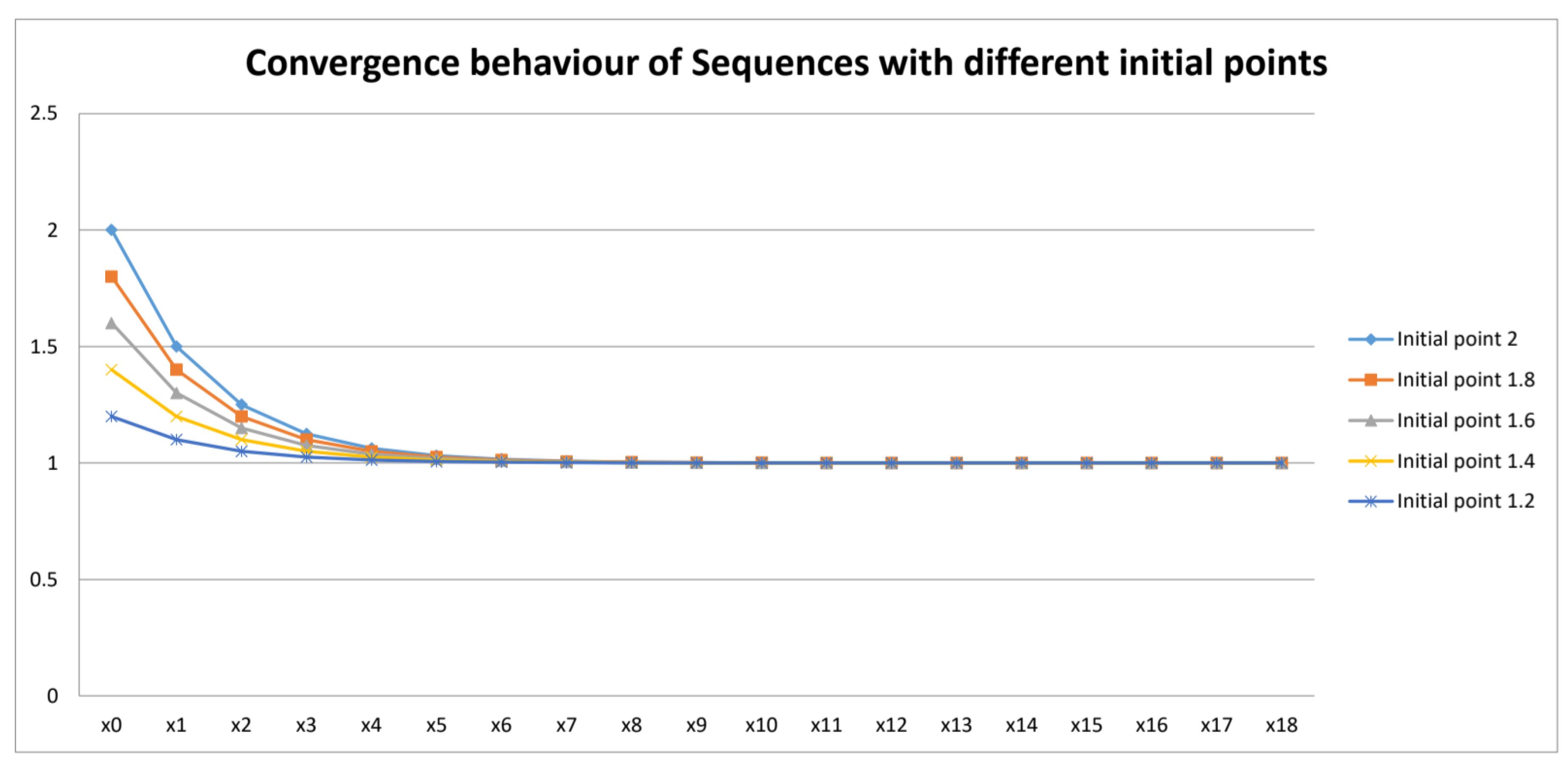
In the subsequent analysis, we investigate the convergence behavior of the sequence under consideration, employing various initial points. The tabulated results given below in
Table 1
clearly depict the distinctive convergence patterns exhibited by the sequences.
Table 1.
Numerical convergence behavior of sequences with different initial points.
A graph demonstrating the behavior of sequences created from various starting points is shown in Figure 1. The graph gives valuable insights into the convergence patterns exhibited by these distinct sequences.
Figure 1.
Convergence behavior of sequences with different initial points.
6. Application to the Fredholm Integral Equation
In this section, we rigorously assess the existence and uniqueness of solutions to a Fredholm integral equation within a function space by applying the results which were established in the previous section.
The Fredholm integral equation is given as
The continuous function is defined across the space in the present scenario, but the continuous function is on the interval .
We present a numerical example that clearly illustrates the usefulness of our findings to highlight the importance of our contributions. The study of function spaces as the selected metric space gives our research a fascinating new dimension. In this regard, we utilize the strength of Theorem 3 to investigate in detail the existence and uniqueness of solutions to the Fredholm integral equation, therefore making a valuable contribution to the field’s general knowledge.
Consider the function space and , defined by
Clearly, form a rectangular metric space. Now, we introduce a self-mapping given by
Let and , where . Equation (18) is then given by
where and are continuous functions. Now, consider
The alternating function is and , leading to
Now, let ; applying it on both sides of the inequality (19), we obtain
which implies that
Hence, it satisfies the proximal contraction, and, by Theorem 3, the Fredholm integral equation has a unique solution. Equation (17) clearly has an exact solution, which is .
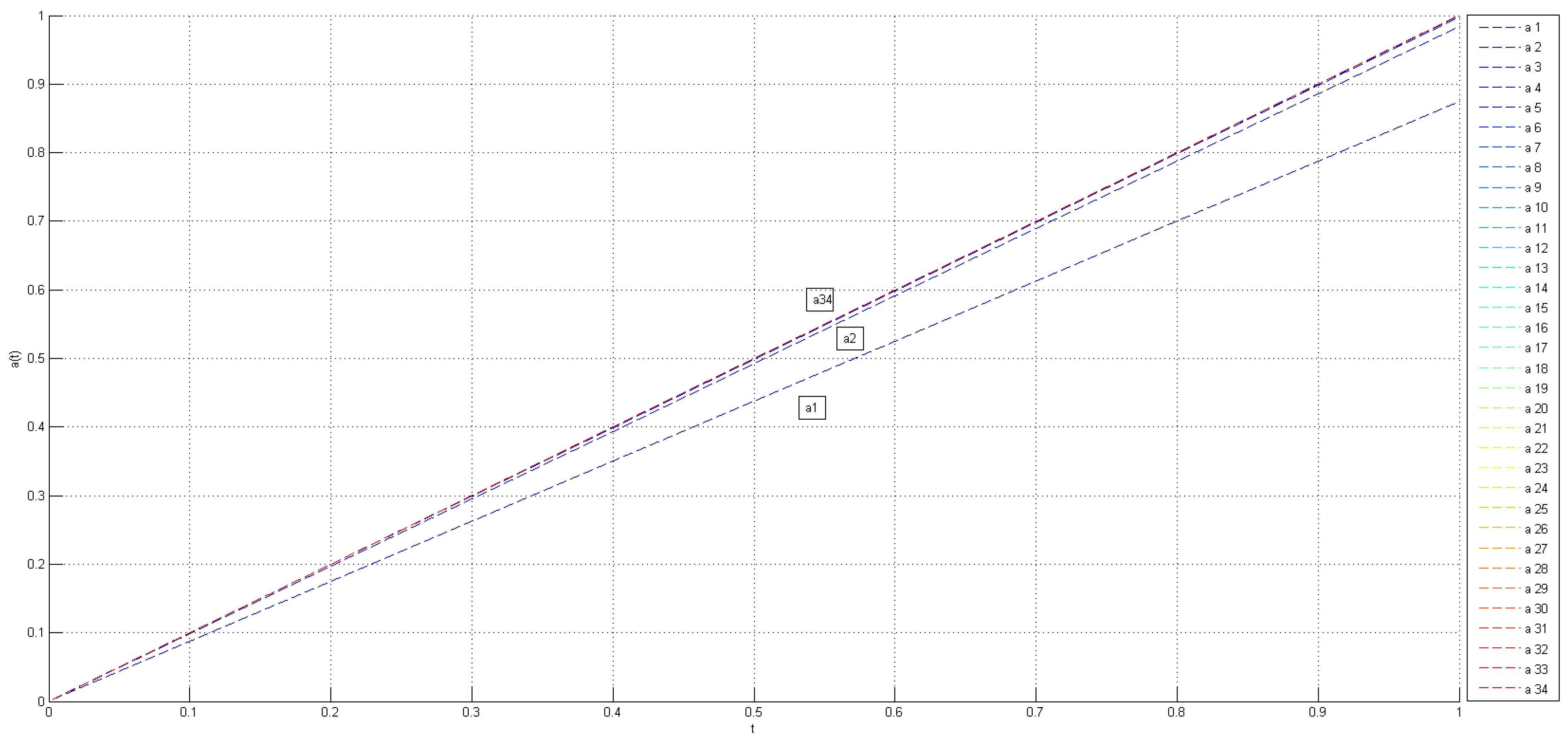
We next highlight the importance of our findings by showing that the numerical solution converges. The iterative scheme is defined by
We select as the initial guess to start the procedure. When are substituted into Equation (20), we obtain the values shown in Table 2.
Table 2.
Numerical convergence behavior of the sequence.
Upon examination, we conclude that the unique solution is . This finding supports the answer to Equation (17) and is unique. Subsequently, we provide visual evidence of the convergence behavior of all iterations in Figure 2.
Figure 2.
Convergence behavior of iterations.
7. Conclusions
In this article, we examine the existence of coincidence best proximity points for multivalued mappings using the newly developed -proximal contraction, and the best proximity points for multivalued mappings through the -proximal contraction approach within a rectangular metric space, employing the alternating distance function . We also introduce contractions for single-valued mappings to establish results on coincidence best proximity points, best proximity points, and fixed points, such as and . To enhance adaptability, we provide examples illustrating multivalued and single-valued proximity points and fixed points. Additionally, we apply these results to prove the solution existence for Fredholm integral equations and provide graphical and numerical illustrations showing the convergence behavior of iterations. These findings are valuable for theoretical research in fixed point theory and practical challenges in mechanics and engineering.
Future Direction
Readers may extend this work to Hilbert spaces by employing maximal monotone operators, potentially broadening its applicability within functional analysis.
This work can also be extended by using iterative procedures other than the Picard process to claim a faster convergence.
This work can be generalized into different metric structure settings such as Fuzzy metric spaces, probabilistic metric spaces, etc. These extensions offer opportunities for a deeper exploration of diverse mathematical frameworks.
For application purposes, it would be interesting if the results in this article were utilized to discuss the chaotic dynamics of different models, especially Chua’s attractor model, as discussed in [33].
Author Contributions
Conceptualization, M.Z. and M.Y.; Methodology, M.Z. and M.Y.; Software, M.Z. and H.A.; Validation, F.U.D., H.A. and M.Ö.; Formal analysis, F.U.D. and M.Y.; Investigation, F.U.D. and M.Y.; Resources, M.Z.; Data curation, M.Y. and H.A.; Writing—original draft, M.Y. and H.A.; Writing—review & editing, M.Ö.; Project administration, M.Ö.; Funding acquisition, M.Ö. All authors have read and agreed to the published version of the manuscript.
Funding
This research received no external funding.
Data Availability Statement
This study does not involve any datasets or data collection. All results and conclusions are based on theoretical analysis and simulations.
Conflicts of Interest
The authors declare no conflicts of interest.
References
- Shaheryar, M.; Ud Din, F.; Hussain, A.; Alsulami, H. Fixed Point Results for Fuzzy Enriched Contraction in Fuzzy Banach Spaces with Applications to Fractals and Dynamic Market Equilibrium. Fractal Fract. 2024, 8, 609. [Google Scholar] [CrossRef]
- Zahid, M.; Ud Din, F.; Shah, K.; Abdeljawad, T. Fuzzy fixed point approach to study the existence of solution for Volterra type integral equations using fuzzy Sehgal contraction. PLoS ONE 2024, 19, e0303642. [Google Scholar] [CrossRef] [PubMed]
- Basha, S.; Veeramani, P. Best proximity pair theorems for multi-functions with open fibres. J. Approx. Theory 2000, 103, 119–129. [Google Scholar] [CrossRef]
- Basha, S.; Veeramani, P. Best approximations and best proximity pairs. Acta. Sci. Math. 1997, 63, 289–300. [Google Scholar]
- Eldred, A.A.; Veeramani, P. Existence and convergence of best proximity points. J. Math. Anal. Appl. 2006, 323, 1001–1006. [Google Scholar] [CrossRef]
- Bari, C.D.; Suzuki, T.; Vetro, C. Best proximity points for cyclic Meir-Keeler contractions. Nonlinear Anal. 2008, 69, 3790–3794. [Google Scholar] [CrossRef]
- Kikkawa, M.; Suzuki, T. Some similarity between contractions and Kannan mappings. Fixed Point Theory Appl. 2008, 8, 649749. [Google Scholar] [CrossRef]
- Anuradha, J.; Veeramani, P. Proximal pointwise contraction. Topol. Appl. 2009, 156, 2942–2948. [Google Scholar] [CrossRef]
- Suzuki, T.; Kikkawa, M.; Vetro, C. The existence of best proximity points in metric spaces with the property UC. Nonlinear Anal. Theory Methods Appl. 2009, 71, 2918–2926. [Google Scholar] [CrossRef]
- Abkar, A.; Gabeleh, M. Best proximity points for asymptotic cyclic contraction mappings. Nonlinear Anal. 2011, 74, 7261–7268. [Google Scholar] [CrossRef]
- Basha, S. Best proximity points for global optimal approximate solutions. J. Glob. Optim. 2011, 49, 15–21. [Google Scholar] [CrossRef]
- Basha, S.; Shahzad, N. Best proximity point theorems for generalized proximal contractions. Fixed Point Theory Appl. 2012, 2012, 42. [Google Scholar] [CrossRef]
- Sametric, B.; Vetro, C.; Vetro, P. Fixed point theorem for ζ-ψ-contractive type mappings. Nonlinear Anal. 2012, 75, 2154–2165. [Google Scholar]
- Jleli, M.; Karapinar, E.; Samet, B. Best proximity points for generalized ζ-ψ-proximal contractive type mappings. J. Appl. Math. 2013, 2013, 534127. [Google Scholar] [CrossRef]
- Fan, K. Extensions of two fixed point theorems of F.E. Browder. Math. Z. 1969, 112, 234–240. [Google Scholar] [CrossRef]
- Komal, S.; Hussain, A.; Sultana, N.; Kumam, P. Coincidence best proximity points for Geraghty type proximal cyclic contractions. J. Math. Comput. Sci. 2018, 18, 98–114. [Google Scholar] [CrossRef]
- Latif, A.; Abbas, M.; Hussain, A. Coincidence best proximity point of Fg-weak contractive mappings in partially ordered metric space. J. Nonlinear Sci. Appl. 2016, 9, 2448–2457. [Google Scholar] [CrossRef]
- Ahmad, H.; Younis, M.; Köksal, M.E.; Lateef, D. Nonunique fixed-point results in a general setting with an application. J. Math. 2024, 2024, 9190867. [Google Scholar] [CrossRef]
- Kirk, W.A.; Reich, S.; Veeramani, P. Proximinal retracts and best proximity pair theorems. Numer. Funct. Anal. Optim. 2003, 24, 851–862. [Google Scholar] [CrossRef]
- Saleem, N.; Ahmad, H.; Aydi, H.; Ulrich Gaba, Y. On Some Coincidence Best Proximity Point Results. J. Math. 2021, 2021, 8005469. [Google Scholar] [CrossRef]
- Suzuki, T.; Vetro, C. Three existence theorems for weak contractions of Matkowski type. Int. J. Math. Stat. 2010, 6 (Suppl. S10), 110–220. [Google Scholar]
- Wani, S.A.; Mursaleen, M.; Nisar, K.S. Certain approximation properties of Brenke polynomials using Jakimovski–Leviatan operators. J. Inequalities Appl. 2021, 2021, 104. [Google Scholar] [CrossRef]
- Laha, S.; Som, S.; Dey, L.K.; Huang, H. Best proximity point results for proximal contraction in topological spaces. Fixed Point Theory 2024, 25, 1. [Google Scholar] [CrossRef]
- Asim, M.; Imdad, M. Fixed Point and Best Proximity Point Results in PIV–Metric Spaces. Ann. Math. Silesianae 2024. ahead of print. [Google Scholar] [CrossRef]
- Das, A.; Som, S.; Kalita, H.; Bag, T. An Application of-Metric and Related Best Proximity Point Results Generalizing Wardowski’s Fixed Point Theorem. Tatra Mt. Math. Publ. 2024, 86, 123–134. [Google Scholar] [CrossRef]
- Frechet, M.M. Sur quelques points du calcul fonctionnel. Rend. Circ. Mat. Palermo 1906, 22, 1–72. (In French) [Google Scholar] [CrossRef]
- Branciari, A. A fixed point theorem of Banach-Caccioppoli type on a class of generalized metric spaces. Publ. Math. Debr. 2000, 57, 31–37. [Google Scholar] [CrossRef]
- Sankar Raj, V. A best proximity point theorem for weakly contractive non-self-mappings. Nonlinear Anal. 2011, 74, 4804–4808. [Google Scholar] [CrossRef]
- Khan, M.S.; Swaleh, M.; Sessa, S. Fixed point theorems by altering distances between the points. Bull. Aust. Math. Soc. 1984, 30, 1–9. [Google Scholar] [CrossRef]
- Wardowski, D. Fixed points of a new type of contractive mappings in complete metric spaces. Fixed Point Theory Appl. 2012, 2012, 94. [Google Scholar] [CrossRef]
- Rockafellar, T.R.; Wets, R.J.V. Variational Analysis; Springer: Berlin/Heidelberg, Germany, 2005. [Google Scholar]
- Younis, M.; Chen, L.; Singh, D. Recent Developments in Fixed Point Theory: Theoretical Foundations and Real-World Applications; Springer: Singapore, 2024. [Google Scholar] [CrossRef]
- Younis, M.; Ahmad, H.; Ozturk, M.; Singh, D. A novel approach to the convergence analysis of chaotic dynamics in fractional order Chua’s attractor model employing fixed points. Alex. Eng. J. 2025, 110, 363–375. [Google Scholar] [CrossRef]
Disclaimer/Publisher’s Note: The statements, opinions and data contained in all publications are solely those of the individual author(s) and contributor(s) and not of MDPI and/or the editor(s). MDPI and/or the editor(s) disclaim responsibility for any injury to people or property resulting from any ideas, methods, instructions or products referred to in the content. |
© 2024 by the authors. Licensee MDPI, Basel, Switzerland. This article is an open access article distributed under the terms and conditions of the Creative Commons Attribution (CC BY) license (https://creativecommons.org/licenses/by/4.0/).