


Abstract
In this paper, we construct two deformations of the Godeaux surface with , such that each central fibre contains a family of conics. We show that surfaces that are birational to these Godeaux surfaces exist in two connected components of the moduli space of the Campedelli surfaces with a fundamental group of order 8. The whole construction is simplified by the use of key varieties.
MSC:
14J29; 14J10; 14D06
1. Introduction
Understanding moduli spaces is an important step for completing the classification process in algebraic geometry, a problem which is not yet settled, even in dimension 2. One of the interesting classes in dimension 2 consists of the surfaces of general type. In [1], Gieseker proved the existence of the modulus varieties , parameterising the surfaces of general type with given invariants and . The ultimate goal is to understand its compactification —the moduli space of stable surfaces that, intuitively, are the limits of smooth surfaces. One of the basic questions about the geometry of is to find and analyze the codimension 1 components of the boundary. One important boundary divisor consists of normal surfaces with Wahl singularities, also known as T-singularities [2].
In this work, we are interested in studying the moduli space of Campedelli surfaces, which are the surfaces of general type with and . Campedelli surfaces are the first example of non-rational surfaces with [3]. Every finite group of order ≤9 can occur as the fundamental group for such surfaces, except for Dihedral groups of order 6 and 8. We consider only the Campedelli surfaces with a fundamental group of order 8 [4].
Two minimal surfaces of general type belong to the same connected component of the Gieseker moduli scheme iff they are deformation equivalent. Moreover, surfaces in the same connected component have the same fundamental group. We aim to find two deformations of the Godeaux surface with such that the central fibre contains the resolution graph of a T-singularity. Using unprojection, we then show that there exist two connected components at the boundary of that contain surfaces birational to Godeaux surfaces. In [5], Alexeev and Pardini showed that, in the compactification of the moduli space of the Campedelli surfaces with , Godeaux surface T with does not appear. There are three Campedelli surfaces corresponding to Abelian fundamental groups of order 8. In this work, we consider the other two cases. There are Campedelli surfaces with non-Abelian fundamental groups of order 8, which are not considered.
The key idea in the present work is derived from [6] (Lemma 2.3) which describes how different T-singularities change in the case of canonically embedded algebraic surfaces. Based on this, there are two possible directions. The forward part is to consider the -Gorenstein deformations of a surface such that the central fibre contains a desired T-singularity, then resolving the central fibre decrease by a specified positive integer. The reverse part is to deform a surface so that it contains the resolution graph of a desired T-singularity, contracting the resolution graph increase . In [6], we adapted the forward way and constructed some deformations of Campedelli surfaces with two different fundamental groups to contain singularities and, thus, proved the existence of the surfaces birational to the Godeaux surface with in two different connected components of . In this work, we consider the reverse part, that is, constructing the deformations of the Godeaux surface with to contain the resolution graphs of . For the canonically embedded surfaces, these resolution graphs are conics. As a consequence of our deformation construction, we are able to construct Campedelli surfaces, with higher , from a Godeaux surface, a surface with a low value of . In general, the reverse part is important since the construction of these surfaces of general type is harder for higher values of .
One of the main challenges is that the deformation spaces of such surfaces of general type satisfy Murphy’s law and can be arbitrarily singular [7]. We aim to find the deformations of the universal cover of a Godeaux surface T such that each central fibre contains specific resolution graphs without any additional singularities. We use the group action on the canonical ring of the universal cover of the Godeaux surface T to achieve our goal. Here is the main result which addresses this issue.
Theorem 1.
There exist two deformations of Godeaux surface T with fundamental group , such that each central fibre contains a conic.
To contract these conics, we use unprojection. To unproject these conics and to find the fundamental group of the unprojections, we use key varieties constructed using Triple Tom & Jerry [8], an unprojection format introduced by Reid et al. These key varieties are sixfold and make our constructions explicit in the sense that the generators and relations of polarised graded rings are given at each stage.
In Section 2, we recall the basics of unprojection and Tom & Jerry, a format for unprojection. Section 3 is our main section, where we use group action on the graded rings to find two deformation families of a sixfold. Using the central fibres of these deformations and the theory of unprojection, we construct our key varieties in Section 4. In Section 5, we first review the construction of the Godeaux surfaces T with fundamental group from [9], and then construct two families inside using previous constructions. We then construct stable surfaces with singularities in Section 6. Using these families and -Gorenstein smoothing, introduced by Lee and Park in this context [10,11], we construct Campedelli surfaces [12,13] with fundamental groups and .
Notation: We work over the field of complex numbers .
2. A Brief on Kustin–Miller Parallel Unprojection
In 2012, Reid et al. [14] introduced a theory of unprojection for constructing high-codimension varieties. Consider projectively Gorenstein varieties , where is a codimension 1 divisor, such that we have the following:
Applying and using the adjunction formula gives us
The -module is generated by two elements , where i is the basis of and is an injection such that the Poincaré residue is the basis of . This element s is our unprojection variable, which defines a rational map
such that is mapped to . The variety is projectively Gorenstein [14,15]. The existence of s can also be seen using complexes if we further assume that and W are contained in an ambient local scheme A, with and W having finite projective dimension over . [14] (p. 8).
Tom & Jerry Parallel Unprojection
In 2012, Reid et al. introduced two formats for unprojection, namely, Tom and Jerry. Both these formats provide a way to specify unprojection data, that is, a divisor contained in a scheme W defined by Pfaffians of a skew-symmetric matrix. Here, W is codimension 3 and is a complete intersection. Let
under the assumption that entries belong to a regular ambient ring. The two formats are defined as follows:
- :
- For fixed , the entries for all ;
- :
- For fixed , the entries if either l or k equal to i or j.
One can naturally ask if W contains more than one Tom or Jerry type of divisor. One such construction exists in [16] (p. 75), but the first formal appearance is due to Petrotou [8], where they introduced a format for triple Tom and Jerry and used parallel unprojection theory, introduced by Papadakis et al. [17], for their unprojection constructions in high codimensions.
3. Deformation Using Group Action
Group Action and the Graded Ring
Let V be a normal projective variety such that the locus of the fixed points of group action by a finite Abelian group has codimension . Consider an ample line bundle . Henceforth, we let G be a cyclic group of order n that acts on the graded ring of the polarised variety , which is given as
Each summand can be decomposed as the direct sum of eigenspaces
where denotes the eigenspace corresponding to the element g in G. For the cyclic group G, each character is given by for . Therefore, the entire graded ring can be decomposed as
where is the eigenspace and the action of G is via the character .
Definition 1.
For an element , define the principal length of the orbit to be the cardinality of the following set:
Observe that . For example, if , then, for general , the principal length is , whereas .
To construct our required key varieties in the following section, we start by deforming the following sixfold, given by the complete intersection of two quartics:
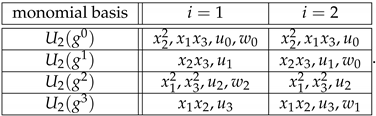
with coordinates of weight 1 and of weight 2. Then, , where . Moreover, we define the following actions of on W, such that, in each action, denote the invariant and anti-invariant quartics, respectively. We consider two different group actions of for the deformations and . For , we take the following diagonalised group action:
where is a primitive fourth root of unity. The monomial basis for is explicitly given in the following table.
Theorem 2.
Let W be as above. There exist two distinct deformations of W, say, , for , such that the central fibre of each of the deformation contains four loci, namely, . Each is defined by a complete intersection of three quadrics, permuted by , that intersect with each other in codimension .
Proof.
Taking , where and , Equation (3), under the action of , becomes the following:
A general element of the above space has a principal length of 4. Elements with principal length 2 belong to one of the following spaces:
This leads to two different deformations , for , of W; the general fibre for both deformations is a complete intersection of two quartics, one invariant and the other invariant, under an action of . We now discuss the central fibres for both deformations one by one. Let
be the central fibre of .
- Case 1 (): Let be a general element with , that is, its elements are permuted in the following way:Let be an arbitrary element with for . The quartic is invariant since the action of permutes and . The central fibre is then constructed as follows:Here, the quartics and are invariant and anti-invariant, respectively.
- Case 2 (): Let be a general element with and . Using these quadrics, we define the following quadrics:such thatFor a general , the quartic is anti-invariant, where , for . We construct as the following complete intersection:It can be seen that is invariant and is anti-invariant.
For each central fibre , there are four families , defined as follows:
where . Under the action of , the are permuted in the following way:
The generators of form a regular sequence of length 5 and, hence, the intersect each other in codimension 5. □
4. Key Varieties
We start from the central fibres (9), and unproject from the divisors (15). The constructions of and allow us to perform unprojection for both n-folds simultaneously. Let be the n-fold obtained from unprojecting .
We perform unprojections in two stages: in the first stage, we unproject from , and, in the second stage, we use the theory of triple Tom and Jerry to unproject the three divisors .
4.1. Stage 1:
Due to our choices of coefficients from Equations (11)–(14), we have
The unprojection is the ring . To find relations expressing as a rational function, we follow [18] and write the right hand side of (17) as , where
where the entries of the column matrix are the defining equations of . Since is a complete intersection, the equations of involving can be described using Cramer’s rule as
where the are the minors of . The homogenous coordinate ring of is then given as
where is the ideal generated by Pfaffians of the following anti-symmetric matrix:
Moreover, is Gorenstein by [15].
4.2. Triple Tom Parallel Unprojection
The n-fold contains the following three divisors:
Observe that, , and appear in the skew-symmetric matrix (20) as , , and formats, respectively. Using Theorem 2, it can be seen that these three divisors satisfy the conditions of parallel unprojection [17] (Theorem 2.3).
Following constructions from [8,18], the homogenous coordinate ring of , for , is given as
where the ideal is generated by the Pfaffians of the antisymmetric matrices , where
Here, , and the relations are quadratic in :
Here, . Moreover, the group acts on the in the following way:
Remark 2.
The defining relations for depend on the choice of action of and on the weights of variables.
Proposition 1.
For fixed , the n-fold is a section of .
Proof.
The ideal generated by Pfaffians of , and the associated relations of unprojection variables (24), can also be generated by Pfaffians of the submatrix of the following matrix obtained by deleting the top rows and columns:
□
The following can be seen using a magma [19] computation.
Lemma 1.
The ideal is generated by minors of the following symmetric matrix A:
Lemma 2.
The sixfolds , for , are invariant under action.
Proof.
All the minors of the matrix A (28) are invariant under the group action. □
5. Families of Conics Inside a Godeaux Surface
Using Theorem 2, we construct two deformation families of a Godeaux surface with , such that each central fibre contains families of four conics.
Godeaux Surface with
A Godeaux surface is a general-type surface with and . Bombieri showed in [20] that, in the case of Godeaux surfaces, . Reid in [9] proved that and also gave a complete description of the cases , , .
Let T be a Godeaux surface with , and be an etale Galois cover such that , , and . The canonical ring of S is given by
where , . Moreover, the relations and are invariant and anti-invariant quartics, respectively [9].
Finding a non-singular conic on T is the same as finding a non-singular conic on the -cover S such that the sets are mutually disjoint. It is not a straightforward task to find containing four desired families of conics. Consider a conic given by the image of defined by
where . Let be a quartic in ; restricting to gives a polynomial of degree 8 and, hence, imposes 9 conditions on the coefficients of . Hence, if we impose three general conics, we can only expect to find a three-dimensional family of quartics, and, if we fix four general conics, then we expect to obtain none. Another way to define a conic in is the intersection of three quadrics. The following Lemma discusses this situation.
Lemma 3.
A general quartic in contains a 6-dimensional family of conics.
Proof.
We assume that a conic in is given by the intersection of three quadrics. Consider the incidence variety
where , with two projections, , and . Here, , and , implying .
For a fixed , the fibre of imposes nine conditions on . The fibre has dimension 21-1, which makes the dimension of I to be 15+20. Hence, the result is proven. □
To construct our required deformations, we use sixfolds, as constructed in Section 4.
Lemma 4.
There exist two deformations , for , such that the fibres are etale Galois covers of the Godeaux with . Moreover, the central fibre, denoted as , contains four disjoint conics permuted by the action of .
Proof.
Using deformations , we can further define two deformations , such that the general fibre is
where the s and s are quadrics belonging to the following eigenspaces (see Equation (6)):
The central fibres are given by
Under some appropriate projective transformation (which eliminates four weight 2 variables using four quadric s and s), all fibres become an intersection of two quartics in , one invariant and the other invariant. Thus, the central fibres are etale Galois covers of the Godeaux surface, containing the following conics:
where the are given in (15), which become conics under some appropriate projective transformation. Furthermore, the conics are permuted by the group action as follows:
□
Theorem 3.
There exist two deformations of Godeaux surface T with fundamental group , such that each central fibre contains a conic.
Proof.
From Lemma 4, we have deformations , for , such that the fibres are etale Galois covers of the Godeaux with . Moreover, the fibres of are invariant under the respective actions. The general fibres are non-singular and the action of is fixed-point-free [9]. As such, there exist deformations such that the general fibre is . For central fibres, namely, , we proceed as follows.
Using quadrics , given in (34), we write in terms of , and in terms of (see Equation (6)). The above quartics become the general elements of the following vector spaces:
By observing the monomials, we can say that the linear system of quartics has an empty base locus; hence, it is quasi-smooth. Moreover, none of the ambient singularities lie on . Hence, is non-singular. On the same lines, we show that the conics, given in (36), are non-singular. Moreover, (37) shows that the conics are permuted by the action of . It remains to be shown that there is a fixed-point-free action of on , . The fixed locus of the action of on , defined in (5), is given belowL
For , using we can express in terms of so any point of does not lie on . The presence of the monomial term in and the expression of in terms of using quadrics guarantees that no point from lies on . The presence of and implies that the points of and have empty intersection with , respectively. The other case is similar. Hence, the central fibres of are , which is a deformation of the Godeaux surface with containing a family of conics. □
6. Constructing Campedelli Surfaces from Godeaux with
A Campedelli surface is a surface of general type with , and the order of the algebraic fundamental group is at most 9 [21]. Our focus is on Campedelli surfaces with .
Theorem 4
([12]). Let X be a Campedelli surface, and be an etale cover of degree 8. The canonical model of Z is isomorphic to a complete intersection of four quadrics . Moreover, Z is the universal cover of X and the covering group is the topological fundamental group .
We denote by the Campedelli surfaces with fundamental groups and . Let be the etale Galois cover for , such that .
Lemma 5.
Unprojecting , for , we obtain surfaces with and containing singularities with a action. The singularities form an orbit under the action.
Proof.
The surfaces (35) have invariants , , containing four conics (36) permuted by action (37). Since
and
the unprojection can be obtained by using the unprojection of given in (22). Using key varieties , the surfaces after the unprojection of all four conics are given by
Using [6] (Lemma 2.3), we obtain and . The four singularities form an orbit because of the action of on the unprojection variables given in (25). □
Theorem 5.
There exist -Gorenstein smoothings of such that the fibres are invariant under the respective group actions of .
Proof.
To obtain a -Gorenstein smoothing of , we move the quadric sections (34); the new quadrics are given as
where are parameters. It can be seen that
and, hence, the general fibre, given below, is invariant under the action of :
The coordinate ring of the general fibre is given by
where , , and E are minors of Matrix (28).
The sixfold is obtained through unprojection from , which is Gorenstein since it is a complete intersection. Also, an unprojection of a Gorenstein is a Gorenstein. Hence, is Gorenstein, being a complete intersection with a Gorenstein. □
Theorem 6.
The fundamental group of the general fibre is . Moreover, there exists an etale Galois cover of given as an intersection of four quadrics in .
Proof.
For , the key variety is constructed in terms of the general elements of and . We can take
with orbits and , such that
Let be the square matrix of the coefficients of with respect to variables . The are non-singular so we can express in terms of the symbols , and use these as our new variables. Similarly, for , the symbols become .
Let , for , be the quadrics in terms of . Then,
where E is given as the minors of the following matrix:
Thus,
where are the quadrics in our new variables. Let be the surface defined by these four quadrics. The surfaces are smooth by Bertini’s theorem. The action of on is given by
Moreover, the group acts on as (5) and, from the matrix , we have
□
Corollary 1.
The surface , together with the action of , gives a construction of Campedelli with .
Proof.
The action of on is obtained by combining the action of given in (51) and of given as
This gives a construction of Campedelli with fundamental group (c.f. page 13 in [13]). The situation is similar for . □
7. Conclusions
We constructed two deformations of the Godeaux surface with , each containing a family of conics in the central fiber. By using -Gorenstein smoothing and unprojection techniques, we linked families of surfaces birational to these Godeaux surface to two distinct components of the Campedelli surfaces with fundamental group of order 8.
These deformations provide insight into the birational geometry of Godeaux and Campedelli surfaces. While our study focuses on explicit constructions using deformation and unprojection methods, our results may have broader implications for the study of algebraic cycles and cohomological invariants, potentially offering new examples relevant to motivic cohomology.
Additionally, our work explores the structure of polynomial rings under the action of the fundamental group. By using graded rings with group actions, we provide explicit constructions. This provides a new perspective on the interplay between group actions and the study of varieties.
Author Contributions
Conceptualization, methodology, and investigation, S.I.; validation, H.W. and S.I.; writing—original draft preparation, H.W.; writing—review and editing, H.W. and S.I.; supervision and project administration, S.I. All authors have read and agreed to the published version of the manuscript.
Funding
This research received no external funding.
Data Availability Statement
No new data were created or analyzed in this study. Data sharing is not applicable to this article.
Acknowledgments
The authors would like to thank Miles Reid, Stavros Papadakis, and Michele Torielli for the helpful discussions.
Conflicts of Interest
The authors declare no conflicts of interest.
References
- Gieseker, D. Global moduli for surfaces of general type. Invent. Math. 1977, 43, 233–282. [Google Scholar] [CrossRef]
- Hacking, P. Compact moduli spaces of surfaces of general type. Compact. Modul. Spaces Vector Bundles 2012, 564, 1–18. [Google Scholar]
- Campedelli, L. Sopra Alcuni Piani Doppi Notevoli Con Curva di Diramazione del Decimo Ordine. Atti Acc. Naz. Lincei 1932, 15, 358–362. [Google Scholar]
- Bauer, I.; Catanese, F.; Pignatelli, R. Surfaces of general type with geometric genus zero: A survey. In Complex and Differential Geometry: Conference Held at Leibniz Universität Hannover, Hannover, Germany, 14–18 September 2009; Springer: Berlin/Heidelberg, Germany, 2011; pp. 1–48. [Google Scholar]
- Alexeev, V.; Pardini, R. Explicit compactifications of moduli spaces of Campedelli and Burniat surfaces. arXiv 2009, arXiv:1102.4184v3. [Google Scholar] [CrossRef] [PubMed]
- Iqbal, S. Godeaux, Campedelli, and surfaces of general type with χ = 4 and 2 ≤ K2 ≤ 8. Math. Nachrichten 2017, 290, 2296–2307. [Google Scholar] [CrossRef]
- Vakil, R. Murphy’s law in algebraic geometry: Badly-behaved deformation spaces. Invent. Math. 2006, 164, 569–590. [Google Scholar] [CrossRef]
- Petrotou, V. Tom and jerry triples with an application to fano 3-folds. Commun. Algebra 2022, 50, 3960–3977. [Google Scholar] [CrossRef]
- Reid, M. Surfaces with pg = 0, K2 = 1. J. Fac. Sci. Univ. Tokyo Sect. IA Math. 1978, 25, 75–92. [Google Scholar]
- Lee, Y.; Park, J. A simply connected surface of general type with pg = 0 and K2 = 2. Invent. Math. 2007, 170, 483–505. [Google Scholar] [CrossRef][Green Version]
- Lee, Y.; Park, J. A complex surface of general type with pg = 0, K2 = 2 and H1 = ℤ/2ℤ. Math. Res. Lett. 2009, 16, 323–330. [Google Scholar] [CrossRef]
- Mendes, L.M.; Pardini, R.; Reid, M. Campedelli surfaces with fundamental group of order 8. Geom. Dedicata 2009, 139, 49–55. [Google Scholar] [CrossRef][Green Version]
- Reid, M. Surfaces with pg = 0, k2 = 2. Available online: http://www.warwick.ac.uk/staff/Miles.Reid/surf (accessed on 24 May 2024).
- Papadakis, S.; Reid, M. Kustin-Miller unprojection without complexes. J. Algebraic Geom. 2004, 13, 563–577. [Google Scholar] [CrossRef]
- Kustin, A.R.; Miller, M. Constructing big Gorenstein ideals from small ones. J. Algebra 1983, 85, 303–322. [Google Scholar] [CrossRef]
- Iqbal, S. Surfaces of General Type via ℚ-Gorenstein Smoothing. Ph.D. Thesis, University of Warwick, Coventry, UK, 2012. [Google Scholar]
- Neves, J.; Papadakis, S.A. Parallel kustin–miller unprojection with an application to calabi–yau geometry. Lond. Math. Soc. 2013, 106, 203–223. [Google Scholar] [CrossRef]
- Reid, M. Graded rings and birational geometry. In Proceedings of the Algebraic Geometry Symposium, Kinosaki, Japan, 26–30 October 2000; Ohno, K., Ed.; pp. 1–72. Available online: https://repository.kulib.kyoto-u.ac.jp/dspace/bitstream/2433/214728/1/2000-01.pdf (accessed on 24 May 2024).
- Bosma, W.; Cannon, J.; Playoust, C. The Magma algebra system. I. The user language. J. Symbolic Comput. 1997, 24, 235–265. [Google Scholar] [CrossRef]
- Bombieri, E. Canonical models of surfaces of general type. Inst. Hautes Études Sci. Publ. Math. 1973, 42, 171–219. [Google Scholar] [CrossRef]
- Barth, W.P.; Hulek, K.; Peters, C.A.M.; Van de Ven, A. Compact Complex Surfaces, 2nd ed.; Springer: Berlin/Heidelberg, Germany, 2004. [Google Scholar]
Disclaimer/Publisher’s Note: The statements, opinions and data contained in all publications are solely those of the individual author(s) and contributor(s) and not of MDPI and/or the editor(s). MDPI and/or the editor(s) disclaim responsibility for any injury to people or property resulting from any ideas, methods, instructions or products referred to in the content. |
© 2024 by the authors. Licensee MDPI, Basel, Switzerland. This article is an open access article distributed under the terms and conditions of the Creative Commons Attribution (CC BY) license (https://creativecommons.org/licenses/by/4.0/).
