


Abstract
For , let denote the group of integers modulo m, and let denote the t-uniform hypergraph with vertex set and hyperedge set . Any hypergraph isomorphic to is a t-uniform tight m-cycle. In this paper, we consider the existence of tight 9-cycle decompositions of -fold complete 3-uniform hypergraphs. According to the recursive constructions, the required designs of small orders are found. For hypergraphs with large orders, they can be recursively generated using some designs of small orders. Then, we obtain the necessary and sufficient conditions for the existence of -decomposition of . We show there exists a -decomposition of if and only if , and .
MSC:
05C65; 05B05
1. Introduction
The problem of cycle decompositions of complete uniform hypergraphs has been studied for a long time. There are several ways of defining an m-cycle in a t-uniform hypergraph. We focus on tight m-cycle, which generalize the Katona–Kierstead [1] definition of a Hamiltonian cycle. The problem of the tight cycle decomposition of was first investigated by Bailey and Stevens [2]. Hanani obtained the necessary and sufficient conditions for -decomposition of [3]. More recently, several authors have given partial results on -decomposition of and -decomposition of [4,5,6,7,8]. Bunge and Akin et al. solved -decomposition of and -decomposition of [9,10]. H. Zhao and J. Wang solved tight 6-cycle decompositions of -fold complete bipartite 3-uniform hypergraphs and tight 6-cycle decompositions of -fold complete 3-uniform hypergraphs [11,12].
There is still much to be discussed about the tight cycle decompositions of complete uniform hypergraphs. In this paper, we will study the tight 9-cycle decompositions of -fold complete 3-uniform hypergraphs.
A hypergraph consists of a finite nonempty set V of vertices and a set E of nonempty subsets of V, called hyperedges. If for each , we have , then H is said to be a t-uniform. In particular, if , then H is a graph. If the edge set E contains each t subset of V exactly once, and , the hypergraph is called a complete t-uniform hypergraph of order n.
If a hypergraph does not contain multiple hyperedges (i.e., there are no repeated elements in its hyperedge E), the hypergraph is called a simple hypergraph. When a hypergraph H is simple, we can obtain a -fold hypergraph by repeating each hyperedge times in H. is called a -fold complete t-uniform hypergraph.
Let be pairwise-disjoint sets. The hypergraph with vertex set and an edge set consisting of all three subsets having at most two vertices in each of and is denoted by . If and , we use to denote any hypergraph that is isomorphic to .
Let be pairwise-disjoint sets. The hypergraph with vertex set and edge set consisting of all three subsets having exactly one vertex in each of is denoted by . If , and , we use to denote any hypergraph that is isomorphic to .
Let be a positive integer, be a t-uniform hypergraph, and be a set of t-uniform hypergraphs. The -decomposition of is its partitioning into sub-hypergraphs, each of which is isomorphic to a certain hypergraph of , which is denoted by -design or . For a -design, we denote it as . For a -design, we denote it as . If only contains one type of hypergraph J, it is denoted by . When , is replaced with .
We use the usual exponential notation for the types of groups divisible -designs. Then, type denotes that there are groups of size , . A group divisible -design of type can be denoted by , where . For a -design, let ; we denote it as of type .
If , then hypergraph is called a sub-hypergraph of the hypergraph , and denotes the hypergraph obtained from H by deleting the edges of . For a -design, we denote it as .
Now, we will give the definition of a tight cycle. For , let denote the group of integers modulo m, and let denote the t-uniform hypergraph with vertex set and hyperedge set . Any hypergraph isomorphic to is a t-uniform tight m-cycle. In this paper, we will use to denote any hypergraph isomorphic to the with vertex set and hyperedge set , , as seen in Figure 1. It is worth noting that when exists in the set of vertices, is a fixed point, and remains itself by modulo addition with any number.
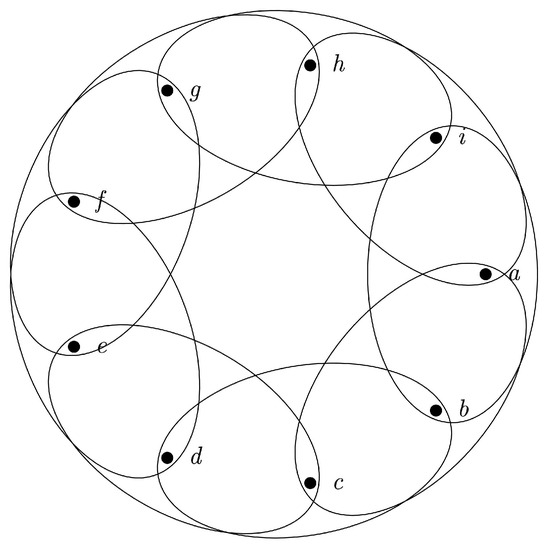
Figure 1.
The 3-uniform tight 9-cycle denoted .
2. Recursive Constructions
Construction 1.
Let be non-negative integers, and let be a positive integer. Suppose . If there exists an , an , an , an , and a of type , then there exists an .
Proof of Construction 1.
For , the result is vacuously true. For and , the result is also vacuously true.
For and , let be pairwise-disjoint sets of vertices with and , and let . Then, can be decomposed into the following disjoint union:
Therefore, for , if there exists an , an , an , an , and a of type , then there exists an . □
Construction 2.
Let be positive integers. If there exists a of type , then there exists a of type .
Proof of Construction 2.
Let and , and let be pairwise-disjoint sets of vertices with and . For , , and , then
Therefore, if there exists a of type , then there exists a of type . □
3. Some Small Orders
Lemma 1.
There exists an .
Proof of Lemma 1.
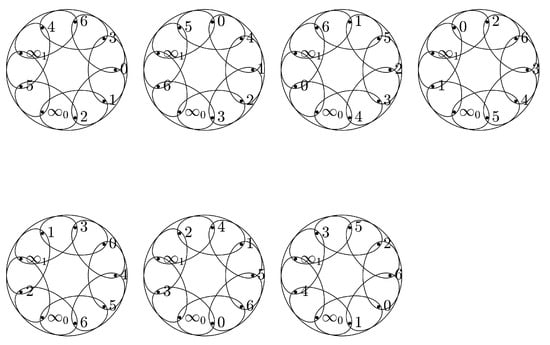
Let . Base blocks for this design are given below. All other blocks are obtained by developing these base blocks by +1 modulo 7, where , .
Next, I will briefly explain these base blocks. For , seven blocks can be generated from it by modular addition calculation, as shown in Figure 2. Similarly, the same can be performed using the remaining three base blocks. The 28 blocks generated from all base blocks can contain all 252 hyperedges.
Figure 2.
The seven blocks generated by through modular addition calculation.
□
Lemma 2.
There exists an .
Proof of Lemma 2.
By Lemma 1, there exists an . Repeating each block in the three times, we obtain an . □
Lemma 3.
There exists an .
Proof of Lemma 3.
Let . Base blocks for this design are given below. All other blocks are obtained by developing these base blocks by +1 modulo 10,
□
Lemma 4.
There exists an .
Proof of Lemma 4.
Let . Base blocks for this design are given below. All other blocks are obtained by developing these base blocks by +1 modulo 11,
□
Lemma 5.
There exists a of type .
Proof of Lemma 5.
Let . All other blocks are obtained by developing by +2 modulo 6, where . □
Lemma 6.
There exists a of type .
Proof of Lemma 6.
By Lemma 5, there exists a of type . Repeating each block in the of type nine times, we obtain a of type . Applying Construction 2, let ; then, there exists a of type . □
Lemma 7.
There exists a of type , and a of type .
Proof of Lemma 7.
By Lemma 5, there exists a of type . Repeating each block in the of type three times, we obtain a of type . Applying Construction 2, let ; then, there exists a of type .
In a similar way, repeating each block in the of type nine times, we obtain a of type . Applying Construction 2, let ; then, there exists a of type . □
Lemma 8.
There exists an , and an .
Proof of Lemma 8.
By [10], there exists an . Repeating each block in the three times, we obtain an . Repeating each block in the nine times, we obtain an . □
Lemma 9.
There exists an , and an .
Proof of Lemma 9.
By [10], there exists an . Repeating each block in the three times, we obtain an . Repeating each block in the nine times, we obtain an . □
Lemma 10.
There exists an .
Proof of Lemma 10.
Let with vertex partition . Base blocks for this design are given below. All other blocks are obtained by developing these base blocks by +1 modulo 18,
□
Lemma 11.
There exists an , and an .
Proof of Lemma 11.
By Lemma 10, there exists an . Repeating each block in the three times, we obtain an . Repeating each block in the nine times, we obtain an . □
Lemma 12.
There exists an .
Proof of Lemma 12.
Let . Base blocks for this design are given below. All other blocks are obtained by developing these base blocks by +1 modulo 11, where .
□
Lemma 13.
There exists an .
Proof of Lemma 13.
Let . Base blocks for this design are given below. All other blocks are obtained by developing these base blocks by +1 modulo 13,
□
Lemma 14.
There exists an .
Proof of Lemma 14.
Let . Base blocks for this design are given below. All other blocks are obtained by developing these base blocks by +1 modulo 14,
□
Lemma 15.
There exists an .
Proof of Lemma 15.
Let . Base blocks for this design are given below. All other blocks are obtained by developing these base blocks by +1 modulo 13, where , .
□
Lemma 16.
There exists an .
Proof of Lemma 16.
Let . Base blocks for this design are given below. All other blocks are obtained by developing these base blocks by +1 modulo 16,
□
Lemma 17.
There exists an .
Proof of Lemma 17.
Let . Base blocks for this design are given below. All other blocks are obtained by developing these base blocks by +1 modulo 17,
□
Lemma 18.
There exists an .
Proof of Lemma 18.
By Lemma 6 and Lemma 11, there exists a of type and an . Then, there exists an . □
Lemma 19.
There exists an .
Proof of Lemma 19.
If be pairwise-disjoint sets, , and , , , ; then,
Therefore, . can be decomposed into and . By Lemma 8 and Lemma 6, there exists an and a of type . Then, there exists an . □
Lemma 20.
There exists an .
Proof of Lemma 20.
The same as with Lemma 19, . can be decomposed into and . By Lemma 9 and Lemma 6, there exists an and a of type . Then, there exists an . □
Lemma 21.
There exists an .
Proof of Lemma 21.
The same as with Lemma 19, . can be decomposed into and . By Lemma 18 and Lemma 6, there exists an and a of type . Then, there exists an . □
Lemma 22.
There exists an .
Proof of Lemma 22.
The same as with Lemma 19, . can be decomposed into and . By Lemma 19 and Lemma 6, there exists an and a of type . Then, there exists an . □
Lemma 23.
There exists an .
Proof of Lemma 23.
The same as with Lemma 19, . can be decomposed into and . By Lemma 20 and Lemma 6, there exists an and a of type . Then, there exists an . □
Lemma 24.
There exists an .
Proof of Lemma 24.
Let with vertex partition . Base blocks for this design are given below. All other blocks are obtained by developing these base blocks by +1 modulo 9, where .
□
Lemma 25.
There exists an .
Proof of Lemma 25.
Let with vertex partition , . Base blocks for this design are given below. All other blocks are obtained by developing these base blocks by +1 modulo 9, where .
□
Lemma 26.
There exists an .
Proof of Lemma 26.
Let with vertex partition , . Base blocks for this design are given below. All other blocks are obtained by developing these base blocks by +1 modulo 9, where .
□
Lemma 27.
There exists an .
Proof of Lemma 27.
Let with vertex partition , , . Base blocks for this design are given below. All other blocks are obtained by developing these base blocks by +1 modulo 9, where .
□
Lemma 28.
There exists an .
Proof of Lemma 28
Let with vertex partition , , . Base blocks for this design are given below. All other blocks are obtained by developing these base blocks by +1 modulo 9, where .
□
Lemma 29.
There exists an .
Proof of Lemma 29.
Let . Base blocks for this design are given below. All other blocks are obtained by developing by +1 modulo 9 and , where .
:
:
□
Lemma 30.
There exists an .
Proof of Lemma 30.
By Lemma 29, there exists an . Repeating each block in the three times, we obtain an . □
Lemma 31.
There exists an .
Proof of Lemma 31.
If , , , , then
Therefore, can be decomposed into and . By Lemma 2 and Lemma 24, there exists an and an . Then, there exists an . □
Lemma 32.
There exists an .
Proof of Lemma 32.
If , , , , then
Therefore, can be decomposed into and . By Lemma 2 and Lemma 25, there exists an and an . Then, there exists an . □
Lemma 33.
There exists an .
Proof of Lemma 33.
If , , , , then
Therefore, can be decomposed into and . By Lemma 2 and Lemma 26, there exists an and an . Then, there exists an . □
Lemma 34.
There exists an .
Proof of Lemma 34.
If , , , , then
Therefore, can be decomposed into and . By Lemma 2 and Lemma 27, there exists an and an . Then, there exists an . □
Lemma 35.
There exists an .
Proof of Lemma 35.
If , , , , then
Therefore, can be decomposed into and . By Lemma 2 and Lemma 28, there exists an and an . Then, there exists an . □
4. Results
In this part, we obtain the necessary and sufficient conditions for the existence of -decomposition of .
Theorem 1.
There exists a -decomposition of only if , for .
Proof of Theorem 1.
Consider that has size 9 and is 3-regular; whereas has size and is -regular. Therefore, for a -decomposition of to exist, we must have , for , which is and for . □
Through sorting, the necessary conditions for the existence of can be divided into the following three cases:
(1) and , for ;
(2) and , for ;
(3) and , for .
Theorem 2.
There exists a -decomposition of if , , and .
Proof of Theorem 2.
By [10], there exists an . For any positive integer , repeating each block in the times, we obtain an . □
Theorem 3.
There exists a -decomposition of if , and .
Proof of Theorem 3.
Let k be a positive integer. If , then is isomorphic to . The proof of the existence of is discussed in the following three cases:
(1) For . By Lemmas 1, 11, and 7, there exists an , an , and a of type . Applying Construction 1, let ; then, there exists an .
(2) For . By Lemmas 3, 8, and 7, there exists an , an , and a of type . Applying Construction 1, let ; then, there exists an .
(3) For . By Lemmas 4, 9, and 7, there exists an , an , and a of type . Applying Construction 1, let ; then, there exists an .
For any positive integer , repeating each block in the times, we obtain an . □
Theorem 4.
There exists a -decomposition of if , and .
Proof of Theorem 4.
The proof of the existence of is discussed in the following six cases.
(1) For . By Lemmas 12, 18, 30, and 7, there exists an , an , an , and a of type . Applying Construction 1, let ; then, there exists an .
(2) For . By Lemmas 13, 19, 31, and 7, there exists an , an , an , and a of type . Applying Construction 1, let ; then, there exists an .
(3) For . By Lemmas 14, 20, 32, and 7, there exists an , an , an , and a of type . Applying Construction 1, let ; then, there exists an .
(4) For . By Lemmas 15, 21, 33, and 7, there exists an , an , an , and a of type . Applying Construction 1, let ; then, there exists an .
(5) For . By Lemmas 16, 22, 34, and 7, there exists an , an , an , and a of type . Applying Construction 1, let ; then, there exists an .
(6) For . By Lemmas 17, 23, 35, and 7, there exists an , an , an and a of type . Applying Construction 1, let ; then, there exists an .
For any positive integer , repeating each block in the times, we obtain an . □
Theorem 5.
There exists a -decomposition of if and only if , and .
Proof of Theorem 5.
According to Theorem 1, we derive the necessary conditions for the existence of . According to Theorems 2, 3, and 4, we derive the sufficient conditions for the existence of . Therefore, the conclusion is valid. □
5. Conclusions
In this paper, we considered the existence of tight 9-cycle decompositions of -fold complete 3-uniform hypergraphs. First, we introduced the concepts and definitions used in this paper. Then, according to the recursive constructions, the required designs of small orders were found. Next, we obtained the necessary conditions and sufficient conditions for the existence of -decomposition of . Finally, we proved that there exists a -decomposition of if and only if , and .
6. Discussion
A hypergraph is one of the basic structures in discrete mathematics, which is an extension of simple graphs. The decomposition of hypergraph has been paid more and more attention by scholars. It has been widely used and important in combinatorial design, graph theory, coding, and other fields. For example, hypergraph decomposition can be used to construct efficient secret sharing schemes. In [13], the application of this technique allows us to obtain secret sharing schemes for several classes of access structures (such as hyperpaths, hypercycles, hyperstars, and acyclic hypergraphs) with improved efficiency over previous results. With continuous research, we believe that the application of hypergraph decomposition will be more extensive.
Author Contributions
Conceptualization, J.G.; Supervision, H.Z. All authors have read and agreed to the published version of the manuscript.
Funding
This research received no external funding.
Data Availability Statement
The data presented in this study are available on request from the corresponding author.
Conflicts of Interest
The authors declare no conflicts of interest.
References
- Katona, G.Y.; Kierstead, H.A. Hamiltonian chains in hypergraphs. J. Graph Theory 1999, 30, 205–212. [Google Scholar] [CrossRef]
- Bailey, R.F.; Stevens, B. Hamiltonian decomposition of complete k-uniform hypergraphs. Discret. Math. 2010, 310, 3088–3095. [Google Scholar] [CrossRef]
- Hanani, H. On quadruple systems. Can. J. Math. 1960, 12, 145–157. [Google Scholar] [CrossRef]
- Meszka, M.; Rosa, A. Decomposing complete 3-uniform hypergraph into Hamiltonian cycles. Australas. J. Comb. 2009, 45, 291–302. [Google Scholar]
- Li, G.; Lei, Y.; Jirimutu, J. Decomposing complete 3-uniform hypergraph into 5-cycles. Appl. Mech. Mater. 2014, 672–674, 1935–1939. [Google Scholar] [CrossRef]
- Keszler, A.; Tuza, Z. Hypercycle systems of 5-cycles in complete 3-uniform hypercycles. Mathematics 2021, 9, 484. [Google Scholar] [CrossRef]
- Gionfriddo, M.; Milazzo, L.; Tuza, Z. Hypercycle systems. Australas. J. Comb. 2020, 77, 336–354. [Google Scholar]
- Meihua, M.; Guan, J. Decomposing complete 3-uniform hypergraph into 7-cycles. Opusc. Math. 2019, 39, 383–393. [Google Scholar] [CrossRef]
- Akin, M.; Bunge, R.C.; El-Zanati, S.I.; Hamilton, J.; Kolle, B.; Lehmann, S.; Neiburger, L. On tight 6-cycle decompositions of complete 3-uniform hypergraphs. Discret. Math. 2022, 345, 112676. [Google Scholar] [CrossRef]
- Bunge, R.C.; Darrow, B.; El-Zanati, S.I.; Hadaway, K.; Stover, A.; Romer, A.; Stover, A. On tight 9-cycle decompositions of complete 3-uniform hypergraphs. Australas. J. Comb. 2021, 80, 233–240. [Google Scholar]
- Zhao, H.; Wang, J. Tight 6-cycle decompositions of λ-fold complete bipartite 3-uniform hypergraphs. J. Kunming Univ. Sci. Technol. (Nat. Sci.) 2023, 48, 232–238. [Google Scholar]
- Wang, J. Cycle Decompositions of Hypergraphs and Their Large Sets. Master’s Thesis, North China Electric Power University, Beijing, China, 2023. [Google Scholar]
- Crescenzo, G.D.; Galdi, C. Hypergraph decomposition and secret sharing. Discret. Appl. Math. 2009, 157, 928–946. [Google Scholar] [CrossRef]
Disclaimer/Publisher’s Note: The statements, opinions and data contained in all publications are solely those of the individual author(s) and contributor(s) and not of MDPI and/or the editor(s). MDPI and/or the editor(s) disclaim responsibility for any injury to people or property resulting from any ideas, methods, instructions or products referred to in the content. |
© 2024 by the authors. Licensee MDPI, Basel, Switzerland. This article is an open access article distributed under the terms and conditions of the Creative Commons Attribution (CC BY) license (https://creativecommons.org/licenses/by/4.0/).